

Phosphatidylserine for Cats

Why there is no cat trial yet, which blend ingredient is a hazard for cats, and what to do about an older cat's confusion.

By La Petite Labs Editorial 11 min read

As Seen On

  • AVMA, American Veterinary Medical Association
  • Today’s Veterinary Business
  • Petfood Industry
Woman cuddling an orange-and-white cat and a silver tabby while holding a Hollywood Elixir box
Hollywood Elixir® Senior Cat Supplement

17 science-backed actives

From$50/moSave up to 47%Save up to 44%Shop Now
Contents
Phosphatidylserine (PS) is sold for aging cats' brains, but we found no study that has tested it in cats. PS is a fat found in nerve cell membranes. Its pet research comes from dogs, where it has only been tried inside blends. Cat-labeled PS products exist, and a 2010 feline review noted that none had been through a published trial.

This guide covers what is and isn't known, the blend ingredient that is a real hazard for cats, and what to do when an older cat starts to seem confused.

  • What it is: Phosphatidylserine (PS) is a fat in cell membranes, and nerve tissue is rich in it.10
  • Cat evidence: We found none. A 2025 systematic review turned up two cat trials of brain-support nutrition, and neither used PS.2
  • Dog evidence: Six trials, all of blends or enriched foods, with mixed results.2
  • Cat products: PS blends are labeled for cats. A 2010 feline review noted that no efficacy studies in cats had been published, and we found none since.1
  • Amount: None is established for cats, and there is no cat study to borrow one from.
  • Watch for: Alpha-lipoic acid in blends made for dogs or people. It damaged liver cells in cats in a tolerance study.4
  • In Hollywood Elixir: No. Hollywood Elixir has no phosphatidylserine. It's daily nutrition for adult and senior cats.

What is phosphatidylserine, and why is it in cat supplements?

Phosphatidylserine, or PS, is one of the fats that build cell membranes. It carries a negative charge, and nerve tissue keeps an especially rich supply on the inner face of the membrane.10 Cells make PS themselves from two other membrane fats, one of which is phosphatidylcholine.10

PS matters to nerve cells because it shapes how they release chemical messengers and how the receptors in the membrane behave.10 That is the theory behind giving extra PS to an aging brain.

PS reached cat supplements secondhand. Trials in older people came first, using PS taken from cow brain.13, 16 Blends for dogs were tested next.5 The same kind of blend is also labeled for cats.1

In cat products, PS is rarely alone. Merck's veterinary manual describes them as cognitive supplements containing antioxidants, vitamins and PS.6 The PS itself is now made from soy lecithin with an enzyme and the amino acid serine.9

Woman kneeling with two long-haired tabby cats while holding a Hollywood Elixir box beside a food bowl

What does the research on phosphatidylserine in cats show?
Phosphatidylserine research in cats is an empty shelf. We searched PubMed for trials of PS in cats and found none: no memory study, no behavior study and no safety study.

A 2025 systematic review got to the same place by a wider route. Its authors searched four databases for trials of enriched foods and supplements for thinking in aging dogs and cats. They found 29 trials, and two were in cats.2

  • An enriched food: fish oil, vitamins E and C, B vitamins and arginine, fed for 345 days.2
  • A SAMe supplement: it improved one kind of thinking test but not learning.2

Neither contained PS.

Woman exercising beside a tabby cat, with a Hollywood Elixir box and food bowl on a small table

Which cat supplements contain phosphatidylserine?

Phosphatidylserine comes to cats in "senior" or "cognitive" blends. Two product lines appear by name in the veterinary literature.

  • Senilife: PS with ginkgo, vitamin B6, vitamin E and resveratrol. A 2010 feline review noted that it is labeled for cats, and that efficacy studies in cats had not been published.1
  • Aktivait for cats: the dog version combines PS with omega-3 fats, vitamins E and C, carnitine, lipoic acid, coenzyme Q and selenium. The cat version drops the lipoic acid, and it had not been through clinical trials either.1

A 2021 review still names both among the supplements used for cats with cognitive dysfunction.3 Being on a list of options is a lower bar than passing a trial.

Orange-and-white cat reaching toward a woman holding a Hollywood Elixir box while sitting in a chair

Does phosphatidylserine help cats with dementia?

Phosphatidylserine has no proven benefit for cats with cognitive dysfunction, the condition often called cat dementia. We found no trial that tested it in cats at all.

The case for it is a chain of borrowed results. PS is part of nerve membranes.10 In older people with memory loss, PS from cow brain improved memory tests compared with placebo.13 In dogs, blends containing PS helped in some small trials.2

The chain has weak links. In a trial of 120 older adults, soy PS, the kind sold today, did no better than placebo on memory tests after 12 weeks.11 And no link in it is a cat.

Our guide to feline cognitive dysfunction explains the condition and its care.

Gray-haired man holding a Hollywood Elixir box while two cats rest beside him in an armchair

Can the dog studies of phosphatidylserine be applied to cats?

Phosphatidylserine's dog studies make a shaky base for a cat decision, for two reasons.

First, the dog results are modest. In the best-known study, nine aged beagles on a PS blend beat their own starting scores on a memory task, yet the blend and control periods came out level overall.5 In a separate trial, a year on a PS-enriched food changed nothing measurable in pet dogs.15

Second, cats are their own species. A feline review warns that treatments that are safe in dogs and people could be toxic in cats.1 That warning applies to the company PS keeps in a blend as much as to PS.

Dog results can point to a question worth testing in cats. They can't hand over a tested amount or a safety record.

Being on a list of options is a lower bar than passing a trial.

Is phosphatidylserine safe for cats?

Phosphatidylserine's safety in cats is unknown, in the plain sense that we found no measurement of it. No tolerance or toxicity study of PS in cats turned up in our search.

Three things can be said.

  • Normal body fat: cells make PS, and nerve tissue is rich in it.10
  • Tolerated by people: in a trial of 120 older adults, 300 or 600 mg of soy PS a day for 12 weeks produced no differences from placebo in blood tests, blood pressure, heart rate or side effects.12
  • A changed source: PS once came from cow brain, which raised concern about passing on infectious disease.16 It is now made from soy lecithin.9

No study we found shows how a cat handles a daily PS supplement over months, or how PS behaves alongside kidney or thyroid disease. Older cats often have several conditions at once.17

The larger practical risk sits beside the PS. Blends made for dogs or people can hold ingredients that cats tolerate badly. Alpha-lipoic acid, covered below, is the clearest example.

Tabby cat looking up at a Hollywood Elixir sachet held above it, with the product box on a small table

What side effects could phosphatidylserine cause in cats?

Phosphatidylserine's side effects in cats are unrecorded, because we found no cat study to record them. The nearest reports come from other species.

  • People: in a six-month trial of 78 adults given soy PS or a placebo, no side effect was traced to PS.9
  • Dogs: in an open trial of a multi-ingredient PS supplement, one dog went off its food and the supplement was stopped.18

Appetite is the thing to watch in a cat. Stop the supplement and call your vet if your cat eats less, vomits, has loose stools or hides more than usual. A cat that won't eat needs to be seen, supplement or no supplement.

Hand gently petting an orange-and-white cat beside a food bowl and Hollywood Elixir box

How much phosphatidylserine can a cat have?

No amount of phosphatidylserine has been established for cats, and there is no cat study to borrow one from. The figures that circulate come from other species.

  • Dogs: the beagle study gave 25 mg of PS for every 5 kg of body weight a day, inside a four-ingredient blend.5 Across dog trials, PS intake ran from 0.2 to 6.3 mg per kg.2
  • People: trials gave 100 to 600 mg a day.9, 11

Scaling either down to a cat's weight is guesswork. If you and your vet agree on a trial, choose a product made and labeled for cats, follow its feeding guide, and note the PS amount per serving so the vet can see it.

Man holding a Hollywood Elixir box beside a black cat, an orange tabby and a food bowl

Why is alpha-lipoic acid a risk in phosphatidylserine blends?

Phosphatidylserine often shares a capsule with antioxidants, and one of them, alpha-lipoic acid, is a known hazard for cats.

In a tolerance study, ten healthy adult cats received lipoic acid by mouth at 60 or 30 mg per kg, or none. Every cat on the higher amount showed clinical signs of toxicity, liver cells were damaged, and the researchers put the most a cat can tolerate below 30 mg per kg.4 The paper's title states the conclusion: lipoic acid is 10 times more toxic in cats than reported in people, dogs or rats.4

One PS blend tested in dogs contains lipoic acid.2 Its cat version leaves it out.1 So never give a cat the dog version of a PS blend, and read human "brain" formulas for lipoic acid too.

What does cognitive decline look like in an older cat?

Phosphatidylserine is marketed for a cluster of changes that vets call cognitive dysfunction syndrome. A 2021 review lists them: loud crying, changed interaction with owners, altered sleep, house soiling, disorientation, changes in activity, anxiety, and trouble with learning or memory.3

These changes are common. In a study of 154 cats aged 11 to 21, 36% had behavior changes that no medical problem explained, and the share climbed with age: 28% of cats aged 11 to 14 and 50% of cats over 15 were affected.1

Crying is the sign owners report most.6 When 37 owners of cats with cognitive dysfunction were asked what lay behind it, 40.5% said disorientation and 40.5% said attention seeking. Most believed there was more than one cause.8

A missing nutrient isn't part of the definition. Cognitive dysfunction is diagnosed by ruling out medical and environmental causes for the behavior.7 Our guide to night vocalization in senior cats goes further into the crying.

And no link in it is a cat.

Silver tabby sitting beside a food bowl and a Hollywood Elixir box held in a person's hand

DVM Voice: Clinical Vignette of a Common Pattern in Senior Cat Aging

Case provided by JoAnna Pendergrass, DVM

Sasha, a 12-year-old cat, was brought in after her owner noticed increased thirst and urination, lethargy, vomiting, and a generally unkempt appearance. Examination showed weight loss, elevated blood pressure, and reduced vitality.

Diagnostic testing revealed elevated kidney markers, poorly concentrated urine, and protein loss in the urine — findings consistent with chronic kidney disease, one of the most common chronic conditions in senior cats.

Her care required a kidney-focused diet, blood pressure management, targeted supplementation, medication support, and regular monitoring — a necessary plan, but one started after clinical signs were already visible.

Clinical takeaway: Sasha’s case reflects why senior-cat wellness should begin before obvious decline. Earlier monitoring, body-condition tracking, hydration awareness, antioxidant support, and daily cellular resilience may help support quality of life as cats age.

Single-case vignette. Not generalizable. Veterinary diagnosis and monitoring are essential for increased thirst, urination, vomiting, lethargy, weight loss, or suspected kidney disease.

Explore Hollywood Elixir Research →
Woman holding a Hollywood Elixir box toward a brown cat perched on the back of a sofa

Which cats should not have phosphatidylserine?

Phosphatidylserine is untested in every kind of cat, so this is a list of where the stakes are highest.

  • Kittens and young cats, who have no known use for it.
  • Pregnant or nursing cats. We found no data.
  • Cats with a new behavior change that a vet hasn't examined.
  • Cats on prescription medicine, selegiline included. We found no study of PS with any cat medicine.
  • Cats that are eating poorly, where anything that puts them off food is a risk.

For a healthy senior cat, PS is a judgment call to make with your vet. It isn't a need.

Woman leaning toward a fluffy orange cat beside a Hollywood Elixir box and green food bowl

Is phosphatidylserine a calming supplement for cats?

Phosphatidylserine has been studied for stress in people, not in cats. In one study, nine healthy men who took 800 mg of brain-derived PS a day for 10 days had a smaller rise in two stress hormones, ACTH and cortisol, after exercise.14

We found no study of PS for stress, travel fear or tension between cats. Thinking and anxiety are also separate targets. A product built around memory shouldn't be expected to settle a cat that dreads the carrier.

If calm is the goal, tell your vet that. Merck's manual notes that an ingredient called alpha-casozepine can provide a calming effect in cats.6

Tabby cat licking its nose beside a food bowl and Hollywood Elixir box

Is phosphatidylserine worth trying for a senior cat?

Phosphatidylserine sits low on the list for a senior cat, for a plain reason: there is nothing in cats to go on. No trial, no tested amount, no safety record.

Untested and harmful are different things, and a vet who knows your cat may still agree to try a cat-labeled product. If so, set the trial up so you learn something.

  • Pick one or two behaviors to count, such as night crying or missed litter box trips.
  • Film them. Feline guidelines say that when owners record and review videos of a cat's routines, changes show up earlier.7
  • Change nothing else for the first month.
  • Agree a date to stop if nothing has shifted.

How do you choose a phosphatidylserine product for a cat?

A phosphatidylserine product for a cat has to clear a higher bar than one for a dog, because the cat evidence is missing and some blend partners are unsafe.

Check that:

  • it is made and labeled for cats, with a feeding guide by weight;
  • the label gives the PS amount per serving in milligrams, and not just a blend total;
  • every other active is named with its amount;
  • alpha-lipoic acid is not on the list;4
  • the maker can say where the PS comes from, such as soy or sunflower lecithin;21
  • your cat will eat it.

Take the whole label to your vet, inactive ingredients included. Don't give a dog product at a smaller serving, and don't open a human capsule. The human trials used 100 to 600 mg a day, amounts sized for adults.9, 11

We put our own label through the printed-amounts test. Hollywood Elixir lists all 17 actives with their amounts, and PS isn't among them. Our guide to the best supplements for senior cats shows how other formulas compare.

Is phosphatidylserine different for cats and dogs?

Phosphatidylserine is the same molecule in a cat and a dog. The evidence and the risks are not the same.

  • Evidence: dogs have six trials of PS blends and enriched foods, one of them a year long.2, 15 Cats have none that we could find.
  • Medicines: selegiline is approved for dogs in the United States and Canada.5 No drug or diet is licensed for cognitive dysfunction in cats, and selegiline is used off label.6
  • Blends: a blend made for dogs can contain alpha-lipoic acid, which is far more toxic to cats than to dogs.2, 4

Keep the dog's supplement for the dog. Our guide to phosphatidylserine for dogs goes through the canine trials one by one.

Tabby cat sitting at a table with a food bowl and Hollywood Elixir box

When should a confused senior cat see the vet?

Phosphatidylserine shouldn't be the first answer to a cat that seems lost or cries in the night. Book a visit if your cat:

  • cries loudly, mostly after dark;
  • has accidents outside the litter box;
  • stares at walls or gets stuck in corners;
  • is thirstier, thinner or off its food.

Cornell's feline health center notes that night crying is fairly common in cats with an overactive thyroid or high blood pressure, that kidney failure and arthritis can change litter box habits, and that high blood pressure can cause blindness and confusion.19 Feline guidelines call for a blood pressure reading at each exam in cats over 10.7 Our guide to senior cat bloodwork explains the tests.

Woman cuddling a silver tabby and a cream-colored cat while holding a Hollywood Elixir box

What has more evidence than phosphatidylserine for an aging cat?

Several options have more behind them than phosphatidylserine does.

  • An enriched food: cats aged 5.5 to 8.7 years on a diet with added fish oil, B vitamins, antioxidants and arginine beat cats on the plain diet in three of four thinking tests.20
  • SAMe: in a cat trial it improved one type of thinking test, and only in the best performers.2
  • Home changes: easy access to key resources, plus calming pheromones.3
  • Prescription medicine: selegiline is used off label for cats.6 See our selegiline guide for cats.

Our guides to MCT oil for cats and cognitive supplements for cats cover more of the field.

Is phosphatidylserine in Hollywood Elixir?

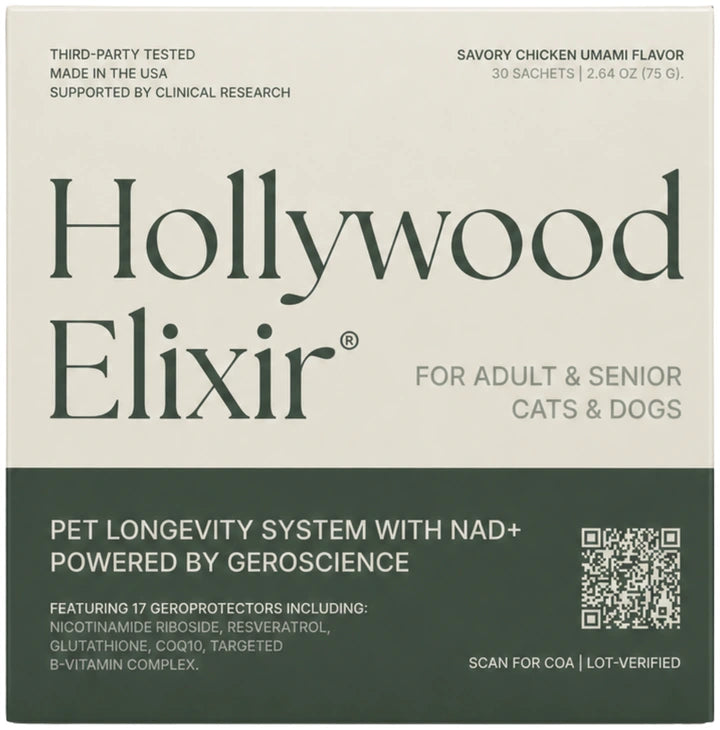
No. Hollywood Elixir doesn't contain phosphatidylserine, and it isn't a treatment for cognitive dysfunction.

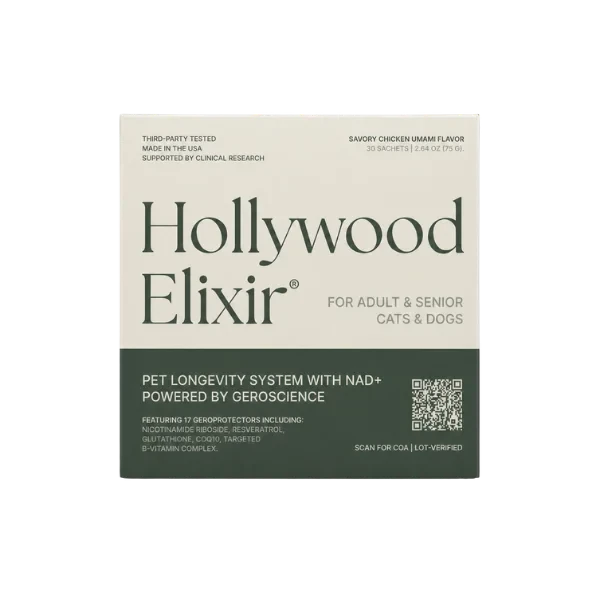
PS is a building block of cell membranes. Hollywood Elixir is built around something else, the energy supply inside cells. One sachet provides 60 mg of nicotinamide riboside, which is an NAD+ precursor, along with 40 mg of CoQ10 and 50 mg of blueberry powder. All 17 actives appear on the label with their amounts.

It's a daily nutrition powder that goes into food. A cat under 7 lb gets half a sachet, and a cat from 7 to 30 lb gets one. Hollywood Elixir is a supplement. It hasn't been tested for memory, cognitive dysfunction or lifespan, and it's no stand-in for a vet visit.

If you were reading about PS because your cat is getting older, the label is worth a look. See the full Hollywood Elixir formula and serving guide.

Keep the dog's supplement for the dog.

Educational content only. This material is not a substitute for veterinary advice. Always consult your veterinarian about your cat’s specific needs. These statements have not been evaluated by the Food and Drug Administration. Products mentioned are not intended to diagnose, treat, cure, or prevent any disease.

Glossary

Phosphatidylserine (PS): A fat molecule in cell membranes that is concentrated in nerve tissue.

Phospholipid: A fat that forms cell membranes. PS and phosphatidylcholine are two kinds.

Cognitive dysfunction syndrome: Age-related decline in a cat's brain, seen as crying, confusion, sleep changes and house soiling.

Alpha-lipoic acid: An antioxidant used in some supplement blends that is far more toxic to cats than to dogs or people.

SAMe: S-adenosylmethionine, a supplement tested for thinking skills in older cats.

Off label: Use of a medicine for a species or condition it isn't licensed for.

Related Reading

References

Numbered references identify the sources used for specific claims. Read the study design, species and evidence boundaries alongside each finding.

FAQ

Is phosphatidylserine toxic to cats?

We found no report of PS poisoning in cats, and no safety study either. The known hazard is a blend partner, alpha-lipoic acid, which damaged liver cells in cats in a tolerance study. Check every ingredient on the label, not only the PS.

Can I give my cat my dog's phosphatidylserine supplement?

No. One PS blend made for dogs contains alpha-lipoic acid, and its cat version leaves that out. A smaller serving of a dog product still delivers ingredients that were never checked in cats.

Does Hollywood Elixir contain phosphatidylserine?

No. Hollywood Elixir has no phosphatidylserine. It supplies 60 mg of nicotinamide riboside, 40 mg of CoQ10 and 50 mg of blueberry powder per sachet, and it isn't a treatment for cognitive dysfunction.

Is phosphatidylserine the same as phosphatidylcholine?

No. Both are membrane fats, and cells can make PS from phosphatidylcholine, but they are different molecules with separate research. A study of one doesn't carry over to the other.

Can a blood test show that my cat needs phosphatidylserine?

No. Cells make their own PS, and we found no test that identifies a cat as short of it. Senior bloodwork is still worth doing, because thyroid and kidney disease can sit behind a behavior change.

How long would phosphatidylserine take to work in a cat?

Nobody can say, because we found no cat trial. In dog studies of PS blends, results were checked after roughly one to three months. If your vet agrees to a trial, set a stopping point at about three months.

Can kittens have phosphatidylserine?

There's no reason to give it. We found no study of PS in kittens or young cats, and cells make their own supply. Keep supplements made for aging brains away from growing kittens unless your vet prescribes one.

Is soy-based phosphatidylserine a problem for cats?

We found no study of soy-derived PS in cats, good or bad. Supplement PS is made from soy lecithin, and the same method works on sunflower lecithin. If your cat has a diagnosed food allergy, ask the maker about the source.

Will phosphatidylserine stop my cat crying at night?

We found no study of PS for night crying. Owners in one survey most often blamed disorientation or attention seeking, and thyroid disease and high blood pressure can cause it too. See your vet before trying a supplement.

Orange-and-white cat beside a Hollywood Elixir box held in a person's hand

Discover LPL-01: How This Fits Into a Larger Feline Longevity System

Aging in cats unfolds quietly. It’s not driven by a single failure, but by gradual shifts across interconnected systems — cellular energy, oxidative balance, immune tone, and tissue integrity — each influencing the others over time.

This article explores one layer of that system. To understand what actually shapes long-term health, you need to step back and look at how these layers interact.

Start with the underlying science:

Keep exploring

What would you like to understand next?

Search practical guides about healthy aging, cellular energy, ingredients, and daily support for cats.