



Magnesium for Dogs

What a complete food already supplies, which dogs run low, and why human magnesium products are a poor fit.

By La Petite Labs Editorial 11 min read

As Seen On

  • AVMA, American Veterinary Medical Association
  • Today’s Veterinary Business
  • Petfood Industry
Woman hugging a golden retriever while holding a Hollywood Elixir box
Hollywood Elixir® Senior Dog Supplement

17 science-backed actives

From$50/moSave up to 47%Save up to 44%Shop Now
Contents

Most dogs don't need a magnesium supplement, because a complete dog food already supplies this essential mineral. Low magnesium is mostly a problem of sick dogs, and a vet finds it with a blood test. We found no trial of magnesium as a calming aid for dogs, and extra amounts are risky for a dog with kidney disease.

This guide covers what food provides, which dogs run low, the signs of too little and too much, and what to check on a label.

  • What it is: An essential mineral. Every cell reaction that uses ATP, the body's energy molecule, needs magnesium.1
  • Food first: Magnesium is rarely deficient in complete and balanced diets.2 In a survey of 61 dog foods, dry foods averaged 0.4 g per 1,000 kcal.4
  • Who runs low: Mostly sick dogs. One teaching hospital found low blood magnesium in 6.1% of 3,102 dogs.6
  • Calming: We found no trial of magnesium for anxiety in dogs. One pilot study measured blood levels and gave no supplement.12
  • Too much: Large amounts cause stomach upset, a slow heart rate and weakness, and kidney disease makes the effects last longer.14
  • Amount: No supplement amount is established for dogs. A vet sets it after a blood test.
  • In Hollywood Elixir: No. Hollywood Elixir has no added magnesium. It's daily nutrition.

What is magnesium, and what does it do for dogs?

Magnesium is an essential mineral. The Merck Veterinary Manual lists it with sodium, potassium, calcium and phosphorus as one of the major minerals in a dog's diet.2 Inside cells, it's the second most abundant positively charged mineral, after potassium.1

The main job of magnesium is energy. Cells run on a molecule called ATP, and every reaction that uses ATP needs magnesium attached to it.1 Magnesium takes part in more than 300 metabolic processes.6 Nerves and muscles, the heart included, rely on it to signal and contract.10

Where a dog's body keeps its magnesium matters when you read a blood test:

  • Bone: about 50% of the total.1
  • Muscle and soft tissue: most of the rest.1
  • Blood: roughly 1%.1

The gut absorbs magnesium from food, and the kidneys decide how much to keep.1 A healthy dog passes any excess out in urine.2 That's why intake from food is rarely a problem, and why kidney disease changes the picture.

Woman holding a Hollywood Elixir box beside a pug, a terrier and a food bowl

Do dogs get enough magnesium from their food?

Magnesium is rarely deficient in dogs that eat a complete and balanced diet.2 In the U.S., a food can carry that claim only if it meets the AAFCO nutrient profile for dogs or passes a feeding trial.3

Researchers in Colorado bought 61 adult and senior dog foods from retail stores and measured what was in them. Dry foods averaged 0.4 g of magnesium per 1,000 kcal, and canned foods averaged 0.2 g.4 Senior foods held about as much as adult foods.4

So a dog that eats 1,000 kcal a day of an average dry food takes in about 400 mg of magnesium before any supplement.4

Woman in sportswear holding a Hollywood Elixir box beside a black-and-tan dog outdoors

Does my dog need a magnesium supplement?

Magnesium supplements aren't needed by a healthy dog on a complete food. The Merck Veterinary Manual advises against adding minerals without a reason, because extra of one mineral can upset the balance of the others.2

A supplement makes sense in two cases. One is a dog whose blood test shows low magnesium, where your vet treats the cause and sets the amount. The other is a home-cooked diet designed by a veterinary nutritionist, where magnesium is one line in a full recipe.

If neither applies, the money is better spent on the food itself.

Woman holding a Hollywood Elixir box above her forehead beside a Bernese mountain dog outdoors

Which dogs run low on magnesium?

Low blood magnesium is mainly a finding in sick dogs, and it's common in the critically ill.5 How common depends on the test:

  • Total magnesium: 6.1% of 3,102 dogs admitted to one teaching hospital were low.6
  • Ionized magnesium: 35.5% of 430 hospitalized dogs were low by that analyzer's range.7

Gut disease is a frequent cause, since diarrhea and poor absorption drain magnesium.1, 8 Yorkshire Terriers with a protein-losing gut disorder are a known example.9 Heavy urine losses, as with IV fluids or diuretic drugs, can lower it too.1

Golden retriever nuzzling a woman holding a Hollywood Elixir box on the grass beside a food bowl

What are the signs of low magnesium in dogs?

Low magnesium usually causes no signs of its own in dogs.5 It tends to show up through other problems: low potassium or calcium that resists treatment, muscle tremors, or an irregular heartbeat.10 Those signs are easy to miss, because the illness behind them is usually louder.10

In puppies fed a deficient diet, the signs are listlessness, lethargy and muscle weakness.2 Very low levels can bring weakness, muscle spasms, convulsions and cardiac arrest.1

None of these signs points to magnesium alone. A trembling or weak dog needs a vet visit and blood work, not a mineral from the cupboard.

A trembling or weak dog needs a vet visit and blood work, not a mineral from the cupboard.

What have studies of magnesium in dogs found?

Magnesium research in dogs is almost all about blood levels in sick dogs. We found no trial that gave pet dogs a magnesium supplement by mouth and measured a benefit.

  • Hospital dogs: low ionized magnesium was common, at 35.5% of 430 dogs, and it wasn't linked to survival.7
  • Heart disease: among 181 dogs with mitral valve disease, those with low ionized magnesium had about four times the risk of death. One-year survival was 53%, against 91.5% in dogs with normal levels.11
  • Diabetes: 122 diabetic dogs didn't have markedly low magnesium when first examined.19
  • Stress: guide-dog trainees early in their course had lower blood magnesium than dogs in advanced classes, and levels fell after treadmill exercise in six laboratory dogs.12

These studies watched dogs. They didn't treat them. A low reading may simply mark how sick a dog is, and no one has yet tested whether raising it changes the outcome.

Overhead view of a black-and-white dog beside a food bowl and Hollywood Elixir box

Does magnesium calm anxious dogs?

Magnesium hasn't been tested as a calming supplement in dogs, as far as we could find. The idea leans on a pilot study of guide dogs. Dogs new to training had markedly lower blood magnesium than dogs in advanced classes, and the authors suggested that supplements be considered.12 They didn't give any.

The human evidence is thin too. A review of 18 studies in people called the effect on anxiety suggestive and the quality of the evidence poor.13

A blood level that dips under stress doesn't tell you that feeding more will settle a dog. Our guide to anxiety in older dogs covers approaches with more behind them.

Woman smiling beside a golden retriever, a green food bowl and a Hollywood Elixir box

Is magnesium safe for dogs?

Magnesium is safe for dogs at the levels found in complete food, and a healthy dog clears any excess in urine.2 Poisoning is uncommon, but it can happen when a dog swallows a large amount at once.14

High blood magnesium is rare. In a hospital study of 9,950 dogs, 2.0% had a raised ionized level.15 Raised kidney values were the leading cause, at 40% of cases, and treatment or medication accounted for another 19%.15

The pattern is clear. Magnesium turns risky when the kidneys can't remove it, or when the amount is far beyond what food provides.

Man holding a Hollywood Elixir box while sitting on an outdoor sofa with a golden retriever

What happens if a dog gets too much magnesium?

Too much magnesium slows the signals between nerves and muscles, and it slows the heart.14 After a large amount by mouth, signs usually start within 2 to 3 hours:

  • stomach and gut upset;
  • a slow heart rate;
  • weakness.14

Blood calcium and potassium often drop as well. Signs typically last 12 to 48 hours, and longer in a dog with kidney disease.14 Very high blood levels can stop the heart.5

Supplements aren't the only source. High magnesium has been reported in dogs that ate ice melt.5 If your dog gets into either one, call your vet or a poison line and keep the package.

How much magnesium does a dog need?

No magnesium chart by body weight exists for dogs, because the official standards work another way. They set a minimum level in the food itself, and the amount a dog takes in then rises with how much it eats.

These are the figures that have a source:

  • Food standards: the National Research Council and the European pet food federation, FEDIAF, both publish minimum magnesium levels for dog diets.18 In the U.S., AAFCO profiles give every listed nutrient a minimum.3
  • What foods contain: 0.4 g per 1,000 kcal in the average dry food and 0.2 g in canned, across 61 products.4
  • Supplement trials in dogs: none that we found.
  • Human trials: adults in one study took 300 mg of elemental magnesium a day.16 That figure was chosen for people, and nobody has scaled it for dogs.

For a dog with a diagnosed shortfall, the amount is a medical decision. Your vet weighs kidney function and the other electrolytes before giving any.

Magnesium turns risky when the kidneys can't remove it, or when the amount is far beyond what food provides.

Woman sitting with a beagle in a kitchen while holding a Hollywood Elixir box

DVM Voice: Clinical Vignette of a Common Pattern in Senior Dog Aging

Case provided by JoAnna Pendergrass, DVM

Rex, a 7-year-old Labrador Retriever, was brought in after his owner noticed he was slower to rise, hesitant on stairs, and less able to play as before. Examination showed stiffness and reduced hip mobility; radiographs confirmed degenerative joint changes.

His care required weight management, veterinary-guided pain control, nutritional support, and rehabilitation — a comprehensive plan, but one started only after visible decline appeared.

Clinical takeaway: Rex’s case reflects the value of proactive aging support: maintaining lean body condition, monitoring mobility early, and supporting cellular resilience, antioxidant defense, and healthy inflammatory balance before decline becomes obvious.

Single-case vignette. Not generalizable. Veterinary oversight is essential for pain, stiffness, or suspected joint disease.

Explore Hollywood Elixir Research →
Spotted gray dog beside a Hollywood Elixir box held in a person's hand

Which foods and forms supply magnesium?

Magnesium reaches most dogs through their regular food, and dry food carries more of it per calorie than canned.4

Supplements come in several forms, including magnesium oxide, magnesium citrate and amino-acid chelates. In a 60-day trial in 46 healthy people, citrate and the chelate were absorbed better than oxide, and oxide did no better than placebo.16 We found no study that compared forms in dogs.

Magnesium also sits in products that aren't sold as magnesium. Multivitamins commonly include it, and antacids are another source.14, 1

Golden retriever nuzzling a man holding a Hollywood Elixir box beside a food bowl

Can I give my dog a human magnesium supplement?

Human magnesium products are a poor fit for dogs, because they're sized for adult people. One human trial gave adults 300 mg of elemental magnesium a day.16 That's three quarters of the magnesium in 1,000 kcal of average dry dog food, and a dog would get it on top of the food.4

Human products also bundle other ingredients, so the whole label matters, not only the magnesium line.

If you still want to use one, take the package to your vet first. If your dog eats a bottle by accident, treat it as a possible poisoning and call for advice.14

Golden spaniel eating from a green bowl beside a Hollywood Elixir box

Which dogs should not get extra magnesium?

Extra magnesium is a bad idea for some dogs. Check with your vet first if your dog:

  • has kidney disease, since failing kidneys can't clear magnesium and blood levels climb;1, 15
  • eats a prescription diet, because these foods often adjust magnesium on purpose;2
  • takes antacids or other products that already contain magnesium;1
  • is a puppy, or is pregnant or nursing, and eats a food made for growth and reproduction.3

Our guide to chronic kidney disease in dogs explains how vets track kidney function. Extra calcium or phosphorus can also block magnesium absorption, so stacking mineral supplements works against you.2

How do you read a magnesium label?

A magnesium label should tell you three things: the form, the amount of elemental magnesium per serving, and how the serving changes with your dog's weight. "Elemental" means the weight of the magnesium itself, without the compound it's bound to. Trials report that figure.16

Check for:

  • the form by name, such as oxide or citrate;
  • elemental magnesium per serving, in milligrams;
  • a serving guide by body weight, written for dogs;
  • every other active ingredient, each with its own amount.

The word "complete" on a supplement deserves a second look. When researchers tested seven vitamin-mineral supplements sold in Brazil for homemade pet food, most failed to supply the minimum magnesium at the labeled serving.18 Our guide to supplements for homemade dog food goes deeper.

We hold our own label to the same test: Hollywood Elixir prints all 17 amounts, and magnesium isn't one of them.

Is magnesium different for dogs and cats?

Magnesium does the same jobs in dogs and cats, but the worries differ.

  • Bladder stones: struvite stones are built from magnesium, phosphorus and ammonia.20 In cats they usually form without an infection, and low-magnesium foods that acidify urine are the main defense. In dogs, most struvite stones follow a urinary infection, so clearing the infection comes first and diet is a second step.17
  • Blood levels in hospital: low magnesium was the common finding in dogs, at 35.5%. In cats only 6.8% were low, while 8% ran high and those cats died 2.3 times as often.7

A supplement bought for one species shouldn't be passed to the other. Our guide to magnesium for cats covers the feline side.

Woman holding a Hollywood Elixir box beside a dapple dachshund and green food bowl on a sofa

When should you see the vet about magnesium?

Magnesium questions belong with your vet whenever a symptom is involved. Book a visit if your dog has:

  • muscle tremors, twitching or weakness;
  • fainting, collapse or an irregular heartbeat;
  • vomiting or diarrhea that lasts more than a day or two;
  • kidney disease, and you have a new supplement in mind.

Go at once if your dog has eaten a magnesium product or ice melt and seems weak or slow.14, 5

Ask which test was run. Blood holds only about 1% of the body's magnesium, and the total and ionized tests don't track each other well.1, 15 Our guide to senior dog blood work explains the panel.

Woman cuddling a brown-and-white spaniel while holding a Hollywood Elixir box

What can you try instead of a magnesium supplement?

Magnesium is rarely the missing piece, so the better move depends on what you hoped it would fix.

  • A nervous dog: a behavior plan and, where needed, medicine prescribed by your vet.
  • Weakness or tremors: a diagnosis first, since many illnesses cause both.
  • An aging dog with less stamina: the questions shift to other cell-energy nutrients, such as CoQ10 and NAD+ precursors.

Hollywood Elixir, our daily powder, supplies both and has no added magnesium. Our overview of mitochondrial support for dogs compares the options.

Is magnesium in Hollywood Elixir?

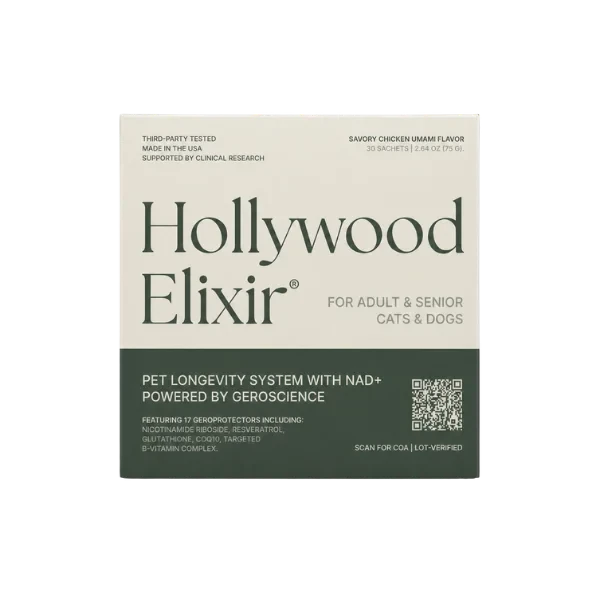
No. Hollywood Elixir has no added magnesium, and the mineral isn't among its 17 actives. A complete dog food already covers it.

Magnesium is the mineral every unit of cell energy depends on. Hollywood Elixir adds other nutrients that cells use to make energy: each sachet has 40 mg of CoQ10, 60 mg of nicotinamide riboside, which is an NAD+ precursor, and 1 mg of vitamin B6. Fourteen more actives sit beside them, and all 17 amounts are printed on the label.

It's a daily supplement for adult and senior dogs, a powder you stir into food: half a sachet under 7 lb, one sachet from 7 to 30 lb, two sachets above 30 lb. Hollywood Elixir hasn't been tested for anxiety, heart disease or lifespan, and it won't correct a low magnesium reading.

If your dog's food is complete and you want daily support on top, compare formulas in our guide to the best all-in-one supplements for dogs. See the full Hollywood Elixir formula and serving guide.

A blood level that dips under stress doesn't tell you that feeding more will settle a dog.

Educational content only. This material is not a substitute for veterinary advice. Always consult your veterinarian about your dog’s specific needs. These statements have not been evaluated by the Food and Drug Administration. Products mentioned are not intended to diagnose, treat, cure, or prevent any disease.

Glossary

Magnesium: An essential mineral that cells need for every reaction that uses ATP.

ATP: The molecule cells use to store and spend energy.

Ionized magnesium: The free, active share of magnesium in blood, measured by a different test from total magnesium.

Elemental magnesium: The weight of the magnesium itself in a supplement, without the compound it's bound to.

Complete and balanced: A label claim for foods that meet an AAFCO nutrient profile or pass a feeding trial.

Struvite: A bladder-stone mineral made of magnesium, ammonium and phosphate.

Related Reading

References

Numbered references identify the sources used for specific claims. Read the study design, species and evidence boundaries alongside each finding.

FAQ

Is there a magnesium chart by weight for dogs?

No official one. Nutrient standards set a minimum magnesium level in the food, so a bigger dog gets more simply by eating more. In a survey of 61 foods, dry diets averaged 0.4 g per 1,000 kcal. For a sick dog, the vet sets the amount after blood tests.

Does Hollywood Elixir contain magnesium?

No. Hollywood Elixir has no added magnesium, which a complete dog food already supplies. Each sachet adds CoQ10, nicotinamide riboside, vitamin B6 and 14 more actives, with every amount printed on the label.

Do senior dogs need more magnesium?

No standard says so. AAFCO and the National Research Council set no separate nutrient levels for older dogs, and in a survey of 61 foods the senior diets held about as much magnesium as the adult ones. Ask about a blood test if your senior dog seems weak.

Is magnesium the same as manganese?

No. They're different minerals with different jobs and very different amounts. In one dog food survey, magnesium was measured in tenths of a gram per 1,000 kcal and manganese in milligrams. Read supplement labels twice, because the names look alike.

Can magnesium cause bladder stones in dogs?

Struvite stones contain magnesium, but in dogs most of them follow a urinary infection. Vets focus on finding and clearing the infection first. Foods low in magnesium and phosphorus are a second step, so cutting magnesium on your own is unlikely to help.

Does a dog need extra magnesium after exercise?

Probably not. Blood magnesium fell after treadmill exercise in one pilot study of healthy dogs, but nobody tested whether replacing it helped. A complete food supplies magnesium every day.

Can a blood test show if my dog is low in magnesium?

Partly. Blood holds about 1% of the body's magnesium, so a normal result can miss a shortfall in the tissues. Vets can measure total or ionized magnesium, and the two don't always agree. Your vet reads the result alongside the illness and the diet.

Are magnesium antacids safe for dogs?

Only with your vet's say-so. Antacids are a known source of extra magnesium, and the risk climbs when the kidneys are weak. In one hospital study, treatment or medication explained 19% of the dogs with raised blood magnesium.

Can puppies have magnesium supplements?

Puppies shouldn't need them. Foods labeled for growth follow their own nutrient profile, and a magnesium shortage is rare on a complete diet. Extra calcium or phosphorus can even reduce how much magnesium a puppy absorbs. Ask your vet before giving a puppy any mineral.

Dalmatian looking toward a Hollywood Elixir box held in a person's hand

Discover LPL-01: How This Fits Into a Larger Canine Longevity System

Aging in dogs is not driven by a single pathway. It’s the result of interacting biological systems—energy metabolism, oxidative stress, immune signaling, and structural integrity—changing over time.

This article explores one piece of that puzzle. If you want to understand how these pieces connect—and what actually moves the needle—you need to zoom out.

Start with the underlying science:

Keep exploring

What would you like to understand next?

Search practical guides about healthy aging, cellular energy, ingredients, and daily support for dogs.