

The 12 Hallmarks of Aging in Dogs, Explained
Read full insightExercise Routines for Senior Cats
By La Petite Labs Editorial 15 min read
When an older cat moves less, the fix is rarely “more exercise”—it’s small, repeatable movement that protects comfort while keeping muscles and balance online. Short micro-bursts a cat can finish feeling capable do more than one tiring session, because muscle is active tissue that weakens fast when activity drops and joints start to feel vulnerable. That is the heart of senior cat exercise: keep everyday movement patterns available, so jumping onto a chair, stepping into the litter box, or turning in a hallway stays smooth. Cats naturally prefer micro-bouts of activity, which makes gentle exercise both realistic and effective when it is planned around traction, low heights, and clear stop signs. This page covers the two clinical realities behind reduced activity—arthritis discomfort and deconditioning—plus what to watch over days and weeks, how to progress without flare-ups, and what to bring to your veterinarian.
- Senior cat exercise works best as brief, repeatable micro-bouts that protect joints while keeping muscles “online.”
- Aging reduces strength and coordination; consistent movement supports smoother balance and better bounce-back.
- Prioritize traction, straight-line walking, and low step-ups over jumping and twisting.
- Use FITT thinking: increase frequency first, then time, and change only one variable weekly.
- Watch stop signs like a sudden sit, tail flicking, next-day stiffness, or reluctance to turn.
- Track functional markers (jumps, ramp use, litter-box entry, recovery time) and take weekly videos.
- Bring logs and videos to the veterinarian to tailor pain-aware activity and rule out medical limits.
Why Tiny Daily Movement Matters in Older Cats
Aging changes how a cat’s muscles, joints, and nerves coordinate movement. When daily motion shrinks, muscle fibers lose “work” signals that help regulate glucose handling, circulation, and tissue repair, and the whole body becomes more volatile under stress. Gentle movement acts like a low-dose message to keep those pathways engaged, supporting smoother balance, steadier posture, and a better margin for bounce-back after a sleepy day. The goal is not athletic training; it is preserving the body’s coordination with small, repeatable inputs.
For most homes, senior cat exercise starts with micro-bouts: 30–90 seconds of play, then a pause, repeated a few times. A wand toy dragged in a slow “S” on carpet, a treat rolled down a hallway, or a short follow-the-leader walk to the food station can count. Keeping an aging cat active works best when sessions are predictable and end before fatigue shows, so the cat finishes with confidence rather than soreness. (see our Cat Life Stages →)
Breaking the Pain–deconditioning Loop with Consistency
In older cats, discomfort and deconditioning feed each other: less movement weakens stabilizing muscles, joints feel less secure, and the cat moves even less. The way out is the routine you can repeat without flare-ups, because consistency—not intensity—is what builds headroom over weeks. Rehabilitation work in cats favors targeted, low-stress exercises that build control while respecting pain signals (Goldberg, 2025).
Think “practice, not push.” Pick one or two easy activities your cat already likes and make them slightly more frequent, not harder. If the cat is stiff after naps, warm up first: a few steps to a favorite window, then a short play prompt. Gentle exercise for older cats should look almost boring to humans—small movements done often are the point.
What “Therapeutic Exercise” Means for a Senior Cat
Therapeutic exercise is defined as planned, structured activity used to improve strength, endurance, flexibility, and neuromuscular control, with careful progression and safety monitoring (Joseph E. Bielecki, 2023). For senior cats, “planned” matters more than “hard.” The body adapts to what is repeated, so a routine that is brief but reliable can support smoother gait patterns and better stability. Progress is measured in comfort and confidence, not in distance.
Build a simple weekly rhythm: two to four micro-sessions per day, each tied to an existing habit (before breakfast, after litter box, before evening nap). Use the same surface and toy at first so the cat knows what to expect. If the cat enjoys stairs but hesitates, create a “stair alternative” with a low step or sturdy box so the movement stays joint-friendly while still training coordination.
Use the Home Environment to Invite Safe Activity
Cats are not small dogs, and their activity needs are strongly tied to species-typical behaviors: stalking, pouncing, climbing, and exploring. Environmental-needs guidance highlights that enrichment should be adapted to the cat’s physical abilities, including easier access to resources and appropriate play opportunities (Ellis, 2013). For a senior cat, the mechanism is simple: when the environment invites movement, the cat self-doses activity in short bursts, which is safer than forced, prolonged sessions.
Set up “movement invitations” rather than workouts: a perch with a ramp, a food puzzle that requires a few steps, and a toy rotation that keeps curiosity alive. Place water, litter, and resting spots so the cat must walk a little—but not climb steeply—to meet daily needs. Keeping an aging cat active often succeeds when the home quietly nudges motion without making the cat feel chased.
A Misconception That Keeps Cats Too Inactive
A common misconception is that an older cat who sleeps more is “just slowing down,” and that encouraging movement is unnecessary or unkind. Normal aging does change sleep patterns, but pain, muscle loss, and reduced confidence can also hide behind extra rest. Senior care guidance emphasizes proactive assessment of mobility and comfort in older cats, because subtle changes can be clinically meaningful (Ray, 2021). Movement is not about forcing; it is about preserving options.
Owners can test the difference between “sleepy” and “limited” by offering a low-effort choice: a slow toy drag near the bed, or a treat placed a few steps away. If interest is there but the body looks hesitant, the routine should shift toward shorter bouts and easier surfaces. Gentle exercise for older cats should leave the cat more willing to move later in the day, not less.
“Short, repeatable movement builds more resilience than occasional big play.”
Stop Signs and Safety Rules for Gentle Play
Stop signs matter because older bodies have less margin when discomfort flares. Safety principles for therapeutic exercise include screening for precautions and monitoring for adverse responses such as pain, fatigue, or altered movement patterns (Joseph E. Bielecki, 2023). In cats, those signals can be quiet: a tail flick, a sudden sit, or a change in how the back legs track. The safest plan is the one that ends early enough to avoid a next-day setback.
What not to do: do not laser-pointer a stiff cat into frantic twisting; do not toss toys onto high furniture to “make them jump”; do not extend play until panting; and do not restart at full intensity after a sore day. Instead, keep sessions on non-slip flooring and favor straight-line walking, gentle reaching, and slow pounces. Senior cat exercise should look controlled, not chaotic.
Use FITT Principles to Build Senior Cat Exercise
A practical way to design senior cat exercise is to borrow the FITT structure—frequency, intensity, time, and type—then scale it to feline reality (Hoffmann, 2016). Frequency is usually the most important lever: more tiny sessions beat one long session. Intensity should stay in the “could do more” zone, because the goal is resilience and smoother movement patterns. Type should match what the cat can do comfortably today, not what the cat did at age three.
A starter template: 3–5 micro-bouts daily, 45–90 seconds each, with 1–2 minutes of rest between. Types to rotate include hallway walks for treats, slow wand play, and step-ups onto a low platform. Over two weeks, add one extra micro-bout before adding height or speed. Keeping an aging cat active is a layering process, not a weekend project.
Owner Checklist: Subtle Mobility Clues to Watch
Owner checklist (home observations) helps separate “needs encouragement” from “needs medical attention.” Watch for: hesitation before jumping onto a favorite chair; a wider stance when turning; grooming less over the lower back; taking longer to rise after naps; or choosing the closest litter box even when others are cleaner. These are movement-quality clues, not personality flaws, and they often show up before obvious limping.
Use the checklist during normal routines rather than during play, because cats can mask discomfort when excited. If two or more signs are present for a week, shift to gentler, shorter sessions and improve traction (runners, mats). Senior cat exercise should be built around what the cat can repeat comfortably, so the body learns that movement is safe again.
What to Track so Progress Feels Real
What to track over days and weeks should focus on function, not hero moments. Track: number of voluntary jumps per day; willingness to use a ramp; time to settle after play; next-morning stiffness; litter box entry style; and whether the back feet “bunny hop” on stairs. These markers show whether the routine is building headroom or creating a delayed flare. A simple notes app can reveal patterns that memory misses.
Add one objective anchor: a 10-second video of a hallway walk once weekly from the same angle. Small changes in stride length and turning confidence are easier to see side-by-side than day-to-day. Keeping an aging cat active becomes less emotional when progress is measured as smoother movement and quicker bounce-back, not as “playing like a kitten.”
A Real-world Scenario: When Interest Outruns Comfort
Case vignette: A 14-year-old cat begins sleeping in the living room instead of the upstairs bedroom and stops jumping onto the windowsill. The owner assumes it is normal aging, but notices the cat pauses before stepping into the litter box and seems stiff after naps. When play is offered, the cat watches intently but quits after two pounces. That pattern often points to reduced confidence and discomfort rather than laziness.
In that scenario, the first win is not “more play,” but easier access and safer surfaces: a low step to the couch, a ramp to the sill, and two daily micro-bouts that end early. Over a few weeks, many cats show a more consistent willingness to move when the routine stays predictable. Gentle exercise for older cats works best when the environment and the body are adjusted together.
“The best routine ends early enough to protect tomorrow.”
DVM Voice: Clinical Vignette of a Common Pattern in Senior Cat Aging
Case provided by JoAnna Pendergrass, DVM
Sasha, a 12-year-old cat, was brought in after her owner noticed increased thirst and urination, lethargy, vomiting, and a generally unkempt appearance. Examination showed weight loss, elevated blood pressure, and reduced vitality.
Diagnostic testing revealed elevated kidney markers, poorly concentrated urine, and protein loss in the urine — findings consistent with chronic kidney disease, one of the most common chronic conditions in senior cats.
Her care required a kidney-focused diet, blood pressure management, targeted supplementation, medication support, and regular monitoring — a necessary plan, but one started after clinical signs were already visible.
Clinical takeaway: Sasha’s case reflects why senior-cat wellness should begin before obvious decline. Earlier monitoring, body-condition tracking, hydration awareness, antioxidant support, and daily cellular resilience may help support quality of life as cats age.
Single-case vignette. Not generalizable. Veterinary diagnosis and monitoring are essential for increased thirst, urination, vomiting, lethargy, weight loss, or suspected kidney disease.
Arthritis-safe Movement That Protects Confidence
Arthritis is a primary clinical focus for many senior cats, even when limping is not obvious. Feline hospice and palliative guidance emphasizes maintaining comfort and quality of life, including supporting mobility with low-stress handling and environmental modifications (Eigner, 2023). Movement supports joint nutrition through gentle loading and helps maintain the stabilizing muscles that protect sore joints. The key is to keep motion within a comfortable window so the cat stays willing to repeat it.
Practical arthritis-safe choices include: slow figure-eight walking around two chairs, treat “scatter” on a rug to encourage controlled steps, and sit-to-stand transitions prompted by a treat held just above nose level. Avoid slippery floors and sharp pivots. Senior cat exercise for arthritic cats should favor traction, straight lines, and low heights, because confidence is part of pain control.
When Medical Conditions Change the Safe Activity Range
Secondary context: heart disease, kidney disease, and hyperthyroidism can change a cat’s safe activity range, but they do not automatically mean “no movement.” The practical issue is that these conditions can shrink the margin for overheating, dehydration, or fatigue, so pacing becomes more important than intensity. Senior care recommendations emphasize regular health screening in older cats so subtle disease does not get misread as “just aging” (Ray, 2021). When medical status is known, activity can be tailored rather than avoided.
In a multi-condition household, keep routines short and calm: one to two minutes of gentle play, then water access and rest. If appetite, breathing effort, or litter box habits change alongside reduced activity, the plan should pause until a veterinarian weighs in. Keeping an aging cat active is safest when the body’s bigger constraints are identified early.
Weight, Calories, and Joint Load in Older Cats
Weight and movement are tightly linked in older cats: extra body mass increases joint load, while low activity makes weight control harder. Adult-cat energy needs can be lower than owners expect, and small calorie changes can matter over time (Bermingham, 2010). The goal is not rapid weight loss; it is creating a routine where movement and feeding patterns support each other. When weight trends down slowly and movement feels smoother, the cat gains headroom for daily life.
Use feeding to cue motion without overfeeding: divide daily food into smaller portions and place them in two or three locations that require a short walk. Pair one micro-bout of play with a measured treat, then subtract that treat from the day’s total. Gentle exercise for older cats is more sustainable when the household plan prevents “reward calories” from quietly erasing progress.
How to Progress Without Triggering Next-day Stiffness
Progression should be gradual because tissues adapt on different timelines: the nervous system can learn a new pattern quickly, while tendons and joint-supporting structures change more slowly. Exercise guidance for chronic conditions emphasizes gradual progression and monitoring for adverse signs, adjusting the plan when symptoms flare (Hoffmann, 2016). For cats, that means increasing only one variable at a time—more sessions, or slightly longer sessions, or a slightly higher step—then holding steady for a week.
A simple rule: if the cat is stiffer the next morning, the last change was too much. Roll back to the previous level for several days, then try a smaller step forward. Senior cat exercise becomes more consistent when the owner treats soreness as data, not as a reason to quit entirely.
Prepare for the Vet Visit with Videos and Logs
Vet visit prep is most useful when it is specific. Bring: a one-week log of micro-bouts (time, type, and any stop signs); a short video of walking and turning; notes on jumping changes; and any grooming or litter box posture shifts. Feline rehabilitation approaches are individualized and adjusted based on tolerance, so good inputs help the plan fit the cat (Goldberg, 2025). Clear observations can also help a veterinarian decide whether pain control, imaging, or referral is appropriate.
Questions to ask: Which movements should be avoided right now (stairs, jumping, twisting)? What is a safe weekly progression target? Are there signs that suggest arthritis pain versus neurologic weakness? Would a rehab professional or home exercise plan be appropriate? Keeping an aging cat active is easier when the vet conversation is about function, not just age.
Comfort-first Mobility for Frail or Very Old Cats
When a cat is very old or medically fragile, the goal shifts from “conditioning” to comfort-first mobility. Hospice and palliative care guidance for cats emphasizes minimizing stress, supporting mobility, and using gentle handling strategies to prevent setbacks (Eigner, 2023). In this stage, movement still matters because it supports circulation, digestion, and the cat’s sense of control, but the dose may be only a few steps at a time. The win is a calmer day with fewer mobility surprises.
Set up a “short loop” the cat can complete easily: bed to water to litter to bed, with non-slip mats and low entry points. Encourage one or two slow walks per day with a treat lure, then stop while the cat is still comfortable. Gentle exercise for older cats at this stage should be quiet, predictable, and paired with easy access to favorite resting spots.
Where a Supportive Daily Layer Can Fit
Supportive nutrition can make a routine easier to sustain, but it never replaces traction, pacing, and pain-aware planning. The harder part of aging is usually coordination across systems—energy handling and oxidative balance—not one missing nutrient, which is why a daily layer can help even when the diet is complete.
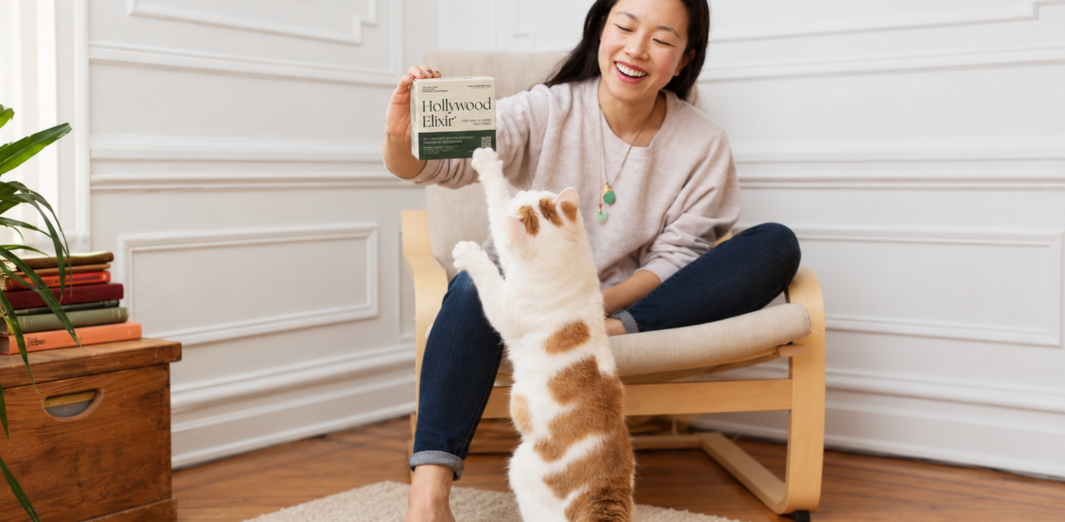
For owners building senior-cat exercise habits, Hollywood Elixir is a food-mixed daily routine that supports normal energy and oxidative balance through readable actives—nicotinamide riboside, CoQ10, and a multi-antioxidant complex—alongside veterinary guidance, good nutrition, and gentle movement. The most reliable results come from stacking small changes over weeks, then keeping the routine consistent once it fits the cat. If you want to understand the formula first, start with the Hollywood Elixir explainer.
Putting It Together: a Routine You Can Sustain
A sustainable plan for keeping an aging cat active has three anchors: a safe environment, a repeatable micro-bout schedule, and a tracking habit that catches flare-ups early. The mechanism-first view helps owners stay calm: movement is a signal that keeps muscles, nerves, and joints communicating, and the dose can be tiny. When the plan is right, the cat’s day looks smoother—more voluntary steps, fewer hesitant pauses, and a better bounce-back after rest.
If progress stalls, the next step is not to “try harder,” but to adjust one variable and reassess: traction, step height, session timing, or pain management. Senior cat exercise succeeds when it respects feline preferences and ends on a positive note. Over time, the household learns what the cat can do comfortably, and that knowledge becomes the most protective tool of all.
“Track function, not hero moments, to see real change.”
Educational content only. This material is not a substitute for veterinary advice. Always consult your veterinarian about your dog’s specific needs. These statements have not been evaluated by the Food and Drug Administration. Products mentioned are not intended to diagnose, treat, cure, or prevent any disease.
Glossary
- Micro-bout - A very short activity session (often under two minutes) repeated through the day.
- Traction - Surface grip that helps a cat push off and turn without slipping.
- Stop signs - Observable signals that an activity is causing discomfort or fatigue (for example, sudden sitting or next-day stiffness).
- FITT - A planning framework: frequency, intensity, time, and type of activity.
- Stair alternative - A low step, box, or ramp that replaces steep stairs while keeping the movement pattern.
- Step-up - A controlled movement where a cat places front paws (or all paws) onto a low platform.
- Figure-eight walk - Slow walking around two objects to practice turning control without sharp pivots.
- Recovery time - How quickly a cat returns to normal breathing and relaxed posture after activity.
- Functional marker - A real-life ability to track over time (jumping, litter box entry, ramp use) rather than a single performance moment.
Related Reading
Aging & Senior Cat Guidance
• Cat Age Calculator: Cat Years to Human Years
• Lethargy in Cats
• Senior Cat Not Eating
• Cat Drinking A Lot
• Why Is My Senior Cat Withdrawn?
Healthy Aging Support
• NAD+ for Cats
• NMN for Cats
• Vitamins For Older Cats
• Senior Cat Food
References
Ellis. AAFP and ISFM feline environmental needs guidelines. PubMed Central. 2013. https://pmc.ncbi.nlm.nih.gov/articles/PMC11383066/
Joseph E. Bielecki. Therapeutic Exercise. 2023. https://www.ncbi.nlm.nih.gov/books/NBK555914
Eigner. 2023 AAFP/IAAHPC feline hospice and palliative care guidelines. PubMed Central. 2023. https://pmc.ncbi.nlm.nih.gov/articles/PMC10812026/
Hoffmann. Prescribing exercise interventions for patients with chronic conditions. PubMed Central. 2016. https://pmc.ncbi.nlm.nih.gov/articles/PMC4835280/
Goldberg. Physical rehabilitation of cats: 2. Treatment therapies and exercises. PubMed Central. 2025. https://pmc.ncbi.nlm.nih.gov/articles/PMC12227875/
Ray. 2021 AAFP Feline Senior Care Guidelines. PubMed Central. 2021. https://pmc.ncbi.nlm.nih.gov/articles/PMC10812122/
Bermingham. Energy requirements of adult cats. 2010. https://www.cambridge.org/core/journals/british-journal-of-nutrition/article/energy-requirements-of-adult-cats/225A91E97C8B94CAB4A5BF0646EFA2A2
FAQ
How much exercise should an older cat get daily?
Most older cats do best with several tiny sessions rather than one long workout. Aim for 3–5 micro-bouts a day, often under two minutes each, with rest between. The right amount is the most your cat can repeat tomorrow without stiffness or reluctance.
If next-day movement looks less consistent, shorten sessions or reduce intensity. If your cat has known heart, kidney, or thyroid disease, confirm safe limits with a veterinarian before increasing activity.
What does gentle exercise for older cats look like at home?
Gentle exercise for older cats is controlled, low-height movement that avoids frantic twisting. Good options include slow wand-toy “stalk and pounce,” treat rolls down a hallway, and short follow-the-leader walks to food or a window perch.
Use non-slip surfaces and end while your cat still looks comfortable. The goal is a smoother day-to-day gait and better confidence, not exhaustion.
Why does movement matter if my senior cat sleeps more?
Sleepier days can be normal with age, but reduced movement can also reflect pain, weakness, or lower confidence. Small daily motion helps keep muscles and nerves engaged, which supports stability and makes the body less volatile under stress.
A simple test is offering a low-effort choice: a slow toy drag near the bed or a treat placed a few steps away. Interest without follow-through is a clue to adjust the plan and consider a veterinary check.
What are common stop signs during senior cat exercise?
Stop signs include sudden sitting or lying down mid-play, repeated tail flicking, ears pinned back, hiding immediately after activity, or a new limp. Another key signal is next-morning stiffness after a session that seemed fine at the time.
When these appear, shorten the next sessions, improve traction, and avoid twisting games. If signs persist for several days, pause progression and contact a veterinarian.
Is jumping good or bad for older cats?
Jumping is not automatically “bad,” but it is often the first movement to become uncomfortable with arthritis or weakness. Repeated high jumps can shrink a cat’s margin if joints flare afterward, even when the cat looks determined in the moment.
A safer approach is to keep the behavior but change the geometry: add a low step, ramp, or intermediate platform. That preserves confidence while reducing impact.
How can I keep an aging cat active in a small apartment?
Small spaces can work well because routines are easy to repeat. Create a short “loop” between bed, water, litter, and a window, then invite movement with treat scatters on a rug or slow wand play in a hallway.
Use vertical space safely with ramps and low perches rather than tall cat trees. The best setup is the one your cat chooses voluntarily multiple times a day.
What not to do when exercising a senior cat?
Avoid laser-pointer sessions that cause rapid pivots, chasing games on slippery floors, and tossing toys onto high furniture to force big jumps. Do not keep playing until panting, and do not “make up for lost time” after a sore day.
Instead, choose straight-line walking, low step-ups, and slow pounces on traction. Ending early is a safety feature, not a failure.
How do I start senior cat exercise after a long inactive period?
Start with the smallest dose that feels almost too easy: 30–60 seconds of slow play or a short treat walk, once or twice daily. Hold that level for several days so the body learns the routine without soreness.
Then increase only one variable at a time, usually frequency first. If next-day stiffness appears, roll back and progress more gradually.
How soon should I see results from a new routine?
Some cats show early changes in willingness—more voluntary steps or a quicker response to toys—within 1–2 weeks. More meaningful changes, like smoother turning or better confidence with ramps, often take several weeks of consistent micro-bouts.
Track next-morning stiffness and recovery time after play. If those worsen, the plan may be too intense or pain control may need veterinary attention.
Can exercise help a senior cat with arthritis pain?
Appropriately paced movement can support joint function by maintaining stabilizing muscles and keeping daily motion more consistent. The key is staying in a comfortable window and avoiding flare-ups, because pain can teach a cat to move less.
For suspected arthritis, discuss pain management and a tailored plan with a veterinarian. Home routines work best when traction, low heights, and gradual progression are built in.
Should I use stairs to exercise my older cat?
Stairs can be useful for strength, but they also increase joint load and can trigger hesitation in cats with discomfort. If your cat already uses stairs confidently and shows no next-day stiffness, short, calm stair trips may fit.
If there is reluctance, create a stair alternative with a low step or ramp. The goal is controlled practice, not repeated strain.
What should I track to know the plan is working?
Track functional markers: voluntary jumps per day, willingness to use a ramp, litter box entry posture, time to settle after play, and next-morning stiffness. Add a weekly 10-second video of a hallway walk from the same angle.
Improvement often looks like smoother turning and fewer hesitant pauses, not longer play marathons. If markers worsen, reduce intensity and consult a veterinarian.
Do senior cats need warm-ups and cool-downs?
A warm-up is helpful because older joints and muscles can feel stiff after rest. A simple warm-up can be a slow walk to a window or a few treat-guided steps before any pouncing. Cool-down is mostly about ending early and letting the cat rest on a familiar surface.
If your cat looks stiffer after activity, the session was likely too long or too twisty. Shorter, calmer bouts usually create a better bounce-back.
Is it safe to use a laser pointer with older cats?
Laser pointers can encourage rapid pivots and sudden stops, which may be risky for cats with arthritis or reduced stability. If used at all, keep the dot moving slowly in straight lines on a non-slip surface and end by letting the cat “catch” a physical toy.
If your cat shows hesitation, stiffness, or frustration, switch to wand toys or treat walks. Safer movement is usually more consistent over time.
How do I talk to my vet about mobility changes?
Bring a short video of walking and turning, plus notes on jumping changes, litter box posture, and next-day stiffness after play. A one-week log of activity micro-bouts and any stop signs helps the veterinarian match recommendations to your cat’s real tolerance.
Ask which movements to avoid right now, what progression is reasonable, and whether pain control or rehab referral is appropriate. Specific observations lead to more useful answers.
Can Hollywood Elixir™ replace exercise or pain management?
No. Supplements are not a substitute for veterinary diagnosis, pain control, traction, or an appropriate movement plan. If a cat is avoiding jumps, moving less, or showing stop signs, the first priority is identifying discomfort and making the routine safer.
How do I add Hollywood Elixir™ to a daily plan?
Add one change at a time so it is clear what your cat responds to. Track appetite, stool quality, and willingness to move over days and weeks. If your cat has chronic disease or takes medications, confirm fit with your veterinarian.
What ingredients or qualities matter most in senior cat supplements?
For aging cats, the most meaningful products are those designed to support broad coordination—normal energy handling, oxidative balance, and daily resilience—rather than promising a single dramatic effect. Look for clear labeling, consistent dosing instructions, and quality controls that match the brand’s claims.
Discuss any supplement with your veterinarian if your cat has kidney disease, heart disease, or is on long-term medications. The goal is a plan that stays stable and predictable.
Are exercise routines for senior cats different from kittens’ play?
Yes. Kittens often thrive on high-speed bursts, jumping, and twisting. Older cats usually do better with controlled, low-height movement that protects joints and supports balance. The emphasis shifts from intensity to repeatability and next-day comfort.
That difference is why micro-bouts and traction matter so much. A good senior plan looks calm but produces more consistent daily function.
When should I stop home exercise and call the vet?
Call a veterinarian promptly for sudden inability to jump or walk, dragging a limb, open-mouth breathing, collapse, or crying out in pain. Also seek help if your cat becomes progressively less active over a week, especially with appetite changes, hiding, or litter box accidents.
For milder stop signs like next-day stiffness, pause progression and simplify the routine while you arrange an appointment. Early adjustments often prevent bigger setbacks.
Discover LPL-01: How This Fits Into a Larger Feline Longevity System
Aging in cats unfolds quietly. It’s not driven by a single failure, but by gradual shifts across interconnected systems — cellular energy, oxidative balance, immune tone, and tissue integrity — each influencing the others over time.
This article explores one layer of that system. To understand what actually shapes long-term health, you need to step back and look at how these layers interact.
Start with the underlying science:
- Feline Geroscience Framework →
A structured view of how aging progresses across cellular energy, inflammation, and resilience systems. - Senior Biological Defense Coverage (BDC) Modeling →
A systems-level map of which biological pathways decline first, and how layered interventions can support them. - 2026 Market Research: Best Cat Longevity Supplements →
A feline-specific review of longevity supplements. 2026 Industry report created by LPL-01 Research. - LPL-01 Standard →
The formulation system that translates these models into real-world supplementation—covering multiple pathways in a coordinated way.
Essential Summary
Why is keeping an aging cat active important?
Gentle, repeatable movement helps older cats keep muscles, joints, and nerves communicating in a smoother way. The safest routines use micro-bouts, traction, and gradual progression, with clear stop signs and simple tracking. Small daily choices often matter more than occasional big play sessions.
As part of a daily plan that includes traction, pacing, and veterinary guidance, Hollywood Elixir supports normal energy and oxidative balance in aging cats. It fits best as a consistent layer added over weeks, alongside gentle movement and an environment that invites safe, low-stress activity.
Hollywood Elixir®
Starting at $89/mo
Hollywood Elixir is amazing! She put back on 5 lbs to a healthy weight, her eyes are shiny, her coat is beautiful!
— Jessie
She hopped up onto the windowsill again for the first time in years.
— Charlie
Considering senior mobility support?
If you're researching senior cat mobility, here's what matters most
If mobility changes are driving your research, focus on plans that stay consistent: traction at home, micro-bouts that end early, and simple tracking that catches flare-ups. Discuss pain control and safe progression with a veterinarian, especially if jumping, litter box posture, or grooming has changed. As a daily layer alongside those basics, Hollywood Elixir is designed to support normal energy and oxidative balance, which can contribute to a steadier routine over weeks. Keep changes gradual so it’s clear what helps your cat feel more capable day to day.
Learn about how our DVMs think about cat aging
Dr. JoAnna Pendergrass DVM
Hollywood Elixir®
Starting at $89/mo
Explore your cat’s changing needs over time
Related Reading
When an older cat starts moving less, the body doesn’t just “slow down”—it loses daily signals that keep muscles, joints, and nerves coordinated. The most effective plan is usually small: short, repeatable movement that protects comfort while rebuilding confidence.