








Chondroitin Sulfate for Dogs

What the dog trials found, the amounts they used, the real risks, and what has better evidence for stiff joints.

By La Petite Labs Editorial 11 min read

As Seen On

Woman cuddling a golden retriever and a collie beside a Pet Gala box and a food bowl
Pet Gala™ Skin & Coat Supplement for Dogs

15 science-backed barrier actives

From$43/moSave up to 47%Save up to 46%Shop Now
Contents

Chondroitin Sulfate for Dogs

What the dog trials found, the amounts they used, the real risks, and what has better evidence for stiff joints.

Chondroitin sulfate has been well tolerated by dogs in trials lasting up to three months, but in three placebo-controlled trials it eased arthritis no better than a dummy pill. Those trials, of 71, 75 and 60 dogs, tested it with glucosamine, the way it's nearly always sold.3, 4, 5 A 2022 review of 72 trials advised vets to stop recommending it for joint pain.7

This guide covers what chondroitin is, what the dog trials found, the amounts they used, the risks, and what has better evidence for a stiff dog.

  • What it is: A natural part of cartilage. Supplement makers extract it from cow, pig, chicken or fish cartilage.1, 2
  • Does it work: Three placebo-controlled dog trials tested it with glucosamine, and none found a gain in movement or activity.3, 4, 5
  • Expert view: The Merck Veterinary Manual says the evidence gives no support for using it against arthritis pain in dogs.13
  • Safety: Healthy dogs took it for 30 days with only minor blood changes.9 A whole tub eaten at once is an emergency.11
  • How much: No authority we checked sets an amount for dogs. One trial gave a commercial chew by body weight.4
  • What has better evidence: Weight loss, vet-prescribed pain relief and omega-3 fish oil.3, 7, 18 Ask your vet which fits your dog.
  • In Pet Gala: No. Pet Gala has no chondroitin. It's daily skin, coat and nail nutrition.

What is chondroitin sulfate?

Chondroitin sulfate is a long sugar chain found in cartilage, the cushioning tissue inside joints. There it helps the cartilage resist being squeezed.1 Chemists place it in a family called glycosaminoglycans, alongside hyaluronic acid.2

The chondroitin in a supplement comes from animals. Makers extract it from cow, pig or chicken cartilage, or from sharks, skates and other fish, and one batch can mix several of these.2

In dog products, chondroitin sulfate is rarely sold alone. Most pair it with glucosamine, a smaller building block of the same cartilage molecules.1 Keep that in mind when you read the research. Nearly every dog trial we found tested the pair, so the results below belong to the combination.

Woman cuddling a golden retriever and a fluffy white dog while holding a Pet Gala box beside a food bowl

What does chondroitin do in a dog's joints?

Inside a joint, chondroitin helps cartilage stand up to pressure.1 The idea behind a supplement is that feeding more of it will protect that cartilage.

The first hurdle is the gut. In 8 beagles, about 5% of a single serving of chondroitin reached the blood, measured as its breakdown units. Blood levels built up when the dogs took it daily for two weeks.8

So a dog does absorb some of what it swallows. Whether enough reaches a sore joint to change how the dog moves is what the trials below set out to test.

Woman holding a Pet Gala box beside a curly-coated brown dog outdoors

Does chondroitin work for dogs with arthritis?

Chondroitin has not beaten a placebo in any sizable trial of dogs with arthritis. That's the plain reading of the controlled trials, which tested it alongside glucosamine.

A 2022 review pooled 72 trials of joint diets and supplements in dogs and cats. Of its 9 chondroitin and glucosamine trials, 88.9% found no effect, and none found a clear effect against a control group. The authors advised that these products no longer be recommended for arthritis pain.7

The Merck Veterinary Manual, a standard vet reference, reaches the same verdict in its chapter on arthritis care.13

Woman cuddling a Dalmatian while holding a Pet Gala box

What did the dog trials find?

Three placebo-controlled trials have tested a chondroitin and glucosamine supplement in arthritic dogs with an objective measure. Each came up empty.

  • 71 dogs, 60 days: Force-plate readings improved on the pain medicines carprofen and meloxicam. On the supplement they showed no significant improvement.3
  • 60 dogs, 90 days: Activity monitors recorded no difference between the supplement group and the placebo group.5
  • 75 dogs, 6 weeks: Weight-bearing rose on carprofen and on two marine oils. The supplement group's change was not significant.4

The maker of the marine oils funded the last trial.4

Cream-colored dog resting on a person's lap beside a Pet Gala box and a food bowl

Why do some owners and studies report improvement?

Chondroitin can look like it's working when the placebo would have looked just as good. In the 60-dog trial, owners' pain scores improved over 90 days in both groups, supplement and placebo alike. The researchers called it a caregiver placebo effect.5

One positive study had no placebo group at all. In 35 dogs, vets scored pain and weight-bearing as improved after 70 days on chondroitin and glucosamine, a slower response than with carprofen.6 With no placebo arm, nobody can say how much of that came from the supplement.

A 20-dog trial also reported some pain relief, in a group of just 5 dogs.17 That's why the three larger placebo-controlled trials carry more weight.

Chondroitin has not beaten a placebo in any sizable trial of dogs with arthritis.

How much chondroitin do dog studies give?

No veterinary authority we checked sets an amount of chondroitin for dogs, and the Merck Veterinary Manual's arthritis chapter gives none.13 What exists is a record of what studies gave:

  • Hip arthritis trial, 75 dogs: A commercial chew with 350 mg of chondroitin sulfate, 900 mg of glucosamine, 800 mg of MSM and 90 mg of avocado and soybean extract. Dogs got enough chews to supply 30 mg of glucosamine per kg of body weight each day for 6 weeks.4
  • Small arthritis trial, 20 dogs: One group of 5 dogs got 1,600 mg of chondroitin with 2,000 mg of glucosamine daily for 120 days.17
  • Absorption study, 8 beagles: Each dog weighed 12 kg and got single servings of 1,200 mg or 1,600 mg of chondroitin.8

None of these is a recommended amount for your dog. The 75-dog trial found no benefit at the amount it used.4

If you and your vet decide to try a product, follow its label for your dog's weight. Human tablets are sized for people, so ask your vet before sharing one.

Hand lifting a sachet from an open Pet Gala box beside a dog's long golden coat

How long does chondroitin take to work in dogs?

Chondroitin has been given months to work in dog trials. In the larger ones, the wait did not pay off.

  • 6 weeks: No significant change in weight-bearing.4
  • 70 days: Vets saw improvement in a trial with no placebo group. The response came later than with carprofen.6
  • 90 days: No difference from placebo on activity monitors or owner pain scores.5
  • 120 days: A small trial reported some pain relief in 5 dogs on chondroitin and glucosamine.17

If you try it, set an end date with your vet before you start. Write down two or three things you can check each week, such as rising after a nap, taking the stairs and the length of a walk. If they haven't changed by the end date, stop.

Woman leaning toward a golden retriever in a kitchen while holding a Pet Gala box

Is chondroitin sulfate safe for dogs?

Chondroitin sulfate has been well tolerated in dog trials. The trials of 71 and 60 dogs reported no serious problems from the supplement over 60 and 97 days.3, 5

A safety study gave 13 healthy Beagles a chondroitin and glucosamine product for 30 days. Some blood values shifted, and the researchers judged the changes minor and of no clinical importance.9

A separate study of 12 healthy dogs checked blood sugar control after 3 weeks on chondroitin and glucosamine and found no change.10 None of these studies ran longer than 97 days, and the two safety studies used healthy dogs.

Man cuddling two dogs while holding a Pet Gala box

What are the side effects of chondroitin in dogs?

Serious side effects of chondroitin did not turn up in the dog trials.3, 5 One finding deserves a note. In the 30-day safety study, platelets, the blood cells that start a clot, clumped a little less and fell a little in number. Bleeding time stayed normal.9

The researchers called those changes minor.9 We think they're still worth a mention to your vet before surgery, or if your dog has a bleeding disorder or takes a blood thinner. In people, chondroitin and glucosamine have been linked to a higher bleeding risk with the blood thinner warfarin.1

Stop the product and call your vet if your dog vomits, has diarrhea or goes off food after starting it.

What if a dog eats a whole tub of chondroitin chews?

A whole tub of chondroitin chews is an emergency, even though a normal serving is low risk. Two published cases show how badly it can go.

  • About 200 tablets: A 5-year-old Bernese mountain dog developed clotting problems, pancreatitis and kidney injury. She was put to sleep despite intensive treatment.11
  • About 100 tablets: A 5-year-old Pug developed liver failure and was put to sleep six days later. Tests found very high levels of manganese, a mineral common in joint tablets, in her liver and kidneys.12

Both dogs ate multi-ingredient joint products, so the harm can't be pinned on chondroitin. A tub holds more than one ingredient, and at that volume the extras add up.

If your dog gets into a container, call your vet or a pet poison line straight away. Bring the package so they can see every ingredient and count what's missing. Store joint chews the way you'd store medicine, in a closed cupboard.

See the vet before you start chondroitin, not after it fails.

Woman in a white coat sitting with a pug while holding a Pet Gala box

DVM Voice: Clinical Vignette of When Skin Changes Point Deeper Than the Surface

Case contributed by Sarah Calvin, DVM

Rosey, a 10-year-old Shih Tzu, was brought in after two weeks of paw redness and head shaking. Her owner had also noticed lower energy, thinning abdominal hair, and mild generalized itchiness over the previous few months.

Examination showed inflammation in the ears, skin folds, and paws. Testing confirmed mixed yeast and bacterial infections, while parasites and fungal disease were ruled out. Because Rosey’s skin changes appeared alongside reduced energy and coat thinning, her veterinarian performed a broader workup, which revealed hypothyroidism as a likely underlying contributor.

Her care required a staged approach: treating the infections, addressing the thyroid imbalance, and then restoring the skin barrier through diet, bathing support, paw care, and omega-3 supplementation.

Six months later, Rosey’s owner reported a thicker coat, fewer tangles, less breakage, no itch, and restored energy.

Clinical takeaway: Rosey’s case shows why skin and coat changes should not be treated as cosmetic alone. Healthy skin depends on immune balance, endocrine health, nutrition, barrier integrity, and daily support for resilient coat growth.

Single-case vignette. Not generalizable. Veterinary diagnosis and oversight are essential for itching, redness, ear irritation, hair thinning, recurrent infections, or suspected endocrine disease.

Explore Pet Gala Research →
Woman smiling beside a chocolate-brown dog while holding a Pet Gala box

Where does chondroitin come from, and which form is best?

Chondroitin for supplements is extracted from animal cartilage: cow, pig and chicken, or sharks, skates and other fish.2 The source changes the molecule's structure, and one batch can mix several sources.2 If your dog has a food allergy, ask the maker which animal theirs comes from.

Dog products come as soft chews, chewable tablets, capsules and liquids. We found no dog study comparing how well chondroitin is absorbed from one form or another.

Vets also use an injectable relative, polysulfated glycosaminoglycan. The Merck Veterinary Manual says it may help more in the earlier stages of arthritis.13 Results from an injection tell you nothing about a chew.

Hand petting a brown dog beside a Pet Gala box and a bowl of food

How do you choose a chondroitin supplement and read the label?

Choosing a chondroitin product comes down to what the label can prove. Look for the amount of chondroitin sulfate per chew in mg, stated on its own line. Check the animal source, every other active including manganese, and a lot number.

Ask whether each batch is tested. When chemists analyzed 25 joint supplements sold for people in Europe, more than 19 held less chondroitin and glucosamine than the label declared, some by as much as 60.3%.16 We found no matching survey of dog products.

Then ask the maker for a placebo-controlled trial of the finished product in dogs. Our guide to all-in-one supplements for dogs shows how to compare labels.

German shepherd raising a paw beside a Pet Gala box on a small table

Which dogs is chondroitin for, and which should skip it?

Chondroitin is a low-risk extra for an adult dog whose arthritis is already diagnosed and treated, if your vet agrees. For a dog in pain it's a poor first choice, because the larger trials found no relief.7

Check with your vet first for:

  • Bleeding risks: A dog with a bleeding disorder, on a blood thinner or booked for surgery.9
  • Diabetes: The blood sugar study used healthy dogs for only 3 weeks.10
  • Pregnant or nursing dogs: Little is known about safety in pregnancy, even in people.1
  • Food allergies: Chondroitin comes from beef, pork, chicken or fish cartilage.2

A senior dog on several medicines should have the whole list reviewed together.

Is chondroitin different for dogs and cats?

Chondroitin has the same weak record in cats as in dogs, with less research behind it. The 2022 review assessed just three cat trials, and one of them tested chondroitin with glucosamine.7

The main cat trial followed 59 arthritic cats. A chondroitin and glucosamine capsule eased their pain no better than a placebo capsule.19

Two practical differences matter in a home with both species. The cat trial's capsule held far less: 100 mg of chondroitin, against 350 mg in the chew from the 75-dog trial.19, 4 And chondroitin absorption has been measured in dogs, while we found no such study in cats.8

Don't share a dog chew with a cat unless the label covers both. Our guide to chondroitin sulfate for cats covers the feline evidence.

Chondroitin vs glucosamine, omega-3 and collagen: how do they compare?

Chondroitin sits at the bottom of the joint supplement rankings, and omega-3 sits at the top. That's how the 2022 review of dog and cat trials sorted them.7

  • Glucosamine: Chondroitin's usual partner. The dog trials tested the two together, so they share one result.7
  • Omega-3 fish oil: The review found clear pain relief from omega-3 diets and supplements.7 The Merck Veterinary Manual says the omega-3 fat EPA has improved gait and mobility in dogs and reduced the need for anti-inflammatory medicine.13
  • Collagen: The review rated its effect as weak, with many low-quality trials.7

Hyaluronic acid, MSM and collagen peptides also appear in skin and coat formulas, including our own Pet Gala, where their job is skin, coat and nails.

For more on each, see our guides to omega 3-6-9 for dogs, collagen for dogs and hyaluronic acid for dogs.

Man leaning toward a golden retriever while holding a Pet Gala box beside a food bowl

What helps a stiff dog more than chondroitin?

Three things have better evidence than chondroitin for an arthritic dog, and your vet can help with each.

  • Weight loss: In 14 obese dogs with arthritis, lameness eased once they had lost about 6% of their body weight.18
  • Prescribed pain relief: Carprofen and meloxicam improved force-plate readings in the 71-dog trial where the supplement failed.3
  • Regular, controlled exercise: Part of standard arthritis care in the Merck Veterinary Manual.13

Our guides to weight management for senior dogs and exercise for senior dogs cover the home side.

Brown-and-white dog raising a paw beside a Pet Gala box held in a person's hand

When should a stiff or limping dog see the vet?

See the vet before you start chondroitin, not after it fails. Stiffness has many causes, and a supplement can't sort them out.

Book a visit if your dog is slow to rise after rest, struggles with stairs, or jumps and plays less. Those are common signs of arthritis.13

Go the same day if your dog won't put weight on a leg, cries when touched, has a swollen joint, or has eaten a container of joint chews. Our guide to pain, inflammation and arthritis in dogs and cats explains the differences.

If your dog is on prescribed pain relief, keep giving it. Adding a joint chew is no reason to cut it back.

Is chondroitin sulfate in Pet Gala?

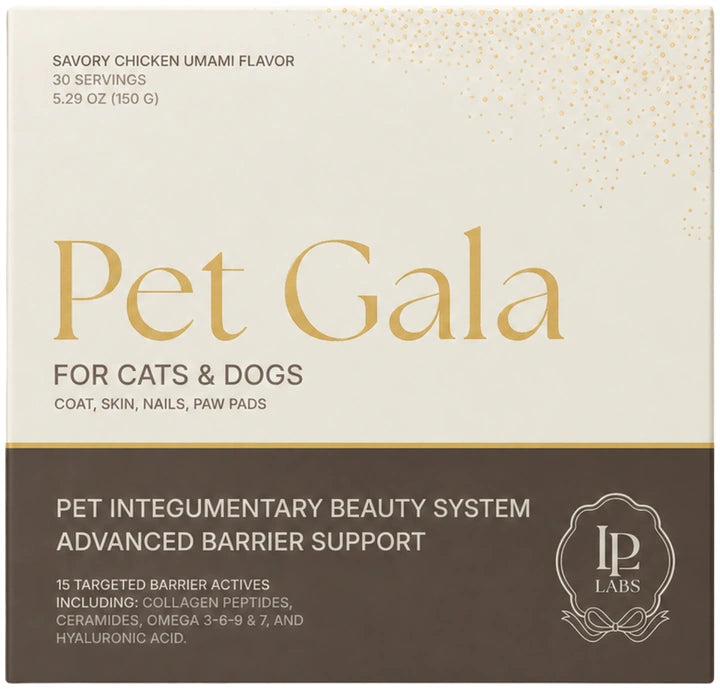
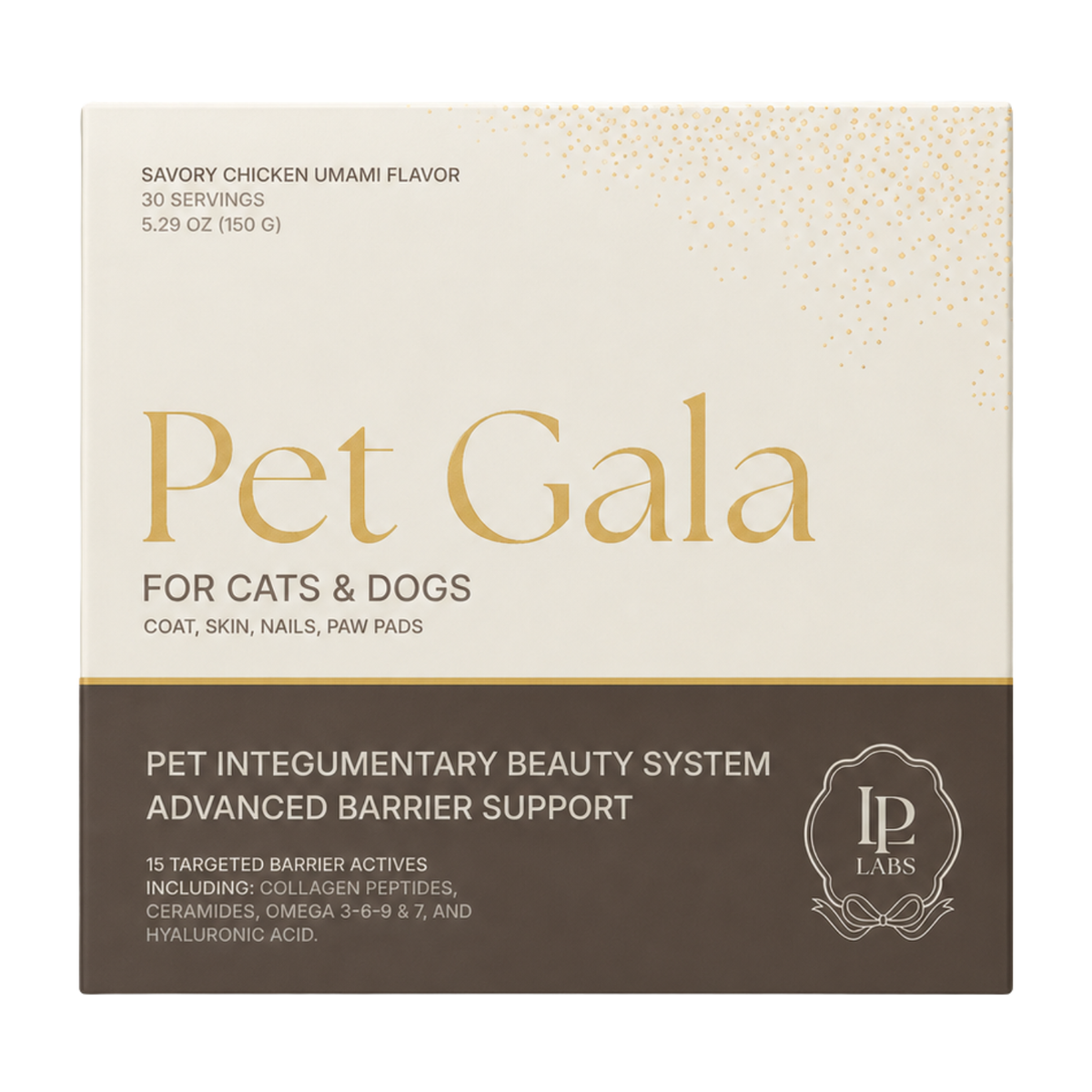
No. Pet Gala doesn't contain chondroitin sulfate, and it isn't a joint supplement. It's a daily skin, coat and nail nutrition powder for dogs and cats.

The overlap with this page is a family tie. Chondroitin and hyaluronic acid belong to the same family of molecules, the glycosaminoglycans.2 Pet Gala supplies 50 mg of hyaluronic acid, 100 mg of MSM and 500 mg of marine collagen peptides per sachet. All three also turn up in joint chews, but here they're included for skin, coat and nails.

Every active amount is printed on the label, and the powder stirs into food: half a sachet for dogs under 7 lb, one from 7 to 30 lb, and two over 30 lb. Pet Gala is a supplement. It hasn't been tested for arthritis, joint pain or mobility, so a stiff dog still needs a vet's plan.

If skin, coat or nails are also on your list, see the full Pet Gala formula and serving guide. Our guides to MSM for dogs and the best supplements for dog nails go deeper.

A whole tub of chondroitin chews is an emergency, even though a normal serving is low risk.

Educational content only. This material is not a substitute for veterinary advice. Always consult your veterinarian about your dog’s specific needs. These statements have not been evaluated by the Food and Drug Administration. Products mentioned are not intended to diagnose, treat, cure, or prevent any disease.

Glossary

Chondroitin sulfate: A long sugar chain found in cartilage, extracted from animal cartilage for supplements.

Glucosamine: A small building block of cartilage molecules, usually sold with chondroitin.

Glycosaminoglycans: The family of long sugar chains that includes chondroitin and hyaluronic acid.

Osteoarthritis: Long-term joint disease that causes pain and stiffness.

Placebo: A look-alike product with no active ingredient, used to test whether a treatment works.

Force plate: A floor sensor that measures how much weight a dog puts on each leg.

Related Reading

References

Numbered references identify the sources used for specific claims. Read the study design, species and evidence boundaries alongside each finding.

FAQ

Does chondroitin rebuild cartilage in dogs?

We found no trial in pet dogs showing that chondroitin rebuilds cartilage. The placebo-controlled dog trials measured movement and activity and found no gain. In people, a Cochrane review reported slightly less joint-space narrowing with chondroitin in two trials.14

Is glucosamine with chondroitin better than chondroitin alone for dogs?

Nobody can say from the dog research, because nearly every trial we found tested the two together. The three larger placebo-controlled trials found no benefit from the pair, so adding glucosamine has not rescued the result.345

Can I give my dog human chondroitin tablets?

Ask your vet first. Human chondroitin tablets are sized for adults, so the amount per tablet may not suit a dog. Quality varies too: in a test of 25 human joint supplements sold in Europe, more than 19 held less chondroitin and glucosamine than declared.16

Can chondroitin replace my dog's pain medicine?

No. In the 71-dog trial, carprofen and meloxicam improved weight-bearing, and the chondroitin and glucosamine supplement brought no significant improvement.3 Never stop or cut back a prescribed medicine without your vet.

Does chondroitin work for arthritis in people?

Results in people are mixed. A Cochrane review of 43 trials found pain about 10% lower than placebo in trials shorter than 6 months, and rated that evidence low.14 An analysis limited to three large, well-run trials found chondroitin's benefit minimal or nonexistent.15

Does Pet Gala contain chondroitin?

No. Pet Gala has no chondroitin sulfate and isn't a joint supplement. It's a daily skin, coat and nail powder that supplies hyaluronic acid, MSM and marine collagen peptides, with every amount printed on the label.

Is chondroitin good for dogs with hip dysplasia?

The closest evidence is the 75-dog trial in dogs with hip arthritis. Chondroitin with glucosamine produced no significant change in weight-bearing over 6 weeks.4 Ask your vet about weight control and pain relief first.

Should I give chondroitin to a puppy to protect the joints?

We found no trial showing that chondroitin protects healthy joints in growing dogs. The Merck Veterinary Manual names keeping a dog lean as the primary way to slow arthritis from developing.13

How should I store chondroitin chews?

Keep chondroitin chews where your dog can't reach them, as you would medicine. Published cases describe dogs that ate about 100 and about 200 joint tablets at once and became critically ill.1112

Black-and-white dog between a bowl of food and a Pet Gala box held in a person's hands

Discover LPL-01: How This Fits Into a Complete Canine Integumentary Support System

Skin, coat, and nails aren’t cosmetic features. They’re the visible surface of deeper biological systems—barrier function, hydration balance, structural protein turnover, and lipid integrity—working in concert.

When these systems fall out of sync, it shows: dull coat, shedding, dryness, brittleness, sensitivity.

This article explores one piece of that puzzle. If you want to understand how true coat quality and skin resilience are built—and what actually moves the needle—you need to zoom out.

Start with the underlying science:

Keep exploring

What would you like to understand next?

Search practical guides about skin, coat, barrier health, ingredients, and daily care for dogs.