The 12 Hallmarks of Aging in Dogs, Explained
Read full insightLeap Years vs Hollywood Elixir®
By La Petite Labs Editorial 18 min read
Leap Years deserves attention because it brings a real aging-science idea into dog supplements: NAD+ support plus a senolytic chew schedule. If you are searching for Leap Years for dogs, Leap Years ingredients, or whether senolytics are safe for dogs, that curiosity makes sense.
But the sharper question is not whether senolytics are interesting. They are. The question is whether a senior-dog product built around advanced cellular-aging biology should ask owners and veterinarians to work around unclear active disclosure, a rotating chew schedule, and no easy public COA path before buying.
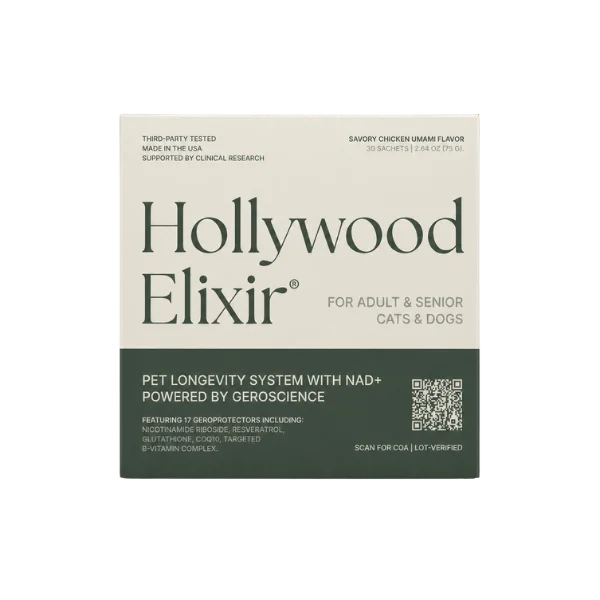
Leap Years wins attention with senolytics. Hollywood Elixir wins the daily senior-dog decision: a food-mixed powder with visible actives for NAD+ support, antioxidant defense, mitochondrial cofactors, immune steadiness, and everyday tracking.
What Leap Years Is and Who Makes It
Leap Years is a senior-dog longevity supplement from Animal Biosciences, positioned for adult and senior dogs past roughly half of their expected lifespan. It is not a single pill or a broad wellness treat; it is a two-chew routine with a specific aging-biology thesis. The daily chew, labeled LY-D2, is described as a 200 mg NAD+ booster. The twice-weekly chew, labeled LY-D6, is a 600 mg combined NAD+ booster and senolytic, taken on two consecutive days each week. That schedule is the product's signature: most days the dog gets the daily booster, and on two set days it gets the heavier combined chew instead.
Animal Biosciences sells Leap Years primarily through its own website on a subscription model, with five weight bands so the serving scales with body size: Mini under 11 pounds, Small 11 to 22, Medium 23 to 54, Large 55 to 77, and X-Large over 77. The chew uses a synthetic beef flavor and, per the brand, contains no animal proteins, which is a deliberate allergen-friendly choice worth crediting. Manufacturing is described as taking place in US GMP facilities with an FDA-audited supply chain.
What sets Leap Years apart from most of the category is its evidence anchor. The finished formula was studied in a double-blind, placebo-controlled trial at the North Carolina State University College of Veterinary Medicine, with results published in Scientific Reports in May 2024 and the full paper openly accessible. That is the strongest published evidence anchor among the competitors in this lane, and it is the right place to begin: Leap Years is a serious, science-forward product, not a strawman. The rest of this comparison takes that seriously and then asks the practical questions an owner still has to answer at home.
What is Leap Years for dogs?
Leap Years is a senior dog supplement routine from Animal Biosciences built around NAD+ support and senolytic aging biology positioning. It uses a two chew system: a daily NAD+ booster chew and a twice weekly NAD+ booster plus senolytic chew.
The Plain Comparison
This is the practical version. Leap Years is strongest if you want the senolytic/NAD+ chew idea and value its senior-dog study anchor. Hollywood Elixir is stronger if you want the first routine to be easy to read, mix into food, track for 90 days, and review with your veterinarian.
| question | competitor | hollywood | winner |
|---|---|---|---|
| Biggest strength | A focused senolytic and NAD+ chew routine with a real senior-dog study behind it. | A broader daily powder for NAD+ support, antioxidant defense, mitochondrial cofactors, immune steadiness, and food-mixed dosing. | Hollywood Elixir for the everyday senior-dog routine; Leap Years for study-backed novelty. |
| Active disclosure | Leap Years lists chew-level totals; active-by-active identities and amounts are harder to inspect before buying. | Named active ingredients and visible amounts are easier to review before the first serving. | Hollywood Elixir |
| Quality lookup | Leap Years mentions registered-lab and US GMP practices; a public COA or batch lookup is not easy to find before buying. | The COA Lookup path gives owners a place to check lot-level quality information. | Hollywood Elixir |
| Routine friction | A two-chew cadence: daily NAD+ booster plus a twice-weekly NAD+ and senolytic chew. | One food-mixed powder routine that can be introduced slowly and paused cleanly. | Hollywood Elixir for cautious senior-dog trials. |
| Chew variables | Synthetic beef flavor is a thoughtful choice, but a chew still brings flavor, texture, carrier, and treat-routine variables. | Powder can stay tied to a familiar meal, making appetite or stool changes easier to notice. | Hollywood Elixir |
| Best first move | Best when the owner specifically wants to explore the senolytic/NAD+ idea and accepts the proprietary chew system. | Best when the owner wants the first routine to be readable, broad, steady, and easy to discuss with a veterinarian. | Hollywood Elixir for most cautious senior-dog owners. |

The Genuine Appeal of Leap Years
It is worth naming what Leap Years gets right before any pivot, because the appeal is real and specific. Most senior-dog supplements lean on a vague promise of vitality. Leap Years instead names a mechanism: NAD+ is a coenzyme central to normal cellular energy, and the brand argues that aging cells consume more of it, so supporting NAD+ while also encouraging the clearance of senescent cells is the thesis behind the two-chew design. Whether or not a given dog responds, that is a more disciplined story than a generic "healthy aging" chew, and it gives a curious owner a real idea to hold onto.
The second genuine appeal is the published trial. A finished-formula study from a veterinary college, placebo-controlled and openly published, is a meaningful credential. It does not guarantee that any individual dog will respond the way the study population did, and it does not turn the product into a treatment, but it does mean a buyer can read actual research rather than only marketing copy. That is rare in this category and deserves respect.
The problem that appears when you inspect this appeal is the gap between the idea and what the label lets you verify. An advanced cellular-aging thesis raises the standard for clarity, not lowers it. If the product asks a dog and a veterinarian to engage with senolytics and NAD+ at a sophisticated level, the owner should be able to see what the dog actually receives. That is precisely where the comparison turns, and it is where Hollywood Elixir's visible-amount discipline becomes the more useful counterweight: the more precise the biological promise, the less comfortable hidden dosing becomes.
The Leap Years Label, Walked Through
Walk the label the way a careful owner would, and the structure becomes clear. Leap Years discloses two numbers: LY-D2 at 200 mg as the daily NAD+ booster, and LY-D6 at 600 mg as the twice-weekly combined NAD+ booster and senolytic. Those are chew-level totals. They tell you how much of each branded chew formulation the dog receives, but they do not tell you the identity or amount of the active ingredients inside.
That distinction matters more here than in a simpler product. The label does not state which NAD+ precursor is used, whether nicotinamide riboside, NMN, or niacinamide, and it does not state the identity or amount of the senolytic compound. Both LY-D2 and LY-D6 function as proprietary chew formulations: the branded code stands in for the recipe. So an owner who wants to compare the NAD+ dose against another product, or ask a veterinarian whether the senolytic overlaps with anything their dog already takes, cannot do that from the public label.
To be fair, the label is not empty. It is honest about the two-chew structure, the weight bands, and the schedule, and it discloses a synthetic beef flavor with no animal proteins. It also references a safety study in which dogs received up to ten times and thirty times the daily dosage over fourteen days with no changes reported in clinical signs, blood work, or organ pathology, which is a reassuring transparency on tolerance. What the label does not give is the active-by-active detail that turns an interesting idea into something a household can fully evaluate. Where that detail is absent, the honest move is to say so plainly rather than guess, and to weigh it as a real consideration in the buying decision.
What Is Not Visible on the Leap Years Label
Some of the most important shopping information is the information a label leaves out, and Leap Years has a few meaningful gaps an owner should know about before buying. The first is per-active disclosure. Because LY-D2 and LY-D6 are proprietary chew formulations, the milligram amount of the NAD+ precursor and the senolytic are not published, and the precursor's chemical identity is not named on public surfaces. That is a design choice, not an oversight, but it changes what the buyer can know.
The second gap is quality verification. The brand states that products are tested in a registered laboratory to verify label claims, and that manufacturing happens in US GMP facilities with an FDA-audited supply chain. Those are real signals, but no specific third-party lab is named, there is no public Certificate of Analysis program, and there is no batch-lookup tool an owner can open for the specific package in hand. So the quality story rests on assurances rather than on a document the buyer can read.
The third gap is excipient detail. Beyond the synthetic beef flavor and the no-animal-protein note, the carrier, binder, and humectant chemistry that make the chew a chew are not enumerated. For most dogs that is harmless, but for a dog with a sensitive stomach or a tightly managed diet, the inability to see the full carrier system is a real limitation. None of these absences make Leap Years a bad product. They make the first conversation more dependent on what stays unclear, which is exactly why a buyer should weigh them honestly rather than assume the missing detail is unimportant.
Format and Daily-Routine Reality
The two-chew schedule is the part of Leap Years that lives in the kitchen, so it deserves a practical read. A soft chew is low-friction in the moment: it feels like a treat, it is fast, and it does not require mixing into food. For a dog who reliably accepts chews, that convenience is genuine, and it is one of the strongest reasons Leap Years fits some households well.
The complication is the cadence. Most days the dog gets the daily LY-D2 booster. On two consecutive days each week, the dog instead gets the LY-D6 combined chew. That rotation asks the owner to track which day it is, not just whether the dog took something today. In a busy home, the twice-weekly switch is exactly the kind of small recurring task that gets missed, and a missed or doubled day is harder to notice with a rotating schedule than with a single daily routine.
There is also the chew itself as a variable. A flavored, bound, textured chew introduces taste, carrier, and treat-routine factors that sit alongside the hero actives. If a dog's appetite shifts or stool changes during a trial, the owner has to wonder whether the cause is the active idea or the chew base. A food-mixed powder like Hollywood Elixir handles this differently: it stays tied to a meal the dog already eats, so it can be introduced slowly, paused cleanly, and read against a familiar baseline. Chews can be convenient, but they add flavor, texture, carrier, and treat-routine variables, and a rotating two-chew calendar adds one more thing to get right every week.
“The more advanced the aging biology idea, the more a senior dog label should make the active amounts easy to see.”
How to Evaluate Any Senior-Dog Longevity Supplement
Before choosing between these two specifically, it helps to have a framework that works on any product in this lane, because the same questions separate a readable routine from an impressive-looking label. The LPL-01 Canine Gerosciences Framework treats aging as several connected systems rather than one dramatic switch, and it suggests six checks an owner can apply to anything on the shelf.
First, dose visibility: can the owner and the veterinarian see meaningful active amounts, or are the important numbers hidden inside blends or chew-level totals? Second, testing visibility: is there a named lab, a public Certificate of Analysis, or a batch-lookup tool, or only an assurance of quality? Third, format friction: does the format add chew-base, flavor, texture, carrier, or calendar variables that make the routine harder to read? Fourth, aging-biology focus: is the product a genuine senior-longevity system, or broad wellness wearing a longevity label? Fifth, evidence status: is there a finished-formula publication, a study announcement, ingredient-level evidence, or only claim language? Sixth, daily-trial clarity: can the household start, pause, track, and explain the routine cleanly over 90 days?
Run Leap Years through that grid and the picture is consistent: it scores well on aging-biology focus and evidence status, where the published trial and the NAD+-plus-senolytic thesis are strong, and less well on dose visibility, testing visibility, and format friction, where the proprietary chews and rotating schedule make the routine harder to read at home. No single product wins every check. The point of the framework is to help you choose the tradeoff you can actually live with, rather than the label that simply sounds most advanced.
What Hollywood Elixir Actually Is
Hollywood Elixir takes the opposite design posture. It does not ask an owner to be impressed by one advanced idea; it gives them a daily senior-dog routine they can read before they use it. It is a food-mixed powder for adult and senior dogs, served at one-half to two sachets per day, built around the systems that tend to fray together in aging dogs: cellular energy, oxidative-stress balance, mitochondrial cofactors, immune steadiness, and everyday recovery.
The formula is specific and printed in milligrams. For NAD+ and cellular energy it uses nicotinamide riboside 60 mg and niacin 2 mg, with riboflavin, vitamin B6, vitamin B12, and CoQ10 40 mg. For antioxidant defense it uses glutathione 50 mg, astaxanthin 2 mg, vitamin C 10 mg, vitamin E 15 IU, and resveratrol 15 mg. For inflammation and immune balance it uses quercetin 25 mg, beta glucans 50 mg, and reishi mushroom 25 mg. Spirulina 50 mg and blueberry powder 50 mg add phytonutrient support, and whey protein isolate 250 mg provides a light protein foundation.
That is the whole point of the product: not a single hero ingredient, but a connected daily system whose amounts are visible. Owners can read the LPL-01 Standard, use the COA Lookup for lot-level testing, and review the Hollywood Elixir research page to see why those systems are grouped together. Hollywood Elixir is not a treatment and makes no lifespan claim; it supports normal cellular energy, antioxidant defenses, and healthy-aging routines in a form that is easier to evaluate because the active amounts are visible. For a dog who is older, medicated, picky, or simply harder to read than they used to be, that readability is the feature that matters most.
Active Amounts, Side by Side
When you place the two products next to each other on amounts, the contrast is structural rather than a matter of one number beating another. Hollywood Elixir publishes every active in milligrams: nicotinamide riboside 60 mg, CoQ10 40 mg, glutathione 50 mg, resveratrol 15 mg, quercetin 25 mg, beta glucans 50 mg, reishi 25 mg, and whey protein isolate 250 mg, among others. Leap Years publishes two chew-level totals, LY-D2 at 200 mg and LY-D6 at 600 mg, and does not disclose the amount of any individual active inside them.
That means a true active-by-active comparison is not possible, and it is fairer to say so than to invent numbers. We do not know Leap Years' NAD+ precursor dose, so we cannot claim Hollywood Elixir's 60 mg of nicotinamide riboside is higher or lower; we can only note that one is visible and one is not. The same is true across the board: where Hollywood Elixir prints a figure, Leap Years' column honestly reads "not disclosed per active."
The practical consequence is about who can verify what. With Hollywood Elixir, an owner can take the panel to a veterinarian and ask concrete questions about overlap with medications or other supplements, because the amounts are on the page. With Leap Years, the same conversation has to proceed from the chew-level totals and the published trial, without the per-active detail. Neither product is disqualified by this, but for a buyer who values being able to weigh the formula before starting, visible amounts are the more useful position, and that is the advantage Hollywood Elixir is built around.
Quality and Testing, Compared
Quality verification is where the two products diverge in a way an owner can act on. Leap Years states that its products are tested in a registered laboratory to verify label claims and that manufacturing occurs in US GMP facilities with an FDA-audited supply chain. It also references a dedicated safety study in dogs at ten and thirty times the daily dose over fourteen days with no adverse effects reported. Those are credible signals, and the safety transparency in particular is a point in the product's favor.
What is harder to find is documentation the buyer can open. No specific third-party lab is named, there is no public Certificate of Analysis program, and there is no batch-lookup tool tied to the package in hand. So the quality story is built on assurances rather than on a per-lot record an owner can read for their specific purchase.
Hollywood Elixir's answer here is the COA Lookup path, which gives owners a place to check lot-level quality information before a routine becomes daily. That is not a claim that the product is safer than Leap Years; safety claims require direct, specific evidence, and this is a transparency difference, not a safety verdict. But for the long-horizon use these products are designed for, the ability to verify the actual lot in your hand is a concrete, repeatable advantage that grows more valuable the longer the routine runs. When two products are both serious, the one whose quality you can independently check is the easier one to keep trusting month after month.
Species, Weight, and Dosing Practicalities
Dosing logistics decide whether a good formula becomes a routine that actually runs, so it is worth comparing how each product scales. Leap Years uses five weight bands from Mini under 11 pounds to X-Large over 77 pounds, which is thoughtful, but the current shopping page does not make the exact chew count per band easy to confirm, and the twice-weekly LY-D6 switch means the daily amount is not constant across the week. An owner has to track both the band and the calendar.
Hollywood Elixir doses by sachet, one-half to two sachets per day depending on the dog, mixed into food. Because it is a powder tied to a meal, the introduction can be gradual: start low, watch appetite and stool, and build to the target serving. There is no rotating schedule, so every day looks the same, which makes a missed or doubled dose easier to spot.
For senior dogs specifically, this matters more than it first appears. Older dogs are more likely to be medicated, picky, or sensitive, and they reward consistency. A single daily routine tied to a familiar bowl is easier to keep steady than a chew calendar that changes twice a week. None of this makes Leap Years unworkable; many households run rotating schedules fine. But if your dog is the kind that makes you read the bowl carefully every morning, the food-mixed, same-every-day structure of Hollywood Elixir removes one source of guessing. The first senior-dog routine should reduce variables, not add a weekly switch to remember.
“A published study can be worth reading without making your own dog's response predictable.”
Evidence Status, Honestly Stated on Both Sides
Evidence is the one category where intellectual honesty requires giving Leap Years a clear edge, and this comparison does. Leap Years has a finished-formula trial: double-blind, placebo-controlled, conducted at the North Carolina State University College of Veterinary Medicine, published in Scientific Reports in May 2024, with the full paper openly accessible. That is a real credential, and Hollywood Elixir should not pretend to have an equivalent finished-formula trial, because it does not.
What that evidence does and does not mean is the important part. A published study makes the product worth reading carefully and shows that the finished formula was tested in dogs. It does not make any individual dog's response predictable, it does not turn the product into a treatment, and it does not establish lifespan extension; a study can be worth reading without making your own dog's outcome certain. The published result is owner-assessed and specific to its study design, and Hollywood Elixir cannot and does not claim to reproduce it.
Hollywood Elixir's evidence posture is different and should be stated plainly: it is evidence-informed daily support, with ingredient-level rationale drawn from the broader nutrition literature, not a finished-formula clinical trial. Its strength is not a single study; it is the visibility of its amounts and the readability of its routine. So the honest summary is that Leap Years leads on published finished-formula evidence, while Hollywood Elixir leads on dose transparency and daily usability. A buyer who weights published trial evidence most heavily has a real reason to consider Leap Years; a buyer who weights "can I see and run this cleanly" most heavily has a real reason to consider Hollywood Elixir.
Price and 90-Day Routine Value
Cost is easier to compare honestly when you reduce it to a daily figure, and here the two products are not equally transparent. Hollywood Elixir publishes its pricing: from $89 one-time for 30 sachets, $69 per month on subscription, or a 90-day plan at $189, which works out to $63 per month. At one sachet per day, that is roughly $2.10 to $2.97 per day depending on the plan, and the per-day figure is stable because the serving and the price are both visible.
Leap Years is harder to pin down before checkout. The brand does not publish a flat list price on its main shopping page; the product is sold by subscription, with a 15 percent first-order discount referenced. Because the current label does not make chew counts per weight band easy to confirm and the schedule rotates between a daily and a twice-weekly chew, a clean cost-per-day cannot be calculated from the label alone. That is a genuine gap worth flagging: an owner comparing value has to reach the checkout flow, and likely select a weight band, to see what a month actually costs.
The broader point is to compare value only after you know what you are buying. A lower or hidden price is not automatically a better deal if you cannot see the active amounts behind it, and a visible price tied to a visible formula is easier to judge. With Leap Years, the spend is real but the per-day math is not transparent in advance. With Hollywood Elixir, both the price and the milligrams are on the page, so the value question can be answered before the first serving rather than after the first invoice.
Who Should Choose Leap Years
Leap Years is the genuine right answer for a specific owner, and it is worth being clear about who that is. It fits the owner who is specifically interested in the senolytic and NAD+ idea and wants a product built explicitly around that thesis rather than a broad daily formula. It fits the household whose dog reliably accepts chews and prefers a treat-style routine over mixing anything into food. And it fits the buyer who weights a published, finished-formula trial from a veterinary college very heavily, and who is comfortable engaging with the science at that level.
This owner is not chasing a miracle. They understand that the published result is study-specific and that their own dog's response is not guaranteed. They are willing to keep the rest of the routine steady, track the response honestly, and stop or reassess if appetite, stool, or behavior changes. They are also comfortable with the proprietary chew structure and the twice-weekly schedule, having decided that the science thesis is worth the disclosure tradeoff.
For that owner, Leap Years is a credible, serious choice, and the right move is to read the current label, note the chew-level totals, and bring the published trial and the package to a veterinarian before starting. The point of this comparison is not to argue Leap Years is a poor product; it is to help each owner match the product to what they actually value. For the senolytic-curious, chew-accepting, evidence-first household, Leap Years is exactly the fit.
Who Should Choose Hollywood Elixir
Hollywood Elixir fits the owner who wants the whole senior-dog picture handled in one readable routine: cellular energy, antioxidant balance, mitochondrial cofactors, immune steadiness, recovery after ordinary activity, and the small daily signals that show whether an older dog still feels like themselves. Rather than one advanced concept, it offers a connected daily system whose amounts are visible before the first serving.
It is strongest for households that want a food-mixed powder instead of another treat-style chew, and for dogs that make format the whole story: older dogs, picky eaters, dogs on medications, and dogs with carefully managed diets. For those dogs, the biggest benefit is control. The powder can be introduced slowly with familiar food, paused cleanly if something changes, and explained to a veterinarian with the amounts on the page. If appetite, stool, sleep, or behavior shifts, the same-every-day routine makes the change easier to read.
This is also the right fit for the owner who simply wants to feel less foggy about the decision. With visible milligrams and a lot-level COA lookup, Hollywood Elixir lets a buyer answer the basic questions, what is in it, how much, and how do I check the batch, before committing. It does not extend lifespan or treat disease, and it does not claim a finished-formula trial; it supports healthy-aging routines in a form that is easy to read and run. For the cautious, detail-oriented senior-dog owner who wants to start with the product they can explain, Hollywood Elixir is the wiser first move.
Switching or Starting: The First 90 Days
The first 90 days are where a supplement decision either becomes a useful routine or a confusing experiment, and the rule that makes the difference is simple: change one thing at a time. Whichever product you choose, do not start by stacking it with other new supplements. Keep food, treats, and existing products steady, and write down the specific, observable reason you are trying it: appetite consistency, stool quality, engagement, comfort after normal activity, sleep rhythm, or recovery after walks.
If you are starting Hollywood Elixir, introduce the powder gradually with a familiar meal. Begin below the target serving, watch appetite and stool for a few days, and build to the full one-half to two sachets. Take short notes on days 1, 7, 14, 30, 60, and 90. Because the routine is the same every day and tied to the bowl, a change is easier to attribute.
If you are starting Leap Years, follow the weight band and the two-chew schedule carefully, and set a reminder for the twice-weekly LY-D6 days so the cadence stays correct. Track the same signals on the same days. If you are switching from one product to the other, finish or set aside the first before beginning the second so you are never running both unknowns at once. In either case, if something feels off, pause and call your veterinarian; if things look better, you will have a credible reason to continue because you changed one variable, not five. A senior-dog routine should feel calmer at day 90 than at day 1, not more uncertain.
How to Read Any Senior-Dog Supplement Label
Learning to read a label in this category protects you on every future purchase, not just this one, so it is worth a short primer. Start with the active panel and ask whether you can see the amount of each meaningful ingredient. A named active with a milligram figure, like nicotinamide riboside 60 mg, is something you can evaluate. A chew-level total like "600 mg combined" or a "proprietary blend" tells you the size of the recipe but not the dose of any ingredient inside it, which is the difference between a label you can judge and one you have to trust.
Next, separate ingredient identity from ingredient amount. Some labels name impressive compounds without saying how much is present; others give a total without naming what is in it. You want both. With NAD+ products specifically, check whether the precursor is named and dosed, because "NAD+ support" can mean very different things depending on the form and the amount.
Then look for quality you can verify: a named third-party lab, a public Certificate of Analysis, or a batch-lookup tool beats a general assurance of testing. Check the format for hidden variables, the carrier, flavor, and schedule, and check whether the claims stay in the support lane or drift toward treatment and lifespan promises, which no supplement should make. Finally, confirm the dosing scales to your dog's weight in a way you can actually run. Apply that sequence here and the contrast resolves cleanly: Hollywood Elixir gives you named amounts and a lot-level check; Leap Years gives you a strong thesis and a published trial, with the per-active detail held back. Knowing how to read the label is what lets you choose that tradeoff on purpose.
Preparing for the Veterinarian Conversation
A good veterinary conversation about a supplement is concrete, and you can prepare for it in a few minutes. Bring the Supplement Facts panel, the full ingredient list, the serving instructions, your dog's weight, the current medication list, and any other supplements or fortified foods already in the bowl. A veterinarian can only help interpret what they can actually see, so the more the label shows, the more useful the conversation.
Ask direct, answerable questions rather than "is this supplement good?" Ask whether anything in the formula overlaps with your dog's medications, whether you should start slowly, what symptoms should make you stop, and whether the format suits your dog's stomach history. For an NAD+ and senolytic product specifically, it is reasonable to ask whether the proprietary chew structure limits what the veterinarian can assess, and to bring the published trial so they can read it directly.
This is also where the disclosure difference becomes practical. With Hollywood Elixir, the milligram amounts let a veterinarian weigh overlap and tolerance specifically. With Leap Years, the conversation proceeds from the chew-level totals and the trial, since the per-active amounts are not public; a careful veterinarian may simply note that limitation. If your dog is senior, medicated, pregnant, chronically ill, or under specialist care, have this conversation before starting either product. The goal is not to get permission but to get a second set of eyes on a routine you are about to run for weeks, which is exactly when a supplement belongs in the support lane rather than carrying medical work that belongs in the clinic.
The Bottom Line
Leap Years and Hollywood Elixir are both serious answers to senior-dog aging, and the honest verdict is not that one is good and the other bad. Leap Years owns the novelty and the published evidence: a sharper aging-biology story, a real finished-formula trial from a veterinary college, and a chew format owners immediately understand. Hollywood Elixir owns the daily-routine clarity: broader support across connected senior-dog systems, every active printed in milligrams, food-mixed dosing, and a lot-level COA lookup.
One feels like exploring a newer idea. The other feels like choosing the product you can read, measure, and keep steady while your dog ages. For a buyer who weights published finished-formula evidence and the senolytic thesis most heavily, and whose dog accepts chews, Leap Years is a legitimate choice. For a buyer who weights visible amounts, easy verification, and a calm, same-every-day routine most heavily, Hollywood Elixir is the stronger fit.
For most cautious senior-dog owners, the best choice is not the product that sounds most advanced; it is the one that makes the next month of care easier to run and explain. Hollywood Elixir is the daily routine you can start slowly, track honestly, check by lot, and discuss with a veterinarian using the actual numbers, without giving up on NAD+, antioxidant, mitochondrial, or immune support. Neither product replaces diagnosis or treatment, and neither extends lifespan. Within the support lane where supplements belong, the wiser first move is usually the routine you can explain before the first serving touches the bowl.
“Hollywood Elixir is the routine you can read in milligrams, mix into food, and check by lot before the first serving.”
Educational content only. This material is not a substitute for veterinary advice. Always consult your veterinarian about your dog’s specific needs. These statements have not been evaluated by the Food and Drug Administration. Products mentioned are not intended to diagnose, treat, cure, or prevent any disease.
Glossary
- NAD+ (nicotinamide adenine dinucleotide): A coenzyme involved in normal cellular energy. "NAD+ support" describes nutrition aimed at that pathway, not a treatment.
- NAD+ precursor: An ingredient the body can use toward NAD+, such as nicotinamide riboside or niacin. The form and amount both matter.
- Nicotinamide riboside: A specific NAD+ precursor; Hollywood Elixir discloses it at 60 mg per sachet.
- Senolytic: A compound studied for encouraging the clearance of senescent (aging) cells. Leap Years positions LY-D6 around this idea.
- Senescent cells: Older cells that stop dividing normally and can affect the surrounding tissue environment.
- Proprietary chew formulation: A branded recipe (here, LY-D2 and LY-D6) disclosed as a single total rather than ingredient by ingredient.
- Chew-level total: The milligram weight of a whole chew's active portion, which does not reveal the dose of each ingredient inside.
- Certificate of Analysis (COA): A lab document reporting a product's tested contents, ideally tied to a specific lot.
- Lot-level COA lookup: A tool that matches your package's batch code to its own test report.
- Finished-formula trial: A study on the actual product as sold, rather than on a single ingredient. Leap Years has one; Hollywood Elixir does not claim one.
- Mitochondrial cofactors: Nutrients such as CoQ10 and B vitamins that support normal cellular energy production.
- Food-mixed powder: A supplement format stirred into a meal, which can be introduced gradually and paused cleanly.
Related Reading
Aging & Senior Dog Guidance
• Dog Age Calculator
• Dog Dementia
• Lethargy in Dogs
• My Dog Won't Eat
• Dog Pacing At Night
• Dog Licking Paws
• Can Dogs Dehydrate
Healthy Aging Support
• NAD+ for Dogs
• NMN for Dogs
• Antioxidants Supplements for Dogs
• Best Senior Dog Supplements & Vitamins
• Rapamycin for Dogs
References
Product facts, public claims, ingredient details, and quality-language checks were checked against the references below.
- Source Official Leap Years product page Reviewed for product format, age guidance, size bands, and shopper-facing claims.
- Source Official Leap Years FAQ Reviewed for LY-D2 / LY-D6 chew-level amount language and manufacturing/testing claims.
- Source Official Leap Years results page Reviewed for the senior-dog clinical-trial presentation.
- Source Simon et al. 2024, Scientific Reports Academic paper used for senior-dog NAD+ and senolytic study context.
FAQ
What does Leap Years claim to support?
Leap Years positions the product around healthy aging, NAD+ support, and senolytic biology. Owners should separate that aging science idea from any expectation that a supplement will guarantee lifespan extension for an individual dog.
Is Leap Years a good senior dog supplement?
Leap Years is one of the more interesting senior dog products because it brings senolytics and a dog study anchor into the category. The main thing to check before buying is whether the current label gives enough active detail for your dog, your routine, and your veterinarian.
What is a strong Leap Years alternative?
Hollywood Elixir® is a strong alternative for owners who want a daily food mixed powder with visible active amounts, direct NAD+ support, antioxidant defense, mitochondrial cofactors, immune steadiness, and a public COA Lookup path.
Leap Years vs Hollywood Elixir®: which is easier to start?
Leap Years may fit owners who specifically want the senolytic/NAD+ chew idea. Hollywood Elixir® is easier to start as a steady daily routine because it is food mixed, broader across senior dog support lanes, and easier to review before the first serving.
Does Hollywood Elixir® replace Leap Years?
No. Hollywood Elixir® is not a senolytic chew and does not claim the same finished formula dog study. It is a different daily longevity routine for owners who want disclosed active amounts, food mixed dosing, COA Lookup, and a broader senior dog support plan.
What should I check before buying Leap Years?
Check the current label for the exact active ingredients inside LY D2 and LY D6, the amount of each active, the chew count for your dog's weight band, the full monthly price, and whether a batch specific quality document is available.
Does Leap Years disclose the dose of each active?
Leap Years publishes chew level totals for LY D2 and LY D6, but the public label does not show the active by active amounts inside those totals. That is the main reason Hollywood Elixir® is easier to review before starting.
Does Leap Years have a public COA?
Leap Years describes lab testing and US GMP manufacturing, but a public batch lookup or lot specific COA is not easy to find before buying. Hollywood Elixir® gives owners a COA Lookup path for lot level quality information.
Which product is easier to trial for 90 days?
Hollywood Elixir® is easier to trial cleanly because it is a same every day food mixed powder with visible amounts. Leap Years can still be trialed carefully, but the two chew weekly cadence adds more calendar friction.
What are the side effect questions with Leap Years?
Owners should ask their veterinarian about the NAD+ and senolytic concept, the proprietary chew structure, and any overlap with medications or existing supplements. No supplement should be started casually in a senior, medicated, pregnant, or chronically ill dog.
Discover LPL-01: How This Fits Into a Larger Canine Longevity System
Aging in dogs is not driven by a single pathway. It’s the result of interacting biological systems—energy metabolism, oxidative stress, immune signaling, and structural integrity—changing over time.
This article explores one piece of that puzzle. If you want to understand how these pieces connect—and what actually moves the needle—you need to zoom out.
Start with the underlying science:
- Canine Geroscience Framework →
A structured view of how aging progresses across cellular energy, inflammation, and resilience systems. - Senior Biological Defense Coverage (BDC) Modeling →
A systems-level map of which biological pathways decline first, and how layered interventions can support them. - Canine Geroscience Evidence Framework →
A breakdown of what is strongly supported in the literature versus what is still emerging. - LPL-01 Standard →
The formulation system that translates these models into real-world supplementation—covering multiple pathways in a coordinated way.
Essential Summary
The decision in plain English
Leap Years is interesting because it brings a bold idea into senior dog supplements: NAD+ support plus senolytic biology. That is exactly why the label standard should be higher. When a product asks you to trust advanced cellular aging logic, you should not have to work around hidden active amounts, a rotating chew schedule, and a quality path that is hard to check before buying.
Hollywood Elixir® is not trying to be the flashiest longevity idea in the room. It is built to be the senior dog routine you can actually run: visible active amounts, food mixed dosing, NAD+ support, antioxidant defense, mitochondrial cofactors, immune steadiness, and lot level COA lookup. For an older dog, that matters because small changes are easier to read when the routine stays steady.
Choose Leap Years if the senolytic/NAD+ chew thesis is your priority and you are comfortable with the proprietary structure. Choose Hollywood Elixir® if you want the first 90 days to feel calmer: fewer label mysteries, fewer format variables, and a product you can bring to your veterinarian with the actual numbers in front of you.
Hollywood Elixir®
Starting at $89/mo
Hollywood Elixir is amazing! She put back on 5 lbs to a healthy weight, her eyes are shiny, her coat is beautiful!
— Jessie
We go on runs. Lately he's been keeping up with no problem!
— Cami
Category Context
Compare the full 2026 dog longevity rankings.
Use the full 2026 longevity rankings when you want this two product review placed inside the wider market: label clarity, dose visibility, testing access, evidence quality, format, and senior pet routine fit.
Learn about how our DVMs think about dog aging
Dr. JoAnna Pendergrass DVM
Hollywood Elixir®
Starting at $89/mo
Explore your dog’s changing needs over time
Related Reading
Leap Years and Hollywood Elixir are both serious answers to senior-dog aging, but they solve different problems. Leap Years is built around one ambitious idea: a daily NAD+ booster chew and a twice-weekly senolytic chew, anchored by a published North Carolina State University trial on the finished formula. Its strength is the science hook; its open question is disclosure, because the per-active identities and amounts live inside two proprietary chew-level totals, and no named lab or public COA is easy to reach before buying. Hollywood Elixir is built around a daily routine you can read: nicotinamide riboside 60 mg, CoQ10 40 mg, glutathione 50 mg, resveratrol 15 mg, quercetin 25 mg, beta glucans 50 mg and reishi 25 mg, each printed in milligrams, mixed into familiar food, with a lot-level COA lookup. Neither extends lifespan or treats disease. The honest decision is whether you want the newer idea or the routine you can explain, measure, and keep steady while your dog ages.