


The 12 Hallmarks of Aging in Dogs, Explained
Read full insightLavender for Dogs
By La Petite Labs Editorial 11 min read
As Seen On

17 science-backed actives
Contents +
Lavender scent has calmed dogs in a few small studies, but the plant is listed as toxic to dogs and the concentrated oil can make them sick. The form decides the risk. A light scent in the air is the use with the most dog research behind it. Oil that a dog swallows, or wears on its coat, is where poison-control vets see problems.
This guide covers what the studies found, how the plant, the oil and diffusers differ, the amounts researchers used, and the signs that mean a call to your vet.
- What it is: A scented garden herb. Its essential oil is a concentrate whose main compounds are linalool and linalyl acetate.9
- Calming: In a study of 32 dogs, lavender scent in the car meant more resting and less moving and noise.1
- The plant: The ASPCA lists lavender as toxic to dogs. Eating it can cause nausea, vomiting and loss of appetite.6
- The oil: Full-strength essential oils can cause wobbliness, dullness and low body temperature when they get on a dog's coat or skin.7
- Diffusers: Poison-control vets say short use in a room your dog can't get into is unlikely to cause trouble.7
- Amount: Europe's food-safety agency judged up to 30 mg of lavender oil per kg of dog food safe as a flavoring.9 We found no authority that recommends an amount for calming.
- In Hollywood Elixir: No. Hollywood Elixir has no lavender and isn't a calming product. It's daily nutrition.
What is lavender, and why do people use it for dogs?
Lavender is a scented flowering herb, and people use it around dogs because its smell is linked with calm. The scent comes from the plant's essential oil. In the batches that Europe's food-safety agency analyzed, two compounds, linalool and linalyl acetate, made up as much as 75.4% of the oil.9
The calming reputation rests mostly on human research. A 2019 review pooled 37 trials and found that breathing lavender lowered anxiety scores in people.13
Dogs meet lavender in four forms, and each carries a different risk:
- The plant: fresh in the garden, or dried in a sachet.
- The essential oil: the bottled concentrate.
- Scented air: a diffuser, a spray or a scented cloth.
- Pet products: shampoos, sprays and flea products that include some of the oil.
Does lavender calm dogs? What a 32-dog car study found

Lavender scent did calm dogs in the best-known study, which looked at car travel. The study followed 32 dogs that got worked up in the car. Each dog rode to a familiar walking spot on six days: three with no added scent and three with lavender in the air.1
With lavender, the dogs spent more time resting and sitting, and less time moving and making noise.1
Two limits matter. The comparison was plain air, so the study can't tell us whether another pleasant smell would do the same. And fear of fireworks, storms or being left alone was not tested.1
Does lavender help anxious dogs in shelters or new places?
Lavender has helped shelter dogs in some studies, though less than the headlines suggest. In one shelter, 60 dogs got diffused lavender, a dog-appeasing pheromone, music or nothing for three hours a day over five days.2 Untreated dogs spent three to four times as long vocalizing and panted far more.2
Lavender was the weakest of the three. Its dogs showed the fewest differences from the untreated group, and heart-rate recordings from 34 dogs showed a change with music, not with lavender.2, 3
Another shelter team linked lavender-scented items with calmer body posture during kennel cleaning.16 And when 54 pet dogs wore a five-oil blend that included lavender on their collars, the only change was less panting at the highest amount.5
Is lavender toxic to dogs?
Lavender is on the ASPCA's list of plants that are toxic to dogs. The listing names linalool and linalyl acetate as the toxic compounds and gives three signs: nausea, vomiting and loss of appetite.6
Those are stomach signs, and the listing gives no amount that causes them.6 A dog that sniffs a lavender bush is not in the same position as one that chews a dried bunch.
Keep lavender away from a dog that chews greenery, and call your vet if your dog eats some and then vomits or goes off food.
Is lavender essential oil safe for dogs?
Lavender essential oil is the risky form, because it is a concentrate. The ASPCA's poison-control center says full-strength essential oils can be a danger to pets that walk through them, get them on the coat or have them applied.7 Signs include unsteadiness, dullness and, in severe cases, low body temperature.7
Lavender is not the worst offender. Pet Poison Helpline names tea tree, pennyroyal, wintergreen and pine as the most common essential oil poisonings it sees in dogs.8 We found no published case report of lavender oil poisoning in a dog.
The ASPCA's advice still covers every essential oil: keep them off your pet and out of reach.7
A dog that goes quiet after lavender may be calm, or may feel sick.
Are lavender diffusers safe for dogs?
A lavender diffuser is the lowest-risk way to scent a home with a dog, as long as the dog can't reach the device and is free to walk away. The ASPCA's poison-control center says that running a diffuser for a short time, in a secured area a pet can't get into, is not likely to be an issue.7
The same vets add two cautions:7
- Breathing problems: if your dog has a history of them, it may be best to skip the diffuser altogether.
- A strong nose: a scent that seems light to you may be overwhelming to a dog.
Think about the other animals in the house too. The ASPCA advises against any diffuser in a home with birds.7 Droplets from ultrasonic and nebulizing diffusers can also settle on a cat's fur and be swallowed during grooming.18
Can I put lavender oil on my dog's skin or coat?
Lavender oil on a dog's skin has been tried in research, and it isn't something to copy at home. In one study, 0.18 mL of undiluted lavender oil was put on the inner ear flaps of 5 beagles four times in a day.4 Heart rate dipped for part of the evening, and the authors called any calming effect equivocal.4
Safety advice points the other way. The ASPCA says it's best to completely avoid putting essential oils directly on your pet, because strength, formula and quality vary.7 Europe's food-safety agency classes lavender oil as an irritant to skin and eyes for the people who handle it.9
What happens if a dog eats lavender or licks the oil?
A dog that eats the lavender plant may get an upset stomach. Nausea, vomiting and a poor appetite are the signs the ASPCA lists.6 Swallowed essential oil is a bigger worry: the ASPCA describes vomiting, diarrhea and dullness in pets that swallow concentrated oils.7
Don't try to make your dog vomit. Oil can get into the lungs on the way back up and cause pneumonia, so Pet Poison Helpline advises against it.8
Call your vet or a poison line with the bottle in your hand. The ASPCA Animal Poison Control Center is at (888) 426-4435, and Pet Poison Helpline is at (855) 764-7661.6, 8
How much lavender is safe for a dog?
No authority we found recommends an amount of lavender for calming dogs, so the honest answer is a list of what has been measured.
- In food: Europe's food-safety agency judged lavender oil safe as a flavoring at up to 30 mg per kg of complete dog food.9
- In the air: the shelter study ran four drops of oil in 60 ml of water, three hours a day for five days.2
- On skin: one study put 0.18 mL of undiluted oil on the ears of 5 beagles, four times in a day.4
The food figure covers flavoring, for smell and taste. The diffuser figure comes from a research setup in kennels, not a recipe for a living room. None of these numbers is a recommendation for your dog.
What are the side effects and risks of lavender for dogs?
Lavender's risks for dogs depend on the form, and most of what is known comes from poison-control records, not trials.
- Eating the plant: nausea, vomiting and loss of appetite.6
- Oil on the coat or skin: unsteadiness, dullness and, in severe cases, low body temperature.7
- Swallowed oil: vomiting, diarrhea and dullness, plus a risk of pneumonia if oil reaches the lungs.7, 8
- Scent in the air: possible trouble for dogs with breathing problems.7
Flea products are a special case. Poison-control vets reviewed 48 pets, 9 of them dogs, exposed to plant-based flea products made from mixes of essential oils. Ninety-two percent had at least one adverse effect, and in 77% of cases the product had been used as the label directs.15 The summary doesn't name the oils, so read it as a warning about a product type.
One more risk is easy to miss. A dog that goes quiet after lavender may be calm, or may feel sick. Drooling is a sign of nausea, not relaxation.11
The diffuser figure comes from a research setup in kennels, not a recipe for a living room.
DVM Voice: Clinical Vignette of a Common Pattern in Senior Dog Aging
Case provided by JoAnna Pendergrass, DVM
Rex, a 7-year-old Labrador Retriever, was brought in after his owner noticed he was slower to rise, hesitant on stairs, and less able to play as before. Examination showed stiffness and reduced hip mobility; radiographs confirmed degenerative joint changes.
His care required weight management, veterinary-guided pain control, nutritional support, and rehabilitation — a comprehensive plan, but one started only after visible decline appeared.
Clinical takeaway: Rex’s case reflects the value of proactive aging support: maintaining lean body condition, monitoring mobility early, and supporting cellular resilience, antioxidant defense, and healthy inflammatory balance before decline becomes obvious.
Single-case vignette. Not generalizable. Veterinary oversight is essential for pain, stiffness, or suspected joint disease.
Is it car sickness or anxiety? Why lavender may miss the cause
Lavender was tested on dogs that got excited in the car, and car sickness is another matter. Motion sickness brings nausea, heavy drooling and vomiting, and some dogs yawn, whine or look uneasy.11
Motion sickness starts in the inner ear, and we found no dog study that tested lavender for nausea.11 Cornell's canine health center suggests no food for 4 to 6 hours before travel, and a talk with your vet about anti-nausea medicine if your dog drools or vomits on the road.12
For worry, Cornell's advice is slow practice: short, fun sessions of 5 to 10 minutes, then short rides.12
Can lavender interact with a dog's medicines?
Lavender oil may change how a dog's liver handles some medicines, according to a 2026 laboratory study. Working with liver enzymes from dogs, researchers found that lavender oil and its two main compounds slowed the breakdown of tramadol and methadone, two pain medicines.10 The authors flagged a potential for interactions when dogs are given lavender oil.10
That was a test-tube result, and we found no study that measured the effect in a living dog.
In people, the U.S. National Center for Complementary and Integrative Health says there are reasons to suspect that lavender interacts with some sedative drugs.17 If your dog takes pain medicine or a sedative, tell your vet about any lavender product in the house.
Which dogs should skip lavender? Puppies, seniors and more
Lavender is a poor fit for some dogs, even as a scent.
- Dogs with breathing problems: poison-control vets suggest skipping diffusers altogether.7
- Dogs on pain medicine or sedatives: the lab finding on tramadol and methadone is a reason to ask your vet first.10
- Dogs that chew plants: the plant and the oil both cause stomach signs when swallowed.6, 7
- Dogs that live with cats or birds: essential oils are a bigger hazard for those animals.7, 18
Puppies, pregnant dogs and seniors are a blank: we found no lavender study in any of those groups. An older dog that has turned anxious for the first time needs a checkup more than a scent, as our guide to anxiety in senior dogs explains.
How do you choose a lavender product for a dog and read the label?
A lavender product for a dog is worth a look only if the label tells you three things: the form, the strength and what else is in it.
- Form: a room spray or diffuser scents the air. A shampoo, wipe or collar puts lavender on the coat, where a dog can lick it. A chew or drop goes straight to the stomach.
- Strength: look for the percentage of essential oil. Full-strength oil is the form poison-control vets warn about.7
- Other oils: scan the list for tea tree, pennyroyal, wintergreen and pine, the oils most often tied to dog poisonings.8
Then ask what the product was tested to do. The dog studies tested lavender scent in the air, in cars and in shelters.1, 2 We found no trial of a lavender shampoo, chew or calming collar sold for dogs.
Words such as "natural", "pure" and "therapeutic grade" say nothing about safety for a dog. If you want the scent, the cautious choice is a product that keeps lavender in the air and off your dog.
Is lavender different for dogs and cats?
Lavender is riskier for cats than for dogs, and the gap shows up in official numbers. When Europe's food-safety agency assessed lavender oil as a feed flavoring, it judged 30 mg per kg of food safe for dogs and 7 mg per kg for cats.9 The reason it gave: cats have an unusually low capacity for glucuronidation, one of the liver's routes for clearing the oil's compounds.9
Habits widen the gap. Cats lick their coats clean, so oil droplets that land on fur get swallowed.18 Pet Poison Helpline says concentrated essential oils should never be applied directly to a cat.18
In a home with both pets, set the rules by the cat. Our guide to lavender for cats covers that side in full.
When should you see the vet instead of trying lavender?
Lavender is for mild, predictable jitters at most. See your vet first if your dog:
- panics when left alone, or hurts itself trying to escape;
- drools or vomits in the car;
- has become anxious or restless for the first time in later life;
- growls or snaps when frightened.
Signs like these need a diagnosis and a plan. Cornell's canine health center advises asking your vet about calming aids or medicine for a dog that is anxious when traveling.12
After any contact with lavender oil, vomiting, wobbling or unusual dullness means a call to your vet right away.7
What else calms a dog besides lavender?
Lavender is one of several low-risk things to try, and the others have at least as much behind them.
- Pheromone and music: in the 60-dog shelter study, a dog-appeasing pheromone was linked with more lying down and music with more head-down rest.2
- Practice: short, upbeat car sessions that build up slowly.12
- Medicine: vets can prescribe sedatives and anti-nausea medicines for travel, and one hospital trial gave trazodone to dogs that showed anxiety after surgery.11, 19
A 2021 systematic review judged the evidence for aromatherapy in dogs, cats and horses too weak to say how well it works.14 So start with the cause. Our guides to a stressed dog and to trazodone for dogs cover the next steps.
Is lavender in Hollywood Elixir?
No. Lavender isn't one of the ingredients in Hollywood Elixir, and the product isn't a calming aid. Lavender is a scent, and its dog research is about smell in the air, not about food.
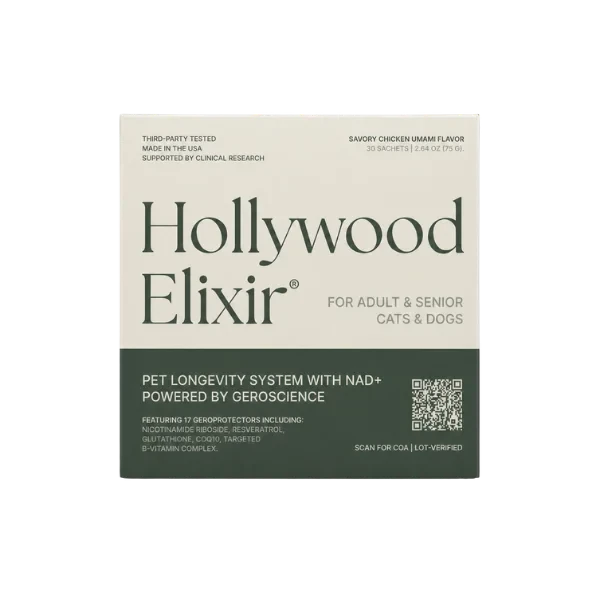
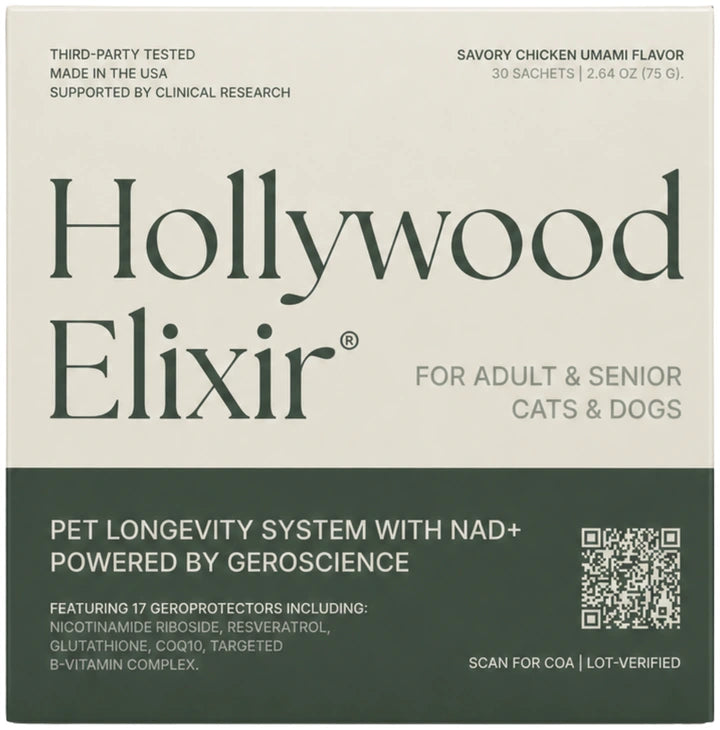
Hollywood Elixir is fed, not diffused. It's a daily nutrition powder for adult and senior dogs. Each sachet lists 17 actives with their amounts, including 25 mg of reishi mushroom, a mushroom often grouped with the adaptogens, and 1 mg of vitamin B6. Our guides to reishi mushroom for dogs and vitamin B6 for dogs explain what each one does.
The powder is stirred into food once a day: half a sachet for a dog under 7 lb, one sachet from 7 to 30 lb and two sachets above 30 lb. Hollywood Elixir is a supplement. Nobody has tested it for anxiety, travel stress or lifespan.
For daily nutrition in an aging dog, start with our guide to NAD+ for dogs or our roundup of the best all-in-one supplements for dogs. See the full Hollywood Elixir formula and serving guide.
In a home with both pets, set the rules by the cat.
Educational content only. This material is not a substitute for veterinary advice. Always consult your veterinarian about your dog’s specific needs. These statements have not been evaluated by the Food and Drug Administration. Products mentioned are not intended to diagnose, treat, cure, or prevent any disease.
Glossary
Essential oil: The concentrated, scented oil taken from a plant. Lavender oil is one example.
Linalool: One of the two main compounds in lavender oil, along with linalyl acetate.
Diffuser: A device that spreads scent into the air. Ultrasonic and nebulizing types also release tiny oil droplets.
Dog-appeasing pheromone: A synthetic copy of a scent that nursing mother dogs give off.
Motion sickness: Nausea, drooling and vomiting set off by movement, starting in the inner ear.
Glucuronidation: A liver process that helps clear plant compounds from the body. Cats have a low capacity for it.
Related Reading
Aging & Senior Dog Guidance
• Dog Age Calculator
• Dog Lifespan by Breed
• Dog Dementia
• Lethargy in Dogs
• My Dog Won't Eat
• Dog Pacing At Night
• Dog Licking Paws
• Can Dogs Dehydrate
Healthy Aging Support
• NAD+ for Dogs
• NMN for Dogs
• Antioxidants Supplements for Dogs
• Best Senior Dog Supplements & Vitamins
• Dog Longevity Drugs
• Rapamycin for Dogs
References
Numbered references identify the sources used for specific claims. Read the study design, species and evidence boundaries alongside each finding.
- [1]
- [2]
- [3]
- [4]
- [5]
- [6]
- [7]
- [8]
- [9]
- [10]
- [11]
- [12]
- [13]
- [14]
- [15]
- [16]
- [17]
- [18]
- [19]
FAQ
Is lavender oil safe for dogs to smell?
A light lavender scent is the lowest-risk form. The ASPCA's poison-control center says a diffuser run for a short time, in an area a pet can't get into, is not likely to be an issue. Skip it for a dog with breathing problems.
Can I put lavender oil on my dog's bedding?
We found no tested recipe for that. Later researchers describe the car study as using a lavender-scented cloth in the car. Oil on bedding can end up on the coat and tongue, so keep the scent in the air.
Does lavender repel fleas and ticks on dogs?
Not in any dog trial we found. Essential-oil flea products also have a poor safety record: in a poison-control review of 48 pets, 92% had adverse effects, and lethargy and vomiting were common in dogs. Ask your vet for a tested flea and tick product.
Can lavender help a dog with separation anxiety?
We found no study that tested lavender for separation anxiety. The dog research covers car rides, shelters and a strange room. A dog that panics when left alone needs a vet or a behavior specialist.
Is lavender shampoo safe for dogs?
We found no study of lavender shampoo in dogs. Pet Poison Helpline notes that tea tree poisonings come from concentrated oil, not from the very low levels in dog shampoos. Choose a shampoo made for dogs, rinse well, and stop if the skin turns red.
How long does lavender's calming effect last in dogs?
In the shelter study, the lower panting and vocalizing tended to carry through the four hours after each session, and the difference in vocalizing lasted into the night. The dog studies ran for days, not months.
Does lavender work for anxiety in people?
In people, a 2019 review pooled 37 trials and found that inhaled lavender lowered anxiety scores. The U.S. National Center for Complementary and Integrative Health still calls the benefits of lavender aromatherapy unclear and asks for better studies.
Is lavender safe for puppies?
We found no lavender study in puppies. Keep plants, sachets and oil bottles out of a puppy's reach, and ask your vet before using any scented product around a young dog.
Does Hollywood Elixir contain lavender?
No. Hollywood Elixir has no lavender and isn't a calming product. It's a daily nutrition powder with 17 actives, including reishi mushroom and vitamin B6.
Discover LPL-01: How This Fits Into a Larger Canine Longevity System
Aging in dogs is not driven by a single pathway. It’s the result of interacting biological systems—energy metabolism, oxidative stress, immune signaling, and structural integrity—changing over time.
This article explores one piece of that puzzle. If you want to understand how these pieces connect—and what actually moves the needle—you need to zoom out.
Start with the underlying science:
- Canine Geroscience Framework →
A structured view of how aging progresses across cellular energy, inflammation, and resilience systems. - Senior Biological Defense Coverage (BDC) Modeling →
A systems-level map of which biological pathways decline first, and how layered interventions can support them. - 2026 Market Research: Best Dog Longevity Supplements →
A 2026 industry report and review of leading senior-dog and cellular-aging formulas. - LPL-01 Standard →
The formulation system that translates these models into real-world supplementation—covering multiple pathways in a coordinated way.
Keep exploring
What would you like to understand next?
Search practical guides about healthy aging, cellular energy, ingredients, and daily support for dogs.
Hollywood Elixir®Senior Dog SupplementSenior dog energy, mobility & cognitionFrom$50/moSave up to 47%Save up to 44%Shop Now
Limited time offerEnds Nov 30
Hollywood Elixir®Senior Dog SupplementSenior dog energy, mobility & cognitionFrom$50/moSave up to 47%Save up to 44%Shop Now
Essential Summary
What should dog owners know about lavender?
Lavender scent in the air is the form with the most dog research: 32 dogs rested more on car rides, and shelter dogs panted and vocalized less.
The plant is on the ASPCA's toxic list, and full-strength oil on the coat or in the mouth can cause vomiting, wobbliness and dullness.
Keep the oil off your dog, keep diffusers short and out of reach, and see your vet for car sickness or lasting anxiety.
“The most impressive results in our real-world testing.”
Jessica Kim, Dogster. Three months with her 16-year-old Dalmatian mix, now “once again bouncing around like her 7-year-old self.”

Hollywood Elixir® Senior Dog Supplement
17 science-backed actives in every sachet
Supports senior energy, mobility & cognition
60-day first-box guarantee
Hollywood Elixir is amazing! She put back on 5 lbs to a healthy weight, her eyes are shiny, her coat is beautiful!
— Jessie
We go on runs. Lately he's been keeping up with no problem!
— Cami
Caring for an older dog day to day?
Daily nutrition, nothing to diffuse.
Hollywood Elixir gives adult and senior dogs 17 actives in a sachet you stir into food, including 25 mg of reishi mushroom and 1 mg of vitamin B6, with every amount printed. It contains no lavender.

Hollywood Elixir® Senior Dog Supplement
17 science-backed actives in every sachet
Supports senior energy, mobility & cognition
60-day first-box guarantee
Learn about how our DVMs think about dog aging
Dr. JoAnna Pendergrass DVM

Hollywood Elixir® Senior Dog Supplement
17 science-backed actives in every sachet
Supports senior energy, mobility & cognition
60-day first-box guarantee
Explore your dog’s changing needs over time
Related Reading
Lavender scent calmed dogs on car rides in a 32-dog study, but the plant and the oil can make dogs sick. See what's safe, the amounts studied and vet signs.