
The 12 Hallmarks of Aging in Dogs, Explained
Read full insightPanax Ginseng for Cats
By La Petite Labs Editorial 11 min read
As Seen On

17 science-backed actives
Contents +
We found no published trial of Panax ginseng in cats, so nobody can say whether it helps a cat or how much is safe. The best-known pet study was done in older dogs, with a ginseng and yeast tablet.4 For cats there are two European safety reviews. One could not confirm that a ginseng extract was safe, and the other judged a weak tincture safe as a food flavoring.1, 2 A tired or restless older cat needs a diagnosis first.
This guide covers what those reviews said, how cats differ from dogs, the overdose signs and what to check before you reach for a stimulant herb.
- What it is: Panax ginseng is the root of an Asian plant, sold as an adaptogen for energy and stress. Its marker compounds are ginsenosides.8
- Cat evidence: We found no feeding trial in cats. The only pet aging trial was in dogs.4
- Regulators: A European panel could not conclude that a ginseng dry extract was safe for cats. It later judged a weak tincture safe as a flavoring, at 162 mg per kg of feed.1, 2
- Overdose: Very large amounts can cause agitation, a fast heart rate, high blood pressure and gut upset.6
- Watch for: Thyroid disease. An older cat that turns restless and hungry while losing weight may be ill, not energized.7
- Amount: None is established for cats. Dog and human amounts don't transfer, and any plan needs your vet's agreement first.
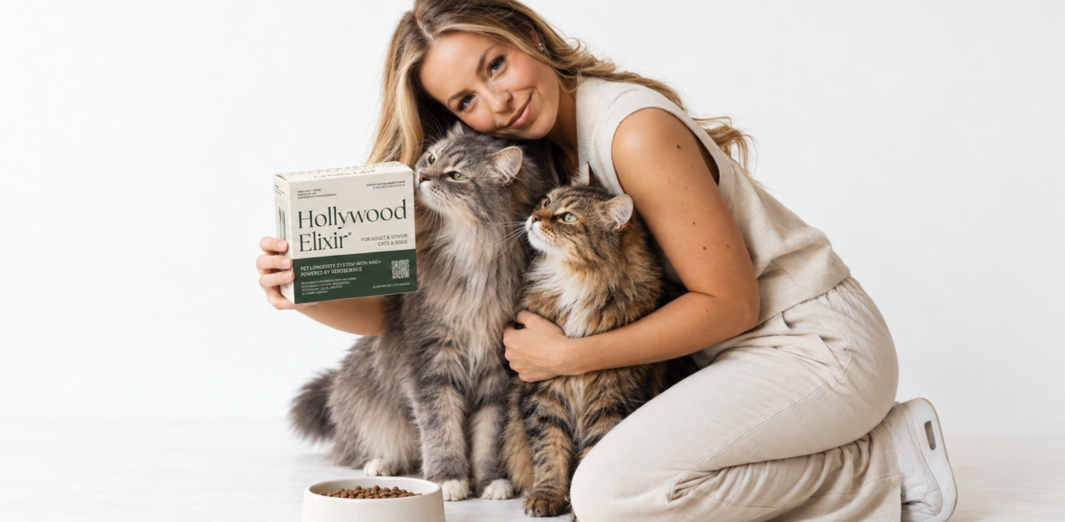
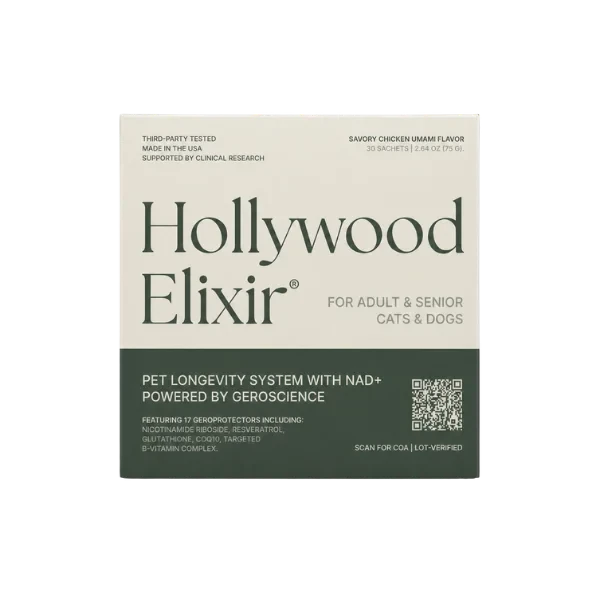
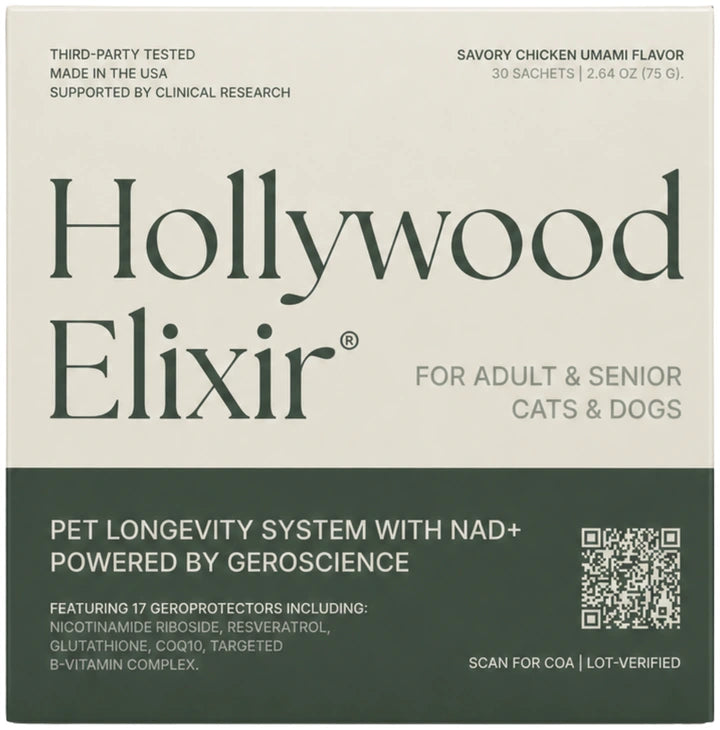
- In Hollywood Elixir: No. Hollywood Elixir has no Panax ginseng. It's daily nutrition for adult and senior cats.
What is Panax ginseng, and what is it sold for?
Panax ginseng is the root of a plant from Korea, northeastern China and far-eastern Siberia.8 Shops sell it as Asian ginseng, Korean ginseng, red ginseng or white ginseng, and all four names point to one species. Red and white describe two ways of preparing the root.8
Its best-known compounds are the ginsenosides, a large family of saponins.3 Ginseng is marketed as an adaptogen, meaning a herb thought to help the body resist stress. For people it is promoted for fatigue, thinking, stress and aging, among other uses.8 The results there are modest: a pooled analysis of 15 trials found a small gain in memory and no effect on overall thinking or attention.16
Cat products repeat those promises, usually for seniors. Two facts belong at the start. Most human trials have been small and short, with fewer than 200 people and less than 3 months of follow-up.8 And the cat trials do not exist yet, as far as we could find.
Our hub on adaptogens for cats covers the wider group of herbs and mushrooms sold under that label.
Can cats have Panax ginseng?
Cats can meet Panax ginseng in tiny amounts as a food flavoring, and beyond that level its safety is unknown. A European safety panel judged a ginseng tincture safe for cats at flavoring level in 2024.2 Three years earlier the same panel could not confirm the safety of a stronger dry extract.1
We found no study that followed cats on a ginseng supplement, so there is no proof of benefit and no tested amount. A healthy cat on a complete diet has no need for it.
If a product is already in your cupboard, show the label to your vet before the first serving.
Is there any research on Panax ginseng in cats?
Panax ginseng has no trial in living cats that we could find. A search of the medical literature turns up three kinds of paper.
- Cell work: Korean red ginseng extract lowered levels of feline calicivirus in cat kidney cells grown in a dish. The virus stood in for human norovirus, and the extract worked only when cells were treated before infection.9
- Safety reviews: two European opinions on ginseng as a flavoring in cat food.1, 2
- A review article: a 2024 paper on ginseng in pet diets. It cites dog studies and calls for trials in both species.3
A dish of cells says nothing about a sick cat.
What did European regulators decide about ginseng for cats?
European regulators have assessed Panax ginseng for cats twice, as a feed flavoring, and reached two different answers.
- 2021, dry extract: specified at 27 to 30% ginsenosides, for use at up to 20 mg per kg of complete feed. Up to 73% of the extract was never identified, and the maker supplied no tolerance or toxicology studies. The panel could not conclude that it was safe for cats and dogs.1
- 2024, tincture: a weak alcohol and water extract with 0.01 to 0.5% of two marker ginsenosides. The panel judged it safe for cats at up to 162 mg per kg of complete feed.2
Both opinions concern flavor. Neither assessed ginseng as a health supplement.
Does the senior dog trial tell us anything about cats?
The senior dog trial of Panax ginseng tells us little about cats. In that study 41 geriatric dogs received ginseng with brewers' yeast and 39 received yeast only, over 8 weeks. Owners rated four of seven mental measures better in the ginseng group, and no side effects appeared.4
Three things block the jump to cats. No cats were enrolled. The tablet was a blend, and the comparison group was not a true placebo.4 And cats clear some foreign compounds less well than most mammals do.5
Our guide to Panax ginseng for dogs goes through the trial in detail.
A dish of cells says nothing about a sick cat.
Is Panax ginseng safe for cats?
Panax ginseng has no safety study in cats, so above flavoring level nobody knows.
Here is what the record holds:
- Flavoring level: a tincture was judged safe for cats at up to 162 mg per kg of complete feed. The applicant proposed 0.01 mL per cat per day.2
- Stronger extracts: the one dry extract put forward for cats could not be confirmed as safe, because most of it was never characterized.1
- Another species: beagles showed no toxic effects on a standardized extract at up to 15 mg per kg of body weight a day for 90 days.1 Those were dogs.
The missing pieces are a tolerance study in cats, any record of long-term use, and any data in cats with kidney, heart or thyroid disease. A 2024 review says studies are still needed to identify safe amounts of specific ginseng products in dogs and cats.3
In people, use for up to 6 months appears safe for most people, and questions remain about longer use. Uncommon reports include severe rash, liver damage and severe allergic reactions.8
What are the side effects of ginseng in cats?
Panax ginseng side effects have never been recorded in a cat study, because there are no cat studies. The human list is the best guide available.
Trouble sleeping is the most common complaint in people, and headache and stomach upset are reported too.8, 13 Ginseng may also interfere with blood clotting and might lower blood sugar.8
In a cat, watch for restlessness, crying at night, a racing heart, vomiting, loose stools or a skipped meal. Stop the product and phone your vet if you see any of them. A cat that stops eating needs attention quickly, whatever the cause.
What if a cat eats too much ginseng?
Too much ginseng can overstimulate a cat. According to the Merck Veterinary Manual, some animals that swallow very large amounts develop agitation, restlessness, a fast heart rate, high blood pressure and stomach or bowel signs.6 The signs are generally self-limiting, and treatment can begin with emptying the stomach soon after the ingestion.6 Leave that step to a clinic.
A capsule made for an adult person is a lot of ginseng for a cat, and human supplements are often blends. Guarana, a natural source of caffeine, and 5-HTP are two blend ingredients that can poison pets.6
Keep the package, note the time and call your vet.
How much Panax ginseng can a cat have?
No amount of Panax ginseng is established for cats, and no trial offers one. The single reference point is the flavoring level.
- Flavoring level: up to 162 mg of ginseng tincture per kg of complete feed. That tincture held no more than 0.5% of its two marker ginsenosides.2
- Dog trial: tablets with 40 mg of ginseng extract, giving 1.58 to 4.44 mg per kg of body weight a day.3 Those were dogs, on a different product.
A supplement capsule is a far stronger thing than a flavoring. Dog and human amounts shouldn't be cut down by weight for a cat. If your vet supports a trial, agree on the product, the amount and a stop date in advance.
Why would a cat handle ginseng differently?
Ginseng takes a long road through the body, and the cat's version of that road has a known narrow point.
Ginsenosides are poorly absorbed. In rats, less than 1% of a swallowed serving of ginsenoside Rb1 reached the blood.2 Gut bacteria strip the sugars off most ginsenosides, and the smaller compounds left behind are thought to do part of the work.15 We found no study that mapped any of this in cats.
Then comes clearance. The liver tags many foreign compounds with glucuronic acid so they can leave the body. Cats have a significantly lower capacity than most mammals to do this for phenolic compounds, and the gene UGT1A6 no longer works in the cat.5 The researchers who showed this tie it to the cat's highly carnivorous diet and its minimal contact with plant defenses.5
European regulators build this in. For cats they generally want a safety margin five times wider than usual, and their ginseng opinion notes that glucuronide conjugation is limited in cats.2
Whether that slows the clearance of ginseng compounds in a real cat is an inference. We found no measurement of ginsenosides in cat blood. A cat is not a small dog, and ginseng amounts can't be borrowed across species.
A tired older cat needs a cause before it needs Panax ginseng.
DVM Voice: Clinical Vignette of a Common Pattern in Senior Cat Aging
Case provided by JoAnna Pendergrass, DVM
Sasha, a 12-year-old cat, was brought in after her owner noticed increased thirst and urination, lethargy, vomiting, and a generally unkempt appearance. Examination showed weight loss, elevated blood pressure, and reduced vitality.
Diagnostic testing revealed elevated kidney markers, poorly concentrated urine, and protein loss in the urine — findings consistent with chronic kidney disease, one of the most common chronic conditions in senior cats.
Her care required a kidney-focused diet, blood pressure management, targeted supplementation, medication support, and regular monitoring — a necessary plan, but one started after clinical signs were already visible.
Clinical takeaway: Sasha’s case reflects why senior-cat wellness should begin before obvious decline. Earlier monitoring, body-condition tracking, hydration awareness, antioxidant support, and daily cellular resilience may help support quality of life as cats age.
Single-case vignette. Not generalizable. Veterinary diagnosis and monitoring are essential for increased thirst, urination, vomiting, lethargy, weight loss, or suspected kidney disease.
Which cats should not have Panax ginseng?
Panax ginseng is a poor choice for several groups of cats. Speak to your vet first if your cat:
- has thyroid disease, heart disease or high blood pressure, since very large amounts of ginseng can raise heart rate and blood pressure;6, 7
- has diabetes, because ginseng might lower blood sugar;8
- takes a blood thinner or faces surgery, as ginseng is one of four common herbs with anti-clotting effects;14
- is pregnant or nursing;8
- is a kitten, since nothing has been tested in young cats.
Cats on insulin deserve extra care, and their vet should hear about any supplement first.
Is a more energetic older cat a healthier cat?
A sudden burst of energy in an older cat is a reason for a blood test, not for more ginseng. Hyperthyroidism is common in middle-aged and older cats. Its most frequent signs are weight loss, a bigger appetite and more thirst and urination, and it can also cause hyperactivity, vomiting and diarrhea.7
Some cats with the condition go on to develop heart disease and high blood pressure.7 A stimulant herb is the wrong tool for a cat whose heart is already working too hard.
Our guide to methimazole for cats covers a prescription treatment for the condition.
What should you rule out before giving a tired cat ginseng?
A tired older cat needs a cause before it needs Panax ginseng. One study suggests that 28% of pet cats aged 11 to 14 years develop at least one age-related behavior problem, and the figure passes 50% in cats of 15 years or older.10
Those changes can come from body-wide illness, brain disease or true behavior problems, and the authors urge a full search for treatable medical conditions.10
Start with a vet exam and senior bloodwork. Our guide to low energy in older cats goes through what to look for at home.
How do you choose a ginseng product for a cat?
The safest ginseng product for a cat is usually none. If your vet does back a trial, the label has to carry the weight.
Ginseng labels have a poor record. In a test of 25 store-bought ginseng products, marker compound levels differed from what the labels claimed, and the ginsenoside content of liquids varied 36-fold between products.12 A label that says only ginseng tells you neither the plant nor the strength.
Ask these questions of any product:
- Does it name Panax ginseng and the part used?
- Does it state the ginsenoside content in milligrams per serving?
- Is it made for cats, with a feeding guide?
- Is ginseng the only active, or one of many?
- Is it free of caffeine sources such as guarana?6
The fourth question matters because blends have the worse safety record. A review of ginseng side effects found serious events more often with combination products than with ginseng-only ones.13
We hold our own powder to the same rule. Hollywood Elixir lists an amount for each of its 17 actives, and ginseng is not among them.
Is Panax ginseng different for cats and dogs?
Panax ginseng has a thin record in dogs and almost none in cats.
- Trials: dogs have an 8-week senior trial of 80 animals and several short feeding studies.4, 3 We found no feeding trial in cats.
- Flavoring level judged safe: 162 mg of tincture per kg of complete feed for cats, against 228.7 mg for dogs.2
- Daily tincture: the applicant proposed 0.01 mL per cat and 0.06 mL per dog.2
- Liver handling: glucuronide conjugation is limited in cats, which is why regulators usually want a wider safety margin for them.2, 5
A household with both species should keep ginseng products apart. What suits the dog, in amount and in form, has not been tested in the cat.
When does a slowing cat need the vet, not a supplement?
Panax ginseng can wait until a vet has seen any cat with these changes:
- weight loss, with or without a bigger appetite;
- more drinking and more urine in the litter box;
- crying at night or seeming lost in the house;
- less grooming, or a coat that looks unkempt, matted or greasy;
- hiding, sleeping far more, or no longer jumping up.
Several of these fit thyroid disease, and others fit age-related brain changes.7, 11 All of them deserve an exam before a supplement.
What works better than ginseng for an older cat?
Several steps have more behind them than Panax ginseng for an aging cat. A veterinary review of cognitive dysfunction in cats lists these options, once other causes have been ruled out.11
- Home changes: easy access to food, water, litter and resting places.
- Diets: foods with antioxidants or medium-chain triglycerides.
- Supplements: products studied in older cats, such as SAMe.
- Medication: potentially selegiline or propentofylline, through your vet.
Our guides to feline cognitive dysfunction and the best supplements for senior cats go deeper.
Is Panax ginseng in Hollywood Elixir?
No. Hollywood Elixir contains no Panax ginseng and no ginsenosides, and it isn't an energy booster.
Ginseng is an adaptogen once studied in senior dogs, and never in cats. The adaptogenic ingredient in our formula is reishi mushroom, at 25 mg per sachet. The label also shows 40 mg of CoQ10 and 60 mg of nicotinamide riboside, an NAD+ precursor, with 14 other actives. Every one of the 17 amounts is printed.
Hollywood Elixir is a daily nutrition supplement for adult and senior cats, a powder you mix into food. Cats under 7 lb get half a sachet, and cats from 7 to 30 lb get one. It hasn't been tested for energy, alertness, thyroid disease or lifespan, and it is no stand-in for a diagnosis.
Our guides to reishi for cats and CoQ10 for cats explain what those two ingredients are. See the Hollywood Elixir label and serving guide.
A supplement capsule is a far stronger thing than a flavoring.
Educational content only. This material is not a substitute for veterinary advice. Always consult your veterinarian about your cat’s specific needs. These statements have not been evaluated by the Food and Drug Administration. Products mentioned are not intended to diagnose, treat, cure, or prevent any disease.
Glossary
Panax ginseng: An Asian plant whose root is used in supplements, also sold as Asian, Korean or red ginseng.
Ginsenosides: The family of plant compounds used to measure the strength of a ginseng product.
Adaptogen: A loose label for herbs and mushrooms thought to help the body resist stress. It is not a medical category.
Glucuronidation: A liver process that tags compounds for removal from the body. Cats have a low capacity for it with some plant chemicals.
Tincture: A liquid extract made with alcohol and water.
Hyperthyroidism: An overactive thyroid gland, common in middle-aged and older cats.
Related Reading
Aging & Senior Cat Guidance
• Cat Age Calculator: Cat Years to Human Years
• Cat Lifespan by Breed
• Lethargy in Cats
• Senior Cat Not Eating
• Cat Drinking A Lot
• Why Is My Senior Cat Withdrawn?
Healthy Aging Support
• NAD+ for Cats
• NMN for Cats
• Vitamins For Older Cats
• Senior Cat Food
• Longevity Drugs for Cats
References
Numbered references identify the sources used for specific claims. Read the study design, species and evidence boundaries alongside each finding.
- [1]
- [2]
- [3]
- [4]
- [5]
- [6]
- [7]
- [8]
- [9]
- [10]
- [11]
- [12]
- [13]
- [14]
- [15]
- [16]
FAQ
Is ginseng toxic to cats?
We found no poisoning study in cats. The Merck Veterinary Manual reports agitation, restlessness, a fast heart rate, high blood pressure and gut signs in some animals after very large amounts of ginseng. Treat any raid on a supplement bottle as a reason to call your vet.
Can I give my cat my own ginseng capsule?
No. A human capsule is sized for an adult person, ginseng labels can be inaccurate, and blends may contain caffeine sources that poison pets. No human amount of ginseng has been tested in cats, as far as we found.
Does Hollywood Elixir contain Panax ginseng?
No. Hollywood Elixir has no ginseng in any form. Its 17 actives include 25 mg of reishi mushroom and 40 mg of CoQ10 per sachet, and it isn't a stimulant.
Does ginseng help cats with kidney disease?
We found no study of ginseng in cats with kidney disease, and no safety data for cats whose kidneys are failing. Ask the vet who manages your cat's kidneys before adding any herb.
Is Siberian ginseng the same as Panax ginseng for cats?
No. Siberian ginseng is a different plant, eleuthero, with its own marker compounds called eleutherosides. Results for one plant don't carry over to the other.
Can ginseng help an old cat's memory or confusion?
There is no cat evidence. In people, a pooled analysis of 15 ginseng trials found a small gain in memory and no effect on overall thinking, attention or planning. A confused older cat needs a vet exam, because other illnesses can cause the same changes.
Is ginseng in cat food safe?
At flavoring level, a European panel judged a ginseng tincture safe for cats at up to 162 mg per kg of complete feed. That opinion covers taste only. Supplements are a different and stronger kind of product.
How long can a cat stay on ginseng?
Nobody has tested any length of use in cats, as far as we found. In people, health authorities describe up to 6 months of ginseng as apparently safe and say questions remain about longer use. Involve your vet before you start.
Can kittens have Panax ginseng?
We found no study of Panax ginseng in kittens, and human guidance includes advice against it for infants and children. There is no reason to give a stimulant herb to a growing kitten.
Does red ginseng work differently from white ginseng in cats?
Nobody has compared them in cats. Red ginseng is steamed before drying, and the cell work with cat kidney cells used Korean red ginseng. That is laboratory work, not proof in a living cat.
Discover LPL-01: How This Fits Into a Larger Feline Longevity System
Aging in cats unfolds quietly. It’s not driven by a single failure, but by gradual shifts across interconnected systems — cellular energy, oxidative balance, immune tone, and tissue integrity — each influencing the others over time.
This article explores one layer of that system. To understand what actually shapes long-term health, you need to step back and look at how these layers interact.
Start with the underlying science:
- Feline Geroscience Framework →
A structured view of how aging progresses across cellular energy, inflammation, and resilience systems. - Senior Biological Defense Coverage (BDC) Modeling →
A systems-level map of which biological pathways decline first, and how layered interventions can support them. - 2026 Market Research: Best Cat Longevity Supplements →
A feline-specific review of longevity supplements. 2026 Industry report created by LPL-01 Research. - LPL-01 Standard →
The formulation system that translates these models into real-world supplementation—covering multiple pathways in a coordinated way.
Keep exploring
What would you like to understand next?
Search practical guides about healthy aging, cellular energy, ingredients, and daily support for cats.
Hollywood Elixir®Senior Cat SupplementSenior cat energy, mobility & cognitionFrom$50/moSave up to 47%Save up to 44%Shop Now
Limited time offerEnds Nov 30
Hollywood Elixir®Senior Cat SupplementSenior cat energy, mobility & cognitionFrom$50/moSave up to 47%Save up to 44%Shop Now
Essential Summary
What should cat owners know about Panax ginseng?
We found no published trial of Panax ginseng in cats. The only pet aging trial was done in dogs, with a ginseng and yeast blend.
A European safety panel judged a weak ginseng tincture safe as a flavoring for cats and could not confirm the safety of a stronger dry extract.
A restless, hungry older cat that is losing weight may have thyroid disease. Get a diagnosis before trying any stimulant herb.

Hollywood Elixir® Senior Cat Supplement
17 science-backed actives in every sachet
Supports senior energy, mobility & cognition
60-day first-box guarantee
Hollywood Elixir is amazing! She put back on 5 lbs to a healthy weight, her eyes are shiny, her coat is beautiful!
— Jessie
She hopped up onto the windowsill again for the first time in years.
— Charlie
Caring for an older cat day to day?
Seventeen printed amounts, none of them ginseng.
Hollywood Elixir gives adult and senior cats 25 mg of reishi mushroom, 40 mg of CoQ10 and 15 more actives in each sachet. It is daily nutrition, not a stimulant.

Hollywood Elixir® Senior Cat Supplement
17 science-backed actives in every sachet
Supports senior energy, mobility & cognition
60-day first-box guarantee
Learn about how our DVMs think about cat aging
Dr. JoAnna Pendergrass DVM

Hollywood Elixir® Senior Cat Supplement
17 science-backed actives in every sachet
Supports senior energy, mobility & cognition
60-day first-box guarantee
Explore your cat’s changing needs over time
Related Reading
We found no published trial of Panax ginseng in cats. See what 2 European safety reviews concluded, the overdose signs, and what to check in a tired cat.