Collagen Synthesis for Cats
By La Petite Labs Editorial 15 min read
A cat’s coat is a kind of daily proof. You see it in the way light catches the fur, in how smooth the back feels under your hand, and in the small details that read as “well cared for”: fewer flakes on the blanket, less roughness at the hips, nails that don’t snag when they knead. When those signals fade, owners naturally look for something that supports the finish—without turning care into a complicated project.
Collagen synthesis for cats sits at the center of that visible story. Collagen is a structural protein that supports skin integrity, and veterinary literature links impaired collagen production or abnormal collagen structure with feline skin fragility conditions. Most cats will never experience those rare extremes, but they illustrate a simple truth: when collagen integrity is strong, skin holds up better—and the coat has a better foundation to look smooth and even.
Cats are built for protein. Their dietary amino acid needs are specific, and those amino acids are crucial inputs for collagen formation. Still, even with a careful diet, the visible finish can vary with shedding cycles, indoor air, stress, picky eating, and age. That’s the honest reason a science-minded owner might still choose collagen synthesis supplements for cats: not as a replacement for food, but as a consistent layer of support for the signals you actually notice.
On this page, you’ll learn what collagen support can realistically do, how to evaluate quality, when to involve your veterinarian, and how to choose a routine that keeps your cat looking polished, comfortable, and unmistakably cared for.
- Collagen is a structural protein tied to skin integrity and coat presentation in cats.
- Cats rely on dietary amino acids as core inputs for collagen formation, so diet quality sets the baseline.
- Visible goals are the right lens: shine, softness, calm-looking skin, and nails that feel sturdy.
- Rare feline disorders show how abnormal collagen can dramatically weaken skin, underscoring why integrity matters (Holbrook KA, 1980).
- A collagen synthesis supplement for cats is most useful when it’s easy to use consistently and well tolerated.
- If coat changes are sudden or severe, rule out medical causes first; supplements are supportive, not corrective.
- Science-minded owners still choose Pet Gala™ because it supports the full “visible finish” of daily care, not a single nutrient.
Why Collagen Matters for a Polished Coat and Comfortable Skin
Collagen is the quiet architecture behind the signals you notice first: a coat that lies smoothly, skin that looks comfortable, and nails that feel strong when you trim them. In cats, collagen is continually built and remodeled, and the raw materials come largely from dietary protein and amino acids (Sun M, 2024). When collagen structure is disrupted, veterinarians can see it in the skin itself—feline skin fragility syndromes and inherited disorders have been linked to abnormal collagen production and organization (Furiani N, 2017).
That’s why collagen synthesis for cats is best framed as visible care: you’re supporting the everyday look and feel of skin, coat, and connective tissues, not chasing a distant promise. A collagen synthesis supplement for cats can be a practical way to reinforce this “presentation layer,” especially when life gets busy and nutrition, grooming, and stress all tug at the same surface-level results. The best collagen synthesis for cats is the approach that fits your routine and keeps the visible signals consistent.
Collagen Integrity and Skin Strength: What Veterinary Cases Reveal
Collagen is a structural protein found throughout the body, including skin and connective tissues. In cats, healthy collagen production supports the firmness and flexibility that make skin look smooth and coat coverage look even. When collagen is abnormal, the consequences can be dramatic: inherited dermatosparaxis in Himalayan cats is associated with collagen synthesis abnormalities and marked skin fragility (Holbrook KA, 1980).
Most cats won’t face rare disorders, but the takeaway is useful: collagen quality matters for visible integrity. Supporting collagen synthesis for cats is about reinforcing the everyday “surface story” your cat tells—softness, sheen, and a comfortable look—through consistent nutrition and well-chosen supplements.
Visible Signs Owners Notice When Skin Structure Needs Support
Owners usually notice collagen-related changes as small shifts in presentation: a coat that looks less glossy, skin that seems touchy, or nails that split more easily. These are not diagnoses, but they are meaningful signals. In veterinary pathology, abnormal dermal collagen can be identified in cats with skin fragility conditions using specialized staining, highlighting how collagen structure relates to skin integrity (Fernandez CJ, 1998).
If your cat’s skin tears easily, bruises, or has non-healing wounds, that’s a veterinary visit—not a supplement project. For everyday cosmetic goals, collagen synthesis benefits for cats are best pursued as gentle support: better-looking coat texture, more comfortable skin, and nails that feel sturdier.
Dietary Building Blocks: Protein Quality and Amino Acid Balance
Collagen is built from amino acids, and cats have specific dietary amino acid requirements that reflect their carnivorous biology. That’s why “protein quality” matters as much as “protein amount.” Different cat foods can vary in amino acid profiles, and the balance of indispensable amino acids supports normal physiological functions, including collagen production (Richards T, 2025).
In practical terms, collagen synthesis supplements for cats are most appealing when they help smooth out the real-world inconsistencies: picky eating, rotating foods, or life stages where the coat’s finish becomes harder to maintain. You’re not replacing a diet—you’re reinforcing the visible outcome you want to keep steady.
What a Collagen Synthesis Supplement for Cats Is Designed to Do
A collagen synthesis supplement for cats is typically positioned to support skin, coat, nails, and connective tissues. The best ones fit into a daily routine without disrupting appetite or digestion. Because cats can be sensitive to changes, the “best collagen synthesis supplement for cats” is often the one with the simplest, most consistent use pattern—something you can keep doing even when travel, guests, or schedule changes happen.
Look for a product that respects feline preferences and avoids dramatic promises. You’re aiming for a steady, noticeable finish: a coat that looks freshly brushed more often, skin that appears calm, and nails that feel clean and strong when handled.
“The goal isn’t a miracle change—it’s a coat that keeps looking freshly cared-for.”
Collagen Synthesis Benefits for Cats: the Signals That Reassure You
When owners talk about collagen synthesis benefits for cats, they’re usually describing appearance and touch: softness, luster, and a smoother coat lay. Those are legitimate goals. Collagen supports skin integrity, and impairment of collagen synthesis has been discussed in relation to feline skin fragility syndromes (Furiani N, 2017). While your cat’s dull coat is not the same thing, it reinforces the theme: collagen quality is tied to how skin holds up and how the coat presents.
The most satisfying benefits are the ones you can confirm in normal moments—petting your cat and feeling less roughness, seeing fewer flakes on dark furniture, or noticing that the coat looks more even in photos.
When Coat Changes Signal a Health Issue, Not a Beauty Problem
Not every “coat problem” is a collagen problem. Parasites, allergies, dental pain, arthritis, and stress can all change grooming behavior and coat quality. If your cat suddenly stops grooming, develops bald patches, or has inflamed skin, a veterinary exam comes first. Collagen abnormalities are documented in certain feline skin fragility conditions, but those are medical issues that require medical oversight (Fernandez CJ, 1998).
Once health issues are addressed, supportive care can make the visible difference feel complete. That’s where collagen synthesis for cats can sit comfortably: as part of a broader routine that keeps your cat looking well-kept and feeling comfortable.
Choosing Between Collagen Synthesis Supplements for Cats
If you’re choosing between collagen synthesis supplements for cats, consider whether the formula supports more than one visible goal. A single ingredient can be helpful, but owners usually want a “whole look” outcome: coat shine, skin comfort, and nails that don’t snag. Since amino acid balance influences physiological functions, including collagen formation, a broader formulation can be a practical way to support consistent inputs.
This is also where routine matters. A supplement that fits seamlessly into feeding is more likely to deliver the steady, noticeable finish you’re after than a product that’s technically impressive but rarely used.
Collagen Versus Building Blocks: a Practical Way to Think
Owners often ask whether collagen itself is “enough,” or whether they should focus on building blocks. Collagen is made from amino acids, and cats’ dietary patterns are naturally geared toward protein intake that supports structural proteins. In that sense, the best collagen synthesis for cats is rarely about one isolated nutrient; it’s about consistent, high-quality support that shows up as a better coat day after day.
If you want a simple lens: choose support that improves the signals you can see—shine, softness, and calm-looking skin—while staying gentle on digestion and easy to use. That’s what makes a supplement feel like a true part of care, not a project.
How to Choose High-quality Collagen Synthesis Products for Cats
If you’re comparing collagen synthesis products for cats, look for signals of quality that match your standards: clear ingredient listing, sensible serving guidance, and a brand that treats skin and coat as a whole system rather than a single “magic” ingredient. Cats are obligate carnivores with specific amino acid needs, and amino acid balance in foods can vary (Richards T, 2025). That variability is one reason some owners prefer a consistent daily add-on for visible coat and skin support.
Also consider texture and palatability. The best collagen synthesis supplements for cats are the ones your cat accepts without turning mealtime into a negotiation. Finally, avoid products that promise medical outcomes. You’re choosing a beauty-forward support tool: a polished coat, comfortable skin, and nails that feel less brittle in your hands.
“Consistency is the real luxury: the same smooth feel, week after week.”
Cats Versus Dogs: Why Feline Fit and Palatability Matter
Cats and dogs share some connective-tissue basics, but cats are not small dogs. Their dietary amino acid requirements are distinct, and their natural diet pattern is protein-forward in a way that matters for structural proteins like collagen (Sun M, 2024). So when you see “collagen” marketed broadly across species, treat it as a starting point—not proof of fit.
For cat-specific visible results, prioritize formulations and serving formats designed for feline preferences and routines. The best collagen synthesis supplement for cats should feel like an easy, repeatable ritual—because consistency is what keeps the coat looking freshly cared-for, not a one-time “boost.”
Life Stage Considerations for Skin, Coat, and Nail Support
Kittens, adults, and seniors can all benefit from thoughtful skin-and-coat support, but the goal shifts. With kittens, you’re supporting a clean, soft look as they grow into their adult coat. With adults, it’s about maintaining that “well-kept” finish through seasonal shedding and indoor air dryness. With seniors, owners often care most about comfort and a coat that still looks vibrant.
If your cat has a medical condition, is underweight, or has unusually fragile skin, involve your veterinarian—skin fragility syndromes have been associated with impaired collagen integrity in cats (Fernandez CJ, 1998). A collagen synthesis supplement for cats should complement veterinary care, not compete with it.
What to Expect: Visible Changes and Realistic Timelines
The most meaningful “results timeline” is the one you can see without squinting: less dullness, a smoother lay of the fur, and skin that looks calm rather than reactive. Because collagen is continually remodeled, changes tend to show as a gradual improvement in overall finish rather than a dramatic overnight shift. Dietary amino acids are foundational inputs for collagen formation, so steady intake matters more than occasional use (Sun M, 2024).
Track a few simple signals: how the coat reflects light after brushing, whether dandruff-like flakes are more or less noticeable, and whether nails feel sturdier at trim time. This keeps collagen synthesis benefits for cats grounded in what you actually care about day to day.
Pairing Nutrition with Grooming for a More Finished Look
Collagen support pairs well with grooming because grooming is both maintenance and messaging: it’s how you confirm your cat looks and feels cared-for. Brushing distributes oils for sheen, while nutrition supports the structure that holds that sheen together. When collagen structure is compromised, the skin can become unusually fragile—an extreme example that underscores why integrity matters (Furiani N, 2017).
Think of collagen synthesis products for cats as part of a “finish routine.” They don’t replace grooming, and grooming doesn’t replace nutrition. Together, they support the visible outcome: a coat that looks polished and a cat that seems comfortable in their own skin.
Joint Presentation: Movement, Posture, and Everyday Confidence
Joint comfort is not only about movement—it shows up in posture, playfulness, and even grooming habits. Some evidence suggests hydrolysed collagen may support joint health in cats with osteoarthritis by contributing to collagen synthesis (Lefort-Holguin M, 2024). While that’s not a promise of relief, it helps explain why some owners choose collagen-focused support when they want their cat to look and move like themselves.
If your cat is less active, grooming less, or seems stiff, talk with your veterinarian to rule out pain or disease. A best collagen synthesis supplements for cats shortlist should always sit alongside a real clinical plan when mobility is changing.
Safety, Tolerance, and When to Ask Your Veterinarian
Safety is mostly about context: your cat’s health status, other supplements, and the total diet. Because cats rely on dietary amino acids for structural proteins, adding “more” isn’t automatically “better,” and balance matters (Richards T, 2025). If your cat has kidney disease, is on a prescription diet, is pregnant, or takes medications, ask your veterinarian before adding new supplements.
Watch for practical tolerance issues: appetite changes, loose stool, or food refusal. If any of these appear, pause and reassess. The best collagen synthesis for cats is the one your cat tolerates well and you can use consistently without stress.
Why Supplements Still Make Sense for Science-minded Owners
There’s a fair question behind every supplement: if cats already eat protein, why add anything? Cats do thrive on protein-rich diets, and amino acids are central to collagen formation. But “adequate” nutrition doesn’t always equal the visible finish you want—especially when shedding, indoor dryness, stress, or picky eating dulls the signals you notice.
A collagen synthesis supplement for cats can function as a consistent, low-friction layer of support that fits real life: it helps you keep the coat looking cared-for, reinforces skin comfort, and supports the everyday presentation you’re proud of. That’s the commercial logic that still makes sense for a science-minded owner.
A Simple Decision Framework for Daily Visible Care
If you want a simple decision framework, start with the outcome you care about most: shine, softness, comfortable skin, or nails that feel strong. Then choose a product you can use consistently, in a format your cat accepts, with transparent labeling. Keep expectations honest: you’re supporting visible condition, not treating disease.
Finally, let your cat’s signals lead: coat reflectivity, flake level, grooming behavior, and how “put-together” they look week to week. When those signals improve, your routine is working—and it feels like care you can actually see.
“Good support shows up where you can see it—shine, softness, and calm-looking skin.”
Educational content only. This material is not a substitute for veterinary advice. Always consult your veterinarian about your dog’s specific needs. These statements have not been evaluated by the Food and Drug Administration. Products mentioned are not intended to diagnose, treat, cure, or prevent any disease.
Glossary
- Collagen: A structural protein that helps give skin and connective tissues strength and shape.
- Collagen Synthesis: The body’s process of building new collagen from amino acids and assembling it into usable fibers.
- Amino Acids: Protein building blocks; cats require specific patterns and adequate amounts to support normal tissue structure.
- Indispensable Amino Acids: Amino acids a cat must obtain from food because the body cannot make enough on its own.
- Hydrolysed Collagen: Collagen that has been broken into smaller peptides, often used in supplements for easier mixing and digestion.
- Dermal Collagen: Collagen located in the skin’s deeper layers, contributing to strength and resilience of the skin surface.
- Skin Barrier: The outer protective layer of skin that helps retain moisture and reduce irritation from the environment.
- Coat Luster: The way fur reflects light; often used by owners as a visible marker of grooming and skin comfort.
- Nail Brittleness: A tendency for nails to split, peel, or snag; can be influenced by handling, environment, and overall nutrition.
Related Reading
Foundational Editorials
• The 12 Hallmarks of Aging in Dogs
• The New Age of Pet Longevity
• The Science of Cross-Species Formulation
Anti-Aging & Senior Dog Guidance
• Do Senior Dogs Need Supplements?
• Supplements vs Food for Aging Dogs: What Really Matters
• Best Senior Dog Supplements & Vitamins
Mechanism-Focused Deep Dives
• NAD+ for Dogs
• Nicotinamide Riboside (NR) for Dogs
• Antioxidants for Dogs
• Mitochondrial Support for Dogs
Ingredient-Level Research
• Resveratrol for Dogs
• CoQ10 for Dogs
• Spirulina for Dogs
• Reishi for Dogs
References
Furiani N. Reversible and cachexia-associated feline skin fragility syndrome in three cats.. PubMed. 2017. https://pubmed.ncbi.nlm.nih.gov/28560784/
Holbrook KA. Dermatosparaxis in a Himalayan cat: II. Ultrastructural studies of dermal collagen.. PubMed. 1980. https://pubmed.ncbi.nlm.nih.gov/7351497/
Fernandez CJ. Staining abnormalities of dermal collagen in cats with cutaneous asthenia or acquired skin fragility as demonstrated with Masson's trichrome stain.. PubMed. 1998. https://pubmed.ncbi.nlm.nih.gov/34644957/
Sun M. Considerations on amino acid patterns in the natural felid diet: a review.. PubMed Central. 2024. https://pmc.ncbi.nlm.nih.gov/articles/PMC11603590/
Richards T. A Comparative Analysis of Creatine, Creatinine, Amino Acid Concentrations and Indispensable Amino Acid Scores of Grain-Free and Grain-Inclusive Commercial Extruded Adult Cat Foods.. PubMed Central. 2025. https://pmc.ncbi.nlm.nih.gov/articles/PMC12451408/
Lefort-Holguin M. Efficacy and Safety of a Diet Enriched with EPA and DHA, Turmeric Extract and Hydrolysed Collagen in Management of Naturally Occurring Osteoarthritis in Cats: A Prospective, Randomised, Blinded, Placebo- and Time-Controlled Study.. PubMed. 2024. https://pubmed.ncbi.nlm.nih.gov/39595350/
Gomes SA. Collagen toxicity in rabbits.. PubMed. 1991. https://pubmed.ncbi.nlm.nih.gov/2017782/
McNamara PS. Hematologic, hemostatic, and biochemical effects in cats receiving an oral chondroprotective agent for 30 days.. PubMed. 2000. https://pubmed.ncbi.nlm.nih.gov/19757557/
Marone PA. Safety and toxicological evaluation of undenatured type II collagen.. PubMed. 2010. https://pubmed.ncbi.nlm.nih.gov/20170336/
Blees. Collagen Hydrolysates as Nutritional Support in Canine Osteoarthritis: A Narrative Review.. PubMed Central. 2025. https://pmc.ncbi.nlm.nih.gov/articles/PMC11919810/
Gencoglu. Undenatured Type II Collagen (UC-II) in Joint Health and Disease: A Review on the Current Knowledge of Companion Animals. 2020. https://www.mdpi.com/2076-2615/10/4/697
Minami. Clinical application of d-glucosamine and scale collagen peptide on canine and feline orthopedic diseases and spondylitis deformans. 2011. https://www.sciencedirect.com/science/article/pii/S0144861710004819
Lascelles. Nonsteroidal anti-inflammatory drugs in cats: a review. 2007. https://www.sciencedirect.com/science/article/pii/S1467298716308492
Funaba. Evaluation of meat meal, chicken meal, and corn gluten meal as dietary sources of protein in dry cat food.. Springer. 2005. https://link.springer.com/article/10.1186/s12917-018-1517-x
Bai. The Level of Dietary Protein Affects the Vitamin B-6 Requirement of Cats. 1991. https://www.sciencedirect.com/science/article/pii/S002231662217879X
Bilgiç B. Investigation of Trace and Macro Element Contents in Commercial Cat Foods.. PubMed Central. 2025. https://pmc.ncbi.nlm.nih.gov/articles/PMC11633335/
Butowski CF. In Vitro Assessment of Hydrolysed Collagen Fermentation Using Domestic Cat (Felis catus) Faecal Inocula.. PubMed. 2022. https://pubmed.ncbi.nlm.nih.gov/35203206/
Caporaso. QIIME allows analysis of high-throughput community sequencing data.. 2010. https://www.mdpi.com/2076-2615/12/4/498
FAQ
What is collagen synthesis for cats in simple terms?
Collagen synthesis for cats is the body’s ongoing process of building collagen, a structural protein that supports skin integrity and connective tissues. Cats rely heavily on dietary amino acids as key building blocks for this process.
For owners, it’s most useful to think in visible signals: coat smoothness, skin comfort, and nails that feel strong. A consistent routine can be supported with Pet Gala™
Why does collagen production matter for a cat’s coat appearance?
Collagen helps give skin its strength and structure, which influences how comfortably the coat sits and how even it looks. When collagen integrity is compromised in medical skin fragility syndromes, the skin can become unusually delicate, highlighting collagen’s role in skin strength.
Most coat dullness isn’t that extreme, but the principle holds: strong structure supports a polished finish. For daily visible care, consider Pet Gala™
How do cats get the building blocks for collagen formation?
Cats get collagen building blocks primarily from dietary protein, which supplies amino acids needed to form structural proteins. Cats also have specific amino acid requirements shaped by their carnivorous biology.
Because real-life feeding can be inconsistent (picky eating, food rotation), some owners add a collagen synthesis supplement for cats to support a steady, visible coat-and-skin routine. A simple option is Pet Gala™
Is a collagen synthesis supplement for cats safe for daily use?
Daily use can be reasonable for many healthy cats, but safety depends on the full context: health conditions, total diet, and other supplements. Amino acid balance matters in feline nutrition, so “more” isn’t automatically better.
If your cat is on a prescription diet, has kidney disease, is pregnant, or takes medications, check with your veterinarian first. For a routine-focused option, see Pet Gala™
When should I avoid collagen synthesis supplements for cats?
Avoid adding new supplements without veterinary guidance if your cat has significant medical issues, is on a therapeutic diet, or has unexplained weight loss or fragile skin. Skin fragility syndromes in cats have been associated with impaired collagen integrity and require veterinary evaluation.
Also pause if a new product causes vomiting, diarrhea, or food refusal. Once your vet agrees supplementation fits, you can consider Pet Gala™
How quickly can I see visible results from collagen support?
Visible changes usually show up gradually: a smoother coat lay, more luster after brushing, or fewer flakes on furniture. Because collagen formation depends on steady access to amino acids, consistency tends to matter more than short bursts.
Take weekly photos in the same light to track subtle improvements without guessing. For a routine-friendly approach to collagen synthesis for cats, consider Pet Gala™
What side effects might occur with collagen supplements in cats?
The most common issues owners report with new supplements are practical tolerance problems: soft stool, mild digestive upset, or a cat refusing food if the smell or texture changes. Individual sensitivity varies, and diet composition can influence tolerance.
If you notice appetite changes or GI upset, stop and consult your veterinarian before restarting. For a gentle daily option that supports visible coat care, look at Pet Gala™
Can collagen supplements interact with medications my cat takes?
Any supplement can potentially complicate a medical plan, especially if your cat is on a prescription diet or multiple medications. The main concern is not “collagen” itself, but how added ingredients affect appetite, digestion, or diet balance.
Bring the full ingredient label to your veterinarian so they can assess fit with your cat’s medications. If approved, you can support collagen synthesis for cats with Pet Gala™
Is collagen support helpful for senior cats with stiff movement?
Some evidence suggests hydrolysed collagen may support joint health in cats with osteoarthritis by contributing to collagen synthesis(Lefort-Holguin M, 2024). That doesn’t replace pain management or veterinary care, but it helps explain why owners include collagen-focused support when they want their senior cat to look and move more comfortably.
If stiffness is new or worsening, get a diagnosis first, then add supportive care as appropriate. For daily visible-and-comfort support, consider Pet Gala™
Do kittens need collagen synthesis supplements for cats?
Most kittens do well on a complete, growth-formulated diet, which supplies amino acids needed for normal collagen formation. Supplementation is usually about owner preference for coat finish and routine consistency, not “fixing” a deficiency.
If your kitten has health issues or poor growth, involve your veterinarian before adding anything. For a simple, routine-based option to support a polished look, consider Pet Gala™
Are some breeds more prone to collagen-related skin fragility?
Rare inherited conditions exist. For example, dermatosparaxis in Himalayan cats has been associated with abnormalities in collagen synthesis and marked skin fragility(Holbrook KA, 1980). These cases are medical and require veterinary management.
For most cats, breed is less important than overall health, diet quality, and grooming habits. For everyday visible coat-and-skin support, you can consider Pet Gala™
Is collagen synthesis for cats the same as for dogs?
The basic idea is similar—collagen is built and remodeled—but cats have distinct dietary amino acid needs and a carnivore-leaning nutrition profile that shapes how they meet building-block requirements. That’s why cat-specific formulation and palatability matter.
Choose products designed with feline routines in mind rather than repurposed dog supplements. For cat-friendly daily support, consider Pet Gala™
What should I look for in collagen synthesis products for cats?
Look for transparent labeling, a serving format your cat will accept, and a formula that supports visible goals (coat sheen, skin comfort, nail strength) without exaggerated claims. Since amino acid balance supports normal physiological functions, including collagen formation, overall formulation quality matters.
The best collagen synthesis supplements for cats are the ones you can use consistently without mealtime battles. A streamlined option to consider is Pet Gala™
How do I give a collagen synthesis supplement to picky cats?
For picky cats, the winning strategy is minimal disruption: keep the smell and texture close to what they already accept. Mix thoroughly into a small amount of a favorite food first, then offer the rest of the meal once they’ve started eating.
If refusal persists, don’t force it—stress can undermine the routine you’re trying to build. For a product designed to fit daily care without drama, consider Pet Gala™
Can I combine collagen supplements with omega-3s for coat shine?
Many owners pair different “beauty supports,” but combining products can unintentionally change calorie intake or upset digestion. It’s also easy to overcomplicate the routine. Since diet amino acid balance matters for normal functions including collagen formation, keep the overall plan coherent.
If your cat has medical conditions or is on a prescription diet, confirm combinations with your veterinarian. For a simplified daily approach, consider Pet Gala™
Does a high-protein diet make collagen supplements unnecessary?
A protein-forward diet is a strong foundation because cats rely on dietary amino acids to build structural proteins like collagen. However, “nutritionally adequate” doesn’t always equal the visible finish you want, especially with picky eating, seasonal shedding, or indoor dryness.
That’s where collagen synthesis supplements for cats can still make sense: they support a consistent routine aimed at noticeable coat and skin presentation. One option is Pet Gala™
What research connects collagen integrity to feline skin strength?
Veterinary reports describe conditions where cats have abnormal dermal collagen and fragile skin, including acquired skin fragility syndromes and inherited disorders. These observations connect collagen structure with skin integrity in a direct, visible way.
For everyday owners, the takeaway isn’t fear—it’s clarity: supporting skin structure supports the look and feel you notice. For daily visible-care support, consider Pet Gala™
When should I call the vet about coat or skin changes?
Call your veterinarian if changes are sudden, severe, or accompanied by itching, wounds, hair loss, weight loss, lethargy, or skin that tears easily. Skin fragility syndromes in cats have been associated with impaired collagen integrity and can signal underlying illness.
Once medical causes are addressed, supportive routines can help maintain a polished, comfortable look. For that daily support, consider Pet Gala™
How do I choose the best collagen synthesis supplements for cats?
Choose based on three things: your visible goal (shine, softness, calm-looking skin), your cat’s tolerance, and your ability to use it consistently. Since amino acid balance supports normal physiology, including collagen formation, avoid products that feel “overbuilt” or unclear.
If you’re comparing options, pick the one that fits your household rhythm and your cat’s preferences. A streamlined choice for collagen synthesis for cats is Pet Gala™
What’s a sensible way to evaluate if a supplement is working?
Use simple, repeatable checkpoints: take photos in the same lighting, note how the coat reflects light after brushing, and track flakes on bedding or dark surfaces. Because collagen formation depends on steady inputs from diet, give any routine enough consistency to be fairly judged.
If nothing changes or your cat seems bothered, reassess with your veterinarian. For a daily routine designed around visible coat-and-skin support, consider Pet Gala™
Discover LPL-01: How This Fits Into a Complete Feline Integumentary Support System
Skin, coat, and nails in cats are not surface traits. They reflect deeper biological systems—barrier integrity, hydration dynamics, lipid balance, and structural protein turnover—working in coordination.
When these systems drift, the signs are subtle but telling: reduced coat softness, increased shedding, dryness, brittle claws, changes in grooming behavior.
This article explores one piece of that system. If you want to understand how true coat quality and skin resilience are built in cats—and what actually drives visible improvement—you need to zoom out.
Start with the underlying science:
- Feline Skin & Coat Framework →
A structured view of how skin, coat, and claw health are maintained across collagen synthesis, lipid nourishment, and barrier function. - Barrier Protection Coverage Modeling →
A systems-level map of which integumentary pathways are most vulnerable—and how layered nutritional inputs can support them. - Feline Skin & Coat Evidence Framework →
A breakdown of what is strongly supported in the literature versus what is still emerging in feline skin and coat science. - LPL-01 Standard →
The formulation system that translates these models into real-world supplementation—covering multiple pathways in a coordinated way.
Essential Summary
Why is collagen synthesis for cats important?
Collagen synthesis for cats supports the visible details owners care about: a smooth coat, comfortable-looking skin, and nails that feel strong. Because collagen relies on dietary amino acids, consistency matters more than quick fixes. The right supplement fits your routine, respects your cat’s appetite, and reinforces a polished, well-kept look you can see.
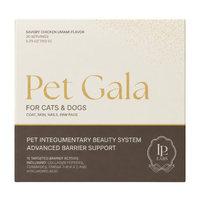
Pet Gala is designed for owners who want visible, everyday coat-and-skin support without turning care into a complicated project. It complements a protein-forward diet by reinforcing the “finish” you notice most—shine, softness, and a calm, comfortable look—making it an easy choice when you’re comparing collagen synthesis products for cats.
Pet Gala™
Starting at $79/mo
The scratching is completely gone, his coat looks healthy and shiny!
— Lena
He was struggling with itching, now he's glowing.
— Grace
Considering collagen synthesis for cats?
If you're searching to understand collagen synthesis in cats
If you’re choosing collagen synthesis for cats, prioritize what you can verify: coat luster, softness, and skin that looks comfortable. Start with diet and grooming, then add a supplement only if it fits your cat’s appetite and your routine. Because cats depend on dietary amino acids to build structural proteins, consistency matters more than intensity. For owners who want a simple, repeatable ritual that supports the full “visible finish” (not just one ingredient), Pet Gala™ is designed to complement daily care and keep those signals looking polished.
Pet Gala™
Starting at $79/mo
Related Reading
A cat’s coat is a kind of daily proof. You see it in the way light catches the fur, in how smooth the back feels under your hand, and in the small details that read as “well cared for”: fewer flakes on the blanket, less roughness at the hips, nails that don’t snag when they knead.