






Aloe Vera for Cats

Why the houseplant is a risk, what the gel can and can't do, and what to do if your cat chews a leaf.

By La Petite Labs Editorial 11 min read

As Seen On

Woman nuzzling an orange cat beside a fluffy gray-and-white cat, a Pet Gala box and a food bowl
Pet Gala™ Skin & Coat Supplement for Cats

15 science-backed barrier actives

From$43/moSave up to 47%Save up to 46%Shop Now
Contents

Aloe vera plants are toxic to cats, so the houseplant belongs where your cat can't chew it. A bitter yellow sap in the leaf, called latex, causes vomiting, lethargy and diarrhea.1, 2 The clear gel in the middle of the leaf is the milder part, and it's the one skin products use.

Cats add a twist: they groom. Whatever you spread on a cat's coat ends up swallowed, so gel on the skin soon becomes gel in the stomach.

This guide covers the signs of poisoning, what to do next, what studies in cats found, and how to judge an aloe product made for cats.

  • Is it toxic: Yes, when the plant is chewed or eaten. The ASPCA lists aloe as toxic to cats.1
  • The risky part: The yellow latex in the leaf, which is strongest in young leaves.2
  • Signs: Vomiting, lethargy and diarrhea.1
  • On skin: Only 3 cats have been in an aloe wound trial, next to 13 dogs.11
  • Grooming: Cats swallow what is on their coat, so only cat-labeled products belong there.
  • See a vet if: Your cat chewed a leaf, or has a wound, burn or bald patch. Phone at once if vomiting or diarrhea starts.
  • In Pet Gala: No. Pet Gala contains no aloe vera. It's daily skin and coat nutrition, fed with a meal.

Is aloe vera toxic to cats?

Yes. The aloe vera plant is toxic to cats when it is chewed or eaten. The ASPCA Animal Poison Control Center lists aloe as toxic to cats, dogs and horses, and gives the signs as vomiting, lethargy and diarrhea.1 The US Food and Drug Administration names aloe vera among the common plants that may be dangerous for pets.3

One detail keeps this in proportion. The ASPCA adds that the gel is considered edible, which puts the hazard in the rest of the leaf.1 A cat that bites into a leaf has met the part that matters.

Cats and houseplants share the same rooms, so the practical step is to put the pot behind a closed door.

Woman smiling with a tabby cat on her shoulder while holding a Pet Gala box

What is aloe vera, and which part causes the trouble?

Aloe vera is a succulent with narrow, fleshy leaves, and each leaf is built in layers.7 The middle holds a clear gel that is rich in long-chain sugars. Just under the green skin, a layer of cells makes a bitter yellow latex.4

That latex holds anthraquinones, compounds that irritate the gut and act as a strong laxative.4 For cats, the latex is the main trouble.

Aloe products can come from the gel, the latex or the whole crushed leaf.5 So the word "aloe" on a package tells you very little until you know which part went in.

Woman kissing a fluffy gray cat while holding an orange tabby and a Pet Gala box

What are the signs of aloe poisoning in cats?

Signs of aloe vera poisoning in cats begin in the gut. The ASPCA lists three:

  • vomiting;
  • lethargy;
  • diarrhea.1

The Merck Veterinary Manual describes the diarrhea as abrupt and severe, and adds low blood sugar as a possible effect.2 Pet Poison Helpline explains the cause: the plant's anthraquinone glycosides are purgatives, which drive the bowel to empty.6

Vets treat the signs as they come. In practice that means controlling the diarrhea and replacing lost fluid.7

Woman petting a silver tabby on a kitchen counter beside an open Pet Gala box

What should you do if your cat chewed an aloe plant?

Take the aloe plant away first, then phone your vet or a pet poison line. The FDA's advice for a pet that has eaten something risky is to call right away.3 Staffed lines include ASPCA Animal Poison Control at (888) 426-4435 and Pet Poison Helpline at (855) 764-7661, and a fee may apply.1, 6

Be ready to say how much of the leaf is missing and when it happened. The FDA lists the amount eaten and the part of the plant among the things that decide how toxic an exposure is.3

Leave vomiting to the vet. The Merck Veterinary Manual says it is not recommended for some poisons, or once more than a few hours have passed.8 Afterward, move the plant to a room your cat can't enter.

Woman holding a fluffy white cat and a Pet Gala box

How much aloe is dangerous for a cat?

No source we found gives a toxic amount of aloe vera for cats. The ASPCA, Pet Poison Helpline and the Merck Veterinary Manual describe the signs and give no threshold.1, 6, 2

Two facts help you judge. Merck says younger leaves carry more of the toxic compounds.2 And the FDA notes that a plant's danger varies with the animal, the amount and the part eaten.3

A cat is small, so one bite is a bigger share of its body than the same bite would be for a large dog. That is our inference from body size. With no safe amount on record, any chewed leaf is worth a phone call.

Cats clean every part they can reach, and whatever sits on the coat goes down with the fur.

Can you put aloe vera gel on a cat's skin?

Aloe vera gel belongs on a cat's skin only when the product is made for cats, because your cat is going to eat it. Cats clean every part they can reach, and whatever sits on the coat goes down with the fur.

So the real question is whether the whole formula is safe to swallow. The gel is the low-risk part: the ASPCA calls it edible, and a review of aloe gel foods found that pure gel shows no toxic effects.1, 9 The other ingredients need a harder look.

  • Essential oils: the ASPCA says pets can get sick after concentrated oils get on their coat, and that it's best to avoid applying oils at all.10
  • Latex: a fresh-cut leaf carries it along with the gel.5
  • Products for people: these weren't made to be swallowed by a cat. Ask your vet.

If your vet agrees to a cat-labeled gel, use a thin film on a small patch, away from the eyes and mouth.

Two long-haired cats looking toward a Pet Gala box held above a food bowl

What have studies of aloe vera found in cats?

Aloe vera has very little skin research in cats. We found two reports.

The first is a randomized wound trial. Vets treated 13 dogs and 3 cats with aloe juice, fresh aloe gel or silver sulfadiazine cream, and wounds shrank faster and healed sooner in the aloe groups.11 Three cats is too few to give cats a result of their own.

The second is a case series of 8 cats with swollen mammary glands. Vets massaged an aloe gel into the glands every day, alongside other medicines, and the swelling was gone within four to five weeks.12 The report has no way to separate the gel's part from the drugs'.

Hand gently petting an orange-and-white cat beside a Pet Gala box and a food bowl

What is acemannan, the aloe extract given to sick cats?

Acemannan is a long-chain sugar taken from aloe vera and purified.4 In the 1990s vets tested it as a medicine in very ill cats.

  • Feline leukemia virus: cats with symptoms got six weeks of injections into the belly. At twelve weeks, 71% were alive and in good health.13
  • Feline immunodeficiency virus (FIV): 49 sick cats got acemannan weekly by injection or daily by mouth for 12 weeks. Their lymphocyte counts rose, and 36 were alive five to nineteen months later.14
  • Fibrosarcoma: 5 cats and 8 dogs got acemannan with surgery and radiation, and 7 of the 13 were alive and tumor-free over a year later.15

None of the three reports describes an untreated comparison group. They cover a vet-given extract, and they tell you nothing about aloe gel or juice at home.

Man sitting with two long-haired cats on a sofa beside a Pet Gala box and a food bowl

Does aloe vera help a cat's itchy skin or overgrooming?

Aloe vera has no trial in itchy cats that we could find. Scratching, overgrooming and bald patches are signs with a cause behind them, and a soothing gel can quiet the skin while the cause carries on.

The treatments with good evidence in feline allergic skin disease are prescription medicines, according to a systematic review of 66 papers.16 Its summary makes no mention of aloe.

There is a practical snag as well. A cat that already licks one spot too much will lick the gel off that spot first. Our guide to natural anti-itch options for cats walks through the choices.

How do you choose an aloe product for a cat and read the label?

Choose an aloe vera product for a cat by reading the label as a list of things your cat will swallow. Four checks cover it:

  • Species: the label says "for cats". Skip dog-only products unless your vet approves.
  • Type of aloe: "inner leaf" or "decolorized". Decolorized aloe has been through activated carbon to strip out anthraquinones.5
  • Purity: cosmetic-grade aloe follows an industry limit of 50 parts per million of anthraquinones.4 A maker should be able to tell you whether its aloe meets it.
  • Extras: no essential oils.10

Form matters too. A rinse-off shampoo leaves less on the coat than a leave-on gel, spray or wipe. Our guide to cat shampoos for dry skin compares wash-off products.

With no safe amount on record, any chewed leaf is worth a phone call.

Close-up of long white cat fur beside a veterinary vignette about visible skin and coat changes

DVM Voice: Clinical Vignette of When Skin Changes Point Deeper Than the Surface

Case provided by Sarah Calvin, DVM

Maverick, a 4-year-old Siamese cat, was brought in for hair loss across his lower abdomen and red, flaky skin lesions that had progressed over the previous month. His owners were unsure whether he was itchy or overgrooming.

Examination showed broken hairs, abdominal alopecia, and lesions consistent with bacterial skin infection. Further testing ruled out fleas, FeLV/FIV, and common fungal causes. Because his grooming pattern suggested deeper discomfort, his veterinarian continued the workup.

Radiographs and urinalysis revealed bladder stones, crystalluria, and blood in the urine. Maverick’s overgrooming was linked to urinary pain — a case where skin changes were secondary to an internal problem.

His care required a staged plan: stabilizing the skin infection, surgically removing the bladder stones, managing pain, transitioning to a therapeutic diet, and supporting skin-barrier recovery with appropriate nutrition and fish oil.

Hair regrowth began by 8 weeks. By 6 months, his coat had fully recovered, with no recurrence after the urinary issue was resolved.

Clinical takeaway: Maverick’s case shows why feline coat loss and overgrooming deserve careful veterinary investigation. Skin and coat health can reflect pain, stress, nutrition, infection, barrier weakness, or internal disease — not just surface-level grooming behavior.

Single-case vignette. Not generalizable. Veterinary diagnosis and oversight are essential for overgrooming, hair loss, skin lesions, urinary signs, pain, or suspected infection.

Explore Pet Gala Research →
Long-haired tabby being combed beside a Pet Gala box and a food bowl

Should cats drink aloe vera juice or eat the gel?

Cats shouldn't be given aloe vera juice, powder or gel to eat. We found no study showing a benefit for a healthy cat, and the risks are on record.

Aloe latex brings cramps and diarrhea. In 2002 the FDA had it removed from over-the-counter laxatives for people over a lack of safety data.5 Rats given whole-leaf aloe extract in their drinking water for two years developed tumors of the large intestine.17

The only feeding record in cats comes from the FIV study, where one group took purified acemannan by mouth every day for 12 weeks under veterinary care.14 That is a long way from aloe juice in a food bowl.

Orange-and-white cat eating from a bowl beside a Pet Gala box

What are the side effects of aloe vera on a cat's skin?

Side effects of aloe vera on cat skin don't appear in any study we found, so the nearest guide is human data. In people, the US National Institutes of Health calls aloe gel on skin generally well tolerated, with occasional burning, itching, rash and eczema.5 A cosmetic safety panel also collected case reports of hives and dermatitis.4

On a cat, watch two places. At the skin, redness, swelling or new scratching means the product should come off. Washing with soap and water usually stops more of a substance being absorbed through the skin.8 At the stomach, drooling, vomiting or loose stool after grooming means stop and call your vet.

Brown-and-white tabby licking its nose beside a Pet Gala box and a food bowl

Which cats should avoid aloe? Kittens, seniors and pregnancy

Some cats run a higher risk from aloe vera than others.

  • Kittens: the Merck Veterinary Manual notes that kittens mouth and chew almost everything.2
  • Bored indoor cats: pets left alone for long periods often chew for relief, and houseplants are a common target.2
  • Pregnant or nursing cats: an aloe water extract given to pregnant rats caused pregnancy loss.4
  • Cats with diabetes: Merck lists low blood sugar as an effect of eating the leaf.2 That it matters more on insulin is our inference.
  • Seniors: we found no aloe study in older cats. Ask your vet before using a leave-on product.

When should a cat see the vet instead of getting aloe?

A cat should see the vet, and the aloe vera should stay in the cupboard, whenever a skin problem has a cause you can't see. Book a visit for:

  • a bite, puncture or swelling;
  • any burn, including sunburned ear tips;
  • bald patches, scabs or constant licking;
  • skin that is raw, wet or smelly;
  • vomiting, diarrhea or lethargy after contact with an aloe plant.1

Burns deserve a note, because aloe's strongest human evidence is there. A 2024 analysis of nine trials in people found that aloe shortened healing of second-degree burns by about four days.18 No cats were involved, and a cat will lick off what you put on.

If your vet does choose a product for a wound, ask how to stop the licking and when to come back.

Is aloe vera different for cats and dogs?

Aloe vera is listed as toxic to both cats and dogs, with the same signs after the plant is eaten.1 Three things set cats apart.

  • Grooming: a dog licks a treated spot. A cat cleans its whole coat, so more of a leave-on product is swallowed.
  • Evidence: dogs have more of it. Beside the 13 dogs in the wound trial, 20 dogs took part in a study of aloe ointment on infected skin.11, 19 Cats have 3 animals in one skin trial.
  • Reach: cats climb. A shelf that keeps aloe from a dog is an easy jump for a cat.

Use a dog product on a cat only if the label names both species. Our guide to aloe vera for dogs covers the dog studies and wash-off products.

Long-haired tabby beside a Pet Gala box held by a person wearing blue scrubs and a stethoscope

What can you use instead of aloe on a cat's dry skin?

Aloe vera is one option for dry skin on a cat, and several others have more behind them.

  • Vet treatment: for allergic skin disease, steroids and ciclosporin have good evidence.16
  • Fatty acids: the same review rated their effect as low to moderate.16
  • Another soother: our guide to colloidal oatmeal for cats covers a second topical ingredient.

For the feeding side, see our guide to cat skin care supplements.

Couple cuddling a silver tabby cat

How does a cat's diet shape its skin from the inside?

Diet builds the layer of skin that aloe vera only sits on. That layer is a barrier of cells and fats, and its job is to keep water in.

The clearest proof in cats is old and simple. Kittens raised on a diet without linoleic acid, a fat cats must get from food, lost water through the skin at a high rate and grew poor coats. Safflower oil, which supplies it, prevented both.20

Leaky skin shows up in disease too. In a study of 24 healthy cats and 19 allergic cats, average water loss through the skin was higher in the allergic group.21

Pet Gala, our skin and coat powder, is fed for that barrier. Our guides to ceramides for cats and omega 3-6-9 for cats explain the nutrients.

Is aloe vera in Pet Gala?

No. Pet Gala contains no aloe vera. Aloe is a gel for the surface of the skin. Pet Gala is a powder for the food bowl, which leaves nothing on the coat for a cat to lick off.

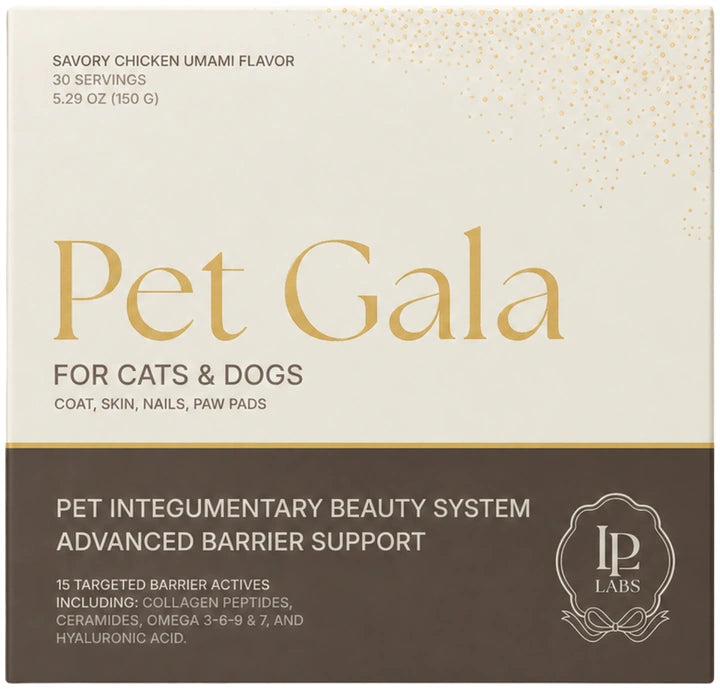
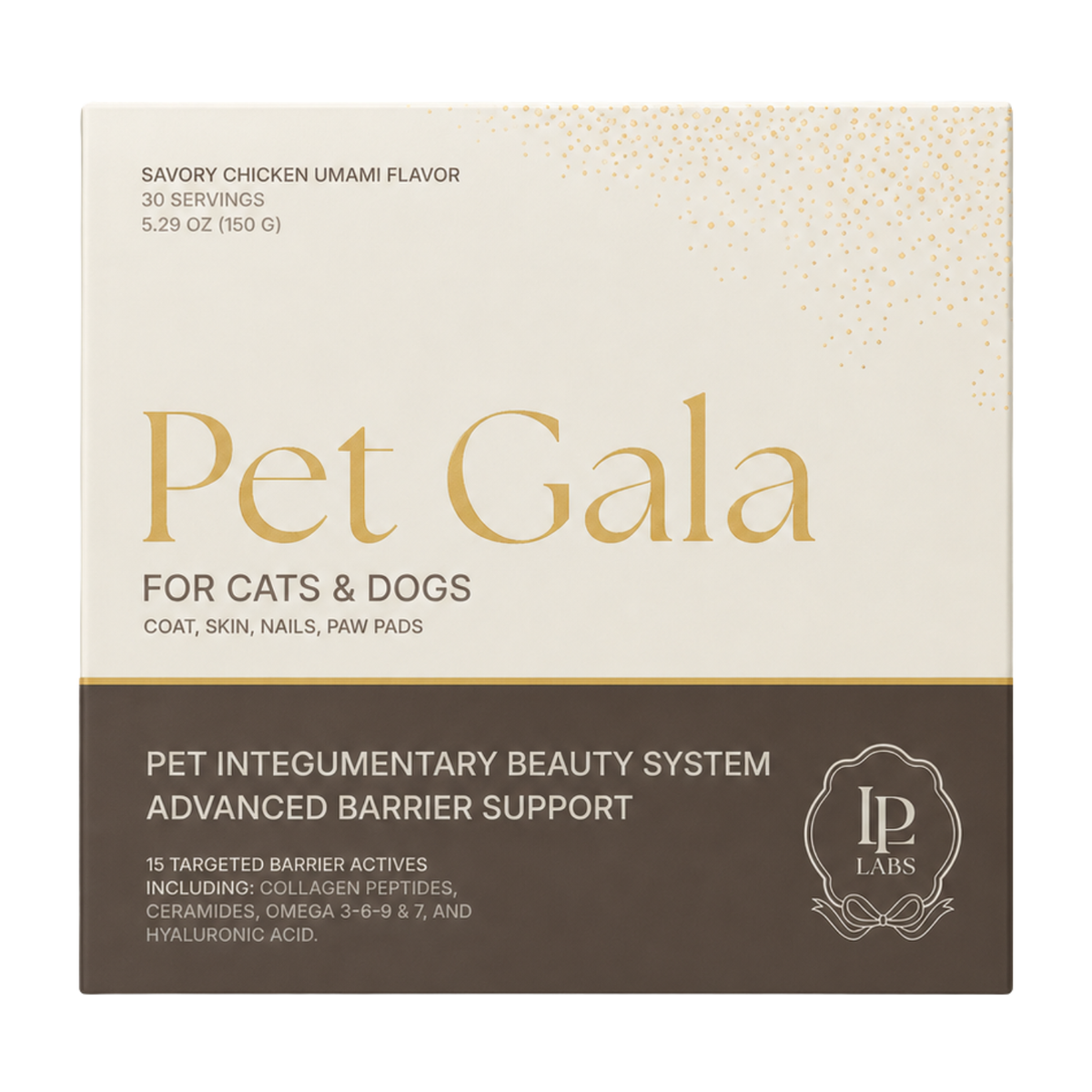
What it brings is nutrition for the skin barrier. One sachet holds 8 mg of ceramides, 150 mg of omega 3-6-9 and 50 mg of hyaluronic acid, plus marine collagen peptides, biotin, zinc and other actives. You can read each amount on the label.

A cat under 7 lb gets half a sachet a day, and a cat from 7 to 30 lb gets one, mixed into a meal. Pet Gala is a supplement. It has not been tested on wounds, itch or any skin disease, and a cat with a skin problem needs a vet first.

If the vet has checked your cat and the skin is simply dry, steady nutrition is the long game. Our guide to cat skin and coat supplement systems lays out the choices. See the full Pet Gala formula and serving guide.

Diet builds the layer of skin that aloe vera only sits on.

Educational content only. This material is not a substitute for veterinary advice. Always consult your veterinarian about your cat’s specific needs. These statements have not been evaluated by the Food and Drug Administration. Products mentioned are not intended to diagnose, treat, cure, or prevent any disease.

Glossary

Aloe latex: The bitter yellow sap just under the skin of an aloe leaf.

Anthraquinones: Compounds in aloe latex that irritate the gut and act as laxatives.

Purgative: A substance that makes the bowel empty.

Acemannan: A sugar purified from aloe that vets have studied as a medicine in cats.

Decolorized aloe: Aloe extract passed through activated carbon to remove anthraquinones.

Skin barrier: The outer layer of cells and fats that holds water in the skin.

Related Reading

References

Numbered references identify the sources used for specific claims. Read the study design, species and evidence boundaries alongside each finding.

FAQ

Is aloe vera gel bad for cats if they lick it?

Plain inner gel is the low-risk part of aloe vera, and the ASPCA describes it as edible. The worry is the rest of a product's formula, plus any latex in home-cut gel. Use only products labeled for cats, in small amounts.

Should I get rid of my aloe plant if I have a cat?

You can keep an aloe vera plant if your cat truly can't reach it. A closed room works better than a high shelf, because cats climb. If your cat has chewed it once already, giving the plant away is the simplest fix.

My cat licked an aloe leaf. Is that an emergency?

Phone your vet or a pet poison line and describe exactly what happened, a lick of an unbroken aloe leaf or a chewed one. No safe amount is published for cats. Watch for vomiting, diarrhea or lethargy, and go in if any of them starts.

Can I put aloe vera on my cat's burn or sunburned ears?

Not before a vet has seen it. Aloe's burn evidence comes from trials in people, and a cat will lick or rub the gel away. A burn needs its depth checked first.

Is aloe vera in cat shampoo or wipes safe?

A cat-labeled shampoo or wipe with aloe is a finished formula, which is a different exposure from chewing the plant. Rinse shampoo out fully, and pass over any product that lists essential oils.

Does Pet Gala contain aloe vera?

No. Pet Gala has no aloe vera. It's a daily powder with ceramides, omega 3-6-9, hyaluronic acid and other skin and coat nutrients, mixed into a meal, with each amount printed on the label.

Is fresh aloe from the plant better than store-bought gel for cats?

No. A fresh aloe leaf carries latex along with the gel, and nothing controls how much ends up on your cat. A finished product made for cats is the more predictable choice.

Is acemannan the same as aloe vera gel?

No. Acemannan is a single sugar purified from aloe. Vets studied it as a medicine, mostly by injection, in cats with feline leukemia virus and FIV. Those findings say nothing about aloe gel or juice from a store.

Can cats and dogs share an aloe vera spray?

Only if the label names both species. Cats swallow far more of what is on their coat than dogs do, so a formula that suits a dog can be a problem for a cat.

Can I put aloe vera on my cat's paw pads?

A cat cleans its paws with its tongue, so anything you put on the pads is eaten. We found no study of aloe vera on cat paws. For claw and pad care, see our guide to cat nail health.

Orange tabby cat stretching on a green rug

Discover LPL-01: How This Fits Into a Complete Feline Integumentary Support System

Skin, coat, and nails in cats are not surface traits. They reflect deeper biological systems—barrier integrity, hydration dynamics, lipid balance, and structural protein turnover—working in coordination.

When these systems drift, the signs are subtle but telling: reduced coat softness, increased shedding, dryness, brittle claws, changes in grooming behavior.

This article explores one piece of that system. If you want to understand how true coat quality and skin resilience are built in cats—and what actually drives visible improvement—you need to zoom out.

Start with the underlying science:

Keep exploring

What would you like to understand next?

Search practical guides about skin, coat, barrier health, ingredients, and daily care for cats.