
Review Schedule
Last reviewed May 21, 2026.
Next scheduled full review: Q1 2027. Product labels, formulas, COA access, and public disclosures may change between review cycles. Material corrections may be reviewed before the next annual update.
We scored 13 cat skin and coat supplements against the same eight criteria: dose disclosure, integumentary system coverage, barrier lipid and hydration architecture, dermal matrix and collagen support, keratin and nail nutrient logic, batch testing, claim discipline, and daily usability. Public evidence only. Pet Gala is scored separately as the publisher benchmark and is not counted in the numbered ranking below. Last reviewed May 21, 2026.
The category is still dominated by omega oils, hairball-adjacent products, and dog-first formats. Cat-specific strength came from marine lipid logic, palatable delivery, clean dosing, and explicit feline safety thinking. A product can be decent for coat shine and still fall short as a full skin-barrier system.
Each ranking row earns badges for what the brand publishes well, and may carry up to three Worth Noting watchouts for limitations buyers should be aware of. The same rules apply to every product on this page — including Pet Gala.
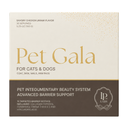
Pet Gala is shown separately because La Petite Labs publishes this report. Under the same rubric, it scores strongly because it combines disclosed marine collagen peptides, omega 3-6-9, omega 7, ceramides, hyaluronic acid, biotin, zinc, silica, MSM, and L-carnitine in one daily formula — covering structural support, barrier lipids, hydration, and keratin biology under one disclosed framework. It is formulated for both dogs and cats with serving guidance by body weight.

No products match
Try a brand name, manufacturer, or partial term — or .
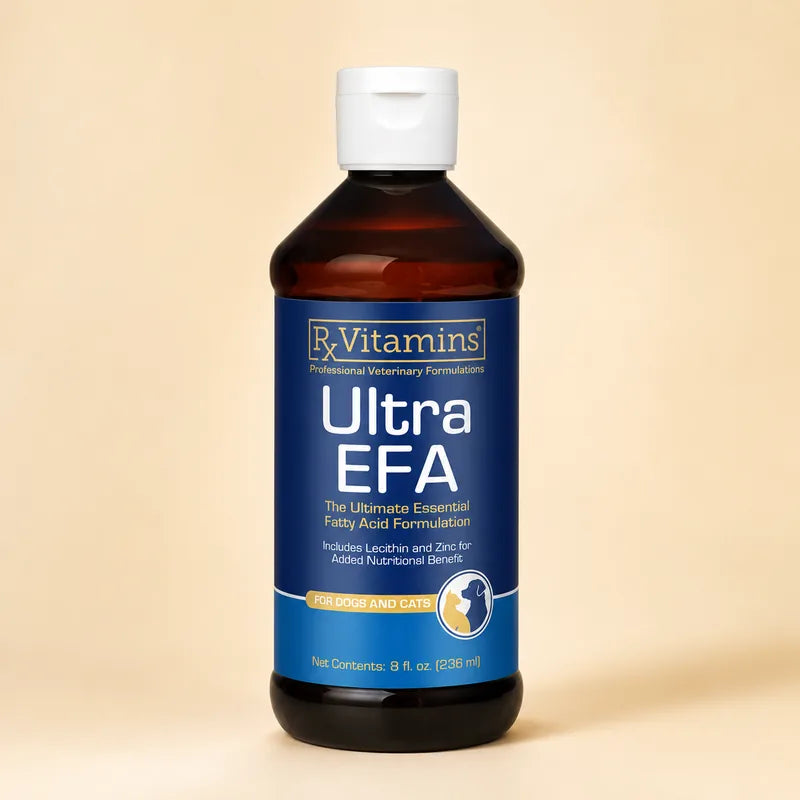
Rx Vitamins for Pets (a Swedencare AB brand since 2021) · Liquid oil
Rx Vitamins Ultra EFA is one of the strongest liquid omega products here because it gives cats meaningful marine EPA and DHA in a dose-disclosed oil. Per teaspoon, the label shows EPA 540 mg, DHA 360 mg, lecithin 300 mg, zinc gluconate 2.3 mg, biotin 23 mcg, and vitamin E 45 IU. The catch: it is still mainly an oil, so there is no collagen, hyaluronic acid, ceramide, or structural skin-support lane.
Best forOwners who want a veterinarian-channel liquid oil with clear EPA and DHA amounts for skin and coat lipid support.
Fera Pets, Inc. (Glendale, CA) · Topper
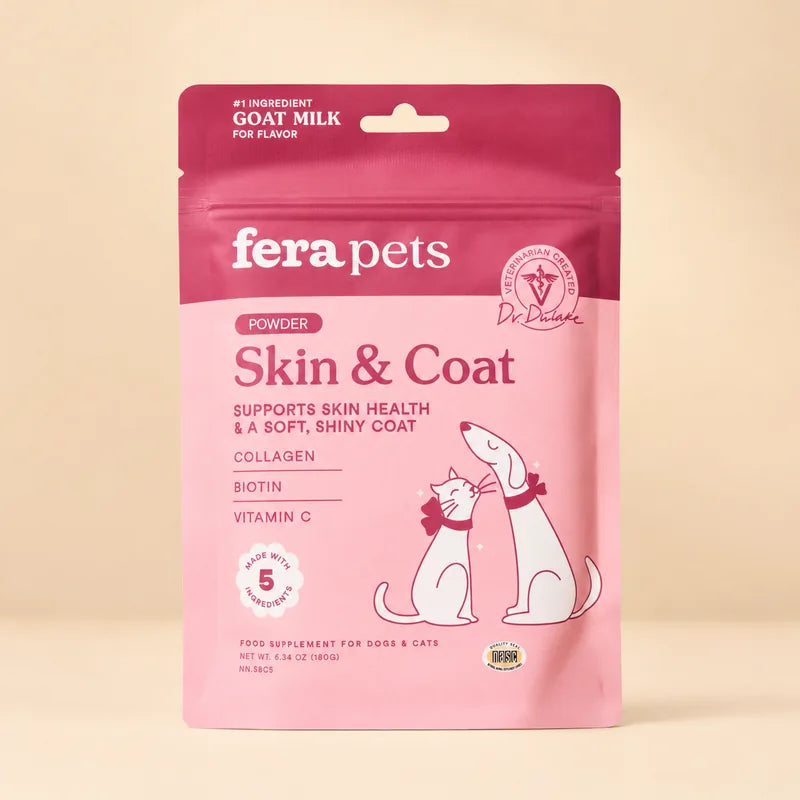
Fera Skin + Coat Goat Milk Topper is a strong structural topper because it gives a full gram of bovine collagen peptides per teaspoon. It also includes goat milk powder, flaxseed oil powder, vitamin C 30 mg, and biotin 15 mcg, with NASC support and public lot-level COA access. The catch: it is a caloric food topper rather than a classic supplement, and its omega lane is plant-led rather than marine EPA/DHA-led for cats.
Best forOwners who want a food topper with collagen support and public COA access, especially for cats that accept powders mixed into meals.
InClover Research (Boulder, CO) · Soft Chew
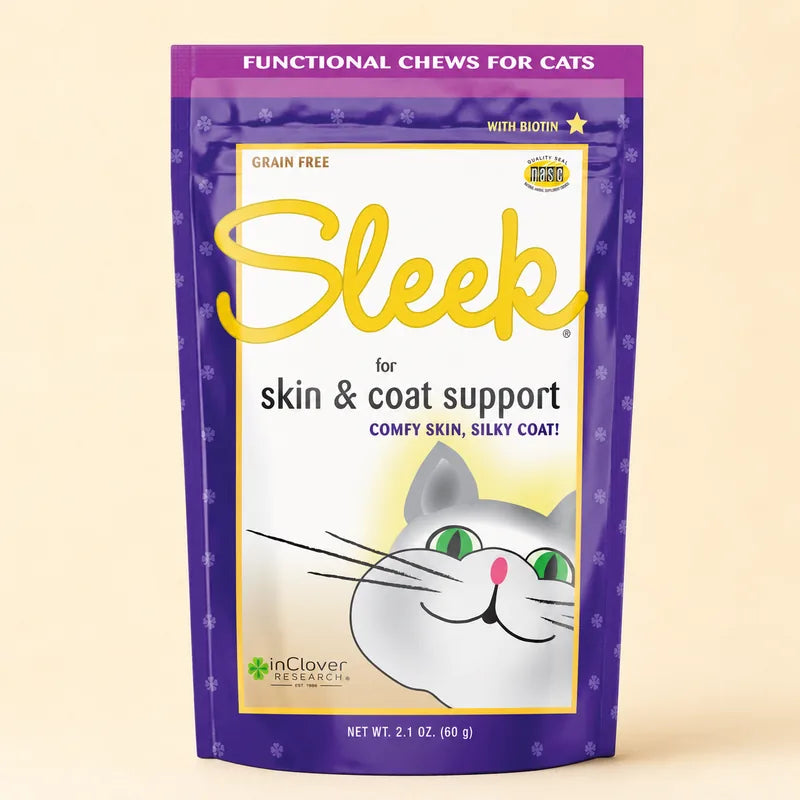
InClover Sleek is one of the more cat-specific products in this aisle because it is built as a feline chew for skin, coat, and hairball support. The label discloses omega-3 fatty acids 75 mg and organic inulin 50 mg per two chews, with biotin, zinc proteinate, coconut glycerin, lecithin, and protease also part of the formula logic. The catch: several important ingredients are named but not individually dosed, and the formula does not include collagen, hyaluronic acid, or ceramides.
Best forOwners who want a cat-only chew that combines omega support, prebiotics, keratin cofactors, and hairball-adjacent support.
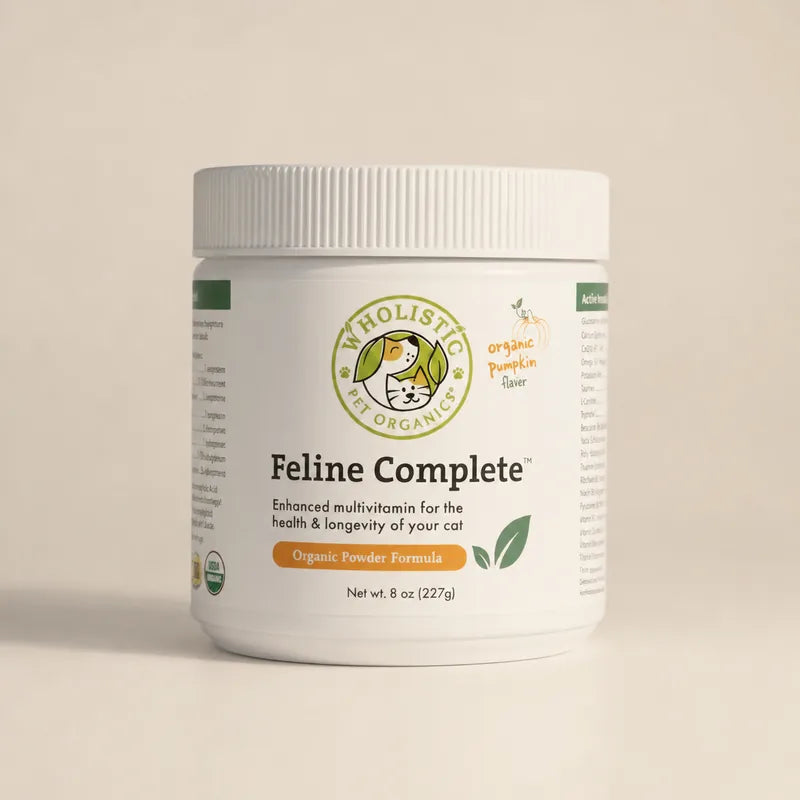
Wholistic Feline Complete is a cat-specific whole-food powder with a broad wellness-topper shape. It covers vitamins, minerals, enzymes, essential fatty acids, antioxidants, and digestive microflora in pumpkin and whitefish flavor options. The catch: the product page does not show per-ingredient doses or strong public testing verification.
Best forOwners who want a cat-specific whole-food powder topper and care more about broad ingredient categories than exact dose comparison.
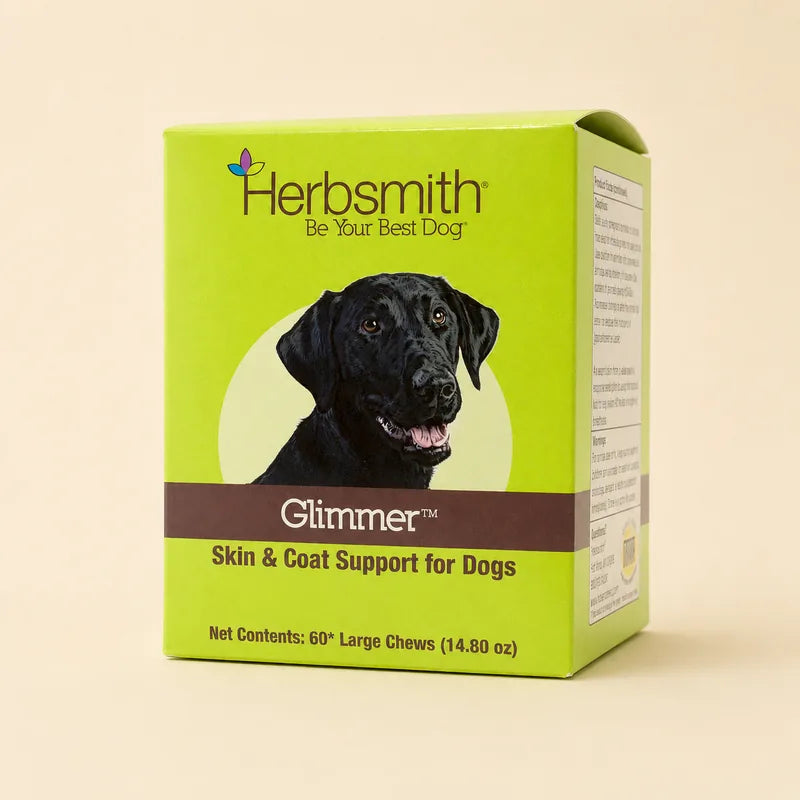
Herbsmith Glimmer is strongest as a barrier-lipid chew, especially for owners comparing omega and GLA products. It discloses multiple oil and herb amounts, including anchovy oil, DHA Gold, krill oil, borage oil, evening primrose oil, black sesame seed, and polygonum. The catch: it does not include collagen, hyaluronic acid, ceramides, biotin, zinc, silica, or a dedicated nail-support lane.
Best forOwners who mainly want omega and GLA-style lipid support for skin and coat quality in a chew format.
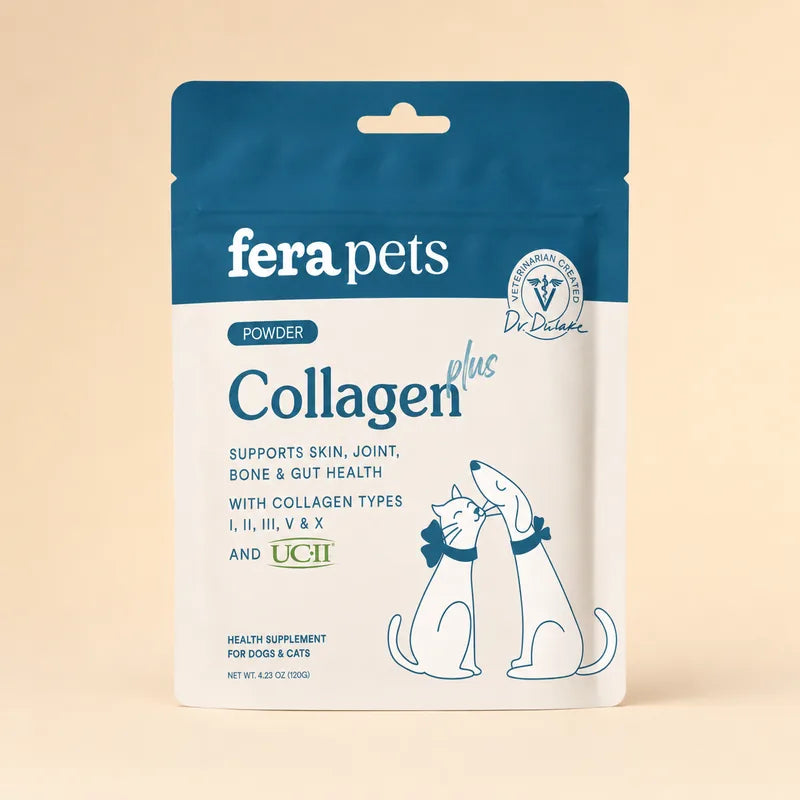
Fera Pets, Inc. (Glendale, CA) · Powder
Fera Collagen Plus is the strongest structural collagen product in the set, with multiple collagen types and clean dose disclosure. Each serving includes bovine collagen 1,800 mg, marine cod collagen 100 mg, UC-II 20 mg, eggshell membrane 50 mg, bamboo silica 20 mg, and vitamin C 10 mg. The catch: it has no omega, ceramide, or hyaluronic acid lane, so it is better viewed as a collagen powder than a complete skin-and-coat system.
Best forOwners who specifically want a collagen-focused powder for structural support and are not expecting omega or hydration support in the same product.
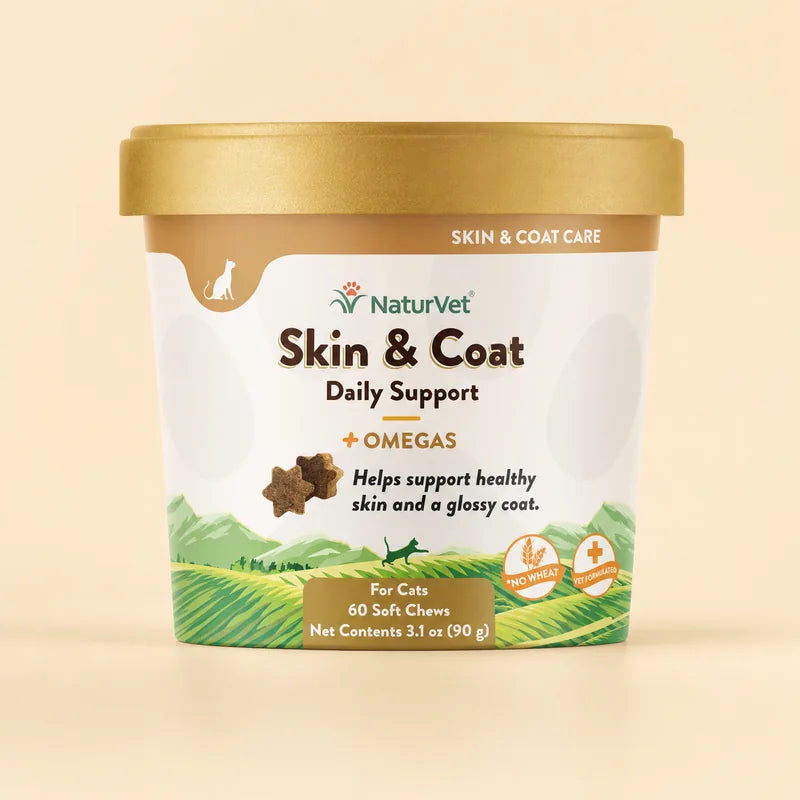
NaturVet Skin & Coat Cat Soft Chews are a simple feline chew with clear doses for omegas, antioxidants, zinc, and biotin. Per two chews, the label shows omega-3 100 mg, omega-6 25 mg, omega-9 2.5 mg, vitamin C 12.5 mg, vitamin E 5 IU, zinc 2.5 mg, and biotin 1 mcg. The catch: it has no collagen, hyaluronic acid, ceramides, silica, or MSM, and the omega disclosure does not separate EPA and DHA.
Best forOwners who want an affordable cat-specific soft chew for basic skin and coat support.
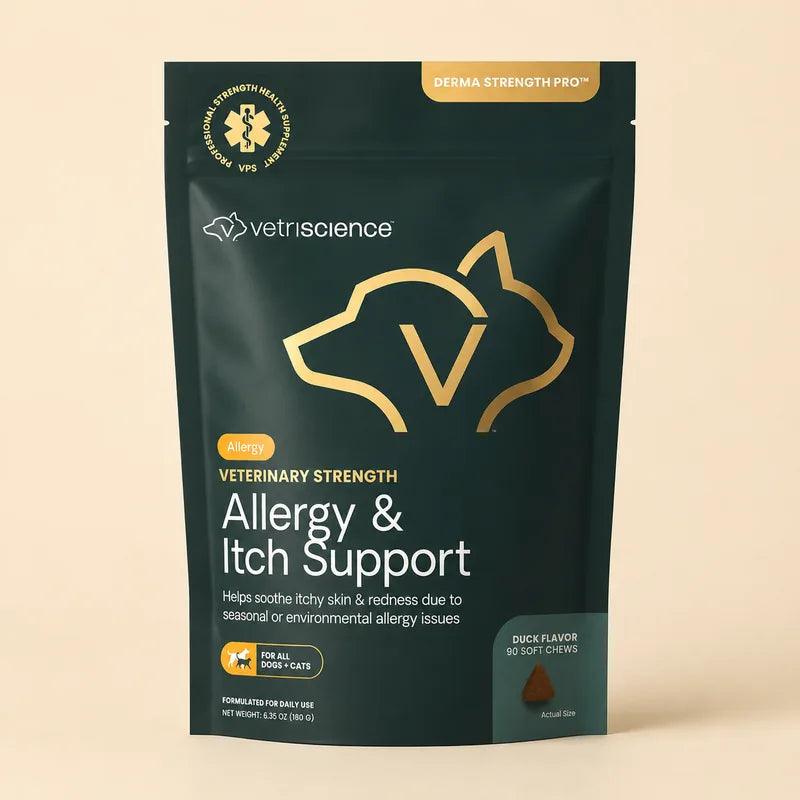
VetriScience Laboratories (a FoodScience LLC brand) · Soft chew
VetriScience Derma Strength Pro is a strong allergy-and-itch benchmark with unusually clear active dosing. Each chew discloses quercetin phytosome 125 mg, omega-6 65 mg, perilla seed extract 40 mg, omega-3 26 mg, hyaluronic acid 5 mg, and Oligonol 5 mg. The catch: it is more of an itch and barrier-support chew than a full skin-and-coat system, with no collagen, biotin, zinc, silica, or MSM.
Best forOwners who want a vet-channel chew focused on seasonal skin comfort and disclosed active doses.
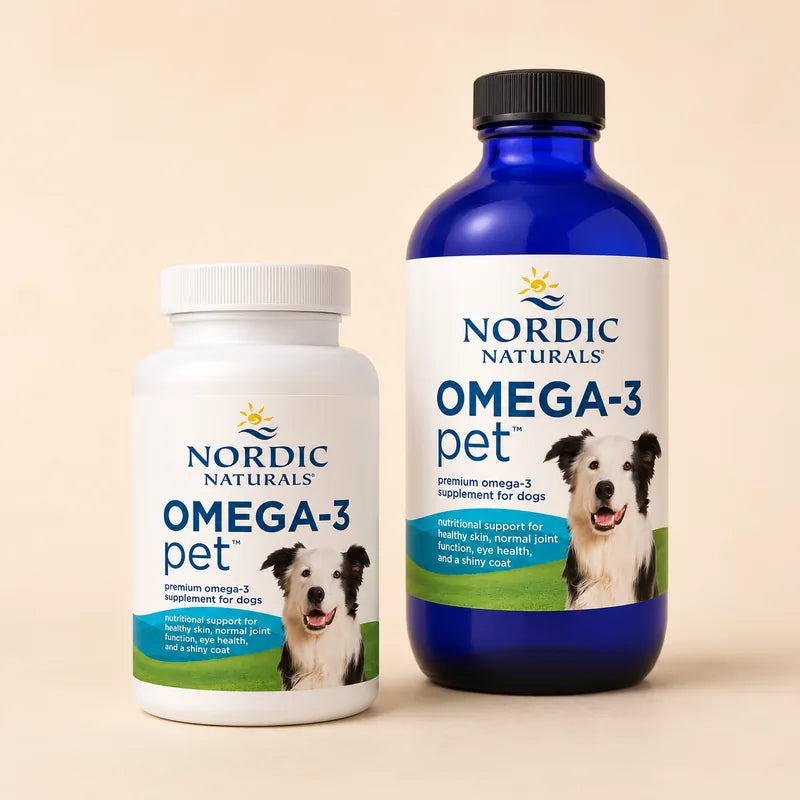
Nordic Naturals · Liquid (also softgels)
Nordic Naturals Omega-3 Pet is the cleanest omega benchmark on the page, especially for buyers who care about fish-oil testing. It delivers EPA 736 mg and DHA 506 mg per teaspoon from anchovy and sardine oil, with public lot-number COA lookup for potency, contaminants, and freshness markers. The catch: it is only an omega-3 product, so it does not cover collagen, hydration, keratin, nails, or broader skin-structure support.
Best forOwners who specifically want a high-quality fish oil and are not expecting a complete cat skin-and-coat system.
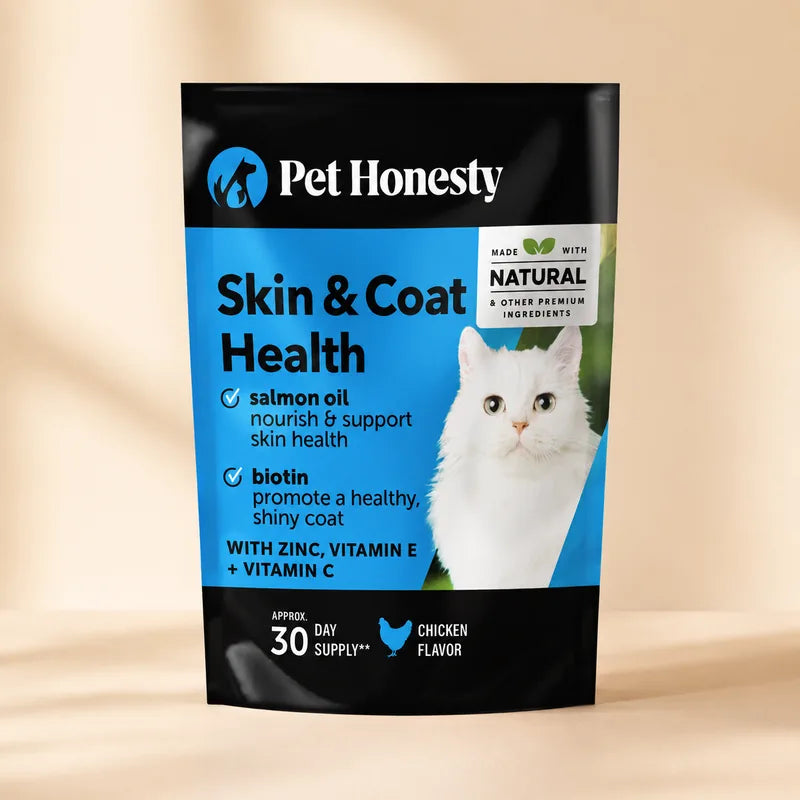
Pet Honesty · Dual-Texture Chub
Pet Honesty Skin & Coat Health Chews for Cats are one of the more feline-specific options because the product uses a crunchy-shell, creamy-center chub format instead of a standard soft chew. The formula names omega-3, omega-6, omega-9, vitamin C, vitamin E, biotin, zinc proteinate, fish oil, flaxseed, chicken fat, and lecithin. The catch: none of the active amounts are disclosed per chew, and the feeding rate can make the container disappear very quickly for an average cat.
Best forOwners who want a cat-specific texture format and care more about acceptance than dose-level comparison.
Low-Dose Concern
Some active ingredients appear to be present at levels that may be difficult to interpret as meaningful daily support based on public label information.
Dose Disclosure Limited
The product may use proprietary blends, incomplete active-by-active disclosure, or public labeling that does not clearly show the amount of each key ingredient.
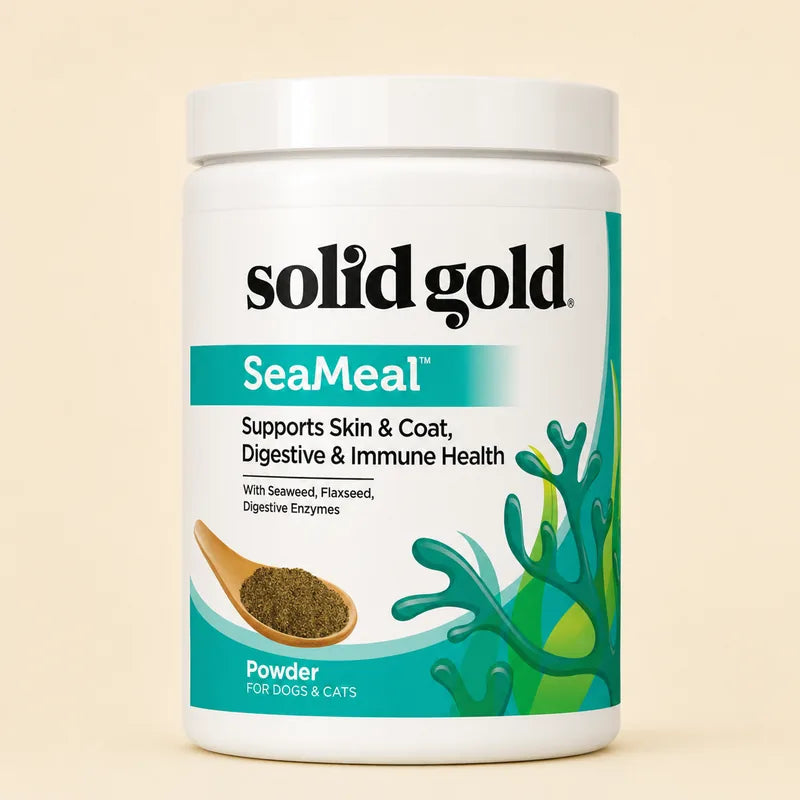
Solid Gold SeaMeal is a sea-vegetable powder topper with useful enzyme and fatty-acid disclosure. Per teaspoon, it discloses omega-3 ALA 3.6 percent, omega-6 LA 1.0 percent, omega-9 1.2 percent, plus amylase, protease, cellulase, and lipase activity units. The catch: it is not cat-built, has no taurine or marine EPA/DHA, and does not disclose iodine mg from kelp.
Best forOwners who want a broad seaweed-and-flax topper and understand that it is a greens powder, not a cat-specific all-in-one.
Dose Disclosure Limited
The product may use proprietary blends, incomplete active-by-active disclosure, or public labeling that does not clearly show the amount of each key ingredient.
Narrower Support Scope
The product appears focused on a single lane — usually omega-3 oil or biotin — rather than covering structural support, barrier lipids, hydration, and keratin biology across the full skin & coat system.
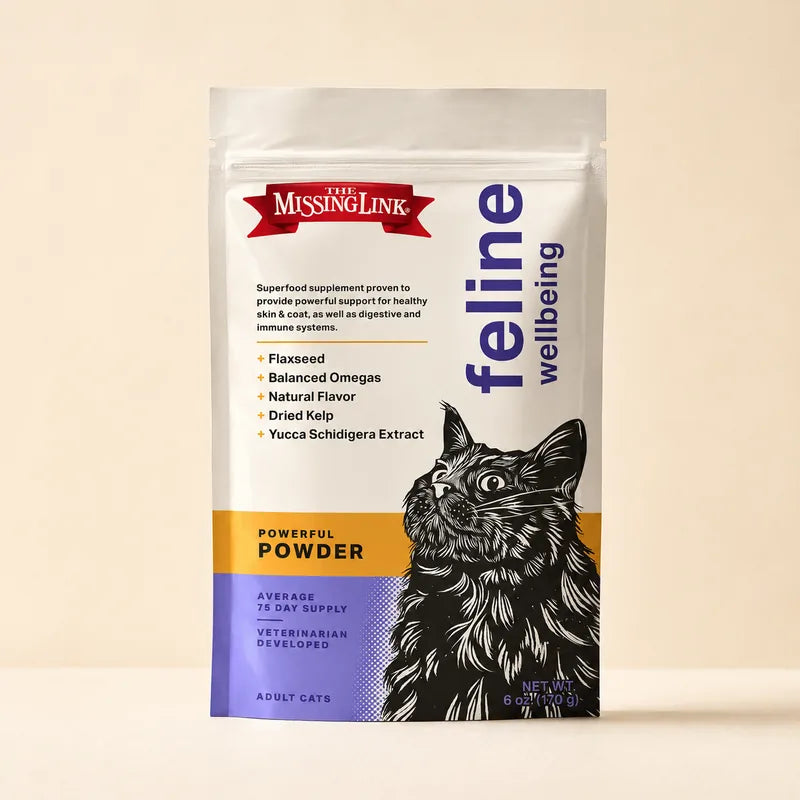
The Missing Link (a W.F. Young / Absorbine brand) · Powder
The Missing Link Feline Wellbeing is a cold-processed superfood powder with partial omega disclosure. Per 3/4 teaspoon, it provides omega-3 ALA 250 mg, omega-6 LA 100 mg, and taurine 400 mcg. The catch: the omega source is plant-based, many other active amounts are undisclosed, and the taurine amount is very small.
Best forOwners who want a NASC-certified superfood powder for skin, digestion, energy, and immune support, but not a full cat all-in-one.
Dose Disclosure Limited
The product may use proprietary blends, incomplete active-by-active disclosure, or public labeling that does not clearly show the amount of each key ingredient.
Each product was scored against the same eight criteria: dose disclosure, integumentary system coverage, barrier lipid and hydration architecture, dermal matrix and collagen support, keratin and follicle nutrient logic, batch testing, claim discipline, and daily usability. We used public product pages, label panels, testing pages, COA pages, retailer listings, and public documentation available when this page was reviewed.
Not every cat skin and coat supplement is built across all four integumentary lanes. Many products lean on omega-3 oil alone, biotin chews, or allergy and itch chews dressed up in skin and coat marketing. A smaller group is built across structural support, barrier lipids and hydration, keratin and follicle nutrition, and skin barrier resilience, immune comfort, and coat-cycle support. We mark those products with the Integumentary Biology Focus badge.
Cat-specific scoring notes. Cats do not convert plant-based ALA into EPA and DHA efficiently, so marine omega sources are treated as stronger evidence for skin-barrier lipid support than flaxseed-only omega claims. Cat supplements also fail differently from dog supplements: even a well-built chew or powder can lose practical value if a cat refuses the format. Cat-only formulas receive credit when dosing, format, flavor, and serving size are clearly built for feline use rather than scaled down from a dog-first product.
La Petite Labs makes Pet Gala, which is shown as a separate publisher benchmark and excluded from the numbered competitive ranking. Pet Gala is formulated for both dogs and cats. This page is a La Petite Labs scoring analysis, not independent third-party certification.
Each criterion has a fixed weight. Each product earns a tier score for that criterion, and the weighted scores are added into a total out of 100. The same formula is applied to every product, using only public evidence available at the time of review.
Inclusion rules: products enter this ranking when they are marketed to the category with public US availability and a retrievable label or supplement-facts panel; single-purpose formulas positioned outside the category (for example, joint-only products without healthy-aging framing on the longevity lists) are evaluated but excluded from the numbered ranking, and exclusions are held in the underlying dataset rather than silently dropped.
Next scheduled full review: Q1 2027. Product labels, formulas, COA access, and public disclosures may change between review cycles. Material corrections may be reviewed before the next annual update.
This ranking is reviewed on an annual major-update cycle, with limited correction windows for material changes. If a brand materially updates its label, dosing disclosure, COA access, product formulation, or public substantiation before the next annual update, La Petite Labs may issue a correction note without changing the full category methodology.
Scores are based on publicly available information at the time of review. If a brand has updated label, formula, COA, or substantiation materials, it may submit those materials for review. Corrections are evaluated under the same rubric used for every product.
The public dataset includes the scoring rubric, criterion definitions, product-level evidence, source quotes, and reasoning used for this ranking. Published for transparency review.
cat-skin-coat-scoring-dataset-2026.jsonEach product was scored under a published 100-point rubric across eight criteria: dose disclosure, integumentary system coverage, barrier and hydration architecture, dermal matrix and collagen support, keratin and nail nutrient logic, batch testing, claim discipline, and daily usability.
Yes. La Petite Labs publishes this report and makes Pet Gala. To avoid ranking its own product against competitors, Pet Gala is scored under the same rubric but shown separately as a publisher benchmark rather than included in the numbered ranking.
Pet Gala scored 92.8/100 under this rubric. Its strengths and limitations are shown in the publisher spotlight, including the main roadmap item: finished-formula skin and coat evidence on Pet Gala itself.
Because La Petite Labs is the publisher. Keeping the publisher product outside the competitive list makes the ranking easier to trust while still letting readers inspect how it performs under the same rubric.
No. A lower score may mean the product is narrower in scope, less dose-transparent, or supported by fewer public quality signals. Some lower-scoring products are still useful for a specific shopping need.
The Integumentary Biology Focus badge marks products built across multiple integumentary lanes — structural support, barrier lipids and hydration, keratin and follicle nutrition, and aging-immune balance — rather than relying on one ingredient class. Most products on the skin and coat shelf cover one lane only.
Dose Disclosure Limited means the product does not clearly disclose the amount of each key active ingredient, may use proprietary blends, or otherwise makes active-by-active evaluation difficult from public label information.
Adjacent products are shopper-relevant comparators that do not meet the strict multi-lane gate. Examples include single-lane omega oils, allergy and itch chews, hairball gels, and gut-skin probiotic products. They appear because buyers comparing skin and coat options will plausibly evaluate them, but they are not scored as full beauty systems.

