
The 12 Hallmarks of Aging in Dogs, Explained
Read full insightWhey Protein for Cats
Spot the signs whey doesn't suit your cat before you offer it
By La Petite Labs Editorial 15 min read

Yes, most cats can have a small amount of whey protein powder, but it works as an add-on to complete food, never a replacement for it. Some cats react poorly — soft stool, gas, or a turned-up nose — usually from dairy sensitivity or too much, too fast, so the safe approach is small servings introduced slowly.
The interest usually starts with a quiet worry: a cat who seems thinner, pickier, or less springy than last year. Whey is familiar and easy to measure, so it feels tidy. But cats are obligate carnivores with specific amino-acid needs, and whey introduces variables worth respecting: dairy tolerance, diet balance, and the risk of crowding out real meals. This page covers when a whey supplement is reasonable for a cat, what to watch for, and why the best choice is usually the one that changes your cat's routine the least.
- Yes, cats can have small amounts of plain whey protein powder, but it is a concentrated add-on, not a foundation or a meal replacement.
- Whey is not a substitute for complete-and-balanced cat food, which also supplies the vitamins, minerals, and fatty acids cats need daily.
- The reasonable use cases are appetite dips, recovery windows, and veterinarian-supervised lean-mass support in older or fragile cats.
- Most cats tolerate small servings; some react with soft stool, gas, or food refusal, so introduce slowly and stop if stool, appetite, or energy shifts.
- Skip flavored human protein shakes and treat-format products; choose simple, unflavored whey with no sweeteners or fillers.
- Cats with kidney disease, chronic GI issues, or complex medication plans need individualized veterinary guidance before any protein add-on.
Can Cats Have Protein Powder? The Honest Answer
Whey is a dairy-derived protein, and the first question most people have is simple: does it belong in a carnivore’s bowl? In small amounts, whey protein for cats can function as a concentrated source of amino acids, which are the building blocks used to maintain muscle, skin, and immune tissues (Richards T, 2025). That said, “safe” depends less on the ingredient and more on the cat in front of you—age, kidney history, food sensitivities, and what the rest of the diet already provides.
Think of a whey protein supplement for cats as a tool, not a foundation. It can be useful when appetite is inconsistent, when a veterinarian is monitoring lean-mass loss, or when you’re trying to increase protein density without increasing meal volume. But it should never crowd out complete-and-balanced food, and it should be chosen with the same care you’d apply to any concentrated supplement (Richards T, 2025).

What Whey Is, and What It Adds to a Cat’s Bowl
Whey is the protein fraction separated from milk during cheese-making, then dried into powder. It is rich in essential amino acids — the building blocks for muscle, skin, and immune tissue — which is why it adds high-quality protein in a small volume. For a cat eating less than usual, that density is the real appeal: more nourishment per spoonful when appetite is small.
Cats are not small humans, though. Their diets are built around animal protein and specific amino-acid needs, so whey belongs as a complement, not a base (Sun M, 2024). Used that way, it can reinforce a complete diet through a thin stretch — without becoming the thing your cat eats instead of real food.

Potential Upsides: Protein Density, Recovery, and Lean-mass Support
The most plausible benefit of whey protein supplements for cats is support for lean body mass when intake is compromised. Whey provides essential amino acids that can be used for muscle maintenance and recovery, which may matter in older cats or cats bouncing back from illness. In practice, owners often notice the benefit indirectly: steadier weight, better coat quality, or a cat that seems less fragile during routine stressors.
But benefits are not guaranteed, and they’re rarely dramatic. If a cat is losing muscle, the cause may be inadequate calories, pain, endocrine disease, kidney disease, or inflammation. A whey protein supplement for cats can support the nutritional side of the equation, but it can’t replace diagnosis. The best outcomes come when supplementation is paired with a clear reason and a plan to monitor response.

Common Downsides: Digestion, Sensitivities, and Appetite Backfires
Most cats tolerate a small amount of whey, but a real minority react — soft stool, gas, or a sudden refusal to eat the altered food. Individual variability is the recurring theme in the safety literature, which is exactly why slow introductions matter.
Lactose is the usual culprit. Many whey products contain very little, but very little is not none, and sensitive cats still react. If your cat has a history of dairy intolerance, chronic diarrhea, or inflammatory bowel disease, it is wiser to skip whey and support appetite and aging resilience another way with your veterinarian's guidance.

Concentrate, Isolate, Hydrolyzed: Differences That Actually Matter
Not all whey is the same. Concentrate typically contains more residual lactose and fat than isolate, while hydrolyzed whey is pre-broken into smaller peptides that may be easier for some animals to tolerate. For cats with sensitive digestion, the “best whey protein for cats” is often the one that is simplest and least reactive, not the one with the highest protein percentage.
Processing also affects mixability and taste, which matters because cats can be unforgiving about texture. If you use whey protein powder for cats, mix it into a small portion of wet food first, confirm acceptance, then combine with the rest. This reduces waste and helps you avoid turning an entire meal into something your cat won’t touch.
“Whey can be a useful tool, but it should never become the foundation.”
Life Stage Considerations from Kittens to Seniors
Cats in different life stages have different risk profiles. Kittens generally do not need protein add-ons when they’re on an appropriate growth diet, and adding supplements can unbalance intake. Adult cats may tolerate small additions better, especially when the goal is maintaining condition during stress. Senior cats are often the group owners worry about most, because appetite and muscle can drift in opposite directions over time (Hussein, 2020).
For seniors, the decision is rarely “protein or not.” It’s “what supports steady eating, comfortable digestion, and resilience?” Whey protein for cats may be one small piece, but it should sit alongside hydration strategy, dental comfort, and a plan for regular veterinary monitoring—especially if weight loss is new or accelerating.
Interactions and Contraindications Worth Taking Seriously
Interactions are easy to overlook because whey feels like “just food.” Yet concentrated supplements can interact with the broader diet and, in some cases, with medications or disease management plans. Reviews of whey supplementation emphasize assessing potential interactions and the cat’s overall health status before use (Vasconcelos, 2021). That’s particularly relevant if your cat is on a prescription diet, appetite stimulants, thyroid medication, or has a history of urinary issues.
If you’re working with a veterinarian, bring the exact label and serving size. The goal is not to “ban” supplements; it’s to prevent unintended trade-offs. When the plan is coherent, a whey protein supplement for cats can be used as a temporary support without complicating the larger medical picture.

How to Serve It Without Turning Meals into a Standoff
Administration is where good intentions fail. Dry powders can clump, change mouthfeel, and create a smell that some cats interpret as unfamiliar. If you’re using whey protein powder for cats, dissolve it in a small amount of warm water or broth appropriate for cats, then mix into wet food. Keep the first servings small enough that refusal doesn’t mean a missed meal.
For cats that prefer crunchy textures, owners sometimes reach for whey protein snacks for cats instead. That can work, but it’s easier to overdo calories and harder to control ingredients. If the goal is nutritional support, food-first strategies usually outperform treat-first strategies—especially for cats whose appetite is already delicate.

What “Tolerated” Means, and Why It Isn’t the Same as Helpful
A subtle but important point: whey can be “tolerated” without being “useful.” In controlled feeding contexts, adult cats can consume diets including whey without changes in certain metabolic measures, and gastric emptying rate was unaffected in the referenced work (Tycholis TJ, 2014). That supports feasibility, but it doesn’t automatically translate into visible improvements at home.
So the decision becomes practical: are you solving a real problem—low intake, muscle loss risk, recovery—without creating a new one? If yes, whey protein supplements for cats may be reasonable. If no, you may be better served by a system-level approach that supports aging biology more broadly, rather than adding another variable to a stable routine.
Choosing Products That Respect Feline Digestion and Daily Balance
If you’re comparing the best whey protein for cats, start with what it is not: it’s not a flavored gym powder, not a meal replacement, and not a “mass gainer.” Cats do best with simple formulas: unflavored, minimal ingredients, and no sugar alcohols or sweeteners. A short ingredient list is not a virtue by itself, but it makes it easier to spot what could trigger stomach upset.
Next, look for transparency. Reputable brands can tell you the protein source, processing type, and basic quality testing. Because individual response varies, especially in cats with underlying conditions, it’s wise to treat any whey protein supplements for cats as a trial: introduce slowly, watch stool quality and appetite, and stop if the pattern changes (Vasconcelos, 2021).
“The biggest risk is often not the whey—it’s what it displaces.”

DVM Voice: Clinical Vignette of a Common Pattern in Senior Cat Aging
Case provided by JoAnna Pendergrass, DVM
Sasha, a 12-year-old cat, was brought in after her owner noticed increased thirst and urination, lethargy, vomiting, and a generally unkempt appearance. Examination showed weight loss, elevated blood pressure, and reduced vitality.
Diagnostic testing revealed elevated kidney markers, poorly concentrated urine, and protein loss in the urine — findings consistent with chronic kidney disease, one of the most common chronic conditions in senior cats.
Her care required a kidney-focused diet, blood pressure management, targeted supplementation, medication support, and regular monitoring — a necessary plan, but one started after clinical signs were already visible.
Clinical takeaway: Sasha’s case reflects why senior-cat wellness should begin before obvious decline. Earlier monitoring, body-condition tracking, hydration awareness, antioxidant support, and daily cellular resilience may help support quality of life as cats age.
Single-case vignette. Not generalizable. Veterinary diagnosis and monitoring are essential for increased thirst, urination, vomiting, lethargy, weight loss, or suspected kidney disease.

Powder, Treats, or Snacks: Picking the Least Disruptive Format
A common misconception is that “more protein” is always better. In reality, the goal is usually better protein distribution and better intake consistency. For some cats, a small amount of whey protein powder for cats mixed into wet food can increase palatability and protein density without adding much bulk. For others, any dairy-adjacent ingredient is a fast route to loose stool.
This is where context matters: if a cat is already eating a high-protein, complete diet, adding a separate whey protein supplement for cats may not improve outcomes and could complicate the overall nutrient balance (Richards T, 2025). If you’re using it for a specific reason—recovery, aging, or picky eating—keep the plan narrow, and keep your veterinarian in the loop.

Why Treat Formats Can Add More Risk Than Benefit
Whey protein treats for cats and whey protein snacks for cats can look harmless because the serving sizes are small. The risk is rarely the whey itself; it’s the “extras.” Many treat formats add glycerin, flavorings, or fillers that can be harder on sensitive stomachs than the protein. If you’re using treats as a delivery method, choose the simplest option and count them as part of daily intake.
Treats also create a behavioral loop: cats may start refusing their regular food in favor of the higher-reward item. If your goal is steady nutrition, keep whey protein treats for cats occasional, not foundational. When the goal is long-term vitality, it’s often more effective to support the broader aging network—energy, cellular repair, and resilience—rather than chasing single-ingredient wins.

Amino Acids, Carnivores, and the Limits of Simple Additions
Cats are obligate carnivores, and their amino acid needs are specific. Whey’s amino acid profile can complement feline diets, particularly when you’re trying to support muscle maintenance in older or medically fragile cats (Sun M, 2024). But “complement” is the operative word: it’s not a substitute for animal-based complete nutrition, and it doesn’t automatically solve the reasons a cat is losing weight or muscle.
If you’re considering the best whey protein supplement for cats, it helps to ask a different question: what system are you trying to support? Protein is one lever. Hydration, inflammation, appetite, dental comfort, and age-related metabolic shifts are others. A thoughtful plan keeps whey in a supporting role while addressing the broader physiology that shapes how well a cat uses nutrients over time.
Safety First: When Medical History Changes the Entire Decision
Safety conversations often collapse into a single word: kidneys. Protein decisions for cats with kidney disease should be individualized and veterinarian-guided; adding concentrated protein without a plan can be counterproductive (Vasconcelos, 2021). Even in healthy cats, sudden increases in protein load can cause digestive changes, and those changes can reduce overall intake—defeating the purpose.
The more honest framing is this: whey protein for cats is usually tolerated in small amounts, but adverse effects and variability are real, and they depend on the individual (Vasconcelos, 2021). If your cat has a history of pancreatitis, chronic GI disease, food allergies, or is on multiple medications, treat supplementation as a medical decision, not a pantry experiment.
Dosing Without Guesswork: What to Monitor and Why It Matters
Owners often ask for a precise dose. The problem is that dosing depends on the cat’s current diet, body condition, and the specific product’s concentration, and the safety literature emphasizes the importance of evaluating dosing and interactions rather than assuming a universal “safe” amount (Vasconcelos, 2021). Your veterinarian can help you decide whether you’re correcting a short-term intake gap or creating a new daily habit.
As a practical rule, start with the smallest amount the product label allows, mix thoroughly into wet food, and watch for changes over several days: stool, appetite, water intake, and energy. If anything trends the wrong direction, stop and reassess. With whey protein supplements for cats, slow introductions are not caution for its own sake; they’re how you learn what your cat can actually tolerate.

Avoiding Diet Displacement and Protecting Complete Nutrition
Whey protein is not a replacement for cat food. Complete-and-balanced diets deliver far more than amino acids — the vitamins, minerals, and fatty acids your cat depends on every day — and whey supplies none of that. The quiet risk of adding powder to a meal is displacement: the texture changes, the cat turns selective, and overall intake drops.
So if your cat is eating well, the bar for adding whey should be high. If your cat is not eating well, the first job is finding out why — pain, nausea, stress, dental disease, or an underlying condition. Whey can be part of a short bridge strategy, but it should never replace the diagnostic work that protects long-term health.

What Cat Research Suggests, and What It Still Cannot Promise
Research specific to cats is more limited than owners expect, but there are useful signals. In adult cats, replacing casein with whey did not alter phenylalanine flux, and gastric emptying rate was unaffected in the study context (Tycholis TJ, 2014). That doesn’t prove benefit for every goal, but it supports the idea that whey can be physiologically workable for cats under controlled conditions.
The other signal is caution: systematic reviews emphasize that whey supplementation can have adverse effects and that outcomes vary by individual health status (Vasconcelos, 2021). Put together, the most defensible stance is moderate: whey can be a reasonable adjunct for certain cats, but it’s not a universal upgrade, and it’s not a substitute for a broader aging strategy.
Where Whey Fits in a Broader Plan for Long-term Resilience
If you are science-minded, you may notice a tension: if a complete diet already meets protein needs, why add anything? Because comfort and longevity are shaped by systems, not single nutrients — energy production, oxidative balance, and the ability to recover from ordinary wear all shift with age. Protein is one lever among several.
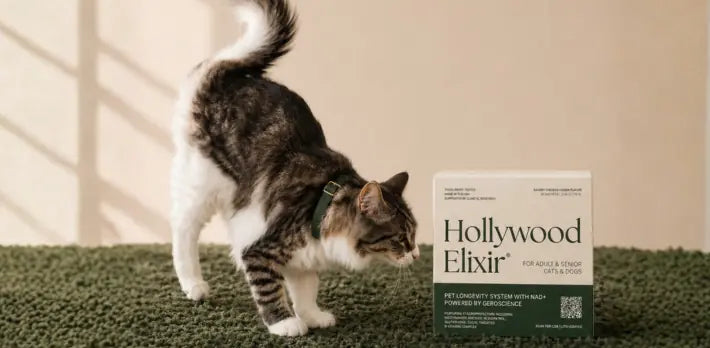
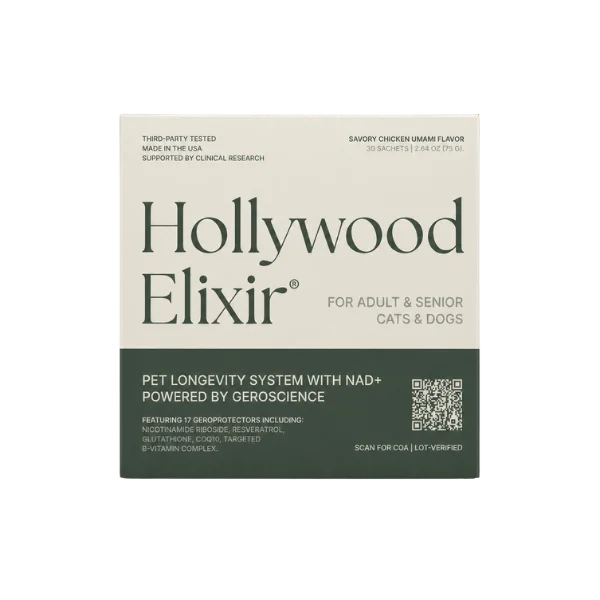
That is also the lens for judging any product. Look for disclosed amounts per serving, named forms, and third-party testing you can actually look up. A daily system like Hollywood Elixir, for example, lists its actives on the label — whey protein isolate at 250 mg per sachet alongside NAD+ and antioxidant support — and mixes into food for cats who do not need another treat. Whey powder stays a narrow tool for specific moments; a readable daily routine is what you keep using.
“Longevity is a network problem; single ingredients rarely carry the whole answer.”
Educational content only. This material is not a substitute for veterinary advice. Always consult your veterinarian about your dog’s specific needs. These statements have not been evaluated by the Food and Drug Administration. Products mentioned are not intended to diagnose, treat, cure, or prevent any disease.
Glossary
- Whey Protein: A dairy-derived protein fraction, often dried into powder, valued for essential amino acids.
- Whey Concentrate: Whey with more residual lactose and fat than isolate; may be less tolerated in sensitive cats.
- Whey Isolate: More purified whey with higher protein percentage and typically lower lactose.
- Hydrolyzed Whey: Whey broken into smaller peptides; sometimes used for easier digestion.
- Essential Amino Acids: Amino acids cats must obtain from diet because they cannot synthesize enough internally.
- Obligate Carnivore: A species, like cats, that relies on animal-based nutrients and specific amino acids.
- Complete And Balanced: A diet formulated to meet established nutrient requirements when fed as directed.
- Diet Displacement: When supplements or treats reduce intake of nutritionally complete food.
- Food Sensitivity: Non-allergic adverse response to an ingredient, often presenting as GI upset or itchiness.
Related Reading
Aging & Senior Cat Guidance
• Cat Age Calculator: Cat Years to Human Years
• Lethargy in Cats
• Senior Cat Not Eating
• Cat Drinking A Lot
• Why Is My Senior Cat Withdrawn?
Healthy Aging Support
• NAD+ for Cats
• NMN for Cats
• Vitamins For Older Cats
• Senior Cat Food
References
Sun M. Considerations on amino acid patterns in the natural felid diet: a review. PubMed Central. 2024. https://pmc.ncbi.nlm.nih.gov/articles/PMC11603590/
Richards T. A Comparative Analysis of Creatine, Creatinine, Amino Acid Concentrations and Indispensable Amino Acid Scores of Grain-Free and Grain-Inclusive Commercial Extruded Adult Cat Foods. PubMed Central. 2025. https://pmc.ncbi.nlm.nih.gov/articles/PMC12451408/
Vasconcelos. Whey protein supplementation and its potentially adverse effects on health: a systematic review. PubMed. 2021. https://pubmed.ncbi.nlm.nih.gov/32702243/
Tycholis TJ. Phenylalanine flux and gastric emptying are not affected by replacement of casein with whey protein in the diet of adult cats consuming frequent small meals. PubMed. 2014. https://pubmed.ncbi.nlm.nih.gov/25266643/
Ahmed. Bioaccumulation of heavy metals in some commercially important fishes from a tropical river estuary suggests higher potential health risk in children than adults. Nature. 2019. https://www.nature.com/articles/s41598-021-00467-4
Summers S. Evaluation of iron, copper and zinc concentrations in commercial foods formulated for healthy cats. PubMed Central. 2022. https://pmc.ncbi.nlm.nih.gov/articles/PMC10812249/
Hussein. Toxicity study and blood pressure–lowering efficacy of whey protein concentrate hydrolysate in rat models, plus peptide characterization. 2020. https://www.sciencedirect.com/science/article/pii/S0022030219311270
DeBeer. A Review of Pet Food Recalls from 2003 Through 2022. 2024. https://www.sciencedirect.com/science/article/pii/S0362028X23068837
Watson. Drivers of Palatability for Cats and Dogs-What It Means for Pet Food Development. Springer. 2023. https://link.springer.com/article/10.1007/s12011-025-04680-4
Boirie. Slow and fast dietary proteins differently modulate postprandial protein accretion. Springer. 1997. https://link.springer.com/article/10.1186/s12917-014-0177-8
FAQ
What is whey protein, and why consider it for cats?
Whey is a milk-derived protein rich in essential amino acids. In cats it’s sometimes considered as a compact way to add protein density without increasing meal size, and it’s best treated as a targeted add-on rather than a replacement for complete food. If your goal is broader aging support rather than one nutrient, Hollywood Elixir™ is a food-mixed routine that already includes whey protein isolate at 250 mg alongside its other actives.
Is whey protein for cats generally safe in small amounts?
For many healthy adult cats, small amounts are tolerated, but individual response varies. Reviews emphasize that adverse effects can occur and depend on health status and context.
If your cat has chronic GI issues, kidney concerns, or is on multiple medications, make the decision with your veterinarian.
When might a cat benefit from added whey protein?
The most plausible use is supporting lean mass when intake is inconsistent—older cats, picky phases, or recovery periods—because whey supplies essential amino acids used for tissue maintenance(Sun M, 2024).
It’s still important to address the reason intake changed, not only the protein number.
Can whey protein upset a cat’s stomach or stool?
Yes. Soft stool, gas, or food refusal are common signs that the addition isn’t agreeing with your cat. Sensitivity can relate to residual lactose, added flavors, or simply a sudden diet change(Summers S, 2022).
Start tiny, mix thoroughly, and stop if symptoms appear.
Is a whey protein supplement for cats necessary on good food?
Often, no. Complete-and-balanced diets are designed to meet protein and amino acid needs, and adding extra can complicate the overall nutrient picture.
Where supplements can still make sense is when appetite is unreliable or a veterinarian is targeting lean-mass support.
How should I introduce whey protein for cats safely?
Introduce it slowly and treat it like a tolerance trial. Mix a very small amount into a small portion of wet food, confirm acceptance, then scale cautiously over several days while watching stool and appetite.
If your cat has medical conditions or is on a prescription diet, ask your veterinarian before starting.
What cats should avoid whey protein supplements entirely?
Cats with known dairy intolerance, persistent GI disease, or a history of adverse reactions to new foods are poor candidates. Cats with kidney disease also need individualized, veterinarian-guided protein decisions rather than casual add-ons.
Can whey protein interact with medications or prescription diets?
It can. Concentrated supplements may change overall nutrient intake and can complicate carefully designed prescription diets. Reviews highlight the importance of assessing interactions with other dietary components or medications before adding whey.
Bring the exact product label to your veterinarian so the plan stays coherent.
Is whey protein powder for cats better than treats?
Powder mixed into food can be easier to control and less likely to add unnecessary fillers. Treat formats often include flavorings or binders that can be harder on sensitive cats, even when the whey amount is small(Summers S, 2022).
If you do use treats, keep them occasional and count them toward daily intake.
What should I look for in the best whey protein for cats?
Look for unflavored formulas with minimal additives and clear labeling. Avoid sweeteners and “performance” blends designed for humans. The goal is a simple protein source that doesn’t introduce unnecessary ingredients.
Also consider tolerance: the best product is the one your cat can eat consistently without GI changes.
Does whey protein change digestion speed in adult cats?
In a study context, including whey in adult cat diets did not affect gastric emptying rate, suggesting it can be digested without obvious changes in that parameter(Tycholis TJ, 2014).
Real-world tolerance still varies, especially with flavored products or abrupt changes.
How quickly might I see results after adding whey?
If whey helps, the first “result” is usually practical: better meal acceptance or steadier intake. Changes in body condition take longer and depend on total calories, underlying health, and consistency, not just the added protein.
If weight loss is ongoing, don’t wait on supplements—seek veterinary evaluation.
Are whey protein supplements for cats helpful for senior cats?
They can be, especially when seniors eat smaller meals or struggle to hold lean mass, since aging cats often face appetite shifts and body-composition changes that make protein density more relevant. But seniors also have higher odds of kidney or GI disease, so the decision should be individualized with your vet. For owners wanting broader aging support than protein alone, Hollywood Elixir™ pairs whey protein isolate with antioxidant and cellular-energy actives.
Can kittens have whey protein added to their food?
Usually, kittens don’t need add-on protein if they’re eating an appropriate growth diet. Supplementing can unbalance intake and may reduce consumption of complete kitten food, which matters during development.
If a kitten isn’t thriving, the priority is veterinary assessment rather than DIY supplementation.
Is whey protein for cats the same as for dogs?
No. Cats are obligate carnivores with distinct amino acid requirements and different feeding behavior. A product tolerated by dogs may still be a poor fit for cats due to flavorings, sweeteners, or serving size assumptions.
If you use whey at all, choose a cat-appropriate approach and keep it modest.
Could whey protein worsen kidney issues in cats?
Cats with kidney disease need individualized nutrition planning, and adding concentrated protein without guidance can conflict with a veterinarian’s goals. Safety discussions emphasize evaluating dosing and overall context before use.
If kidney values are borderline or changing, don’t self-supplement—ask your veterinarian.
What side effects suggest I should stop whey immediately?
Stop if you see repeated vomiting, diarrhea, marked lethargy, or sudden food refusal. Because adverse effects can vary by individual, it’s better to stop early than to “push through” and risk dehydration or appetite loss.
If symptoms persist, contact your veterinarian promptly and bring the product label.
How do I avoid unbalancing my cat’s diet with whey?
Keep whey additions small and ensure your cat still eats the majority of calories from complete-and-balanced food. The main risk is displacement—less of the diet that carries vitamins and minerals, more of a single macronutrient.
If you need longer-term support, ask your veterinarian about a nutrition plan rather than stacking supplements.
Are whey protein treats for cats a good daily habit?
Usually not. Treats are easy to overuse, and many include extra ingredients that can be more problematic than the whey itself. They can also train a cat to hold out for higher-reward foods, reducing balanced meal intake.
If you use them, keep them occasional and purpose-driven.
What does research say about whey use in cats?
Cat-specific data is limited, but there are useful findings. In adult cats, replacing casein with whey did not alter phenylalanine flux in the studied setting, supporting basic feasibility.
At the same time, broader reviews emphasize variability and potential adverse effects with supplementation, reinforcing the need for individualized decisions.
When should I call my vet before adding whey protein?
Call before adding it if your cat is losing weight, vomiting, has chronic diarrhea, has kidney disease, or is on a prescription diet or multiple medications. Guidance matters because dosing and interactions should be evaluated in context.
If your veterinarian agrees it’s reasonable, introduce slowly and monitor.

Discover LPL-01: How This Fits Into a Larger Feline Longevity System
Aging in cats unfolds quietly. It’s not driven by a single failure, but by gradual shifts across interconnected systems — cellular energy, oxidative balance, immune tone, and tissue integrity — each influencing the others over time.
This article explores one layer of that system. To understand what actually shapes long-term health, you need to step back and look at how these layers interact.
Start with the underlying science:
- Feline Geroscience Framework →
A structured view of how aging progresses across cellular energy, inflammation, and resilience systems. - Senior Biological Defense Coverage (BDC) Modeling →
A systems-level map of which biological pathways decline first, and how layered interventions can support them. - 2026 Market Research: Best Cat Longevity Supplements →
A feline-specific review of longevity supplements. 2026 Industry report created by LPL-01 Research. - LPL-01 Standard →
The formulation system that translates these models into real-world supplementation—covering multiple pathways in a coordinated way.
Essential Summary
Why is whey protein for cats important?
Whey protein for cats can be safe in small, well-chosen amounts, but it’s best viewed as a targeted add-on rather than a daily cornerstone. The main upside is concentrated amino acids; the main risks are digestive upset, diet imbalance, and poor fit for certain medical conditions. A veterinarian-guided, slow introduction keeps the decision grounded.
If you’re exploring whey as one piece of a bigger longevity plan, Hollywood Elixir is designed for system-level support—helping the metabolic network that shapes energy, resilience, and healthy aging—so you’re not relying on a single powder or treat to carry the whole story.
Longevity Core
Hollywood Elixir®
★★★★★(313)
More good years, starting now — steady energy, engagement, and a pet who keeps showing up fully, every day.
Starting at $89/mo
Hollywood Elixir is amazing! She put back on 5 lbs to a healthy weight, her eyes are shiny, her coat is beautiful!
— Jessie
She hopped up onto the windowsill again for the first time in years.
— Charlie
Considering whey protein for cats?
If you're looking for whey protein for cats
If you’re considering whey protein for cats, keep the decision narrow and the expectations calm. Choose an unflavored product with minimal additives, introduce it slowly, and watch the basics: stool, appetite, hydration, and overall comfort. Avoid using whey to “patch over” unexplained weight loss; that deserves a veterinary workup. And remember the bigger picture: even when protein needs are met by diet, aging still affects energy, recovery, and resilience across the whole body. That’s why many owners pair careful feeding with system-level support like Hollywood Elixir—a way to support the broader metabolic network rather than relying on a single powder or treat.
Veterinary Insights

Learn about how our DVMs think about cat aging
Dr. JoAnna Pendergrass DVM


Longevity Core
Hollywood Elixir®
★★★★★(313)
More good years, starting now — steady energy, engagement, and a pet who keeps showing up fully, every day.
Starting at $89/mo
Wellness Tools
Explore your cat’s changing needs over time


Related Reading
The interest in whey protein for cats usually comes from a quiet worry: a cat who seems a little thinner, a little pickier, a little less springy than last year. Whey is familiar to humans, easy to buy, and easy to measure—so it feels like a tidy solution.
