





PURR-001 for Cats: An Early Look at a Muscle-Loss Drug

What The Cat Health Company's 35-cat trial found, what's reportedly in the capsule, and what to do about muscle loss now.

By La Petite Labs Editorial 10 min read

As Seen On

Woman cuddling an orange-and-white cat and a silver tabby while holding a Hollywood Elixir box
Contents

PURR-001 is an experimental once-weekly capsule from The Cat Health Company for age-related muscle loss (sarcopenia) in older cats, and it isn't approved anywhere. In the company's 35-cat, 12-week trial, treated cats gained more weight and back muscle than placebo cats. The results are a preprint, not peer reviewed.

Here's what was measured, what's reportedly in it, why muscle matters more than weight, and what you can do for an older cat now.

La Petite Labs publishes this guide and makes Hollywood Elixir, a supplement for dogs and cats. We're not affiliated with The Cat Health Company or any company named here.

What is PURR-001?

PURR-001 is an experimental drug for primary age-related sarcopenia, the muscle loss that comes with age in cats with no other disease to explain it.1 It's a capsule given by mouth once a week, built to act on three aging pathways at once: nutrient sensing, mild insulin resistance and chronic mTOR activity.1

PURR-001 is the first clinical-stage program from The Cat Health Company. As of November 2026, it hasn't received marketing authorization anywhere.2

PURR-001 at a glance

What it is
An investigational once-weekly capsule for age-related muscle loss in cats
Developer
The Cat Health Company, registered in Delaware with a subsidiary in Bucharest, Romania
What's in it
An mTOR inhibitor (reportedly low-dose rapamycin), mirtazapine and acarbose
Evidence
One 35-cat, 12-week, placebo-controlled trial, posted as a company preprint
Headline result
Body mass +7.40% vs +1.14% on placebo; back muscle +22.75% vs +9.00% (15 cats measured)
Status
Not authorized for sale anywhere
When available
No date announced
Best step today
A vet check, a muscle condition score and a look at diet

What the PURR-001 trial measured, and what it can't tell us

What was measuredPURR-001 vs placeboWhat it suggestsWhat it can't tell us
Body mass (27 cats)+7.40% vs +1.14%Treated cats gained more weight in 12 weeksWhether the gain was muscle, fat or fluid
Back muscle height on ultrasound (15 cats)+22.75% vs +9.00%Treated cats' back muscles grew moreWhether strength, mobility or activity improved
Bloodwork at weeks 0, 6 and 12No treatment effect on any valueNo sign of organ toxicity over 12 weeksRare or long-term side effects
Appetite and activityNot formally measuredOwners reported increases anecdotallyHow much of the gain came from eating more
Deaths over about a yearOne treated cat, one placebo catFewer than the roughly four expected at these agesWhether a rare reaction played a part
LifespanNot measuredNot studiedWhether PURR-001 helps cats live longer

Competitor label and pricing facts checked November 11, 2026. Sources are listed in the References section below.
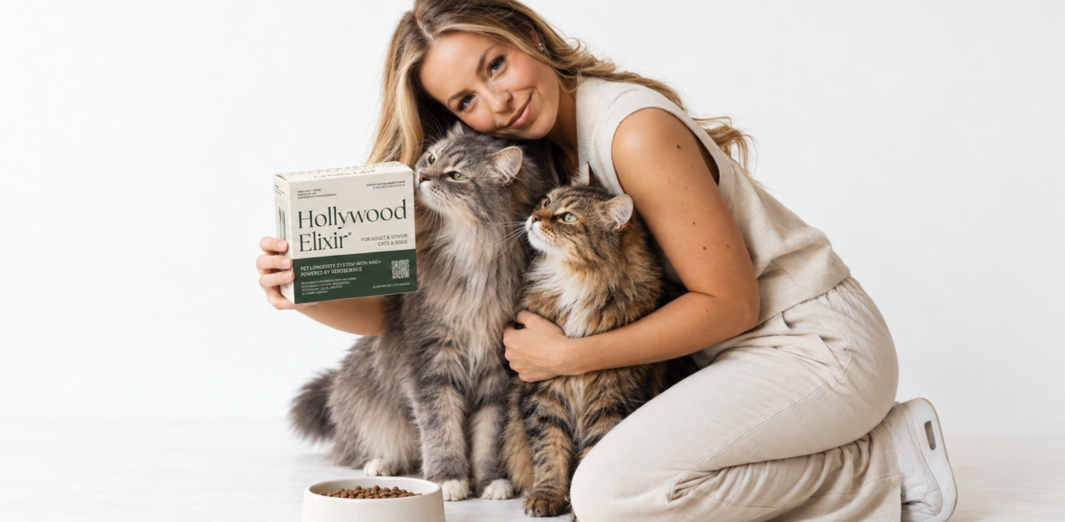
Woman kneeling with two long-haired tabby cats while holding a Hollywood Elixir box beside a food bowl

Who makes PURR-001?

The Cat Health Company makes PURR-001. It's a biotech founded in 2024 to develop medicines for aging cats, registered in Delaware with a subsidiary in Bucharest, Romania.31 Its co-founders are Alex Voda, the CEO, and Alex Bacita, the COO.4

In October 2025 it raised $1.2 million in a round led by Portfolia's Active Aging & Longevity Fund II, with 100 Plus Capital, Alex Zhavoronkov and Early Game Ventures also investing.3 The trial was run with veterinary practices in Romania, and chemists at a Bucharest technical university developed the formulation.1

Woman exercising beside a tabby cat, with a Hollywood Elixir box and food bowl on a small table

What is in PURR-001?

According to the company's preprint, each PURR-001 capsule holds a nominal 0.5 mg of an mTOR inhibitor, 2 mg of mirtazapine and 10 mg of acarbose.1 The preprint calls the mTOR inhibitor a "rapalog," a rapamycin-type drug, without naming it. Trade press reports, citing the lead author's public comments, that it's low-dose rapamycin.5

Mirtazapine is an appetite stimulant already used in cats.16 The preprint notes that rapamycin can raise blood sugar slightly and that acarbose works against high blood sugar.1 For the research on rapamycin itself, see our rapamycin for cats guide.

Orange-and-white cat reaching toward a woman holding a Hollywood Elixir box while sitting in a chair

How was PURR-001 tested?

PURR-001 was tested in a randomized, double-blind, placebo-controlled trial of 35 older cats, 25 pets and 10 shelter cats, for 12 weeks.1 To enroll, cats had to be at least 9 years old and either weigh 3.5 kg (about 7.7 lb) or less, show mild to severe muscle loss on the WSAVA muscle condition chart, or be underweight on body condition score.1

Cats with serious disease that could explain muscle loss, such as kidney disease, hyperthyroidism, cancer or heart failure, were excluded.1 Romania's veterinary regulator, ANSVSA, approved the protocol in March 2025, and staggered recruitment kept the trial running into August 2026. The main measures were body weight and the height of the back (epaxial) muscles on ultrasound, at the start and at week 12.1

Gray-haired man holding a Hollywood Elixir box while two cats rest beside him in an armchair

Does PURR-001 work?

In this one small trial, treated cats gained more weight and muscle than placebo cats, according to the company. Of the 35 cats, 27 had finished when the data were frozen: 14 on PURR-001 and 13 on placebo. Body mass rose by an average of 7.40% on PURR-001 and 1.14% on placebo.1

Back-muscle height was measured by ultrasound in only 15 cats, partly because owners objected to having fur clipped. It rose 22.75% on PURR-001 and 9.00% on placebo.1 Both differences were statistically significant, but these are the company's own results, analyzed by its own scientists.12

PURR-001 is an experimental drug for muscle loss in older cats. It isn't approved anywhere.

What do the PURR-001 results actually tell us?

The PURR-001 trial answered a few questions and left others open.1 Here's what each result can and can't support:

The placebo cats' back muscles grew 9% too. The Underbite suggested that may reflect how cats were selected or the extra care of being in a trial.5

Tabby cat looking up at a Hollywood Elixir sachet held above it, with the product box on a small table

Why does muscle matter more than weight?

Because one of PURR-001's ingredients is an appetite stimulant, and eating more adds weight on its own. Mirtazapine is already FDA-approved for cats as Mirataz, an ear ointment indicated for body weight gain in cats with a history of weight loss.6 In Mirataz's own trial, cats gained 3.94% of their body weight in two weeks, against 0.41% on a placebo ointment.6

The PURR-001 trial also let cats enroll on low body weight alone, so some started thin.1 Weight gain in those cats wouldn't show whether muscle was rebuilt. The muscle measure is the more telling one, but it covered only 15 cats, and the trial didn't test the three drugs separately, so it can't say which one did what.1

Hand gently petting an orange-and-white cat beside a food bowl and Hollywood Elixir box

Is PURR-001 safe for cats?

No safety problem showed up in the 12-week trial, but it was too small to rule out rare ones. Bloodwork stayed stable, and out-of-range values were about as common on PURR-001 as on placebo (11.1% vs 10.4%). Brief bouts of vomiting, diarrhea and behavior change occurred in both groups.1

Two cats died over about a year of trial supervision. A 10-year-old cat on PURR-001 died in week 9 of severe pancreatitis, about two months after being treated for an E. coli infection, and a placebo cat was euthanized for a tumor at an old vaccination site.1 The authors say the trial wasn't powered to rule out rare reactions, and they advise caution in cats with a history of repeated severe E. coli infections and pancreatitis.1

Man holding a Hollywood Elixir box beside a black cat, an orange tabby and a food bowl

Has the PURR-001 trial been peer reviewed?

No. The results were posted on August 17, 2026, as a preprint on Zenodo, an open research repository, so no independent reviewers have checked them.1 We found no peer-reviewed paper as of November 2026. The authors who work for The Cat Health Company hold stock or options in it, and the product is patent-pending.1

The preprint said cat-level data and analysis code would be made public in September 2026.1 As of November 2026, the Zenodo record still held only the version 1.0 preprint. The Underbite put it plainly: "Preprint is the operative word."5

Does PURR-001 help cats live longer?

That hasn't been tested. PURR-001's trial lasted 12 weeks and measured weight and back muscle, not lifespan, strength or mobility.12 The authors list multi-year follow-up for deaths, muscle-strength tests and activity tracking as future work.1

Muscle does matter for survival. In a study of 209 aging pet cats, those with muscle loss in middle age had about twice the risk of dying during follow-up.7 That's an association, though, and it doesn't show that rebuilding muscle with a drug would add time.

Weight gain proves little when one ingredient is an appetite stimulant. The muscle measure is what counts.

Woman holding a Hollywood Elixir box toward a brown cat perched on the back of a sofa

When will PURR-001 be available?

There's no date. PURR-001 hasn't been authorized for sale anywhere, and The Cat Health Company hasn't given an approval date.2 The company has said it expected to submit data for conditional approval in the second half of 2026, and we found no record of an approval as of November 2026.5

In September 2026 it announced a licensing deal with Vetro Solutions, a European veterinary drug company, to handle manufacturing at scale, the regulatory dossier and distribution in Europe. Terms weren't disclosed, and the company kept the US and other rights.2 Don't try to recreate PURR-001 from prescription drugs: decisions about mirtazapine or rapamycin belong with your vet.

Woman leaning toward a fluffy orange cat beside a Hollywood Elixir box and green food bowl

What is sarcopenia in cats?

Sarcopenia in cats is the loss of muscle that comes with age, without an underlying disease to explain it. Cachexia is different: it's muscle wasting driven by disease, such as kidney disease, hyperthyroidism, cancer or heart failure, and the two often overlap in older cats.1 Our sarcopenia in older cats guide covers it in depth.

Muscle loss is common. In a long-term study of 209 aging pet cats, muscle scores began to slip between ages 7 and 10 and then fell steeply, and after age 10 mild muscle loss became more likely than none.8 Cats that developed chronic disease declined faster.8

Tabby cat licking its nose beside a food bowl and Hollywood Elixir box

Why is my older cat losing muscle along its back?

Muscle loss in older cats usually shows first along the spine, because the epaxial muscles beside the backbone tend to shrink first.9 Loss in a single leg is different and can come from the cat not using that leg.9 Either way, it's a reason for a vet visit rather than waiting to see.

Muscle loss can be the first visible sign of disease, because cats hide illness well. In one study cited by dvm360, cats with kidney disease began losing weight about three years before diagnosis.9 That's why the PURR-001 trial screened out cats with kidney disease, hyperthyroidism and other illnesses before calling their muscle loss age-related.1

How can I tell if my older cat is losing muscle?

Vets check with a muscle condition score, which WSAVA, the World Small Animal Veterinary Association, keeps separate from body condition: it assesses muscle, which disease or aging can reduce, rather than fat.10 Your vet feels the muscles along the spine first, then the shoulder blades and skull as loss progresses.9

The grades run from normal through mild, moderate and marked loss. In a normal cat, the bumps of the spine can't be felt even with pressure; with moderate loss they stand out without pressure.9 An overweight cat can still be losing muscle, so the scale alone can miss it.9 If your cat's spine feels bonier than it used to, mention it at the next visit.

What should I do if my senior cat is losing muscle?

Start with your vet, because muscle loss can be the first sign of disease.9 Ask for a muscle condition score at each visit and for bloodwork to look for causes such as kidney disease or hyperthyroidism. Feline senior care guidelines call for checkups at least every six months for cats aged 10 to 15, and every four months for healthy cats over 15.11

Between visits, weigh your cat on the same scale every few weeks and note any change in appetite or activity. Don't start an appetite stimulant or any other prescription drug without your vet. Our guide to natural alternatives to longevity drugs for cats covers what owners can do without a prescription.

Tabby cat sitting at a table with a food bowl and Hollywood Elixir box

Does an older cat need more protein?

For geriatric cats, generally yes. A review of nutrition in aging cats concluded that geriatric cats need more dietary energy and protein.12 Older cats can also digest food less efficiently: about a third of cats over 12 may digest fat less well, and nutrient-dense, highly digestible diets are suggested for geriatric cats.13

Diet changes aren't one-size-fits-all. Cats with chronic kidney disease, for example, have their own dietary needs, so ask your vet before switching foods.12 Our senior cat diet guide goes through what to feed.

Woman cuddling a silver tabby and a cream-colored cat while holding a Hollywood Elixir box

How does PURR-001 compare with Felycin-CA1 and rapamycin?

PURR-001 and Felycin-CA1 both involve rapamycin-type drugs, but they're very different products. Felycin-CA1 is a sirolimus tablet the FDA conditionally approved in March 2025 for one heart condition, subclinical hypertrophic cardiomyopathy.14 PURR-001 reportedly pairs low-dose rapamycin with two other drugs, targets muscle loss, and isn't authorized anywhere.52 Our Felycin-CA1 guide covers it in full.

Neither is a longevity drug, and as far as we can find, no drug is approved to extend a cat's life. Our Loyal for cats guide explains why the dog longevity drugs don't carry over to cats, and our rapamycin for cats guide covers what rapamycin has and hasn't shown.

Where daily nutrition fits

We make Hollywood Elixir, a daily nutrition powder for adult and senior dogs and cats. It's built around nicotinamide riboside, an NAD+ precursor, with CoQ10, glutathione and 14 more actives, and every active amount is printed on the label. It's a supplement, not a PURR-001 substitute: it isn't designed to do what PURR-001 is being tested to do, and it hasn't been tested for lifespan. Its case is practical: one daily sachet stirred into food (half a sachet for cats under 7 lb) instead of a cupboard of separate supplements. If your cat is losing muscle, see your vet first, and check with them before adding it or any other supplement. See the full formula and serving guide.

Muscle loss can be the first sign of disease, so an older cat losing muscle needs a vet now, not a wait for PURR-001.

Educational content only. This material is not a substitute for veterinary advice. Always consult your veterinarian about your cat’s specific needs. These statements have not been evaluated by the Food and Drug Administration. Products mentioned are not intended to diagnose, treat, cure, or prevent any disease.

Glossary

Sarcopenia: age-related loss of muscle with no other disease to explain it.

Cachexia: muscle wasting caused by disease, such as kidney disease or cancer.

Epaxial muscles: the muscles running along both sides of the spine.

Muscle condition score: a vet's hands-on grade of muscle, from normal to marked loss.

Preprint: a study posted publicly before peer review.

Mirtazapine: an appetite-stimulating drug used in cats, sold for cats as Mirataz.

Related Reading

References

Sources and further detail

  1. Bacita A, Duagi J, Marian I-C et al. (17 Aug 2026), *A randomized double-blind placebo-controlled clinical trial of a multi-target therapeutic against primary age-related feline sarcopenia: PURR-001* (preprint v1.0, not peer reviewed), Zenodo
  2. Longevity.Technology (18 Sept 2026), Cat sarcopenia drug moves toward market
  3. Longevity.Technology (8 Oct 2025), Cat Health Company secures $1.2m to extend feline healthspan
  4. The Cat Health Company, *Company website and team* (checked November 2026)
  5. The Underbite (18 Aug 2026), A feline muscle-loss drug clears its first trial
  6. Dechra Veterinary Products (label rev. January 2024), *Mirataz (mirtazapine transdermal ointment) prescribing information*, DailyMed
  7. Pye CR, Dowgray NJ, Eyre K et al. *Frontiers in Veterinary Science* (2026). Patterns of morbidity, multimorbidity, and mortality in aging cats: findings from seven years of the Cat Prospective Aging and Welfare Study
  8. Pye CR, Dowgray NJ, Eyre K et al. *Frontiers in Veterinary Science* (2025). Longitudinal changes in bodyweight, body condition, and muscle condition in aging pet cats
  9. Yau M. dvm360 (9 Apr 2025), Muscle condition scoring in cats
  10. World Small Animal Veterinary Association, *Global Nutrition Guidelines and toolkit* (checked November 2026)
  11. American Association of Feline Practitioners (2021), AAFP releases updated feline senior care guidelines
  12. Laflamme D, Gunn-Moore D. *Veterinary Clinics of North America: Small Animal Practice* (2014). Nutrition of aging cats
  13. Laflamme DP. *Veterinary Clinics of North America: Small Animal Practice* (2005). Nutrition for aging cats and dogs and the importance of body condition
  14. FDA (14 March 2025), FDA conditionally approves drug for management of ventricular hypertrophy in cats

FAQ

Is PURR-001 FDA approved?

No. As of November 2026, PURR-001 isn't approved by the FDA or authorized by any other regulator. It's an investigational drug that has completed one small trial.

Does PURR-001 contain rapamycin?

Reportedly, yes. The company's preprint lists an unnamed mTOR inhibitor, a rapamycin-type drug, alongside mirtazapine and acarbose, and trade press reports, citing the lead author, that it's low-dose rapamycin.

Can I buy PURR-001 for my cat?

No. It hasn't been authorized for sale anywhere, so vets and pharmacies can't supply it. Be wary of anyone who offers it.

How many cats were in the PURR-001 trial?

Thirty-five cats aged 9 and older, 25 pets and 10 shelter cats, were randomized to PURR-001 or placebo for 12 weeks. Twenty-seven had finished when the data were analyzed, and back muscle was measured by ultrasound in 15.

What is The Cat Health Company?

It's a biotech founded in 2024 to develop medicines for aging cats, registered in Delaware with a subsidiary in Bucharest, Romania. PURR-001 is its first clinical-stage program.

Who is Vetro Solutions?

Vetro Solutions is a European veterinary pharmaceutical company with GMP manufacturing. In 2026 The Cat Health Company licensed PURR-001 to Vetro to handle manufacturing, regulatory filings and distribution in Europe, on undisclosed terms.

Is mirtazapine approved for cats?

Yes. Mirtazapine is FDA-approved for cats as Mirataz, an ointment applied to the ear for body weight gain in cats with a history of weight loss. It's a prescription drug, so use it only as your vet directs.

Can sarcopenia in cats be reversed?

No drug is approved for age-related muscle loss in cats, and PURR-001 is still investigational. The first steps are a vet check for any disease behind the muscle loss and a diet with enough protein for an older cat.

What is a normal muscle condition score for a cat?

Normal means the bumps of the spine can't be felt even with pressure. Mild, moderate and marked loss follow as the spine, and then the shoulder blades and skull, become easier to feel.

Does sarcopenia shorten a cat's life?

In a study of 209 aging pet cats, those with muscle loss in middle age had about twice the risk of dying during follow-up. That's an association, so it doesn't prove muscle loss itself caused the deaths.

Orange-and-white cat beside a Hollywood Elixir box held in a person's hand

Discover LPL-01: How This Fits Into a Larger Feline Longevity System

Aging in cats unfolds quietly. It’s not driven by a single failure, but by gradual shifts across interconnected systems — cellular energy, oxidative balance, immune tone, and tissue integrity — each influencing the others over time.

This article explores one layer of that system. To understand what actually shapes long-term health, you need to step back and look at how these layers interact.

Start with the underlying science: