





Natural Alternatives to Longevity Drugs for Cats

Why no supplement copies rapamycin, Felycin-CA1 or LOY-002, what helps cats live longer, and how to judge the supplements people ask about.

By La Petite Labs Editorial 10 min read

As Seen On

Woman cuddling an orange-and-white cat and a silver tabby while holding a Hollywood Elixir box
Contents

No supplement or food has been shown to do what cat and dog longevity drugs are being tested for, or to extend a cat's life. What has evidence is plainer: vet visits twice a year from age 10, early kidney checks, a healthy weight, dental care and traffic safety.

Here's how each drug compares with its "natural" alternative, what the cat evidence says about popular supplements, and how to choose one safely.

La Petite Labs publishes this guide and makes Hollywood Elixir, a supplement for dogs and cats. We're not affiliated with Loyal, TriviumVet, The Cat Health Company, IAM CAT or any company named here.

Is there a natural alternative to longevity drugs for cats?

No, not one that has been shown to work. No drug is approved to extend a healthy cat's life either. The drugs closest to that idea each target one problem: Felycin-CA1 (rapamycin) for early heart disease, PURR-001 for muscle loss and FeliAIM for kidney disease.256 No supplement or food has been shown to do what any of them does.

What has evidence is ordinary care that catches the problems that cut cats' lives short, and that's most of this guide. Our Loyal for cats guide covers the drug side in more depth.

Natural alternatives for cats at a glance

Natural alternative to rapamycin or Felycin-CA1?
None shown in cats; Felycin-CA1 is rapamycin itself
Natural LOY-002 for cats?
No; LOY-002 is a dog drug, and it isn't approved
Best-supported habit
Vet visits at least every six months from age 10
Most useful early check
Kidney screening: it found disease in 8% of healthy-looking older cats
Weight
Cats just above ideal had the lowest death risk in a 2,609-cat study
Supplement with the most cat data
Omega-3s, for joint stiffness in a 16-cat trial
NAD+ supplements
No published trial in cats found
Never give cats
Alpha-lipoic acid or concentrated essential oils

Each cat longevity drug and its closest natural idea

Drug and its targetClosest "natural" ideaEvidence in cats
Felycin-CA1 (rapamycin): heart-wall thickening in early HCM"Natural rapamycin" or mTOR supplementsNo cat studies found; rapamycin itself was tested in 43 cats for heart-wall thickness, not lifespan
LOY-002: aging metabolism, in senior dogs onlyKeeping a healthy weightIn 2,609 cats, the lowest death risk was at a body condition score of 6 of 9
PURR-001: age-related muscle lossMuscle checks at every vet visitNo supplement shown to rebuild muscle in older cats; guidelines call for muscle scoring at each exam
FeliAIM: chronic kidney diseaseFoods branded "for AIM"No trial shows a food copies the injected protein; renal diets are linked to longer survival
OKV-119 (exenatide implant): obesityA vet weight plan97% of 413 overweight cats lost weight on a diet plan

Competitor label and pricing facts checked November 11, 2026. Sources are listed in the References section below.
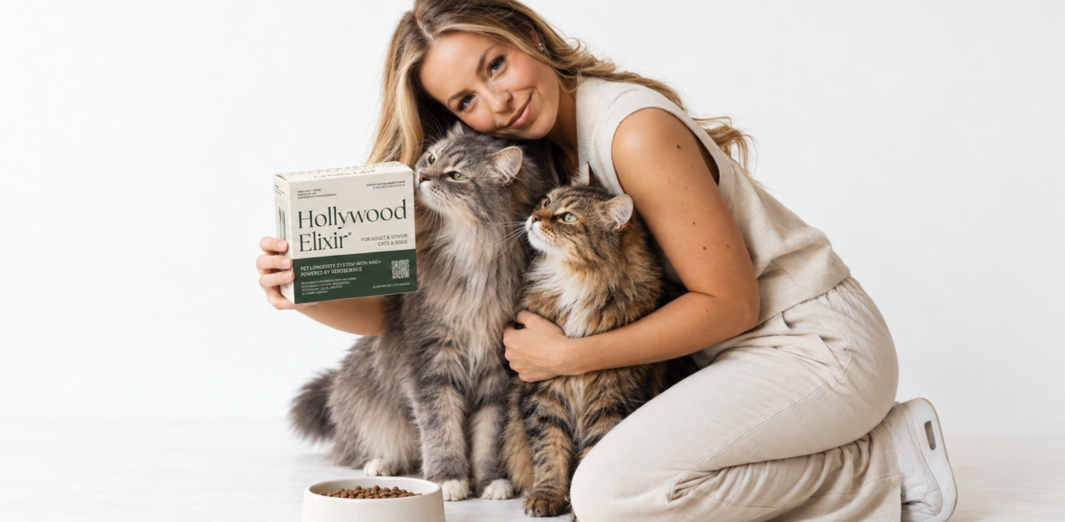
Woman kneeling with two long-haired tabby cats while holding a Hollywood Elixir box beside a food bowl

Is there a natural LOY-002 for cats?

No. LOY-002 is a daily pill that Loyal is developing for senior dogs, 10 and older and at least 14 lb. It isn't approved for any animal.1 Loyal says it targets age-related metabolic dysfunction by improving insulin sensitivity and lowering insulin.1

If LOY-002 is conditionally approved, FDA rules won't allow off-label use, so vets couldn't prescribe it for cats.3 The nearest everyday step to its metabolic idea is keeping a cat at a healthy weight, covered in chapter 7.

Woman exercising beside a tabby cat, with a Hollywood Elixir box and food bowl on a small table

What's the closest natural idea to each cat longevity drug?

Each drug below targets one problem. The middle column is what owners try instead, and the last column says what the cat evidence shows.

Felycin-CA1 was conditionally approved by the FDA in March 2025 for cats with subclinical hypertrophic cardiomyopathy (HCM). It's prescription-only and shouldn't be used in cats with liver disease or diabetes.2 Its main trial, RAPACAT, followed 43 cats for six months.4 Our Felycin-CA1 guide covers it in full.

PURR-001 is still investigational. In a company preprint of 35 older cats, body mass rose 7.4% on the drug against 1.1% on placebo, and the drug reportedly combines low-dose rapamycin with the appetite stimulant mirtazapine.5 See our PURR-001 guide. IAM CAT applied for approval of FeliAIM in Japan on April 24, 2026.6 One Japanese "for AIM" food line adjusts minerals and states that it doesn't treat kidney disease.7 Our AIM and cat kidney disease guide separates the drug from the foods. The weight, muscle and diet figures come from the studies in chapters 6 and 7.891011

Orange-and-white cat reaching toward a woman holding a Hollywood Elixir box while sitting in a chair

What helps a cat live longer?

The steps with evidence catch or prevent the problems that shorten cats' lives. In a seven-year study of 209 aging cats examined every six months, 84% developed dental disease, 82% had orthopedic abnormalities and 84% developed two or more health problems. Median life expectancy was 15.2 years.17

  • Vet visits on schedule, so problems are found early (chapter 5)
  • Kidney checks, because kidney disease is common and quiet at first (chapter 6)
  • A healthy weight, avoiding both obesity and unexplained loss (chapter 7)
  • Dental care, since mouth disease is the most common problem (chapter 8)
  • Water, especially once kidney disease starts (chapter 9)
  • Traffic safety, the leading cause of death in young cats in UK data (chapter 10)
Gray-haired man holding a Hollywood Elixir box while two cats rest beside him in an armchair

How often should an older cat see the vet?

At least every six months from age 10. The American Association of Feline Practitioners' 2021 senior care guidelines call for visits at least every six months for cats aged 10 to 15, and every four months for healthy cats over 15. Cats with chronic illness may need to be seen more often.12

The 2026 iCatCare kidney disease guidelines recommend screening from age 7, using weight checks, bloodwork and urine tests even in cats that seem well. They recommend yearly exams for cats aged 7 to 10.13

No supplement or food has been shown to do what cat and dog longevity drugs are being tested for.

Why does early kidney disease detection matter?

Chronic kidney disease is common, quiet at first and manageable when caught. Studies report it in 28% to 81% of cats over 12, and it was the most common cause of death in a UK study of cats aged 5 and older.13 Many cats are diagnosed at an advanced stage, because they show few signs early.13

Screening finds it. In two Belgian studies, routine checks found kidney disease at stage 2 or higher in 8% of older cats that seemed healthy. Managing it by stage can lead to longer survival and a good quality of life.13 Diet matters here: in a retrospective study, cats offered renal diets survived a median 16 months, against 7 months on ordinary food.11

Tabby cat looking up at a Hollywood Elixir sachet held above it, with the product box on a small table

What is a healthy weight for an older cat?

Slightly above ideal may be fine, but obesity and unexplained weight loss aren't. In 2,609 cats at an Australian clinic, cats whose highest body condition score was 6 of 9, just above ideal, had the lowest risk of death. Cats that never went above 5, and cats that reached 9, had higher risk.8 US records of 2.4 million cats showed a similar pattern: cats scored slightly overweight had a life expectancy at birth of 13.67 years, against 12.18 at ideal and 12.56 when obese.14

These studies look back at records, and thin cats can include sick ones, so they don't mean extra weight is good. Obesity still matters: Cornell says obese cats are up to four times more likely to develop diabetes.15 If your cat needs to lose weight, go slowly with your vet, because a sudden starvation diet risks fatty liver disease.16 Vets are also advised to score muscle condition at every exam.10

Hand gently petting an orange-and-white cat beside a food bowl and Hollywood Elixir box

Does dental care help cats live longer?

It hasn't been shown to add years, but dental disease is the most common problem in aging cats. In the seven-year study above, 84% of cats developed it.17 The 2019 AAHA dental care guidelines focus on reducing the pain and harm of periodontal disease, through exams, cleaning under general anesthesia and preventive care.18

Ask your vet to check your cat's mouth at every visit, and ask what home care is realistic for your cat.

Man holding a Hollywood Elixir box beside a black cat, an orange tabby and a food bowl

Does wet food or more water help cats?

For cats with kidney disease, more water helps, and wet food is one way to get it. The 2026 iCatCare guidelines list feeding a wet diet, adding water to food, water fountains and wide ceramic bowls among ways to raise a kidney cat's water intake. Dehydration can harm the kidneys.13

We found no trial showing that wet food extends the life of a healthy cat. Wet food does make it easier to feed set meals instead of leaving dry food out all day, which Cornell recommends for weight control.16

Do indoor cats live longer?

Indoor cats avoid the biggest killer of young cats: traffic. In a UK study of 2,444 cats, road accidents caused 45.6% of deaths in cats up to age 8.19 The authors say keeping cats indoors can cut that risk.

They add one caution. An indoor-only life still has to meet a cat's needs to play, explore, hunt, climb and scratch, or it can cause stress.19 Climbing space, scratching posts and daily play help an indoor cat stay active.

Routine kidney screening found disease in 8% of older cats that seemed healthy.

Woman holding a Hollywood Elixir box toward a brown cat perched on the back of a sofa

Do NAD+ supplements help cats?

They haven't been tested in cats. NAD+ is a molecule cells use to turn food into energy, and nicotinamide riboside (NR) and NMN are precursors the body can use to make it. As of November 2026, we found no published trial of NR or NMN in cats, so there's no cat evidence on benefit, safety or the right amount.

Mouse and human results can't simply be applied to cats. Our NAD+ for cats guide goes through what's known and what isn't, including for our own product.

Woman leaning toward a fluffy orange cat beside a Hollywood Elixir box and green food bowl

Do omega-3s help older cats?

There's some cat evidence, mainly for stiff joints. In a 10-week, placebo-controlled crossover trial of 16 cats with osteoarthritis, owners reported less stiffness and higher jumps when the food was supplemented with fish oil rather than corn oil.20 A systematic review found three randomized omega-3 trials in cats, with a benefit for osteoarthritis and a possible one for allergic skin disease.21

For kidneys, the evidence is indirect. In the retrospective renal-diet study, the diet linked to the longest survival had the most EPA, an omega-3 fat.11 The iCatCare guidelines note that renal diets may also help through added omega-3s.13 Ask your vet about the right amount and form for your cat.

Tabby cat licking its nose beside a food bowl and Hollywood Elixir box

Do antioxidants help cats live longer?

Antioxidants alone didn't, in the one cat lifespan study we found. Nestlé Purina fed 90 cats aged 7 to 17 one of three diets: a standard food, the same food with added vitamin E and beta-carotene, or a food with those antioxidants plus dried chicory root and a blend of omega-3 and omega-6 fats.22 Cats on the full blend lived about a year longer than cats on either of the other diets.22

Read it fairly. It was a company study of complete diets, not supplements, and we found no independent repeat. It points toward a complete senior diet, not an antioxidant pill.

Do probiotics help cats with kidney disease?

The evidence is thin. In the one controlled trial we found, 10 cats with kidney disease got either a probiotic-prebiotic product or a prebiotic alone, sprinkled on food for two months. Kidney blood values didn't differ between the groups.23 The maker recommended giving the capsules whole, so the trial tested the way many owners actually give it.23

The 2026 iCatCare guidelines list prebiotics, probiotics and binders among ways to reduce kidney waste toxins, alongside diet and treating constipation.13 If your cat has kidney disease, ask your vet before adding one, and don't use it in place of a renal diet or prescribed treatment.

Is there a natural rapamycin for cats?

No. Rapamycin is natural in origin, but it's a prescription drug, not a supplement. It was discovered in the 1970s in soil bacteria from Easter Island.24 For cats, it's sold as Felycin-CA1, a once-weekly prescription tablet for one heart condition.2

Supplements sold as "natural rapamycin" or "mTOR support" aren't rapamycin, and we found no cat study of any of them. The FDA doesn't review animal supplements before sale; it regulates them as food or as drugs, depending on their ingredients and intended use.25 Our rapamycin for cats guide covers the cat research.

Tabby cat sitting at a table with a food bowl and Hollywood Elixir box

Can my cat take supplements alongside a prescription?

Often, but only with your vet's agreement. Some cat drugs come with conditions a supplement could complicate. Felycin-CA1 requires screening for liver disease first and shouldn't be used in cats with liver disease or diabetes.2 The label for Senvelgo, a diabetes drug, tells vets that sudden appetite loss, lethargy, dehydration or weight loss call for stopping it and checking for diabetic ketoacidosis.26 A new supplement that upsets the stomach could blur those warning signs.

  • Show your vet the label, with every active amount.
  • Start one new product at a time, so you can tell what caused any change.
  • Never stop or change a prescription drug yourself to make room for a supplement.
  • Tell every vet who treats your cat what it takes, supplements included.
Woman cuddling a silver tabby and a cream-colored cat while holding a Hollywood Elixir box

How do I judge a supplement for my cat?

Start from the fact that cats are not small dogs. Alpha-lipoic acid, an antioxidant sold for people and pets, is about 10 times more toxic in cats than reported in people, dogs or rats. In a UC Davis study, the highest amount cats tolerated was below 30 mg per kg of body weight, and larger amounts damaged the liver.27 Cats also lack a liver enzyme needed to clear essential oils; tea tree, peppermint, eucalyptus, cinnamon, clove and citrus oils are among those known to poison cats.28

  • Look for cat evidence. Ask for a study in cats, its size and its comparison group.
  • Check that every active amount is printed. You and your vet need the numbers.
  • Be wary of disease claims. Under FDA rules, a product meant to treat or prevent disease is a drug, and it needs FDA approval.25
  • Check the cat-specific risks, including alpha-lipoic acid and essential oils.

Our guide to supplements for senior cats applies these checks to specific products.

Where daily nutrition fits

We make Hollywood Elixir, a daily nutrition powder for adult and senior cats and dogs. It's built around nicotinamide riboside, an NAD+ precursor, with CoQ10, glutathione and 14 more actives, and every active amount is printed on the label. It's a supplement, not a natural alternative to rapamycin or LOY-002: it isn't designed to do what those drugs are being tested for, and it hasn't been tested for lifespan. Its case is practical: one daily sachet stirred into food (half for cats under 7 lb) instead of a cupboard of separate supplements. If your cat takes Felycin-CA1 or any other prescription drug, check with your vet before adding it or any other supplement. See the full formula and serving guide.

Cats are not small dogs: alpha-lipoic acid is about 10 times more toxic in cats than reported in people or dogs.

Educational content only. This material is not a substitute for veterinary advice. Always consult your veterinarian about your cat’s specific needs. These statements have not been evaluated by the Food and Drug Administration. Products mentioned are not intended to diagnose, treat, cure, or prevent any disease.

Glossary

Rapamycin (sirolimus): a drug that dampens mTOR, a growth-signaling hub in cells; sold for cats as Felycin-CA1.

HCM: hypertrophic cardiomyopathy, a thickening of the heart muscle and the most common heart disease in cats.

Chronic kidney disease (CKD): a slow, lasting loss of kidney function, common in older cats.

Body condition score: a 1-to-9 scale vets use to judge fat; 4 to 5 is ideal.

NAD+ precursor: a compound the body can use to make NAD+, such as nicotinamide riboside (NR) or NMN.

Conditional approval: FDA permission to sell an animal drug for up to five years while full effectiveness data are collected. Off-label use isn't allowed.

Related Reading

References

Sources and further detail

  1. Loyal, *For veterinarians* (checked November 2026)
  2. FDA (14 March 2025). *FDA conditionally approves drug for management of ventricular hypertrophy in cats*
  3. FDA, *Conditional approval explained: a resource for veterinarians*
  4. Kaplan JL, Rivas VN, Walker AL et al. *JAVMA* (2023). Delayed-release rapamycin halts progression of left ventricular hypertrophy in subclinical feline hypertrophic cardiomyopathy: results of the RAPACAT trial
  5. The Underbite (18 Aug 2026). *First feline sarcopenia drug trial posts results*
  6. IAM CAT (24 April 2026). *Notice of manufacturing and marketing approval application for the AIM cat drug FeliAIM* (in Japanese)
  7. Inaba Petfood, *for AIM pet food series* (in Japanese, checked November 2026)
  8. Teng KT, McGreevy PD, Toribio JL et al. *Journal of Feline Medicine and Surgery* (2018). Strong associations of nine-point body condition scoring with survival and lifespan in cats
  9. Flanagan J, Bissot T, Hours MA et al. *PLoS One* (2018). An international multi-center cohort study of weight loss in overweight cats: differences in outcome in different geographical locations
  10. Cline MG, Burns KM, Coe JB et al. *Journal of the American Animal Hospital Association* (2021). 2021 AAHA nutrition and weight management guidelines for dogs and cats
  11. Plantinga EA, Everts H, Kastelein AM, Beynen AC. *Veterinary Record* (2005). Retrospective study of the survival of cats with acquired chronic renal insufficiency offered different commercial diets
  12. American Association of Feline Practitioners (2021). *AAFP releases updated feline senior care guidelines*
  13. Taylor S, Finch N, Caney S et al. *Journal of Feline Medicine and Surgery* (2026). 2026 iCatCare consensus guidelines on the diagnosis and management of chronic kidney disease in cats
  14. Montoya M, Morrison JA, Arrignon F et al. *Frontiers in Veterinary Science* (2023). Life expectancy tables for dogs and cats derived from clinical data
  15. Cornell Feline Health Center, *Feline diabetes*
  16. Cornell Feline Health Center, *Obesity*
  17. Pye CR, Dowgray NJ, Eyre K et al. *Frontiers in Veterinary Science* (2026). Patterns of morbidity, multimorbidity, and mortality in aging cats: findings from seven years of the Cat Prospective Aging and Welfare Study
  18. Bellows J, Berg ML, Dennis S et al. *Journal of the American Animal Hospital Association* (2019). 2019 AAHA dental care guidelines for dogs and cats
  19. Taylor AR, McDonald J, Foreman-Worsley R et al. *Journal of Feline Medicine and Surgery* (2025). Mortality and life table analysis in a young cohort of pet cats in the UK
  20. Corbee RJ, Barnier MM, van de Lest CH, Hazewinkel HA. *Journal of Animal Physiology and Animal Nutrition* (2013). The effect of dietary long-chain omega-3 fatty acid supplementation on owner's perception of behavior and locomotion in cats with naturally occurring osteoarthritis
  21. Magalhães TR, Lourenço AL, Gregório H, Queiroga FL. *In Vivo* (2021). Therapeutic effect of EPA/DHA supplementation in neoplastic and non-neoplastic companion animal diseases: a systematic review
  22. Nestlé Purina PetCare, *Effect of nutritional interventions on longevity in senior cats* (research report on Cupp et al.)
  23. Rishniw M, Wynn SG. *Journal of Feline Medicine and Surgery* (2011). Azodyl, a synbiotic, fails to alter azotemia in cats with chronic kidney disease when sprinkled onto food
  24. Ryave J, Coleman A. *Journal of Veterinary Science* (2025). Rapamycin as a potential intervention to promote longevity and extend healthspan in companion dogs
  25. FDA, *FDA's regulation of pet food*
  26. Boehringer Ingelheim (14 Aug 2023). *Senvelgo receives FDA approval*
  27. Hill AS, Werner JA, Rogers QR et al. *Journal of Animal Physiology and Animal Nutrition* (2004). Lipoic acid is 10 times more toxic in cats than reported in humans, dogs or rats
  28. Pet Poison Helpline, *Essential oils and cats*

FAQ

Is there a natural alternative to rapamycin for cats?

No supplement or food has been shown to act like rapamycin in cats. Rapamycin itself comes from soil bacteria, but it's a prescription drug, sold for cats as Felycin-CA1 for one heart condition.

Can supplements make my cat live longer?

No supplement has been shown to extend a cat's life. In the one cat lifespan study we found, a complete diet with antioxidants, chicory and omega fats was linked to about a year of extra life, but antioxidants alone weren't.

What is the best supplement for an older cat?

No supplement has been shown to extend life. Omega-3s have the most cat data, for joint stiffness in osteoarthritis, so ask your vet whether they suit your cat and in what amount.

Is alpha-lipoic acid safe for cats?

No. A UC Davis study found it about 10 times more toxic in cats than reported in people, dogs or rats, with liver damage at higher amounts. Check labels on any antioxidant blend before giving it to a cat.

Are essential oils safe for cats?

Concentrated essential oils can poison cats, because cats lack a liver enzyme needed to clear them. Tea tree, peppermint, eucalyptus, cinnamon, clove and citrus oils are among those known to cause poisoning.

Is NR or NMN better for cats?

No one knows, because we found no published trial of either in cats. Claims that one works better in cats rest on studies in other species.

Is fish oil good for cats with kidney disease?

It may help. In a study of cats on renal diets, the diet with the most EPA, an omega-3 fat, was linked to the longest survival. Ask your vet before adding fish oil, because the renal diet may already contain it.

Is Azodyl good for cats with kidney disease?

In a 10-cat controlled trial, Azodyl sprinkled on food didn't change kidney blood values over two months. The maker recommended giving the capsules whole, so ask your vet how to use it.

What is the most common cause of death in older cats?

Kidney disease was the most common cause of death in a UK study of cats aged 5 and older. Regular screening can find it before signs appear.

Orange-and-white cat beside a Hollywood Elixir box held in a person's hand

Discover LPL-01: How This Fits Into a Larger Feline Longevity System

Aging in cats unfolds quietly. It’s not driven by a single failure, but by gradual shifts across interconnected systems — cellular energy, oxidative balance, immune tone, and tissue integrity — each influencing the others over time.

This article explores one layer of that system. To understand what actually shapes long-term health, you need to step back and look at how these layers interact.

Start with the underlying science: