Protein for Senior Dogs: How Much, What Kind, and When to Be Careful

Healthy older dogs should not have protein reduced merely because of age; the better decision starts with what the dog eats, absorbs, and does with it.

By La Petite Labs Editorial 13 min read

Short answer: a healthy senior dog generally should not have protein reduced merely because of age. Start with the dog's actual food intake, calories, body condition, muscle condition, appetite, activity, and medical history. Age changes the questions worth asking; it does not create one universal high- or low-protein prescription. [1]

The label percentage is only one input. A useful protein decision asks how many grams the dog actually eats, how the food compares on a common moisture and calorie basis, whether the protein supplies digestible essential amino acids, and whether weight or muscle is changing. Diagnosed disease can then override the healthy-senior default.

  • Do not reduce protein solely because a dog has become senior.
  • There is no AAFCO senior profile and no universal protein target for every older dog.
  • Crude-protein percentage is not the same as daily grams eaten or usable amino-acid supply.
  • Compare wet and dry foods on a dry-matter basis, then add calories and actual serving size.
  • Track muscle condition separately from body condition and scale weight.
  • Weight or muscle loss deserves investigation, not automatic protein powder.
  • Diagnosed kidney disease requires a staged whole-diet plan, not an age-based protein rule.
  • Hollywood Elixir is optional complementary nutrition—not protein or sarcopenia treatment.

Begin With the Healthy-Senior Default

Healthy older dogs should not have dietary protein reduced solely because they have reached a senior age. AAHA guidance instead emphasizes changing energy needs, lean-mass trends, protein quality, and individual disease. A small older-dog study also did not show a general age-related failure to utilize nutrients from the tested diets. [1] [4]

That is a starting rule, not permission to chase the highest percentage. The senior dog food guide owns the full diet decision—calories, fat, fiber, texture, micronutrients, manufacturer, and palatability. Here, the job is narrower: determine whether the protein part of that diet makes sense for this dog's intake and condition.

Woman sitting poolside with a black-and-white dog and a Hollywood Elixir box

Senior Is Not One Metabolic State

One senior dog is lean, active, and stable. Another carries excess fat but is losing epaxial or thigh muscle. A third eats half its usual calories because chewing hurts. A fourth has staged kidney disease. Their front-of-bag age category can match while their nutrition problems are fundamentally different.

AAFCO does not publish a separate senior nutrient profile, so 'senior' does not encode one protein requirement. Treat it as a prompt to measure more carefully: recent weights, body condition, muscle condition, daily food grams, treats, activity, stool, appetite, diagnoses, medications, and laboratory trends. [1] [2]

Man running on grass beside a golden retriever

Separate Percentage From Daily Intake

Crude-protein percentage alone does not reveal how many grams a dog eats or how much protein is usable. A calorie-dense food may deliver more calories—and therefore a smaller portion—than a lower-calorie food. A dog eating only two-thirds of its intended ration receives two-thirds of the protein grams too. [3] [6]

Record the exact product, batch label if available, grams or cans offered, leftovers, treats, and every add-on for at least seven typical days. Ask the manufacturer for typical analysis rather than relying only on the guaranteed minimum. The question is not 'Is 28 percent high?' but 'What reaches this dog each day within an adequate complete diet?'

Person running beside a black-and-white dog

Put Wet and Dry Food on the Same Moisture Basis

Wet and dry food protein percentages require dry-matter conversion before direct percentage comparison. Subtract moisture from 100 to estimate dry matter, divide the as-fed protein percentage by that dry-matter percentage, then multiply by 100. FDA uses this method because a can's water otherwise makes its protein percentage look artificially low beside kibble. [3]

Example: 8 percent protein with 78 percent moisture is about 36 percent protein on a dry-matter basis. This is arithmetic, not a recommendation. Guaranteed analysis may be a minimum, and dry matter still ignores calories, serving size, digestibility, amino-acid balance, and how much the dog actually consumes.

Dog jumping to catch a green flying disc

Add Grams per Thousand Calories

When a manufacturer provides protein grams and metabolizable energy, grams per 1,000 kilocalories helps compare how much protein accompanies a given energy intake. This matters for a senior dog whose calorie allowance falls: cutting food volume can unintentionally cut protein and micronutrient intake unless the diet is designed for that use.

Do not reverse-engineer a medical prescription from a guaranteed minimum. Ask for the typical protein and calorie analysis, calculate what the measured daily portion supplies, and let a veterinary nutrition professional interpret targets when disease, substantial weight change, or muscle loss is present.

Do not reduce protein solely because a dog has become senior.

Protein Quality Is More Than a Meat-First Label

Protein source, amino-acid pattern, digestibility, and intake can influence the diet's usable amino-acid supply. Dogs need the right essential amino acids in sufficient amounts; the body responds to the finished diet, not the emotional appeal of the first ingredient. [6]

A plant ingredient is not automatically poor, and an animal ingredient is not automatically well balanced or highly digestible. Formulation, processing, ingredient variability, complementary amino-acid patterns, quality control, and finished-food data all matter. Ask what the complete formula delivers and how the company knows.

Runner's shoes and dog paws beside a Hollywood Elixir box

Use the Low-Protein Study as a Warning, Not a Target

In a ten-week study of young adult female dogs, those fed 12 percent protein gained fat, and greater reliance on corn gluten correlated with greater lean-mass loss. The result supports attention to both protein level and amino-acid quality. It does not tell us the optimal percentage for an old Labrador, terrier, or mixed-breed dog. [5]

The animals were young, the test diets were deliberately different, and the outcome window was short. This is exactly why the article avoids a universal number: evidence can identify a plausible risk at one condition without mapping every safe or optimal intake across age, body size, activity, health, and formula.

Woman running outdoors with two dogs

Score Body Fat and Muscle Separately

Body condition and muscle condition answer different questions and both matter when assessing an older dog's diet. A dog can carry excess fat while losing muscle over the spine, skull, shoulder blades, or pelvis. Scale weight can therefore look stable even while composition changes. [1] [2]

Learn the nine-point body-condition and muscle-condition methods with your veterinary team, take comparable monthly photographs, and record weight on the same scale when possible. A trend is more useful than one imperfect score. Weakness, pain, neurologic disease, inactivity, and systemic illness can also change muscle, so food is not the only variable.

Two women running outdoors with their dogs

For a Stable Senior, Protect the Whole Pattern

If weight, body condition, muscle condition, appetite, stool, activity, and veterinary screening are stable, there may be no protein problem to solve. Confirm that the diet is complete and balanced for the appropriate life stage, that actual calories fit, and that the company can discuss typical nutrient analysis and quality control.

Avoid switching repeatedly in pursuit of a higher number. Every transition changes palatability, stool, calories, fat, fiber, minerals, and routine along with protein. Define what evidence would make the new diet better for this dog, and change one major variable at a time when practical.

For an Overweight Senior, Do Not Sacrifice Muscle

An overweight senior dog can need calorie control and muscle protection at the same time. Simply feeding much less of an ordinary maintenance food may reduce protein and essential nutrients along with calories. A purpose-designed weight plan can change nutrient density while controlling energy, with serial weight, body condition, and muscle condition checks. [8]

Do not use 'high protein' to ignore total calories, and do not use 'low calorie' to ignore daily protein grams. Measure treats and toppers, preserve appropriate movement within the dog's medical limits, and adjust the plan from observed rate and composition change rather than a dramatic before-and-after target.

Compare wet and dry foods on a dry-matter basis, then add calories and actual serving size.

Black dog resting its chin in a person's hand beside a senior-dog clinical vignette

DVM Voice: Clinical Vignette of a Common Pattern in Senior Dog Aging

Case provided by JoAnna Pendergrass, DVM

Rex, a 7-year-old Labrador Retriever, was brought in after his owner noticed he was slower to rise, hesitant on stairs, and less able to play as before. Examination showed stiffness and reduced hip mobility; radiographs confirmed degenerative joint changes.

His care required weight management, veterinary-guided pain control, nutritional support, and rehabilitation — a comprehensive plan, but one started only after visible decline appeared.

Clinical takeaway: Rex’s case reflects the value of proactive aging support: maintaining lean body condition, monitoring mobility early, and supporting cellular resilience, antioxidant defense, and healthy inflammatory balance before decline becomes obvious.

Single-case vignette. Not generalizable. Veterinary oversight is essential for pain, stiffness, or suspected joint disease.

Explore Hollywood Elixir Research →
Woman walking with a brown-and-white dog on grass

Treat Low Appetite as an Intake Problem First

A food with an impressive protein percentage delivers little when the dog does not eat it. Measure offered and leftover grams, note time to finish, and record whether texture, temperature, feeding location, nausea, pain, medication timing, or social stress changes intake. Nutrient density and palatability may become more important as volume falls.

A new appetite decline is not normal aging. Dental disease, gastrointestinal illness, kidney or liver disease, pain, cancer, cognitive change, and medication effects are among many possibilities. Unexplained loss of weight, muscle, or appetite is a clinical signal rather than proof that the food simply needs more protein. [2]

Man playing with a tan dog beside the water

Solve Chewing and Digestive Constraints Without Guessing

A dog may leave large hard pieces yet eat a softer complete food, or tolerate one fat and fiber profile better than another. Texture, dental comfort, nausea, stool quality, and feeding frequency can determine whether the planned protein ever reaches the dog. Changing format can be more useful than adding powder.

Persistent vomiting, diarrhea, dark stool, difficulty swallowing, mouth pain, or rapid weight loss needs veterinary evaluation. Do not let a palatable incomplete topper silently become most of the ration. If home-prepared food becomes necessary, use a formula designed and monitored for the individual rather than supplementing by intuition.

Two dogs looking at a La Petite Labs delivery box on grass

Pair Nutrition With Appropriate Muscle Use

Adequate amino-acid supply cannot fully preserve function if pain, neurologic disease, prolonged inactivity, or an unsafe environment prevents muscle use. Conversely, exercise cannot compensate for inadequate intake. Nutrition, pain control, activity, sleep, and disease management form one system.

If reduced strength, rising difficulty, or visible muscle loss is the main concern, the sarcopenia in dogs guide owns recognition, veterinary work-up, and rehabilitation boundaries. This page contributes the intake audit; it does not diagnose sarcopenia or prescribe resistance work for a dog whose orthopedic or neurologic status is unknown.

Do Not Confuse Age With Kidney Disease

Being old is not a diagnosis of chronic kidney disease. Do not cut protein pre-emptively because a healthy senior's birthday changed. If kidney disease is diagnosed, however, the decision is no longer a generic protein article: CKD stage, phosphorus, calories, appetite, hydration, blood pressure, proteinuria, medications, and serial laboratory findings matter. [7]

Canine CKD nutrition is a staged clinical plan and should not be reduced to an age-based high-versus-low-protein rule. The chronic kidney disease in dogs guide explains staging and care; the veterinarian selects and monitors the therapeutic diet. More protein is not automatically safe, and less is not automatically better.

Let Other Diseases Change the Question Explicitly

Liver disease, some urinary conditions, gastrointestinal disease, cancer, endocrine disease, severe wounds, and medication effects can change intake, metabolism, losses, or the safest food. The correct response is not a generic restriction list; it is a diagnosis-specific nutrition question linked to current clinical data.

Bring the exact label, product name, daily amount, treats, powders, chews, table food, and medication list to the appointment. Ask: What is the goal? Which nutrient or endpoint changes? What daily amount is intended? What should be monitored, and when do we stop or revise?

Woman running on a beach with two dogs

Use the Senior Dog Protein Decision Grid

The grid begins with what is happening—not a bag percentage. Choose the row that best describes the dog, collect the first measurement, and separate the protein question from the calorie, intake, activity, and clinical questions. Most rows require more than one lever.

Use it to prepare a better conversation, not to self-prescribe a disease diet. The 'do not assume' column is the safety feature: stable weight can conceal muscle loss, obesity does not prove adequate protein, and a kidney diagnosis cannot be managed from crude-protein percentage alone.

Original decision tool — The Senior Dog Protein Decision Grid: Separate the observable pattern, protein question, calorie and intake question, and clinical trigger before changing food.

• Observed pattern: Stable weight and muscle | Measure first: Seven-day intake plus serial BCS and MCS | Protein question: Does the complete diet deliver consistent intake? | Other decision: Confirm calories and overall diet fit | Do not assume: A higher percentage will improve outcomes

• Observed pattern: Overweight with stable muscle | Measure first: Calories, treats, BCS and MCS | Protein question: Will calorie reduction also cut protein grams? | Other decision: Use an individualized weight plan | Do not assume: Extra body weight means adequate muscle

• Observed pattern: Overweight with muscle loss | Measure first: Serial photos, MCS, gait and intake | Protein question: Is nutrient density preserved during restriction? | Other decision: Investigate pain, disease and activity | Do not assume: Scale stability means body composition is stable

• Observed pattern: Low appetite | Measure first: Offered versus eaten grams | Protein question: How much protein is actually consumed? | Other decision: Find the cause and improve safe intake | Do not assume: A high-protein label solves not eating

• Observed pattern: Unexplained weight loss | Measure first: Weight trend, BCS, MCS and food log | Protein question: Is intake adequate for calories and protein? | Other decision: Prompt veterinary work-up | Do not assume: More powder is the diagnosis

• Observed pattern: Chewing or swallowing difficulty | Measure first: Meal video, oral exam and texture response | Protein question: Can a complete softer format deliver the plan? | Other decision: Address dental or swallowing disease | Do not assume: Refusal is pickiness

• Observed pattern: Diagnosed CKD | Measure first: IRIS stage and current clinical data | Protein question: What does the prescribed whole diet require? | Other decision: Manage phosphorus, calories and other stage needs | Do not assume: Age-based protein rules apply

• Observed pattern: Visible weakness or muscle loss | Measure first: MCS, neurologic/orthopedic exam and intake | Protein question: Is nutrition one contributor? | Other decision: Use the sarcopenia and rehabilitation pathway | Do not assume: Protein alone restores function

Method: Rows combine AAHA and WSAVA nutritional assessment with label arithmetic and explicit disease boundaries; the grid prioritizes measurement and triage rather than assigning a universal intake.

Limit: This tool cannot diagnose muscle loss, calculate a patient-specific protein requirement, assess digestibility from a label, or replace veterinary nutrition care.

Woman hugging a gray dog outdoors

Run a Seven-Day Protein and Intake Audit

For seven representative days, weigh food offered and leftovers; record cans or pouches precisely; list treats and add-ons; note appetite, stool, activity, medication timing, and unusual events. Capture the label's as-fed protein, moisture, calories, adequacy statement, and serving directions. Use the dog diet coverage check to keep the inventory organized.

Add current and prior weights, body-condition and muscle-condition observations, and comparable photographs. Bring the record to the veterinary team if intake is falling, scores are changing, or disease is present. The audit converts 'maybe he needs more protein' into quantities and trends someone can evaluate.

• Weigh what goes into the bowl and what remains.

• Count every treat, topper, chew, powder, and table-food item.

• Record calories and moisture beside crude protein.

• Track body and muscle condition as separate trends.

• Escalate unexplained appetite, weight, strength, or muscle change.

Keep Complementary Nutrition in Its Lane

A protein gap should be solved through the complete diet or a clinician-formulated plan—not hidden inside an all-purpose supplement stack. A senior dog supplement guide can help evaluate other defined goals only after base-diet intake, duplication, disease, and medications are understood.

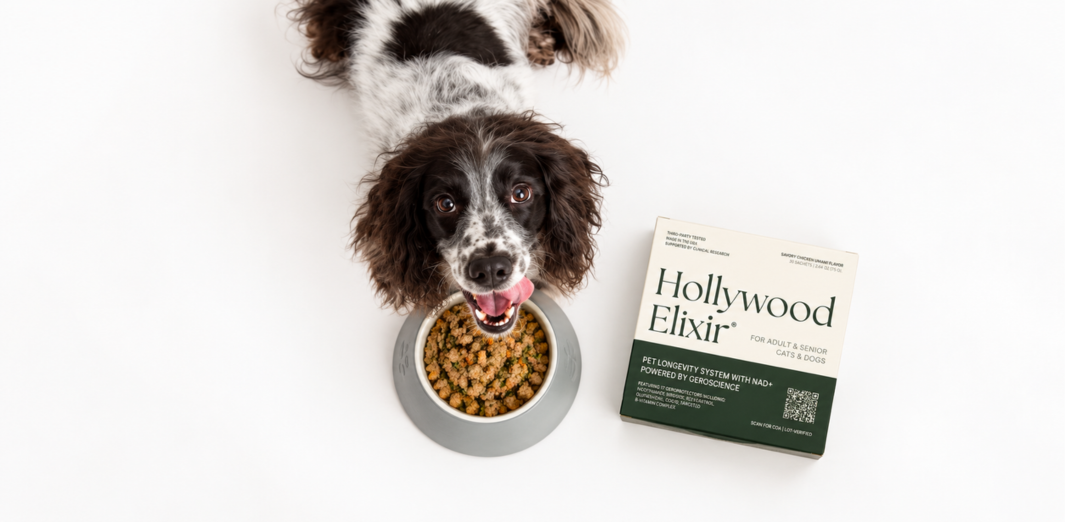
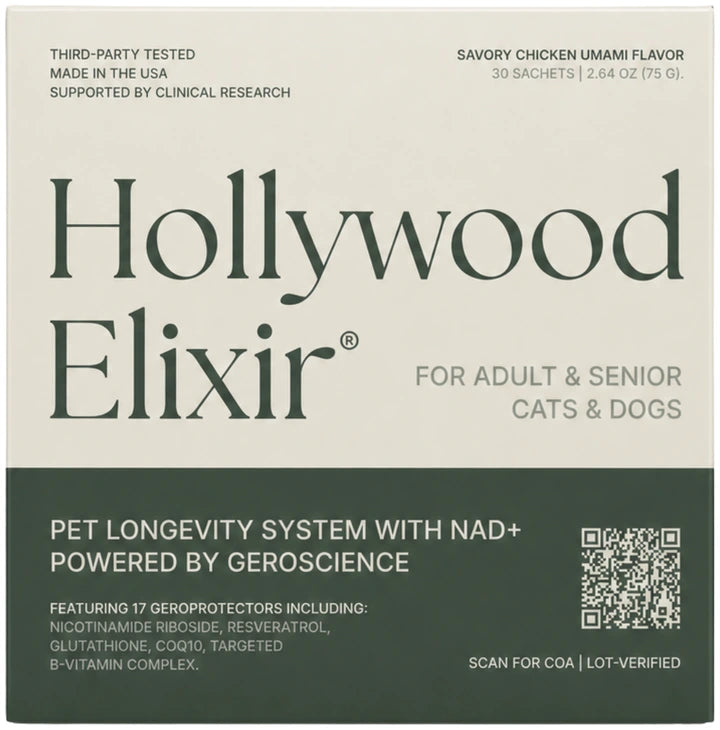
La Petite Labs makes Hollywood Elixir, so its appearance here is a disclosed commercial bridge. Hollywood Elixir is not a protein source, sarcopenia treatment, kidney diet, or substitute for adequate calories and veterinary assessment. If considered as optional complementary nutrition, judge the labeled daily dose, overlap, species fit, safety, evidence relevance, and stop rule independently from the dog's protein plan.

• Fix inadequate complete-diet intake before adding complexity.

• Do not borrow protein claims for a non-protein formula.

• Add one defined intervention at a time when practical.

• Stop and reassess if appetite, stool, behavior, or medication tolerance changes.

Hollywood Elixir is optional complementary nutrition—not protein or sarcopenia treatment.

Educational content only. This material is not a substitute for veterinary advice. Always consult your veterinarian about your dog’s specific needs. These statements have not been evaluated by the Food and Drug Administration. Products mentioned are not intended to diagnose, treat, cure, or prevent any disease.

Glossary

  • Crude protein: A label estimate based on measured nitrogen; it does not directly state digestibility, amino-acid balance, or daily intake.
  • Dry-matter basis: A nutrient comparison after removing water mathematically so foods with different moisture can be compared more fairly.
  • Muscle condition score: A clinical scoring method that evaluates muscle at defined body sites separately from body-fat condition.
  • Body condition score: A structured estimate of body-fat condition using visual and hands-on features rather than scale weight alone.
  • Essential amino acid: An amino acid the dog must obtain in adequate amounts from the diet because endogenous supply is insufficient.
  • Proteinuria: Excess protein detected in urine, a clinical finding that is different from the protein percentage of the diet.

Related Reading

References

Numbered references support claims cited in the article. Evidence context identifies the study population and design; it does not turn indirect evidence into pet-specific proof.

  1. American Animal Hospital Association. 2023 AAHA Senior Care Guidelines: Nutrition. American Animal Hospital Association · 2022GuidelinePopulation: bothEvidence boundary: Evidence-guided senior-care recommendations; numerical statements are population guidance, not universal protein prescriptions.↩ 1 · ↩ 2 · ↩ 3 · ↩ 4
  2. WSAVA Nutritional Assessment Guidelines Task Force Members. WSAVA nutritional assessment guidelines. Journal of feline medicine and surgery · 2011· DOI 10.1016/j.jfms.2011.05.009GuidelinePopulation: bothEvidence boundary: Global nutrition-screening framework; it does not set one senior-dog protein target or endorse a particular diet.↩ 1 · ↩ 2 · ↩ 3
  3. U.S. Food and Drug Administration. Complete and Balanced Pet Food. U.S. Food and Drug Administration · 2024RegulatoryPopulation: bothEvidence boundary: Official label guidance and conversion method; a guaranteed minimum is not a digestibility or individual-requirement result.↩ 1 · ↩ 2
  4. Sheffy BE, Williams AJ, Zimmer JF, et al. Nutrition and metabolism of the geriatric dog. The Cornell veterinarian · 1985· PMID 2985334Controlled StudyPopulation: dogEvidence boundary: Small, older two-year study of 16 old and eight young dogs; useful against automatic restriction, not for a modern universal target.
  5. Wakshlag JJ, Barr SC, Ordway GA, et al. Effect of dietary protein on lean body wasting in dogs: correlation between loss of lean mass and markers of proteasome-dependent proteolysis. Journal of animal physiology and animal nutrition · 2003· DOI 10.1046/j.0931-2439.2003.00452.xControlled StudyPopulation: dogEvidence boundary: Ten-week study in 56 young adult intact female dogs; adjacent evidence only and not a senior requirement study.
  6. Li P, Wu G. Amino acid nutrition and metabolism in domestic cats and dogs. Journal of animal science and biotechnology · 2023· DOI 10.1186/s40104-022-00827-8ReviewPopulation: bothEvidence boundary: Mechanistic narrative review with strong prescriptive views; use for principles and identify claims that lack direct senior-dog trials.↩ 1 · ↩ 2
  7. International Renal Interest Society. IRIS Guidelines for Chronic Kidney Disease. International Renal Interest Society · 2023GuidelinePopulation: dogEvidence boundary: Specialist CKD guidance; it applies after diagnosis and staging and is not a healthy-senior feeding rule.
  8. American Animal Hospital Association. 2021 AAHA Nutrition and Weight Management Guidelines for Dogs and Cats. American Animal Hospital Association · 2021GuidelinePopulation: bothEvidence boundary: Clinical guideline for nutrition and weight management; recommendations require adjustment to the individual patient.

FAQ

Should senior dogs eat less protein?

Not solely because of age. For a healthy older dog, assess actual intake, calories, body condition, muscle condition, protein quality, activity, and veterinary findings. A diagnosed disease can change the plan and should be managed specifically. [1] [4]

What protein percentage is best for a senior dog?

There is no one best label percentage for every senior dog. Moisture, calories, portion size, actual intake, amino-acid quality, digestibility, body composition, and disease all affect interpretation. Use a complete diet and individual monitoring rather than one universal number. [1] [3]

How do I compare protein in wet and dry senior-dog foods?

Convert both to dry matter: subtract moisture from 100, divide as-fed protein by the dry-matter percentage, and multiply by 100. Then compare calories and actual daily grams too; dry matter alone does not show digestibility or intake. [3]

Does higher protein damage an older dog's kidneys?

Age alone is not CKD, so preventive protein restriction is not an automatic senior rule. If CKD is diagnosed, diet is selected from stage and the whole clinical picture—including phosphorus, calories, appetite, proteinuria, and monitoring—not a generic percentage. [7]

Can the ingredient list tell me whether protein is high quality?

Not reliably by itself. Usable supply depends on the finished diet's essential-amino-acid pattern, digestibility, processing, ingredient interactions, daily amount eaten, and quality control. Meat-first wording is not a digestibility test. [6]

Does an overweight senior dog still need attention to protein?

Yes. Calorie control and muscle protection can be simultaneous goals. Aggressively feeding less of an ordinary food can reduce protein and other nutrients, so use an individualized plan and track both body and muscle condition. [8]

Should I add protein powder when my senior dog loses weight?

Do not assume that is the solution. Measure intake and seek veterinary evaluation for unexplained appetite, weight, strength, or muscle change. Pain, dental disease, gastrointestinal illness, kidney disease, cancer, medications, and other causes may require different care. [2]

Why check muscle condition as well as body condition?

Body condition mainly estimates fat, while muscle condition examines sites such as the spine, skull, shoulder blades, and pelvis. A dog can be overweight and still lose muscle, so serial use of both reveals more than scale weight alone. [1] [2]

Is Hollywood Elixir a protein supplement for senior dogs?

No. La Petite Labs does not position Hollywood Elixir as a protein source, sarcopenia treatment, or replacement for a complete diet. If considered, it belongs in a separate optional complementary-nutrition decision after intake, overlap, disease, and medications are reviewed.

Hollywood Elixir box behind a spotted dog in the canine longevity-system framework section

Discover LPL-01: How This Fits Into a Larger Canine Longevity System

Aging in dogs is not driven by a single pathway. It’s the result of interacting biological systems—energy metabolism, oxidative stress, immune signaling, and structural integrity—changing over time.

This article explores one piece of that puzzle. If you want to understand how these pieces connect—and what actually moves the needle—you need to zoom out.

Start with the underlying science: