Sarcopenia (Muscle Wasting) in Older Dogs

Recognize Muscle Wasting Drivers and Support Mobility, Metabolism, Heart, and Immunity

Essential Summary

Why Is Sarcopenia In Older Dogs Important?

Muscle is the tissue that protects a senior dog’s span: it stabilizes joints, buffers illness, and supports a cleaner, more rhythmic daily gait. When lean mass drops, the body’s surplus shrinks and recovery becomes slower and more fragile, even if body weight looks unchanged.

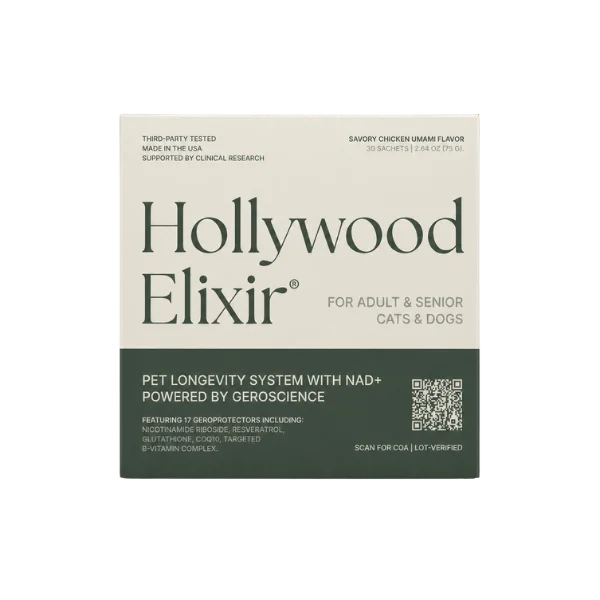
Hollywood Elixir™ can be part of a daily plan that supports healthy aging foundations, including normal cellular energy and recovery rhythms. It is best positioned alongside veterinarian-guided nutrition, pain control when needed, and a progressive strength routine that supports lean body mass over time.

Sarcopenia (Muscle Wasting) in Older Dogs is not just “getting slower”—it is a shift in how the body budgets protein, energy, and recovery. The common confusion is between two stories: “my dog is aging, so rest is safest” versus “my dog is losing muscle, so the plan must change.” Both can be true, but they lead to very different outcomes. Muscle is longevity tissue: when lean mass shrinks, mobility becomes more jagged, metabolism loses surplus, and the regeneration rate after illness, surgery, or a minor injury drops.

This page compares normal aging changes with true muscle wasting, then contrasts food-only strategies with food-plus-training strategies. It also separates “weight loss” from “lean loss,” because a stable scale number can hide shrinking thigh and shoulder muscle. Owners will learn what actually differs in older dogs—protein synthesis signaling, appetite patterns, and activity loops—and how to rebuild a cleaner, more rhythmic baseline over a 30-day window. The goal is not a quick swap; it is a phased plan that protects span: steadier walks, easier stairs, and a dog that rebounds faster after a hard day.

By La Petite Labs Editorial, ~15 min read

Featured Product:

  • Sarcopenia (Muscle Wasting) in Older Dogs means age-related loss of lean tissue that narrows mobility, metabolism, and recovery capacity.
  • A dog can keep the same body weight while losing muscle and gaining fat; the hands-on feel of thighs, shoulders, and topline matters.
  • Older dogs often need clearer protein signals and consistent resistance-style movement to keep protein synthesis responsive.
  • Nutrition and training work best as a pair: food supplies building blocks, while targeted activity tells the body where to allocate them.
  • A 30-day window should track trend points like sit-to-stand ease, stair confidence, stride length, and post-walk next-day stiffness.
  • Vet partnership is essential when appetite changes, pain, endocrine disease, heart disease, or kidney concerns complicate muscle plans.
  • The most reliable progress is gradual: a cleaner gait, more stable posture, and a faster regeneration rate after normal activity.

The Confusion: Aging Slowness Versus True Muscle Loss

Owners often lump every senior change into “normal aging,” but Sarcopenia (Muscle Wasting) in Older Dogs is a specific drift: less lean tissue and a weaker signal to rebuild it. The key contrast is between a dog that is simply pacing itself and a dog whose protein synthesis and regeneration rate are falling behind daily wear. In dogs, lean body wasting has been linked to higher protein breakdown activity, meaning the body can become more willing to dismantle muscle when stressed (Wakshlag, 2003). That shift narrows surplus—less cushion for illness, travel, or a missed meal.

At home, the earliest clue is often “shape,” not weight: a sharper spine, flatter rump, or shoulder blades that feel more prominent under the hand. Walk videos taken from the side can show shorter stride and less push-off before limping appears. When these changes are treated as inevitable, routines quietly shrink, and the body receives an even weaker reason to keep muscle.

Mitochondria artwork highlighting longevity science connected to sarcopenia in older dogs.

Side a: Weight Loss Is Not the Same Problem

Weight loss can be a red flag, but sarcopenia can progress even when the scale barely moves. The compare-and-contrast point is simple: body weight is a total, while lean mass is the working tissue that powers mobility and recovery. Some older dogs trade muscle for fat, so the “same weight” story can still hide a shrinking engine. Nutrition assessments in aging pets emphasize looking beyond calories to body composition and functional status, because the goal is not just maintaining weight—it is maintaining capability (Blanchard, 2025).

A household routine that helps is a weekly hands-on check during grooming: feel the thigh muscles, the shoulder shelf, and the topline over the spine. Pair that with one consistent photo angle each month. If treats increased while walks shortened, the dog may look “fine” while losing the tissue that keeps stairs and slippery floors manageable.

Scientific DNA render highlighting oxidative defense supported by sarcopenia in older dogs.

Side B: Pain-limited Movement Can Mimic Sarcopenia

Another common mix-up is assuming every muscle change is purely age-driven, when pain is often the hidden driver. Arthritis, spinal discomfort, or dental pain can reduce movement and chewing, which then reduces the muscle-building signal and protein intake. The practical difference is that pain-limited dogs may still have the biological capacity to rebuild, but they need discomfort addressed so movement becomes cleaner and more rhythmic. This is where aging, chronic inflammation, and musculoskeletal wear intersect; the muscle story rarely exists alone.

Owners can watch for “avoidance tells”: hesitation before jumping into the car, choosing carpet over tile, or a slower turn when called. If a dog stops shaking off after a walk or licks one joint at night, the body may be protecting a sore area. Treating the problem as “just weakness” can lead to under-treating pain and over-resting, which accelerates lean loss.

Structural biology image symbolizing ingredient integrity supported by sarcopenia in older dogs.

What Actually Differs in Older Muscle Biology

In younger dogs, a normal day of play and walking repeatedly triggers muscle protein turnover: breakdown and rebuilding stay in balance. In older dogs, the rebuilding side can become less responsive, so the same activity and the same bowl may no longer produce the same lean tissue result. Research in dogs links lean mass loss with markers of proteasome-dependent proteolysis, a pathway involved in protein breakdown (Wakshlag, 2003). That matters because stressors—illness, boarding, a new medication—can tip the balance toward dismantling muscle faster than it is rebuilt.

This biology shows up as a narrower span: a senior dog can have a good morning walk and still look “spent” the next day. Owners often interpret that as laziness, then reduce activity further. A better interpretation is that the dog needs a clearer training signal and a steadier recovery routine, not a smaller life.

Pug portrait highlighting companionship and steady support from sarcopenia in older dogs.

Case Vignette: the “Same Weight, Smaller Dog” Pattern
A 12-year-old Labrador keeps the same scale weight at annual visits, yet the rear looks flatter and the paws scuff on longer walks. The owner adds joint chews and shorter strolls, but the dog’s sit-to-stand becomes slower and the back end sways when turning. This is a classic Sarcopenia (Muscle Wasting) in Older Dogs scenario: the number stayed stable while the working tissue quietly shrank. The decision point is not “more rest,” but a plan that rebuilds lean mass while protecting joints.

In a household, the first win is often environmental: runners on slick floors and a lower step into the car so movement feels safe again. Then the routine shifts to short, repeatable strength moments—controlled sit-to-stands and slow hill walks—rather than long, exhausting outings. The dog’s confidence returns before the body shape changes.

Hollywood Elixir™ is amazing and makes my 13 y/o young again!

— Jessie

We go on runs. Lately he's been keeping up with no problem!

— Cami

“Muscle loss changes the whole day: gait, appetite loops, and recovery span.”

Owner Checklist: Home Signs That Point to Lean Loss

A useful contrast is between “tired after fun” and “less capable in ordinary life.” Owners can check for: (1) slower sit-to-stand with a front-end push, (2) nails scuffing the ground on the back feet, (3) a narrower stance or trembling when standing to eat, (4) a flatter rump or more prominent shoulder blades, and (5) a longer recovery after a normal walk. These are functional clues that lean tissue is slipping, even before obvious limping.

Run the checklist during calm moments, not during excitement. A dog that “performs” for a leash can mask weakness for a few minutes. The most honest observations happen at transitions: getting up from a nap, stepping over a threshold, or turning in a tight hallway.

Dog portrait symbolizing confidence and healthy aging support from sarcopenia in older dogs.

What to Track over a 30-Day Window

Sarcopenia management is won through trend points, not single-day impressions. Track 3–7 markers: (1) time to rise from lying, (2) number of controlled sit-to-stands before form breaks, (3) stair confidence score (smooth, hesitant, refuses), (4) stride length on a familiar sidewalk segment, (5) next-day stiffness after a standard walk, (6) appetite consistency, and (7) weekly thigh circumference at the same spot. The compare-and-contrast lesson is that muscle change is slow, but function often shifts first.

Use short phone videos once weekly, filmed from the same angle and distance. Keep the walk route and time of day consistent so the signal is cleaner. When trend points move in the right direction, owners can add difficulty gradually rather than chasing a dramatic single workout.

Profile shot of a dog showing attentive expression supported by sarcopenia in older dogs.

Food-only Versus Food-plus-strength: the Real Divide

Owners often compare two approaches: “upgrade the food” versus “do physical therapy.” The practical truth is that muscle needs both building blocks and a reason to allocate them. Senior nutrition guidance emphasizes tailored dietary strategies and regular reassessment, because aging changes appetite, digestion, and body composition (Blanchard, 2025). Meanwhile, without a strength signal, extra calories can drift toward fat rather than lean tissue. The best plan is a paired one: adequate protein and amino acids, plus progressive, pain-aware resistance-style movement.

In a household, “strength” does not mean sprinting. It can be slow leash walks on gentle inclines, controlled step-ups, and sit-to-stands with perfect form. These sessions should end with the dog looking capable, not depleted, so the next day remains cleaner rather than more jagged.

Inside-the-box graphic showing active blend design supporting sarcopenia in older dogs.

Protein: Enough, Tolerated, and Spread Across the Day

Protein is the headline nutrient in Sarcopenia (Muscle Wasting) in Older Dogs, but the comparison that matters is “enough and tolerated” versus “high on paper.” Dog research has linked lean mass loss to protein breakdown pathways, underscoring why adequate dietary protein and overall nutrition strategy matter when muscle is slipping (Wakshlag, 2003). Many senior diets vary widely in nutrient composition, so label reading alone is not a guarantee of a muscle-supportive profile (German, 2025). The goal is a diet the dog consistently eats, digests well, and can stay on.

Owners can support consistency by splitting food into two or three meals, warming wet food for aroma, and keeping treat calories from crowding out protein. Sudden diet jumps often backfire by causing stool changes and skipped meals. A phased transition keeps intake rhythmic, which matters when the body’s surplus is already narrower.

Amino Acids, mTOR Signaling, and the “on Switch” Problem

Owners may hear that “mTOR turns on muscle building,” then assume any protein powder solves the problem. The better contrast is between having amino acids available and having a strong enough signal to use them. In older muscle, the “on switch” for protein synthesis can be less responsive, so the same meal may produce a smaller building response than it did years earlier. That is why the combination of protein plus a training cue is so central: movement tells the body where to spend amino acids, and food supplies the material.

At home, this means pairing meals with gentle strength work rather than feeding and then resting for hours. A short sit-to-stand set before dinner, followed by a calm walk, can create a more coherent daily rhythm. If the dog is painful, the “signal” should be adjusted, not abandoned.

“A stable scale number can hide shrinking thighs and shoulders.”

Scientific attire image highlighting formulation rigor associated with sarcopenia in older dogs.

Supplements: Where They Fit and Where They Don’t

Supplements are often framed as a shortcut, but the useful contrast is “supporting the plan” versus “replacing the plan.” In dogs, a pilot study in a muscular disease model reported changes in activity and protein metabolism with HMB, an amino-acid–related compound, suggesting a plausible support role for muscle maintenance conversations with a veterinarian (Nghiem, 2025). That does not mean every senior dog needs HMB, or that supplements override pain, poor intake, or inactivity. The core remains food quality, adequate protein, and progressive movement.

Owners should treat any add-on as a “tolerance test” rather than a permanent stack. Introduce one change at a time, watch stool and appetite, and keep the rest of the routine stable so trend points are interpretable. A supplement that disrupts eating or digestion can shrink surplus further, even if the label sounds perfect.

Shop Now
Ingredients around product reflecting antioxidant support within sarcopenia in older dogs.

Unique Misconception: “More Omega-3 Always Means More Muscle”

A specific misconception in senior muscle conversations is that high-dose fish oil automatically translates to better muscle outcomes. Omega-3s can be part of an inflammation-aware plan, but “more” is not automatically safer or more effective. Veterinary literature notes potential adverse effects of omega-3 fatty acids in dogs and cats, including gastrointestinal upset and effects on hemostasis at higher intakes, which is especially relevant for seniors on other medications (Lenox, 2013). The practical takeaway is to treat omega-3 dosing as a vet-guided decision, not an escalating experiment.

In a household, the red flags are often mundane: looser stool, new greasy coat, or easy bruising after play. If these appear, the plan should pivot back to food consistency and strength work rather than adding more oils. Muscle is built by repeated, tolerable signals—not by chasing a single nutrient.

Shop Now
Pet owner presenting supplement, highlighting home wellness supported by sarcopenia in older dogs.

What Not to Do When Rebuilding Senior Muscle

Common mistakes are usually well-intended but mismatched to older physiology. Avoid: (1) weekend “catch-up” hikes that leave the next day jagged, (2) cutting protein to manage weight without a body-composition plan, (3) adding multiple supplements at once and losing clarity on what changed, and (4) forcing slippery-floor exercise that teaches the dog to move cautiously. The compare-and-contrast point is that seniors need repeatable, moderate signals more than occasional heroic effort.

A better routine is small and frequent: two short strength moments daily, plus a walk that ends with the dog still looking capable. If a dog is sore the next morning, the plan was too large for the current span. Dial back, make it cleaner, and rebuild gradually.

Shop Now

Vet Visit Prep: Make the Appointment More Productive

A veterinary visit is most useful when it compares function over time, not just a single exam moment. Bring: (1) two short videos—rising from bed and walking away from the camera, (2) a 30-day log of appetite and stool, (3) the exact diet and treat list with amounts, and (4) the trend points being tracked (sit-to-stand count, stair confidence, next-day stiffness). Ask targeted questions: “Is pain limiting the strength signal?”, “Is current protein appropriate for this dog’s conditions?”, and “Which exercises are safest for the back end?”

Also ask whether screening is needed for endocrine disease, dental disease, or heart disease when muscle loss is paired with appetite change or fatigue. The goal is a plan that matches the dog’s medical reality, so rebuilding is not fighting an unseen constraint. A good handoff turns worry into a clear next step.

Vitamin D, Bone-mobility Links, and Safe Context

Muscle does not operate alone; bone and muscle form a unit that determines stability and confidence. Vitamin D is part of small-animal bone metabolism discussions, and it can matter indirectly for mobility plans when deficiency or imbalance is present (Zafalon, 2020). In adult dogs, increased dietary vitamin D has been associated with increased circulating vitamin D without observable adverse effects in one study context, reinforcing that vitamin status is measurable and should be managed deliberately rather than guessed (Jewell, 2023). The compare-and-contrast lesson is “test and tailor” versus “supplement blindly.”

At home, vitamin conversations often start because a dog seems weaker on stairs. That symptom can reflect pain, muscle loss, traction issues, or conditioning—not just a vitamin gap. If supplements are used, keep them consistent and disclose them to the veterinarian so the full intake picture stays clean and interpretable.

Visual breakdown contrasting competitors and quality standards in sarcopenia in older dogs.

Diet Quality Signals and Dcm-aware Decision-making

Owners rebuilding muscle often consider boutique or novel-ingredient diets, but diet selection should also consider heart safety signals. Reviews of canine dilated cardiomyopathy in the context of diet-associated concerns emphasize careful evaluation of diet formulation and veterinary guidance, especially when changing protein sources or relying heavily on certain ingredient patterns (McCauley, 2020). The practical contrast is between “high-protein sounding” and “well-formulated and appropriate for the dog.” Muscle plans should not create a new risk elsewhere.

A household rule that helps is to avoid frequent brand hopping. Choose one complete-and-balanced diet that fits the dog’s medical needs, then adjust portions and activity before changing the entire formula. If a change is needed, transition slowly and track trend points so the dog’s response is clear.

Shop Now
Hollywood Elixir in protective wrap, emphasizing quality behind sarcopenia in older dogs.

How Long It Takes: Patience, Phases, and Realistic Wins

Owners often expect a fast transformation, but muscle is slow tissue—especially in seniors. The useful comparison is between early functional wins and later body-composition wins. Within weeks, many dogs show a cleaner rise from bed, more stable turns, and less next-day stiffness when the plan is well matched. Visible muscle shape changes typically lag behind, because the body needs repeated signals and consistent intake to rebuild surplus and raise regeneration rate.

The best routine is boring in the right way: short, frequent, and repeatable. Owners should celebrate the quiet wins—one extra controlled sit-to-stand, a smoother stair climb—because those are the trend points that predict longer-term resilience. When progress stalls, the next move is usually pain control, protein consistency, or exercise form, not intensity.

Shop Now

Decision Framework: Rebuild Longevity Muscle Without Overreaching

A decision framework keeps Sarcopenia (Muscle Wasting) in Older Dogs from becoming a scatter of products and guesses. Step 1: confirm the pattern—shape change, functional decline, and slower recovery. Step 2: remove constraints—pain, dental issues, nausea, or medical disease that blocks intake or movement. Step 3: build the paired plan—adequate protein plus progressive strength signals. Step 4: track trend points over a 30-day window and adjust one variable at a time.

In daily life, this looks like a dog with a slightly bigger life, not a harsher one: better traction, shorter but more purposeful sessions, and meals that are reliably eaten. When the plan is right, the dog’s day becomes less jagged—more adaptable, with a wider span for normal joys.

“Food builds tissue; training tells the body where to spend it.”

Educational content only. This material is not a substitute for veterinary advice. Always consult your veterinarian about your dog’s specific needs. These statements have not been evaluated by the Food and Drug Administration. Products mentioned are not intended to diagnose, treat, cure, or prevent any disease.

Glossary

  • Sarcopenia - Age-related loss of muscle mass and function.
  • Lean Body Mass - Body tissue excluding fat; includes muscle and organs.
  • Muscle Protein Synthesis - The process of building new muscle proteins from amino acids.
  • Proteolysis - Breakdown of proteins; excessive muscle proteolysis contributes to wasting.
  • Proteasome Pathway - A cellular system that degrades proteins; can be upshifted during muscle wasting.
  • mTOR Signaling - A nutrient- and activity-sensitive pathway involved in muscle-building signals.
  • Amino Acids - Protein building blocks; essential amino acids must come from diet.
  • Sit-to-Stand Test - A simple functional check counting controlled rises from a sit.
  • Trend Points - Repeatable markers tracked over time to judge direction of change.

Related Reading

References

Wakshlag. Effect of dietary protein on lean body wasting in dogs: correlation between loss of lean mass and markers of proteasome-dependent proteolysis.. PubMed. 2003. https://pubmed.ncbi.nlm.nih.gov/14633050/

Blanchard. Nutrition and aging in dogs and cats: assessment and dietary strategies. PubMed Central. 2025. https://pmc.ncbi.nlm.nih.gov/articles/PMC12520854/

Nghiem. Beta-hydroxy-beta-methylbutyrate (HMB) improves daily activity and whole-body protein metabolism in Duchenne muscular dystrophy dogs: a pilot study.. PubMed Central. 2025. https://pmc.ncbi.nlm.nih.gov/articles/PMC11788438/

Lenox. Potential adverse effects of omega-3 Fatty acids in dogs and cats.. PubMed. 2013. https://pubmed.ncbi.nlm.nih.gov/23323770/

German. Exploratory analysis of nutrient composition of adult and senior dog diets.. PubMed Central. 2025. https://pmc.ncbi.nlm.nih.gov/articles/PMC12757753/

Zafalon. The Role of Vitamin D in Small Animal Bone Metabolism. 2020. https://www.mdpi.com/2218-1989/10/12/496

Jewell. Increased dietary vitamin D was associated with increased circulating vitamin D with no observable adverse effects in adult dogs.. PubMed Central. 2023. https://pmc.ncbi.nlm.nih.gov/articles/PMC10445235/

McCauley. Review of canine dilated cardiomyopathy in the wake of diet-associated concerns.. PubMed Central. 2020. https://pmc.ncbi.nlm.nih.gov/articles/PMC7447921/

FAQ

What is Sarcopenia (Muscle Wasting) in Older Dogs?

Sarcopenia (Muscle Wasting) in Older Dogs is age-related loss of lean body mass that reduces strength, stability, and recovery span. It is not the same as simple weight loss, because a dog can keep a similar scale number while muscle shrinks and fat rises.

The most useful definition is functional: the dog has less push-off, slower sit-to-stand, and a longer regeneration rate after ordinary activity. Those changes guide what to assess and what to change at home.

Why does muscle matter so much for longevity?

Muscle is longevity tissue because it supports joint stability, glucose handling, and the ability to stay active without becoming depleted. When lean mass drops, the body’s surplus narrows and everyday tasks—stairs, turns, getting up—become more fragile.

That fragility can cascade: less movement leads to less muscle signal, which leads to further loss. A plan that protects muscle often protects multiple aging outcomes at once.

How is muscle wasting different from arthritis?

Arthritis is primarily joint pain and inflammation; sarcopenia is loss of the muscle tissue that stabilizes and powers movement. They often overlap, but the action steps differ: arthritis needs pain-aware mobility and medical management, while sarcopenia needs a clear strength signal plus adequate protein.

When pain is untreated, the dog avoids movement and muscle loss accelerates. A veterinarian can help separate “won’t move because it hurts” from “can’t move because strength is slipping.”

Can a dog lose muscle without losing weight?

Yes. Sarcopenia (Muscle Wasting) in Older Dogs can progress while the scale stays stable, because fat can replace muscle. The dog may look similar from a distance but feel bonier over the spine, shoulders, and hips.

Weekly hands-on checks and monthly photos from the same angle are often more revealing than weight alone. Functional trend points—rising, stairs, stride length—usually change before the scale does.

What are early home signs of lean mass loss?

Early signs include slower sit-to-stand, back feet scuffing, a narrower stance while eating, and a longer next-day recovery after a normal walk. Body-shape clues include a flatter rump and more prominent shoulder blades.

These signs are most reliable at transitions: getting up from bed, turning in a hallway, stepping over a threshold. Short weekly videos help owners see whether the day is becoming cleaner or more jagged.

What should be tracked over a 30-day window?

Track trend points that reflect strength and recovery: time to rise, controlled sit-to-stand count, stair confidence, stride length on a familiar segment, and next-day stiffness after a standard walk. Appetite and stool consistency belong on the same log.

Keep conditions consistent—same route, similar time of day—so changes are interpretable. Adjust one variable at a time, or it becomes unclear what actually helped.

Is more rest safer for senior dogs with weakness?

Rest can protect an injured dog, but blanket rest often worsens Sarcopenia (Muscle Wasting) in Older Dogs. The safer contrast is “less total strain” versus “no strength signal.” Seniors typically do better with short, repeatable sessions that end before fatigue makes movement sloppy.

If next-day function is worse, the session was too large. The goal is a cleaner rhythm: frequent, tolerable work that supports muscle without provoking pain.

What exercises are usually most helpful for rebuilding muscle?

The most useful exercises resemble gentle resistance: controlled sit-to-stands, slow hill walking, step-ups onto a low platform, and slow leash walks that emphasize form. These create a clear muscle signal without requiring high speed.

Traction matters. Runners on slick floors and a stable surface for step-ups prevent defensive movement patterns that make gait more jagged. A rehabilitation professional can tailor choices to hips, knees, and spine.

How much protein does an older dog need?

Protein needs are individual and should be set with a veterinarian, especially when kidney, liver, or heart disease is present. The practical goal is adequate, well-tolerated protein that the dog reliably eats, paired with a strength signal.

Rather than chasing a single number, owners can focus on consistency: stable appetite, good stool quality, and steady energy. If intake is erratic, even a “perfect” label will not translate into lean tissue support.

Should protein be spread across meals or fed once?

For many seniors, spreading intake across two or three meals supports steadier digestion and more consistent amino acid availability. That can be helpful when appetite is smaller or when large meals cause nausea or loose stool.

Pairing a meal with a brief strength moment—like a few controlled sit-to-stands—can make the day’s signals more coherent. The best schedule is the one the household can repeat without frequent skips.

Are supplements necessary for Sarcopenia (Muscle Wasting) in Older Dogs?

Supplements are not mandatory. The foundation is still complete-and-balanced nutrition, adequate protein, pain-aware mobility, and progressive strength work. Supplements can fit as support when a veterinarian agrees they match the dog’s medical context.

If an add-on disrupts appetite or stool, it can shrink surplus and work against the goal. Introduce one change at a time and track trend points so the response is clear.

Where does Hollywood Elixir™ fit in a muscle plan?

In a senior plan, Hollywood Elixir™ is best viewed as upstream support for healthy aging foundations, not as a replacement for protein intake or strength work. Muscle is built by repeated, tolerable movement signals plus adequate building blocks.

Owners get the cleanest read when the routine is stable: keep food and exercise consistent, then add one supportive layer and track trend points over weeks. A veterinarian should review the full supplement list for interactions.

How soon should results be expected after starting changes?

Functional changes often appear before visible muscle shape changes. Over a few weeks, owners may notice a cleaner rise from bed, steadier turns, and less next-day stiffness when the plan is well matched.

Body composition typically shifts more slowly because muscle is slow tissue, especially in seniors. Tracking trend points over a 30-day window prevents overreacting to day-to-day swings.

Is Sarcopenia (Muscle Wasting) in Older Dogs breed-specific?

Any breed can develop muscle wasting with age, but risk patterns differ. Large breeds may show earlier mobility constraints, while small breeds may hide weakness until stairs or jumping becomes difficult. Individual pain history and activity style often matter more than breed label.

The practical approach is the same: confirm lean loss with hands-on checks and function logs, then tailor protein, traction, and strength work to the dog’s size and orthopedic vulnerabilities.

Can senior dogs safely do resistance-style training?

Many senior dogs can, but it should be pain-aware and progressive. Resistance-style training for dogs often looks like slow, controlled movements rather than heavy impact: sit-to-stands, step-ups, and incline walking with good form.

Safety comes from dosage: short sessions, frequent rest, and stopping before fatigue makes movement sloppy. A veterinarian or rehabilitation therapist can help choose exercises that protect the spine, hips, and knees.

What diet quality signals matter most for seniors?

Look for a complete-and-balanced diet from a manufacturer with strong formulation and quality control practices, then match it to the dog’s medical needs. For seniors, consistency and tolerability are as important as the protein number on the label.

Avoid frequent brand hopping, which can destabilize appetite and stool. If a change is needed, transition slowly and track trend points so the dog’s response stays interpretable.

Can Hollywood Elixir™ be used daily long-term?

Daily use is a reasonable format for many supportive supplements, but long-term fit should be individualized. Hollywood Elixir™ is best positioned as part of a stable routine that supports healthy aging foundations while food and strength work do the primary muscle-building work.

A veterinarian should review the full list of medications and supplements, especially in seniors with complex conditions. Introduce changes one at a time and watch appetite, stool, and energy trend points.

What side effects should owners watch for with supplements?

The most common issues are gastrointestinal: reduced appetite, nausea, gas, or loose stool. In seniors, even mild appetite disruption can shrink surplus and slow muscle rebuilding because intake becomes inconsistent.

Owners should also watch for new itchiness, restlessness, or changes in sleep. If any new symptom appears after a change, pause the newest addition and contact the veterinarian for guidance.

Do supplements interact with medications in older dogs?

They can. Seniors are more likely to be on pain medications, heart medications, or endocrine treatments, and interactions can be subtle. Even “nutritional” products can change appetite, stool, or bleeding tendency, which can matter alongside other therapies.

A veterinarian should review the exact product list and timing. Keeping a single, updated list in the home makes vet visits more productive and reduces accidental stacking.

How should Hollywood Elixir™ be introduced alongside diet changes?

Introduce one change at a time so the dog’s response stays clear. If a diet transition is underway, it is often cleaner to finish the transition first, then add Hollywood Elixir™ as a supportive layer within a stable routine.

Track appetite, stool, and functional trend points for several weeks. The goal is a cleaner rhythm—consistent eating and repeatable movement—so any support layer can be evaluated fairly.

When should a veterinarian be called urgently for weakness?

Urgent evaluation is warranted if weakness is sudden, asymmetric, or paired with collapse, heavy panting at rest, pale gums, severe pain, or inability to rise. Those patterns are not typical of gradual Sarcopenia (Muscle Wasting) in Older Dogs.

Also call promptly if appetite drops for more than a day in a frail senior, or if vomiting/diarrhea appears with lethargy. Rapid intake loss can quickly narrow surplus and destabilize recovery.

Is Sarcopenia (Muscle Wasting) in Older Dogs the same in cats?

The concept—age-related lean loss—exists across mammals, but cats and dogs differ in appetite patterns, mobility expression, and common comorbidities. Cats often hide pain and reduce jumping long before owners notice obvious weakness, while dogs more often show gait changes on walks.

Plans should be species-specific. This page focuses on dogs; cat muscle aging should be assessed with feline-specific guidance and veterinary input.

5K+ Happy Pet Parents

Excellent 4.8

Sarcopenia (Muscle Wasting) in Older Dogs | Why Thousands of Pup Parents Trust Hollywood Elixir™

"He seems more happy overall. I've also noticed he has more energy which makes our walks and playtime so much more fun."

Olga & Jordan

"He's got way more energy now! We go on runs pretty often; he use to get tired halfway through, but lately, he's been keeping up without any problem."

Cami & Clifford

"I want her to live forever. She hasn't had an ear infection since!"

Madison & Azula

"It helps with her calmness, her immune system. I really like the clean ingredients. Highly recommend La Petite Labs!"

Maple & Cassidy

"He seems more happy overall. I've also noticed he has more energy which makes our walks and playtime so much more fun."

Olga & Jordan

"He's got way more energy now! We go on runs pretty often; he use to get tired halfway through, but lately, he's been keeping up without any problem."

Cami & Clifford

"I want her to live forever. She hasn't had an ear infection since!"

Madison & Azula

"It helps with her calmness, her immune system. I really like the clean ingredients. Highly recommend La Petite Labs!"

Maple & Cassidy

"He seems more happy overall. I've also noticed he has more energy which makes our walks and playtime so much more fun."

Olga & Jordan

"He's got way more energy now! We go on runs pretty often; he use to get tired halfway through, but lately, he's been keeping up without any problem."

Cami & Clifford

"I want her to live forever. She hasn't had an ear infection since!"

Madison & Azula

"It helps with her calmness, her immune system. I really like the clean ingredients. Highly recommend La Petite Labs!"

Maple & Cassidy

"He seems more happy overall. I've also noticed he has more energy which makes our walks and playtime so much more fun."

Olga & Jordan

"He's got way more energy now! We go on runs pretty often; he use to get tired halfway through, but lately, he's been keeping up without any problem."

Cami & Clifford

"I want her to live forever. She hasn't had an ear infection since!"

Madison & Azula

"It helps with her calmness, her immune system. I really like the clean ingredients. Highly recommend La Petite Labs!"

Maple & Cassidy

SHOP NOW