The 12 Hallmarks of Aging in Dogs, Explained
Read full insightProtein for Senior Cats: Muscle, Appetite, Kidney Questions, and Better Decisions
By La Petite Labs Editorial 13 min read
Short answer: a healthy senior cat generally should not have protein restricted merely because of age. Start with the cat’s actual food intake, calories, body condition, muscle condition, appetite, and medical findings. Older cats are not one metabolic population, and a crude-protein number cannot replace those measurements. [1] [3]
The central distinction is between a stable older cat and a cat whose intake, weight, muscle, or health is changing. The first may need monitoring rather than a new diet. The second needs the cause identified before “more protein” or “less protein” becomes a defensible plan.
- Do not restrict protein solely because a healthy cat has become senior.
- There is no universal protein percentage that fits every older cat.
- Measure the amount eaten; a high percentage cannot compensate for low intake.
- Compare wet and dry foods on dry matter, then add calories and daily grams.
- Track muscle condition separately from body fat and scale weight.
- Investigate unexplained appetite, weight, or muscle loss before fortifying the bowl.
- Diagnosed CKD requires a staged renal plan, not an age-based protein shortcut.
- Complementary supplements are not protein replacement or renal therapy.
Begin With the Healthy-Senior Default
Healthy senior cats should not have protein reduced solely because they are old. A healthy cat with stable weight, stable muscle, reliable appetite, and no disease requiring diet therapy usually needs a nutritionally adequate complete diet that is eaten consistently—not an automatic low-protein senior formula. [1]
That principle is intentionally narrower than a food recommendation. The senior cat food guide covers the whole diet, including calories, fat, texture, water, micronutrients, manufacturer practices, and palatability. This page asks how to interpret protein when age, appetite, muscle, weight, and kidney questions begin to overlap.
Treat Senior as a Life Stage, Not a Diagnosis
There is no universal protein target that is appropriate for every senior cat. One older cat may be lean, active, and eating steadily; another may be overweight but losing muscle; a third may eat less because chewing hurts; a fourth may have diagnosed CKD. The same front-panel percentage cannot answer four different problems. [1] [2]
Commercial senior foods underline the point. A laboratory survey found substantial variation in calories and nutrients among products marketed for senior cats and advised against broad recommendations from the category label alone. “Senior” describes a market segment; it does not guarantee one standardized protein strategy. [6]
Separate Label Percentage From the Amount Eaten
Crude-protein percentage alone does not reveal daily protein intake because moisture basis and the amount eaten must also be known. Record the food, exact product, daily amount offered, amount left, treats, toppers, and medication foods. A high percentage multiplied by very little food can still yield low daily intake. [3] [4]
This matters disproportionately in cats because a modest change in portion can be a meaningful share of a small daily ration. Weighing offered and leftover food for seven days is more useful than describing appetite as “fine.” For shared bowls, timed meals or temporary separation can turn a vague impression into usable evidence.
Put Wet and Dry Food on the Same Moisture Basis
Wet and dry food protein percentages require dry-matter conversion before direct percentage comparison. Subtract moisture from 100, divide the as-fed protein percentage by the remaining dry-matter percentage, then multiply by 100. An 11% protein food at 78% moisture is 50% protein on a dry-matter basis. [4]
The calculation corrects one label illusion; it does not declare a winner. Dry-matter percentage makes unlike formats comparable, but it still does not show how many grams the cat eats each day or establish an individual feeding prescription. Add actual intake and patient context before drawing a practical conclusion. [3] [4]
Add Calories and Daily Grams to the Comparison
Two foods can have similar dry-matter protein percentages yet provide different protein amounts per calorie. Ask the manufacturer for grams of protein per 100 or 1,000 kilocalories when that information is available. Then calculate from the amount the cat actually consumes, not the feeding guide’s idealized portion.
This energy basis is especially helpful when calories are being reduced for obesity or when appetite has fallen. Feeding less of an ordinary food reduces every nutrient delivered with the portion. A veterinarian or veterinary nutritionist can decide whether a more nutrient-dense complete diet is appropriate; simply adding an isolated powder can unbalance the larger plan. [7] [9]
Do not restrict protein solely because a healthy cat has become senior.
Judge the Ration, Not Ingredient Order
“Meat is the first ingredient” is not a daily protein calculation. The guaranteed analysis supplies an as-fed crude-protein minimum, FDA’s conversion places unlike moisture formats on a common basis, and the diet history supplies the amount the cat actually consumes. Those are separate pieces of evidence; ingredient order cannot substitute for them. [3] [4]
Record the exact product, nutritional-adequacy statement, calorie information, typical nutrient analysis when available, and the cat’s measured portion. If a manufacturer supplies additional product data, evaluate those data on their own terms rather than inferring them from ingredient names or position.
Use the Adult-Cat Study as a Clue, Not a Prescription
A frequently cited study fed different protein intakes to 24 adult neutered male cats and found that the amount associated with lean-body-mass maintenance was higher than the amount estimated from nitrogen balance. That is a useful methodological warning: appearing to be in nitrogen balance may not answer the body-composition question. [5]
It is not a universal senior-cat target. The cats were adult males, not a representative cohort of geriatric cats with different diseases, sexes, body conditions, and energy intakes; the authors worked for the study sponsor. The finding supports watching lean mass and intake. It does not justify a precise percentage for every bowl.
Score Body Fat and Muscle Separately
Body condition estimates fat; muscle condition examines muscle over defined sites such as the spine, shoulder blades, skull, and pelvis. A cat can carry excess fat and still lose muscle. That makes scale weight alone a poor early-warning system, particularly when fat gain masks tissue loss. [2] [3] [9]
Ask the veterinary team to record both scores and compare them over time. Monthly top-and-side photographs, taken on the same surface and at the same distance, can support the record without replacing palpation. The feline sarcopenia guide owns diagnosis and rehabilitation; this page keeps the nutrition question tied to measurable change.
For Stable Aging, Protect Consistency Before Chasing More
For a senior cat with stable weight, stable muscle condition, normal appetite, and no diet-responsive disease, the first goal is consistency: an appropriate complete food, enough calories, reliable intake, water access, and serial monitoring. There is no evidence-based reason to disrupt a tolerated diet solely to obtain the largest protein number. [1] [2]
Review the adequacy statement and life stage, measure portions, and keep a baseline. Revisit the plan when weight, muscle, stool, thirst, appetite, activity, or laboratory findings change. “No change today” is an active decision when it rests on a good baseline and a scheduled reassessment.
For Low Intake, Solve the Eating Problem First
When a senior cat is eating less, the urgent arithmetic is offered versus eaten. A food can look protein-rich and still deliver little protein, energy, or micronutrition if much of the meal remains in the bowl. The senior cat not eating guide explains when an appetite change needs prompt care. [2] [7]
Improve access and palatability without hiding the trend: offer fresh measured portions, try an appropriate complete texture, use quiet feeding locations, and document response. Do not rotate through many toppers at once. A cat that keeps eating less, seems nauseated, or changes behavior needs investigation rather than an escalating flavor contest.
Compare wet and dry foods on dry matter, then add calories and daily grams.
DVM Voice: Clinical Vignette of a Common Pattern in Senior Cat Aging
Case provided by JoAnna Pendergrass, DVM
Sasha, a 12-year-old cat, was brought in after her owner noticed increased thirst and urination, lethargy, vomiting, and a generally unkempt appearance. Examination showed weight loss, elevated blood pressure, and reduced vitality.
Diagnostic testing revealed elevated kidney markers, poorly concentrated urine, and protein loss in the urine — findings consistent with chronic kidney disease, one of the most common chronic conditions in senior cats.
Her care required a kidney-focused diet, blood pressure management, targeted supplementation, medication support, and regular monitoring — a necessary plan, but one started after clinical signs were already visible.
Clinical takeaway: Sasha’s case reflects why senior-cat wellness should begin before obvious decline. Earlier monitoring, body-condition tracking, hydration awareness, antioxidant support, and daily cellular resilience may help support quality of life as cats age.
Single-case vignette. Not generalizable. Veterinary diagnosis and monitoring are essential for increased thirst, urination, vomiting, lethargy, weight loss, or suspected kidney disease.
For Unexplained Weight Loss, Investigate Before Fortifying
Unexplained weight, appetite, or muscle loss is a clinical signal rather than proof that the cat simply needs more protein. The senior cat losing weight guide covers the diagnostic pathway. Oral pain, hyperthyroidism, diabetes, gastrointestinal disease, CKD, cancer, pain, and other conditions can create superficially similar nutrition problems. [2] [3]
Bring a timeline, food log, photographs, current products, stool and vomiting notes, thirst changes, and medication list. Nutrition may become part of treatment, but the direction depends on the cause. Adding concentrated nutrients before assessment can delay recognition, alter intake, and make it harder to know what changed.
For Obesity, Preserve Nutrient Density and Watch Muscle
An overweight senior cat may need calorie control and muscle protection simultaneously. Reducing a standard portion sharply can reduce protein and other essential nutrients along with calories. Use an individualized complete weight-management plan, record body and muscle condition, and reassess the pace and composition of loss. [9]
Do not use a stable scale number as proof of stable tissue. Muscle loss can be obscured by fat, while crash restriction carries separate clinical risks. The useful question is not “high protein or low protein?” but “does this complete calorie plan deliver adequate nutrients while body fat falls and muscle is protected?”
Make Texture, Palatability, and Oral Comfort Visible
A technically suitable food fails if the cat cannot or will not eat enough of it. Dental disease, pain, nausea, smell changes, stress, bowl placement, temperature, and texture can all influence intake. Senior-care guidance treats oral examination and intake monitoring as clinical work, not mere fussiness. [2]
Change one variable at a time when the situation is stable: soften or change the complete-food texture, warm a measured portion gently, offer smaller fresh meals, or alter the feeding location. If chewing appears painful, appetite keeps declining, or the cat approaches food and retreats, stop experimenting and seek care.
Do Not Confuse Healthy Aging With Diagnosed CKD
Diagnosed feline CKD requires a staged whole-patient nutrition plan rather than an age-based high-versus-low-protein rule. IRIS staging occurs after CKD is diagnosed, then treatment is adapted to stage, phosphate status, appetite, hydration, proteinuria, blood pressure, other findings, and serial response. [8]
The chronic kidney disease guide for cats owns treatment context. Renal nutrition is not “protein alone”: a percentage cannot show phosphorus management, caloric adequacy, diet acceptance, nausea control, or the trade-off created when a cat refuses the prescribed food. Do not apply a renal diet to a healthy senior as a preventive guess.
Let Other Conditions Change the Question Explicitly
Hyperthyroidism, diabetes, chronic enteropathy, dental disease, cancer, pain, medication effects, and concurrent conditions can change appetite, weight, muscle, calories, or diet suitability. The question then becomes condition-specific: what diagnosis is driving the pattern, what complete diet fits it, and what measurements will show whether the plan is working? [1] [2]
The senior cat bloodwork guide can help owners prepare for the assessment, but laboratory results still need clinical interpretation. When diseases compete—for example, obesity with muscle loss or CKD with poor appetite—the safest plan may prioritize adequate intake before nutritional elegance. That trade-off belongs with the veterinary team.
Use the Senior Cat Protein Triage Grid
The grid starts with the cat’s observable pattern, not a target percentage. Select the closest row, collect the listed measurement, and keep three questions separate: Is enough complete food being eaten? Is body composition changing? Is a disease process likely to override the healthy-senior default?
Its last column is a safety check. Stable aging does not demand maximal protein; low intake is not solved by label mathematics; obesity does not guarantee preserved muscle; and diagnosed CKD cannot be managed from one nutrient. Use the grid to prepare a more precise veterinary conversation, not to prescribe remotely.
Original decision tool — The Senior Cat Protein Triage Grid: Separate stable aging, intake failure, weight and muscle change, obesity, and diagnosed CKD before changing the diet.
• Observed pattern: Stable aging | Measure now: Seven-day intake plus serial weight, BCS, and MCS | Nutrition question: Is the complete diet eaten consistently? | Clinical question: Has any trend or laboratory finding changed? | Unsafe shortcut: Chase the highest protein percentage
• Observed pattern: Reduced intake | Measure now: Grams offered versus eaten and meal behavior | Nutrition question: Can an appropriate complete format restore intake? | Clinical question: Pain, nausea, oral disease, or systemic illness? | Unsafe shortcut: Assume a richer label fixes not eating
• Observed pattern: Unexplained weight loss | Measure now: Weight timeline, BCS, MCS, calories, and symptoms | Nutrition question: Are energy and protein actually consumed? | Clinical question: Which disease or medication is driving loss? | Unsafe shortcut: Add powder before diagnosis
• Observed pattern: Visible muscle loss | Measure now: Serial MCS, strength, activity, and intake | Nutrition question: Is the complete ration adequate and eaten? | Clinical question: Sarcopenia, pain, endocrine, renal, GI, or other disease? | Unsafe shortcut: Treat function with protein alone
• Observed pattern: Obesity with stable muscle | Measure now: Calories, extras, BCS, and MCS | Nutrition question: Will restriction preserve nutrient density? | Clinical question: What is a safe monitored loss plan? | Unsafe shortcut: Shrink an ordinary portion indefinitely
• Observed pattern: Obesity with muscle loss | Measure now: Serial BCS/MCS, gait, intake, and exam | Nutrition question: Can calories fall while muscle nutrition is protected? | Clinical question: What explains simultaneous muscle loss? | Unsafe shortcut: Use scale stability as reassurance
• Observed pattern: Diagnosed CKD | Measure now: IRIS stage, phosphate, appetite, weight, and current plan | Nutrition question: What does the prescribed whole diet require? | Clinical question: How is response monitored and adjusted? | Unsafe shortcut: Choose food from protein percentage alone
• Observed pattern: Chewing or texture difficulty | Measure now: Meal video, oral exam, preferred complete textures | Nutrition question: Can a softer complete food deliver enough intake? | Clinical question: Is dental or swallowing treatment needed? | Unsafe shortcut: Label refusal as pickiness
Method: The rows combine feline life-stage guidance, WSAVA nutritional assessment, intake arithmetic, body-versus-muscle scoring, and an explicit IRIS boundary; they triage decisions without assigning a universal protein target.
Limit: The grid cannot diagnose disease, measure digestibility from a label, calculate an individual protein requirement, or replace veterinary nutrition and renal care.
Run a Seven-Day Intake and Trend Audit
For seven days, record the exact complete food, batch or flavor, grams offered, grams left, calories if known, treats and toppers, water pattern, stool, vomiting, medication timing, and anything that changed around meals. Add current weight plus the most recent previous weights and muscle-condition records. [2] [3]
Then ask one decision question: stable plan, intake repair, calorie adjustment, or clinical work-up? Do not change food, supplements, and feeding setup simultaneously unless a clinician directs it. One-variable changes preserve attribution; a stop rule prevents a tidy spreadsheet from delaying care.
• Escalate promptly for persistent refusal, repeated vomiting, marked lethargy, weakness, dehydration concerns, or rapid change.
• Recheck after any meaningful diet change at the interval set by the veterinary team.
• Keep the package and typical analysis so the exact formula can be identified.
Keep Complementary Nutrition in Its Proper Lane
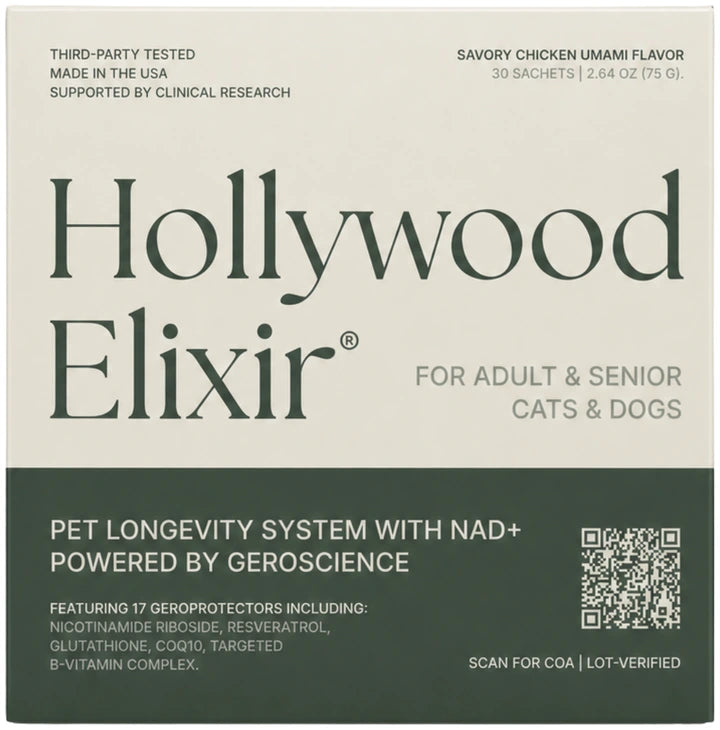
Protein adequacy should be solved through the complete diet or a clinician-formulated plan, not inferred from an all-purpose add-on. La Petite Labs makes Hollywood Elixir, so this is a disclosed commercial bridge. The Hollywood Elixir ingredients page can be used to inspect what is actually labeled—not to borrow a protein, kidney, or muscle claim.
Hollywood Elixir is optional complementary nutrition. It is not protein replacement, CKD prevention, treatment for muscle loss, or correction of an inadequate diet. If it is considered for a separate defined goal, review the labeled feline serving, total intake, duplication, medications, disease, calories, evidence relevance, and a stop rule with the same discipline used for any supplement.
• Do not use a supplement to conceal falling food intake.
• Do not infer finished-product benefit from ingredient presence alone.
• Introduce one optional product at a time when practical.
• Stop and reassess if appetite, stool, behavior, or medication tolerance changes.
Complementary supplements are not protein replacement or renal therapy.
Educational content only. This material is not a substitute for veterinary advice. Always consult your veterinarian about your cat’s specific needs. These statements have not been evaluated by the Food and Drug Administration. Products mentioned are not intended to diagnose, treat, cure, or prevent any disease.
Glossary
- Crude protein: A guaranteed-analysis value reported on an as-fed basis; it must be interpreted with moisture and the amount consumed.
- Dry-matter basis: A nutrient comparison after water is removed mathematically so foods with different moisture contents can be compared.
- Muscle condition score: A structured clinical assessment of muscle at defined body sites, performed separately from body-fat scoring.
- Body condition score: A visual and hands-on estimate of body-fat condition that adds context beyond scale weight.
- Nutrient density: The amount of a nutrient delivered relative to food energy or serving size, useful when total intake changes.
- IRIS stage: A clinical classification applied after CKD diagnosis to guide monitoring and individualized management.
Related Reading
Aging & Senior Cat Guidance
• Cat Age Calculator: Cat Years to Human Years
• Cat Lifespan by Breed
• Lethargy in Cats
• Senior Cat Not Eating
• Cat Drinking A Lot
• Why Is My Senior Cat Withdrawn?
Healthy Aging Support
• NAD+ for Cats
• NMN for Cats
• Vitamins For Older Cats
• Senior Cat Food
References
Numbered references support claims cited in the article. Evidence context identifies the study population and design; it does not turn indirect evidence into pet-specific proof.
-
[1]
Quimby J, Gowland S, Carney HC, et al. 2021 AAHA/AAFP Feline Life Stage Guidelines. Journal of feline medicine and surgery · 2021· DOI 10.1177/1098612X21993657GuidelinePopulation: catEvidence boundary: Consensus life-stage guidance; it acknowledges uncertainty and does not establish one protein target for every older cat.↩ 1 · ↩ 2 · ↩ 3 · ↩ 4 · ↩ 5
-
[2]
Feline Veterinary Medical Association. 2021 AAFP Feline Senior Care Guidelines. American Association of Feline Practitioners · 2021GuidelinePopulation: catEvidence boundary: Feline senior-care guidance for clinical assessment; it does not diagnose a cause of weight or muscle loss from a food label.↩ 1 · ↩ 2 · ↩ 3 · ↩ 4 · ↩ 5 · ↩ 6 · ↩ 7 · ↩ 8
-
[3]
WSAVA Nutritional Assessment Guidelines Task Force Members. WSAVA nutritional assessment guidelines. Journal of feline medicine and surgery · 2011· DOI 10.1016/j.jfms.2011.05.009GuidelinePopulation: bothEvidence boundary: Global screening framework for dogs and cats; it does not prescribe a feline senior protein concentration.↩ 1 · ↩ 2 · ↩ 3 · ↩ 4 · ↩ 5 · ↩ 6 · ↩ 7
-
[4]
U.S. Food and Drug Administration. Complete and Balanced Pet Food. U.S. Food and Drug Administration · 2024RegulatoryPopulation: bothEvidence boundary: Official label guidance; guaranteed analysis reports nutrients on an as-fed basis and requires dry-matter conversion when moisture differs.↩ 1 · ↩ 2 · ↩ 3 · ↩ 4
-
[5]
Laflamme DP, Hannah SS. Discrepancy between use of lean body mass or nitrogen balance to determine protein requirements for adult cats. Journal of feline medicine and surgery · 2013· DOI 10.1177/1098612X12474448Controlled StudyPopulation: catEvidence boundary: Prospective work in 24 adult neutered male cats employed by the sponsor; it was not a senior-cat requirement study or universal prescription.↩
-
[6]
Summers SC, Stockman J, Larsen JA, et al. Evaluation of nutrient content and caloric density in commercially available foods formulated for senior cats. Journal of veterinary internal medicine · 2020· DOI 10.1111/jvim.15858Observational StudyPopulation: catEvidence boundary: Laboratory comparison of 31 senior and 59 adult foods; it measured composition, not long-term health outcomes.↩
-
[7]
Rollins AW, Murphy M. Nutritional assessment in the cat: Practical recommendations for better medical care. Journal of feline medicine and surgery · 2019· DOI 10.1177/1098612X19843213ReviewPopulation: catEvidence boundary: Clinical review summarizing heterogeneous aging evidence; population observations should not be treated as a diagnosis in an individual cat.↩ 1 · ↩ 2
-
[8]
International Renal Interest Society. IRIS Guidelines for Chronic Kidney Disease. International Renal Interest Society · 2023GuidelinePopulation: catEvidence boundary: Current specialist guidance for cats with diagnosed CKD; it is not a preventive feeding rule for healthy senior cats.↩
-
[9]
American Animal Hospital Association. 2021 AAHA Nutrition and Weight Management Guidelines for Dogs and Cats. American Animal Hospital Association · 2021GuidelinePopulation: bothEvidence boundary: Clinical weight-management guidance; safe rates and nutrient density depend on the individual patient and chosen complete diet.↩ 1 · ↩ 2 · ↩ 3
FAQ
Should senior cats eat less protein?
Not merely because of age. For a healthy older cat, assess the complete diet, actual intake, calories, body condition, muscle condition, and medical findings. A diagnosed disease can change the plan and should be managed specifically. [1]
What protein percentage is best for a senior cat?
How do I compare protein in wet and dry cat foods?
Does higher protein damage an older cat’s kidneys?
Age alone is not diagnosed CKD, so preventive protein restriction is not an automatic senior rule. With diagnosed CKD, the veterinary plan is stage-based and considers phosphate, the renal diet, appetite, calories, other findings, and serial response. [8]
Should I add protein when my senior cat is losing weight?
Can the ingredient list prove that a cat food has high-quality protein?
Is Hollywood Elixir a protein or kidney supplement for senior cats?
No. La Petite Labs does not position Hollywood Elixir as protein replacement, CKD prevention, renal treatment, or correction of an inadequate diet. It is optional complementary nutrition that must be evaluated separately for dose, overlap, safety, and the cat’s clinical context.
Discover LPL-01: How This Fits Into a Larger Feline Longevity System
Aging in cats unfolds quietly. It’s not driven by a single failure, but by gradual shifts across interconnected systems — cellular energy, oxidative balance, immune tone, and tissue integrity — each influencing the others over time.
This article explores one layer of that system. To understand what actually shapes long-term health, you need to step back and look at how these layers interact.
Start with the underlying science:
- Feline Geroscience Framework →
A structured view of how aging progresses across cellular energy, inflammation, and resilience systems. - Senior Biological Defense Coverage (BDC) Modeling →
A systems-level map of which biological pathways decline first, and how layered interventions can support them. - 2026 Market Research: Best Cat Longevity Supplements →
A feline-specific review of longevity supplements. 2026 Industry report created by LPL-01 Research. - LPL-01 Standard →
The formulation system that translates these models into real-world supplementation—covering multiple pathways in a coordinated way.
Hollywood Elixir®
From $89
Hollywood Elixir is amazing! She put back on 5 lbs to a healthy weight, her eyes are shiny, her coat is beautiful!
— Jessie
She hopped up onto the windowsill again for the first time in years.
— Charlie
Learn about how our DVMs think about cat aging
Dr. JoAnna Pendergrass DVM
Hollywood Elixir®
From $89
Related Reading