The 12 Hallmarks of Aging in Dogs, Explained
Read full insightPawprint Protocol vs Hollywood Elixir® for Dogs
By La Petite Labs Editorial 33 min read
La Petite Labs publishes this comparison and makes Hollywood Elixir. That commercial relationship is a reason to make the Pawprint case accurately: its format is convenient, its four active amounts are visible, its guarantee terms are public, and its dated price wins the cost comparison. A credible recommendation also has to say where Hollywood Elixir falls short. It is not liquid, it is materially more expensive, and it cannot claim direct NMN or NAD+ just because it uses another NAD+ precursor.
This page compares what a pet parent can verify: current labels, current directions, package math, disclosed ingredients, finished-product documentation, and the exact scope of cited studies. It does not infer clinical outcomes from attractive pathway language. Neither product replaces a complete diet, an examination, diagnostic work, prescription care, or a condition-specific plan.
The short verdict
Pawprint Protocol is the lower-cost and shorter-label option. Its current panel is unusually direct for a four-active supplement: one full dropper contains 100 mg NAD+, 30 mg NMN, 5 mg resveratrol, and 5 mg CoQ10. If an owner specifically wants those listed materials in a flavored liquid, and the dog's clinician agrees, that can be a sensible reason to keep Pawprint on the shortlist. The $69 one-bottle price and $179.96 three-bottle price also make it substantially cheaper than Hollywood Elixir at every weight worked here.
The catch is basic but consequential: PawPrint Lab currently publishes two different weight guides. The prose puts a 15 lb dog at half a dropper, while the dosage image puts that dog at one full dropper. At 40 lb, the choices are one or one and a half; at 70 lb, one and a half or two. No comparison page should decide which set the manufacturer intended. Ask PawPrint Lab for a written answer and show both materials to the veterinarian before starting.
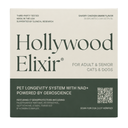
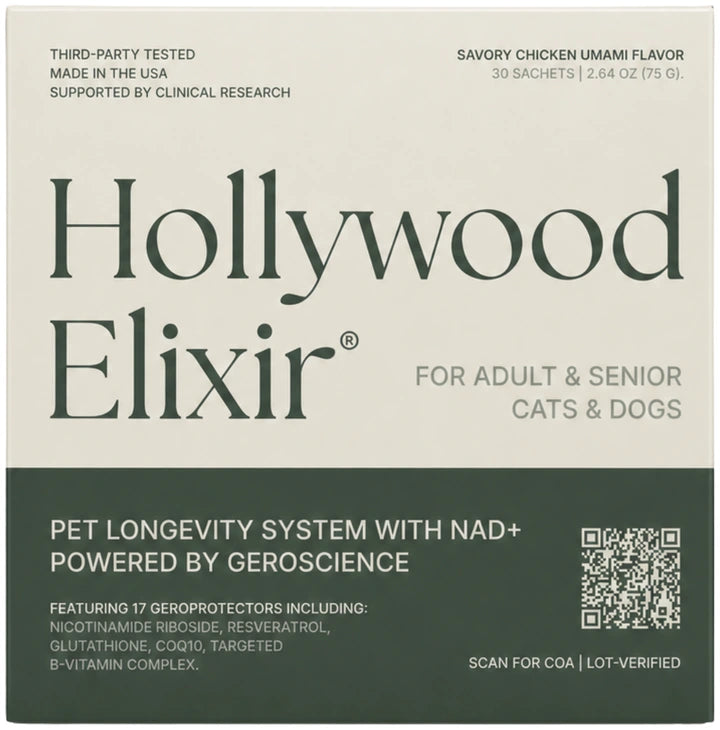
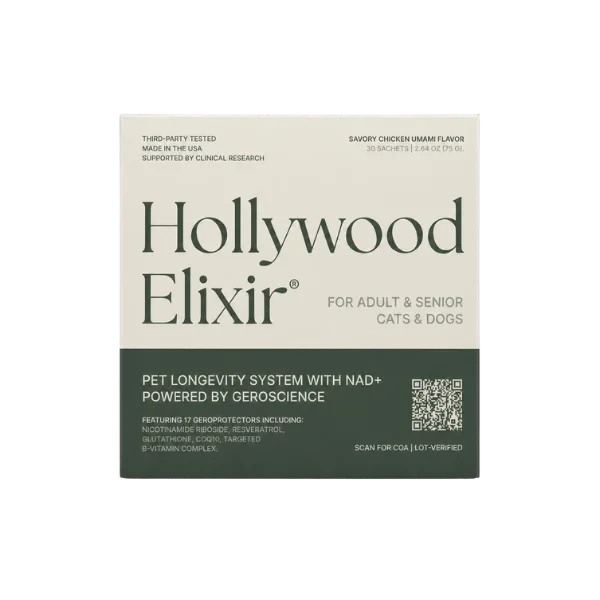
Hollywood Elixir is the broader and more publicly documented option. It prints 17 active amounts, uses one stable three-tier structure with a narrow ambiguity at exactly 30 lb, and displays a finished-batch record with named parties and result lines. That does not make it clinically superior. It costs more, is a powder rather than a liquid, contains whey and chicken, and uses NR and niacin instead of directly listing NMN or NAD+. The practical verdict is preference-dependent: Pawprint for lower cost and liquid simplicity after clarification; Hollywood Elixir for broader disclosure and inspectable batch details.
What is Pawprint Protocol for dogs?
Pawprint Protocol is a 60 mL liquid dog supplement from PawPrint Lab. Its Product Facts panel lists four actives per full 1 mL dropper: NAD+ 100 mg, NMN 30 mg, resveratrol 5 mg, and CoQ10 5 mg. It is sold in one , three , and six bottle options for one time purchase or subscription.
The Plain Comparison
The products overlap in healthy-aging positioning but make meaningfully different choices about format, ingredient scope, documentation, and price.
| Question | Pawprint Protocol | Hollywood Elixir | Better fit when... |
|---|---|---|---|
| Core format | 60 mL flavored liquid measured by dropper | 2.5 g food-mixed powder sachets | Pawprint for liquid preference; Hollywood Elixir for pre-portioned sachets |
| NAD+ approach | NAD+ 100 mg plus NMN 30 mg per full 1 mL dropper | NR 60 mg plus niacin 2 mg per sachet | The veterinarian's desired ingredient and full-formula fit decide; the compounds are not mg-equivalent |
| Other actives | Resveratrol 5 mg and CoQ10 5 mg per full dropper | Resveratrol 15 mg, CoQ10 40 mg, glutathione 50 mg, beta glucans 50 mg, and 11 other listed actives per sachet | Pawprint for a compact four-active label; Hollywood Elixir for broader disclosed coverage |
| Serving clarity | Current written directions and dosage image conflict at several weights | One stable three-tier structure; exactly 30 lb is worded ambiguously | Hollywood Elixir for the narrower serving ambiguity; Pawprint after written dose clarification |
| 25-lb, 90-day one-time outlay | $138 for two bottles, with 30 mL remaining | $199 for the Standard 90-sachet pack | Pawprint when lower outlay is a leading constraint |
| Finished-batch information | Third-party testing is claimed; no named lab or public lot-linked result located | Current page displays lot-linked microbial, heavy-metal, and active checks with named parties | Hollywood Elixir when the owner wants a visible finished-batch record |
| Finished-formula clinical trial | None identified | None identified | Neither has a demonstrated finished-formula clinical advantage here |
| Food and calorie cautions | Beef and apple flavouring, rice syrup, 2 g sugar and 10 calories per full dropper | Whey protein isolate, chicken flavor, and chicken liver powder | The chosen product fits the dog's food sensitivities, calorie plan, and medication review |
Competitor label and pricing facts checked September 3, 2026. Sources are listed in the References section below.
Why Pawprint earns a place on the shortlist
Many dog supplements make the shopper hunt for the active panel. Pawprint does something valuable: its official product image puts four amounts in one readable frame. The owner can see what a full dropper adds and can calculate a half, one-and-a-half, or double serving without decoding a proprietary blend. That clarity is a genuine strength even though the weight boundaries need correction.
The liquid format is also more than a cosmetic preference. A dog that spits out capsules, refuses a medicinal chew, or leaves powder in the bowl may accept a small flavored liquid portion. The page says it can be given with food, and its bottle avoids individual wrappers. A dropper also makes half-step servings possible. For households already managing several pills, removing one administration fight can improve consistency.
Price strengthens the case. A 90 lb dog following either public guide uses three 60 mL bottles in 90 days. The current three-bottle one-time pack is $179.96, about $2.00 per day over that period. Hollywood Elixir Double uses 180 sachets and costs $379 one time, about $4.21 per day. That is not a marginal difference. Buyers who understand Pawprint's narrower ingredient scope and documentation limits may reasonably choose it because it meets their desired format and budget.
Pawprint also publishes the conditions of its 90-day guarantee. The $2 non-refundable fee, one-claim-per-household limit, official-site restriction, and non-resetting subscription window matter more than a generic “risk free” badge. Read those conditions before subscribing, but credit the brand for making them findable.
What one full dropper contains
Pawprint defines one serving as 1 mL, or one full dropper. That serving lists 30 mg nicotinamide mononucleotide, 100 mg nicotinamide adenine dinucleotide, 5 mg resveratrol, and 5 mg CoQ10. The panel also lists 10 calories, 2 g sugar, and 2 g carbohydrate. Other ingredients are vegetable glycerin, purified water, rice syrup, and beef and apple flavouring.
Those numbers should be scaled mechanically, not interpreted as a recommendation. Half a dropper provides 15 mg NMN, 50 mg NAD+, 2.5 mg resveratrol, 2.5 mg CoQ10, 5 calories, and 1 g sugar. One and a half droppers provide 45, 150, 7.5, and 7.5 mg respectively, plus 15 calories and 3 g sugar. Two droppers provide 60 mg NMN, 200 mg NAD+, 10 mg resveratrol, 10 mg CoQ10, 20 calories, and 4 g sugar.
This is why the dose conflict matters. It is not just a disagreement about what to call a “small” dog. At some weights it doubles the listed exposure and the non-active intake. For a tiny dog, an energy-restricted dog, or a dog whose diet is being adjusted closely, 5 versus 10 calories or 1 versus 2 g sugar may be worth including in the veterinarian's nutrition review.
The panel does not state the source or standardization of resveratrol, the CoQ10 form, the NMN purity, or the detailed composition of the nanoliposome system. Those are questions, not proof of a defect. Owners who chose Pawprint specifically for an ingredient form or delivery claim should ask for the specification that answers their exact concern.
Because the label defines the full dropper in milliliters, use that volume—not an assumed number of drops—when checking the math. A partially filled or visually estimated dropper can make an already uncertain weight-band decision less consistent.
The two Pawprint dose guides do not agree
The written directions divide dogs at 22, 55, and 88 lb. They assign half a dropper under 22 lb, one dropper at 22–55 lb, one and a half at 55–88 lb, and two at 88 lb or more. The official dosage graphic divides dogs at 10, 30, and 60 lb. It assigns half a dropper under 10 lb, one at 10–30 lb, one and a half at 30–60 lb, and two at 60 lb or more.
Those schemes agree for some dogs and diverge for many. A 5 lb dog receives half a dropper under either set. A 90 lb dog receives two under either set. But a 15 lb dog receives half according to the prose and one according to the graphic. A 40 lb dog receives one versus one and a half. A 70 lb dog receives one and a half versus two. Dogs near 10, 22, 30, 55, 60, and 88 lb need especially careful clarification because a small change in body weight can move them into a different band depending on the chart used.
Do not average the directions, alternate them, or choose the cheaper one. Save both current versions, contact PawPrint Lab, and ask which guide applies to the lot in hand. If the bottle or carton provides another instruction, photograph that too. Then bring the answer to the veterinarian, especially if the dog takes medication, has a medical condition, follows a calorie-controlled diet, or reacts poorly to new supplements.
The correction also needs to flow through subscription timing. A half-dropper bottle lasts about 120 days; a two-dropper bottle about 30. A universal four-week shipment cannot be a neutral default for both households.
Bottle duration and subscription reality
A 60 mL bottle lasts about 120 days at half a milliliter daily, 60 days at 1 mL, 40 days at 1.5 mL, or 30 days at 2 mL. Those durations follow directly from the label volume. Actual usable days can be slightly lower if liquid remains in the bottle or the dropper measurement is inconsistent, so record the open date and replacement date rather than assuming the theoretical total.
Pawprint's current subscription price is $51.75 for one bottle and the displayed cadence is every four weeks. That cadence is close to consumption for a dog using 2 mL daily, but it is much faster than consumption for lower daily amounts. A half-dropper dog could receive more than four bottles during the time one bottle is theoretically consumed. A one-dropper dog could receive about two bottles in the time it uses one. The subscription policy allows managing, skipping, pausing, or cancelling, and says a reminder comes three days before a charge, with a 24-hour cutoff to avoid that cycle.
This does not make the subscription inherently poor. It means the buyer must manage it. Start with the confirmed daily amount, calculate approximate bottle duration, and set a reminder before the brand's pre-charge email. Do not interpret a 25% discount as savings if unopened bottles accumulate faster than the dog uses them.
Hollywood Elixir's pre-portioned sachets remove dropper measurement and make inventory counting obvious. They also create more packaging and require powder acceptance in food. Neither format wins universally. The useful question is which one the household can measure, administer, store, reorder, and stop without confusion.
“When two dose guides disagree, the first job is clarification—not optimization.”
How to compare NAD+, NMN, and NR without false math
Pawprint lists two compounds in the NAD+ pathway: NAD+ itself at 100 mg and NMN at 30 mg per full dropper. Hollywood Elixir lists nicotinamide riboside at 60 mg and niacin at 2 mg per sachet. All four labels are relevant to NAD+ metabolism, but they are not the same ingredient and their printed weights cannot be added into a single “NAD+ support” number.
Oral stability, absorption, conversion, tissue distribution, dose, species, formulation, and measurement time all affect what a precursor label might mean biologically. PawPrint Lab's science page itself notes that oral NAD+ is unstable and says it pairs NAD+ with NMN. That is a reason to ask for finished-product pharmacokinetic data, not a reason to assume either zero absorption or complete delivery. Likewise, Hollywood Elixir should not present 60 mg NR as equivalent to 60 mg NMN or as proof of a better result.
The fair comparison therefore stays descriptive. Pawprint directly supplies labeled NAD+ and NMN in a liquid. Hollywood Elixir supplies NR plus niacin in a powder, alongside other cofactors and antioxidant ingredients. An owner who has a veterinarian-directed reason to prefer one compound can use that distinction. An owner who simply wants “the biggest NAD number” cannot choose responsibly from label mass alone.
Ask each brand for the ingredient form, purity or assay, finished-product stability, relevant pharmacokinetics, and the dog dose used to justify its directions. Without those details, pathway language remains plausible rationale rather than a head-to-head outcome.
The disciplined answer may be that the preferred compound is still uncertain. That is more honest than manufacturing a conversion factor from unrelated label numbers.
What Hollywood Elixir adds—and does not add
Per sachet, Hollywood Elixir lists NR 60 mg, niacin 2 mg, riboflavin 0.5 mg, vitamin B6 1 mg, vitamin B12 0.25 mg, CoQ10 40 mg, glutathione 50 mg, resveratrol 15 mg, astaxanthin 2 mg, vitamin C 10 mg, vitamin E 15 IU, quercetin 25 mg, beta glucans 50 mg, reishi 25 mg, spirulina 50 mg, blueberry powder 50 mg, and whey protein isolate 250 mg. Every active amount is visible rather than grouped inside an undivided blend.
That breadth may suit an owner seeking one food-mixed formula spanning NAD+ precursor nutrition, mitochondrial cofactors, antioxidant nutrients, immune-support ingredients, and phytonutrients. It can also create unwanted overlap with an existing multivitamin, mushroom product, antioxidant supplement, or protein ingredient. More listed ingredients increase the need to compare the entire daily stack; they do not make the product automatically better.
Hollywood Elixir does not directly supply NMN and does not list orally supplied NAD+. It is not a dropper liquid. It contains whey protein isolate, chicken flavor, and chicken liver powder, so it may be a poor fit for a dog with relevant food sensitivities. Its 90-day one-time packs cost $199 for Standard and $379 for Double, materially above Pawprint's worked package costs.
Hollywood Elixir uses one stable three-tier structure, but the boundary at exactly 30 lb is not perfectly worded. The back label says 7–30 lb receives one sachet and 30 lb or more receives two; the product copy says two sachets for dogs over 30 lb. Ask La Petite Labs or the veterinarian to confirm the serving for a dog weighing exactly 30 lb. This is narrower than Pawprint's multiple conflicting bands, but it still deserves disclosure and is not clinical proof.
For a dog already doing well on a narrow plan, the extra ingredients may add complexity without solving the owner's actual problem.
The shared ingredients are not dose-equivalent outcomes
The formulas share resveratrol and CoQ10. At one label unit, Pawprint supplies 5 mg of each; Hollywood Elixir supplies 15 mg resveratrol and 40 mg CoQ10. Daily totals depend on the confirmed Pawprint dropper amount and the Hollywood Elixir weight tier. A 40 lb dog would use two Hollywood Elixir sachets, totaling 30 mg resveratrol and 80 mg CoQ10. Pawprint's two public charts would assign that dog either 1 or 1.5 droppers, totaling 5–7.5 mg resveratrol and 5–7.5 mg CoQ10.
That difference is factual, but “higher” is not the same as “better.” The labels do not provide a head-to-head study, a common formulation, a common bioavailability measurement, or a demonstrated target dose for a generally healthy 40 lb dog. Pawprint emphasizes a nanoliposomal delivery claim; Hollywood Elixir uses a dry sachet and identifies hydroxypropyl beta-cyclodextrin among its inactive ingredients. Neither formulation detail lets a shopper convert printed milligrams into expected clinical response.
Pawprint's CoQ10 citations also require dose context. A cited controlled study in dogs with myxomatous mitral valve disease used water-soluble CoQ10 at 100 mg twice daily for three months alongside standard cardiac care. That is a special population and 200 mg/day—not Pawprint's 2.5–10 mg/day label range. It cannot validate Pawprint's heart-related marketing or justify using the supplement in place of cardiac evaluation.
Use amounts to understand what is being purchased and to spot overlap. Use appropriate trials, veterinary judgment, and observation to decide whether the dog should receive it.
The comparison is therefore a dose inventory, not a potency ranking. It tells the veterinarian what is present and what still needs justification.
What “nanoliposomal” still needs to show
PawPrint Lab says nanoliposomes protect ingredients during digestion, improve delivery to the bloodstream, and provide “up to 10x better absorption compared to powders or pills.” Other current Pawprint sales pages use “up to 98% absorption” or “up to 98% better absorption.” Those are not the same metric. Tenfold improvement requires a baseline and comparator; 98% absorption is an absolute fraction; 98% better is a relative improvement. A shopper needs the underlying report to know which statement, endpoint, and formulation apply.
No public Pawprint Protocol canine pharmacokinetic comparison was located on the product or science pages. The label does not identify the lipid carrier, mean particle size, size distribution, encapsulation efficiency, stability over shelf life, or how much of each active is encapsulated. The cited liposome literature supports the general possibility that delivery systems can change exposure, but it does not establish the marketed multiple for this finished oral product.
That distinction is not an argument that the liquid fails to absorb. It is a limit on what can be concluded. The right questions are specific: Was Pawprint Protocol itself compared with an unencapsulated version? In dogs or another species? At what dose? Was plasma NMN, NAD-related metabolite, CoQ10, or resveratrol measured? What was the area under the curve, peak concentration, variability, and sample size? Was the sold lot tested for particle properties?
Until those answers are public, choose the liquid because it fits administration preference and the disclosed ingredients—not because an unverified multiplier guarantees a better result.
The same standard applies to any powder, chew, capsule, or liquid that promotes a delivery technology: name the tested product and show the measured comparison.
Testing claims versus an inspectable batch record
Pawprint's current product imagery and science page describe the product as third-party tested, made in the USA, and manufactured in a GMP facility. Those are useful claims to investigate. No named testing laboratory, public lot lookup, analyte panel, result table, acceptance specification, sample identifier, or named manufacturing facility was located on the public pages used for this comparison. That absence does not mean testing was not performed. It means an owner cannot independently inspect the scope or match a result to the bottle from those pages.
A practical request to PawPrint Lab would ask for the certificate tied to the bottle's lot, the laboratory name and accreditation status, and results for identity, active amount or potency, microbes, heavy metals, and any relevant stability or delivery-system properties. “Third-party tested” can describe anything from one contaminant screen to a broad finished-product program. Only the report tells the buyer what was tested and whether the sample met a defined specification.
Hollywood Elixir currently displays more detail. Its page identifies lot 2604066 and shows five microbial lines associated with Daane Labs, four heavy-metal lines associated with Harken Research, and 17 active checks in a NutraSky manufacturer quality summary. The page provides methods or specifications for several items and identifies reporting dates. An owner should still match the purchased lot and understand that the active summary is not equivalent to every analyte being independently assayed by one external laboratory.
This is a transparency advantage for Hollywood Elixir, not an efficacy advantage. Microbial, contaminant, and composition records answer whether a tested sample met listed checks. They do not show that a dog will have more energy, improved cognition, easier movement, or a longer life.
“Pawprint wins the worked price comparison; Hollywood Elixir offers broader disclosure and a more inspectable batch record.”
The cited studies are not a Pawprint Protocol trial
PawPrint Lab does something important in its own fine print: it says the displayed percentages are derived from peer-reviewed canine studies on individual ingredients, and it says its customer-feedback percentages are not a clinical trial. Those statements should control how the surrounding marketing is read. The research provides context for ingredient interest; it does not convert the sold four-active liquid into a tested intervention.
The cited NMN paper is a 14-day subacute toxicology study in ten beagles exposed by gavage. It helps inform short-term tolerability under that protocol. It did not test Pawprint Protocol, a typical companion-dog routine, the four-ingredient blend, the current flavor base, or 90-day effectiveness.
The cited senior-dog paper studied LY-D6/2, a different proprietary regimen combining a senolytic and an NAD+ precursor. It reported a between-group difference in an owner-assessed cognition score at three months, but no group difference in in-house cognitive testing and no significant difference in measured activity. Pawprint contains the four actives on its label, not the studied LY-D6/2 regimen. That trial cannot be presented as a Pawprint result.
The CoQ10 papers involve dogs with myxomatous mitral valve disease, specified formulations, and doses unlike Pawprint's. Resveratrol studies also vary widely in population and endpoint. The responsible conclusion is narrow: individual components have canine research, but no finished-formula clinical trial of Pawprint Protocol was identified. The same honesty applies to Hollywood Elixir, which also lacks a finished-formula clinical trial identified here.
The result percentages need their own label
Pawprint's product page presents a 70% reduction in cognitive-decline markers within 90 days, 71% improved heart-health indicators in four weeks, and 30% less age-related muscle loss after six weeks. Immediately below, it says these figures are backed by studies on individual ingredients. Elsewhere it marks customer-feedback percentages as not a clinical trial. A fast reader can still mistake the large numbers for outcomes achieved by Pawprint Protocol.
The safest interpretation is that they are evidence-adjacent marketing summaries, not product trial results. A finished-product percentage should identify the Pawprint formula and lot, enrolled dogs, dose, comparator, randomization and blinding, prespecified endpoint, analysis population, uncertainty, and publication or report. None of that accompanies the product-level numbers in the visible module.
The underlying papers also do not form a single interchangeable evidence set. The senior-dog cognition trial used a proprietary senolytic and NAD-precursor combination. The NMN paper emphasized toxicology. The CoQ10 studies used dogs receiving cardiac care and, in one controlled three-month study, 200 mg CoQ10 daily. Pawprint supplies 5 mg per full dropper. A mechanistic or ingredient connection does not justify importing the study's percentage, duration, or outcome into another formula.
This does not require dismissing every owner report. Feedback can suggest what users notice and help generate questions. It cannot separate the product effect from expectation, natural fluctuation, diet changes, medication changes, regression to the mean, or the attention that comes with starting a new routine. For a 90-day home evaluation, define observable measures before day one and avoid promising a predetermined result.
The clean 90-day cost comparison
Cost should be calculated from the same dog, the exact daily serving, the 60 mL bottle, and whole packages. At 15 lb, Pawprint's prose assigns 0.5 mL but its graphic assigns 1 mL. Ninety days therefore consume 45 or 90 mL and require one or two $69 bottles: $69–$138, or $0.77–$1.53 per day of calendar outlay. Hollywood Elixir assigns one sachet daily and sells the 90-sachet one-time pack for $199, or $2.21 per day.
At 25 lb, both Pawprint guides assign one full 1 mL dropper daily. One 60 mL bottle therefore lasts 60 days by arithmetic; 90 days requires two bottles at the current $69 one-time price, or $138 total and $1.53 per day, with 30 mL remaining. Hollywood Elixir assigns one sachet daily at that weight, so its 90-sachet one-time pack is $199, or $2.21 per day. This is the cleanest comparison because Pawprint's two public dose presentations agree.
At 40 lb, Pawprint's charts assign 1 or 1.5 mL. Ninety days consume 90 or 135 mL, requiring two single bottles for $138 or the three-bottle pack for $179.96: $1.53–$2.00 per day. Hollywood Elixir assigns two sachets daily; its 180-sachet one-time pack is $379, or $4.21 per day.
At 70 lb, Pawprint's charts assign 1.5 or 2 mL. Both require the three-bottle pack over 90 days, so the package outlay is $179.96, about $2.00 per day; the lower amount leaves about 45 mL. At 90 lb, both Pawprint charts assign 2 mL, again using exactly three bottles for $179.96. Hollywood Elixir remains $379 at both weights.
Pawprint wins these cost examples decisively. Hollywood Elixir's higher price buys a different product: broader disclosed actives, pre-portioned sachets, and a visible finished-batch record. Those features may or may not justify the difference for a given household. Price cannot settle formula fit, but the page should never hide the cheaper result.
When Pawprint may be the better fit
Pawprint may be the better fit when the owner wants a liquid, the dog reliably accepts its beef-and-apple flavor base, the four specific actives match the veterinarian's goal, and budget is a leading constraint. It is also the cleaner label for someone deliberately avoiding a broad multi-ingredient formula. A short list can reduce unwanted overlap when the dog already receives a multivitamin, mushroom product, antioxidant mix, or another wide supplement.
The format can be especially attractive for a dog that refuses pills and soft chews. A dropper allows half-step amounts and can be mixed into a small food portion so the owner can confirm consumption before serving the rest of the meal. The published 90-day guarantee may reduce commercial risk if the buyer understands its official-site, timing, transaction-fee, and one-claim-per-household terms.
Three conditions should be met first. The correct daily amount must be clarified because the two public Pawprint guides conflict. The veterinarian should review the full ingredient list, calories, sugar, diet, medications, and health conditions. Finally, the owner should ask for a lot-linked testing report and the product-specific data behind the absorption statement if those claims are important to the purchase.
There is no reason to switch away from a Pawprint routine that is correctly dosed, well tolerated, affordable, and useful merely because La Petite Labs publishes this page. Conversely, new or worsening stiffness, disorientation, appetite change, exercise intolerance, weakness, or sleep disruption deserves veterinary evaluation rather than being treated as a supplement-selection problem.
When Hollywood Elixir may be the better fit
Hollywood Elixir may be the better fit when the owner wants more than four healthy-aging actives in one pre-portioned routine and values a public finished-batch record. Its label adds glutathione, quercetin, beta glucans, reishi, astaxanthin, vitamins C and E, B vitamins, spirulina, blueberry, and whey protein isolate alongside NR, CoQ10, and resveratrol. A veterinarian may find that broader panel useful when it reduces the need for several separate products and does not create unwanted overlap.
Serving structure is another reason. Hollywood Elixir publishes three tiers: half a sachet under 7 lb or for sensitive pets, one sachet across the middle band, and two for larger dogs. The label and product copy should still be reconciled for a dog weighing exactly 30 lb. Sachets avoid dropper-fill variation and make missed servings and remaining inventory easy to count. The public record for lot 2604066 gives an owner a concrete starting point for questions about microbial checks, heavy metals, and active conformance.
The tradeoffs are substantial. Hollywood Elixir costs $199 over 90 days for a 15 lb dog and $379 for dogs over 30 lb at the checked one-time prices. It requires food-mixed powder acceptance. It contains whey and chicken ingredients. It does not list direct NMN or supplied NAD+, so it is not the same ingredient choice as Pawprint. A long active list also requires more careful overlap review, not less.
Choose Hollywood Elixir for the combination of ingredient breadth, measured sachets, and public batch detail—not because it has a finished-formula outcome trial. It does not. A fair page can prefer its documentation while refusing to invent clinical superiority.
If the dog's current diet already supplies or the existing stack repeats several of these nutrients, the narrower Pawprint formula may remain the cleaner choice.
Switching or starting: the first 90 days
Before day one, photograph the current package and lot, weigh the dog, list every food, medication, treat, and supplement, and record appetite, stool, sleep, energy, willingness to walk, ease of rising, and response to familiar cues. Ask the veterinarian which observations are appropriate for this dog and which changes require examination rather than continued tracking. Do not delay care while waiting for a supplement routine to work.
For Pawprint, resolve the dose discrepancy in writing. For Hollywood Elixir, choose the correct weight tier and check whey and chicken tolerance. Introduce one new product at a time unless the veterinarian directs otherwise. Use a small, fully consumed food portion first, then serve the rest of the meal. Mark each administration and do not double the next amount after a missed day without manufacturer or veterinary guidance.
During the first week, focus on acceptance and tolerance rather than expected benefits. Note vomiting, diarrhea, appetite change, unusual thirst, restlessness, lethargy, itching, swelling, or another unexpected change. Stop and contact the veterinarian when a reaction is concerning; seek urgent care for breathing difficulty, collapse, marked swelling, or another severe response.
Recheck the same baseline measures at days 30, 60, and 90 without changing the definition of success midway. Review cost, adherence, diet overlap, and whether any apparent change is stable enough to matter. A 90-day plan is an observation structure, not proof that either product needs three months or guarantees a result.
At the final review, decide explicitly whether to continue, change, or stop. Passive renewal is not the same as a reasoned choice, especially when bottles arrive faster than they are used.
Cautions and side effects to discuss first
Pawprint's public page calls the formula suitable for daily use and advises checking with a veterinarian when a dog uses prescription medication or has special health needs. The Product Facts image used here did not show a detailed warning panel, pregnancy or lactation guidance, minimum age, medication interaction list, or adverse-event instructions. Ask PawPrint Lab whether the physical package contains additional cautions and follow the most current package and veterinarian advice.
The label's 2 g sugar and 10 calories per full dropper scale with the daily amount. At two droppers that is 4 g sugar and 20 calories. Those numbers may be relevant to a very small dog, a calorie-controlled plan, or a dog with a condition affecting diet selection. Beef flavoring also belongs in the food-sensitivity discussion. The page's “allergen free” language is not enough to define what allergens or thresholds the claim covers.
Hollywood Elixir's package tells owners to consult a veterinarian before use, particularly for medical conditions, medication use, pregnancy, or nursing, and says it is not suitable for pets under one year. It contains whey protein isolate, chicken flavor, and chicken liver powder. The package says to discontinue after an adverse reaction and consult a veterinarian.
No supplement is universally tolerated. Potential side effects cannot be predicted from a marketing page alone and may depend on dose, diet, disease, medications, ingredient sensitivities, and other supplements. Keep the label and lot available if a reaction occurs. Neither formula should be used to replace or change prescribed care without the treating veterinarian.
Bottom line
Pawprint Protocol makes a credible first impression where many longevity supplements fail: four actives are named and quantified per full dropper, the liquid is simple to understand, and the one-time price is comparatively low. For a buyer who wants NAD+, NMN, resveratrol, and CoQ10 in a compact format, that is a legitimate product identity—not merely a weaker version of a broader powder.
Its decisive unresolved issue is the serving guide. The same current product page assigns different daily amounts through its prose and its dosage image. Until the brand confirms which one applies, owners at affected weights cannot know their intended active intake, calories, sugar, bottle duration, or reorder schedule. The claim layer also reaches farther than the identified evidence: ingredient studies, another proprietary regimen, short toxicology, and special disease cohorts do not establish Pawprint Protocol outcomes or a product-specific absorption multiple.
Hollywood Elixir is stronger on breadth, its otherwise stable three-tier serving structure, and inspectable finished-batch detail, although its exact 30-lb boundary should be confirmed. It is weaker on cost and liquid convenience, contains whey and chicken, and does not directly supply NMN or NAD+. Neither formula has a finished-product clinical trial identified here, and neither can promise lifespan extension or a specific improvement.
The clean decision is therefore conditional. Choose Pawprint when its confirmed dose, four-active formula, liquid format, and lower price fit. Choose Hollywood Elixir when its broader disclosed panel, sachets, and public batch record fit. In either case, align the label with the dog's diet, medications, health status, and veterinarian-led plan.
“Ingredient research can justify interest without proving the finished product's result.”
Educational content only. This material is not a substitute for veterinary advice. Always consult your veterinarian about your dog’s specific needs. These statements have not been evaluated by the Food and Drug Administration. Products mentioned are not intended to diagnose, treat, cure, or prevent any disease.
Glossary
- Active amount: The quantity of a named active ingredient stated for a defined serving.
- Bioavailability: The extent and rate at which an administered substance becomes available in the body; it requires a defined measurement and comparator.
- COA: Certificate of Analysis, a record showing tests and results for a specified sample, batch, or lot.
- CoQ10: Coenzyme Q10, a mitochondrial cofactor and antioxidant used in both formulas at different stated amounts.
- Finished-formula trial: A study of the product as sold, rather than one ingredient or a different combination.
- NAD+: Nicotinamide adenine dinucleotide, a coenzyme involved in cellular energy and signaling.
- Nanoliposome: A very small lipid-based carrier intended to change delivery; performance depends on the actual formulation and measured properties.
- NMN: Nicotinamide mononucleotide, a precursor in NAD+ metabolism and a listed Pawprint active.
- NR: Nicotinamide riboside, another precursor in NAD+ metabolism and a listed Hollywood Elixir active.
- Package-rounded cost: The amount actually paid for whole containers needed across a chosen period, including leftover product.
- Pharmacokinetics: Measurements of how a substance is absorbed, distributed, metabolized, and eliminated over time.
- Structure/function support: Language about maintaining normal body functions, distinct from a claim to diagnose or change a disease.
Related Reading
Aging & Senior Dog Guidance
• Dog Age Calculator
• Dog Lifespan by Breed
• Dog Dementia
• Lethargy in Dogs
• My Dog Won't Eat
• Dog Pacing At Night
• Dog Licking Paws
• Can Dogs Dehydrate
Healthy Aging Support
• NAD+ for Dogs
• NMN for Dogs
• Antioxidants Supplements for Dogs
• Best Senior Dog Supplements & Vitamins
• Rapamycin for Dogs
References
Product facts, public claims, ingredient details, and quality-language checks were checked against the references below.
- Source Official Pawprint Protocol product page Current Product Facts image, written directions, conflicting dosage image, claims, purchase presentation, and availability; checked 2026-09-03.
- Source Official Pawprint Product Facts panel Serving size, bottle volume, calories, sugar, carbohydrate, active amounts, and other ingredients; SHA-256 de78c740456ef1ca4d61682d0cfcdc893dbf150cc918a34f4cf4aeda6334ac28.
- Source Official Pawprint dosage graphic Graphic weight bands and daily dropper amounts; SHA-256 66165309d647f884df8f8bb0e356fd0d340b1250a7ae1321b9bbc41578e8b506.
- Source Official Pawprint Protocol product endpoint Current variants, one-time and subscription allocation prices, and availability; checked 2026-09-03.
- Source Official PawPrint Lab science page Ingredient-study list and attributed nanoliposome, manufacturing, and quality statements; checked 2026-09-03.
- Source Official PawPrint Lab Protocol advertorial Used only to document separate up-to-98-percent absorption wording; not treated as independent absorption evidence; checked 2026-09-03.
- Source Official PawPrint Lab refund policy 90-day guarantee terms, exclusions, fee, and household limit; checked 2026-09-03.
- Source Official PawPrint Lab subscription policy Recurring charge, reminder, skip, pause, and cancellation terms; checked 2026-09-03.
- Source You et al. NMN subacute toxicology study Used to distinguish a 14-day beagle toxicology protocol from finished-product effectiveness; checked 2026-09-03.
- Source Simon et al. senior-dog trial Different proprietary senolytic and NAD-precursor regimen; used to prevent finished-product attribution; checked 2026-09-03.
- Source Druzhaeva et al. canine CoQ10 trial Used for special cardiac cohort, 200 mg/day dose, and three-month context; checked 2026-09-03.
- Source Current Hollywood Elixir product, label, and batch page Current active panel, directions, lot 2604066 testing display, named testing parties, and cautions; checked 2026-09-03.
- Source Hollywood Elixir current product endpoint Current variants, availability, serving-tier pack counts, one-time prices, and subscription prices; checked 2026-09-03.
FAQ
What ingredients are in Pawprint Protocol?
Per full 1 mL dropper, Pawprint lists NAD+ 100 mg, NMN 30 mg, resveratrol 5 mg, and CoQ10 5 mg. It also lists 10 calories, 2 g sugar, and 2 g carbohydrate. Other ingredients are vegetable glycerin, purified water, rice syrup, and beef and apple flavouring.
What is the correct Pawprint Protocol dosage?
Ask PawPrint Lab or your veterinarian to clarify it before use. The current written guide says 0.5 dropper under 22 lb, 1 at 22–55 lb, 1.5 at 55–88 lb, and 2 at 88+ lb. The current dosage image instead uses under 10, 10–30, 30–60, and 60+ lb for those same four amounts.
How long does one Pawprint Protocol bottle last?
The label states 60 mL total and defines a full dropper as 1 mL. By arithmetic, one bottle lasts about 120 days at 0.5 mL daily, 60 days at 1 mL, 40 days at 1.5 mL, or 30 days at 2 mL. These are inventory calculations, not dose recommendations; first resolve which public guide applies.
How much does Pawprint Protocol cost for a 25 lb dog over 90 days?
Both current Pawprint guides assign a 25 lb dog one full 1 mL dropper daily. Ninety days uses 90 mL, so two 60 mL bottles are required. At the $69 one time price checked 2026 09 03, the outlay is $138, or $1.53 per day across 90 days, with 30 mL remaining, before tax and shipping.
How much does Hollywood Elixir cost for the same 25 lb dog over 90 days?
A 25 lb dog uses the Hollywood Elixir Standard tier at one sachet daily. The 90 sachet one time pack was $199 on 2026 09 03, or $2.21 per day over 90 days, before tax and shipping. Pawprint's two bottle outlay is lower at this weight; Hollywood Elixir provides a broader active panel and public finished batch detail.
Is Pawprint Protocol a good dog supplement?
It may be a reasonable fit when a dog accepts liquid, the four listed actives match the veterinarian's goal, and lower cost matters. Pawprint deserves credit for disclosing the active amounts. The decision should wait until its conflicting dose guides are reconciled, and buyers who value quality documentation should request a lot linked testing report.
Does Pawprint Protocol have clinical trial evidence?
No finished formula Pawprint Protocol clinical trial was identified. PawPrint Lab says its large percentages come from studies on individual ingredients and says its customer feedback percentages are not a clinical trial. The cited senior dog study tested a different senolytic plus NAD precursor regimen; the NMN and CoQ10 papers also use different protocols, populations, and doses.
Is Pawprint Protocol proven to absorb 10 times better than powders?
The brand claims up to 10x better absorption, but no public product specific canine pharmacokinetic comparison was located. Other Pawprint pages use different “up to 98%” wording. Ask for the tested Pawprint formulation, comparator, dog data, measured analyte, sample size, and pharmacokinetic results before treating any absorption multiplier as established for the finished product.
Does Pawprint Protocol publish third party testing or a lot level COA?
Pawprint describes the product as third party tested and made in a GMP facility, but no named lab, public lot linked COA, analyte panel, result table, specification, or named facility was located on the public pages checked 2026 09 03. This is a public detail gap, not proof testing was absent; ask the brand for records tied to the purchased lot.
What Pawprint Protocol side effects or cautions should owners check?
The public Product Facts image used here does not show detailed contraindications or adverse event directions. The page advises veterinarian review for prescription medication or special health needs. Discuss the dose conflict, full ingredient list, beef flavoring, rice syrup, and the 2 g sugar and 10 calories per full dropper. Stop and contact a veterinarian after a concerning reaction.
Discover LPL-01: How This Fits Into a Larger Canine Longevity System
Aging in dogs is not driven by a single pathway. It’s the result of interacting biological systems—energy metabolism, oxidative stress, immune signaling, and structural integrity—changing over time.
This article explores one piece of that puzzle. If you want to understand how these pieces connect—and what actually moves the needle—you need to zoom out.
Start with the underlying science:
- Canine Geroscience Framework →
A structured view of how aging progresses across cellular energy, inflammation, and resilience systems. - Senior Biological Defense Coverage (BDC) Modeling →
A systems-level map of which biological pathways decline first, and how layered interventions can support them. - Canine Geroscience Evidence System →
A breakdown of what is strongly supported in the literature versus what is still emerging. - LPL-01 Standard →
The formulation system that translates these models into real-world supplementation—covering multiple pathways in a coordinated way.
Essential Summary
Clarify Pawprint's dose before comparing outcomes.
Pawprint's written guide and dosage image assign different daily amounts at several common weights. Save both and ask the brand or your veterinarian which applies.
The four active amounts are visible and Pawprint costs less in the worked examples. Hollywood Elixir adds broader disclosure, one stable three tier structure with a narrow 30 lb boundary to confirm, and a public finished batch record.
Hollywood Elixir® Canine Longevity System with NAD+
From $89
Category Context
Compare the full 2026 dog longevity rankings.
Use the 2026 Dog Longevity Supplement Industry Report to compare more options by dose visibility, evidence scope, testing access, serving math, format, and cost.
Learn about how our DVMs think about dog aging
Dr. JoAnna Pendergrass DVM
Hollywood Elixir® Canine Longevity System with NAD+
From $89
Explore your dog’s changing needs over time
Related Reading
The most important Pawprint Protocol fact is easy to miss because both dose charts look polished. They are not the same chart. The written guide uses under 22, 22–55, 55–88, and 88+ lb; the official product image uses under 10, 10–30, 30–60, and 60+ lb. Until PawPrint Lab reconciles them, buyers should not guess which applies. A written answer also helps align reorder timing with the every-four-week subscription.
Pawprint deserves credit for printing NAD+ 100 mg, NMN 30 mg, resveratrol 5 mg, and CoQ10 5 mg per full dropper. Hollywood Elixir prints a larger, different panel led by NR 60 mg, CoQ10 40 mg, glutathione 50 mg, and beta glucans 50 mg per sachet. These are not interchangeable NAD+ products, and milligrams of NAD+, NMN, and NR cannot be added or ranked as though they were the same material.