


The 12 Hallmarks of Aging in Dogs, Explained
Read full insightNAD+ Precursors for Cats
How food niacin, NR and NMN reach the same coenzyme—and what that means for your cat’s routine
By La Petite Labs Editorial 17 min read

Why cats rely on food niacin

NA and NAM: the two familiar B3 forms

Where NR and NMN meet

A swallowed precursor has a journey first

Nicotinamide and feline heart disease

Comparing the four choices

Reading niacin amounts in food

DVM Voice: Clinical Vignette of a Common Pattern in Senior Cat Aging
Case provided by JoAnna Pendergrass, DVM
Sasha, a 12-year-old cat, was brought in after her owner noticed increased thirst and urination, lethargy, vomiting, and a generally unkempt appearance. Examination showed weight loss, elevated blood pressure, and reduced vitality.
Diagnostic testing revealed elevated kidney markers, poorly concentrated urine, and protein loss in the urine — findings consistent with chronic kidney disease, one of the most common chronic conditions in senior cats.
Her care required a kidney-focused diet, blood pressure management, targeted supplementation, medication support, and regular monitoring — a necessary plan, but one started after clinical signs were already visible.
Clinical takeaway: Sasha’s case reflects why senior-cat wellness should begin before obvious decline. Earlier monitoring, body-condition tracking, hydration awareness, antioxidant support, and daily cellular resilience may help support quality of life as cats age.
Single-case vignette. Not generalizable. Veterinary diagnosis and monitoring are essential for increased thirst, urination, vomiting, lethargy, weight loss, or suspected kidney disease.

Why precursors sit beside energy and antioxidant ingredients

The cat’s age and care plan matter

Human powders and supplement combinations

Compare value by the daily portion

A daily routine and realistic observations
References
Numbered references identify the sources used for specific claims. Read the study design, species and evidence boundaries alongside each finding.
-
Rachel S Fletcher et al. Nicotinamide riboside kinases display redundancy in mediating nicotinamide mononucleotide and nicotinamide riboside metabolism in skeletal muscle cells. Evidence boundary: Mouse muscle and cell experiments examine NR-kinase activity and routes into NAD. The paper supplies pathway background; its cellular findings are not oral supplementation results in cats.↩ 1 · ↩ 2 · ↩ 3 · ↩ 4 · ↩ 5 · ↩ 6 · ↩ 7 · ↩ 8 · ↩ 9 · ↩ 10 · ↩ 11 · ↩ 12 · ↩ 13
-
Masayuki Ikeda et al. Studies on the Biosynthesis of Nicotinamide Adenine Dinucleotide. II. A Role of Picolinic Carboxylase in the Biosynthesis of NAD from Tryptophan in Mammals. Evidence boundary: Cat and rat liver-enzyme experiments examine a competing breakdown route that limits niacin production from tryptophan. The original article was available as a transcription; this was enzyme research, not an oral supplement trial.↩
-
Cornell Feline Health Center. Feeding Your Cat. Evidence boundary: Cornell explains complete feline nutrition, food preferences and the place of veterinary advice when considering supplements. Adequate food intake remains central when an addition changes meal acceptance.↩ 1 · ↩ 2 · ↩ 3 · ↩ 4 · ↩ 5 · ↩ 6
-
Ling Liu et al. Quantitative Analysis of NAD Synthesis-Breakdown Fluxes. Evidence boundary: Mouse isotope-tracing experiments follow precursor metabolism after oral and intravenous administration. Circulating nicotinamide and tissue-specific processing help explain why an intracellular pathway alone cannot rank oral products for cats.↩ 1 · ↩ 2 · ↩ 3 · ↩ 4 · ↩ 5
-
Eden Ephraim, Dennis E. Jewell. Effect of Nutrition on Age-Related Metabolic Markers and the Gut Microbiota in Cats. Evidence boundary: A whole-food crossover study in 40 older cats measured plasma and fecal metabolites. The food changed several ingredients together; fecal NAD+ and plasma nicotinate ribonucleoside are distinct from blood NAD or isolated NR supplementation. Hill’s Pet Nutrition funded the work.↩ 1 · ↩ 2 · ↩ 3 · ↩ 4 · ↩ 5
-
Qinghong Li et al. Metabolic abnormalities and reprogramming in cats with naturally occurring hypertrophic cardiomyopathy. Evidence boundary: An observational comparison of 83 cats found serum metabolic differences across HCM groups, including lower NAM in early subclinical groups. It did not assign precursor treatment. Diet, medicines and other group differences complicate interpretation; Nestlé Purina PetCare funded the study.↩ 1 · ↩ 2 · ↩ 3 · ↩ 4 · ↩ 5
-
FEDIAF. Nutritional Guidelines for Complete and Complementary Pet Food for Cats and Dogs. Evidence boundary: The feline tables give minimum recommended nutrient concentrations for food on stated energy-intake bases. They support the hypothetical food-niacin calculation, not a dose or upper safe intake for an NR or NMN supplement.↩ 1 · ↩ 2 · ↩ 3
-
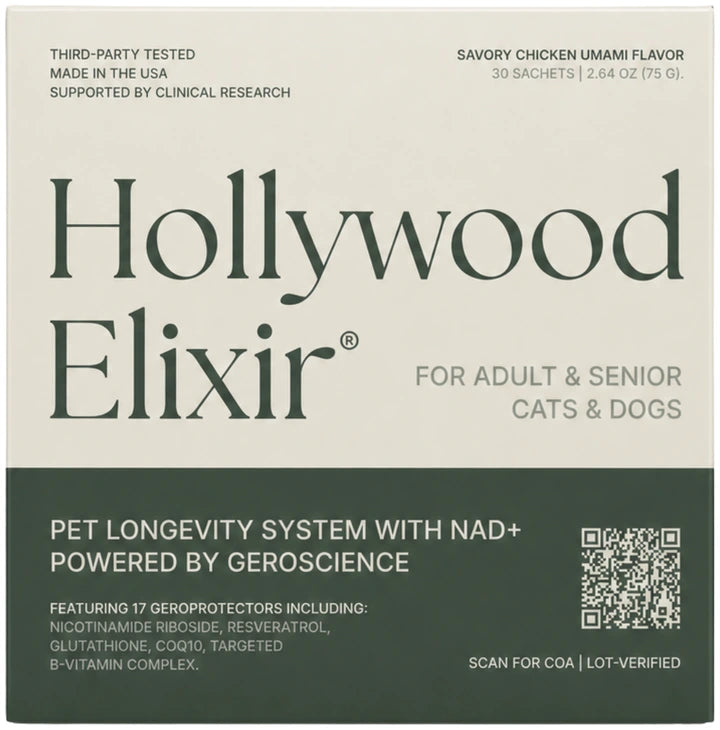
La Petite Labs. Hollywood Elixir: Supplement Facts and Cat Directions. Evidence boundary: The standard 2.5 g sachet lists NR 60 mg and niacin 2 mg. Cat directions give half a sachet for under 7 lb or sensitive pets and one sachet for 7–30 lb, mixed into usual food and served immediately. The product also gives consultation guidance.↩ 1 · ↩ 2 · ↩ 3 · ↩ 4 · ↩ 5 · ↩ 6 · ↩ 7 · ↩ 8 · ↩ 9 · ↩ 10 · ↩ 11 · ↩ 12 · ↩ 13
-
La Petite Labs. Hollywood Elixir Ingredients. Evidence boundary: The ingredient guide specifies nicotinamide riboside tartrate and lists vitamin B3 simply as niacin. It also identifies CoQ10 and reduced L-glutathione and describes wet-food mixing or kibble-topper use.↩ 1 · ↩ 2 · ↩ 3 · ↩ 4 · ↩ 5 · ↩ 6
-
Reactome. Complex I oxidises NADH to NAD+, reduces CoQ to CoQH2. Evidence boundary: This curated human reaction record describes electron transfer from NADH through Complex I to coenzyme Q. It explains normal energy-transfer chemistry, not an outcome from a feline combination supplement.↩ 1 · ↩ 2
-
Reactome. Glutathione reduction using NADPH. Evidence boundary: This curated human reaction record describes glutathione reductase using NADPH to restore reduced glutathione. It supports the antioxidant-recycling explanation, rather than a clinical effect of oral glutathione in cats.↩ 1 · ↩ 2
-
EFSA Panel on Nutrition, Novel Foods and Food Allergens (NDA). Safety of nicotinamide riboside chloride as a novel food and bioavailability of nicotinamide from this source. Evidence boundary: The official EFSA assessment summarizes NR-chloride research, including short-term dog studies. Its safety conclusion concerns specified human uses and does not establish feline dosing. The underlying proprietary dog reports were not publicly available.↩ 1 · ↩ 2

Discover LPL-01: How This Fits Into a Larger Feline Longevity System
Aging in cats unfolds quietly. It’s not driven by a single failure, but by gradual shifts across interconnected systems — cellular energy, oxidative balance, immune tone, and tissue integrity — each influencing the others over time.
This article explores one layer of that system. To understand what actually shapes long-term health, you need to step back and look at how these layers interact.
Start with the underlying science:
- Feline Geroscience Framework →
A structured view of how aging progresses across cellular energy, inflammation, and resilience systems. - Senior Biological Defense Coverage (BDC) Modeling →
A systems-level map of which biological pathways decline first, and how layered interventions can support them. - 2026 Market Research: Best Cat Longevity Supplements →
A feline-specific review of longevity supplements. 2026 Industry report created by LPL-01 Research. - LPL-01 Standard →
The formulation system that translates these models into real-world supplementation—covering multiple pathways in a coordinated way.
Keep exploring
What would you like to understand next?
Search practical guides about healthy aging, cellular energy, ingredients, and daily support for cats.


