The 12 Hallmarks of Aging in Dogs, Explained
Read full insightDo Cats Need Supplements If Their Food Is Complete and Balanced?
By La Petite Labs Editorial 13 min read
Short answer: most healthy cats eating an appropriate complete-and-balanced food do not need routine extra vitamins or minerals to make that food complete. A feline supplement needs a separate, defined job and must pass dose, species-evidence, overlap, disease, medication, intake, measurement, and stop-rule checks. [1] [3]
The cat-specific twist is that the add-on can change the foundation simply by changing what the cat eats. A powder, chew, paste, or topper that displaces part of a small complete ration may subtract more useful nutrition than it adds. The decision tree therefore begins and ends with measured food intake.
- Most healthy complete-fed cats do not need routine vitamin or mineral stacking.
- Complete and balanced is the nutrient foundation for a named feline life stage, not a promise of perfect outcomes.
- A legitimate add-on must enter a demonstrated, therapeutic, risk-based, or transparent optional door.
- An unformulated homemade cat diet needs whole-recipe formulation, not a generic multivitamin.
- Cat-relevant species, formulation, dose, route, and outcome evidence matter.
- Count cumulative exposure and protect consumption of the complete ration.
- Change one optional product at a time with a baseline, review date, and stop rule.
- Hollywood Elixir sits only in the optional branch and makes no deficiency or CKD claim.
Start With the Answer Most Cats Actually Need
Most healthy cats eating an appropriate complete-and-balanced diet do not need routine extra vitamins or minerals to make the food complete. The cat vitamins and supplements guide catalogs product categories; this page asks the more important question first: whether a proposed add-on has a defensible job. [1] [3]
A targeted feline adjunct can be legitimate when it has a defined indication, species-relevant evidence and dose, intake and overlap review, measurement plan, and stop rule. That is different from adding a broad formula “just in case.” The decision turns on five doors, and every open door must preserve consumption of the complete ration.
Define Complete and Balanced for the Actual Cat
Complete and balanced describes nutritional adequacy for cats at a named life stage, not perfection for every individual outcome. The adequacy statement indicates whether the product is intended as a sole diet and which life stage it covers. A complete adult-maintenance food is not automatically appropriate for growth, gestation, or every disease. [1]
Treats, toppers, and many supplements are designed for intermittent or supplemental use, not as the diet foundation. That distinction changes the burden of proof. When the base food already supplies required nutrients in appropriate proportions, an add-on must name a different job; vague nutrient insurance is not enough.
Respect the Small-Ration Problem
A cat’s daily ration can be small enough that a chew, paste, topper, or repeated medication food meaningfully changes calories or the proportion of complete food eaten. The label on one product does not show the whole bowl. Measure the base food, all extras, and what remains uneaten. [1] [7]
This is not a universal percentage rule. It is a reason to use actual intake. A powder that causes a cat to leave part of dinner can reduce delivery of protein, vitamins, minerals, and calories from the complete diet. The nutritional effect must include what the cat stopped eating, not merely what the scoop added.
Do Not Use Stacking as Feline Nutritional Insurance
Routine nutrient stacking can duplicate the complete feline diet without creating a defined benefit. Total exposure can include fortified treats, hairball products, calming chews, oils, powders, dental items, and human products. Different brand names do not prevent the same nutrient or active from appearing repeatedly. [3] [4]
Adding several products at once also destroys attribution. If appetite falls, stool changes, or the cat improves, no one knows which change mattered. Species fit deserves equal attention: a product marketed to people or dogs is not automatically appropriate in formulation, concentration, inactive ingredients, or dose for a cat. [2] [4]
Door One: Formulate a Demonstrably Incomplete Diet
Door one opens for a demonstrated deficiency or an incomplete diet under a formulated plan. The cat supplement for homemade food guide explains why feline recipes require exact formulation. Cats have species-specific nutrient requirements, and ingredient substitutions can change the result. [5]
An incomplete or unformulated home-prepared cat diet should be corrected as a whole recipe rather than with a generic multivitamin. The plan should name exact ingredients, weights, preparation, supplement product, dose, permissible substitutions, storage, and monitoring. A broad scoop may oversupply one nutrient while failing to supply another. [5]
Most healthy complete-fed cats do not need routine vitamin or mineral stacking.
Door Two: Use a Therapeutic Adjunct Under Veterinary Care
Door two opens for a diagnosed condition when a veterinarian recommends a defined adjunct. A diagnosed-condition supplement belongs under veterinary oversight and does not replace medication or therapeutic diet when indicated. The nutrition versus medication guide helps keep supportive and primary treatment roles distinct. [3] [4]
Write down the exact clinical job, formulation, dose, evidence, concurrent treatment, reassessment date, and stop rule. “Kidney support,” “urinary health,” or “glucose support” is not enough. CKD, hyperthyroidism, diabetes, gastrointestinal disease, and urinary disease have different priorities and can make general formulas inappropriate.
Door Three: Address a Defined Risk or Intake Problem
Door three opens when a credible risk or measured intake problem exists and evidence supports a particular intervention. The chain must match the cat, product form, route, daily dose, duration, and intended outcome. A risk label without a baseline or plausible measure is a marketing segment, not yet a patient-specific plan. [4]
If reduced intake is the premise, first identify why the cat is eating less and whether the complete diet can be made acceptable. If a nutrient shortfall is suspected, document it. If a medication or disease creates the risk, involve the treating veterinarian. An adjunct should not conceal the signal that justified considering it.
Door Four: Keep Optional Wellness Honestly Optional
Door four contains transparent complementary nutrition: no claim to correct deficiency, prevent CKD, or treat disease. It can be considered when the goal is modest and specific, the daily feline dose is disclosed, the cat keeps eating the complete ration, overlap and medications are reviewed, evidence limits are stated, and cost and burden are acceptable.
Optional means the cat does not become nutritionally deficient if the product is declined. A time-limited, one-product trial can be reasonable when the downside is proportionate and a measure exists. A hidden-dose kitchen sink with broad claims does not become sensible merely because its ingredients sound familiar. [4]
Door Five: Stop Before Adding Complexity
Door five applies when there is no defined goal, the daily dose is hidden, products duplicate each other, a disease or medication raises concern, the cat rejects the altered food, extras displace the complete ration, adverse effects appear, or no plausible measure can show value. “Do not add” is an evidence-based decision.
It may also mean wait. Preserve a clean baseline while appetite change is investigated, a therapeutic diet is introduced, or one existing intervention is assessed. Cats can form strong food preferences, and repeated poorly timed changes can make feeding harder. More bowl activity is not always more care. [8]
Read the Feline Dose and Every Inactive Ingredient
The relevant feline supplement dose is cumulative across the complete food, treats, toppers, powders, chews, oils, and medicines. Record the ingredient form, amount per serving, number of servings, calories, flavorings, sweeteners, carriers, allergens, lot, storage, and every overlapping source. [4] [7]
Use the pet supplement claims decoder to separate ingredient identity, amount, mechanism, and outcome. Never calculate a cat dose from a human serving by intuition. A proprietary blend can make dose review impossible, and “natural” does not answer species safety, interaction, palatability, or finished-product evidence.
An unformulated homemade cat diet needs whole-recipe formulation, not a generic multivitamin.
DVM Voice: Clinical Vignette of a Common Pattern in Senior Cat Aging
Case provided by JoAnna Pendergrass, DVM
Sasha, a 12-year-old cat, was brought in after her owner noticed increased thirst and urination, lethargy, vomiting, and a generally unkempt appearance. Examination showed weight loss, elevated blood pressure, and reduced vitality.
Diagnostic testing revealed elevated kidney markers, poorly concentrated urine, and protein loss in the urine — findings consistent with chronic kidney disease, one of the most common chronic conditions in senior cats.
Her care required a kidney-focused diet, blood pressure management, targeted supplementation, medication support, and regular monitoring — a necessary plan, but one started after clinical signs were already visible.
Clinical takeaway: Sasha’s case reflects why senior-cat wellness should begin before obvious decline. Earlier monitoring, body-condition tracking, hydration awareness, antioxidant support, and daily cellular resilience may help support quality of life as cats age.
Single-case vignette. Not generalizable. Veterinary diagnosis and monitoring are essential for increased thirst, urination, vomiting, lethargy, weight loss, or suspected kidney disease.
Demand Evidence for the Formula Cats Actually Receive
Ingredient presence, manufacturing quality, or a seal does not by itself prove a finished supplement improves a feline health outcome. Evidence should be traced through species, population, formulation, route, daily dose, duration, comparator, and outcome. A canine trial is not a feline efficacy trial. [4] [6]
Mechanistic or other-species research can explain why a question is worth testing. It cannot fill the missing clinical result. A disciplined summary says what is known, what is adjacent, and what was not tested. Product breadth, scientific vocabulary, and citation count cannot repair a dose that is undisclosed or unlike the study.
Audit Duplication, Medicines, and Disease Together
Create one inventory containing the exact complete food, treats, toppers, supplements, human products, and flavored medicines. Add current diagnoses, recent appetite and weight trends, body and muscle condition, vomiting or stool changes, and laboratory monitoring. WSAVA treats diet history and patient risk as one assessment. [7]
Then review cumulative exposure and interactions with the veterinarian or pharmacist where appropriate. CKD, hyperthyroidism, diabetes, gastrointestinal disease, urinary disease, weight loss, and multi-morbidity can change priorities. The safest choice may be improving intake or simplifying the routine, not adding another active. [8] [9]
Protect Palatability and Total Food Intake
A cat supplement that reduces consumption of the complete ration can undermine the nutritional foundation it is meant to complement. Mix-ins change aroma, texture, and freshness; some cats accept them, while others avoid the bowl. Measure offered versus eaten food before and after the change rather than relying on impression. [8]
If a stable cat is trialing an optional product, start separately or in a small measured portion when appropriate so the main ration remains available. Stop if intake falls. Persistent poor appetite, nausea, food approach-and-retreat behavior, weight loss, or dehydration concern requires assessment, not increasingly elaborate toppers.
Treat Quality Controls as Identity Evidence, Not Outcome Evidence
Quality questions ask whether the product is likely to match its label: who formulates it, how raw materials are identified, whether finished lots are analyzed, how stability and storage are managed, and how complaints and adverse events are recorded. The pet supplement quality guide provides the fuller audit. [4] [6]
These controls are valuable because an effective dose cannot work if identity or amount is unreliable. They still do not demonstrate a health outcome. A process seal, certificate, or laboratory panel answers particular quality questions; it cannot substitute for evidence testing the finished feline formulation at its labeled dose.
Run the Feline Five-Door Decision Tree
Start with the complete-diet gate: right species, right life stage, and consistently eaten. If the diet is incomplete, use door one. If a diagnosed condition creates a veterinarian-directed adjunct, use door two. Then test defined risk, optional wellness, and finally the no-add door.
Every open branch passes through feline-specific gates: Does the cat still eat the complete ration? Is the daily dose disclosed? Are nutrients, products, disease, and medication overlap reviewed? Is the evidence relevant to cats? Is one outcome measured? Is a stop rule written? Any hard failure closes the branch.
Original decision tool — The Feline Five-Door Supplement Decision Tree: Classify a proposed feline supplement use while forcing intake, palatability, duplication, disease, medication, evidence, and stop-rule checks.
• Branch: 1 — Correct the foundation | Entry condition: Demonstrated deficiency or incomplete diet | Feline gate: Whole feline recipe and substitutions formulated | Evidence and measure: Exact product/dose plus clinical monitoring | Stop or redirect: Redirect generic stacking to formulation
• Branch: 2 — Therapeutic adjunct | Entry condition: Diagnosed condition with veterinary role | Feline gate: Therapeutic diet, medicines, and intake preserved | Evidence and measure: Cat-relevant formulation, endpoint, baseline, and review | Stop or redirect: Stop for conflict, adverse effect, or treatment failure
• Branch: 3 — Defined risk or intake problem | Entry condition: Credible patient-specific risk or measured constraint | Feline gate: Cause of low intake investigated; ration remains adequate | Evidence and measure: Evidence matches cat, dose, route, duration, and outcome | Stop or redirect: Stop if premise is absent or cannot be measured
• Branch: 4 — Optional wellness layer | Entry condition: No deficiency, prevention, or treatment claim | Feline gate: Palatability stable; daily feline dose and overlap disclosed | Evidence and measure: One modest goal with explicit uncertainty and timed review | Stop or redirect: Stop for appetite decline, no value, burden, or cost
• Branch: 5 — Do not add | Entry condition: No goal, hidden dose, duplication, conflict, or no measure | Feline gate: Food refusal, calorie displacement, disease, or medication concern | Evidence and measure: Burden of proof fails before purchase | Stop or redirect: Preserve baseline or seek veterinary assessment
• Branch: Intake hard gate | Entry condition: Any proposed powder, chew, paste, oil, or topper | Feline gate: Measure complete food offered versus eaten | Evidence and measure: Compare baseline with trial consumption | Stop or redirect: Close branch if complete-ration intake falls
• Branch: Attribution hard gate | Entry condition: More than one new variable | Feline gate: One optional product at a time when practical | Evidence and measure: Track lot, dose, outcome, stool, vomiting, and behavior | Stop or redirect: Pause additions until the first change is interpretable
Method: The tree combines FDA adequacy boundaries, WSAVA guidance against routine stacking, feline transition and intake principles, and veterinary supplement evidence review; it classifies uses rather than scoring products.
Limit: The tool cannot diagnose deficiency or disease, formulate a feline diet, prove efficacy from a label, or replace veterinary and veterinary-nutrition care.
Change One Product at a Time and Preserve Attribution
Complete this sentence before purchase: “For this cat, we are considering [exact product and dose] to change [one outcome], measured from [baseline] after [time], while protecting [complete-food intake and essential care], and we will stop for [specific finding].” Empty fields mean the trial is not ready.
Photograph the label, record the lot, and introduce only one optional product at a time when practical. Track offered and eaten food, primary outcome, stool or vomiting, behavior, medications, and adverse changes. One variable makes improvement and harm easier to attribute; a review date stops a vague experiment from becoming permanent. [4]
• Goal: one concrete decision, not “overall wellness.”
• Measure: owner-observable or veterinary, defined before dosing.
• Dose and overlap: total daily exposure from every source.
• Stop rule: appetite decline, adverse effect, conflict, no value, or review date.
Escalate Feline Red Flags Instead of Supplementing Around Them
Do not test another supplement when emergency signs are present. Cornell lists difficulty breathing, collapse, difficulty urinating, unresponsiveness, and seizure activity among emergent conditions for which owners should proceed immediately to the nearest emergency clinic. [10]
For other persistent or unexplained deterioration, contact the cat’s veterinarian rather than trying to diagnose the cause with an add-on. The chronic kidney disease guide for cats owns CKD staging and treatment context; IRIS supports CKD-specific care, not general emergency triage. [9] Age does not create a universal need either: the senior cat supplement-need guide covers life-stage decisions. Bring the full product inventory to care while a diagnosis, medication response, or therapeutic diet is being evaluated.
Place Hollywood Elixir Only in the Optional Branch
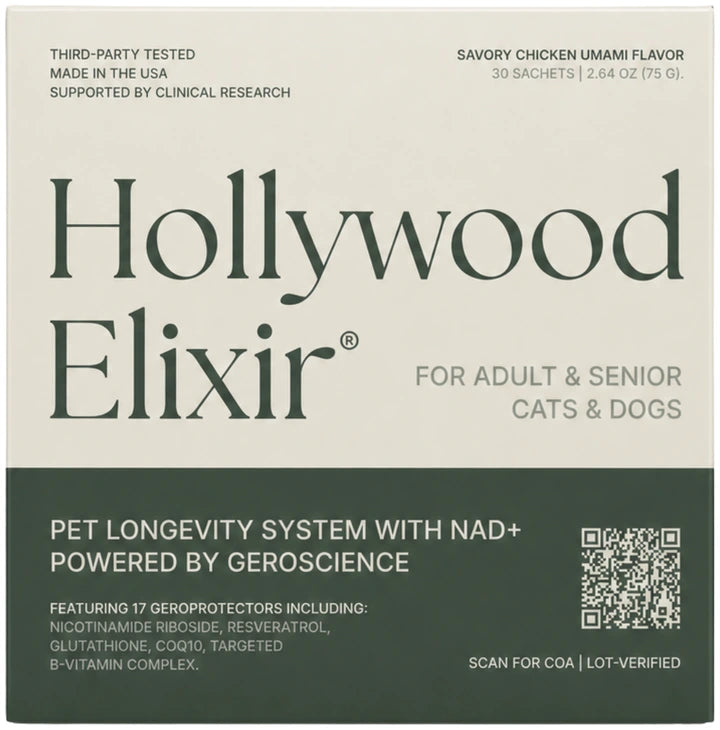
La Petite Labs makes Hollywood Elixir, so this is a disclosed commercial bridge. It belongs only in the optional complementary branch unless a future product-specific record supports a narrower use. The Hollywood Elixir ingredients page lets readers inspect the labeled formula; ingredient presence is not finished-product efficacy.
Hollywood Elixir is optional complementary nutrition, not a universal need, deficiency correction, CKD prevention, or treatment substitute. If considered, apply the same feline gates: labeled daily dose, continued complete-food intake, total overlap, disease and medication review, cat-relevant evidence, one measurable goal, review date, and stop rule. Declining it is valid.
Hollywood Elixir sits only in the optional branch and makes no deficiency or CKD claim.
Educational content only. This material is not a substitute for veterinary advice. Always consult your veterinarian about your cat’s specific needs. These statements have not been evaluated by the Food and Drug Administration. Products mentioned are not intended to diagnose, treat, cure, or prevent any disease.
Glossary
- Complete and balanced: Label language indicating nutritional adequacy for cats at the named life stage when the food is fed as directed.
- Complementary nutrition: An optional product used alongside a complete diet without representing itself as the sole nutrient foundation.
- Cumulative dose: The total daily amount from complete food, treats, toppers, supplements, medicines, and other relevant sources.
- Finished-product evidence: Evidence evaluating the actual marketed feline formulation, dose, route, duration, and outcome rather than an ingredient alone.
- Palatability: The sensory properties and feeding context that affect whether a cat accepts and consumes a food or product.
- Stop rule: A prewritten finding—such as appetite decline, adverse effect, conflict, no value, or review date—that pauses or ends use.
Related Reading
Aging & Senior Cat Guidance
• Cat Age Calculator: Cat Years to Human Years
• Cat Lifespan by Breed
• Lethargy in Cats
• Senior Cat Not Eating
• Cat Drinking A Lot
• Why Is My Senior Cat Withdrawn?
Healthy Aging Support
• NAD+ for Cats
• NMN for Cats
• Vitamins For Older Cats
• Senior Cat Food
References
Numbered references support claims cited in the article. Evidence context identifies the study population and design; it does not turn indirect evidence into pet-specific proof.
-
[1]
U.S. Food and Drug Administration. Complete and Balanced Pet Food. U.S. Food and Drug Administration · 2024RegulatoryPopulation: bothEvidence boundary: Official label guidance; nutritional adequacy does not mean every optional adjunct is useless or every complete food fits every patient.↩ 1 · ↩ 2 · ↩ 3 · ↩ 4
-
[2]
U.S. Food and Drug Administration. FDA's Regulation of Pet Food. U.S. Food and Drug Administration · 2023RegulatoryPopulation: bothEvidence boundary: Authoritative U.S. regulatory context; it does not evaluate a named feline product or establish clinical benefit.↩
-
[3]
World Small Animal Veterinary Association. Frequently Asked Questions and Myths. World Small Animal Veterinary Association · 2020GuidelinePopulation: bothEvidence boundary: Global veterinary nutrition guidance; it distinguishes unnecessary routine stacking from individualized interventions without endorsing every adjunct.↩ 1 · ↩ 2 · ↩ 3 · ↩ 4
-
[4]
Finno CJ. Veterinary Pet Supplements and Nutraceuticals. Nutrition today · 2020· DOI 10.1097/nt.0000000000000399ReviewPopulation: bothEvidence boundary: Narrative review of a heterogeneous category; one ingredient or product class cannot represent all feline supplements.↩ 1 · ↩ 2 · ↩ 3 · ↩ 4 · ↩ 5 · ↩ 6 · ↩ 7 · ↩ 8 · ↩ 9
-
[5]
Veterinary Specialists. Preventing Nutritional Deficiencies in Pets. VetSpecialists.com · 2025GuidelinePopulation: bothEvidence boundary: Specialist clinical guidance; it does not imply a generic multivitamin can balance an unformulated feline recipe.↩ 1 · ↩ 2
-
[6]
World Small Animal Veterinary Association. Guidelines on Selecting Pet Foods. World Small Animal Veterinary Association · 2021GuidelinePopulation: bothEvidence boundary: Veterinary manufacturer-screening guidance; process quality is not proof of a specific health outcome.↩ 1 · ↩ 2
-
[7]
WSAVA Nutritional Assessment Guidelines Task Force Members. WSAVA nutritional assessment guidelines. Journal of feline medicine and surgery · 2011· DOI 10.1016/j.jfms.2011.05.009GuidelinePopulation: bothEvidence boundary: Global assessment framework; it supports inventory and monitoring but does not prescribe an adjunct for a remote patient.↩ 1 · ↩ 2 · ↩ 3
-
[8]
Quimby J, Gowland S, Carney HC, et al. 2021 AAHA/AAFP Feline Life Stage Guidelines. Journal of feline medicine and surgery · 2021· DOI 10.1177/1098612X21993657GuidelinePopulation: catEvidence boundary: Feline consensus guidance; diet acceptance and transition advice does not excuse persistent poor intake or replace diagnostic evaluation.↩ 1 · ↩ 2 · ↩ 3
-
[9]
International Renal Interest Society. IRIS Guidelines for Chronic Kidney Disease. International Renal Interest Society · 2023GuidelinePopulation: catEvidence boundary: Current specialist guidance for diagnosed feline CKD; it does not support preventive renal claims for a general supplement or non-CKD triage advice.↩ 1 · ↩ 2
-
[10]
Cornell University College of Veterinary Medicine. Emergency and Critical Care. Cornell University College of Veterinary Medicine · n.d.GuidelinePopulation: bothEvidence boundary: University veterinary-hospital triage guidance identifying examples of emergent conditions; it does not diagnose their cause or support CKD-specific claims.↩
FAQ
Do cats need supplements if their food is complete and balanced?
Most healthy cats do not need routine extra vitamins or minerals to make an appropriate complete food complete. A targeted adjunct may still be defensible for a formulated diet problem, diagnosed condition, defined risk, or transparent optional goal.
Can a cat get too many vitamins from food plus supplements?
Potentially. Risk depends on nutrient, amount, duration, complete diet, treats, other products, disease, medications, and food intake. Inventory every source and review cumulative exposure rather than assuming more provides extra protection.
Can a general supplement balance homemade cat food?
Not reliably. The feline recipe must be formulated as a whole, including exact ingredients, quantities, preparation, supplement, and substitutions. A generic multivitamin can oversupply some nutrients while leaving other species-specific requirements unmet.
What if a powder or topper makes my cat eat less?
Stop the optional product and measure complete-food intake. A mix-in that reduces the ration can undermine overall nutrition. Persistent appetite decline, nausea, weight loss, or food approach-and-retreat behavior needs veterinary assessment rather than more toppers.
Does a kidney supplement replace a renal diet or CKD treatment?
No. CKD care follows diagnosis, staging, individualized diet and medication decisions, and serial monitoring. A general supplement should not be used to prevent CKD or replace the veterinary renal plan.
Does a quality seal prove a cat supplement works?
No. A seal can signal manufacturing or process requirements, which matter for identity and consistency. It does not by itself demonstrate that the finished formulation at its labeled feline dose improves a health outcome.
Can I give a human supplement to my cat?
Do not assume it is interchangeable. Concentration, inactive ingredients, dosage form, labeling, species evidence, and safe dose can differ. Human dietary-supplement regulation also does not create the same category for animal products. Review the exact label with a veterinarian.
Is a cat supplement with more ingredients better?
No. Ingredient count is not an evidence grade. Each component needs identity, a disclosed relevant feline dose, evidence for the intended outcome, overlap and safety review, and finished-product context. Token amounts can create breadth without a plausible intervention.
How long should I try a cat supplement?
Set the interval from the intended outcome before starting. Record complete-food intake, baseline, exact dose, one primary measure, reassessment date, essential care that continues, and appetite or adverse-effect stop rules. Without those fields, the trial cannot be interpreted.
Is Hollywood Elixir necessary for every cat on complete food?
No. La Petite Labs positions Hollywood Elixir as optional complementary nutrition, not a diet balancer, universal need, deficiency correction, CKD preventive, or treatment replacement. It must pass the same feline intake, dose, overlap, evidence, and stop-rule gates.
Discover LPL-01: How This Fits Into a Larger Feline Longevity System
Aging in cats unfolds quietly. It’s not driven by a single failure, but by gradual shifts across interconnected systems — cellular energy, oxidative balance, immune tone, and tissue integrity — each influencing the others over time.
This article explores one layer of that system. To understand what actually shapes long-term health, you need to step back and look at how these layers interact.
Start with the underlying science:
- Feline Geroscience Framework →
A structured view of how aging progresses across cellular energy, inflammation, and resilience systems. - Senior Biological Defense Coverage (BDC) Modeling →
A systems-level map of which biological pathways decline first, and how layered interventions can support them. - 2026 Market Research: Best Cat Longevity Supplements →
A feline-specific review of longevity supplements. 2026 Industry report created by LPL-01 Research. - LPL-01 Standard →
The formulation system that translates these models into real-world supplementation—covering multiple pathways in a coordinated way.
Hollywood Elixir®
From $89
Hollywood Elixir is amazing! She put back on 5 lbs to a healthy weight, her eyes are shiny, her coat is beautiful!
— Jessie
She hopped up onto the windowsill again for the first time in years.
— Charlie
Learn about how our DVMs think about cat aging
Dr. JoAnna Pendergrass DVM
Hollywood Elixir®
From $89
Related Reading