Pawfy Longevity vs Hollywood Elixir®

Pawfy offers ten disclosed actives in an NMN-and-fucoidan soft chew at a lower 90-day cost. Hollywood Elixir® offers a broader food-mixed system and a public lot-level quality route. Here is the same-dog comparison.

By La Petite Labs Editorial 35 min read

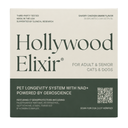
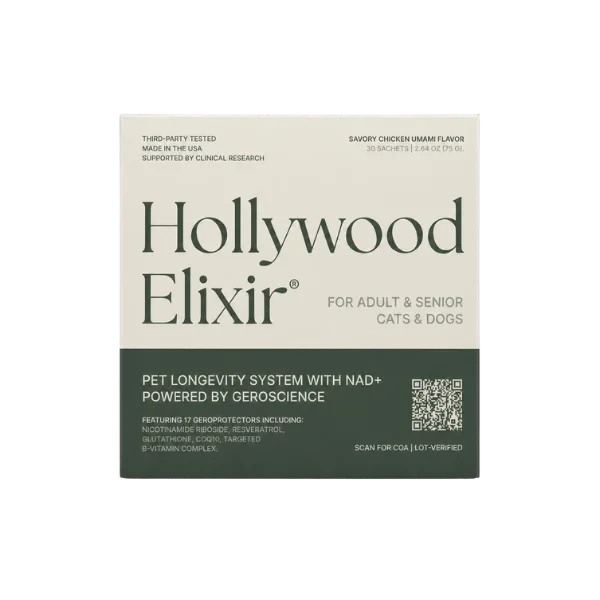
Hollywood Elixir box above a spotted dog on a light background

Pawfy Longevity Complex and Hollywood Elixir approach the same owner anxiety from different directions: how do you support an aging dog before ordinary changes become hard to ignore? Pawfy leads with NMN for dogs, fucoidan, and a turkey soft chew. Hollywood Elixir leads with NR, CoQ10, glutathione, immune-support ingredients, and a pre-portioned powder mixed into food.

Pawfy deserves credit for the part many comparisons miss: every named active has an amount. The real questions are whether the NMN-and-SIRT6 story has been carried too far into lifespan and outcome language, whether the testing claim can be matched to the purchased lot, and how the multi-chew schedule changes cost for larger dogs.

La Petite Labs makes Hollywood Elixir. That commercial relationship is why this guide uses the same standard for both products: calculate the dog's actual daily amount, separate ingredient research from finished-product evidence, name the price type, and distinguish a quality report from an efficacy result.

What Pawfy Longevity Complex Is and Who It Fits

Pawfy Longevity Complex is a dog-only, turkey-flavored soft chew with 30 chews per jar. Unlike a broad multivitamin, it makes a specific aging-biology argument: NMN for NAD+ support, fucoidan for a SIRT6 story, and antioxidant or mitochondrial support from fish oil, blueberry, olive leaf, curcumin, vitamin E, black pepper, brewer's yeast, and CoQ10.

The product comes in a 4 oz jar and assigns one to four chews per day by weight. That creates two kinds of fit. The ingredient fit is narrow enough to understand: a buyer is deliberately choosing NMN and fucoidan, with eight supporting actives, rather than assuming the product is a complete senior multivitamin. The household fit is equally important: the dog must accept turkey soft chews, and the owner must be comfortable maintaining a schedule that can reach four chews and twelve jars over 90 days for the largest weight band.

Pawfy also deserves a fair distinction from products that disclose only a blend total. Every named active has an amount per chew. That lets a veterinarian calculate the dog's daily intake and identify overlap with fish oil, vitamin E, curcumin, black pepper, CoQ10, or another NAD+ precursor already in the routine. It does not tell the buyer that those amounts are clinically effective, but it makes the label discussable.

The best-fit owner therefore wants a chew, prefers NMN specifically, values complete active-amount disclosure, and accepts that the public evidence does not prove the finished product's lifespan language. A dog with fish or turkey sensitivity, a large dog whose multi-chew routine becomes cumbersome, or a household that requires a public lot report may need a different shortlist. For wider company-level disclosure context, the separate Pawfy review covers Pawfy beyond this one formula.

At a Glance

What is Pawfy Longevity Complex?

Pawfy Longevity Complex is a turkey flavored dog supplement sold in a 4 oz jar of 30 soft chews. It combines NMN and fucoidan with fish oil, blueberry, brewer's yeast, olive leaf extract, curcumin, vitamin E, black pepper, and CoQ10. The brand positions it for cellular energy, healthy aging, and whole body support.

Product
Pawfy Longevity Complex Soft Chews
Category
Dog NMN and healthy-aging supplement
Format
30-count turkey soft chew; one to four chews daily by weight
Why owners notice it
A fully quantified NMN-and-fucoidan chew with antioxidant and mitochondrial-support additions.
What to check
Pawfy prints all ten active amounts and all four weight bands, and states independent testing. No named lab or public lot report was easy to locate.
Side by Side

The Plain Comparison

The clearest comparison uses the current active panels, the dog's weight, and a full 90-day purchase window.

QuestionPawfy Longevity ComplexHollywood ElixirStronger fit when...
Main ideaNMN plus fucoidan/SIRT6-focused turkey chewMulti-pathway NR-based food-mixed systemHollywood Elixir for broader daily coverage; Pawfy for the focused chew idea
Dose disclosureAll ten active amounts per chewAll seventeen active amounts per sachetTie on active-amount visibility
NAD+ precursorNMN 50 mg per chewNR tartrate 60 mg per sachetDepends on the intended precursor; raw mg is not equivalence
25-lb 90-day subscription displayThree jars at the $25-per-jar three-jar tier: $75Standard 90-day subscription: $189Pawfy on price
75-lb 90-day subscription displayNine jars at the $25-per-jar three-jar tier: $225Double 90-day subscription: $339Pawfy on price
FormatOne to four turkey soft chews dailyOne or two chicken-flavored sachets mixed with foodHollywood Elixir for food-mixed control; Pawfy for treat acceptance
Quality accessGeneral independent-testing and GMP/SQF statements; no lot report foundPublic lot-level COA lookupHollywood Elixir when batch documentation matters
Evidence boundaryIngredient and mechanism research; no finished-formula canine trial foundIngredient and system research; no finished-formula canine efficacy trialNeither has head-to-head or lifespan proof

Competitor label and pricing facts checked September 3, 2026. Sources are listed in the References section below.

Why the NMN and Fucoidan Story Is Appealing

Pawfy gives buyers two memorable anchors instead of an endless ingredient list. NMN sits in the NAD+ conversation, while fucoidan supplies the more unusual SIRT6 hook. A soft chew turns both ideas into a simple reward routine.

The pairing is commercially coherent. NAD+ participates in normal cellular energy reactions, so NMN gives the formula an easy-to-recognize healthy-aging theme. SIRT6 is involved in cellular regulation, so fucoidan gives Pawfy a second mechanism to explain. Fish oil, blueberry, olive leaf, curcumin, vitamin E, and CoQ10 then make the product feel broader without displacing those two lead ideas. For a pet parent trying to understand a crowded category, a memorable thesis can be more useful than a list with no organizing principle.

The limitation is the distance between a mechanism and an outcome. The fucoidan evidence used for this comparison is laboratory work involving a SIRT6 assay, not an oral trial of Pawfy in dogs. Canine NMN research provides early safety and exploratory context, but it does not test this ten-active chew or prove a household timeline. Pawfy's digestion, energy, and breath percentages also appear without a visible method, sample size, control group, or finished-formula paper.

That does not make the mechanism meaningless. It tells the buyer what kind of confidence is justified. A pathway can support a reason to study an ingredient and a veterinarian can decide whether it belongs in an individual plan. It cannot establish that the chew renews old cells, extends life, or produces staged changes on schedule. Pawfy owns the more distinctive NMN-and-fucoidan story. Hollywood Elixir owns the broader disclosed daily system and the more directly inspectable lot-document route. Neither owns proven canine lifespan results.

The Pawfy Label, One Chew at a Time

The label is unusually readable for a ten-active chew. Per chew it prints fucoidan and NMN at 50 mg each; fish oil, blueberry, brewer's yeast, and olive leaf at 25 mg each; curcumin 20 mg; vitamin E 10 IU; black pepper 5 mg; and CoQ10 5 mg.

Those are per-chew figures, not universal daily figures. A dog up to 30 lb receives the printed panel. A 31–60 lb dog receives twice every line, while a 61–90 lb dog receives three times every line. At three chews, for example, the daily label math becomes NMN 150 mg, fucoidan 150 mg, fish oil 75 mg, curcumin 60 mg, and CoQ10 15 mg. A dog in the highest band receives four times the panel. This multiplication is useful for stack review; it still does not convert a label amount into an outcome prediction.

The current text inactive list names citric acid as a preservative, palm-derived RSPO glycerin, oat flour, organic RSPO palm fruit oil, rice flour, sunflower lecithin, turkey, and natural turkey flavor. The product also carries a fish disclosure. These ingredients matter for elimination diets, known food reactions, and calorie or treat accounting even though they sit outside the active panel.

One retailer gallery image shows a different supporting-ingredient panel that includes chicken bone broth, inulin, and spirulina. The current Pawfy text and current Chewy text instead align around the turkey-based list. That is a reason to inspect the jar that arrives, not a reason to combine both lists or assume one applies to every lot. Photograph the active panel, inactive panel, lot code, and expiration date before discarding the package. Owners managing fish, turkey, chicken, oat, rice, yeast, or palm-derived ingredients should make the shipped label—not a remembered headline—the final reference.

What Still Needs Confirmation Before Buying

Three questions remain open. First, Pawfy displays digestion, energy, and breath percentages without an accessible method or sample description. Second, its 90-day cart banner conflicts with the detailed 60-day guarantee. Third, a Chewy gallery label shows chicken bone broth, inulin, and spirulina while the current text listing shows turkey and different carriers.

The price presentation also needs confirmation. The purchase module showed a one-jar subscription price of $30, lower per-jar tiers for two and three jars, and a separate $45 one-time line. Catalog data showed $35, while Chewy showed $34.99 one time. These can reflect different channels, promotions, or page states, but a buyer should not treat any one of them as the guaranteed charge until the quantity, cadence, discount, shipping, and renewal terms appear together at checkout.

The testing language deserves the same discipline. Pawfy says it uses independent third-party testing and displays GMP, SQF, Made in USA, and NASC-related language. A named laboratory, test panel, numeric result sheet, or public lot lookup was not readily available. Before relying on the quality claim, ask for the finished-product report associated with the jar's lot, what was tested, the specifications used, and whether identity, potency, microbial contaminants, and heavy metals were included.

None of these inconsistencies proves a safety defect or deceptive intent. They are decision points created by information that does not line up cleanly across current displays. Save a screenshot of the checkout and guarantee terms, read the arrived label, and keep the lot number. If a return window matters, ask whether opened containers, subscription shipments, and multi-jar bundles are handled differently. A careful confirmation step protects the owner without turning ordinary storefront inconsistency into an unsupported product verdict.

Soft-Chew Convenience Has a Large-Dog Cost

For a small dog, one chew daily is straightforward. A 75-lb dog receives three chews, and a dog above 90 lb receives four. The 90-day routine then requires nine or twelve jars. That raises storage, reorder, and treat-calorie questions even when the per-jar price remains attractive.

The multiplication changes more than cost. A 31–60 lb dog needs 180 chews, or six jars, across 90 days. A 61–90 lb dog needs 270 chews, or nine jars. A dog above 90 lb needs 360 chews, or twelve jars. That can mean a larger delivery, more frequent opening of packages, and more room needed to keep the chews below the stated 80°F storage guidance. It also means the owner should ask how the chew's calories fit the dog's total reward allowance, because the active panel does not answer that question.

Soft chews still have a genuine convenience advantage. Some dogs take them as a reward, which can be easier than persuading the dog to finish a powder-coated meal. The unit count makes missed servings visible. On the other hand, a dog that refuses the flavor or needs several chews may turn a simple idea into a negotiation. A chew given around medication can also become hard to distinguish from other functional treats unless the household keeps a written routine.

Hollywood Elixir uses one sachet at 7–30 lb and two above 30 lb. Food mixing can be introduced in part of a meal and paused cleanly, while pre-portioned packets reduce measurement variation. Its tradeoffs are chicken and milk-derived ingredients, higher cost, and the need for the dog to eat the prepared food. Pawfy may be easier for a chew-motivated dog. Hollywood Elixir may be easier for a household that prefers counted meal packets. Adherence is dog-specific, not format-specific, so trial the delivery method as seriously as the ingredient list.

“Pawfy's active panel is readable; its product level evidence and batch documentation are the bigger questions.”

How to Judge a Dog Longevity Supplement

Start with six questions: Does the mechanism make biological sense? Is there dog-specific evidence? Can every meaningful amount be read? Can quality results be matched to the package? Can one product be introduced without changing several other variables? Will the routine still work on an ordinary busy day?

Each question protects against a different shortcut. A plausible mechanism keeps the label from becoming a random ingredient collage, but it is only the beginning. Dog-specific evidence matters because human and laboratory findings do not automatically predict canine response. Amount disclosure makes daily intake and supplement overlap calculable. Lot-matched results help show whether the purchased batch met stated quality specifications. A one-change start makes tolerance easier to interpret, and a workable format determines whether the dog receives the planned serving consistently.

Then add cost and safety. Calculate the whole packages required for the dog's weight over 90 days rather than comparing a monthly-looking headline. Read active and inactive ingredients, storage directions, pregnancy or breeding cautions, medication guidance, and instructions for a worsening condition. A refund promise can reduce financial risk, but it cannot substitute for clear stop rules or veterinarian input.

Pawfy scores well on active-panel readability and familiar chew delivery. It also offers a focused mechanism story and a substantially lower small-dog price than Hollywood Elixir. Its bigger gaps are finished-product outcome evidence, public batch-document access, and consistency among price, guarantee, and inactive-ingredient displays. Hollywood Elixir is broader and more inspectable at the lot level, but it costs more and has no finished-formula canine efficacy trial of its own. The pet supplement quality guide explains why a manufacturing badge, general testing statement, lot report, and clinical study answer separate questions. A useful comparison keeps all four evidence layers separate.

What Hollywood Elixir Adds to the Comparison

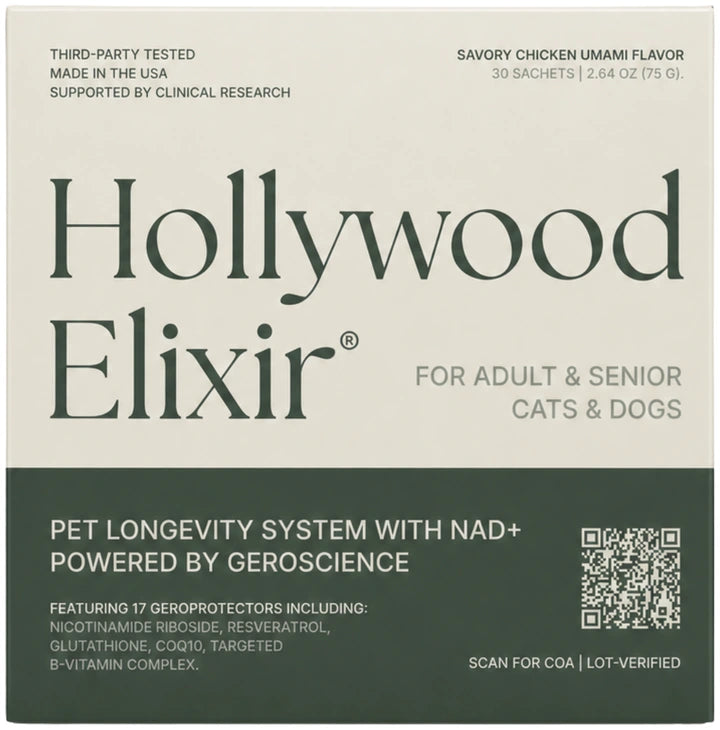
Hollywood Elixir is not built around one aging molecule. Per sachet it combines NR 60 mg, CoQ10 40 mg, glutathione 50 mg, beta glucans 50 mg, reishi 25 mg, quercetin 25 mg, resveratrol 15 mg, astaxanthin 2 mg, vitamins B2, B3, B6, B12, C and E, spirulina 50 mg, blueberry 50 mg, and whey protein isolate 250 mg.

That broader mitochondrial and cellular-energy support is the practical difference. NR and CoQ10 form the most obvious energy-related pair. Glutathione, quercetin, resveratrol, astaxanthin, vitamins C and E, spirulina, and blueberry create several antioxidant lines. Beta glucans and reishi add immune-support ingredients, while B vitamins and whey protein isolate give the sachet a nutritional base. Every listed active carries an amount, so the owner can calculate the one- or two-sachet daily total.

Breadth is not automatic superiority. Hollywood Elixir does not list fucoidan, fish oil, olive leaf, curcumin, or black pepper. An owner choosing Pawfy for fucoidan or an NMN-specific plan would not receive the same formula by switching. Hollywood Elixir also contains chicken flavor, chicken liver powder, yeast extract, and milk-derived whey, which may rule it out for some diets. It is mixed into food rather than offered as a treat, and it costs more in the small-dog 90-day comparison.

What Hollywood Elixir adds is therefore choice, not a universal verdict. It can consolidate several named healthy-aging support lanes in one disclosed, pre-portioned routine and offers a public path to a current lot record. It does not prove better absorption, healthspan, or clinical outcomes, and no finished-formula canine efficacy trial is presented here. The owner should value its wider panel only when those additional ingredients belong in the dog's plan. When the goal is specifically an NMN-and-fucoidan chew at lower cost, Pawfy retains the clearer fit.

NMN, NR, and the Milligram Trap

A 25-lb dog receives Pawfy NMN 50 mg or Hollywood Elixir NR tartrate 60 mg. A 75-lb dog receives Pawfy NMN 150 mg or Hollywood Elixir NR tartrate 120 mg. Those are accurate label calculations and a poor basis for declaring a winner.

NMN and NR are related to NAD+ metabolism, but they are distinct materials. Pawfy's label names nicotinamide mononucleotide. Hollywood Elixir's label names nicotinamide riboside tartrate. The mass printed for an ingredient can include its named salt or carrier form, so the numbers should not be treated as a direct count of identical parent molecules. Neither page supplies a validated conversion that makes 50 mg of one equivalent to 60 mg of the other.

Dog size makes the trap more obvious. Pawfy's serving climbs from one to four chews, so its daily NMN line rises from 50 to 200 mg. Hollywood Elixir moves from half a sachet below 7 lb to one sachet at 7–30 lb and two above 30 lb, so its NR tartrate line rises from 30 to 120 mg. A larger number can describe more label mass without showing greater absorption, a larger NAD+ response, better tolerance, or a better health outcome.

The evidence does not close that gap. The public materials do not provide a head-to-head canine study of NMN and NR, a pharmacokinetic comparison at these servings, tissue-specific NAD+ measurements, or a trial comparing the retail formulas. Even a blood biomarker change would not by itself prove a mobility, cognition, quality-of-life, or lifespan result.

Use the label arithmetic for practical purposes: calculating exposure, finding duplicate NAD+ precursors in the current stack, and giving the veterinarian an exact starting point. Do not use it as a potency ranking. Choose a precursor, if any, from the dog's clinical context, the complete formula, tolerability, documentation, cost, and the veterinarian's reasoning—not from a ten- or thirty-milligram headline difference.

Testing Claims Versus a Lot-Level Result

Pawfy says its products undergo independent third-party testing for food safety and quality. It also displays GMP/SQF badges, Made in USA language, and an NASC membership statement. Those are useful company-level signals, but a named lab, test panel, results sheet, and lot lookup were not easy to find.

These signals answer different questions. Manufacturing standards concern how a facility or quality system operates. An industry seal can reflect participation in a quality program. A general third-party-testing statement says outside analysis occurs. None, by itself, lets a buyer identify which laboratory tested the jar, which analytes were included, what specifications applied, or whether the result matched the lot in hand. NASC language should also be connected to the exact legal or manufacturing entity before a shopper assumes what the displayed badge covers.

Hollywood Elixir's COA lookup displays lot 2604066 with five microbial, four heavy-metal, and seventeen active-ingredient results marked pass. The microbial and metal documents name outside laboratories, while the active results include a manufacturer quality summary. A buyer can use the code on a purchased sachet box to determine whether that record is the relevant one. The page also makes the scope visible, so an owner can distinguish a tested line from an untested assumption.

That is batch verification, not efficacy proof. A passing quality result does not show that a dog will feel better, age more slowly, or live longer. It does not guarantee that every future batch will have the same record. Conversely, Pawfy's lack of a public report does not prove that no testing occurred; it means the buyer cannot independently inspect the claimed result through the current public path.

Before choosing Pawfy on quality grounds, ask for the finished-product COA, laboratory name, lot identifier, test date, methods, specifications, and actual results. Confirm whether identity, active potency, microbial safety, and heavy metals were included. A document tied to the delivered jar is more informative than a badge alone, while still remaining separate from clinical evidence.

Dosing, Storage, and Food Sensitivities

Pawfy's bands are one chew through 30 lb, two at 31–60 lb, three at 61–90 lb, and four at 91 lb and over. Chewy says to store below 80°F in a closed package and not exceed the recommendation. The product is supplemental feeding, not a complete diet.

Translate the bands before ordering. A 30-lb dog stays at one Pawfy chew, while a 31-lb dog moves to two. A 60-lb dog receives two, and a 61-lb dog moves to three. The upper tier begins above 90 lb. Those boundaries determine daily active amounts, jar duration, and the total number of packages needed. Recheck the serving when the dog's weight changes rather than continuing an old routine by habit.

The chew should remain in a closed package below the stated temperature. A hot vehicle, humid storage area, or frequently unsealed bag can undermine the conditions the retailer prints. Count all functional chews in the dog's day, especially when food rewards, dental treats, or medication chews are already part of the plan. The label's “intermittent or supplemental feeding only” language means Pawfy sits beside a complete diet; it does not replace one.

Food history matters on both sides. Pawfy's current text list includes turkey, natural turkey flavor, oat flour, rice flour, sunflower lecithin, yeast, and palm-derived ingredients, and it declares fish. A retailer image shows a different panel containing chicken bone broth, inulin, and spirulina, so the delivered jar should settle the ingredient question. Hollywood Elixir contains chicken flavor, chicken liver powder, yeast extract, and milk-derived whey.

Hollywood Elixir is labeled for adult dogs and cats: half a sachet under 7 lb, one at 7–30 lb, and two above 30 lb. Its powder is mixed into food, while Pawfy is given as one or more chews. Compare the full current labels with allergies, elimination diets, medication excipients, and the rest of the supplement stack. If either formula is started, change one product at a time and confirm that the dog consumes the complete intended serving.

“For a 75 lb dog, Pawfy becomes a three chew, nine jar 90 day routine.”

What the Dog Research Can and Cannot Say

Short canine NMN research exists, including a 14-day beagle safety study and small exploratory work in older or clinically selected dogs. That makes NMN more than a purely theoretical ingredient, but it does not validate Pawfy's dose, formula, timeline, or lifespan language. The fucoidan/SIRT6 anchor is based on laboratory work rather than an oral dog trial.

The 14-day beagle work is most useful as short-term toxicology context under its own study conditions. It does not answer chronic use, a multi-ingredient chew, or what happens across Pawfy's four weight bands. A small 2024 aged-dog intervention offers emerging geroscience context, but its limited sample and intervention design do not establish a Pawfy effect. A later eight-dog case series concerns a clinically selected setting and remains far too narrow to support a general longevity promise.

The other Pawfy ingredients require the same restraint. The fucoidan/SIRT6 work is an in-vitro mechanism paper, not an oral canine trial. Canine CoQ10 studies used different populations and substantially different daily amounts from Pawfy's 5–20 mg weight-scaled line. Research on mixed grape-and-blueberry extracts or combination diets cannot be reassigned to Pawfy's 25–100 mg blueberry line or its 25–100 mg unspecified fish-oil line. Ingredient names that resemble a study do not make the preparation, dose, population, or endpoint equivalent.

Hollywood Elixir also lacks a published finished-formula canine efficacy trial. Its ingredient research supports biological plausibility and helps explain the chosen pathways; it does not prove a better outcome than Pawfy. The public COA supports identified quality checks for a batch, not effectiveness. On both sides, lifespan, reversal of aging, and predictable week-by-week results remain outside what the evidence presented here can establish.

The pet nutrition evidence library is useful for separating four levels that marketing often compresses: laboratory mechanism, research on an isolated ingredient, research on a different combination, and a finished-product trial. Pawfy has evidence context at the earlier levels. It does not have the last level, and this comparison should not write as if it does.

Price and the Full 90-Day Commitment

For 25 lb, Pawfy requires three jars: $75 at the displayed three-jar subscription tier or $135 using the $45 one-time line. Hollywood Elixir Standard was $189 subscription or $199 one time. For 75 lb, Pawfy requires nine jars: $225 subscription-tier math or $405 one time; Hollywood Elixir Double was $339 subscription or $379 one time.

The size bands create a useful crossover. At 25 lb, Pawfy is clearly less expensive in both displayed official-site frames. At 75 lb, Pawfy remains less expensive using the three-jar subscription tier, but its displayed $45 one-time math reaches $405—more than Hollywood Elixir Double's $379 one-time price. A claim that Pawfy is always cheaper would therefore depend on which Pawfy price actually reaches checkout and whether a subscription tier can be maintained for the nine required jars.

The storefront also showed $35 in catalog data, and Chewy showed $34.99 one time and $33.24 with Autoship. Those prices are useful cross-checks, not interchangeable promises. Shipping thresholds, delivery cadence, first-order discounts, renewal prices, cancellation requirements, stock, and tax can change the household total. A multi-jar discount only helps if the quantity and recurring schedule match how quickly the dog uses the product.

Cost per day is most useful when tied to the actual routine. For the 25-lb dog, Pawfy's three-jar subscription-tier display is about $0.83 per day, its $45 one-time line is $1.50, Hollywood Elixir's $189 subscription is $2.10, and its $199 one-time option is about $2.21. For the 75-lb dog, the comparable figures are $2.50, $4.50, about $3.77, and about $4.21.

Verify the cart, delivery cadence, shipping, refund terms, and number of jars before ordering. Then ask what the added spend buys: a preferred format, desired actives, amount visibility, batch-document access, or a routine the household can maintain. Compare money actually charged over 90 days, not an isolated monthly-looking number.

Who Should Put Pawfy on the Shortlist

Pawfy is a rational shortlist choice for an owner who specifically wants NMN and fucoidan, whose dog enjoys turkey soft chews, and who values a lower entry price. It also suits a buyer who prefers ten visible actives over a proprietary blend and is willing to request the relevant lab report.

Its strongest case is concrete. The panel states every active amount, the weight chart is easy to multiply, and a small dog receives the complete printed serving in one chew. Fucoidan is a real point of difference from Hollywood Elixir, as are olive leaf, curcumin, black pepper, and the chew format. The three-jar subscription tier also produces a comparatively low 90-day display for a dog receiving one chew daily. Those advantages can stand without turning them into an efficacy promise.

Pawfy may also suit an owner who has already reviewed the rest of the dog's supplements and wants a narrower formula than Hollywood Elixir. Ten actives are not minimalist, but they create fewer named lanes than the broader 17-active sachet. If the veterinarian specifically wants an NMN product, the complete Pawfy amount record is more useful than a proprietary longevity blend whose headline ingredient cannot be quantified.

The fit weakens when a dog needs three or four chews, has fish or turkey sensitivity, follows a strict elimination diet, or refuses the texture. It also weakens when the owner requires a public finished-batch document or a published finished-formula canine trial before purchase. Conflicting price, guarantee, and inactive-panel displays add a confirmation step that some buyers may reasonably decline.

If Pawfy remains on the shortlist, ask for the lot-matched finished-product report, photograph the delivered label, calculate the 90-day jar count, and confirm the recurring charge. Introduce it without adding another new supplement at the same time. Choose Pawfy for what the label actually provides—quantified NMN and fucoidan in a lower-cost chew—not because lifespan or staged-result language makes an outcome sound settled.

Who Should Choose Hollywood Elixir

Hollywood Elixir is the stronger fit for an owner who wants NAD+ support inside a broader routine rather than as the single headline. Its disclosed set spans mitochondrial cofactors, antioxidant defenses, immune steadiness, phytonutrients, and protein support. The sachet also keeps the daily unit consistent across a meal-based routine.

The choice becomes especially relevant when the owner would otherwise assemble several separate products. NR, CoQ10, reduced glutathione, beta glucans, reishi, quercetin, resveratrol, astaxanthin, companion vitamins, spirulina, blueberry, and whey protein isolate all carry printed amounts. That makes overlap with another antioxidant, mushroom, vitamin, or cellular-energy supplement easier to calculate. Pre-portioned sachets can also help a multi-caregiver household record whether the day's serving was used.

Public lot access is the sharper documentation difference. The COA route lets a buyer inspect listed microbial, heavy-metal, and active checks for an identified batch and then compare that batch number with the purchased package. That does not prove benefit, but it reduces uncertainty about what quality information applies to the lot. An owner or veterinarian who treats batch documentation as a purchasing requirement may reasonably give this feature substantial weight.

Hollywood Elixir is not the better fit for every dog. It costs more at 25 lb and in the 75-lb subscription comparison. It contains chicken flavor, chicken liver, yeast extract, and milk-derived whey. It does not list Pawfy's fucoidan, fish oil, olive leaf, curcumin, black pepper, or NMN, and a powder-coated meal can fail if the dog does not finish eating.

The premium therefore buys a broader quantified ingredient set, sealed daily portions, and better lot-document access—not guaranteed results. Review the Hollywood Elixir product when those specific ingredients, food mixing, and COA access justify the higher 90-day cost for the dog. Choose Pawfy when its distinct actives, chew format, and price are the more relevant advantages.

Starting Either Routine for the First 90 Days

Record appetite, stool, sleep, willingness to walk, recovery after normal activity, and engagement before the first serving. Keep food, treats, exercise, and other supplements stable where possible. Introduce one product at a time, and use the veterinarian's serving plan for a medically complex dog.

Start by identifying the exact package. Photograph the front, active and inactive panels, lot code, and expiration date. Save the order confirmation, subscription cadence, and refund terms. Calculate how many chews or sachets the dog's current weight requires, and choose a consistent meal or reward time. If the veterinarian recommends a gradual introduction, record when the full labeled routine actually begins so a partial serving is not mistaken for a complete trial.

During the early days, prioritize tolerance and food acceptance over a search for benefits. Watch for vomiting, diarrhea, appetite change, itching, unusual behavior, or refusal of the prepared meal or chew. Pawfy contains fish and turkey on the current text list; Hollywood Elixir includes chicken and milk-derived whey. A new response should be discussed in the context of the whole diet and medication list, not automatically labeled a temporary adjustment.

The senior-pet baseline tracker can keep observations consistent. Review the same measures weekly rather than changing the test every few days. At roughly 30 days, ask whether the dog reliably consumes the serving and whether the routine is tolerable. At 60 days, review cost, supply, and any pattern worth discussing with the veterinarian. At 90 days, decide whether the routine is practical, affordable, and still aligned with the original goal.

A 90-day routine is long enough to test adherence and ordinary day-to-day patterns; it is not a home lifespan experiment or proof that one ingredient caused a change. Do not delay examination for a new symptom to complete the calendar. The cleanest trial is one product, one stable baseline, clear stop rules, and a veterinarian who knows what else the dog receives.

Reading the Label Without Being Captured by the Headline

First convert every amount to the dog's daily serving. Second, identify the actual ingredient form: Pawfy prints fish oil but not EPA and DHA amounts, and names several botanicals without standardization details. Third, read inactive ingredients and allergen notes. Fourth, ask what testing can be matched to the lot.

For Pawfy, the first step changes the whole page. One chew is the panel serving, but medium and large dogs receive two, three, or four panels each day. Write those daily totals beside every overlapping fish-oil, vitamin E, curcumin, CoQ10, or NAD+ product. Do the same with calories and functional treats, even when the supplement panel does not print them. A readable number becomes useful only after it is converted to the dog's actual routine.

Next, distinguish an ingredient name from its specification. “Fish oil 25 mg” does not state EPA or DHA. Blueberry does not identify a standardized extract. Fucoidan and curcumin names do not provide every sourcing or assay detail a scientific paper might use. NR tartrate on the Hollywood Elixir side is not the same named material as NMN. These are reasons to avoid false equivalence, not reasons to declare an ingredient worthless.

Then work outward from the panel. Check inactive ingredients, declared allergens, storage temperature, feeding status, weight boundaries, package count, lot, expiration, guarantee, and price type. Ask whether a test report is finished-product or raw-material evidence, whether it names a laboratory, and whether the lot matches. Finally, compare the size of each marketing claim with the level of evidence behind it.

The pet longevity supplement scoring rubric rewards dose disclosure and relevant biological pathways, but it also asks whether testing, safety language, claim discipline, excipient clarity, and daily use keep pace with the promise. Pawfy performs well on readable actives and convenience for some dogs. Its bigger questions sit outside the milligram table. A headline should start the investigation, not finish it.

Preparing for the Veterinarian Conversation

Bring photos of the exact jar's active and inactive panels, the daily amount calculated for the dog's weight, and every medication, supplement, chew, topper, and fortified food already in use. Ask about ingredient overlap, stomach tolerance, allergies, surgery timing, and which change should trigger a pause.

Make the goal specific enough to answer. “Healthy aging” can mean meal acceptance, maintaining ordinary activity, supporting a veterinarian-selected nutritional gap, or simply avoiding an unnecessarily complicated stack. It should not silently stand in for treating a diagnosed condition. Tell the veterinarian what prompted the purchase, what outcome would change the plan, and whether the household can sustain the full 90-day cost and serving routine.

For Pawfy, ask whether NMN, fucoidan, curcumin, black pepper, fish oil, vitamin E, olive leaf, and CoQ10 fit the dog's history. Ask how the fish and turkey ingredients interact with any food trial, whether black pepper or curcumin changes the medication conversation, and whether planned procedures affect timing. If testing access matters, bring the requested COA and confirm that the report identifies the finished product and delivered lot.

For Hollywood Elixir, bring the sachet panel and the lot result. Ask about the chicken and milk-derived ingredients, overlap with other antioxidants or mushroom products, and whether its broader formula adds anything the dog's current diet and supplements do not already supply. Do not assume that a public COA makes the formula appropriate for a particular medical history.

Agree on stop rules before starting. Appetite loss, repeated vomiting or diarrhea, itching, marked behavior change, or worsening of the condition that prompted the supplement deserves a pause and professional advice. Note the serving, start date, and any concurrent change so the record is interpretable. Routine senior-dog veterinary care remains more consequential than either supplement; the comparison should support that conversation, not compete with it.

The Bottom Line

Pawfy Longevity Complex is a serious comparator because it discloses all ten actives, offers a simple NMN-and-fucoidan story, and costs less for most weight bands. Its weakness is not an unreadable label. It is the distance between ambitious lifespan, cell-renewal, and staged-result language and the product-level evidence a buyer can inspect.

Pawfy's strongest evidence-facing feature is its active panel. Every line has an amount, and the weight chart makes daily totals possible. Its soft-chew format may be the easiest option for a dog that treats it as a reward. For a 25-lb dog, the displayed three-jar subscription tier is also much less expensive than Hollywood Elixir's Standard plan. Fucoidan, NMN, olive leaf, curcumin, and fish oil are genuine formula differences that Hollywood Elixir does not reproduce.

Its open questions are equally concrete. The public materials do not show a named lab or lot-linked finished-product report. Price and guarantee displays do not align cleanly, and one retailer image presents a different inactive list. A large dog can require nine or twelve jars over 90 days. Most importantly, ingredient and mechanism research does not establish the lifespan, old-cell-renewal, percentage, or week-by-week outcomes used in marketing.

Hollywood Elixir is broader, food-mixed, and easier to check at the lot level. It prints 17 active amounts and uses one or two sachets for most dogs, but it costs more, contains chicken and milk-derived whey, does not contain fucoidan or NMN, and has no finished-formula canine efficacy trial presented here. Its public batch record supports quality verification, not better clinical results.

The decision can therefore be simple without being absolute. Choose Pawfy when a quantified NMN-and-fucoidan chew, lower small-dog cost, and treat-style delivery lead the plan. Choose Hollywood Elixir when broader disclosed coverage, sealed food-mixed portions, and public lot documentation justify the premium. Choose neither when the ingredients lack a clear role or the dog's veterinarian advises against adding them. The right routine is the one whose full label, format, sensitivities, documentation, and 90-day cost fit the individual dog. Neither choice is a proven lifespan intervention.

“NMN and NR are related NAD+ precursors, not milligram for milligram substitutes.”

Educational content only. This material is not a substitute for veterinary advice. Always consult your veterinarian about your dog’s specific needs. These statements have not been evaluated by the Food and Drug Administration. Products mentioned are not intended to diagnose, treat, cure, or prevent any disease.

Glossary

  • NMN: Nicotinamide mononucleotide, a molecule used in NAD+ metabolism and the precursor listed by Pawfy.
  • NR: Nicotinamide riboside, a vitamin B3-related NAD+ precursor listed by Hollywood Elixir.
  • NAD+: Nicotinamide adenine dinucleotide, a cellular cofactor involved in energy metabolism and many normal cell processes.
  • SIRT6: A sirtuin enzyme involved in cellular regulation; laboratory activity is not the same as a demonstrated dog outcome.
  • Fucoidan: A sulfated polysaccharide associated with brown seaweed and Pawfy's distinctive mechanism claim.
  • COA: Certificate of Analysis, a record of specified tests and results for a material or product lot.
  • Finished-formula trial: Research on the retail formula itself rather than on one ingredient or a different combination.
  • 90-day outlay: The full package cost required to follow the labeled daily serving for 90 days.

Related Reading

References

Product facts, public claims, ingredient details, and quality-language checks were checked against the references below.

  1. Source Official Pawfy Longevity Complex page Product identity, current active and inactive ingredients, directions, price displays, guarantee language, quality statements, claims, and outcome percentages; checked 2026-09-03.
  2. Source Official Pawfy FAQ Manufacture, storage, general starting-age guidance, shipping, and 60-day refund policy; checked 2026-09-03.
  3. Source Chewy Pawfy Longevity listing Retail price, availability, directions, storage, current text ingredients, and review status; checked 2026-09-03.
  4. Source NASC Quality Seal program Program requirements and the proper boundary around a quality-seal claim; checked 2026-09-03.
  5. Source 14-day oral NMN study in beagle dogs Short-term canine NMN safety context; not a Pawfy efficacy or chronic-use study.
  6. Source Fucoidan and SIRT6 laboratory paper In-vitro mechanism context; not oral canine or finished-product evidence.
  7. Source Official Hollywood Elixir product page Current formula, directions, intended use, quality display, and ingredient list; checked 2026-09-03.
  8. Source Hollywood Elixir current package and price listing Current package quantities, one-time prices, availability, and subscription adjustments; checked 2026-09-03.
  9. Source Hollywood Elixir COA lookup Lot 2604066 microbial, heavy-metal, and active-ingredient quality records; checked 2026-09-03.

FAQ

What are the Pawfy Longevity Complex ingredients and amounts?

Each 4 g chew lists fucoidan 50 mg, NMN 50 mg, fish oil 25 mg, blueberry 25 mg, brewer's yeast 25 mg, olive leaf extract 25 mg, curcumin 20 mg, vitamin E 10 IU, organic black pepper 5 mg, and CoQ10 5 mg. All ten active amounts are visible.

How many Pawfy Longevity Complex chews should a dog receive?

Pawfy directs dogs up to 30 lb to receive one chew daily, dogs 31–60 lb two, dogs 61–90 lb three, and dogs 91 lb and over four. A jar therefore lasts 30, 15, 10, or 7.5 days. Chewy says not to exceed the recommended amount.

Does Pawfy Longevity Complex work?

The formula contains plausible healthy aging ingredients, but no published trial of the finished Pawfy chew was located. Dog NMN research is early, and the fucoidan/SIRT6 evidence cited here is laboratory rather than oral canine evidence. The page's lifespan, cell renewal, outcome percentage, and week by week language should not be read as proven product results.

Is Pawfy's NMN the same as Hollywood Elixir's NR?

No. NMN and nicotinamide riboside, or NR, are related but distinct NAD+ precursors. Pawfy lists NMN 50 mg per chew; Hollywood Elixir lists NR tartrate 60 mg per sachet. The raw milligram figures do not establish equivalent parent compound, absorption, NAD+ response, safety, or clinical benefit.

Does Pawfy publish a third party COA?

Pawfy says its chews and meal powders are tested for food safety and quality at an independent third party laboratory and displays GMP/SQF language. A named laboratory, test panel, result sheet, or lot lookup was not easy to find before purchase. Hollywood Elixir provides a public batch level COA route; that verifies quality, not efficacy.

How much does Pawfy Longevity Complex cost for a 25 lb dog over 90 days?

A 25 lb dog receives one chew daily, so 90 days requires three 30 count jars. On 2026 09 03, Pawfy displayed a three jar subscription tier at $25 per jar, or $75 total, and a separate $45 one time line, or $135 total. The page contained conflicting price displays, so verify the cart.

How much does Pawfy Longevity Complex cost for a 75 lb dog over 90 days?

A 75 lb dog receives three chews daily, so 90 days requires 270 chews or nine jars. Using Pawfy's displayed three jar subscription tier, that is $225, or $2.50 per day. Using the separate $45 one time line, it is $405, or $4.50 per day, before tax and shipping.

Which is better, Pawfy Longevity Complex or Hollywood Elixir?

Pawfy is the stronger fit when a turkey soft chew, NMN/fucoidan focus, and lower price matter most. Hollywood Elixir is the stronger fit when the owner wants broader disclosed mitochondrial, antioxidant, immune, and nutritional support, food mixed sachets, and a public lot level COA path. Neither has established superior clinical outcomes in a head to head trial.

Is Hollywood Elixir a Pawfy Longevity Complex alternative?

Yes, for owners comparing daily dog longevity routines, but it is not a direct duplicate. Hollywood Elixir uses NR rather than NMN, contains no fucoidan, mixes into food, and lists a broader set of actives. Pawfy provides a chew, fucoidan, and lower cost. Choose from the actual formula, format, sensitivities, and veterinary plan.

What Pawfy Longevity side effects or cautions should I discuss with a veterinarian?

Ask about medication and supplement overlap, fish or turkey sensitivity, stomach changes, planned procedures, and chronic liver, kidney, cardiac, or gastrointestinal conditions. Introduce only one new product at a time and pause if appetite, stool, vomiting, itching, or behavior changes. The label's ingredient list and the dog's clinical history matter more than the word “natural.”

Hollywood Elixir box above a spotted dog on a light background

Discover LPL-01: How This Fits Into a Larger Canine Longevity System

Aging in dogs is not driven by a single pathway. It’s the result of interacting biological systems—energy metabolism, oxidative stress, immune signaling, and structural integrity—changing over time.

This article explores one piece of that puzzle. If you want to understand how these pieces connect—and what actually moves the needle—you need to zoom out.

Start with the underlying science: