Niagen for Dogs

How NAD Loss Can Drive Fatigue and Decline—and Where Niagen May Fit

Essential Summary

Why is Niagen for dogs important?

Niagen is a common name for nicotinamide riboside (NR), a vitamin B3 form used to support NAD+, a molecule tied to cellular energy and repair. For dogs, the most realistic goal is steadier resilience with age—not a quick fix. Safety data in dogs are reassuring, but individual health status and vet guidance still matter.

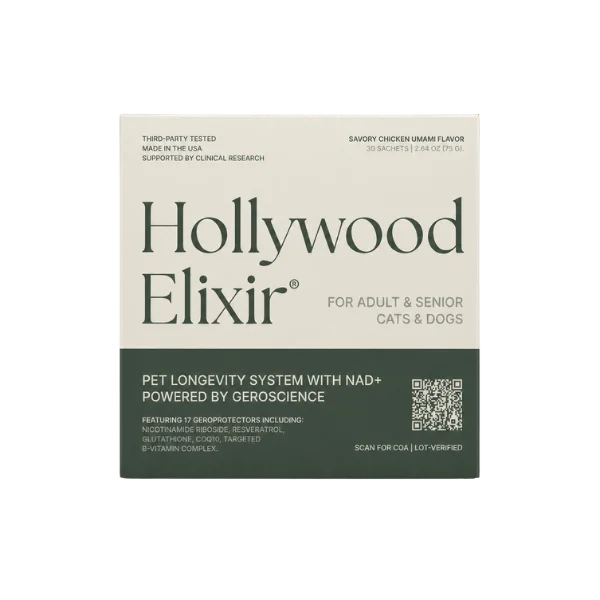
Hollywood Elixir™ is designed for graceful aging: a system-level formula that supports the metabolic network behind everyday vitality, helping owners pair NAD-focused ingredients with broader support for resilience, comfort, and consistency over time.

Niagen for dogs is usually a shopping-intent phrase, not a diagnosis—and it should lead you to label verification before you buy. “Niagen” is a trademarked nicotinamide riboside (NR) ingredient name, so a trustworthy product should clearly state what form of NR it uses and how that claim is supported. Start by checking the Supplement Facts panel for the exact ingredient identity (e.g., nicotinamide riboside chloride) and confirm the brand is not using “Niagen” as vague marketing language on the front label. Next, look for quality controls that reduce uncertainty: batch-level documentation, clear manufacturing information, and a way to verify what’s in the jar matches what’s on the label (Conze DB, 2016). This page is a buyer’s rubric for comparing NR products responsibly—what to confirm, what to avoid, and how to coordinate decisions with your veterinarian when your dog has other supplements, medications, or sensitivities in the mix.

By La Petite Labs Editorial, ~15 min read

Featured Product:

  • Niagen typically refers to nicotinamide riboside (NR), a vitamin B3 form that can support NAD+ production.
  • In dogs, the most sensible aim is long-term resilience—steady energy, smoother recovery, and fewer “off” days.
  • Safety research in dogs includes a 90-day oral toxicity study of high-purity NR with a recovery period, reporting no significant adverse effects in tested dogs.
  • Side effects, when they happen, are usually digestive; introduce changes slowly and track appetite and stool.
  • Avoid casual dosing advice online; your veterinarian should guide decisions, especially for seniors or dogs on medications.
  • Quality signals matter: clear ingredient identity, testing, and consistent manufacturing (often listed as nicotinamide riboside chloride) (Conze D, 2019).
  • Aging isn’t a single-nutrient problem; owners often choose a broader formula to support the whole network, not just one ingredient.

How to evaluate a ‘Niagen’ claim: ingredient identity, amount, and documentation

A credible “contains Niagen” statement should be specific enough that you can verify it. Use this quick rubric:

- Ingredient identity: The label should name the NR ingredient explicitly (not just “Niagen” in marketing copy). Look for the full chemical name and form, and ensure it appears in the Supplement Facts panel.
- Amount per serving: The product should list a clear quantity for the NR ingredient. Be cautious with products that obscure amounts behind broad categories.
- Avoid proprietary blends: If NR is tucked into a proprietary blend, you can’t confirm how much is included—this makes comparisons and consistency checks difficult.
- COA or third-party testing: Prefer brands that provide a Certificate of Analysis (COA) or independent third-party testing for identity and purity, ideally tied to a lot/batch number.
- Manufacturer transparency: Look for a clear manufacturer or distributor, contact information, and a traceable lot code. If a brand won’t answer basic questions about sourcing and testing, treat the “Niagen” claim as unverified (Conze DB, 2016).

Scientific mitochondria render emphasizing oxidative balance supported by nicotinamide riboside chloride.

Practical buying checklist for dogs: formulation, excipients, and safety guardrails

Once the “Niagen” claim is verifiable, the next step is choosing a product your dog can realistically take and tolerate.

- Formulation fit: Consider capsule vs. powder vs. chew formats based on your dog’s preferences and your ability to deliver a consistent serving without mixing errors.
- Excipients: Review inactive ingredients (flavors, sweeteners, binders, anti-caking agents). If your dog has known sensitivities, choose simpler formulas and avoid unnecessary flavor systems.
- Allergen considerations: Check for common allergens and cross-contact statements (e.g., dairy, soy, wheat) and whether the facility discloses allergen controls.
- Storage/stability: Confirm storage instructions (light, heat, moisture). Prefer packaging that supports stability (tight seals, desiccants when appropriate) and brands that state shelf-life and lot-based expiration.
- Batch testing: Look for routine batch testing and lot traceability so you can match your product to documentation.
- Safety guardrails and vet coordination: If your dog is on medications, has chronic conditions, or you’re stacking multiple supplements, coordinate with your veterinarian and keep a simple list of all products and labels for review. Also check the brand’s return policy and customer support responsiveness before purchasing.

Molecular artwork representing healthy aging foundations supported by nicotinamide riboside chloride.

Who Typically Considers NR and What They’re Hoping For

Aging in dogs is rarely dramatic; it’s cumulative. The dog still greets you, still eats, still wants to be near you—just with slightly less ease. Owners exploring niagen for dogs are often responding to that subtle drift. The goal is to support endurance, recovery, and comfort without turning normal aging into a crisis.

The most responsible mindset is “support and observe.” Choose a few meaningful measures, keep your veterinarian in the loop, and avoid stacking multiple new supplements at once. That way, if something changes—good or bad—you can interpret it with clarity rather than hope.

Protein visualization highlighting formulation depth and rigor in nicotinamide riboside chloride.

When NR Is a Poor Fit: Life Stage and Health Context

Not every dog is an ideal candidate. Puppies and pregnant or nursing dogs are typically not where NAD-focused supplements belong, simply because the risk-benefit calculus is different and data are more limited. Dogs with chronic conditions may still be candidates, but only with veterinary guidance and a plan for monitoring (Marinescu AG, 2020).

For the typical healthy adult or senior, the decision often comes down to priorities: Are you trying to support long-term vitality, maintain steadier energy, or help your dog age with fewer “off” days? Niagen for dogs is most coherent when the intent is long-term support, not quick change.

Expressive pug face reflecting gentle aging support associated with nicotinamide riboside chloride.

Dosing Conversations: Why Online Numbers Don’t Belong Here

Dosing is where online advice becomes risky. Dogs differ widely in size, health status, and sensitivity, and there is no one-size number that is appropriate to broadcast. The better approach is to treat NR as a veterinary-guided ingredient choice, especially if your dog is older, on medication, or has a history of digestive upset (Conze D, 2019).

Ask your veterinarian to help you choose a product with transparent labeling and to set a start-and-review plan. That plan should include what success looks like (often subtle), what side effects would mean “stop,” and whether any baseline labs are worth checking before you begin niagen for dogs.

Hollywood Elixir™ is amazing and makes my 13 y/o young again!

— Jessie

We go on runs. Lately he's been keeping up with no problem!

— Cami

“The best outcomes are often quiet: fewer off days, steadier engagement, smoother recovery.”

Possible Side Effects and What to Monitor at Home

Side effects, when they occur, are most often gastrointestinal: softer stool, reduced appetite, or mild nausea. Any new supplement can do this, and it’s one reason to introduce changes one at a time. In dog safety work evaluating high-purity nicotinamide riboside, no significant adverse effects were observed in the tested dogs, which is encouraging for tolerability in controlled settings.

Still, your dog is not a study average. If you see persistent vomiting, marked lethargy, or refusal to eat, stop the supplement and call your veterinarian. For niagen for dogs, “listen to the dog” is not sentiment—it’s practical safety.

Weimaraner portrait reflecting poise and wellness support tied to nicotinamide riboside chloride.

Is This Too Experimental? a Calm Look at Safety Context

Owners sometimes worry that NAD support is “too advanced” or “too experimental.” In reality, NR has been assessed in safety-focused research and is generally described as well-tolerated with minimal side effects in broader safety assessments. The bigger uncertainty is not whether NAD matters, but how much support an individual dog needs—and what outcomes are realistic.

That’s why the best framing is conservative: support the background biology of aging, then judge by lived quality—steady energy, consistent appetite, comfortable movement. Niagen for dogs should feel like a quiet addition to good care, not a dramatic intervention.

Dog looking ahead, capturing presence and calm energy supported by nicotinamide riboside chloride.

What “More Energy” Usually Means in Older Dogs

It’s also worth separating “energy” from excitability. NAD-related support is about cellular capacity, not about revving a dog up. Many owners describe the ideal outcome as a steadier willingness to engage—more consistency across the week, fewer days where the dog seems inexplicably flat.

Because NAD+ is involved in core cellular work, the concept of replenishing it has been explored in canine contexts, including muscle-related disease models (Cardoso D, 2023). For everyday niagen for dogs decisions, the practical takeaway is modest: support may be most noticeable in resilience, not in sudden bursts of pep.

Ingredient explainer image showing clean formulation principles for nicotinamide riboside chloride.

Diet Versus Supplements: the False Choice Many Owners Feel

If your dog eats a complete and balanced diet, they’re not “deficient” in the way people sometimes assume. But aging support isn’t only about meeting minimum requirements. It’s about buffering the wear that accumulates across years—sleep changes, stress, reduced activity, and the slow shift in how efficiently the body maintains itself.

That’s the commercial tension many owners feel: why add anything? A credible answer is that a thoughtfully formulated product supports multiple connected systems at once, rather than chasing a single nutrient. Niagen for dogs can be one piece of that system-level approach, especially when paired with mobility, gut, and antioxidant support.

Medication Interactions and Why Your Vet Should Weigh In

If your dog is already on medications, the safest posture is simple: assume interactions are possible until your veterinarian says otherwise. NR is generally discussed as a vitamin B3 derivative, but “vitamin-like” does not mean inert, especially when a dog has liver or kidney concerns, is on multiple drugs, or is being managed for chronic disease (Conze DB, 2016).

Bring a full list to your appointment—prescriptions, preventives, supplements, and even chews. Ask your vet what to monitor (appetite, stool quality, energy, labwork timing) and what would trigger stopping. This approach keeps niagen for dogs in the category it belongs: thoughtful support, not casual experimentation.

“Safety isn’t a headline; it’s a plan: introduce slowly, observe closely, and involve your veterinarian.”

Research-style uniform highlighting scientific integrity aligned with nicotinamide riboside chloride.

Quality Signals That Matter More Than Trendy Ingredient Lists

Quality matters more than most labels admit. Look for clear ingredient naming (for example, nicotinamide riboside chloride rather than vague “proprietary blends”), lot traceability, and a manufacturer willing to discuss testing. In dogs, consistency is part of safety: you want the same ingredient, in the same form, from one bottle to the next (Conze D, 2019).

Also pay attention to the “extras.” Flavoring systems, sweeteners, and unnecessary botanicals can be the hidden reason a dog doesn’t tolerate a product. A clean, restrained formula makes it easier to interpret what’s helping—and what isn’t—when you’re evaluating niagen for dogs over time.

Shop Now
Supplement with whole-food visuals emphasizing quality sourcing for nicotinamide riboside chloride.

How to Introduce NR Without Upsetting a Sensitive Stomach

Administration is less about technique and more about routine. Most dogs do best when a new supplement is paired with a predictable daily anchor—breakfast, the post-walk treat, or the evening meal. If your dog has a sensitive stomach, your veterinarian may suggest introducing it gradually and watching stool and appetite closely (Marinescu AG, 2020).

Keep notes for two weeks. Not dramatic diaries—just a few lines: energy on walks, willingness to play, sleep patterns, and any digestive changes. For niagen for dogs, the goal is not a sudden “before and after,” but a steadier baseline you can recognize.

Shop Now
Lifestyle image showing supplement use in real homes supported by nicotinamide riboside chloride.

What Results Can Look Like When They’re Realistic

Owners often ask when they should expect to “see something.” With NAD-related support, the most realistic timeline is measured in weeks, not days. Some dogs appear a bit more willing to engage; others show changes that are easier to notice in recovery after activity. And some show no obvious outward shift, even if internal systems are being supported (Conze DB, 2016).

That’s why it helps to choose a small set of markers you can observe without guessing: duration of walks, ease of getting up, interest in toys, and overall demeanor. Niagen for dogs is best evaluated as part of a bigger aging plan—diet, weight, mobility support, and veterinary check-ins.

Shop Now

Senior Brain Changes: Supportive Options and Sensible Expectations

Cognitive aging is one of the most emotionally charged reasons owners explore NAD-supporting ingredients. Research in senior dogs has used controlled, randomized designs to evaluate interventions aimed at cognitive function, with owner observations included among outcomes (Simon KE, 2024). That doesn’t translate into a promise for every dog, but it does validate the idea that brain aging can be studied—and supported—rather than ignored.

If your dog is showing disorientation, sleep-wake changes, or new anxiety, treat it as a veterinary conversation first. Supplements can be part of a supportive plan, but they should sit alongside environmental consistency, pain control when relevant, and medical evaluation for reversible causes.

Muscle, Mobility, and the Metabolic Cost of Staying Strong

Muscle is where many owners first notice aging: slower climbs, shorter bursts of play, longer rest. NAD+ is tied to cellular energy handling, and scientific work in dogs has explored whether replenishing NAD+ could matter in the context of striated muscle disorders (Cardoso D, 2023). For a healthy older dog, that doesn’t mean “treating disease.” It means recognizing that muscle resilience is metabolically expensive—and worth supporting.

The most credible approach pairs metabolic support with the basics that truly move the needle: maintaining lean body mass, keeping weight appropriate, and preserving daily movement. Niagen for dogs fits best when it complements those fundamentals rather than trying to replace them.

Benchmark graphic emphasizing formulation depth and rigor behind nicotinamide riboside chloride.

Safety Data in Dogs and What It Does Not Prove

Safety is the part of the conversation that deserves the most space. A 90-day oral toxicity study in dogs evaluated high-purity nicotinamide riboside and included a recovery period, with results indicating no significant adverse effects in the tested dogs (Marinescu AG, 2020). That’s reassuring, but it’s not a universal clearance for every dog in every circumstance.

Dogs with complex medical histories, those on multiple medications, and dogs with appetite or GI sensitivity should be approached more cautiously. Your veterinarian can help decide whether to avoid, trial carefully, or monitor with labwork. For niagen for dogs, “safe” should always mean “safe for this dog.”

Shop Now
Product reveal shot showing premium feel consistent with nicotinamide riboside chloride.

NR Versus NMN: Similar Story, Different Practical Decisions

Owners sometimes compare NR with other NAD-related ingredients, such as NMN. While they’re related in the broader NAD story, they are not interchangeable in evidence or manufacturing. Oral NMN has been evaluated for subacute toxicity, with no significant adverse effects reported in the tested subjects (You Y, 2020). Still, product quality, dosing decisions, and species-specific considerations remain central.

If you’re choosing between options, prioritize what you can verify: ingredient identity, testing, and a formulation designed for long-term use. Niagen for dogs is ultimately less about chasing the newest molecule and more about choosing a stable, well-considered support strategy.

Shop Now

Why System-level Aging Support Still Matters with Great Nutrition

A careful, science-minded owner might ask: if NR is “just” a vitamin B3 form, why not rely on diet alone? The honest answer is that diet is foundational—but aging is not a single-nutrient problem. The systems that keep energy steady, tissues resilient, and recovery smooth are networked, and they can become less efficient over time.

That’s where a well-designed aging formula earns its place: not as a replacement for food, but as a way to support the broader metabolic environment that food alone may not fully address in later years. Niagen for dogs makes the most sense when it’s part of a bigger, calmer commitment to healthy aging.

“Aging is not a single-nutrient problem, which is why system-level support stays relevant.”

Educational content only. This material is not a substitute for veterinary advice. Always consult your veterinarian about your dog’s specific needs. These statements have not been evaluated by the Food and Drug Administration. Products mentioned are not intended to diagnose, treat, cure, or prevent any disease.

Glossary

  • Nicotinamide Riboside (NR): A form of vitamin B3 used by the body to help build NAD+.
  • Nicotinamide Riboside Chloride: A commonly used supplemental form of NR, valued for stability and consistent labeling.
  • NAD+: A molecule involved in cellular energy handling and repair processes; often discussed in the context of aging support.
  • Cellular Energy: The capacity of cells to meet routine demands; distinct from “stimulant” energy or excitability.
  • Healthy Aging: A long-term focus on maintaining function, comfort, and resilience as a dog gets older.
  • Tolerability: How well a dog handles a supplement in real life, often reflected in appetite, stool quality, and demeanor.
  • Recovery Period (in studies): A follow-up window after stopping a test ingredient to see whether any effects persist.
  • Owner-Observed Outcomes: Changes noticed at home (sleep patterns, engagement, confusion), sometimes included in research designs.
  • Supplement Stack: Multiple supplements started together; avoided when possible because it obscures what caused a change.

Related Reading

References

Simon KE. A randomized, controlled clinical trial demonstrates improved owner-assessed cognitive function in senior dogs receiving a senolytic and NAD+ precursor combination.. PubMed. 2024. https://pubmed.ncbi.nlm.nih.gov/38811634/

Cardoso D. Replenishing NAD(+) content reduces aspects of striated muscle disease in a dog model of Duchenne muscular dystrophy.. PubMed. 2023. https://pubmed.ncbi.nlm.nih.gov/38044436/

You Y. Subacute Toxicity Study of Nicotinamide Mononucleotide via Oral Administration.. PubMed. 2020. https://pubmed.ncbi.nlm.nih.gov/33384603/

Marinescu AG. Safety Assessment of High-Purity, Synthetic Nicotinamide Riboside (NR-E) in a 90-Day Repeated Dose Oral Toxicity Study, With a 28-Day Recovery Arm.. PubMed. 2020. https://pubmed.ncbi.nlm.nih.gov/32715855/

Conze DB. Safety assessment of nicotinamide riboside, a form of vitamin B(3).. PubMed. 2016. https://pubmed.ncbi.nlm.nih.gov/26791540/

Conze D. Safety and Metabolism of Long-term Administration of NIAGEN (Nicotinamide Riboside Chloride) in a Randomized, Double-Blind, Placebo-controlled Clinical Trial of Healthy Overweight Adults.. PubMed. 2019. https://pubmed.ncbi.nlm.nih.gov/31278280/

Birkmayer JG. On the safety of reduced nicotinamide adenine dinucleotide (NADH).. PubMed. 2004. https://pubmed.ncbi.nlm.nih.gov/15312041/

Mouchiroud. The NAD(+)/Sirtuin Pathway Modulates Longevity through Activation of Mitochondrial UPR and FOXO Signaling.. Nature. 2013. https://www.nature.com/articles/s41598-019-46120-z

Kutzsche J. Oral treatment with the all-d-peptide RD2 enhances cognition in aged beagle dogs - A model of sporadic Alzheimer's disease.. PubMed Central. 2023. https://pmc.ncbi.nlm.nih.gov/articles/PMC10440458/

FAQ

What is Niagen, and why do owners use it?

Niagen is a common name for nicotinamide riboside (NR), a form of vitamin B3 used by the body to help build NAD+, a molecule involved in cellular energy and repair. Owners consider it when they want steadier vitality as their dog ages.

The most realistic goal is background support, not a dramatic change overnight. For a broader aging approach that doesn’t rely on a single ingredient, many owners consider Hollywood Elixir™.

Does niagen for dogs act like a stimulant?

No. niagen for dogs is generally discussed as metabolic support, not as a “pep pill.” NR is tied to NAD+, which helps cells meet everyday energy demands rather than pushing a dog into hyperactivity.

If you notice restlessness or unusual behavior after starting any supplement, pause and check in with your veterinarian. For owners who want calmer, system-wide aging support, Hollywood Elixir™ fits well into a long-term routine.

How does NR support NAD+ in a dog’s body?

NR is a vitamin B3 form used in NAD+ biosynthesis, and NAD+ is involved in cellular energy handling and repair processes. That’s why NR is discussed in the context of aging support.

In practice, owners usually evaluate changes in steadiness—walk tolerance, recovery, and day-to-day engagement. For a broader formula that supports the whole aging network, consider Hollywood Elixir™.

Is niagen for dogs considered safe in studies?

A 90-day oral toxicity study in dogs evaluated high-purity nicotinamide riboside and included a recovery period, reporting no significant adverse effects in the tested dogs. That’s reassuring as a safety signal.

Still, “safe” depends on the individual dog’s health status and medication list, so vet guidance matters. Many owners pair that caution with a comprehensive aging formula like Hollywood Elixir™.

Which dogs should avoid NR supplements in general?

Avoid starting NR without veterinary input if your dog is pregnant or nursing, very young, has significant liver or kidney disease, or is medically fragile. If your dog is on multiple medications, your veterinarian should weigh risks and monitoring needs.

For many adult and senior dogs, the decision is individualized rather than categorical. If you want a more holistic aging approach that can be discussed with your vet, look at Hollywood Elixir™ as a system-level option.

Can I get a dosage for niagen for dogs?

It’s not responsible to give a universal dose online, because dogs vary widely by size, age, health conditions, and concurrent medications. Controlled work has evaluated nicotinamide riboside chloride for safety and metabolism, but translating that into an at-home plan should be done with your veterinarian.

Ask your vet to recommend a product and a start-and-review timeline, including what to monitor. For owners who prefer a broader aging formula to discuss in that context, consider Hollywood Elixir™.

What side effects might I notice after starting NR?

When side effects occur, they’re often digestive: softer stool, mild nausea, or reduced appetite. In a dog study evaluating high-purity nicotinamide riboside, no significant adverse effects were observed in the tested dogs, which supports overall tolerability in controlled settings.

If symptoms persist or your dog seems unwell, stop and call your veterinarian. For a gentler, multi-angle approach to aging support, many owners choose Hollywood Elixir™ as part of a consistent routine.

Can NR interact with my dog’s medications?

Potential interactions depend on the medication and your dog’s health status. NR is a vitamin B3 form, but that doesn’t guarantee it’s irrelevant to drug metabolism or monitoring plans, especially in dogs with chronic disease.

Bring your vet a complete list of prescriptions, preventives, and supplements before adding anything new. If you want a product designed for broader aging support to discuss with your veterinarian, consider Hollywood Elixir™.

Is niagen for dogs appropriate for puppies or young adults?

Usually, interest in niagen for dogs is centered on midlife and senior support, not growth stages. Puppies and young dogs have different priorities, and supplement decisions should be conservative unless your veterinarian has a specific reason to recommend otherwise.

If you’re focused on long-term aging well, start with fundamentals—diet quality, lean body condition, and consistent movement—then revisit supplements later. When that time comes, Hollywood Elixir™ offers a system-level approach.

Do small breeds and large breeds respond differently to NR?

They can, mostly because size correlates with dosing sensitivity, lifespan patterns, and common age-related issues. That’s one reason generalized online dosing is a poor fit. Long-term controlled evaluation of nicotinamide riboside chloride focuses on safety and metabolism, but individualization still matters.

Your veterinarian can help tailor a plan to your dog’s size, age, and medical history. For owners who prefer a broader aging formula rather than single-ingredient tinkering, consider Hollywood Elixir™ in that conversation.

Can cats take Niagen, or is it only for dogs?

Cats and dogs differ in metabolism and supplement tolerance, so you shouldn’t assume a dog-oriented NR plan applies to cats. If you’re considering NAD-related support for a cat, treat it as a separate veterinary question rather than a simple extension of niagen for dogs.

Bring the exact product label to your veterinarian for review before offering it to a cat. For dog-specific aging support designed to fit into a thoughtful routine, consider Hollywood Elixir™.

How long before I notice changes after starting NR?

Most owners who notice anything describe gradual shifts over weeks: steadier interest in walks, smoother recovery, or a more consistent mood. Because NR relates to NAD+—a core cellular molecule—changes are rarely immediate or dramatic.

Track a few simple markers (walk duration, ease of rising, appetite) for two to four weeks, then reassess with your veterinarian. For a broader aging strategy that’s built for consistency, consider Hollywood Elixir™ alongside good fundamentals.

What should I look for on a quality NR label?

Look for clear ingredient identity, lot traceability, and testing transparency. Labels that specify the exact form—such as nicotinamide riboside chloride—make it easier to compare products and avoid vague blends.

Also consider the “inactive” ingredients; unnecessary flavor systems can be the real reason a dog doesn’t tolerate a product. For owners who prefer a carefully designed, system-level aging formula, consider Hollywood Elixir™ as a more comprehensive option.

Should NR be given with food or on an empty stomach?

Many dogs do best with supplements given alongside a meal, especially if they have a sensitive stomach. If your dog has a history of GI upset, your veterinarian may recommend introducing any new supplement gradually and monitoring appetite and stool.

Consistency matters more than timing perfection: pick a daily anchor you can keep. For an aging-support routine that’s designed to be easy to maintain, consider Hollywood Elixir™ as part of mealtime.

Can my dog take NR every day long term?

Long-term daily use is a common intent, but it should be approached as a monitored routine rather than an open-ended experiment. Controlled evaluation of nicotinamide riboside chloride has focused on safety and metabolism over time, supporting the idea that sustained use can be studied responsibly.

Your veterinarian can advise whether periodic breaks, check-ins, or labwork make sense for your dog. For daily, system-level aging support that fits a long horizon, consider Hollywood Elixir™.

Is niagen for dogs useful for senior brain aging support?

Interest is common, especially when owners notice sleep-wake changes, confusion, or altered social behavior. Research in senior dogs has used randomized, controlled designs to evaluate interventions aimed at cognitive function, including owner assessments as part of outcomes(Simon KE, 2024).

Any cognitive change deserves a veterinary workup first, since pain and medical issues can mimic “brain aging.” For a broader aging-support plan you can build around, considerHollywood Elixir™as part of a steady routine.

Does NR support muscle function and mobility in aging dogs?

NR is discussed because NAD+ is central to cellular energy handling, and scientific work in dogs has explored whether replenishing NAD+ may matter in the context of striated muscle disease models(Cardoso D, 2023). That doesn’t mean it “treats” mobility issues, but it supports the rationale for metabolic support.

For most dogs, mobility outcomes depend heavily on weight, conditioning, and pain management when needed. For a system-level aging formula that complements those fundamentals, considerHollywood Elixir™.

How does NR compare with NMN for dogs?

NR and NMN are related to the broader NAD story, but they’re not interchangeable in evidence, sourcing, or formulation. Oral NMN has been evaluated for subacute toxicity with no significant adverse effects reported in the tested subjects, which is a useful safety datapoint(You Y, 2020).

For owners, the practical decision often comes down to quality, transparency, and a plan you can sustain. If you prefer a comprehensive aging formula rather than choosing between single molecules, considerHollywood Elixir™for broader support.

When should I call my vet after starting NR?

Call promptly if your dog has repeated vomiting, marked lethargy, refusal to eat, worsening diarrhea, or any sudden behavioral change. Even with reassuring tolerability data in controlled dog studies, individual reactions can happen and should be taken seriously.

If symptoms are mild, your vet may suggest pausing, adjusting timing with meals, or simplifying the supplement stack. For a steadier, system-level approach to aging support, consider Hollywood Elixir™ as part of a monitored plan.

If diet is balanced, why add NR at all?

A complete diet is foundational, but aging isn’t a single-nutrient problem. NR is discussed because it supports NAD+, which is involved in cellular energy and repair—systems that can become less efficient over time. That’s different from correcting a deficiency.

Many owners choose supplements to support the broader network behind resilience, not to replace food. For a formula designed around that system-level idea, consider Hollywood Elixir™ as a more complete aging companion.

What’s a sensible decision framework for niagen for dogs?

Start with three questions: What change are you hoping to support (energy consistency, recovery, senior steadiness)? What will you track weekly? And what would make you stop? Then review your dog’s medical history and medications with your veterinarian before beginning.

This keeps niagen for dogs grounded in observation rather than optimism. If you want a system-level formula that fits into that measured approach, consider Hollywood Elixir™ as part of a long-term plan.

5K+ Happy Pet Parents

Excellent 4.8

Niagen for Dogs | Why Thousands of Pup Parents Trust Hollywood Elixir™

"He seems more happy overall. I've also noticed he has more energy which makes our walks and playtime so much more fun."

Olga & Jordan

"He's got way more energy now! We go on runs pretty often; he use to get tired halfway through, but lately, he's been keeping up without any problem."

Cami & Clifford

"I want her to live forever. She hasn't had an ear infection since!"

Madison & Azula

"It helps with her calmness, her immune system. I really like the clean ingredients. Highly recommend La Petite Labs!"

Maple & Cassidy

"He seems more happy overall. I've also noticed he has more energy which makes our walks and playtime so much more fun."

Olga & Jordan

"He's got way more energy now! We go on runs pretty often; he use to get tired halfway through, but lately, he's been keeping up without any problem."

Cami & Clifford

"I want her to live forever. She hasn't had an ear infection since!"

Madison & Azula

"It helps with her calmness, her immune system. I really like the clean ingredients. Highly recommend La Petite Labs!"

Maple & Cassidy

"He seems more happy overall. I've also noticed he has more energy which makes our walks and playtime so much more fun."

Olga & Jordan

"He's got way more energy now! We go on runs pretty often; he use to get tired halfway through, but lately, he's been keeping up without any problem."

Cami & Clifford

"I want her to live forever. She hasn't had an ear infection since!"

Madison & Azula

"It helps with her calmness, her immune system. I really like the clean ingredients. Highly recommend La Petite Labs!"

Maple & Cassidy

"He seems more happy overall. I've also noticed he has more energy which makes our walks and playtime so much more fun."

Olga & Jordan

"He's got way more energy now! We go on runs pretty often; he use to get tired halfway through, but lately, he's been keeping up without any problem."

Cami & Clifford

"I want her to live forever. She hasn't had an ear infection since!"

Madison & Azula

"It helps with her calmness, her immune system. I really like the clean ingredients. Highly recommend La Petite Labs!"

Maple & Cassidy

SHOP NOW