Are All-in-One Pet Supplements Legitimate—or Just Marketing?

The format can be rational. The label is not a verdict: test the need, serving-level dose, evidence match, overlap, quality controls, and routine it is meant to replace.

By La Petite Labs Editorial 11 min read

Start with the category’s real promise: replace several decisions with one manageable routine. That can be useful. But breadth becomes meaningful only when every important ingredient has a defined job, a readable daily amount, compatible neighbors, and evidence proportionate to the claim.

The central distinction is not minimalist versus maximalist. It is coherent versus decorative. A short formula can be vague, and a broad formula can be carefully engineered. The Formula Coherence Test below makes that difference visible before a label’s ingredient count does the persuading.

  • “All-in-one” is positioning, not an evidence grade.
  • Judge the daily serving, not the ingredient roll call.
  • Breadth is valuable only when it replaces defined routine burden.
  • Ingredient studies do not become finished-formula trials by proximity.
  • A seal or COA answers a quality question, not an outcome question.
  • Check diet, medication, calorie, and supplement overlap before stacking.
  • Unknown public evidence should be labeled unknown, not declared absent.
  • A rational answer can be one formula, one targeted product, or none.

The Short Answer: Legitimate Format, Unearned Label

Yes—an all-in-one pet supplement can be legitimate, but the phrase “all-in-one” proves neither useful dosing nor clinical benefit. The best version solves a defined routine problem with disclosed amounts and clear boundaries. The weak version sells the sensation of coverage: many familiar names, little serving-level context, and claims that expand faster than the evidence. Start by asking what the product is replacing and what it explicitly does not replace. [3][6][13]

Woman sitting poolside with a black-and-white dog and a Hollywood Elixir box

Begin With the Job, Not the Jar

An all-in-one earns attention when the owner can finish this sentence: “I want one routine to cover these specific complementary jobs.” If the answer is merely “general health,” the audit has not started. Write down the baseline food, current products, medications, daily burden, and measurable reason for adding anything. The pet supplement quality guide owns the full evidence chain; here, the narrower question is whether combining jobs makes the formula more rational or simply harder to inspect. [3][13]

Man running on grass beside a golden retriever

Why Fifty-Plus Ingredients Means Almost Nothing

Fifty ingredients are not fifty effective doses. Every additional item competes for physical space in the serving and creates another question about identity, amount, stability, compatibility, and safety. A long label may represent intelligent role separation—or tiny quantities chosen for front-panel recognition. Count is therefore a description of complexity, not a measure of quality. The useful number is how many declared jobs remain credible after dose, form, species, and evidence are checked. [6][7][13]

Person running beside a black-and-white dog

Kitchen-Sink Formulation Is a Design Failure, Not a Number

The kitchen-sink formula problem begins when inclusion itself becomes the architecture. Ingredients accumulate because each adds a marketable story, while the serving size, rationale, and outcome model remain fixed. A wide formula is not automatically guilty: breadth can be coherent when roles are explicit and amounts survive arithmetic. The red flag is unexplained breadth—especially when every ingredient appears to promise a separate organ, symptom, or longevity pathway without a finished-formula evidence bridge. [6][13]

Dog jumping to catch a green flying disc

Do the Serving-Size Arithmetic Before Reading Benefits

Turn the package over and find the daily serving for the actual pet—not the largest serving shown. Record the total mass, then list every active amount that is individually disclosed. If dozens of promoted ingredients share a small chew or scoop and most amounts are missing, meaningful comparison becomes impossible. This arithmetic does not prove that a low amount is useless; some actives are used in small quantities. It reveals which claims can be evaluated and which rest on presence alone. [3][7][13]

“All-in-one” is positioning, not an evidence grade.

Broad Coverage Is Not the Same as Useful Coverage

A coherent formula groups ingredients by a small number of stated jobs, then explains the role, form, amount, and boundary for each group. Weak coverage maps one fashionable ingredient to one grand outcome until the label appears to touch every system. Ask whether removing an ingredient would change the formula’s stated purpose. If nobody can explain why it is there, it may be decorative. If several ingredients serve the same role, ask whether that redundancy is intentional, complementary, or merely duplicative. [3][13]

Runner's shoes and dog paws beside a Hollywood Elixir box

Proprietary Blends Turn Arithmetic Into Guesswork

A proprietary blend can disclose total blend weight while still preventing the buyer from calculating each active amount. That does not prove the formula is ineffective or unsafe. It does mean the owner and veterinarian cannot confidently compare promoted ingredients with research, total exposures, or overlapping products. The proprietary blends guide examines that opacity in depth. For the coherence test, mark every undisclosed important amount as “not publicly verifiable” rather than assuming zero. [6][13]

Woman running outdoors with two dogs

Borrowed Ingredient Science Has a Hard Limit

A study can be relevant yet still sit several steps away from the product in the bowl. Check species, population, ingredient form, amount, duration, and outcome. Then ask whether the same single ingredient or the finished combination was tested. A cell mechanism may justify curiosity; a canine or feline trial at a comparable dose is closer; a well-designed study of the finished formula is closest to a product-level outcome claim. None should be described as another. [6][7][13]

Two women running outdoors with their dogs

Translate “Science-Backed” Into a Match Test

The pet supplement claims decoder helps unpack familiar badges, but the fastest test is grammatical: what exactly is backed, by what evidence, in which animals, at what amount, for which measured result? “Contains studied ingredients” can be accurate while leaving the complete product unstudied. “Vet formulated” identifies participation, not the design of a trial. “Third-party tested” requires a named sample, method, analyte, result, and limit before the reader knows what was tested. [3][13]

Quality Systems Matter—and Have Boundaries

Manufacturing controls reduce risks such as mix-ups, contamination, and inconsistent handling. FDA CGMP guidance addresses the process system for covered animal-food facilities. NASC says its seal requires an audit, complaint and adverse-event systems, label compliance, and random product testing. Those are useful signals. They do not establish that a formula is clinically effective, suitable for every pet, or tested for every promoted active in every lot. Read each credential at its actual scope. [4][5]

Ingredient studies do not become finished-formula trials by proximity.

Black dog resting its chin in a person's hand beside a senior-dog clinical vignette

DVM Voice: Clinical Vignette of a Common Pattern in Senior Dog Aging

Case provided by JoAnna Pendergrass, DVM

Rex, a 7-year-old Labrador Retriever, was brought in after his owner noticed he was slower to rise, hesitant on stairs, and less able to play as before. Examination showed stiffness and reduced hip mobility; radiographs confirmed degenerative joint changes.

His care required weight management, veterinary-guided pain control, nutritional support, and rehabilitation — a comprehensive plan, but one started only after visible decline appeared.

Clinical takeaway: Rex’s case reflects the value of proactive aging support: maintaining lean body condition, monitoring mobility early, and supporting cellular resilience, antioxidant defense, and healthy inflammatory balance before decline becomes obvious.

Single-case vignette. Not generalizable. Veterinary oversight is essential for pain, stiffness, or suspected joint disease.

Explore Hollywood Elixir Research →
Woman walking with a brown-and-white dog on grass

What a Certificate of Analysis Can Actually Prove

A COA can verify the analytes it reports for the identified sample; it cannot prove that the formula improves health. Check product name, lot, laboratory, date, sample type, methods, units, specifications, and actual results. A supplier document may describe an input rather than the finished jar. A generic example may not connect to the purchased lot. Even a strong finished-lot report answers composition or contaminant questions only for what was measured. [13]

Man playing with a tan dog beside the water

Stacking Can Turn Breadth Into Duplication

Place the complete diet, all supplements, treats, oils, powders, and fortified chews on one list. Compare daily totals, not product names. Duplicate vitamins, minerals, fatty acids, botanicals, or flavor calories can hide across categories. Medication context matters as well: the omega-3 literature, for example, discusses dose-related gastrointestinal, platelet, weight, and interaction considerations. That is not a reason to fear appropriate use; it is a reason not to treat familiar ingredients as context-free. [3][12]

Two dogs looking at a La Petite Labs delivery box on grass

When One Formula Is More Rational Than Five Bottles

The all-in-one scoring rubric owns deterministic product scoring; a simpler owner decision comes first. One formula can be more rational when the need is defined, important amounts are visible, ingredients have non-duplicative roles, the combination fits the evidence, and it replaces a burdensome stack without displacing targeted treatment. Convenience matters because a theoretically elegant routine that is rarely delivered has little practical value. But convenience cannot rescue a formula whose jobs, doses, or boundaries remain unreadable. [3][13]

Four Evidence States—and Why Refreshes Matter

The Best Dog All-in-One report is a dated snapshot, not a permanent verdict. A 21 August 2026 primary-page refresh materially changes two earlier observations. Fera still publishes individual active minimums and weight-banded serving, and now advertises third-party batch testing plus a lot-code COA lookup. VitaDog now exposes serving-level amounts and a named February 2026 Eurofins result; the certificate visible on its product page reports E. coli and Salmonella for one identified lot. Its separate lab page says recent powder-lot certificates are published while documentation for the oil component is available on request. Those are real transparency gains. They do not show that every promoted active was verified or that either finished formula improves a clinical outcome. [14][17][18][19][20]

The other examples require different language. Plano Paws’ current first-party page remains sold out and still pairs broad 15-in-1 positioning with one visible numeric probiotic statement whose serving basis is not shown in the captured page. For Vet Promise, the retained evidence is a 3 July retailer-page archive rather than a current first-party label, so this article offers no current verdict. In every case, “not visible here” means exactly that—not “does not exist.” Brands may submit current labels, lot records, or corrections for review. [21][22]

The Formula Coherence Test

Score no points and crown no winner. Instead, complete six fields for the actual serving: defined need, active amount, finished-product relevance, overlap, routine burden, and evidence status. A formula passes only when the fields tell one consistent story. “Unknown” is a useful result because it identifies the exact question to send the manufacturer. A contradiction is more important than a missing badge—for example, an all-in-one claim paired with undisclosed amounts or a tiny serving paired with dozens of promoted actives. [3][13]

Original decision tool — Formula Coherence Test: Replace ingredient-count impressions with a serving-level decision record that exposes missing information, contradictions, and genuine routine value.

• Field: Defined need | Pass question: What specific job should this do? | Strong signal: One bounded complementary job or coherent set | Weak signal: General wellness without a decision | Stop rule: No named job | Record: Write the job in one sentence

• Field: Active amount | Pass question: What reaches this pet each day? | Strong signal: Important amounts and forms disclosed | Weak signal: Presence only or blend total | Stop rule: Cannot calculate promoted actives | Record: Record amount by weight band

• Field: Finished-product relevance | Pass question: What evidence matches this formula? | Strong signal: Species, amount, outcome, and formula align | Weak signal: Borrowed mechanism or human ingredient study | Stop rule: Product outcome claimed without a bridge | Record: Label the evidence distance

• Field: Overlap | Pass question: What duplicates food, products, or medication concerns? | Strong signal: Total stack checked | Weak signal: Categories reviewed separately | Stop rule: Totals or cautions cannot be reconciled | Record: List every daily source

• Field: Routine burden | Pass question: What does the product replace? | Strong signal: Fewer steps with equal clarity | Weak signal: Adds another step without retiring one | Stop rule: Convenience is the only rationale | Record: Name the retired product or step

• Field: Evidence status | Pass question: What is verified now? | Strong signal: Dated public document tied to product or lot | Weak signal: Generic claim or expired snapshot | Stop rule: Unknown presented as certainty | Record: Mark verified, unknown, or conflicting

• Field: Decision | Pass question: Does one story survive all six fields? | Strong signal: Coherent yes with review date | Weak signal: Conditional pending one answer | Stop rule: Contradiction or undefined need | Record: Choose use, ask, target, or do not add

Method: Complete every row using the labeled daily serving for the individual pet, current food and medication list, dated public documents, and explicit unknowns. The test evaluates coherence, not clinical efficacy.

Limit: The audit cannot diagnose disease, establish an effective dose where none is authoritative, or replace veterinary judgment for a pet with symptoms, medication, pregnancy, growth, or a therapeutic diet.

Woman running on a beach with two dogs

Ask the Manufacturer Questions That Can Be Answered

Request the daily amount of each important active for the pet’s weight, the ingredient form or standardization, who formulated the product, where it is made, which finished-product tests are performed, whether a lot-linked report is available, how shelf life was established, and what cautions apply. Our quality-testing standards show one company-specific example; they are not a substitute for the manufacturer’s answer. Silence, a slogan, or a document that does not identify the product should remain unresolved. [3][4][5]

Woman hugging a gray dog outdoors

Use Stop Rules Before Optimism Takes Over

The simplest stop rule is this: if you cannot name the job, read the daily amounts, and check overlap, do not add the product. Also pause when appetite, weight, stool, behavior, skin, mobility, or medication has recently changed; a broad supplement should not delay assessment of a new clinical problem. If the formula causes a suspected adverse event, stop it and contact the veterinarian, preserving the package and lot details. A rational “no” is a successful audit, not a failure to optimize. [1][3][5]

How La Petite Labs Fits Under the Same Rules

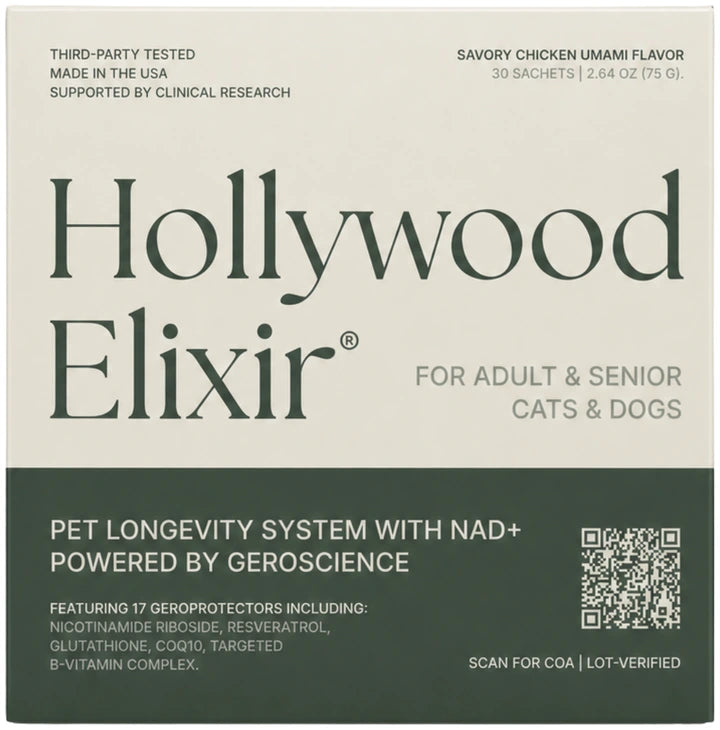
La Petite Labs publishes this page and sells Hollywood Elixir, so our interest is direct. The Hollywood Elixir ingredients page shows the declared formula and serving information; readers should still apply the same coherence test: defined optional job, visible amount, evidence match, total-stack overlap, quality documentation, and realistic burden. We are not presenting Hollywood Elixir as complete food, a deficiency correction, medication, or a product every pet needs. Ingredient rationale and testing transparency do not become finished-product clinical efficacy. [13][14]

A rational answer can be one formula, one targeted product, or none.

Educational content only. This material is not a substitute for veterinary advice. Always consult your veterinarian about your dog’s specific needs. These statements have not been evaluated by the Food and Drug Administration. Products mentioned are not intended to diagnose, treat, cure, or prevent any disease.

Glossary

  • Active amount: The quantity of an ingredient delivered at the labeled daily serving for the individual animal.
  • All-in-one: A positioning term for one product or system intended to cover several complementary jobs; it is not a regulated evidence grade.
  • Certificate of analysis: A laboratory document reporting specified tests and results for an identified sample, input, or finished lot.
  • Finished-product evidence: Testing or research conducted on the complete manufactured formula rather than a separate ingredient.
  • Proprietary blend: A grouped formula disclosure that may state total blend weight without revealing every individual ingredient amount.
  • Routine burden: The number, frequency, difficulty, and adherence cost of the steps required to deliver a daily plan.
  • Stack overlap: Duplicated ingredients, nutrients, calories, or cautions across food, treats, supplements, and medications.

Related Reading

References

Numbered references support claims cited in the article. Evidence context identifies the study population and design; it does not turn indirect evidence into pet-specific proof.

  1. U.S. Food and Drug Administration. FDA's Regulation of Pet Food. U.S. Food and Drug Administration · 2023RegulatoryPopulation: bothEvidence boundary: Authoritative United States regulatory explanation; it does not evaluate any named supplement or establish clinical benefit.
  2. World Small Animal Veterinary Association. Guidelines on Selecting Pet Foods. World Small Animal Veterinary Association · 2021GuidelinePopulation: bothEvidence boundary: Global veterinary nutrition guidance for choosing foods; it supplies decision principles rather than a supplement efficacy standard.↩ 1 · ↩ 2 · ↩ 3 · ↩ 4 · ↩ 5 · ↩ 6 · ↩ 7 · ↩ 8 · ↩ 9 · ↩ 10
  3. U.S. Food and Drug Administration. Current Good Manufacturing Practice Requirements for Food for Animals. U.S. Food and Drug Administration · 2017GuidelinePopulation: bothEvidence boundary: FDA guidance describing CGMP expectations for covered animal-food facilities; compliance is not proof of clinical efficacy.↩ 1 · ↩ 2
  4. National Animal Supplement Council. NASC Quality Seal. National Animal Supplement Council · 2026GuidelinePopulation: bothEvidence boundary: The program owner describes its own criteria; the seal is a process signal and not independent evidence of a health outcome.↩ 1 · ↩ 2 · ↩ 3
  5. Finno CJ. Veterinary Pet Supplements and Nutraceuticals. Nutrition today · 2020· DOI 10.1097/nt.0000000000000399ReviewPopulation: bothEvidence boundary: Narrative veterinary review useful for category context; examples from individual product classes do not estimate the whole market.↩ 1 · ↩ 2 · ↩ 3 · ↩ 4 · ↩ 5
  6. Miscioscia E, Shmalberg J, Scott KC. Measurement of 3-acetyl-11-keto-beta-boswellic acid and 11-keto-beta-boswellic acid in Boswellia serrata Supplements Administered to Dogs. BMC veterinary research · 2019· DOI 10.1186/s12917-019-2021-7Primary ResearchPopulation: dogEvidence boundary: Analytical study of thirteen human and canine Boswellia formulations; results cannot be generalized to every ingredient or brand.↩ 1 · ↩ 2 · ↩ 3
  7. Lenox CE, Bauer JE. Potential adverse effects of omega-3 Fatty acids in dogs and cats. Journal of veterinary internal medicine · 2013· DOI 10.1111/jvim.12033ReviewPopulation: bothEvidence boundary: Ingredient-specific safety review; it supports checking total dose and interactions, not a blanket warning against omega-3 use.
  8. La Petite Labs. Pet Supplement Quality: The Label-to-Bowl Standard. La Petite Labs Editorial · 2026ReviewPopulation: bothEvidence boundary: Publisher-authored methodology and disclosed commercial source; useful for LPL framework definitions, not independent validation of LPL products.↩ 1 · ↩ 2 · ↩ 3 · ↩ 4 · ↩ 5 · ↩ 6 · ↩ 7 · ↩ 8 · ↩ 9 · ↩ 10 · ↩ 11 · ↩ 12 · ↩ 13
  9. La Petite Labs. Best Dog All-in-One Supplements 2026: Scoring Dataset. La Petite Labs Editorial · 2026Observational StudyPopulation: dogEvidence boundary: Publisher-authored, dated market analysis with LPL products disclosed and excluded from numbered competition; scores reflect public evidence at review time, not laboratory verification.↩ 1 · ↩ 2
  10. Fera Pets. Multivitamin Soft Chews for Dogs. Fera Pets · 2026Observational StudyPopulation: dogEvidence boundary: First-party commercial label page captured on 2026-08-21. It records what the manufacturer publicly states; it is not independent verification of composition, testing, safety, or benefit.
  11. Fera Pets. Dr. Michelle's Recommendations. Fera Pets · 2026Observational StudyPopulation: dogEvidence boundary: First-party commercial page captured on 2026-08-21. Its COA description is a manufacturer claim; the capture does not independently audit a purchased lot or every result in the lookup system.
  12. VitaDog Nutrition. Daily All-in-One Supplement. VitaDog Nutrition · 2026Observational StudyPopulation: dogEvidence boundary: First-party commercial label page captured on 2026-08-21. Ingredient and laboratory statements are described at their visible scope and do not establish finished-product clinical efficacy.
  13. VitaDog Nutrition. Independent Lab Results. VitaDog Nutrition · 2026Observational StudyPopulation: dogEvidence boundary: First-party commercial testing page captured on 2026-08-21. It is useful for locating stated lots and analytes, but the page is not an independent audit of release practices or unreported analytes.
  14. PlanoPaws. Vita Treats: Multivitamin Chews. Plano Paws · 2026Observational StudyPopulation: dogEvidence boundary: First-party commercial label page captured on 2026-08-21. Missing information is described as not visible in this capture, not as nonexistent.
  15. Amazon. Dog Multivitamin Chewable with Glucosamine — archived retailer listing. Amazon / Vet Promise listing · 2026Observational StudyPopulation: dogEvidence boundary: Retailer-page text captured on 2026-07-03, not a current first-party manufacturer label. It is retained only to document the earlier snapshot and cannot support a current product verdict.

Further reading

These sources provide additional context but are not mapped to a numbered claim above.

FAQ

Can an all-in-one pet supplement be genuinely useful?

Yes. It can be useful when it combines defined complementary jobs, discloses important daily amounts, avoids problematic overlap, and meaningfully reduces routine burden. The format is legitimate; the phrase itself is not proof.

Is a 50-ingredient supplement better than a 10-ingredient supplement?

Not on count alone. Compare the purpose, form, and daily amount of each important active. A broad formula can be coherent, while a short one can still be vague; ingredient count measures complexity, not quality.

What does fairy dusting mean in pet supplements?

It describes including an ingredient at a token or unevaluable amount so its name can support the marketing story. Presence alone does not establish a useful dose, and an undisclosed amount should be marked unknown rather than assumed effective.

Are proprietary blends automatically bad?

No. They can protect a formula, but they prevent full serving-level comparison when important individual amounts are hidden. That opacity is a real evidence limitation even though it does not prove the product is ineffective.

What should a pet supplement COA show?

Look for the product, lot, sample type, laboratory, date, methods or analytes, units, specifications, and actual results. Read it narrowly: the document supports only what was measured for the identified sample.

Does the NASC seal prove a supplement works?

No. NASC describes audit, labeling, complaint, adverse-event, and random-testing requirements. Those are useful quality-system signals, but they do not establish a clinical outcome or suitability for every animal.

Do clinically studied ingredients make the whole formula clinically studied?

No. Ingredient studies may support plausibility. A finished-formula claim requires evidence that matches the combination, species, population, amount, duration, and outcome; those levels of evidence should not be presented as interchangeable.

Can I combine an all-in-one with other supplements?

Sometimes, but first total the active nutrients, oils, botanicals, calories, and cautions across food, treats, and products. Ask a veterinarian or veterinary nutrition professional when medications, disease, growth, pregnancy, or therapeutic diets are involved.

Does La Petite Labs sell an all-in-one supplement?

La Petite Labs sells Hollywood Elixir and has a direct commercial interest. This page does not claim that it is complete food, medication, universally needed, or supported by finished-product clinical outcomes; it should face the same audit as competitors.

When is a targeted supplement better than an all-in-one?

A targeted product is often more rational when there is one defined job, the relevant evidence and dose are clearer, or a broad formula would create duplication. “No supplement” is also valid when no credible need is defined.

Hollywood Elixir box behind a spotted dog in the canine longevity-system framework section

Discover LPL-01: How This Fits Into a Larger Canine Longevity System

Aging in dogs is not driven by a single pathway. It’s the result of interacting biological systems—energy metabolism, oxidative stress, immune signaling, and structural integrity—changing over time.

This article explores one piece of that puzzle. If you want to understand how these pieces connect—and what actually moves the needle—you need to zoom out.

Start with the underlying science: