The 12 Hallmarks of Aging in Dogs, Explained
Read full insightThorneVet Longevity Complex vs Hollywood Elixir for Cats
By La Petite Labs Editorial 18 min read
ThorneVet Longevity Complex is one of the stronger products in the cat longevity report because the label shows meaningful active amounts and includes a direct NAD+ precursor. That makes it a real comparator, not an easy target.
For cats, though, the daily question can be less glamorous and more important: can the serving be measured cleanly, mixed into food, accepted consistently, and paused if appetite or stool changes? Hollywood Elixir is designed around that kind of household use.
Use the 2026 Cat Longevity Supplement Industry Report for the wider category, then compare these two through the lens cats actually impose: taste, dosing, routine, and quality visibility.
- Best fit: Hollywood Elixir for cat owners who want a measured food-mixed powder that disappears into a trusted meal; ThorneVet for owners who want a disclosed vet-channel formula with feline-relevant taurine and are comfortable portioning fractions.
- Both labels disclose per-active amounts, so cat owners can compare honestly rather than guess.
- ThorneVet's taurine at 500 mg per unit is a genuine, species-appropriate plus for cats, an obligate carnivore with an essential taurine requirement, and its NAD+ precursor dose is high.
- The catch is the serving math: ThorneVet doses one unit per 25 pounds, so most adult cats land well under a full unit and the household ends up portioning fractions every day.
- Neither product treats disease or extends lifespan; the decision is serving consistency, bowl acceptance, breadth, and batch verification, not which brand discloses less.
What ThorneVet Longevity Complex Is and Who Makes It
ThorneVet Longevity Complex is a longevity supplement made by ThorneVet, a veterinary-channel brand independent of Thorne Research since 2019, and it is sold for both dogs and cats. It comes as a soft chew or a powder with an identical active stack, manufactured by Green Mountain Animal in Milton, Vermont, an NASC founding member, under GMP-audited processes. The chew unit is $77; the powder is $74. For a cat household, the powder version is the more relevant format because it references companion species including cats and mixes into food.
The reason ThorneVet earns a place in any serious cat longevity comparison is disclosure. Per unit, the label lists taurine 500 mg, nicotinamide riboside hydrogen malate 100 mg, quercetin phytosome 75 mg, curcumin phytosome 50 mg, green tea phytosome 50 mg, trans-resveratrol 40 mg, and astaxanthin 3 mg, with no proprietary blends and a publicly hosted label PDF. In a category where many cat products lean on vague senior language, that level of transparency is a genuine strength.
The complication that runs through this whole comparison is the serving frame. ThorneVet's dosing instruction is one unit per 25 pounds of body weight, one to two times daily. That logic was clearly built with dogs in mind, and for cats it creates an immediate practical problem, because a typical cat weighs a fraction of 25 pounds. So while ThorneVet is a credible, disciplined, evidence-literate formula, the cat-specific questions are not about whether the formula is good. They are about whether the serving can be portioned accurately, accepted in the bowl, and sustained, plus how the formula's breadth and batch verification compare for a feline household.
What is ThorneVet Longevity Complex for cats?
ThorneVet Longevity Complex is a longevity supplement for dogs and cats, sold as a soft chew or powder, with a direct NAD+ precursor and disclosed active amounts including taurine 500 mg per unit. Its serving is framed around 25 lb body weight, so most cats need fractional dosing.
Is ThorneVet cat specific?
It is positioned for dogs and cats, but the serving structure is framed around 25 lb body weight. Many cats will need fractional serving math.
How is Hollywood Elixir different for cats?
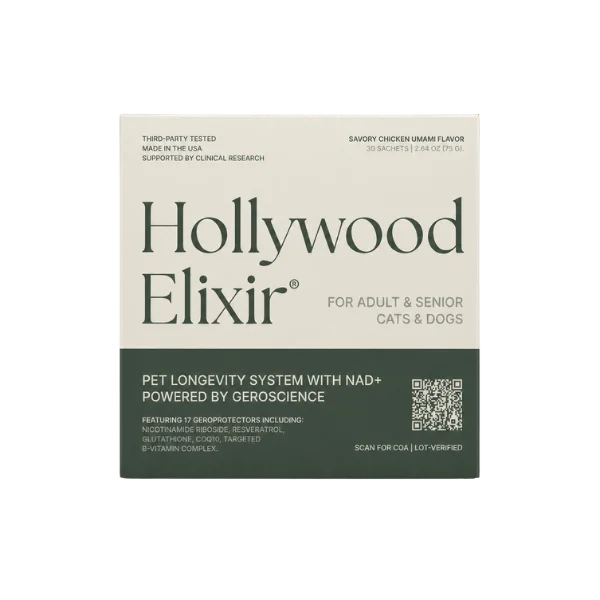
Hollywood Elixir is also a food mixed powder for dogs and cats, with visible active amounts, NAD+ support, antioxidant defense, immune steadiness, a measured feline serving, and a public COA lookup path.
Which is easier for cats?
Hollywood Elixir may be easier when the owner wants a measured powder routine tied to food. ThorneVet may fit if the owner wants a veterinary channel formula and can handle fractional serving details.
What should cat owners check first?
Check serving math, taste acceptance, stool tolerance, medication overlap, and whether the quality path is easy to verify for the product in hand.
The Plain Comparison
Fast Comparison
The Plain Comparison
For cats, the best formula on paper still has to survive the bowl. ThorneVet has strong disclosure. Hollywood Elixir's edge is the owner-friendly daily routine and the testing path around it.
Question
ThorneVet
Hollywood Elixir
Stronger fit
Label clarity
Strong active disclosure.
Strong visible active amounts.
Hollywood Elixir and ThorneVet both strong.
Cat serving fit
Serving is framed around 25 lb body weight, so many cats need fractions.
Food-mixed powder with serving guidance designed for daily household use.
Hollywood Elixir for easier cat routine setup.
NAD+ support
Direct NR hydrogen malate support.
Nicotinamide riboside and niacin with B vitamins and CoQ10.
Hollywood Elixir for broader daily system; ThorneVet for strong direct NR disclosure.
Quality lookup
Quality language is strong, but public lot lookup is not as direct.
COA Lookup gives owners a clear quality-check path.
Hollywood Elixir.
Best fit
Owners comfortable with vet-channel formulas and serving fractions.
Owners who want a daily powder routine that stays easy to explain and track.
Hollywood Elixir for low-friction senior-cat use.
Both labels publish per-active amounts, so cat owners can compare honestly. ThorneVet's taurine at 500 mg per unit is genuinely relevant to cats, an obligate carnivore with an essential taurine requirement, and its NAD+ precursor dose is high. The catch is the serving math: ThorneVet doses one unit per 25 lb of body weight, so most adult cats land well under a full unit and the household ends up portioning fractions. Hollywood Elixir is a measured food-mixed powder with feline serving guidance and a lot-level COA lookup.
| Active (per daily unit) | Hollywood Elixir | ThorneVet Longevity Complex |
|---|---|---|
| NAD+ precursor | Nicotinamide riboside 60 mg | Nicotinamide riboside hydrogen malate 100 mg |
| Taurine (feline-essential) | not in formula | 500 mg |
| Resveratrol | 15 mg | Trans-resveratrol 40 mg |
| Quercetin | 25 mg | Quercetin phytosome 75 mg |
| CoQ10 | 40 mg | not in formula |
| Glutathione | 50 mg | not in formula |
| Beta glucans / reishi (immune) | 50 mg / 25 mg | not in formula |
| Serving model | Measured food-mixed sachet with feline guidance | 1 unit per 25 lb, 1-2x daily (most cats dose in fractions) |
| Starting price | from $89 one-time (30 sachets); $69/mo; 90-day plan $189 ($63/mo) | $77 per unit |
Competitor label and pricing facts checked 2026-06-09.
The Genuine Appeal of ThorneVet for Cats
ThorneVet's appeal for cat owners is real, and the taurine point deserves to lead because it is the most species-appropriate. Cats are obligate carnivores with an essential dietary taurine requirement they cannot meet by synthesis the way some species can, so a longevity formula that carries a meaningful taurine dose has a legitimate feline argument behind it. ThorneVet's 500 mg per unit is not a throwaway inclusion; it is a nutrient that genuinely matters to cats, and crediting that plainly is only fair.
The second appeal is the same transparency that makes ThorneVet strong for dogs: every active is printed per unit, the polyphenols use bioavailable phytosome forms, and a full label PDF is public. A cat owner, or their veterinarian, can read exactly what is in the formula, which is rare in this category and worth respecting. The veterinary-channel posture, with a practitioner portal and a published caution panel, adds credibility for owners whose veterinarians already discuss Thorne-adjacent products.
The pressure on this appeal is feline-specific. A taurine dose written for a 25-pound dosing unit is not the same as the amount a nine-pound cat actually receives, and most cats already get taurine from a complete-and-balanced diet. So the headline 500 mg is a genuine plus on paper, while the amount an individual cat gets depends entirely on how cleanly the household can portion a fraction of that unit every day. That is where the next sections matter more than the number, and it is the gap a measured, cat-guided powder is built to close.
The ThorneVet Label, Walked Through for a Cat
Read the ThorneVet label as a cat owner and two things stand out: the disclosure is excellent, and the serving size is written for a much larger animal. Per unit, the cat would receive taurine 500 mg, nicotinamide riboside hydrogen malate 100 mg, quercetin phytosome 75 mg, curcumin phytosome 50 mg, green tea phytosome 50 mg, trans-resveratrol 40 mg, and astaxanthin 3 mg. The powder's inactive ingredients are minimal, flaxseed and silicon dioxide, which is clean and easy to mix into wet food.
The catch is in the directions. One unit per 25 pounds means a typical eight- to twelve-pound cat is meant to receive roughly a third to a half of a unit. So every figure on the label has to be mentally divided before it describes what the cat actually gets, and the household has to physically portion that fraction. A 500 mg taurine label line becomes perhaps 150 to 250 mg in the bowl, and the same fractioning applies to the NAD+ precursor and every polyphenol.
There is also the caution panel, which is appropriately frank: do not use with blood thinners, may be a GI irritant, do not use in animals with stomach ulcers, and safe use in pregnant animals has not been established. Those are useful disclosures for any cat with a sensitive system. What the label does not resolve is the cat-specific serving precision, and the once-or-twice-daily window makes it looser still. Where the page does not give clear feline dosing, the honest move is to say so and to route the question to a veterinarian, rather than to assume a large-dog frame translates cleanly to a small cat.
What Is Not Visible on the ThorneVet Label for Cats
A few gaps matter specifically for cats. The first is feline dosing precision. The chew product page does not publish a cat-specific serving despite cats being included on the powder, so the owner is left to derive a fraction of a 25-pound unit. That is a real guidance gap for the species that most needs careful portioning, and it is best closed with a veterinarian rather than guessed.
The second gap is batch-level verification. ThorneVet states the product is third-party tested and carries the NASC Quality Seal, but no specific lab is named, there is no public per-lot Certificate of Analysis, and there is no batch-lookup tool for the jar in hand. For a cat with a sensitive system, where owners scrutinize small changes closely, the inability to verify the actual lot is a more noticeable limitation than it might be for a robust dog.
The third gap is breadth. ThorneVet's label is complete for what it contains, but it does not contain CoQ10, glutathione, or immune-specific actives such as beta glucans or reishi. That is a deliberate focus, not an oversight, but it is a real difference for a senior cat whose owner is also watching immune steadiness and oxidative balance. And because suppliers are intentionally undisclosed, one layer of sourcing stays closed. None of these gaps makes ThorneVet a poor choice; they are the honest edges of a strong, deliberately focused, dog-framed formula being used for a cat, and an owner should weigh each one rather than assume the missing detail away.
Format and the Daily Bowl Reality
For cats, format is not a detail; it is often the whole story, and ThorneVet's two-format choice cuts differently here than it does for dogs. The chew is built around dog-style dosing and is hard to portion for a cat, so most feline households will reach for the powder. The powder mixes into wet food, which is good, but it still has to be portioned to a fraction of a 25-pound unit and then accepted by the cat.
That acceptance is the hidden gate on every cat supplement. A cat that decides it dislikes a taste or texture can quietly derail a routine, and ThorneVet's powder relies on the owner mixing it into food without a feline-specific flavor system. For some cats that works fine; for others it does not, and there is no chew-versus-powder workaround that solves a taste objection.
Hollywood Elixir approaches the bowl differently. It is a measured food-mixed powder with feline serving guidance, designed to disappear into a wet food the cat already trusts, with a serving meant for household use rather than derived from a large-dog chart. When taste is the difference between a routine that lasts sixty days and one that stops on day four, a supplement built to vanish into a trusted meal has a quiet but decisive advantage. The point is not that ThorneVet's powder is unworkable; many cats accept it. It is that the simplest feline routine is usually one familiar bowl, one measured amount sized for cats, and one thing changing at a time, which is the structure Hollywood Elixir is built around and the fraction-of-a-unit model is not.
Start with the product you can explain, verify, track, and keep for 90 days.
How to Evaluate Any Senior-Cat Longevity Supplement
Cats impose a stricter test than dogs, so a framework should weight the feline realities, not just the formula. Adapting the LPL-01 lens to cats gives six checks. First, dose visibility: can you read meaningful amounts? Both products pass; this is a tie. Second, testing visibility: is there a named lab, a public COA, or a batch lookup? ThorneVet asserts testing without a public per-lot COA, while Hollywood Elixir offers a lot-level lookup, so Hollywood Elixir leads, and the edge matters more for a sensitive cat.
Third, feline serving practicality: can the dose be portioned and repeated accurately for a small animal? ThorneVet's 25-pound unit forces fractions; Hollywood Elixir's measured, cat-guided sachet does not, a clear Hollywood Elixir advantage. Fourth, bowl acceptance: will the cat actually eat it daily? Both depend on the individual cat, but a powder built to vanish into a trusted meal has the edge over a portioned fraction without a feline flavor system. Fifth, aging-biology breadth: ThorneVet goes deep on a few actives plus feline-relevant taurine, while Hollywood Elixir spreads across more lanes; this one splits by what the owner wants. Sixth, evidence status: neither has a published finished-formula trial, so it is even.
Run that grid and the cat-specific picture is clear: ThorneVet wins on per-active depth and on its taurine inclusion, while Hollywood Elixir wins on serving practicality, bowl acceptance, batch verification, and breadth. For a species that hides discomfort and rewards consistency, the practical checks carry extra weight, which is why a strong label alone does not settle a feline decision.
What Hollywood Elixir Actually Is for Cats
Hollywood Elixir is a food-mixed daily longevity powder for both cats and dogs, with feline serving guidance, built around the connected systems that fray together as an animal ages. For a cat, the appeal is that it is designed to be measured and mixed into a trusted meal rather than portioned from a large-dog chart, while still keeping every amount visible.
The formula is specific. For NAD+ and cellular energy it uses nicotinamide riboside 60 mg and niacin 2 mg, with riboflavin, vitamin B6, vitamin B12, and CoQ10 40 mg. For antioxidant defense it uses glutathione 50 mg, astaxanthin 2 mg, vitamin C 10 mg, vitamin E 15 IU, and resveratrol 15 mg. For inflammation and immune balance it uses quercetin 25 mg, beta glucans 50 mg, and reishi mushroom 25 mg. Spirulina 50 mg and blueberry powder 50 mg add phytonutrients, and whey protein isolate 250 mg provides a light protein foundation.
One honest difference for cats: Hollywood Elixir does not include taurine, because it is built as a cross-species cellular-aging formula rather than a taurine-forward one, and most cats receive taurine from a complete diet. What it adds instead is breadth ThorneVet's label does not carry, CoQ10, glutathione, and immune actives, plus a serving sized for cats and a lot-level COA lookup. Hollywood Elixir is not a treatment and makes no lifespan claim; it supports normal cellular energy, antioxidant defenses, and immune balance in a form built to run cleanly in a cat's bowl. For an owner who wants broad daily support that the cat will actually eat, that is the appeal.
Active Amounts, Side by Side for Cats
With two transparent labels, the fair move is a line-by-line read, and for cats the result has real nuance. On single numbers, ThorneVet is higher where it focuses: nicotinamide riboside hydrogen malate 100 mg versus Hollywood Elixir's 60 mg, trans-resveratrol 40 mg versus 15 mg, quercetin phytosome 75 mg versus 25 mg, and taurine 500 mg where Hollywood Elixir carries none. Those are genuine, and Hollywood Elixir should not pretend to out-dose them on a per-unit basis.
But two feline qualifiers reshape the picture. First, the fraction effect: because a cat receives only a third to a half of a ThorneVet unit, the amount actually delivered is well below the label line, so the gap on the page overstates the gap in the bowl. Second, breadth: Hollywood Elixir adds CoQ10 40 mg, glutathione 50 mg, beta glucans 50 mg, and reishi 25 mg that ThorneVet's label does not name, so it covers more of the connected aging picture a senior cat draws on.
So the honest summary for cats is a trade, not a winner. ThorneVet goes deeper per active and includes feline-essential taurine, but its amounts have to be fractioned for a cat and it omits several lanes. Hollywood Elixir is broader and sized for cats, but does not match ThorneVet's single-number depth or carry taurine. An owner who weights the taurine inclusion and per-active depth most heavily has a real reason to consider ThorneVet; an owner who weights breadth, feline serving accuracy, and bowl acceptance most heavily has a real reason to choose Hollywood Elixir. Both labels are public, which is why this comes down to fit rather than concealment.
Quality and Testing, Compared for a Cat
Quality verification matters more for a cat than people often assume, because owners of cats with sensitive systems watch small changes closely and want to rule out the product as a variable. ThorneVet carries veterinary-channel credibility and an NASC-audited contract manufacturer, which is a stronger quality signal than much of the cat-supplement category offers. Those are real and worth crediting.
The gap is the one many strong brands leave: a public, per-lot Certificate of Analysis or a batch-lookup tool the owner can open for the specific jar is not easy to find, and the testing lab is not named. So the quality story rests on manufacturing credentials rather than a record tied to the batch in hand.
Hollywood Elixir's COA Lookup path closes that gap by letting an owner check lot-level quality information for the batch they actually bought. This is not a claim that Hollywood Elixir is safer than ThorneVet; both are credible, and safety verdicts require direct, specific evidence. It is a difference in verification, and for a cat it is a practical reassurance rather than a marketing line: when a sensitive cat's appetite or litter-box pattern shifts, being able to confirm the exact lot helps an owner decide whether the product is even a candidate cause. For a routine meant to run daily over months in a household that scrutinizes small changes, that batch-level check is one of the clearer reasons a cat owner might choose Hollywood Elixir even while respecting ThorneVet's manufacturing posture.
Species, Weight, and Fraction Dosing in a Real Cat Household
Dosing logistics are where this comparison is decided for cats, because a serving that is hard to portion accurately is a serving that drifts. ThorneVet doses one chew or scoop per 25 pounds of body weight. A typical adult cat weighs eight to twelve pounds, which means most cats need somewhere around a third to a half of a unit per serving. On a spreadsheet that is simple arithmetic. In a real kitchen, with a cat who grazes, walks away from a bowl, or eats on its own schedule, splitting a chew or measuring a partial scoop accurately, possibly twice a day given the one-to-two-times window, is exactly the kind of friction that makes a routine quietly fall apart.
Hollywood Elixir is designed around that reality. It is a food-mixed powder with serving guidance meant for everyday household use, so the owner is not translating a large-dog dosing chart into cat-sized fractions each morning. The measured, cat-guided serving makes the daily amount repeatable, and repeatability is what consistency depends on.
For a species that hides discomfort and rewards routine, the dose that is easiest to repeat accurately is usually the one that actually gets used for the full sixty days. That does not make ThorneVet unworkable; a meticulous owner can portion fractions reliably, and a veterinarian can help set a precise cat serving. But the honest point is that the serving structure, not just the formula, decides whether a senior cat stays on the routine, and on that axis a measured feline sachet has a clear advantage over a fraction of a unit built for a 25-pound animal.
Start with the product you can explain, verify, track, and keep for 90 days.
DVM Voice: Clinical Vignette of a Common Pattern in Senior Cat Aging
Case provided by JoAnna Pendergrass, DVM
Sasha, a 12-year-old cat, was brought in after her owner noticed increased thirst and urination, lethargy, vomiting, and a generally unkempt appearance. Examination showed weight loss, elevated blood pressure, and reduced vitality.
Diagnostic testing revealed elevated kidney markers, poorly concentrated urine, and protein loss in the urine — findings consistent with chronic kidney disease, one of the most common chronic conditions in senior cats.
Her care required a kidney-focused diet, blood pressure management, targeted supplementation, medication support, and regular monitoring — a necessary plan, but one started after clinical signs were already visible.
Clinical takeaway: Sasha’s case reflects why senior-cat wellness should begin before obvious decline. Earlier monitoring, body-condition tracking, hydration awareness, antioxidant support, and daily cellular resilience may help support quality of life as cats age.
Single-case vignette. Not generalizable. Veterinary diagnosis and monitoring are essential for increased thirst, urination, vomiting, lethargy, weight loss, or suspected kidney disease.
Evidence Status, Honestly Stated on Both Sides
Evidence lands in the same honest place for both products, and neither should be overstated for cats. ThorneVet does not reference a published clinical trial on the finished Longevity Complex formula; its benefit claims are anchored in ingredient-level mechanistic rationale rather than outcome data from a study of the product as sold. That is a legitimate posture, but it means the evidence is mechanistic, not finished-formula, and it is not feline-specific.
One nuance to flag for cat owners: ThorneVet's product page includes the phrase "key nutritional support for the veterinary cancer patient," which sits closer to disease-condition language than typical structure-function claims. For a cat with any relevant history, that phrasing should be discussed with a veterinarian rather than read as a treatment claim from the label, particularly given how cautiously feline illness is managed.
Hollywood Elixir's evidence posture is the same in kind and stated plainly: it is evidence-informed daily support drawn from ingredient-level rationale in the broader nutrition literature, not a finished-formula clinical trial, and it makes no lifespan or disease claim. So neither product can cite a published trial of the finished formula in cats. The difference is claim discipline and verification rather than evidence depth: Hollywood Elixir keeps its language in the support lane and pairs it with a lot-level COA, while ThorneVet pairs strong disclosure with one disease-adjacent phrase and no public per-lot record. For a cat owner weighing evidence, the fair conclusion is that this is close to even on study evidence, and decided more by claim posture, feline serving practicality, and batch verification than by anything either label can prove.
Cost Per Day and Pricing Reality for Cats
Cost looks very different for a cat than for a dog, precisely because of the fraction dosing. ThorneVet is $77 per 90-count unit. Because a cat uses only a fraction of a unit per serving, the cost per cat-day is low: a 90-count jar can last a single cat many months. So on raw per-day cost for one cat, ThorneVet can be inexpensive, and that should be said plainly.
Hollywood Elixir is from $89 one-time for 30 sachets, $69 per month, or a 90-day plan at $189 ($63 per month), which is roughly $2.10 to $2.97 per day at one sachet daily. For a single cat, that is a higher per-day figure than a fractioned ThorneVet unit.
But the price comparison should account for what the fraction costs in effort and consistency, not just dollars. ThorneVet's low cat-day cost comes with the daily task of portioning a partial unit accurately, and a routine that drifts because the fraction is inconsistent is not actually delivering the labeled amounts. Hollywood Elixir's higher per-day cost buys a measured, cat-sized serving, broader coverage, and a lot-level COA. So the honest framing is that ThorneVet is cheaper per cat-day if the household can portion fractions reliably, while Hollywood Elixir trades a higher price for a serving that is easier to keep consistent and verify. Value, as always, comes from the match between price, the amounts actually delivered, bowl acceptance, and the routine the household can sustain, not from the sticker price alone.
Who Should Choose ThorneVet for a Cat
ThorneVet is the genuine right answer for a specific cat owner. It fits the owner who wants a veterinarian-channel longevity formula with full active disclosure and who specifically values the feline-relevant taurine dose. It fits the household that is comfortable, and meticulous, about portioning a fraction of a unit accurately each day, or that has a veterinarian guiding the exact cat serving. And it is especially relevant when a veterinarian already prefers ThorneVet or Thorne-adjacent formulas, or when the cat readily accepts the powder mixed into food.
It also fits an owner who prioritizes per-active depth, a high nicotinamide riboside hydrogen malate dose, a bioavailable polyphenol bench, and taurine, and who is willing to manage the fraction dosing to access it. For that owner, ThorneVet's transparency and discipline are real strengths, and the formula is a credible, serious choice.
The practical move is to settle the cat serving with a veterinarian rather than guess it from the 25-pound frame, run the math on how a jar will last for one cat, and bring the publicly hosted label PDF to the appointment, including a question about the "cancer patient" phrasing if the cat has any relevant history. The point of this comparison is not to argue ThorneVet is weak for cats; its label and taurine inclusion are genuine pluses. The point is that its serving was designed around dogs, and for the cat owner who can manage that precisely and values what the formula offers, it is a strong fit.
Who Should Choose Hollywood Elixir for a Cat
Hollywood Elixir fits the cat owner who wants a visible daily routine that the cat will actually eat and the household can actually repeat: food-mixed dosing sized for cats, NAD+ support, antioxidant defense, mitochondrial cofactors, immune steadiness, and a simple way to check lot-level quality. Where ThorneVet forces a fraction of a large-dog unit, Hollywood Elixir provides a measured feline serving, which is the difference between a routine that holds and one that drifts.
It is strongest when serving consistency and bowl acceptance matter more than having the single highest per-active number or a veterinary-channel brand name. For a senior cat, the supplement that is easiest to measure and easiest to keep in the bowl is usually the one that delivers its labeled amounts day after day, because the dose that is never skipped or mis-portioned is the dose that counts.
It also fits the owner who wants to verify the actual batch, which matters for a cat with a sensitive system. The COA Lookup path gives a lot-level place to check the specific jar, which ThorneVet's strong manufacturing credentials do not directly provide. Hollywood Elixir does not include taurine and does not match ThorneVet's per-unit depth, and it makes no lifespan or disease claim; it supports healthy-aging routines in a form built to run cleanly in a cat's bowl. So the honest division is this: ThorneVet for the owner who values feline taurine and per-active depth and can manage fraction dosing, Hollywood Elixir for the owner who wants broader coverage, a serving that is easy to measure for a cat, and batch verification. Both are credible; the feline fit is what differs.
Switching or Starting: The First 90 Days for a Cat
The first 90 days decide whether either product becomes a routine, and cats make careful introduction non-negotiable. Start one product at a time, keep food, treats, and other supplements steady, and track appetite, stool, vomiting, sleep, grooming, activity, and willingness to eat the same food, with notes on days 1, 7, 14, 30, 60, and 90. Cats hide discomfort, so small daily notes matter more than they do for dogs.
If you are starting Hollywood Elixir, mix the measured feline serving into a wet food the cat already trusts, beginning on the lighter side and building within the guidance as you watch acceptance and stool. Because the serving is sized for cats and the routine is the same each day, a change is easier to attribute.
If you are starting ThorneVet, settle the exact cat serving with your veterinarian rather than improvising a fraction, decide whether the chew or powder is more practical, and watch closely whether the cat accepts the portioned amount mixed into food. If you are switching between the two, finish or set aside the first before beginning the second so you are never running both at once. Because both labels are strong, this is also a good case to bring both to a veterinarian before starting, especially for a cat with kidney disease, diabetes, IBD, or appetite changes, where that conversation should happen before either product enters the bowl. If something feels off, pause and call the clinic; if the routine holds at 30 days, continue to 90. A strong feline formula still deserves a slow, one-variable start.
How to Read Any Senior-Cat Supplement Label
Cat owners benefit from a label-reading habit tuned to feline realities, because the same number means something different for a cat than for a dog. Start with the active panel and confirm you can see each ingredient's amount, ThorneVet passes this cleanly, with every active disclosed per unit. That is the baseline a good label should meet.
Then translate the serving to your cat. The most important feline question is not just what is on the label but how much the cat actually receives, which depends on the dosing model. A body-weight serving framed at 25 pounds means a typical cat gets a fraction of every listed amount, so divide the label figures mentally before judging them, and ask whether the household can portion that fraction reliably. A serving designed for cats, by contrast, tells you closer to what the cat gets without arithmetic.
Next, weigh feline-specific nutrients and verification. Taurine is genuinely relevant to cats, so its presence is a real plus, though most cats also get it from a complete diet. Look for a named lab, a public Certificate of Analysis, or a batch-lookup tool, which matters more for a sensitive cat, and check that claims stay in the support lane rather than drifting toward disease language, as ThorneVet's "cancer patient" phrase does. Finally, consider bowl acceptance, since a label the cat will not eat delivers nothing. Apply that sequence and you can judge ThorneVet, Hollywood Elixir, or any cat supplement on the terms that actually decide a feline routine: visible amounts, true delivered dose, feline-relevant nutrients, verification, and acceptance.
Preparing for the Cat's Veterinarian Conversation
For cats, the veterinary conversation is especially worth having before starting, both because feline illness is managed cautiously and because the serving math needs a professional answer. Bring the full Supplement Facts panel, your cat's weight, the current diet, any medications, and a note on appetite and litter-box patterns. For ThorneVet, the publicly hosted label PDF makes this straightforward; bring it directly.
Ask answerable questions. Find out whether the taurine, NAD+ precursor, or polyphenols overlap with anything your cat already gets, how to portion the serving accurately for your cat's weight, and what signs should make you pause. For ThorneVet specifically, ask your veterinarian to set a precise cat serving rather than relying on a fraction of the 25-pound unit, and raise the "cancer patient" phrasing if your cat has any relevant history, since that language is best interpreted professionally rather than taken from the page.
This is also the moment to weigh the two products' feline differences out loud. Both disclose amounts, so the conversation can focus on fit: ThorneVet's vet-channel formula, taurine inclusion, and per-active depth against the fraction-dosing burden, versus Hollywood Elixir's measured cat serving, broader coverage, and lot-level batch verification. For cats with kidney disease, diabetes, IBD, or appetite changes, that conversation should happen before either product enters the bowl, so the supplement stays in the support lane rather than carrying medical work that belongs in the clinic. Those are more useful questions than "is this a good supplement?", because both of these are credible formulas for the right cat.
The Bottom Line
ThorneVet Longevity Complex and Hollywood Elixir both bring fully disclosed labels to cat longevity, so the honest verdict is about feline fit, not transparency. ThorneVet is one of the better cat-relevant longevity products on label clarity, and its feline-essential taurine dose is a genuine point in its favor, alongside a high NAD+ precursor amount and a bioavailable polyphenol bench. Those strengths are real and worth respecting.
The feline catch is the serving structure. ThorneVet's one-unit-per-25-pounds model forces most cats onto fractions, and accurate fraction dosing twice a day is exactly the friction that makes a routine drift, so the amount a cat actually receives depends on how cleanly the household can portion a partial unit. Hollywood Elixir answers with a measured, cat-guided serving that disappears into a trusted meal, broader coverage that adds CoQ10, glutathione, and immune actives ThorneVet does not carry, and a lot-level COA lookup that matters for a sensitive cat. Neither product treats disease or extends lifespan, and neither claims a finished-formula trial.
So the decision comes down to what a cat household values. Choose ThorneVet if you want feline taurine and per-active depth and can manage the fraction dosing precisely, ideally with veterinary guidance. Choose Hollywood Elixir when serving consistency, bowl acceptance, batch verification, and a daily senior-cat routine matter more than the single highest number or a veterinary-channel name. For most cat households, the supplement that is easiest to measure and easiest to keep in the bowl is the one that actually delivers its labeled support day after day, which makes Hollywood Elixir the stronger fit, without pretending ThorneVet is anything less than a strong, transparent label for the right owner.
Start with the product you can explain, verify, track, and keep for 90 days.
Educational content only. This material is not a substitute for veterinary advice. Always consult your veterinarian about your dog’s specific needs. These statements have not been evaluated by the Food and Drug Administration. Products mentioned are not intended to diagnose, treat, cure, or prevent any disease.
Glossary
- Obligate carnivore: A species, like the cat, that requires nutrients from animal tissue and has essential dietary needs such as taurine.
- Taurine: An amino acid essential in the feline diet; ThorneVet includes 500 mg per unit, relevant to cats.
- Fraction dosing: Portioning a partial unit, here a third to a half of a 25-pound serving, which adds daily friction for cats.
- Body-weight serving: A dosing model (one unit per 25 pounds) built for larger animals that forces fractions for cats.
- Nicotinamide riboside hydrogen malate: ThorneVet's NAD+ precursor form, 100 mg per unit (before fractioning for a cat).
- CoQ10 / glutathione: Mitochondrial and antioxidant actives in Hollywood Elixir (40 mg / 50 mg) that ThorneVet's label omits.
- Bowl acceptance: Whether a cat will reliably eat a supplement; often the deciding factor in a feline routine.
- Measured feline serving: Hollywood Elixir's cat-guided sachet, sized for cats rather than derived from a dog chart.
- Certificate of Analysis (COA): A lab document reporting tested contents; Hollywood Elixir offers a lot-level lookup.
- NASC Quality Seal: A National Animal Supplement Council mark tied to audited labeling and quality systems.
- Structure-function claim: Support-lane language (for example, supports normal cellular energy) that stops short of disease claims.
- Phytosome: A delivery form used for ThorneVet's polyphenols to improve absorption.
Related Reading
Aging & Senior Cat Guidance
• Cat Age Calculator: Cat Years to Human Years
• Lethargy in Cats
• Senior Cat Not Eating
• Cat Drinking A Lot
• Why Is My Senior Cat Withdrawn?
Healthy Aging Support
• NAD+ for Cats
• NMN for Cats
• Vitamins For Older Cats
• Senior Cat Food
References
Product facts, public claims, ingredient details, and quality-language checks were checked against the references below.
- Source Official ThorneVet Longevity Complex product page Official source for positioning, active stack, and format.
- Source Official ThorneVet powder product page Official source for powder-format and companion-species details.
- Source ThorneVet Longevity Complex label PDF Official label source for active amounts.
FAQ
Is ThorneVet Longevity Complex good for cats?
It is a strong formula to consider because active amounts are visible and the product includes a direct NAD+ precursor. Cat owners should still check serving math and acceptance.
Is Hollywood Elixir cat-specific?
Hollywood Elixir is formulated for cats and dogs with species-appropriate serving guidance. It is a food-mixed daily powder, not a cat-only supplement.
Why does fraction dosing matter for cats?
Fraction dosing can make daily use less consistent if the owner has to split chews, estimate powder, or manage a cat who does not finish meals.
Can cats take NAD+ supplements?
Do not start any NAD+ supplement casually. Review the full label with your veterinarian, especially for senior cats with medical conditions or medications.
Can I combine ThorneVet and Hollywood Elixir?
Do not stack longevity supplements without veterinary review because ingredients and support lanes may overlap.
Where can I compare cat longevity supplements?
Use the 2026 Cat Longevity Supplement Industry Report to compare products under the same rubric.
Discover LPL-01: How This Fits Into a Larger Feline Longevity System
Aging in cats unfolds quietly. It’s not driven by a single failure, but by gradual shifts across interconnected systems — cellular energy, oxidative balance, immune tone, and tissue integrity — each influencing the others over time.
This article explores one layer of that system. To understand what actually shapes long-term health, you need to step back and look at how these layers interact.
Start with the underlying science:
- Feline Geroscience Framework →
A structured view of how aging progresses across cellular energy, inflammation, and resilience systems. - Senior Biological Defense Coverage (BDC) Modeling →
A systems-level map of which biological pathways decline first, and how layered interventions can support them. - Feline Geroscience Evidence Framework →
A breakdown of what is strongly supported in the literature versus what is still emerging. - LPL-01 Standard →
The formulation system that translates these models into real-world supplementation—covering multiple pathways in a coordinated way.
Essential Summary
Use the category report before choosing.
The broader 2026 report shows where this competitor sits against the rest of the category, not just against Hollywood Elixir.
Hollywood Elixir®
Starting at $89/mo
Hollywood Elixir is amazing! She put back on 5 lbs to a healthy weight, her eyes are shiny, her coat is beautiful!
— Jessie
She hopped up onto the windowsill again for the first time in years.
— Charlie
Market Context
Read the full 2026 industry report.
Use the category ranking to compare dose clarity, daily format, testing visibility, and product scope.
Learn about how our DVMs think about cat aging
Dr. JoAnna Pendergrass DVM
Hollywood Elixir®
Starting at $89/mo
Learn about how our DVMs think about the feline barrier
Related Reading
ThorneVet Longevity Complex and Hollywood Elixir both bring fully disclosed labels into cat longevity, so this is an honest comparison decided by feline-specific practicality rather than transparency. ThorneVet is a veterinary-channel formula with nicotinamide riboside hydrogen malate 100 mg, taurine 500 mg, and a bioavailable polyphenol bench, all printed per unit. Its taurine is a real, species-appropriate plus for cats, who require essential dietary taurine. The catch is the serving model: ThorneVet doses one unit per 25 pounds of body weight, so a typical eight- to twelve-pound cat needs a fraction of a unit, and accurate fraction dosing twice a day is exactly the friction that makes a routine quietly fail. Hollywood Elixir is a measured food-mixed powder with feline serving guidance and a lot-level COA lookup, adding CoQ10 40 mg, glutathione 50 mg, and immune actives. Neither extends lifespan or treats disease. The decision is serving consistency, bowl acceptance, breadth, and batch verification.