








The Verification Gap: Why Pet Supplements Are So Hard to Check

Shoppers now read labels, scan QR codes and ask for lab reports. We read 2,865 dog and cat supplements to find out what a pet supplement buyer can actually confirm.

By La Petite Labs Editorial 14 min read

As Seen On

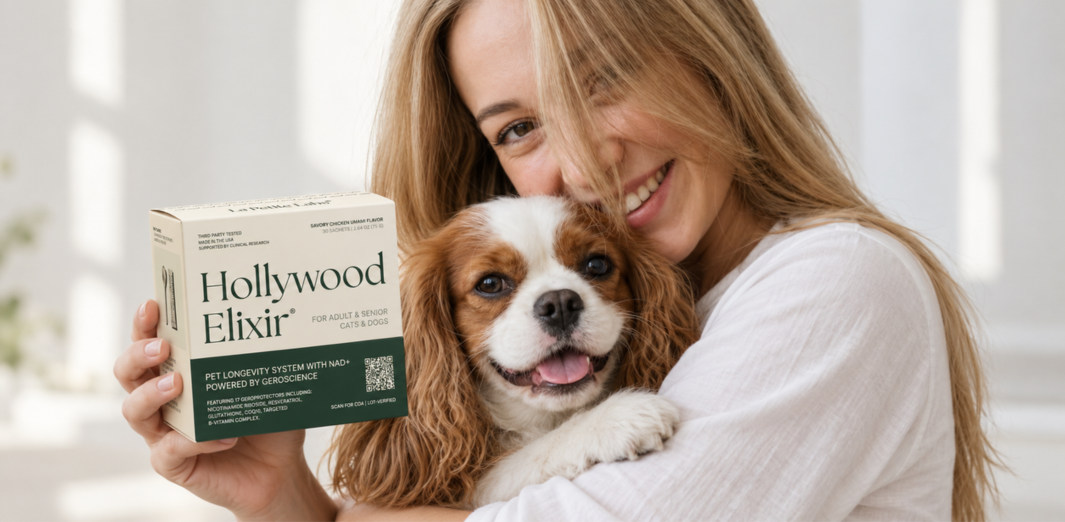
Woman hugging a golden retriever while holding a Hollywood Elixir box
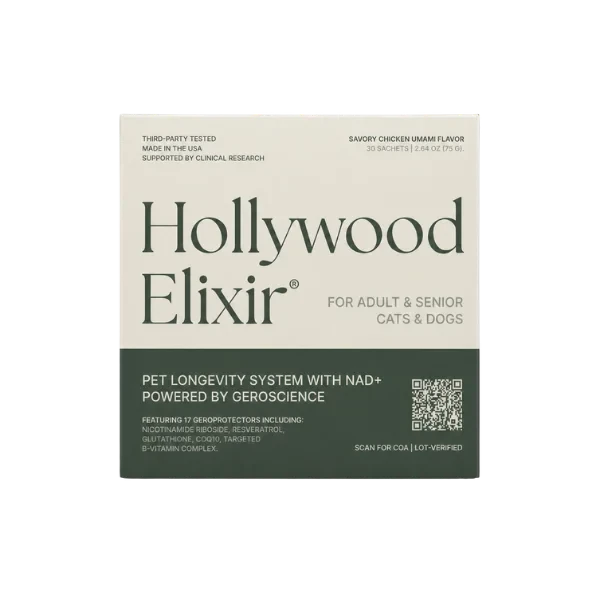
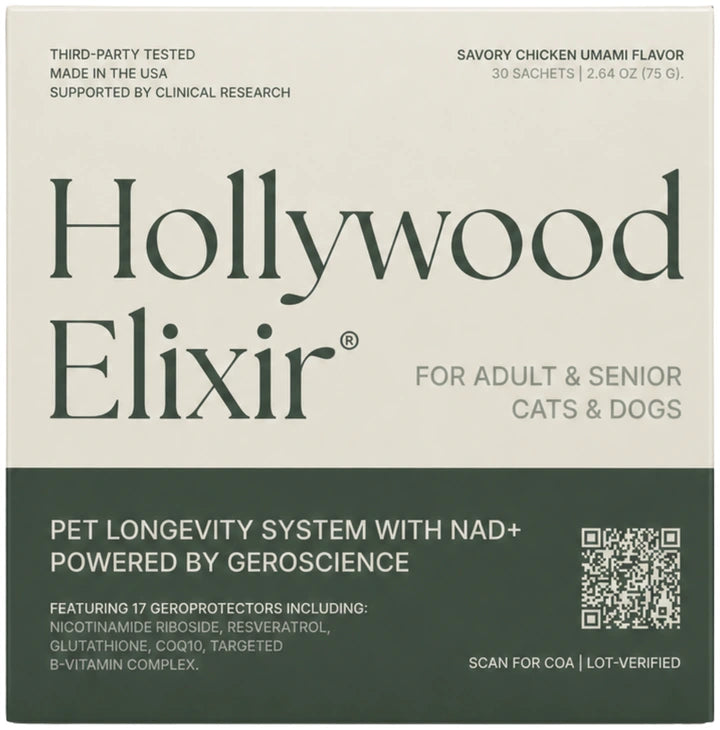
Hollywood Elixir® Senior Dog Supplement

17 science-backed actives

From$50/moSave up to 44%Shop Now
Contents

One supplement we reviewed listed 39 active ingredients. It printed an amount for none of them. Thirty-eight were grouped into eight “proprietary blends”, which give a total weight for the blend but nothing for the ingredients inside it.1

Nothing about that label is unusual in the pet supplement aisle, and nothing about it is necessarily illegal. It is simply impossible to check. That is the verification gap: the distance between what a pet supplement says and what a buyer can confirm.

We wrote 145 dog and cat supplement reviews, audited 56 brands and read the product pages of 2,865 supplements. Most labels leave something a buyer can’t check: an ingredient amount, a lab report, a study on the product itself or the name of the expert behind it.

Every one of those gaps is something some brands already close. Five questions tell you which kind of product you are holding.

Shoppers Have Learned to Ask for Proof

In October 2025, Consumer Reports tested 23 protein powders and shakes and found that more than two-thirds contained more lead in a single serving than its experts consider safe for a whole day.2 Plant-based powders averaged about nine times the lead of dairy-based ones.3 The industry disputed the threshold. Shoppers heard the message anyway: a clean-looking tub is not the same as a tested one.

Lawmakers followed. In February 2026, California state senator Steve Padilla introduced SB 1033, which would require protein powder makers to test for heavy metals and publish the results.4 The same shoppers spend on the animals they call family: US pet supplement sales reached about $2.9 billion in 2025.6 The question is whether the proof they now expect for themselves is there for their pets.

Woman holding a Hollywood Elixir box beside a pug, a terrier and a food bowl

Pet Supplements Aren’t Legally Supplements

Human supplements have their own legal category in the US, created in 1994. Pet supplements don’t. In 1996 the FDA’s Center for Veterinary Medicine said that law does not apply to products for animals.5 A product sold for a dog or cat is, in law, either an animal food or an animal drug, depending on what it claims to do.

Woman in sportswear holding a Hollywood Elixir box beside a black-and-tan dog outdoors

No Premarket Review of What Goes in the Jar

Most pet supplements are sold in the space between those two categories, under what the FDA treats as low enforcement priority unless animal or human health is at risk.7 Nobody reviews the formula, the amounts or the claims before a product goes on sale.

Woman holding a Hollywood Elixir box above her forehead beside a Bernese mountain dog outdoors

27 of 195 Brands Display the NASC Seal

The industry runs its own quality program, the National Animal Supplement Council, whose members pass audits of their quality systems.8 Its seal appears on the sites of 27 of the 195 brands in our census.1 The seal says a company takes part in that program. It isn’t a lab report for a specific batch.

Golden retriever nuzzling a woman holding a Hollywood Elixir box on the grass beside a food bowl

No FDA Warning Letters to Any of 189 Companies

We found none of the 180 FDA warning letters about animal drugs or animal food issued since 2015 addressed to any of the 189 companies behind the 195 brands, and none of their supplements on FDA’s current recall list.1 That is not a clean bill of health. It mostly reflects how rarely regulators look at this aisle.

A pet supplement can look like a human one, read like one and cost like one. Legally, it isn’t one.

61% Left Out at Least One Ingredient Amount

Across our 145 product reviews (135 distinct supplements in six category reports), 89 (61%) left out the amount of at least one active ingredient.1 The more a product promises, the less its label tends to show: among all-in-one supplements, 40 of 54 (74%) left something out, against 54% of other products.

The wider census shows why. Half of formulas with eleven or more actives use a proprietary blend, against a quarter of formulas with five or fewer. Of 31 brands whose full ingredient panels we transcribed by hand, only 3 printed every amount on every product we read.

Overhead view of a black-and-white dog beside a food bowl and Hollywood Elixir box

92% Had No Public Lab Report

A lab report, or certificate of analysis, says what testing found, ideally for the batch in your hand. 133 of the 145 reviews (92%) found neither a public lab report nor a batch lookup.1 In the brand audit, 47 of 56 brands posted none, and 16 of the 24 brands that describe a testing program post no report a buyer can retrieve.

Woman smiling beside a golden retriever, a green food bowl and a Hollywood Elixir box

77% Said “Made in the USA”

What shoppers find instead of a lab report is a country. 111 of the 145 reviewed supplements (77%) said they were made in the USA, roughly nine for every one with a lab report.1 “Made in the USA” says where a product was made, not what is in it. Of 23 brands that point to a US location, 17 never name the facility.

Man holding a Hollywood Elixir box while sitting on an outdoor sofa with a golden retriever

One Trial on the Product Itself, Out of 145

“Clinically studied” is one of the aisle’s favorite phrases. It rarely refers to the product being sold. One of the 145 reviews found a published trial on the product itself.1 The rest relied, at most, on studies of individual ingredients: useful, but not a study of that formula, at those amounts, in the species it is sold for.

29 of 609 “Vet-Formulated” Supplements Name a Vet

“Formulated by veterinarians” is reassuring and, usually, unverifiable. Of 609 supplements that call themselves vet-formulated or vet-recommended, 29 name a vet on the product page.1 In the brand audit, 23 of 56 brands used expert language without naming the expert, and 21 named no identifiable veterinarian, scientist or formulator anywhere we looked.

An unnamed expert isn’t proof that no expert was involved. It does mean a buyer can’t find out who it was, what their training is or what they actually did.

An unnamed expert isn’t proof that no expert was involved. It means a buyer can’t find out.

Woman sitting with a beagle in a kitchen while holding a Hollywood Elixir box

DVM Voice: Clinical Vignette of a Common Pattern in Senior Dog Aging

Case provided by JoAnna Pendergrass, DVM

Rex, a 7-year-old Labrador Retriever, was brought in after his owner noticed he was slower to rise, hesitant on stairs, and less able to play as before. Examination showed stiffness and reduced hip mobility; radiographs confirmed degenerative joint changes.

His care required weight management, veterinary-guided pain control, nutritional support, and rehabilitation — a comprehensive plan, but one started only after visible decline appeared.

Clinical takeaway: Rex’s case reflects the value of proactive aging support: maintaining lean body condition, monitoring mobility early, and supporting cellular resilience, antioxidant defense, and healthy inflammatory balance before decline becomes obvious.

Single-case vignette. Not generalizable. Veterinary oversight is essential for pain, stiffness, or suspected joint disease.
Explore Hollywood Elixir Research →
Spotted gray dog beside a Hollywood Elixir box held in a person's hand

1 of 419 Probiotics Guarantees Its Count to Expiry

A probiotic’s live count falls over time, so it means most when the label says when it applies. Of 419 pet probiotics that print a count, one says it holds through the expiry date.1 Among US human probiotic labels, 27% do.

Golden retriever nuzzling a man holding a Hollywood Elixir box beside a food bowl

23% Name a Disease in Their Own Description
In the US, a product sold to treat or prevent disease in animals is regulated as a drug. Yet 23% of pet supplements (671 of 2,865) name a disease or diagnosis in their own product description, and at least 74 pages from 27 brands describe the product as acting against a named disease.1

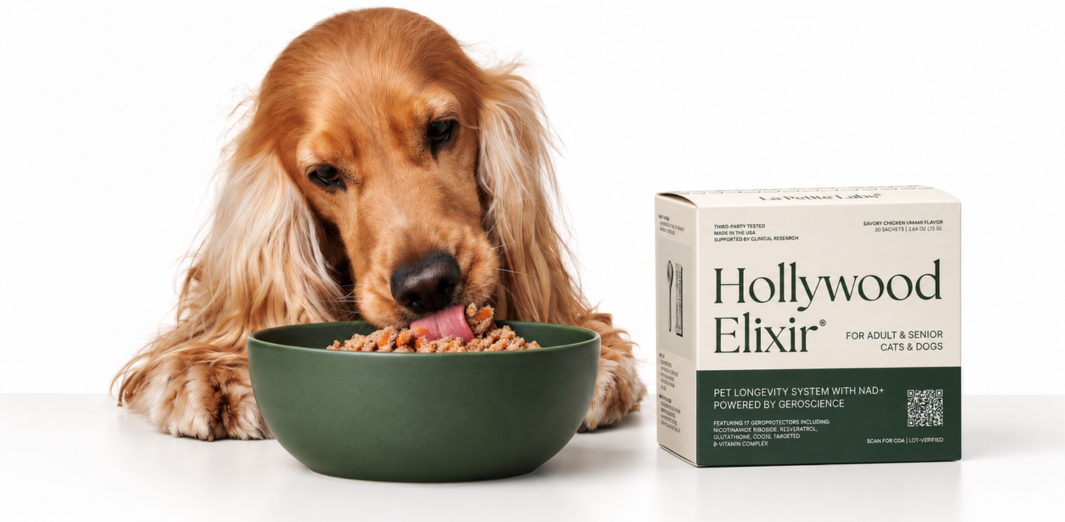
Golden spaniel eating from a green bowl beside a Hollywood Elixir box

85% of Rated Supplements Average 4.5 Stars or More

When labels are thin, shoppers lean on ratings. On brands’ own websites, 85% of rated supplements average 4.5 stars or higher, and 23% show a perfect 5.0.1 When almost everything scores the same, the score stops separating one product from another. Reviews say whether a pet ate a supplement. They can’t say what is in the jar.

195 Brands, 189 Companies, No Shared Recipes

Pet supplements have had their share of headlines about consolidation. The census tells a quieter story: the 195 brands belong to 189 different companies. Only five companies own two or more, and the five largest hold 18% of the supplements on sale.1 This is still an aisle of independent brands, which is part of why disclosure varies so much from one jar to the next.

Contract manufacturers make many of those products, so we looked for the same recipe sold under different names. Comparing 121 fully printed ingredient panels, ingredient by ingredient and amount by amount, we found no recipe shared by two different companies.

4 in 10 Supplements Sold in 2022 Are Gone

In 19 brands whose stores we could compare across time, 4 in 10 of the supplements sold in 2022 were no longer listed in 2026 (269 of 681), and the same brands added 321 new ones.1 Some of that is renaming. Either way, the aisle a shopper researched three years ago is substantially not the one on sale today, which makes a label that can be checked now worth more than a reputation built then.

Woman holding a Hollywood Elixir box beside a dapple dachshund and green food bowl on a sofa

Seven Brands Already Post Batch-Matched Lab Reports
None of this is technically hard. At the time of our brand audit (May to July 2026), seven of the 56 audited brands posted a lab report a buyer could match to their batch: ElleVet Sciences, Fera Pets, Only Natural Pet, Nordic Naturals Pet, Honest Paws, Open Farm and Super Snouts.1 Disclosure is a decision a brand makes, product by product.

Woman cuddling a brown-and-white spaniel while holding a Hollywood Elixir box

Five Questions That Close the Gap

  1. Is every active ingredient’s amount printed?
  2. Is there a lab report, and does it match your batch?
  3. Was this product studied, or only its ingredients?
  4. Who formulated it, by name?
  5. Can the label stand behind its promises, with an amount for your pet’s species and weight and no promise to treat disease?

What La Petite Labs Publishes

La Petite Labs makes pet supplements, so this is our aisle too, and our own products were excluded from every figure above. Here is where we stand against the five questions today.

  • Amounts: Hollywood Elixir® prints an amount for each of its 17 actives, and Pet Gala™ for every active it lists, for each weight band from under 7 lb.
  • Batch reports: our COA lookup lets a buyer match a lot number to its signed quality report. It begins with Hollywood Elixir, and more batches will follow.
  • Studies: no study has yet tested our finished formulas. We are planning our own, beginning with senior dogs and extending to cats.
  • Promises: our products are daily nutrition, not treatments, designed around the biology dogs and cats share.

Every part of the gap is something some brands already close.

Educational content only. This material is not a substitute for veterinary advice. Always consult your veterinarian about your dog’s specific needs. These statements have not been evaluated by the Food and Drug Administration. Products mentioned are not intended to diagnose, treat, cure, or prevent any disease.

Glossary

Proprietary blend: A group of ingredients listed with one combined weight, without the amount of each.

Certificate of analysis (COA): A lab report showing what testing found in a product, ideally for a specific batch or lot.

Batch or lot number: The production run a jar came from; it lets a buyer match a lab report to the product in hand.

NASC: The National Animal Supplement Council, an industry group with a member quality-audit program.

Structure–function claim: A claim about supporting normal body function, as opposed to treating disease.

Related Reading

References

Numbered references identify the sources used for specific claims. Read the study design, species and evidence boundaries alongside each finding.

  1. La Petite Labs Research. Pet Supplement Statistics (2026 edition). La Petite Labs · 2026Study design/context: 145 product reviews, 56-brand audit and a census of 2,865 supplementsSpecies/context: dog, catEvidence boundary: Public product information; not product safety or efficacy.
  2. Consumer Reports. Protein powders and shakes contain high levels of lead. Consumer Reports · 2025
  3. Petfood Industry. Report: Pet supplement sales near $3B as growth moderates. Petfood Industry · 2026Study design/context: Coverage of Packaged Facts research
  4. U.S. Food and Drug Administration. Animal Food & Feeds. FDA · 2026
  5. National Animal Supplement Council. National Animal Supplement Council. NASC · 2026

FAQ

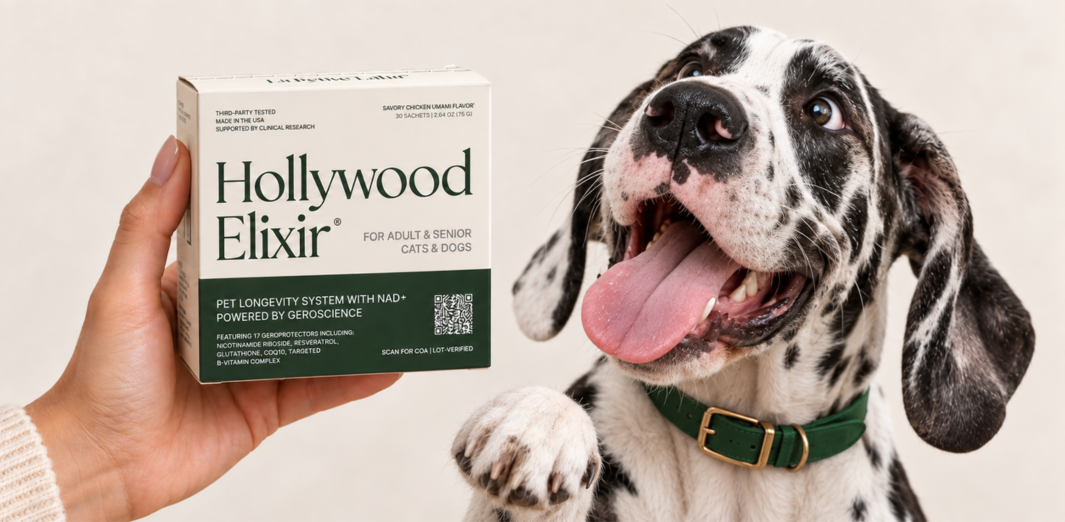
Dalmatian looking toward a Hollywood Elixir box held in a person's hand

Discover LPL-01: How This Fits Into a Larger Canine Longevity System

Aging in dogs is not driven by a single pathway. It’s the result of interacting biological systems—energy metabolism, oxidative stress, immune signaling, and structural integrity—changing over time.

This article explores one piece of that puzzle. If you want to understand how these pieces connect—and what actually moves the needle—you need to zoom out.

Start with the underlying science:

Keep exploring

What would you like to understand next?

Search practical guides about healthy aging, cellular energy, ingredients, and daily support for dogs.