






From Our Shelf to Theirs: How Human Wellness Trends Reach the Pet Aisle

Collagen, ashwagandha, lion’s mane, postbiotics, NAD+. Which human wellness trends cross into pet supplements, who carries them, how long it takes and what evidence makes the trip.

By La Petite Labs Editorial 12 min read

As Seen On

Woman hugging a golden retriever while holding a Hollywood Elixir box
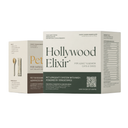
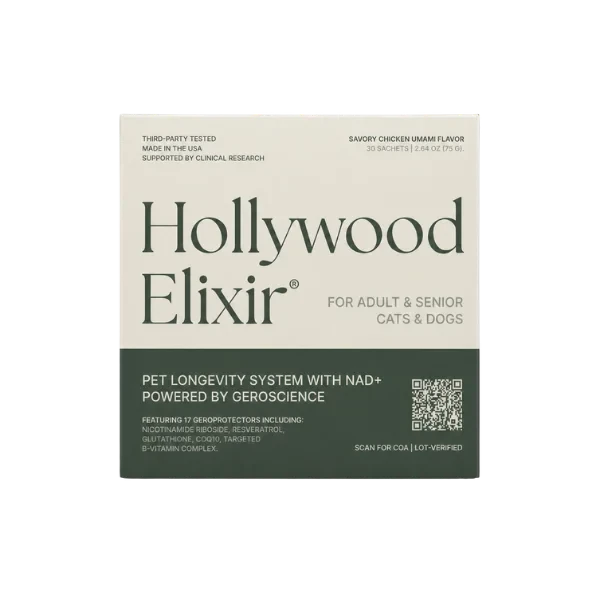
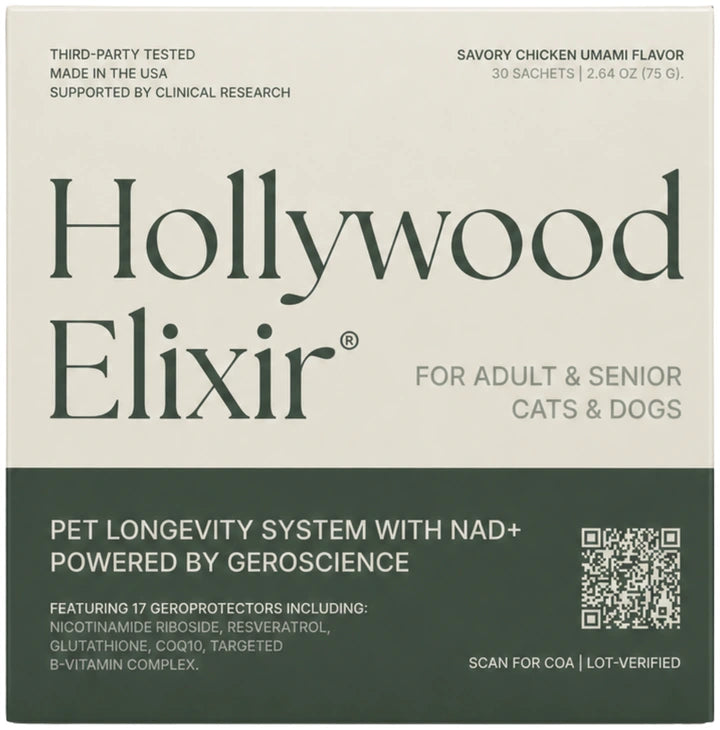
Hollywood Elixir® Senior Dog Supplement

17 science-backed actives

From$50/moSave up to 44%Shop Now
Contents

Wellness has become one of the defining consumer stories of the decade. McKinsey estimated the global consumer wellness market at around $1.8 trillion in 2024,2 and younger shoppers in particular treat sleep, nutrition, fitness and “longevity” as everyday spending. Their supplement cabinets changed accordingly: ashwagandha for stress, lion’s mane in the morning coffee, collagen in the smoothie, perhaps an NAD+ precursor.

Those same shoppers share their homes with dogs and cats they call family. The US pet industry reached $158 billion in 2025, according to the American Pet Products Association.3 It was only a matter of time before the human wellness cabinet reappeared in the pet aisle. The surprise is how completely it has.

Nearly three in four pet supplement brands now sell an ingredient from a human wellness trend, and the crossing is led by pet brands watching the human aisle, not by human supplement companies.

Pet supplements adopt human ingredients a typical seven years later, and the research travels more slowly than the ingredients do. For an owner, the human evidence is the starting point; the pet evidence is the question.

73% of Pet Supplement Brands Sell a Human Wellness Trend

We tracked six ingredient trends from the human supplement aisle: collagen, adaptogens such as ashwagandha, functional mushrooms, cognitive ingredients, postbiotics and NAD+ precursors. Of the 195 brands in our 2026 census, 143 sell at least one product with one of these ingredients (73%).1

Following human trends is mainstream, not a niche strategy. All 10 brands with the largest ranges sell at least one trend ingredient, as do 31 of the 34 brands that sell 20 or more supplements.

Woman holding a Hollywood Elixir box beside a pug, a terrier and a food bowl

Collagen Leads, at 94 Brands

Collagen and connective-tissue ingredients are the most widely sold trend family, at 94 brands (48%).1 They were also the fastest to cross: collagen peptides caught on with pet brands about three years after they caught on in human supplements.

Woman in sportswear holding a Hollywood Elixir box beside a black-and-tan dog outdoors

Adaptogens at 73 Brands, Mushrooms at 69

Adaptogens such as ashwagandha are sold by 73 brands (37%), and functional mushrooms such as lion’s mane, reishi and turkey tail by 69 (35%).1 Both arrived from the human aisle trailing a reputation for calm and resilience that pet research has only begun to test.

Woman holding a Hollywood Elixir box above her forehead beside a Bernese mountain dog outdoors

Cognitive Ingredients at 63, Postbiotics at 36

Cognitive ingredients are sold by 63 brands (32%) and postbiotics, the inactivated bacteria at the frontier of gut health, by 36 (18%).1 Postbiotics were the second-fastest-rising ingredient in new US human supplements between 2016 and 2025.

Golden retriever nuzzling a woman holding a Hollywood Elixir box on the grass beside a food bowl

NAD+ Precursors: 8 Brands, Up From 1 in 2023

The smallest family is the newest: 8 brands (4%) sell an NAD+ precursor such as nicotinamide riboside or NMN, up from one in 2023.1 Its arrival tracks the human longevity boom almost exactly, a few years behind.

The ideas travel from the human aisle. The companies, mostly, don’t.

A Trend Product or Two, Not a New Aisle

The trend is everywhere and, at the same time, a minority of what is sold. Trend products are only 28% of the supplements on the shelf (803 of 2,865).1 The typical pattern is a mushroom blend or a collagen chew added to an established range, not a new line built around the human wellness idea.

That matters for owners, because a trend ingredient in a pet product is often one ingredient among many, at whatever amount fits beside the rest of the formula.

Overhead view of a black-and-white dog beside a food bowl and Hollywood Elixir box

Only 3 of 143 Also Sell Supplements for People

One might expect human supplement companies to carry their trends into pet products. The census says otherwise: only 3 of the 143 brands selling these ingredients also sell supplements for people.1 The crossing is driven by pet brands reading the same trend reports and following the same shoppers. The ideas travel; the companies, mostly, don’t.

Woman smiling beside a golden retriever, a green food bowl and a Hollywood Elixir box

30 of the 40 Fastest-Rising Human Ingredients Have Crossed

Using the NIH’s Dietary Supplement Label Database, which records the labels of US human supplements, we ranked the 40 ingredients growing fastest in new human supplements from 2016 to 2025.4 Thirty of the 40 are already sold in at least one pet supplement.1

Man holding a Hollywood Elixir box while sitting on an outdoor sofa with a golden retriever

Pet Supplements Followed Human Ones for 16 of 17 Ingredients

We dated each ingredient twice: the year it caught on in human supplements, and the year it caught on in pet supplements, counting “caught on” as the first year at least three brands sold it. We could date both for 17 ingredients. Pet supplements came second for 16, the same year for one, and never first. The typical gap was about seven years.1

The Crossings, Dated

Each pair below is the year an ingredient caught on in human supplements, then in pet supplements.1 Both dates are the earliest we can find, so treat each gap as approximate; the order held in every check we ran.

  • Collagen peptides: 2017, then 2020 (3 years)
  • Eggshell membrane: 2014, then 2020 (6 years)
  • NMN: 2020, then 2026 (6 years)
  • Nicotinamide riboside: 2018, then 2025 (7 years)
  • Lion’s mane: 2012, then 2020 (8 years)
  • Chaga: 2012, then 2021 (9 years)
  • UC-II collagen: 2012, then 2024 (12 years)
  • Tremella: 2012, then 2025 (13 years)

The language of the human aisle arrives on day one. The evidence arrives later.

Woman sitting with a beagle in a kitchen while holding a Hollywood Elixir box

DVM Voice: Clinical Vignette of a Common Pattern in Senior Dog Aging

Case provided by JoAnna Pendergrass, DVM

Rex, a 7-year-old Labrador Retriever, was brought in after his owner noticed he was slower to rise, hesitant on stairs, and less able to play as before. Examination showed stiffness and reduced hip mobility; radiographs confirmed degenerative joint changes.

His care required weight management, veterinary-guided pain control, nutritional support, and rehabilitation — a comprehensive plan, but one started only after visible decline appeared.

Clinical takeaway: Rex’s case reflects the value of proactive aging support: maintaining lean body condition, monitoring mobility early, and supporting cellular resilience, antioxidant defense, and healthy inflammatory balance before decline becomes obvious.

Single-case vignette. Not generalizable. Veterinary oversight is essential for pain, stiffness, or suspected joint disease.
Explore Hollywood Elixir Research →
Spotted gray dog beside a Hollywood Elixir box held in a person's hand

Collagen Crossed in Three Years

Collagen peptides moved fastest, partly because collagen already had a home in pet food and treats. UC-II, an undenatured form of collagen with a different research base, took twelve years to follow.1 Same word on the label, very different ingredients.

Golden retriever nuzzling a man holding a Hollywood Elixir box beside a food bowl

Mushrooms Took Eight to Thirteen Years
Lion’s mane took eight years to cross, chaga nine and tremella thirteen.1 Along the way, a basic detail got lost: 61% of mushroom supplements don’t say whether they use the fruiting body or the mycelium, two parts of the fungus with different compositions and different research.

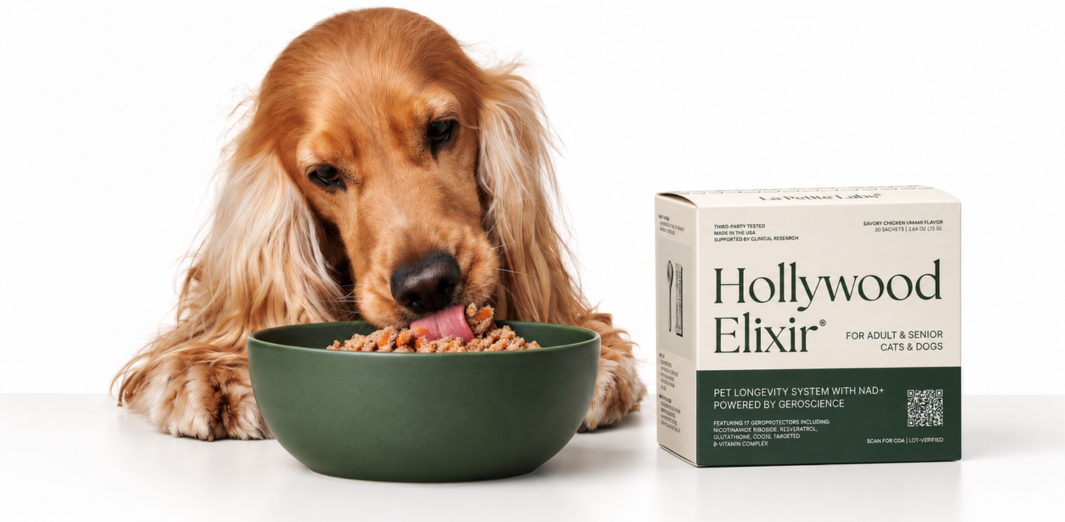
Golden spaniel eating from a green bowl beside a Hollywood Elixir box

NAD+ Precursors Took Six to Seven Years

NR and NMN crossed faster than mushrooms, carried by an unusually visible human longevity culture and a formal human safety record.1 They are also the clearest case of a trend arriving with its science partly intact: there is a randomized trial in senior dogs for the precursor family.

Ten Human Trends Still Waiting at the Border

Ten of the 40 fastest-rising human ingredients haven’t reached a pet supplement yet.1 They include three names from the longevity world, urolithin A, spermidine and fisetin; two from gut health, Akkermansia muciniphila and kombucha; and saffron, shatavari and luteolin.

On the usual timetable, some will arrive within a few years. They are the human trends to watch, and the ones where owners will most need to ask what has actually been studied in dogs and cats.

36 of 64 Trend Ingredients Have No Dog Trial

Ingredients cross over faster than research does. For 36 of the 64 human-wellness ingredients we tracked into pet supplements, we found no randomized controlled trial in dogs. For 32 of the 64, we found no study in live cats at all.1

The most widely sold are the best studied: all 16 tracked ingredients sold by ten or more brands have at least one study in live dogs. The gaps sit with the newer arrivals, exactly where the marketing is loudest.

Woman holding a Hollywood Elixir box beside a dapple dachshund and green food bowl on a sofa

“Clinically Studied” Travels Faster Than Studies
Among supplements with a trend ingredient, 36% say “clinically studied” or “science-backed” without naming a study, against 24% of other supplements.1 The language of the human aisle arrives on day one. The evidence arrives later, if at all.

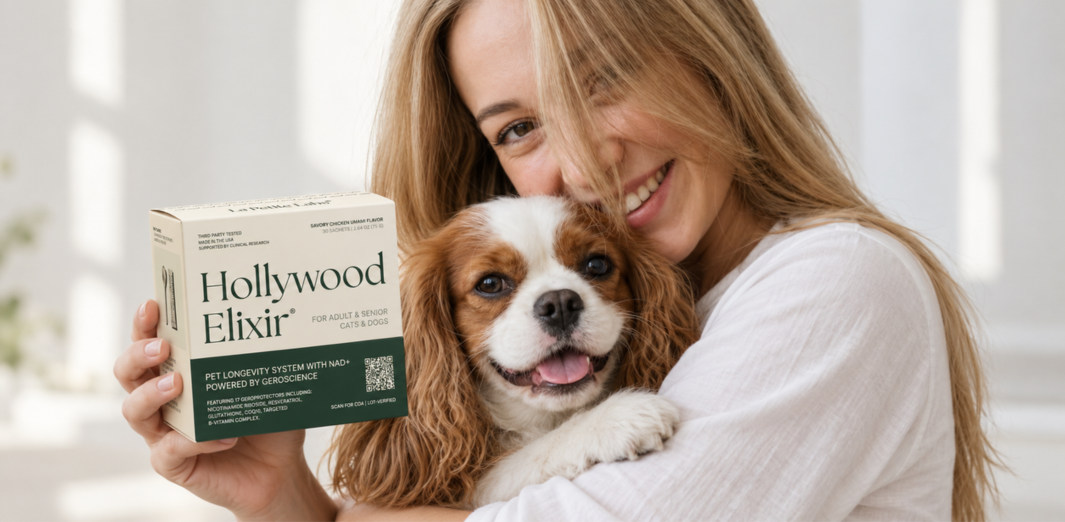
Woman cuddling a brown-and-white spaniel while holding a Hollywood Elixir box

What Doesn’t Travel Automatically

When a wellness ingredient moves from a person to a pet, three things have to be worked out again: the amount, for the pet’s species and weight; the form, such as fruiting body or mycelium, NR or NMN; and the evidence, in which species, at which amounts.

Translating, Not Copying: The La Petite Labs Approach

La Petite Labs sells products that contain human-wellness ingredients, including nicotinamide riboside, reishi and collagen, so we have a stake in this story, and our products are excluded from the census. We think the crossing is a good thing when it is done as translation rather than imitation.

Translation starts from the biology people, dogs and cats share: cellular energy, mitochondrial function, antioxidant defense and the structural proteins of skin and coat. Then it does the species work: an amount for every body weight from under 7 lb, a food-mixed powder that dogs and cats eat, and an honest account of which evidence comes from which species. We are planning our own studies, beginning with senior dogs and extending to cats.

The human evidence is the starting point. The pet evidence is the question.

Educational content only. This material is not a substitute for veterinary advice. Always consult your veterinarian about your dog’s specific needs. These statements have not been evaluated by the Food and Drug Administration. Products mentioned are not intended to diagnose, treat, cure, or prevent any disease.

Glossary

Trend ingredient: An ingredient from one of six fast-growing human supplement trends tracked in our census.

Adaptogen: A plant or fungal ingredient marketed for stress resilience, such as ashwagandha.

Fruiting body: The visible mushroom; mycelium is the root-like network. They differ in composition.

UC-II: Undenatured type II collagen, a different ingredient from hydrolyzed collagen peptides.

Caught on: In our dating, the first year at least three brands sold an ingredient.

Related Reading

References

Numbered references identify the sources used for specific claims. Read the study design, species and evidence boundaries alongside each finding.

  1. La Petite Labs Research. Pet Supplement Statistics (2026 edition). La Petite Labs · 2026Study design/context: Census of 2,865 supplements; human-to-pet ingredient datingSpecies/context: dog, catEvidence boundary: Public product information; dates are earliest observed and approximate.
  2. McKinsey & Company. The trends defining the $1.8 trillion global wellness market in 2024. McKinsey & Company · 2024
  3. NIH Office of Dietary Supplements. Dietary Supplement Label Database. National Institutes of Health · 2026

FAQ

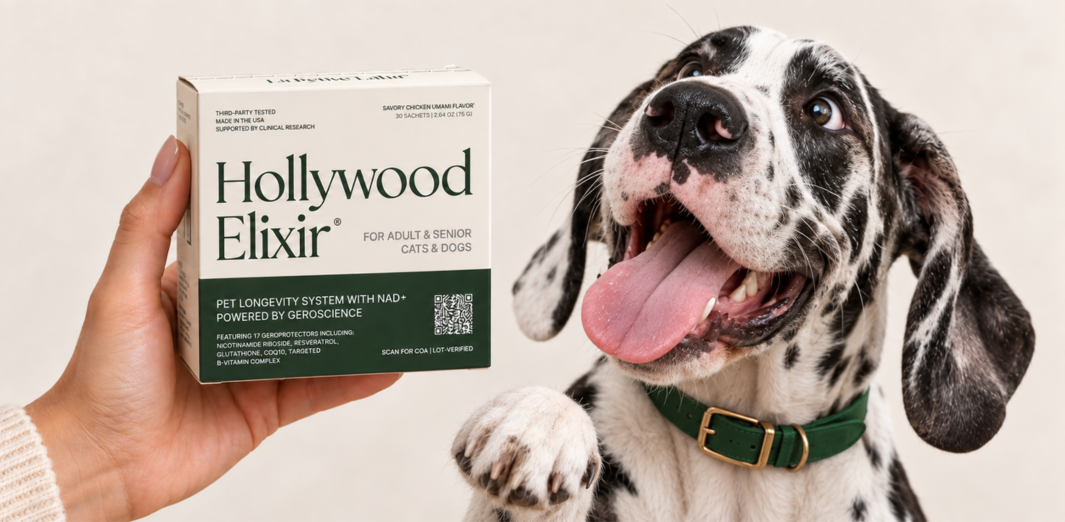
Dalmatian looking toward a Hollywood Elixir box held in a person's hand

Discover LPL-01: How This Fits Into a Larger Canine Longevity System

Aging in dogs is not driven by a single pathway. It’s the result of interacting biological systems—energy metabolism, oxidative stress, immune signaling, and structural integrity—changing over time.

This article explores one piece of that puzzle. If you want to understand how these pieces connect—and what actually moves the needle—you need to zoom out.

Start with the underlying science:

Keep exploring

What would you like to understand next?

Search practical guides about healthy aging, cellular energy, ingredients, and daily support for dogs.