




NAD+ Comes to the Pet Aisle: The Longevity Molecule’s Next Chapter

From celebrity IV lounges to the food bowl: what the human trials show, what has been studied in dogs, and how fast the pet shelf is filling.

By La Petite Labs Editorial 13 min read

As Seen On

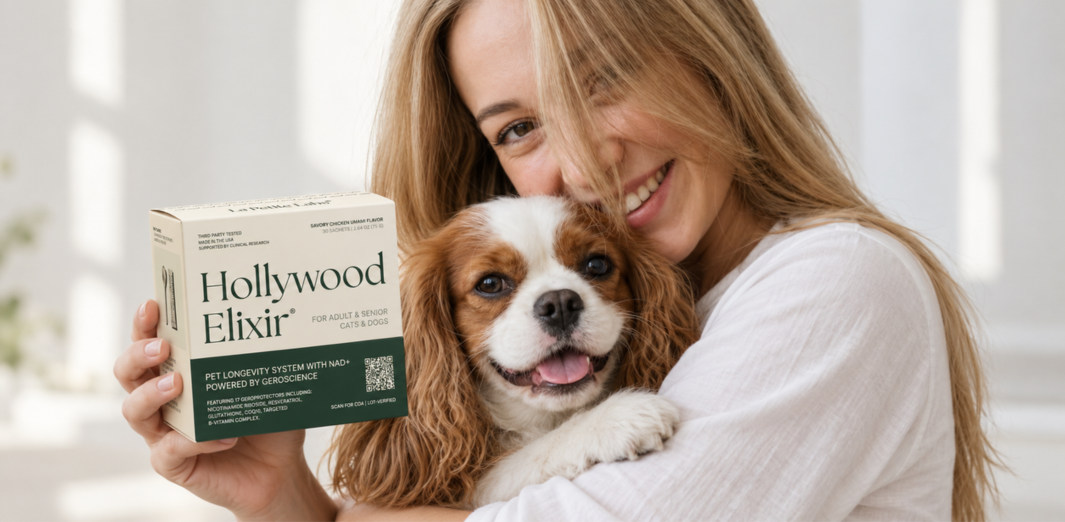
Woman hugging a golden retriever while holding a Hollywood Elixir box
Hollywood Elixir® Senior Dog Supplement

17 science-backed actives

From$50/moSave up to 44%Shop Now
Contents

Ten years ago, nicotinamide adenine dinucleotide was a term most people met once, in a biochemistry lecture. Today NAD+ has its own corner of wellness culture. Clinics sell NAD+ infusions for anywhere from about $200 to more than $1,000 a session, and precursor pills sell for $30 to more than $80 a bottle.2

Much of that enthusiasm runs ahead of the evidence, especially for infusions. But underneath the hype sits a decade of serious science on NAD+ and the vitamin B3 compounds that help the body make it. That science is now crossing into the pet aisle, carried by owners who think about their dog’s aging the way they think about their own.

NAD+ is a coenzyme every cell needs for energy and repair, and its levels fall with age in many tissues. Human trials of the precursors nicotinamide riboside (NR) and nicotinamide mononucleotide (NMN) have grown fast, and their safety and ability to raise NAD+ are now well established.

In dogs, the record is early but real: one randomized trial in senior dogs, formal safety work and several translational studies. The pet shelf is small but filling: 8 of 195 brands sell an NAD+ precursor in 2026, up from 1 in 2023.

A Molecule Every Cell Runs On

NAD+ is a coenzyme found in every living cell. It shuttles energy through metabolism, and it is consumed by the enzymes cells use to repair DNA and manage stress, the sirtuins and PARPs that sit at the center of the biology of aging.

In people and laboratory animals, NAD+ levels fall with age in many tissues. That observation, and a decade of work showing the decline can be offset by supplying NAD+’s building blocks, launched one of the biggest stories in human supplements.

Woman holding a Hollywood Elixir box beside a pug, a terrier and a food bowl

NR and NMN Are Different Molecules

The building blocks are called precursors. The two that matter commercially are nicotinamide riboside (NR) and nicotinamide mononucleotide (NMN), both forms of vitamin B3. They enter the cell by different routes, and the research on one is not research on the other. A label that says “NAD+ support” without naming the precursor tells an owner very little.

Woman in sportswear holding a Hollywood Elixir box beside a black-and-tan dog outdoors

Human Trials Show Safety and Higher NAD+

By our count of PubMed records indexed as human clinical trials, NR went from 3 trials published in 2016–2018 to 15 in 2023–2025, and NMN from 1 to 9.1 Six weeks of NR raised NAD+ metabolism in older adults;4 a placebo-controlled trial reported long-term safety and higher blood NAD+;5 NMN increased muscle insulin sensitivity in women with prediabetes;6 and up to 900 mg a day for 60 days improved walking distance against placebo.7

Woman holding a Hollywood Elixir box above her forehead beside a Bernese mountain dog outdoors

Regulators Have Reviewed NR’s Safety

Not every human trial has found a change in how people feel, and effects on aging itself remain unproven. The safety record, though, has been reviewed formally. In 2016 the FDA had no questions about NR’s status as generally recognized as safe for its intended food uses.8 In 2019 the European Food Safety Authority concluded that NR chloride is safe for healthy adults at up to 300 mg a day.9

Golden retriever nuzzling a woman holding a Hollywood Elixir box on the grass beside a food bowl

The FDA Reversed Course on NMN in 2025

NMN had a stranger journey. In 2022 the FDA said NMN could not be sold as a supplement because it was being studied as a drug. After a citizen petition and a lawsuit from industry groups, the agency reversed itself on 29 September 2025, citing evidence that NMN was on sale as a supplement before it was authorized for drug research.10

Healthy aging in dogs is now a legitimate scientific goal, not a marketing slogan.

Healthy Aging in Dogs Is Now a Serious Research Goal

Aging research in dogs has gone mainstream. The Dog Aging Project is running a placebo-controlled trial of rapamycin in companion dogs at sites including Tufts, with a year of weekly treatment and follow-up to five years.16 The veterinary start-up Loyal is developing a daily pill, LOY-002, for dogs aged ten and over; the FDA has accepted its effectiveness and target-animal safety sections, and its STAY study has enrolled around 1,300 senior dogs.15 LOY-002 is a drug candidate, not a supplement, and it is not yet approved.

For owners, the message is that healthy aging in dogs is a legitimate scientific goal, not a marketing slogan. It is no surprise that the human longevity aisle’s favorite molecule is following them home.

Overhead view of a black-and-white dog beside a food bowl and Hollywood Elixir box

8 Brands Sell an NAD+ Precursor, Up From 1 in 2023

In our 2026 census of 195 brands, 8 sell an NAD+ precursor, up from 1 in 2023 (3 in 2024 and 5 in 2025).1 Four sell NMN, three sell NR and one sells NAD+ itself. Cat products are rarer still: one NMN brand and two NR brands sell one for cats.

Woman smiling beside a golden retriever, a green food bowl and a Hollywood Elixir box

Pets Follow Human Supplements by About Seven Years

NMN caught on in US human supplements in 2020 and in pet supplements in 2026; NR in 2018 and 2025.1 That six-to-seven-year gap is typical: across the human-wellness ingredients we could date in both markets, pet supplements followed a median of about seven years later.

Man holding a Hollywood Elixir box while sitting on an outdoor sofa with a golden retriever

The Vocabulary Is Ahead of the Products

Words such as “cellular”, “mitochondria” and “NAD” appear on 21% of the product pages for supplements with a human-wellness trend ingredient. Yet only 2.1% of all pet supplements (59 of 2,865) claim healthy aging or longevity as a benefit.1 The idea is traveling faster than the products.

The Senior-Dog Trial That Started the Conversation

At NC State, 70 dogs with mild to moderate cognitive impairment received a combination of an NAD+ precursor and a senolytic, at a full amount, a low amount or placebo. Owner-scored cognition differed significantly across groups at three months, with the largest improvement in the full-amount group.3

In-clinic cognitive tests and measured activity did not differ, the effect was not sustained to six months, and adverse events were similar across groups. It is the only randomized trial we found in dogs for the NAD+ precursor family, and a clear first signal in a naturally aging population.

The pet evidence is early. It is not a blank page.

Woman sitting with a beagle in a kitchen while holding a Hollywood Elixir box

DVM Voice: Clinical Vignette of a Common Pattern in Senior Dog Aging

Case provided by JoAnna Pendergrass, DVM

Rex, a 7-year-old Labrador Retriever, was brought in after his owner noticed he was slower to rise, hesitant on stairs, and less able to play as before. Examination showed stiffness and reduced hip mobility; radiographs confirmed degenerative joint changes.

His care required weight management, veterinary-guided pain control, nutritional support, and rehabilitation — a comprehensive plan, but one started only after visible decline appeared.

Clinical takeaway: Rex’s case reflects the value of proactive aging support: maintaining lean body condition, monitoring mobility early, and supporting cellular resilience, antioxidant defense, and healthy inflammatory balance before decline becomes obvious.

Single-case vignette. Not generalizable. Veterinary oversight is essential for pain, stiffness, or suspected joint disease.
Explore Hollywood Elixir Research →
Spotted gray dog beside a Hollywood Elixir box held in a person's hand

Beagles Tolerated NMN in a Safety Study

In a 2020 study, beagles given NMN twice a day for 14 days showed only mild increases in creatinine and uric acid.11 EFSA’s assessment of NR also drew on repeated-amount toxicity studies in rats and in dogs.9 Together with the human trials, that gives NAD+ precursors a deeper safety record than most ingredients new to the pet aisle.

Golden retriever nuzzling a man holding a Hollywood Elixir box beside a food bowl

Dogs Help Explain NAD+ Biology

In golden retrievers with a muscular dystrophy that mirrors the human disease, muscle NAD+ was depleted, and nicotinamide, another B3 precursor, modestly reduced aspects of the disease.12 Dogs are not only patients in this research; they are one of the best windows into how NAD+ behaves in a large, long-lived mammal.

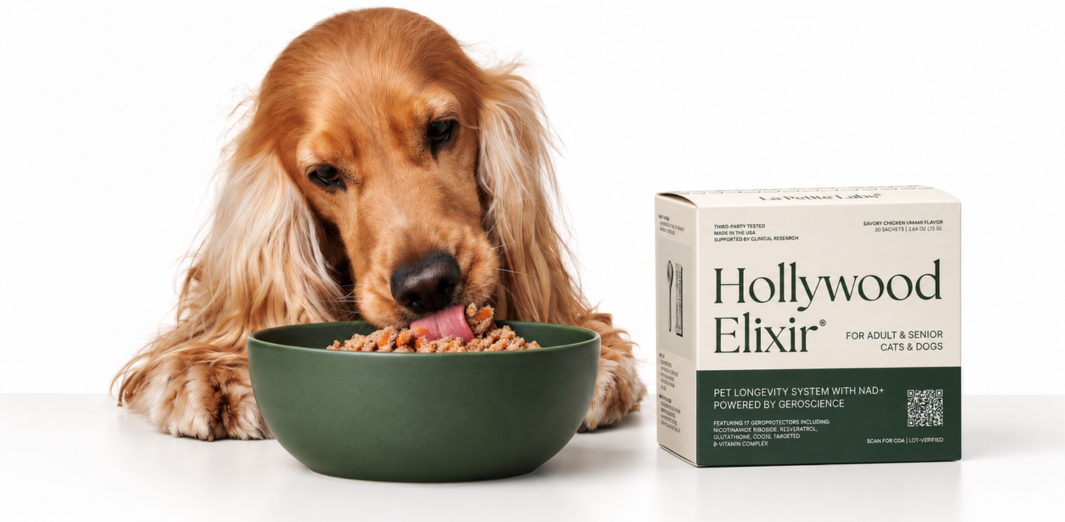
Golden spaniel eating from a green bowl beside a Hollywood Elixir box

Aged Dogs, Inflammation and NMN

In a 2024 study of aging in domestic dogs, aged dogs given NMN, among other interventions, had lower levels of the inflammatory markers IL-6 and TNF-α.13 An uncontrolled 2026 study reported lower levels of the cardiac marker NT-proBNP in dogs given NMN, and called for controlled trials.14

Cats Make Little Niacin on Their Own

In cats, we found no published study of an NAD+ precursor, and we found no study of NR alone in either dogs or cats.1 That gap matters because cats handle vitamin B3 differently: they make little niacin from the amino acid tryptophan, which is why cat food must supply it ready-made, and their liver clears many compounds more slowly than a dog’s.

Neither fact argues against NAD+ support for cats. Both argue for a cat-specific amount, worked out by body weight, and for studies in cats themselves.

How to Read an NAD+ Label

  • The precursor, by name. NR and NMN have different research.
  • The amount, for your pet’s weight. A pet label should give a daily amount for every body weight it covers.
  • A cat amount, if it says “dogs and cats”. Cats handle vitamin B3 differently, so their amount should be stated.
  • The evidence, and its species. Human trials, dog trials and mouse studies answer different questions.
Woman holding a Hollywood Elixir box beside a dapple dachshund and green food bowl on a sofa

NAD+ Itself Is a Different Proposition
One brand in the census sells NAD+ itself rather than a precursor. NAD+ is a large molecule that is broken down in the gut, which is why researchers study the precursors instead.2 A product built on NAD+ is not the same proposition as one built on NR or NMN.

Woman cuddling a brown-and-white spaniel while holding a Hollywood Elixir box

Why Formulas Pair NAD+ With Antioxidants

Many formulas pair NAD+ precursors with antioxidants such as glutathione or mitochondrial cofactors such as CoQ10, on the logic that energy production and oxidative stress are two sides of the same cellular coin. That logic is sound biology. Whether a particular combination helps a particular animal is what pet studies still have to show.

La Petite Labs Is Planning Studies in Senior Dogs, Then Cats

La Petite Labs sells Hollywood Elixir, a daily supplement for dogs and cats built around nicotinamide riboside, so we have a direct interest in this category, and our products are excluded from every census figure here.

The human aisle suggests where pets are heading: more products, more brands and growing pressure for the kind of evidence human NR and NMN now have. That evidence has to be gathered in dogs and cats, at the amounts and in the forms they are actually given. We are planning our own studies, beginning with senior dogs and extending to cats, because a category this promising should earn its evidence in the animals it serves.

A category this promising should earn its evidence in the animals it serves.

Educational content only. This material is not a substitute for veterinary advice. Always consult your veterinarian about your dog’s specific needs. These statements have not been evaluated by the Food and Drug Administration. Products mentioned are not intended to diagnose, treat, cure, or prevent any disease.

Glossary

NAD+: Nicotinamide adenine dinucleotide, a coenzyme used in cellular energy metabolism and repair.

Precursor: A building block the body converts into another molecule; NR and NMN are NAD+ precursors.

Nicotinamide riboside (NR): A form of vitamin B3 that cells can convert into NAD+.

Nicotinamide mononucleotide (NMN): A different B3 compound involved in NAD+ synthesis.

Senolytic: A compound aimed at clearing senescent, or aged, cells.

GRAS: Generally recognized as safe, a US food-safety status.

Related Reading

References

Numbered references identify the sources used for specific claims. Read the study design, species and evidence boundaries alongside each finding.

  1. La Petite Labs Research. Pet Supplement Statistics (2026 edition). La Petite Labs · 2026Study design/context: Census of 2,865 supplements from 195 brands; PubMed human-trial countsSpecies/context: dog, catEvidence boundary: Public product-page information; not product safety or efficacy.
  2. Simon KE, Russell K, Mondino A, et al. A randomized, controlled clinical trial demonstrates improved owner-assessed cognitive function in senior dogs receiving a senolytic and NAD+ precursor combination. Scientific Reports · 2024· DOI 10.1038/s41598-024-63031-wStudy design/context: Randomized controlled clinical trialSpecies/context: dogEvidence boundary: Combination-specific owner-assessed cognition result; does not isolate NR.
  3. Martens CR, Denman BA, Mazzo MR, et al. Chronic nicotinamide riboside supplementation is well-tolerated and elevates NAD(+) in healthy middle-aged and older adults. Nature Communications · 2018· DOI 10.1038/s41467-018-03421-7Study design/context: Randomized crossover trialSpecies/context: human
  4. Conze D, Brenner C, Kruger CL. Safety and Metabolism of Long-term Administration of NIAGEN (Nicotinamide Riboside Chloride) in a Randomized, Double-Blind, Placebo-controlled Clinical Trial of Healthy Overweight Adults. Scientific Reports · 2019· DOI 10.1038/s41598-019-46120-zStudy design/context: Randomized controlled trialSpecies/context: human
  5. Yoshino M, Yoshino J, Kayser BD, et al. Nicotinamide mononucleotide increases muscle insulin sensitivity in prediabetic women. Science · 2021· DOI 10.1126/science.abe9985Study design/context: Randomized controlled trialSpecies/context: human
  6. Yi L, Maier AB, Tao R, et al. The efficacy and safety of β-nicotinamide mononucleotide (NMN) supplementation in healthy middle-aged adults: a randomized, multicenter, double-blind, placebo-controlled, parallel-group, dose-dependent clinical trial. GeroScience · 2023· DOI 10.1007/s11357-022-00705-1Study design/context: Randomized controlled trialSpecies/context: human
  7. EFSA Panel on Nutrition, Novel Foods and Food Allergens (NDA). Safety of nicotinamide riboside chloride as a novel food pursuant to Regulation (EU) 2015/2283 and bioavailability of nicotinamide from this source. EFSA Journal · 2019· DOI 10.2903/j.efsa.2019.5775Study design/context: Regulatory safety assessmentSpecies/context: human, rat, dog
  8. NutraIngredients. FDA declares NMN lawful in dietary supplements. NutraIngredients · 2025
  9. You Y, Gao Y, Wang H, et al. Subacute toxicity study of nicotinamide mononucleotide via oral administration. Frontiers in Pharmacology · 2020· DOI 10.3389/fphar.2020.604404Study design/context: Safety studySpecies/context: dog
  10. Cardoso D, Barthélémy I, Blot S, et al. Replenishing NAD(+) content reduces aspects of striated muscle disease in a dog model of Duchenne muscular dystrophy. Skeletal Muscle · 2023· DOI 10.1186/s13395-023-00328-wStudy design/context: Translational studySpecies/context: dog
  11. Zeng M, Zhou T, Li Z, et al. Transcriptomic and intervention evidence reveals domestic dogs as a promising model for anti-inflammatory investigation. Aging Cell · 2024· DOI 10.1111/acel.14127Study design/context: Experimental studySpecies/context: dog
  12. Jiang Z, Mei L, Huang Z. Exploring the therapeutic potential of β-nicotinamide mononucleotide (NMN) in regulating canine NT-proBNP levels. Journal of Advanced Veterinary and Animal Research · 2026· DOI 10.5455/javar.2026.m1005Study design/context: Uncontrolled studySpecies/context: dog
  13. Tufts Cummings School of Veterinary Medicine. Dog Aging Project: test of rapamycin in aging dogs (TRIAD). Tufts University · 2026Study design/context: Placebo-controlled trial (ongoing)Species/context: dog

FAQ

Dalmatian looking toward a Hollywood Elixir box held in a person's hand

Discover LPL-01: How This Fits Into a Larger Canine Longevity System

Aging in dogs is not driven by a single pathway. It’s the result of interacting biological systems—energy metabolism, oxidative stress, immune signaling, and structural integrity—changing over time.

This article explores one piece of that puzzle. If you want to understand how these pieces connect—and what actually moves the needle—you need to zoom out.

Start with the underlying science:

Keep exploring

What would you like to understand next?

Search practical guides about healthy aging, cellular energy, ingredients, and daily support for dogs.