






The Gut Takes Center Stage: How Digestion Became the Pet Supplement Aisle’s Biggest Job

Kombucha, kefir, fibermaxxing and microbiome tests: the human gut-health boom has a pet-shaped shadow. What the census shows, and what to look for.

By La Petite Labs Editorial 12 min read

As Seen On

Woman hugging a golden retriever while holding a Hollywood Elixir box
Hollywood Elixir® Senior Dog Supplement

17 science-backed actives

From$50/moSave up to 44%Shop Now
Contents

Not long ago, the gut was a private matter. Now it is a lifestyle. Kombucha and kefir sit in the mainstream chiller cabinet. Social media turned “fibermaxxing” into a trend,3 and in October 2025 PepsiCo’s chief executive told investors that “fiber will be the next protein”.2 Words such as microbiome, prebiotic and postbiotic have moved from journals to grocery labels.

Owners who think this hard about their own digestion think about their pets’ too. The supplement aisle has followed them all the way.

Digestion is the most common promise in pet supplements: a third of the 2,865 products in our census claim to support it. Human gut ingredients such as postbiotics are crossing quickly, and the gut ingredients are among the best studied in dogs and cats.

The weak spot is the probiotic count. Live bacteria decline over time, and almost no pet probiotic says whether its count still holds at the expiry date.

Pet Food Science Followed the Microbiome

The industry noticed before the supplement aisle did. Purina partnered with the Gastrointestinal Laboratory at Texas A&M, one of the best-known veterinary gut research groups, on microbiome health.4 Hill’s made microbiome science the centerpiece of its showing at VMX 2025, one of the largest veterinary conferences.5 Owners can now mail a stool sample to a lab, and microbiome language appears on bags of kibble.

Woman holding a Hollywood Elixir box beside a pug, a terrier and a food bowl

33% of Pet Supplements Promise Digestive Support

In our census of 2,865 dog and cat supplements, the most common promise is digestion: 33% claim to support it (940 supplements), ahead of skin and coat (27%), immune health (26%) and joints (25%).1 Inflammation (15%) and calming (13%) follow.

Woman in sportswear holding a Hollywood Elixir box beside a black-and-tan dog outdoors

Digestion Was Already Ahead in 2022

For a long time, a pet supplement meant a joint chew. We can’t date the moment digestion took the lead: in the 19 brand catalogs we could trace back to 2022, digestion products were already ahead then.1 What is clear is that the gut is now the aisle’s center of gravity.

Woman holding a Hollywood Elixir box above her forehead beside a Bernese mountain dog outdoors

The Narrowest Cat Gap Is in the Gut

Cats are usually an afterthought in the supplement aisle. Digestion is the exception: it is where cat-only supplements come closest to dogs (143 against 455), the narrowest gap of any job except hairballs.1

Golden retriever nuzzling a woman holding a Hollywood Elixir box on the grass beside a food bowl

Postbiotics Are Sold by 36 of 195 Brands

Postbiotics, inactivated bacteria and the compounds they produce, were the second-fastest-rising ingredient in new US human supplements between 2016 and 2025.6 They are already sold by 36 of the 195 brands in our census.1

Digestion is now the most common promise in pet supplements, made by a third of the aisle.

Probiotics, Prebiotics and Postbiotics, Explained

  • Probiotics are live microorganisms, such as specific strains of Lactobacillus, Bifidobacterium, Enterococcus or Bacillus. Their effects in studies are tied to the strain, not just the species.
  • Prebiotics are fibers the gut’s own bacteria ferment, such as inulin from chicory root and fructo-oligosaccharides.
  • Postbiotics are inactivated microorganisms or their components.7 They don’t need to be alive, which makes them easier to keep stable.

Only probiotics depend on staying alive until they reach the bowl, which is why their label carries a number the others don’t.

Overhead view of a black-and-white dog beside a food bowl and Hollywood Elixir box

A Spore-Forming Human Probiotic Reached Pets by 2023

Bacillus clausii, a spore-forming probiotic that climbed the human charts over the same years, is now in pet supplements from 8 brands, half of them with a cat product, and was first on sale for pets by 2023.1 Kefir has reached one brand.

Woman smiling beside a golden retriever, a green food bowl and a Hollywood Elixir box

Akkermansia and Kombucha Haven’t Arrived Yet

Two fast-rising human gut ingredients haven’t reached a pet supplement at all: Akkermansia muciniphila and kombucha.1 Human-wellness ingredients typically reach pet supplements several years after they catch on with people, so they may be a few years away.

Man holding a Hollywood Elixir box while sitting on an outdoor sofa with a golden retriever

The Moments Owners Reach for Gut Support

Most owners buy a gut supplement at a particular moment: after a course of antibiotics, during a change of food, around stress such as boarding or a move, or as an older pet’s appetite and digestion change. Each is a reasonable moment to ask a vet about gut support.

1 of 419 Pet Probiotics Guarantees Its Count Through Expiry

Probiotics carry a count of live bacteria, in colony-forming units. Cultures decline over time, faster with heat and moisture, so a count only means something when the label says when it applies.

Of the 419 pet probiotics in the census that print a count, one says the count holds through the expiry date. Three say it applies at manufacture. The other 415 don’t say.1

The pet aisle is selling the same science with less of the guarantee.

Woman sitting with a beagle in a kitchen while holding a Hollywood Elixir box

DVM Voice: Clinical Vignette of a Common Pattern in Senior Dog Aging

Case provided by JoAnna Pendergrass, DVM

Rex, a 7-year-old Labrador Retriever, was brought in after his owner noticed he was slower to rise, hesitant on stairs, and less able to play as before. Examination showed stiffness and reduced hip mobility; radiographs confirmed degenerative joint changes.

His care required weight management, veterinary-guided pain control, nutritional support, and rehabilitation — a comprehensive plan, but one started only after visible decline appeared.

Clinical takeaway: Rex’s case reflects the value of proactive aging support: maintaining lean body condition, monitoring mobility early, and supporting cellular resilience, antioxidant defense, and healthy inflammatory balance before decline becomes obvious.

Single-case vignette. Not generalizable. Veterinary oversight is essential for pain, stiffness, or suspected joint disease.
Explore Hollywood Elixir Research →
Spotted gray dog beside a Hollywood Elixir box held in a person's hand

27% of Human Probiotic Labels Make That Promise

Human supplements show it can be done differently. On a sample of 260 US human probiotic labels with a count, from the NIH’s Dietary Supplement Label Database, 27% promise the count through expiry (71 labels).6 The pet aisle is selling the same science with less of the guarantee.

Golden retriever nuzzling a man holding a Hollywood Elixir box beside a food bowl

20 Dog Trials of Prebiotics, 14 of Postbiotics
For 36 of the 64 trend ingredients we tracked into pet supplements, we found no randomized trial in dogs. The gut is different: we found 20 randomized controlled trials of prebiotics in dogs and 4 in cats, and 14 of postbiotics in dogs and 5 in cats.1

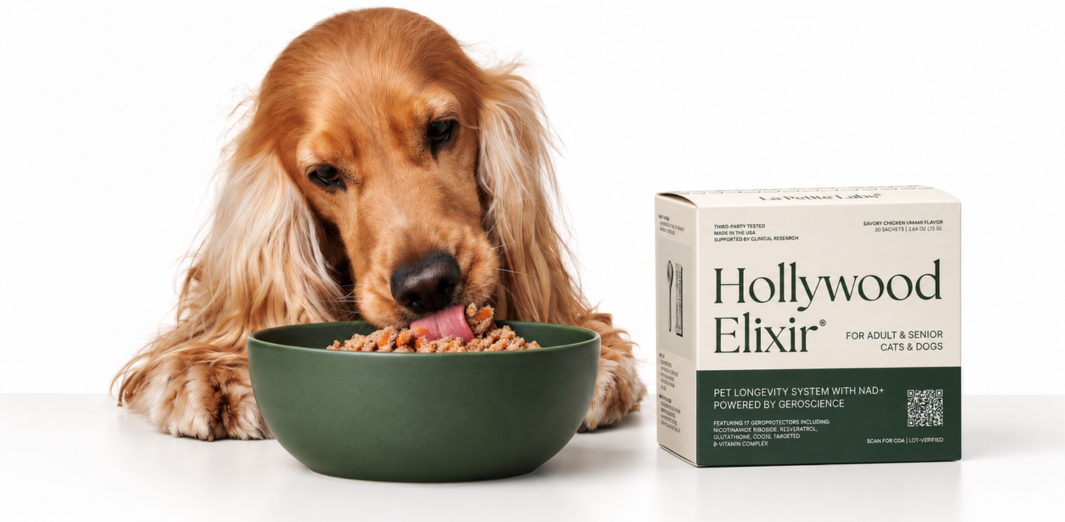
Golden spaniel eating from a green bowl beside a Hollywood Elixir box

The Newest Gut Ingredients Have the Least Pet Evidence

We found no randomized trial of Bacillus clausii in dogs or cats, and Akkermansia, not yet sold for pets, has one dog trial.1 A count of trials is not a verdict on any product. It tells you where to look for evidence, and how much there is to find.

Why Cats Are a Gut-Health Story Too

Format is a big part of why digestion works for cats. A powder or liquid stirred into a meal a cat already trusts is far more likely to be eaten than a chew: in customer reviews that say whether a pet ate a supplement, 14% of cat owners report a refusal, against 2% of dog owners.1 For cat owners, the same rules apply with extra force: a named strain, a count with a time attached, a cat amount by body weight and a format that disappears into food.

What to Look For in a Gut Supplement

  • A strain name, not just a species. A strain carries a code after the species name that can be looked up. “Probiotic blend” can’t.
  • A count with a time attached. “At time of manufacture” is honest. “Through expiry” is better.
  • Storage instructions, if the probiotic needs refrigeration.
  • Prebiotics and postbiotics named, with amounts. The count problem doesn’t apply to them.
Woman holding a Hollywood Elixir box beside a dapple dachshund and green food bowl on a sofa

When Digestive Signs Need a Vet, Not a Supplement

Ongoing diarrhea, vomiting, weight loss, blood in the stool or a change in appetite need a diagnosis, not a supplement. Gut support is for everyday digestion in a healthy pet, chosen with your veterinarian.

Woman cuddling a brown-and-white spaniel while holding a Hollywood Elixir box

The Gut Is Where Every Supplement Starts

Whatever a supplement is for, the gut is where it is absorbed, and it only works if it is eaten. A food-mixed powder, sized by body weight, fits the meal a pet already accepts and keeps the daily routine simple.

Where La Petite Labs Fits

La Petite Labs doesn’t make a probiotic, and our products are excluded from the census. We take the gut seriously in a more basic way. Our formulas are powders, sized by body weight from under 7 lb, that mix into a pet’s usual food, the format this census shows cats in particular accept.

We formulate for the systems every dog and cat share, cellular energy, antioxidant defense and the structural proteins of skin and coat, and we print the amount of every active ingredient, so an owner or their vet can see exactly what goes into the bowl alongside anything else they give.

A supplement only works if it is eaten, and the gut is where every supplement starts.

Educational content only. This material is not a substitute for veterinary advice. Always consult your veterinarian about your dog’s specific needs. These statements have not been evaluated by the Food and Drug Administration. Products mentioned are not intended to diagnose, treat, cure, or prevent any disease.

Glossary

Probiotic: Live microorganisms given in amounts intended to benefit the host.

Prebiotic: A fiber the gut’s own bacteria ferment.

Postbiotic: Inactivated microorganisms or their components.

CFU: Colony-forming units, the number of live bacteria able to grow.

Strain: A specific, named line of a bacterial species, identified by a code after the species name.

Related Reading

References

Numbered references identify the sources used for specific claims. Read the study design, species and evidence boundaries alongside each finding.

  1. La Petite Labs Research. Pet Supplement Statistics (2026 edition). La Petite Labs · 2026Study design/context: Census of 2,865 supplements; trial counts from PubMed, Europe PMC and OpenAlexSpecies/context: dog, catEvidence boundary: Public product information; not product safety or efficacy.
  2. Business Insider. PepsiCo’s CEO says fiber will be the next protein. Business Insider via AOL · 2025
  3. 2 Minute Medicine. TikTok fibermaxxing trend targets gut microbiome health. 2 Minute Medicine · 2026
  4. Hill’s Pet Nutrition. Hill’s Pet Nutrition leads the way in microbiome science at VMX 2025. Hill’s Pet Nutrition · 2025
  5. NIH Office of Dietary Supplements. Dietary Supplement Label Database. National Institutes of Health · 2026
  6. Salminen S, Collado MC, Endo A, et al. The International Scientific Association of Probiotics and Prebiotics (ISAPP) consensus statement on the definition and scope of postbiotics. Nature Reviews Gastroenterology & Hepatology · 2021· DOI 10.1038/s41575-021-00440-6Study design/context: Expert consensus statement

FAQ

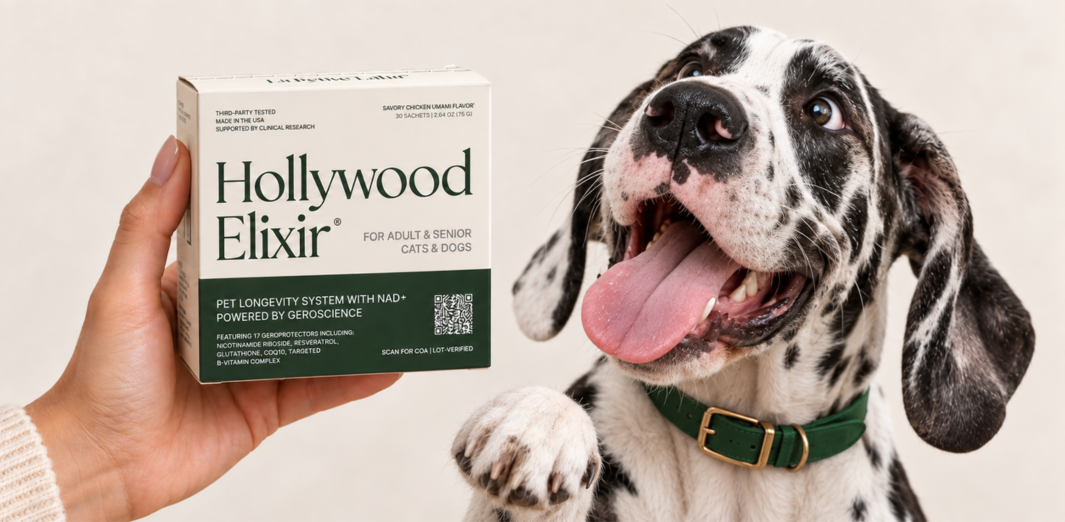
Dalmatian looking toward a Hollywood Elixir box held in a person's hand

Discover LPL-01: How This Fits Into a Larger Canine Longevity System

Aging in dogs is not driven by a single pathway. It’s the result of interacting biological systems—energy metabolism, oxidative stress, immune signaling, and structural integrity—changing over time.

This article explores one piece of that puzzle. If you want to understand how these pieces connect—and what actually moves the needle—you need to zoom out.

Start with the underlying science:

Keep exploring

What would you like to understand next?

Search practical guides about healthy aging, cellular energy, ingredients, and daily support for dogs.