
The 12 Hallmarks of Aging in Dogs
Read full insightPawever Labs NMN for Cats: What NMN Can and Cannot Do for Feline Aging
Compare NAD+ Support and Track Energy, Mobility, and Daily Recovery
By La Petite Labs Editorial 15 min read

When a cat starts aging, the changes can feel both obvious and hard to explain: less jumping, shorter play sessions, more hiding, and a daily rhythm that seems less predictable. NMN is often searched because it is tied to NAD+ biology, and NAD+ is involved in how cells handle energy and routine wear. The honest answer is that NMN for cats has a plausible mechanism, but the feline evidence base is still limited, so dosing and long-term expectations are not well defined.
This page separates what NMN can reasonably be expected to support from what it cannot do alone. It also explains why a pawever labs NMN cats review should focus less on bold outcomes and more on quality testing, ingredient transparency, and a plan for monitoring. Aging cats often have overlapping issues—pain, dental disease, kidney strain, thyroid shifts—so a supplement trial is safest after a baseline veterinary check and with a simple home log.
Owners comparing pawever labs vs Hollywood Elixir cats are usually trying to answer a practical question: is it better to try one ingredient that targets a single pathway, or a broader formula that aims to cover more aging pressures? The most useful approach is to pick a plan that can be measured, changed one variable at a time, and stopped quickly if appetite or stool changes. That is how NMN fits into a careful, cat-first longevity conversation.
- NMN for cats is best viewed as a cautious, trackable trial to support normal cellular energy handling, not a cure for aging.
- NMN is discussed as a precursor the body can use to make NAD+, a helper molecule involved in everyday energy and repair reactions.
- The strongest research base is in mice and humans, so feline dosing and long-term outcomes remain uncertain.
- Expect subtle, functional changes at most (daily rhythm, play interest, recovery after normal activity), and stop if appetite or stool worsens.
- Single-ingredient NMN can be easier to interpret, while multi-pathway formulas aim for broader coverage; neither replaces pain control, dental care, or hydration.
- Quality signals matter: lot numbers, third-party identity testing, contaminant screening, and clear inactive ingredients.
- Use a home log and a vet baseline (weight, labs when appropriate) so any change is attributable and safe.
How NMN Entered the Cat Longevity Supplement Conversation
Interest in NMN for cats has grown because NAD+ biology is tied to how cells manage energy and routine wear over time. Pawever Labs NMN sits in a newer category of cat longevity supplement options that often borrow language from human aging discussions. The key reality is that most NMN research is not in cats, so the “why” is clearer than the “how much” or “for whom.” That gap is not a red flag by itself, but it should change how decisions are made.
At home, the NMN conversation usually starts when a senior cat becomes less interested in play, takes longer to recover after a busy day, or seems more easily stressed by small changes. Owners often search for a single ingredient that feels clean and simple, especially when the cat already takes other medications. A careful approach treats NMN as one possible layer, not a complete aging plan, and keeps the veterinarian in the loop early. (see our Cat Life Stages →)
NMN and NAD+ in Plain Language
NMN is discussed as a building block the body can use to make NAD+, a helper molecule involved in energy handling and many repair-related reactions. In animal models, long-term NMN has been studied for broad age-associated changes, but those results are not a promise for cats (Mills, 2016). A more grounded takeaway is that NMN is part of an NAD+ “supply chain,” and the body’s response depends on diet, health status, and how tissues take it up.
For owners, this means expectations should be modest and specific. If a cat is going to look “different,” it is more likely to be subtle: a calmer daily rhythm, a slightly wider range for activity, or a shorter recovery window after normal exertion. Big, sudden changes should not be credited to a supplement; they should trigger a check for pain, thyroid disease, kidney issues, or appetite problems.

What Makes Cats Different with NAD+ Precursors
Feline-specific caution matters because cats process nutrients differently than many other mammals, and their supplement evidence base is thinner. NMN absorption and NAD+ changes have been demonstrated in mice after oral dosing, showing the concept can be biologically active, but that still does not define what happens in cats (Pihl, 2025). Cats also have unique nutritional constraints, so “more” is not automatically safer when stacking multiple products.
A practical household lens is to treat any NMN supplement cats use as part of the cat’s total daily intake. If a cat is on a prescription kidney diet, a weight-loss plan, or a sensitive-stomach routine, adding powders or capsules can change appetite and food acceptance. Even well-meaning additions can unbalance a carefully designed diet, which is a known risk when cats are already eating close to minimum nutrient targets (Grant, 2020).

Why the Evidence for NMN in Cats Is Limited
The biggest limitation in any pawever labs NMN cats review is that it cannot lean on cat-specific clinical trials to predict outcomes. Human studies of oral NMN focus on metabolic measures and are still not veterinary guidance, but they help illustrate what researchers choose to measure and how variable results can be (Zhang, 2025). For cats, the most honest position is: plausible mechanism, uncertain dosing, and unknown long-term effects in real-world feline households.
This is why “worked for my friend’s cat” stories can mislead. A cat that seems brighter after starting a supplement may also be sleeping better because the home is quieter, eating more because a new topper was added, or feeling less painful because arthritis medication was adjusted. The goal is not to dismiss NMN; it is to separate coincidence from a repeatable pattern that can be logged and discussed with a veterinarian.

What NMN May Support in Aging Cats
What NMN can realistically support is narrow: it may help support normal cellular energy handling in some aging bodies, because NAD+ is involved in many everyday reactions. That is different from “fixing aging,” and it is not a treatment for kidney disease, hyperthyroidism, dental pain, or arthritis. In mouse work, NMN has been explored for age-associated physiological changes, but translating that to cats requires restraint (Mills, 2016).
At home, the most reasonable “wins” to watch for are small and functional: a cat that returns to the window perch more often, grooms with less hesitation, or handles a normal play session without becoming cranky afterward. If the cat is losing weight, drinking more, vomiting, or skipping meals, those are not “aging quirks.” Those are medical signals that should be worked up before any cat longevity supplement is judged.
“A plausible mechanism is not the same as proven results in cats.”
What NMN Cannot Cover by Itself
NMN cannot cover the full landscape of feline aging by itself. Oxidative stress, immune aging, and mitochondrial quality control involve many nutrients and pathways, and a single NAD+ precursor does not automatically address all of them. Even in mice, oral NMN raised tissue NAD+ but did not protect against a specific UV-related cancer outcome, a reminder that “higher NAD+” does not equal universal protection (Pihl, 2025).
A common misconception is that if a supplement targets a “master molecule,” it must influence every aging problem. In real homes, aging looks like a mix of pain, dental disease, muscle loss, constipation, and stress sensitivity. When a cat seems less erratic after routine changes—better litterbox access, warmer sleeping spots, predictable feeding—those basics may be doing more than any capsule.

Why Feline NMN Dosing Is Hard to Pin Down
Dosing ambiguity is the practical sticking point for NMN for cats. Toxicology work in non-cat species has not shown major signals in controlled settings, but that does not define the right dose for a senior cat with kidney changes or a sensitive stomach (You, 2020). Cats also vary widely in body size, appetite, and how reliably they consume a mixed-in powder, which makes “label dose” less precise than it sounds.
Owners can reduce risk by changing one variable at a time and watching food intake closely. If a cat refuses meals after a new supplement is added, the priority is calories and hydration, not “pushing through.” Mixing into a tiny, measured portion first helps confirm acceptance before it touches the full meal. Any vomiting, diarrhea, or sudden hiding should pause the trial and prompt a veterinary call.

Single-pathway Versus Multi-pathway Aging Support
Multi-pathway aging support matters because cats rarely age in a single lane. NAD+ supply is one piece, but older cats also face muscle loss, joint discomfort, and changes in digestion and sleep-wake patterns. This is where comparisons like pawever labs vs Hollywood Elixir cats often arise: some owners prefer a single-ingredient approach, while others want broader coverage across common aging pressures.
A case vignette is typical: a 13-year-old indoor cat still eats well but has stopped jumping to the bed, startles more easily, and seems “off” after visitors. The household wants a simple NMN supplement cats can take without adding multiple pills. In that scenario, the best first step is pain screening and baseline labs, then deciding whether a single ingredient fits the plan or whether comfort, mobility, and diet adjustments should lead.

Quality Signals That Matter More Than Marketing
Quality and testing standards are where supplement choices become concrete. Because NMN products are not all identical, owners should look for identity testing, contaminant screening, and clear lot information rather than relying on marketing language. High-purity NMN has been evaluated in animal safety work, showing how researchers check for problems across organs and bloodwork, but those controlled conditions are not the same as a mixed-diet household cat (Cros, 2021).
An owner checklist can keep the decision grounded: (1) Is there a lot number and expiration date? (2) Is there third-party testing for identity and heavy metals? (3) Are inactive ingredients listed, including flavorings? (4) Can the company provide a certificate of analysis on request? (5) Is the serving size realistic for a cat that eats small meals? If any answer is unclear, pause before starting.
When a Single-ingredient NMN Trial Makes Sense
A single-ingredient NMN approach can make sense for a specific profile: a stable senior cat with good appetite, consistent stool, and no major chronic disease flare-ups, where the household wants to avoid stacking many actives at once. The logic is “change one variable, then observe,” which is the cleanest way to learn whether NMN belongs in that cat’s routine. Mechanistically, NAD+ precursors are a category with oral bioavailability evidence in mammals, even though species details vary (Trammell, 2016).
What to log between vet visits should be simple and repeatable: daily food intake, water intake changes, stool quality, willingness to jump to a known height, play interest, and sleep disruption at night. Add one “stress test” that is safe, like a short wand-toy session, and note recovery time. If the log shows no meaningful pattern after several weeks, it is reasonable to stop rather than endlessly adding more.
“The safest supplement trial changes one variable and tracks daily life.”

DVM Voice: Clinical Vignette of a Common Pattern in Senior Dog Aging
Case provided by JoAnna Pendergrass, DVM
Rex, a 7-year-old Labrador Retriever, was brought in after his owner noticed he was slower to rise, hesitant on stairs, and less able to play as before. Examination showed stiffness and reduced hip mobility; radiographs confirmed degenerative joint changes.
His care required weight management, veterinary-guided pain control, nutritional support, and rehabilitation — a comprehensive plan, but one started only after visible decline appeared.
Clinical takeaway: Rex’s case reflects the value of proactive aging support: maintaining lean body condition, monitoring mobility early, and supporting cellular resilience, antioxidant defense, and healthy inflammatory balance before decline becomes obvious.
Single-case vignette. Not generalizable. Veterinary oversight is essential for pain, stiffness, or suspected joint disease.

When Broader Support and Medical Workups Matter More
Some cats need broader support than NMN alone can offer, especially when aging signs overlap: stiffness plus constipation, or appetite swings plus nighttime restlessness. Those patterns often point to pain, dental disease, blood pressure changes, thyroid shifts, or kidney strain—issues that supplements should not mask. A cat longevity supplement plan is most useful after a veterinarian has defined what is “normal aging” versus a treatable medical problem.
What not to do is as important as what to try: do not start NMN at the same time as a new diet, new litter, and a new calming product; do not hide powders in the full meal before confirming acceptance; do not keep going through vomiting “because it’s detox”; and do not skip pain control discussions because a supplement feels gentler. These mistakes make it impossible to interpret changes and can delay real relief.

How to Bring NMN Questions to the Vet
Making an informed decision about NMN starts with a veterinary baseline. Older cats commonly have silent changes that only show up on bloodwork, urine testing, blood pressure, and a careful pain exam. Once a baseline exists, NMN can be evaluated as a supportive add-on rather than a guess. This is also where a pawever labs NMN cats review should land: product choice is secondary to knowing the cat’s starting point.
Vet visit prep is most helpful when it is specific: ask (1) which lab values should be rechecked if a new supplement is added, (2) whether the cat’s kidney status changes the risk of new ingredients, (3) what pain signs are present on exam, and (4) what timeline is reasonable to judge “no effect.” Bring the home log and a photo of the supplement label so the team can screen ingredients efficiently.

Thinking Clearly About Pawever Labs vs. Hollywood Elixir Cats
Owners often compare pawever labs vs Hollywood Elixir cats as if one must be “right,” but the more useful comparison is single-pathway versus multi-pathway design. NMN targets the NAD+ precursor idea, while broader formulas may include ingredients aimed at stress response, cellular protection, or comfort. Neither approach replaces basics like dental care, hydration support, and pain management, and neither should be expected to change a cat’s lab results on its own.
At home, the decision can be framed as a household management problem: how many changes can be monitored without confusion? If the cat already takes thyroid medication or a joint pain plan, adding a complex blend can make side effects harder to trace. If the cat is stable and the goal is a narrow trial, a single ingredient may be easier to interpret. The “best” choice is the one that can be tracked cleanly.
Safety Depends on the Cat, Not Just the Ingredient
Safety is not just about the ingredient; it is about the cat’s context. A senior cat with borderline appetite, chronic constipation, or a history of pancreatitis-like episodes has less flexibility for new powders and flavorings. While NMN has been evaluated in repeated-dose toxicology settings in non-cat species, those studies do not cover every real-world combination of diets, medications, and stressors found in aging cats (You, 2020).
Household safety steps are straightforward: keep supplements in childproof storage, measure consistently, and avoid “double dosing” when multiple family members feed the cat. If the cat is on a prescription diet, confirm with the veterinarian that adding a supplement will not undermine the diet’s purpose. Any new lethargy, hiding, or appetite drop should be treated as a stop signal, not something to wait out.
Avoiding Confusion from Supplement and Medication Stacking
Interactions are another reason NMN trials in cats should be conservative. Even when an ingredient seems “vitamin-like,” it can still complicate appetite, nausea, or medication timing. NAD+ precursor biology is also shared across tissues, so effects—if any—may not be limited to one organ system. Human and mammal data on oral NAD+ precursors show measurable changes in NAD-related metabolites, which supports biological activity but not a specific feline outcome (Trammell, 2016).
A practical routine is to separate new supplements from critical medications by a consistent window, so any stomach upset can be attributed more accurately. Keep a written list of everything the cat receives, including dental treats, calming chews, and flavored hairball pastes. Many “mystery reactions” come from stacking small extras. If the cat takes multiple items, the veterinarian can help prioritize what is essential and what is experimental.

Setting a Realistic Timeline and Stop Rules
A realistic timeline matters for judging whether NMN for cats is doing anything noticeable. Supplements that support normal function typically show, at most, gradual changes, and many cats show no clear outward shift. In adult human trials, NMN research often tracks metabolic endpoints over weeks, which hints at the slow pace of measurable change even in controlled settings (Zhang, 2025). For cats, the most honest endpoint is “does daily life look calmer and more predictable?”
Owners can set a simple decision rule before starting: choose two primary goals (for example, jumping confidence and play interest), define what “better” looks like, and pick a recheck date. If the cat’s goals are not met and there are any downsides—picky eating, loose stool, hiding—stop the trial. This prevents the common trap of adding more products to chase a vague sense of improvement.

Keeping Nutrition and Comfort as the Foundation
Secondary context can help owners avoid tunnel vision: NAD+ restoration in cats is a popular phrase, but “restoration” is not a guaranteed outcome and is not the same as reversing aging. The more actionable focus is whether the cat has enough calories, protein, hydration, and pain control to keep a workable repair window day to day. Nutrition studies in cats show how easily intake can drift away from targets during diet changes, which is relevant when supplements alter palatability (Grant, 2020).
This is also where internal research paths fit: owners comparing options may benefit from reading about NAD+ for cats, anti-aging for cats, and best supplements for senior cats as separate topics. Each lens answers a different question—mechanism, expectations, and practical selection. NMN can be one tool, but the cat’s daily routine, comfort, and medical screening remain the foundation that determines whether any tool has room to matter.
A Decision Framework for NMN for Cats
A careful decision framework keeps the NMN conversation honest. First, define the aging problem in observable terms; second, rule out common medical drivers; third, choose a product with transparent testing; and fourth, track progress indicators that can be shared with the veterinary team. The goal is not to “win” a pawever labs vs Hollywood Elixir cats debate, but to choose an approach that matches the cat’s needs and the household’s ability to monitor change.
If a supplement trial is started, keep it boring: one change, consistent timing, and a written log. Recheck weight and hydration status, and schedule follow-up labs if the cat has known kidney or thyroid concerns. When owners treat a cat longevity supplement as a monitored experiment rather than a promise, the result is safer, clearer, and more respectful of how complex feline aging pathways really are.
“If appetite shifts, the experiment stops and the basics come first.”
Educational content only. This material is not a substitute for veterinary advice. Always consult your veterinarian about your dog’s specific needs. These statements have not been evaluated by the Food and Drug Administration. Products mentioned are not intended to diagnose, treat, cure, or prevent any disease.
Glossary
- NMN (nicotinamide mononucleotide) - A compound discussed as a building block the body can use to make NAD+.
- NAD+ - A helper molecule cells use in many everyday energy and maintenance reactions.
- NAD+ precursor - A nutrient-like compound the body can convert into NAD+ through normal biochemical steps.
- Bioavailability - Whether an orally given ingredient can be absorbed and appear in the body in a usable form.
- Tissue uptake - The process of an absorbed ingredient reaching organs like liver, muscle, or brain.
- Oxidative stress - Wear-and-tear chemistry that can increase with age and illness, influenced by many pathways.
- Mitochondrial quality control - How cells maintain and recycle energy-producing structures over time.
- Third-party testing - Independent lab checks that confirm identity and screen for contaminants.
- Certificate of analysis (COA) - A document listing test results for a specific product lot.
- Progress indicators - Simple, repeatable daily-life markers (appetite, stool, jumping) logged to judge change.
Related Reading
Aging & Senior Dog Guidance
• Dog Age Calculator
• Dog Dementia
• Lethargy in Dogs
• My Dog Won't Eat
• Dog Pacing At Night
• Dog Licking Paws
• Can Dogs Dehydrate
Healthy Aging Support
• NAD+ for Dogs
• NMN for Dogs
• Antioxidants Supplements for Dogs
• Best Senior Dog Supplements & Vitamins
• Rapamycin for Dogs
References
Mills. Long-Term Administration of Nicotinamide Mononucleotide Mitigates Age-Associated Physiological Decline in Mice. PubMed. 2016. https://pubmed.ncbi.nlm.nih.gov/28068222/
Pihl. Oral nicotinamide mononucleotide (NMN) increases tissue NAD(+) content in mice but neither NMN nor Polypodium leucotomos protect against UVR-induced skin cancer. PubMed. 2025. https://pubmed.ncbi.nlm.nih.gov/40439965/
Zhang. Efficacy of oral nicotinamide mononucleotide supplementation on glucose and lipid metabolism for adults: a systematic review with meta-analysis on randomized controlled trials. PubMed. 2025. https://pubmed.ncbi.nlm.nih.gov/39116016/
Trammell. Nicotinamide riboside is uniquely and orally bioavailable in mice and humans. PubMed Central. 2016. https://pmc.ncbi.nlm.nih.gov/articles/PMC5062546/
You. Subacute Toxicity Study of Nicotinamide Mononucleotide via Oral Administration. PubMed Central. 2020. https://pmc.ncbi.nlm.nih.gov/articles/PMC7770224/
Cros. Safety evaluation after acute and sub-chronic oral administration of high purity nicotinamide mononucleotide (NMN-C) in Sprague-Dawley rats. PubMed. 2021. https://pubmed.ncbi.nlm.nih.gov/33587977/
Grant. Dietary intake of amino acids and vitamins compared to NRC requirements in obese cats undergoing energy restriction for weight loss. PubMed Central. 2020. https://pmc.ncbi.nlm.nih.gov/articles/PMC7648986/
FAQ
What is NMN, and why do cat owners consider it?
NMN (nicotinamide mononucleotide) is discussed as a building block the body can use to make NAD+, a helper molecule involved in many everyday energy and repair reactions. Owners consider nmn for cats because aging can look like lower activity, slower recovery, and more stress sensitivity.
The important caution is that most NMN outcome research is not in cats, so expectations should be modest and tracked with a simple home log rather than judged by hope or hype.
Does NMN reverse aging in cats?
No. NMN cannot reverse aging, and it should not be expected to “fix” common senior-cat problems like arthritis pain, dental disease, kidney disease, or hyperthyroidism. At best, it may help support normal cellular function in a way that is subtle and variable.
If a cat is losing weight, drinking more, vomiting, or skipping meals, those are medical signals. Those problems need veterinary evaluation rather than a supplement trial.
How does NMN relate to NAD+ in simple terms?
NAD+ is a helper molecule cells use during routine energy handling and many maintenance reactions. NMN is one of the compounds the body can use in the process of making NAD+. That is why NMN is grouped with “NAD+ precursors.”
Even when a precursor can raise NAD+ in some animal studies, that does not guarantee a noticeable change in a particular cat’s daily life. The best approach is to track a few practical markers and reassess.
Is there strong research on NMN specifically in cats?
Not yet. Most NMN research that people cite comes from mouse studies and a growing number of human trials, not controlled feline clinical studies. That means a pawever labs nmn cats review cannot rely on cat-specific outcome data to predict results.
This does not automatically make NMN unsafe or useless; it means the trial should be conservative, vet-guided, and judged by observable changes rather than big promises.
What benefits are realistic to watch for at home?
Realistic goals are small and functional: slightly more interest in play, a calmer daily rhythm, or a shorter recovery window after normal activity. These are the kinds of changes owners might notice if NMN supports normal energy handling for that individual cat.
Avoid judging by one good day. Look for a pattern over weeks, and stop the trial if appetite drops, vomiting starts, or stool becomes persistently loose.
What problems will NMN not address on its own?
NMN is not a stand-in for pain control, dental treatment, hydration support, or management of chronic disease. It also does not automatically cover oxidative stress, immune aging, or mitochondrial quality control, which involve many pathways and nutrients.
If a cat’s main issue is stiffness, hiding, or reluctance to jump, a pain-focused veterinary plan often changes quality of life more than any single supplement ingredient.
Is NMN safe for cats?
Cat-specific safety data are limited, so “safe for cats” cannot be stated with the confidence owners may want. Repeated-dose toxicology studies in other species have not flagged major issues under controlled conditions, but that does not define safety for every senior cat with real-world diets and medications(Cros, 2021).
The safest path is veterinarian involvement, conservative trials, and immediate stopping if appetite, vomiting, diarrhea, or behavior changes appear.
Are there side effects owners should watch for?
The most practical side effects to watch for are gastrointestinal and behavioral: reduced appetite, nausea-like lip smacking, vomiting, diarrhea, or new hiding. Some cats also become food-averse if a powder changes smell or taste.
Any side effect that lasts more than a day, or any refusal to eat, should be treated as a stop signal. Senior cats can dehydrate quickly, so waiting it out is risky.
Can NMN be used with prescription kidney diets?
It depends on the cat and the exact product. Prescription kidney diets are carefully balanced, and adding supplements can change palatability or total intake. Cats can drift away from nutrient targets when diets are modified, especially if appetite is already fragile(Grant, 2020).
A veterinarian should review the label and decide whether a trial is reasonable, and what should be monitored (weight, hydration, appetite consistency).
Should NMN be avoided in certain cats?
Caution is warranted for cats with unstable appetite, frequent vomiting, chronic diarrhea, or multiple active medical problems that are still being adjusted. These cats have less flexibility for new ingredients and are harder to monitor cleanly.
Kittens, pregnant or nursing cats, and cats with recent major illness should only use supplements if a veterinarian specifically recommends it, because safety and dosing assumptions are weakest in those groups.
How long does it take to see results in cats?
If NMN supports a cat’s normal function, changes are usually gradual and may be subtle. A reasonable approach is to set a trial window of several weeks with a written log, rather than expecting a quick, dramatic shift.
If there is no consistent pattern—especially if appetite or stool worsens—stopping is a valid outcome. Not every cat will respond in an observable way.
How should NMN be given to picky cats?
Start by testing acceptance in a tiny “sample bite,” not the full meal. Many cats reject a food forever if a new smell is mixed into their main portion. Capsules may be easier for some cats, but pilling can create stress that outweighs any potential benefit.
If the cat skips meals, stop immediately and return to the normal diet. Calories and hydration come first, especially for seniors.
Can NMN be combined with other supplements?
It can be, but stacking supplements is the fastest way to lose clarity about what is helping and what is causing side effects. The safest method is one change at a time, with a stable diet and stable medications.
If multiple goals exist—mobility, digestion, stress sensitivity—ask the veterinarian which single change is most likely to matter first. That keeps the plan measurable and safer.
What quality signals matter when choosing an NMN product?
Look for identity testing (confirming it is NMN), contaminant screening (like heavy metals), and clear lot numbers with expiration dates. A company should be able to provide a certificate of analysis, not just marketing claims.
Also check inactive ingredients. Flavorings and fillers can be the difference between a cat eating normally and refusing food, which is a safety issue in seniors.
Is NMN different from NR for cats?
Yes. NMN and NR (nicotinamide riboside) are different NAD+ precursors. They enter the NAD+ “supply chain” through different steps, and the research literature is not identical for each.
For cat owners, the practical point is the same: feline-specific dosing and outcomes are not well defined, so any trial should be conservative and monitored with appetite, stool, and behavior logs.
Do cats respond differently to NMN than dogs?
Cats are not small dogs. They have unique nutrient handling and can be more sensitive to changes in food smell, taste, and texture. That means a supplement that seems “easy” in a dog household can be disruptive in a cat household.
Because controlled NMN outcome data in cats are limited, it is not reliable to extrapolate from dog experiences. Cat-specific monitoring and veterinary oversight matter more than cross-species anecdotes.
What should be tracked during an NMN trial?
Track progress indicators that reflect daily function: food intake, water intake changes, stool quality, body weight (weekly), willingness to jump to a familiar spot, play interest, and nighttime restlessness. Choose two primary goals so the log stays realistic.
Also log any negatives, especially appetite dips or vomiting. A supplement trial is only useful if it stays measurable and safe.
When should a veterinarian be called during supplementation?
Call promptly if the cat stops eating, vomits repeatedly, has persistent diarrhea, seems weak, hides unusually, or shows rapid breathing. For senior cats, even “mild” appetite loss can become a dehydration problem quickly.
Also call if the cat’s drinking or urination changes, or if weight drops. Those signs should not be attributed to a supplement without medical evaluation.
How does Hollywood Elixir™ compare to single-ingredient NMN?
Single-ingredient NMN is easier to interpret because only one variable changes. A multi-ingredient product like Hollywood Elixir™ is designed to support graceful aging across more than one pathway, which may fit households aiming for broader coverage.
The better question than “which is best” is “which can be monitored cleanly for this cat.” If appetite is fragile or medications are changing, simpler trials are often safer.
What should a pawever labs nmn cats review focus on?
It should focus on transparency and practicality: third-party testing, lot tracking, clear inactive ingredients, and whether the serving format is realistic for a cat. It should also clearly state the evidence limitation: outcomes are not proven in cats.
A useful review also emphasizes monitoring—what to log between vet visits—and encourages baseline screening so changes are not confused with untreated pain or disease.
How can owners decide between Pawever Labs and other options?
Start with the cat’s main need: is the goal a narrow NAD+ precursor trial, or broader aging support? Then choose the option that matches the household’s ability to monitor change and the cat’s willingness to take it consistently.
If comparing pawever labs vs Hollywood Elixir™ cats, keep the decision grounded in testing transparency, ingredient simplicity versus breadth, and a plan for stopping if appetite or stool changes.

Discover LPL-01: How This Fits Into a Larger Canine Longevity System
Aging in dogs is not driven by a single pathway. It’s the result of interacting biological systems—energy metabolism, oxidative stress, immune signaling, and structural integrity—changing over time.
This article explores one piece of that puzzle. If you want to understand how these pieces connect—and what actually moves the needle—you need to zoom out.
Start with the underlying science:
- Canine Geroscience Framework →
A structured view of how aging progresses across cellular energy, inflammation, and resilience systems. - Senior Biological Defense Coverage (BDC) Modeling →
A systems-level map of which biological pathways decline first, and how layered interventions can support them. - Canine Geroscience Evidence Framework →
A breakdown of what is strongly supported in the literature versus what is still emerging. - LPL-01 Standard →
The formulation system that translates these models into real-world supplementation—covering multiple pathways in a coordinated way.
Essential Summary
Why is NMN for cats important?
NMN is an NAD+ precursor with plausible aging biology, but cat-specific dosing and long-term outcome data are limited. The safest way to evaluate NMN for cats is to start after baseline vet screening, choose transparent quality testing, and track a few daily-life markers rather than expecting dramatic change.
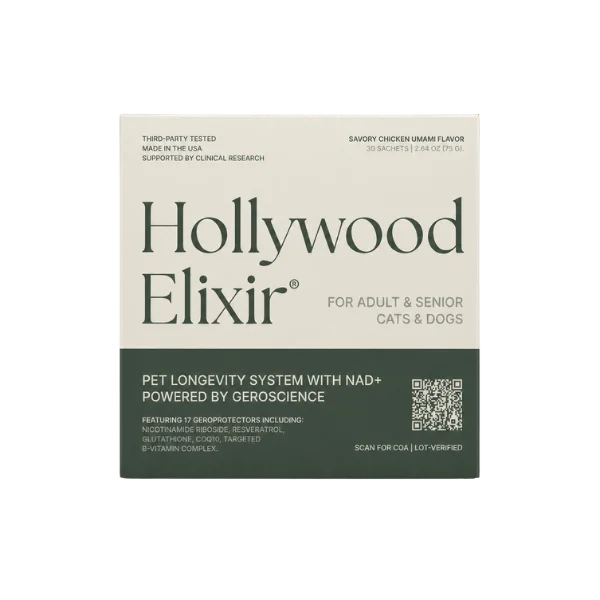
Hollywood Elixir is designed to support graceful aging with a multi-ingredient approach.
Longevity Core
Hollywood Elixir®
★★★★★(313)
More good years, starting now — steady energy, engagement, and a pet who keeps showing up fully, every day.
Starting at $89/mo
Hollywood Elixir is amazing! She put back on 5 lbs to a healthy weight, her eyes are shiny, her coat is beautiful!
— Jessie
She hopped up onto the windowsill again for the first time in years.
— Charlie
Considering NMN for cats?
If you're researching feline aging support, here's what matters most
Start with a senior-cat baseline: weight trend, pain screening, and labs if recommended. If a supplement trial is still desired, pick one change, confirm third-party testing, and log appetite, stool, jumping, and play for several weeks. A multi-ingredient option like {type:"link", url:"https://lapetitelabs.com/products/hollywood-elixir-graceful-aging-a-lifetime-of-love", children:[{type:"text", value:"Hollywood Elixir"}]} supports broader aging goals, but monitoring stays the priority.
Veterinary Insights

Learn about how our DVMs think about cat aging
Dr. JoAnna Pendergrass DVM


Longevity Core
Hollywood Elixir®
★★★★★(313)
More good years, starting now — steady energy, engagement, and a pet who keeps showing up fully, every day.
Starting at $89/mo
Wellness Tools
Explore your dog’s changing needs over time


Related Reading
When a cat starts aging, the changes can feel both obvious and hard to explain: less jumping, shorter play sessions, more hiding, and a daily rhythm that seems less predictable. NMN is often searched because it is tied to NAD+ biology, and NAD+ is involved in how cells handle energy and routine wear.
