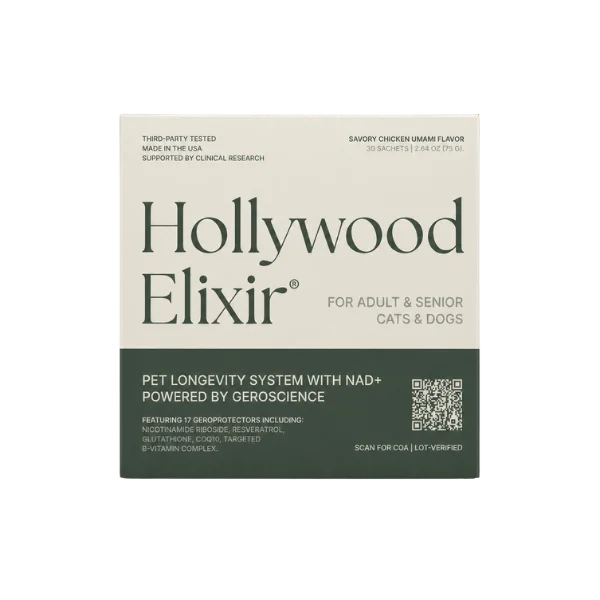
Zesty Paws Healthy Aging Vs Hollywood Elixir

Compare NAD+ Support and Daily Routines for Brain, Mobility, and Recovery

Essential Summary

Why is comparing NAD+ aging options important?

Comparing NAD+ options helps owners choose a plan they can keep consistent and interpret. NAD+ precursors may support normal cellular energy, but many older dogs show multiple aging features, so label breadth, format, and tracking habits often matter as much as the headline ingredient.

Hollywood Elixir™ is a powder formula designed to support healthy aging with NAD+ precursors as part of a broader ingredient system.

When a dog starts aging, the changes are usually small but persistent: slower get-ups, shorter play sessions, and a little more “lost” behavior at night. For owners comparing Zesty Paws healthy aging vs Hollywood Elixir longevity, the practical question is whether a single focus on NAD+ is enough, or whether a broader ingredient plan better matches what aging looks like at home.

NAD+ is a helper molecule used in energy-making and cellular upkeep, and it tends to decline with age. That’s why NAD+ precursors for dogs (often NR or NMN) have become a popular “healthy aging” category, and why a Zesty Paws healthy aging review often centers on energy and cognition. Early research in mammals shows NAD+ precursors can shift metabolism and mitochondrial programs, which helps explain the interest (Cantó, 2012). But aging is rarely one-lane: oxidative wear, inflammatory signaling, sleep disruption, and slower restoration pace can all show up together.

This page keeps the tone diplomatic on purpose. Zesty Paws deserves credit for bringing NAD+ science into mainstream pet aisles. The key is knowing what that “good start” can realistically support, what it cannot, and how to compare formats and labels so the next purchase matches the dog in front of you.

By La Petite Labs Editorial, ~15 min read

Featured Product:

  • A fair Zesty Paws healthy aging review: it’s a solid NAD+ entry point, while Hollywood Elixir treats NAD+ as one piece of a wider aging plan.
  • NAD+ precursors (like NR/NMN) are popular because NAD+ supports energy-making and cellular upkeep; mammal research shows measurable pathway shifts (Cantó, 2012).
  • The decision axis is “single pathway vs multi pathway aging”: NAD+ alone can be helpful, but it may not cover oxidative wear, inflammation, and repair needs.
  • Compare verifiable criteria: ingredient breadth, format (capsule/paste vs powder), added fillers, testing transparency, and how easy it is to keep consistent.
  • Owners usually judge results by “shift indicators”: morning stiffness, nap-to-play transitions, night pacing, appetite steadiness, and recovery after long walks.
  • Bring the vet into the loop if there’s weight loss, new coughing, persistent vomiting/diarrhea, or sudden confusion—supplements shouldn’t mask disease.
  • If the goal is “graduate from a good start,” use a label checklist and a tracking plan before switching, so changes are easier to interpret.

Why NAD+ Matters in Everyday Canine Aging

NAD+ is a helper molecule that cells use to turn food into usable energy and to run “maintenance” reactions that keep tissues functioning as dogs age. Interest in Zesty Paws NAD+ dogs products comes from the idea that providing a precursor may support normal NAD+ availability, which is linked to energy and cellular upkeep. In mammal research, nicotinamide riboside (NR) changed oxidative metabolism and energy expenditure, showing that NAD+ precursors can move measurable biology in the right context (Cantó, 2012). That doesn’t mean “anti-aging,” but it does explain why NAD+ is a reasonable foundation to discuss.

At home, NAD+ conversations usually start with what owners can see: a dog that needs longer to “warm up,” seems less interested in stairs, or gets mentally choppy in the evening. The most useful mindset is to treat any NAD-focused supplement as a support layer, not a diagnosis or a fix. If the dog’s changes are sudden, or paired with thirst, coughing, or weight loss, a vet visit matters more than any ingredient choice.

Close-up mitochondria render visualizing cellular resilience supported by Zesty Paws vs Hollywood Elixir longevity.

Decision Snapshot: Single Pathway Versus Multi-pathway Aging

The cleanest way to think about Zesty Paws healthy aging vs Hollywood Elixir longevity is not “which is best,” but “what problem is being targeted.” A single-pathway approach emphasizes NAD+ precursors for dogs as the main lever. A multi-pathway approach treats NAD+ as the backbone, then adds other supports that may relate to oxidative wear, inflammatory signaling, and recovery processes that change with age. Both approaches can be reasonable; the difference is how much complexity a household wants to manage and how many aging features the dog is showing.

In daily life, the decision often comes down to consistency. If a dog already takes one capsule reliably, a single-pathway plan may be easier to keep steady for months. If the dog has multiple “small” issues at once—stiff mornings plus night pacing plus slower bounce-back after walks—owners often prefer a plan that matches that wider picture. Either way, pick one change at a time and track it, so the household can tell what actually shifted.

Molecular artwork representing healthy aging foundations supported by Zesty Paws vs Hollywood Elixir longevity.

Comparison Criteria That Owners Can Verify on Labels

A useful Zesty Paws aging supplement review compares what can be verified, not what sounds promising. Start with the active category (NR, NMN, or another NAD+ precursor), then look for how many additional actives are present and whether they target different “aging lanes” or repeat the same theme. Next, check the inactive ingredients: pastes and soft formats often need glycerin, oils, or starches to hold shape, which can matter for dogs with sensitive stomachs or weight goals. Finally, look for quality signals like lot testing, clear labeling, and a way to contact the manufacturer.

Owners can do a quick kitchen-table audit: read the label twice—once for actives, once for fillers. If the dog is on a calorie plan, any “extra” carrier ingredients still count as daily intake. If the dog is picky, note whether the format can be mixed into a small amount of wet food without changing the meal’s smell too much. The best comparison is the one that predicts whether the dog will actually take it every day.

Molecular design image tied to antioxidant pathways supported by Zesty Paws NAD+ dogs.

What Zesty Paws Gets Right: a Practical Entry Point

Zesty Paws deserves real credit for making NAD+ language less intimidating for pet owners. Many households first learn about NMN NR dog supplements because a mainstream brand put “healthy aging” on a shelf next to familiar items. That matters, because owners are more likely to start supportive care early—before the dog’s endurance and restoration pace have clearly dropped. The best version of a Zesty Paws healthy aging review acknowledges this: accessibility and simple messaging can improve follow-through, which is often the biggest barrier in real homes.

In routine terms, an “easy start” supplement is one that fits into what the household already does: breakfast bowl, evening treat, or medication time. If the dog’s schedule is chaotic, a simpler product can be the difference between 6 consistent weeks and 6 forgotten days. Consistency is also safer for interpretation—owners can better tell whether the dog’s mobility or nighttime behavior is changing, or whether the week was just unusually busy.

Black pug portrait showing gentle expression and daily vitality with Zesty Paws aging supplement review.

Where NAD+ Alone Can Hit a Ceiling

NAD+ support is a foundation, but aging rarely behaves like a single switch. Dogs can have adequate “energy chemistry” and still struggle with oxidative wear, low-grade inflammatory signaling, or slower tissue upkeep after normal activity. That’s the main limitation behind many “NAD+ only” plans: they may support one part of the picture while leaving other bottlenecks untouched. Research in mammals also explores NAD+ precursors in different tissues, including the eye and nervous system, which shows broad interest but not a one-ingredient guarantee (Zhang, 2024).

At home, this “ceiling” often looks like partial change: the dog seems a bit more willing to start a walk, but still gets sore later; or daytime energy looks better, but night pacing continues. That pattern is a clue to widen the plan rather than doubling down on one ingredient. It’s also a reminder to rule out pain drivers like arthritis, dental disease, or ear infections, because discomfort can mimic “low energy” in very convincing ways.

Hollywood Elixir™ is amazing and makes my 13 y/o young again!

— Jessie

We go on runs. Lately he's been keeping up with no problem!

— Cami

“Aging support works best when it matches what you can actually track.”

What Multi-pathway Formulas Add Beyond NAD+

A multi-pathway aging approach typically keeps NAD+ precursors as the backbone, then adds other categories that aim to support normal function in parallel: antioxidant coverage, inflammatory balance, and cellular cleanup signals. One reason owners hear about combinations is that a controlled trial in senior dogs reported improved owner-assessed cognitive function when dogs received a senolytic plus an NAD+ precursor together, meaning the evidence supports the combination concept rather than NAD+ alone (Simon, 2024). That doesn’t translate into a promise for every product, but it does support the logic of “more than one lane.”

In household terms, multi-pathway plans are most appealing when the dog’s changes are spread out: a little stiffness, a little confusion, and a lower threshold for long days. The tradeoff is complexity—more actives can mean more chances for stomach upset or pickiness. The best use is deliberate: choose a broader formula when the dog’s aging picture is broader, and keep a simple tracking sheet so the household can tell whether the dog is becoming more fluid in movement or just having a good week.

Weimaraner image reflecting strength and companionship supported by Zesty Paws aging supplement review.

Format Matters: Capsule, Paste, or Powder

Format is not just convenience; it changes what else comes along for the ride. Capsule and paste formats often require binders and carriers to keep texture stable, while powders can be simpler but rely on the dog accepting a changed smell in food. Some owners prefer capsules because the dog already takes medications; others prefer powders because they can be mixed into a small “topper” portion. When comparing Zesty Paws healthy aging vs Hollywood Elixir longevity, format is one of the most practical differences because it predicts consistency.

A simple home test helps: try mixing a tiny amount of a neutral powder (like plain probiotic powder) into the dog’s food once to see if the dog notices. If the dog is suspicious, capsules may be less disruptive. If the dog has a sensitive stomach, introducing any new format slowly—over several days—can prevent the household from blaming the ingredient when the real issue was a sudden change in routine.

Dog profile photo emphasizing steady vitality supported by Zesty Paws vs Hollywood Elixir longevity.

Who Zesty Paws Often Fits Best

Zesty Paws Healthy Aging often fits households that want a budget-first, easy-start option and are primarily interested in NAD+ precursors for dogs. It can also fit dogs with mild, early aging changes where the goal is simply to support normal energy and day-to-day engagement. For owners doing a Zesty Paws aging supplement review, the most honest “win” is that it lowers the barrier to starting a consistent routine, which is often more important than chasing the most complex label.

At home, this fit looks like: one dog, one supplement, one feeding time, and a family that can keep it steady without debate. It also fits owners who are still learning what “aging” looks like in their dog and want to observe changes before adding more variables. If the dog is already on several medications, a simpler supplement can reduce confusion and help owners notice whether any new stomach signs or appetite changes line up with the start date.

Visual ingredient map showing formulation transparency connected to Zesty Paws NAD+ dogs.

Who a Deeper, Multi-pathway Plan Often Fits

A deeper plan tends to fit when the dog’s aging picture is multi-feature: mobility plus sleep changes plus slower recovery after normal activity. Owners who already understand NMN NR dog supplements and want NAD+ as a backbone—rather than the whole plan—often look for broader ingredient coverage and clearer testing signals. This is where “mainstream vs specialized pet supplements” becomes a real decision: specialized products may prioritize multi-category actives and third-party testing, while mainstream products prioritize availability and familiarity.

In routine terms, the best candidates are households that can commit to measuring a powder or maintaining a consistent schedule, because the benefit of complexity disappears if doses are frequently skipped. It also helps when the household is already tracking the dog’s walks, stairs, and sleep patterns, so any shift is easier to spot. If the dog is extremely picky, a deeper plan may still work, but it requires a careful introduction and a backup strategy.

Common Objections, Answered Without the Hype

Owners often hesitate for practical reasons, not science. “Zesty Paws is easier to find” is valid—availability supports consistency. “NAD+ is the most important pathway” can also be partly true, but it doesn’t mean it’s the only bottleneck in an older dog. “My dog takes the chews easily” matters more than a perfect label that sits unused. “It’s cheaper” is a real constraint, and “Zesty Paws is a trusted brand” is a reasonable comfort point.

The respectful next step is to match the plan to the dog’s current needs and the household’s follow-through. If the dog has one main issue and takes the product reliably, staying simple can be smart. If the dog has multiple aging features and the household can manage a more involved routine, a broader plan may fit better. In either case, keep the vet in the loop if there are new symptoms, because supplements should not be used to “wait out” a medical problem.

“NAD+ can be a foundation, but it rarely explains every change.”

Branded lab coat reflecting precision and trust supporting Zesty Paws vs Hollywood Elixir longevity.

A Daily Routine That Makes Results Easier to Read

Aging supplements are hardest to judge when everything changes at once. The cleanest routine is to keep food, exercise, and treat patterns stable for two weeks, then introduce one supplement change and hold it steady. That approach helps owners interpret whether a dog’s endurance and restoration pace are shifting, or whether the household simply had a calmer week. It also reduces the risk of blaming a supplement for stomach upset that was actually caused by a new chew, table scraps, or a sudden increase in activity.

A simple schedule works best: give the supplement with a full meal, not on an empty stomach, unless the label says otherwise. Choose a time when someone is always home, so missed days are rare. If the dog is sensitive, start with a partial amount for several days and watch stool quality and appetite. Consistency is what turns vague hopes into observable change.

Shop Now
Hollywood Elixir in food tableau emphasizing purity aligned with Zesty Paws healthy aging review.

Graduating from a Good Start Without Starting Over

The most useful way to frame Zesty Paws healthy aging vs Hollywood Elixir longevity is “graduating,” not “switching teams.” Starting with NAD+ support can be a sensible foundation, especially when the goal is to build a daily habit. If the dog later shows a broader set of aging features, the next step is not to discard what worked, but to decide whether the plan needs additional lanes. That’s the logic behind moving from a single pathway vs multi pathway aging approach.

At home, graduating looks like adding structure: a tracking note on the fridge, a consistent walk route for comparison, and a clear “start date” for any change. It also means avoiding rapid-fire experiments. If a household changes food, adds a joint chew, and swaps an NAD+ product in the same week, there’s no way to know what helped or what caused side effects. One change, one month, then reassess.

Shop Now
Owner and dog moment highlighting wellness rituals supported by Zesty Paws aging supplement review.

Case Vignette: Starting with NAD+ for a Busy Household

Case vignette: A 10-year-old mixed-breed dog begins hesitating at the first stair in the morning and seems mentally choppy after dinner. The family starts with a simple NAD+ precursor routine because it’s easy to buy locally and easy to remember. After six weeks, the dog’s morning start looks a bit more controlled, but night pacing still shows up several times a week.

This is a common “good start” outcome: one area shifts, another doesn’t. The next step is not to stack three new products; it’s to decide what the remaining problem likely is. Night pacing can be pain, anxiety, cognitive change, or a sleep routine issue, and it deserves a vet conversation if it persists. A Zesty Paws healthy aging review is most helpful when it leads owners to this kind of clear next question.

Shop Now

Case Vignette: When Owners Want More Than NAD+ Alone

Case vignette: An older Labrador has a lower threshold for long walks, takes longer to settle at night, and seems slower to bounce back after play. The owner reads about NAD+ precursors for dogs and tries an NAD-focused product first, but the changes feel limited and hard to interpret. The owner then decides to compare single pathway vs multi pathway aging options, looking for a plan that better matches the dog’s multi-feature pattern.

In this situation, the most important move is tracking, not guessing. The owner picks two “anchor routines” (the same morning walk loop and the same evening settling time) and writes down what happens for four weeks. That record makes it easier to tell whether the dog’s movement is becoming more fluid and whether recovery after activity is changing. It also creates a clean handoff for the vet if the dog’s sleep or mobility worsens.

Owner Checklist: What to Compare and What to Track

Owner checklist for comparing labels in a Zesty Paws aging supplement review: (1) Identify the NAD+ precursor type (NR, NMN, or other). (2) Count how many additional active categories are included versus repeated “flavor” ingredients. (3) Scan inactive ingredients for glycerin, oils, or starches if weight or stomach sensitivity is a concern. (4) Look for testing transparency and a lot number. (5) Confirm the product is clearly labeled for dogs and matches the dog’s life stage.

What to track rubric (shift indicators) over 4–8 weeks: morning rise time, willingness to jump into the car, number of pauses on a familiar walk, post-walk limping or licking, nighttime pacing episodes, and appetite consistency. Add one “quality of day” note: did the dog initiate play or seek interaction? These markers are concrete enough to compare between vet visits and help separate true change from normal day-to-day variation.

Chart contrasting minimal formulas with full-spectrum support in Zesty Paws aging supplement review.

Vet Visit Prep: Questions That Make the Appointment Count

Aging support works best when it’s paired with a medical check for common drivers of “slowing down,” especially pain and organ changes. Vet visit prep for this topic: bring a list of all supplements and treats, the start dates, and any stool or appetite changes. Ask: “Could arthritis pain be driving the night pacing or stair hesitation?” “Are there bloodwork or urine tests that should be updated for a senior dog?” and “Are any of these ingredients a concern with my dog’s current medications?” A simple chart of daily observations can be more useful than a long story.

Also bring one short video: the dog rising from bed, walking on a slick floor, or climbing the usual steps. Videos help the vet see what the household sees, especially when the dog acts “fine” in the clinic. If cognitive change is a concern, note the time of day it’s worst and whether it’s tied to meals, noise, or darkness. That detail helps the vet separate confusion from discomfort or anxiety.

Shop Now
Open package showing attention to detail consistent with Zesty Paws healthy aging review standards.

What Not to Do and What Neither Product Can Do

What not to do: (1) Don’t use an aging supplement to delay evaluation of new limping, coughing, fainting, or rapid weight change. (2) Don’t stack multiple new products at once; it hides side effects and blurs results. (3) Don’t assume “more NAD+” is always the answer if the dog’s main issue is pain or sleep disruption. (4) Don’t ignore dental disease and ear infections—both can drain endurance and make a dog seem older than it is.

What neither product can do is diagnose or treat disease, or replace targeted care like pain control, weight management, or prescription diets. A unique misconception is that NAD+ products “reverse aging.” The more accurate view is support: some dogs show better day-to-day engagement, while others show little change because the limiting factor is elsewhere. If cognitive change is a major concern, discuss evidence-based options with the vet; combination approaches have been studied in senior dogs, but results still vary by individual (Simon, 2024).

Shop Now

Evidence Notes and a Calm Next Step

Evidence notes matter because “healthy aging” language can blur into medical claims. The strongest takeaways are general: NAD+ precursors can shift measurable metabolism in mammals, supporting why the category exists. Brain aging is also influenced by hormone-related signaling partners, which is one reason cognition is complex and rarely solved by one ingredient (Yore, 2010). For owners, the practical meaning is to treat supplements as supportive layers and to keep expectations tied to observable household outcomes.

A calm next step is to pick one goal (mobility, sleep, or engagement), choose a product format the dog will take, and track shift indicators for a full month. If the dog is on other medications, use a vet-approved interaction check; reputable veterinary charts and tables can help clinics standardize safe discussions (Richard B Ford, 2006). If the dog worsens, stop experimenting and schedule an exam—aging changes should be slow, not sudden.

“Consistency beats complexity when a dog is picky or sensitive.”

Educational content only. This material is not a substitute for veterinary advice. Always consult your veterinarian about your dog’s specific needs. These statements have not been evaluated by the Food and Drug Administration. Products mentioned are not intended to diagnose, treat, cure, or prevent any disease.

Glossary

  • NAD+ - A helper molecule cells use for energy-making and upkeep reactions.
  • NAD+ precursor - An ingredient the body can convert into NAD+ (such as NR or NMN).
  • NR (nicotinamide riboside) - A commonly used NAD+ precursor studied in mammals.
  • NMN (nicotinamide mononucleotide) - Another NAD+ precursor often discussed in NMN NR dog supplements.
  • Single-pathway aging approach - A supplement strategy focused mainly on one mechanism, such as NAD+ support.
  • Multi-pathway aging approach - A strategy that uses NAD+ support plus additional ingredient categories for broader coverage.
  • Senolytic - A compound category studied for effects on older or stressed cells; sometimes paired with NAD+ precursors in research (Simon, 2024).
  • Oxidative wear - Everyday “wear and tear” from reactive molecules that can accumulate with age.
  • Shift indicators - Simple, repeatable home markers (like stairs or night pacing) used to compare changes between vet visits.

Related Reading

References

Yore. Steroid receptor coactivator-2 expression in brain and physical associations with steroid receptors.. 2010. https://www.mdpi.com/2076-2615/16/4/591

Cantó. The NAD(+) precursor nicotinamide riboside enhances oxidative metabolism and protects against high-fat diet-induced obesity.. Nature. 2012. https://www.nature.com/articles/srep26933

Zhang. Oral supplementation with Nicotinamide Riboside treatment protects RGCs in DBA/2J mouse model.. PubMed. 2024. https://PubMed.ncbi.nlm.nih.gov/39677633/

Simon. A randomized, controlled clinical trial demonstrates improved owner-assessed cognitive function in senior dogs receiving a senolytic and NAD+ precursor combination.. PubMed Central. 2024. https://pmc.ncbi.nlm.nih.gov/articles/PMC11137034/

Richard B Ford. Charts and Tables. PubMed Central. 2006. https://pmc.ncbi.nlm.nih.gov/articles/PMC7158574/

FAQ

What is the main difference between these two aging options?

The simplest difference is design philosophy. Zesty Paws Healthy Aging is typically framed around NAD+ precursor support as the main lane. Hollywood Elixir is framed as a multi-ingredient, multi-pathway approach where NAD+ is one part of a broader plan.

For most households, the “right” choice depends on how many aging features the dog is showing and how consistent the daily routine can be. A simpler plan can be easier to keep steady; a broader plan can match a broader symptom pattern.

What does NAD+ have to do with aging in dogs?

NAD+ is a helper molecule used in energy-making and cellular upkeep. As animals age, NAD+ availability and related processes can shift, which is why NAD+ precursors for dogs are marketed for “healthy aging.”

In mammal research, nicotinamide riboside (NR) changed oxidative metabolism and energy expenditure, showing that NAD+ precursors can influence measurable biology. That supports interest in the category, but it is not the same as a guarantee of visible change in every senior dog.

Is there research in dogs, not just rodents?

Yes, but it’s important to read what was actually tested. A randomized, controlled trial in senior dogs reported improved owner-assessed cognitive function when dogs received a combination product that included a senolytic plus an NAD+ precursor.

That study supports the combination concept rather than proving that any single NAD+ ingredient will reliably change cognition on its own. Owners can use this as a clue that multi-pathway designs may be worth considering when the dog’s aging picture is broader.

How soon should owners expect to notice any changes?

Most owners who notice a difference describe it as gradual, not dramatic. A reasonable window to watch is 4–8 weeks of consistent daily use, because routines, sleep, and activity patterns need time to show a trend.

Use shift indicators rather than vibes: morning rise time, pauses on a familiar walk, post-walk soreness behaviors, and nighttime pacing frequency. If nothing changes after a steady trial, the limiting factor may be pain, diet, or an underlying condition rather than the supplement choice.

Are NAD+ precursors safe for most senior dogs?

Many senior dogs tolerate supplements well, but “safe” depends on the individual dog’s health and medications. The biggest real-world issues are stomach upset, appetite changes, and confusion caused by starting multiple new products at once.

Owners should involve a veterinarian if the dog has kidney disease, liver disease, pancreatitis history, or is on several prescriptions. Bring the full label (including inactive ingredients) so the vet can check for potential conflicts and decide whether baseline bloodwork should be updated.

What side effects should owners watch for at home?

The most common at-home concerns with new supplements are digestive: softer stool, gas, vomiting, or a dog refusing meals. Some dogs also act “off” simply because the food smells different, especially with powders mixed into meals.

If mild stomach signs occur, pause new additions and restart more slowly after things normalize. If there is repeated vomiting, black/tarry stool, marked lethargy, or refusal to eat for a full day, stop the supplement and call the veterinarian promptly.

Can these supplements replace arthritis pain management?

No. Supplements can support normal function, but they do not replace a pain plan when arthritis is present. Pain control, weight management, flooring changes, and vet-guided medications are often what makes movement more fluid.

If a dog is hesitating on stairs, slipping on tile, or licking joints after walks, treat that as a pain signal until proven otherwise. A supplement can be part of a broader plan, but it should not be used to delay an exam or imaging when mobility is changing.

Do these products help with canine cognitive dysfunction?

They may support normal brain aging processes, but cognitive dysfunction is a medical condition that deserves veterinary guidance. Owners should be cautious about assuming that a supplement alone will address night pacing, staring, or getting “stuck” in corners.

There is dog-specific research showing improved owner-assessed cognitive scores with a combination that included an NAD+ precursor plus a senolytic. That supports the idea that multi-ingredient approaches can be relevant, but it still doesn’t replace diagnosis, sleep hygiene, and pain control.

What’s a common misconception about NAD+ dog supplements?

A common misconception is that NAD+ support “reverses aging.” A more accurate expectation is that some dogs may show small, gradual shifts in engagement or recovery after activity, while others show little change because their main limitation is pain, sleep disruption, or disease.

Another misconception is that if NAD+ is important, then more is always better. In real homes, the best plan is the one the dog tolerates and the family can keep consistent, with a tracking method that makes changes easier to interpret.

How should owners choose between single and multi-pathway formulas?

Start with the dog’s pattern. If the main concern is mild slowing down with otherwise stable sleep and behavior, a single-pathway NAD+ approach can be a reasonable first step. If the dog has multiple aging features at once, a multi-pathway formula may match the broader picture.

Then choose based on consistency: the format the dog will take daily wins. Finally, decide how you’ll track outcomes before starting, so the household can tell whether movement is more controlled or whether nighttime behavior is changing over time.

Is powder better than capsules for older dogs?

Neither is universally better. Powder can be easier for dogs that refuse pills, and it may allow simpler inactive ingredients. Capsules can be easier for dogs already trained to take medications and can avoid changing the smell of a meal.

The best format is the one that stays consistent for weeks. If a dog is picky, test whether a tiny amount mixed into a small “topper” portion is accepted. If stomach sensitivity is an issue, introduce any new format slowly and watch stool quality.

Can owners give NAD+ supplements with other vitamins or fish oil?

Sometimes, but stacking supplements can create avoidable problems: too many calories from oils, duplicate ingredients, or a stomach that becomes unpredictable. It also makes it hard to know which product caused a change, good or bad.

If the dog is already on fish oil or a joint product, add only one new item at a time and keep the rest stable. For dogs on prescriptions, ask the veterinarian to review the full list, including treats, because interactions and side effects are easiest to miss at home.

What should owners do if the dog refuses the supplement?

First, avoid turning it into a daily struggle. If a dog refuses a mixed-in powder, try offering it in a very small amount of wet food separate from the main meal, so the whole bowl isn’t “contaminated” if the dog rejects it.

If a capsule is the issue, ask the vet whether it can be opened and mixed (some products can, some should not). If refusal persists, switch formats rather than increasing bribery treats, especially in seniors where extra calories can worsen mobility and endurance.

Does dog size or breed change the decision?

Size and breed change what “aging” looks like and how quickly it shows up. Large breeds often show mobility and recovery changes earlier, while smaller breeds may show cognitive or sleep pattern changes more noticeably later in life.

The supplement decision still comes back to the dog’s specific pattern and the household routine. Owners should follow label guidance for their dog’s weight range and involve a veterinarian if the dog is very small, very old, or has multiple health conditions.

Is this comparison relevant for puppies or young adult dogs?

Usually, no. Puppies and young adults benefit most from basics: complete nutrition, parasite prevention, dental care, and appropriate exercise. “Healthy aging” supplements are generally aimed at middle-aged to senior dogs where owners are noticing a lower threshold for activity or slower restoration pace.

If a young dog seems unusually tired, stiff, or mentally choppy, that should prompt a veterinary evaluation rather than a supplement experiment. Early symptoms can reflect orthopedic issues, infection, endocrine disease, or diet mismatch, and those need targeted care.

How can owners tell if changes are pain or aging?

Aging and pain overlap, but pain tends to create specific patterns: reluctance to jump, licking a joint, stiffness after rest, or a “shorter fuse” with handling. Aging alone is usually slower and more generalized.

If the dog’s behavior changes quickly, if there’s limping, or if nighttime pacing appears alongside mobility changes, assume pain is involved until a vet rules it out. Supplements can support normal function, but pain often needs a direct plan to make movement more fluid.

What quality signals matter most when comparing brands?

Look for clarity and accountability: a full ingredient list with amounts, a lot number, contact information, and a clear statement of species use (dogs). Third-party testing or published standards can be a meaningful signal, especially for multi-ingredient products.

Also consider practical quality: does the product stay consistent in smell and texture over time, and does the dog reliably take it? A product that is “perfect on paper” but refused half the week is lower quality in real life than a simpler product taken daily.

How does this relate to a zesty paws healthy aging review?

A helpful zesty paws healthy aging review should separate three things: the logic of NAD+ support, the dog’s real-world response, and the household’s ability to stay consistent. Reviews that only say “more energy” or “no change” are hard to interpret without context.

The most useful reviews mention what changed at home (stairs, walks, sleep), how long the trial lasted, and whether anything else changed at the same time (food, pain meds, activity). That structure helps other owners make a better decision.

Should owners switch products quickly if they don’t see results?

Switching quickly usually creates more confusion than clarity. Most aging-related goals need weeks of consistent routine to show a trend, and frequent changes make it impossible to know what caused a shift or a side effect.

A better approach is a planned trial: pick 4–6 shift indicators, hold the routine steady for 4–8 weeks, then reassess. If there is no meaningful change, consider whether the dog’s main limitation is pain, sleep disruption, or an underlying condition that needs veterinary care.

When should owners call the vet during a supplement trial?

Call the vet if there is repeated vomiting, persistent diarrhea, refusal to eat, collapse, new coughing, or sudden confusion. Also call if mobility worsens quickly or if the dog seems painful when touched.

For slower concerns—like gradual night pacing or increasing stair hesitation—schedule a non-urgent senior check. Bring the supplement labels and a short log of shift indicators. That makes it easier for the clinic to separate normal aging from treatable problems.

Where does Hollywood Elixir™ fit in this decision?

In the zesty paws healthy aging vs hollywood elixir longevity conversation, Hollywood Elixir™ fits as a “next step” option for owners who want NAD+ support as part of a broader, multi-pathway ingredient plan.

That fit is strongest when the dog’s aging features are multi-area (mobility plus sleep plus recovery) and the household can keep a powder routine consistent. It should still be treated as supportive care, not a substitute for diagnosing pain, endocrine disease, or organ changes.

5K+ Happy Pet Parents

Excellent 4.8

Zesty Paws Healthy Aging Vs Hollywood Elixir | Why Thousands of Pup Parents Trust Hollywood Elixir™

"He seems more happy overall. I've also noticed he has more energy which makes our walks and playtime so much more fun."

Olga & Jordan

"He's got way more energy now! We go on runs pretty often; he use to get tired halfway through, but lately, he's been keeping up without any problem."

Cami & Clifford

"I want her to live forever. She hasn't had an ear infection since!"

Madison & Azula

"It helps with her calmness, her immune system. I really like the clean ingredients. Highly recommend La Petite Labs!"

Maple & Cassidy

"He seems more happy overall. I've also noticed he has more energy which makes our walks and playtime so much more fun."

Olga & Jordan

"He's got way more energy now! We go on runs pretty often; he use to get tired halfway through, but lately, he's been keeping up without any problem."

Cami & Clifford

"I want her to live forever. She hasn't had an ear infection since!"

Madison & Azula

"It helps with her calmness, her immune system. I really like the clean ingredients. Highly recommend La Petite Labs!"

Maple & Cassidy

"He seems more happy overall. I've also noticed he has more energy which makes our walks and playtime so much more fun."

Olga & Jordan

"He's got way more energy now! We go on runs pretty often; he use to get tired halfway through, but lately, he's been keeping up without any problem."

Cami & Clifford

"I want her to live forever. She hasn't had an ear infection since!"

Madison & Azula

"It helps with her calmness, her immune system. I really like the clean ingredients. Highly recommend La Petite Labs!"

Maple & Cassidy

"He seems more happy overall. I've also noticed he has more energy which makes our walks and playtime so much more fun."

Olga & Jordan

"He's got way more energy now! We go on runs pretty often; he use to get tired halfway through, but lately, he's been keeping up without any problem."

Cami & Clifford

"I want her to live forever. She hasn't had an ear infection since!"

Madison & Azula

"It helps with her calmness, her immune system. I really like the clean ingredients. Highly recommend La Petite Labs!"

Maple & Cassidy

SHOP NOW