A Senior Multivitamin Vs a Longevity System: How Senior 27+ Formulas Differ from Aging-biology Support

Compare Senior 27+ and Longevity Systems for Brain, Joint, Kidney, and Immune Support

Essential Summary

Why is the senior dog multivitamin vs longevity supplement choice important?

The senior dog multivitamin vs longevity supplement choice matters because the categories are built for different problems: nutrient coverage versus aging-biology support. Matching the product type to what is actually changing—coat and stool versus stamina, recovery, and cognition—helps owners avoid trial-and-error and gives the veterinarian clearer information.

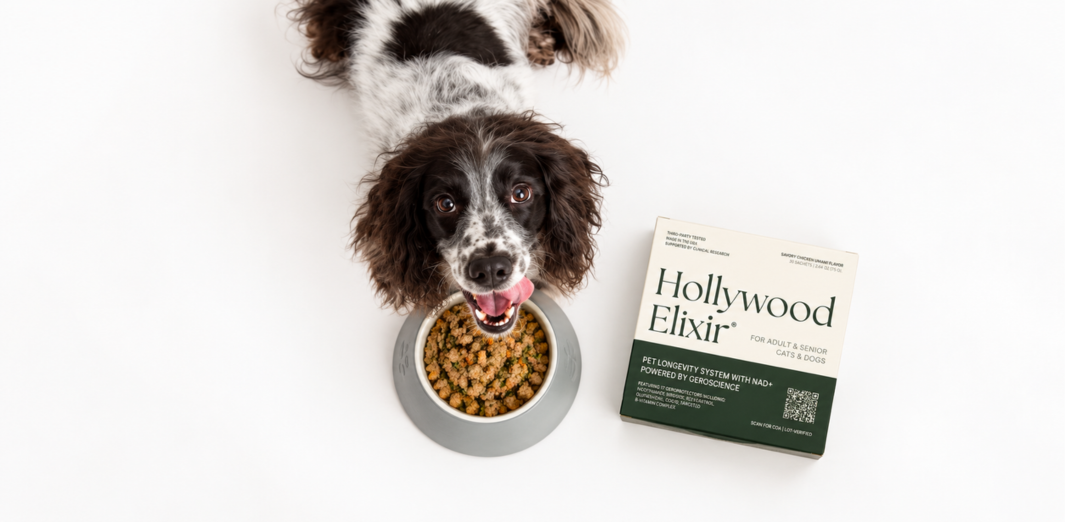
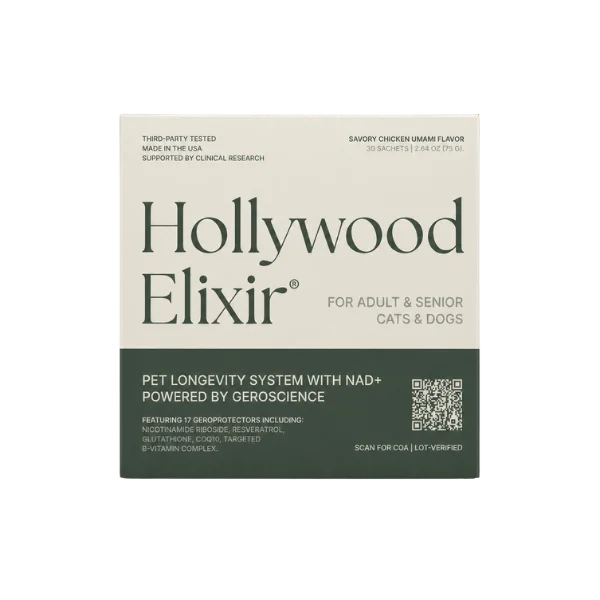
Hollywood Elixir™ is formulated to support normal aging biology pathways in senior dogs as part of a broader wellness plan.

Most older dogs don’t “need more stuff”—they need the right kind of support for the problem that is actually showing up at home. A senior multivitamin is built to cover nutrient gaps, while a longevity-style supplement is built around aging biology like NAD+ metabolism, mitochondrial function, and cellular senescence. That difference matters when the dog’s main change is stamina, recovery, or nighttime confusion rather than coat or appetite.

Owners often land here after reading a vetriscience senior 27 review, then seeing longevity products discussed in the same breath. The categories overlap in the sense that both are “for seniors,” but they are not interchangeable. Broad multis can be a sensible, affordable way to support normal function when the dog is aging smoothly and the goal is coverage. Aging-biology support is a different tool: it is chosen when the dog’s day-to-day feels less consistent—shorter walk tolerance, longer bounce-back, or more fragile sleep—after pain and medical causes are addressed.

This page lays out how to compare a senior dog multivitamin vs longevity supplement without trash talk, and without expecting any supplement to replace diagnostics. The most useful outcome is a calmer decision: pick one category, track a few observation signals over weeks, and bring a clear summary to the veterinarian if the dog is declining.

By La Petite Labs Editorial, ~15 min read

Featured Product:

  • A senior multivitamin is designed for broad nutrient coverage, while a longevity-style supplement targets aging biology (NAD+ metabolism, mitochondria, redox balance, senescence).
  • In many vetriscience senior 27 review threads, the appeal is convenience: many ingredients in one chew to support normal function across multiple areas.
  • The biggest “gap” is design intent—most multis are not built around NAD+ precursors or mitochondria-focused actives, even if the label is long.
  • Dose dilution can happen in multi-ingredient chews; counting ingredients is less useful than asking whether the formula can deliver meaningful amounts for its goal.
  • Quality and safety depend on manufacturing discipline and avoiding nutrient overlap; vitamin D intake changes blood levels, so stacking fortified products should be planned (Jewell, 2023).
  • Owners get the clearest answers by tracking walk tolerance, recovery time, sleep quality, and slips on floors over weeks, not days.
  • When comparing vetriscience vs hollywood elixir, start with a vet check for pain or disease if stamina, thirst, weight, or confusion is changing.

What Senior Dog Multivitamins Are Designed to Do

A senior dog multivitamin is built for coverage: it aims to fill small, everyday nutrient gaps that can add up as appetite, digestion, and activity change with age. The goal is not a single “target,” but a wide net—vitamins, minerals, and sometimes fatty acids that support normal body functions. This approach can make sense when the main concern is general maintenance and a little extra headroom for skin, coat, and immune function. It is also why many owners describe these products as “all-in-one,” even though they are not designed around aging biology.

At home, this looks like choosing a chew that fits into a daily routine: breakfast, a walk, then a supplement as a treat. Owners often notice the easiest-to-see signals first—coat texture, nail growth, and stool consistency—because those change quickly when a diet is slightly unbalanced. If the dog already eats a complete senior diet, the multivitamin role is usually “insurance,” not a dramatic change.

Mitochondria artwork highlighting longevity science connected to vetriscience vs hollywood elixir.

How Senior 27+ Formulas Approach Broad Coverage

In many vetriscience senior 27 review discussions, the product is described as a broad-spectrum senior chew with a “kitchen-sink” philosophy: many ingredients, each at modest amounts, intended to cover common aging-adjacent needs. That design can be practical for owners who want one product rather than separate chews for coat, joints, and digestion. It also reflects a multivitamin mindset—support normal function across multiple organs, rather than aiming at a specific aging mechanism.

In a household routine, broad formulas are easiest when the dog already accepts chews and the family wants a single “daily” item. The tradeoff is that dogs who are picky, have food sensitivities, or need a very narrow ingredient list may not do as well with a long label. A simple check is whether the dog’s stool, itchiness, or ear debris changes after starting any multi-ingredient chew.

DNA strand illustration representing antioxidant support pathways in vetriscience senior 27 review.

What a Longevity System Tries to Support Instead

A longevity-style supplement is organized around aging biology rather than nutrient coverage. The focus is typically on processes that shift with age—NAD+ metabolism, mitochondrial function, redox balance, and cellular senescence—because those changes can influence energy, recovery, and brain aging. This is a different “why” than a multivitamin: instead of asking, “What might be missing from the diet?” it asks, “Which age-linked pathways are becoming less resilient?”

At home, owners usually consider this category when the dog’s day-to-day feels more volatile: good mornings followed by wiped-out afternoons, longer bounce-back after play, or a new reluctance to climb stairs. These are not diagnoses, but they are the kinds of observation signals that make owners compare a senior dog multivitamin vs longevity supplement. The practical difference is that the “success” markers are often energy and recovery patterns, not just coat shine.

Structural biology image symbolizing ingredient integrity supported by vetriscience senior 27 review.

Where Multivitamins Usually Cannot Reach

The coverage gap is real: most senior multivitamins are not built to deliver NAD+ precursors, mitochondria-targeted antioxidants, or ingredients chosen specifically for senescence-associated signaling. That does not make them “bad”—it means they were designed for a different job. When owners compare vetriscience vs hollywood elixir, the key is to compare the design goal: broad nutrient support versus aging-biology support.

A common misconception is that “more ingredients” automatically equals “more anti-aging.” In practice, a long label can still miss the specific actives that geroscience-focused products prioritize. A useful kitchen-table test is to separate what is easy to recognize (vitamins, minerals, fish oil) from what is meant to influence aging pathways (NAD+ related ingredients, mitochondrial cofactors), then ask which category matches the dog’s current needs.

Close-up of a pug highlighting comfort and well-being supported by vetriscience vs hollywood elixir.

Why Multi-ingredient Chews Can Dilute Doses

Formulation economics matter because a chew can only hold so much. When a product includes dozens of ingredients, each one often lands at a smaller amount, which may be appropriate for vitamins but less meaningful for certain specialty actives. This is one reason “best senior dog supplement comparison” charts can be misleading: they count ingredients instead of asking whether the formula can realistically deliver functional amounts for the intended purpose.

Owners can spot dose dilution indirectly by looking at how many separate goals a single chew claims to cover and how small the serving size is. If the dog needs targeted support—like mobility plus cognitive aging—splitting the plan into fewer, more focused products can sometimes be easier to evaluate. The household reality is that fewer moving parts often makes it simpler to notice what changed over days and weeks.

Hollywood Elixir™ is amazing and makes my 13 y/o young again!

— Jessie

We go on runs. Lately he's been keeping up with no problem!

— Cami

“A long label can still miss the pathways owners care about most.”

Quality and Safety Signals That Actually Matter

Quality signals are less about the label’s promises and more about manufacturing discipline: clear ingredient amounts, lot tracking, and stability testing. For vitamins, safety is also about not stacking too many fortified items at once, especially fat-soluble vitamins. In adult dogs, increasing dietary vitamin D predictably raises circulating vitamin D, and a controlled study reported no observable adverse effects at the tested intake range, underscoring that “more” still changes blood levels and should be planned thoughtfully (Jewell, 2023).

At home, the practical move is to list everything the dog gets in a week: senior kibble, dental chews, fish oil, joint chews, and any multivitamin. This prevents accidental piling-on of similar nutrients from multiple products. If a dog is on a therapeutic diet, it is especially important to ask the veterinarian whether adding a multivitamin changes the intended nutrient balance.

Weimaraner portrait reflecting poise and wellness support tied to senior dog multivitamin vs longevity supplement.

Compliance: Chews Versus Powders in Real Homes

Compliance is a hidden driver of results. Chews and tablets are convenient, but they can be inconsistent if the dog starts “sorting” them out of food or if multiple family members double-dose by accident. Powders or sachets can be more precise, but only if the dog reliably eats the full meal. The right format is the one that produces a smoother, more consistent daily intake.

A simple household rule helps: one person owns the supplement routine, and the container lives next to the measuring cup. If the dog is picky, mixing into a small “starter bite” first can prevent wasted product in the bottom of the bowl. Owners should also watch for new food aversion; if the dog refuses meals after a new powder is added, the plan needs adjustment rather than a standoff.

Profile dog image reflecting natural poise supported by vetriscience vs hollywood elixir.

When a Senior Multivitamin Makes the Most Sense

A senior multivitamin often makes the most sense in early aging: the dog is still active, lab work is stable, and the goal is general maintenance. It can also be reasonable for dogs with mild appetite variability or for households that rotate foods and want nutritional “backup.” This is the context where a vetriscience senior 27 review tends to read positively—owners value convenience, affordability, and broad coverage.

What owners might notice is subtle: a coat that looks less dry, nails that chip less, or fewer “off” days after a long walk. The key is to avoid expecting a multivitamin to act like a pain reliever or a cognitive medication. If the dog’s main issue is stiffness, confusion, or major energy loss, those deserve a targeted conversation rather than a bigger multivitamin.

Supplement breakdown graphic emphasizing no fillers approach within vetriscience senior 27 review.

When Aging-biology Support Becomes More Relevant

Aging-biology support becomes more relevant when the dog’s “capacity” feels smaller: shorter play windows, slower bounce-back, and a more fragile routine. Owners often describe this as the dog “running out of gas” sooner, even when weight and appetite look normal. This is where the senior dog multivitamin vs longevity supplement question is most practical, because the goal shifts from coverage to resilience.

CASE VIGNETTE: A 12-year-old Labrador still begs for walks, but after 15 minutes he lags behind and sleeps hard for the rest of the day. The family tries a senior chew and sees no change in stamina, but they do notice the coat looks nicer. That pattern suggests the dog may need a more targeted plan for energy and recovery, plus a veterinary check for pain, thyroid disease, or heart issues.

Using Both Categories Without Creating Overlap

Some dogs use both categories, but the plan should be intentional. A multivitamin can cover baseline nutrients while a longevity-style product focuses on aging pathways, yet stacking products can also create unnecessary overlap. For example, vitamin D is not “just a vitamin”—supplementation can influence measurable physiology, and in healthy dogs vitamin D3 supplementation has been studied for effects on thyroid-related measures, highlighting why add-ons should be discussed rather than guessed (Hashemi, 2025).

At home, the safest approach is to add only one new product at a time and keep the rest stable for several weeks. If both are used, give them with food and keep a written schedule on the fridge to prevent double-dosing. If the dog has kidney disease, heart disease, or is on prescription medications, the veterinarian should review the full supplement list before anything new is added.

“Track walk time and recovery, not just seems better.”

Clinical branding image reflecting trust and validation behind vetriscience vs hollywood elixir.

Owner Checklist: Coverage Needs Versus Aging-pathway Needs

OWNER CHECKLIST: before choosing between a multivitamin and aging-biology support, check (1) whether the dog is already on a fortified senior diet, (2) whether appetite or stool has changed in the last month, (3) whether walks are shorter or recovery takes longer, (4) whether nighttime pacing or new confusion is appearing, and (5) whether stiffness is worse after rest. These signals help separate “coverage” needs from “aging pathway” concerns.

If the checklist points mostly to coat, nails, or mild digestive inconsistency, a senior multi may be a reasonable first step. If it points to stamina, cognition, or recovery, it is time to think about pain control, screening labs, and whether a longevity-style approach is appropriate. Either way, the best plan is the one that matches what is actually happening in the living room, not what sounds impressive on a label.

Shop Now
Ingredients around product reflecting antioxidant support within vetriscience senior 27 review.

What to Track over Weeks, Not Days

WHAT TO TRACK: pick a few markers and write them down weekly—(1) minutes of comfortable walking before slowing, (2) time to settle after activity, (3) number of slips on floors, (4) nighttime rest quality, (5) interest in play, and (6) stool consistency. These are more sensitive than “seems better,” and they help a veterinarian interpret whether a change is real or just a good week.

Tracking also prevents the common trap of changing three things at once: new food, new supplement, and new exercise plan. If the dog’s mobility is a major concern, owners may also explore joint-focused options; nutraceutical research in canine osteoarthritis suggests some supplements can support comfort and function, but results vary by formula and study design (Barbeau-Grégoire, 2022). The point is not to chase every product, but to measure what matters.

Shop Now
Home scene with woman and dog featuring Hollywood Elixir and best senior dog supplement comparison.

A Common Misconception That Delays Real Help

A unique misunderstanding in best senior dog supplement comparison threads is the idea that a “longevity” product should replace basics like protein quality, dental care, and pain management. Aging biology support is not a substitute for diagnosing arthritis, heart disease, or endocrine disease. For example, dogs with Cushing’s syndrome can show panting, muscle loss, and a pot-bellied look; outcomes depend on medical management and monitoring, not supplements alone (Shanlly, 2025).

At home, the red flags are patterns that keep progressing despite routine changes: increasing thirst, accidents in the house, dramatic hair thinning, or a belly that looks larger while the back legs look weaker. Those signs should trigger a veterinary visit before any new supplement plan. Supplements can be part of a supportive routine, but they should not delay basic diagnostics when the body is sending loud signals.

Shop Now

How to Prepare for a Vet Visit About Supplements

VET VISIT PREP: bring a short log and ask (1) “Is pain likely driving the energy drop, or does this look systemic?”, (2) “Which labs would you screen first for an older dog with slower recovery?”, (3) “Is my dog’s diet already complete enough that a multivitamin is redundant?”, and (4) “Are any of these ingredients a concern with current medications?” These questions keep the visit focused on decision-making rather than guessing.

Also bring the actual containers or photos of labels, including treats and dental chews. Many supplement interactions are not dramatic, but overlap can matter, and the veterinarian can only evaluate what is disclosed. If the dog has arthritis signs, ask whether a targeted mobility plan is needed; a randomized controlled trial in dogs with osteoarthritis found a specific dietary supplement supported clinical outcomes compared with placebo, illustrating why formula-specific evidence matters more than category claims (Martello, 2022).

What Not to Do When Building a Senior Supplement Plan

WHAT NOT TO DO: (1) do not start a multivitamin, a joint chew, and a longevity product in the same week, (2) do not “double up” because the dog seems older than the label’s age range, (3) do not ignore calories—chews add up quickly in small dogs, and (4) do not use human longevity products without veterinary guidance. These mistakes create noise and can make the dog’s routine more volatile.

Another common misstep is using supplements to avoid addressing the basics: slippery floors, weak rear legs, and poor sleep. Simple home changes—rugs, a ramp, a consistent bedtime, and shorter but more frequent walks—often create more comfort than any pill. Supplements should sit on top of a stable routine, not try to replace it.

Side-by-side chart contrasting bioactives and fillers relative to best senior dog supplement comparison.

Translating Labels into Biology You Can Observe

When owners read a vetriscience senior 27 review and then look at geroscience-oriented products, it helps to translate the marketing into biology. Multivitamins mostly support “inputs” (nutrients), while longevity formulas often aim at “processes” (how cells make energy, handle oxidative byproducts, and respond to age-related stress). That difference is why two products can both be reasonable yet feel very different in what owners notice.

In the home, the most meaningful question is: what is the dog’s limiting factor right now? If the limiting factor is picky eating or mild digestive inconsistency, coverage may be enough. If the limiting factor is recovery, stamina, or cognitive aging, a targeted plan—often including pain control, exercise adjustment, and possibly aging-biology support—tends to match the problem more closely.

Shop Now
Supplement box revealed in soft light, reflecting premium vetriscience senior 27 review positioning.

A Decision Framework for Choosing the Right Category

A practical decision framework for a senior dog multivitamin vs longevity supplement starts with three buckets: diet quality, symptom pattern, and risk. Diet quality asks whether the base food is complete and whether treats are crowding out nutrition. Symptom pattern asks whether the issue is mostly “surface” (coat, stool) or “performance” (energy, recovery, cognition). Risk asks about kidney disease, heart disease, endocrine disease, and medications that make any add-on more complicated.

Owners comparing vetriscience vs hollywood elixir can then make a calmer choice: pick the category that matches the bucket that is most strained. If the dog is stable and the household wants convenience, a multi can be reasonable. If the dog’s aging signs are more about bounce-back and brain-body stamina, aging-biology support may fit better—after a veterinarian rules out treatable medical causes.

Shop Now

Coverage Versus Mechanism: the Takeaway

The cleanest summary is “coverage versus mechanism.” Senior multivitamins are designed to support normal function broadly, especially when diet gaps or mild age-related changes are the main concern. Longevity-style formulas are designed around aging biology—NAD+ metabolism, mitochondrial function, antioxidant networks, and cellular senescence—because those processes can shape how an older dog feels day to day.

For owners, the best senior dog supplement comparison is the one grounded in observation signals: what changed, when it changed, and what the dog can no longer do comfortably. Start with one product, track a few markers, and keep the veterinarian in the loop—especially if the dog is losing weight, drinking more, coughing, or showing confusion. The goal is a smoother routine and more reliable bounce-back, not chasing a perfect label.

“Coverage and mechanism are different jobs, not competing virtues.”

Educational content only. This material is not a substitute for veterinary advice. Always consult your veterinarian about your dog’s specific needs. These statements have not been evaluated by the Food and Drug Administration. Products mentioned are not intended to diagnose, treat, cure, or prevent any disease.

Glossary

  • NAD+ metabolism - The body’s system for maintaining a coenzyme used in cellular energy and repair reactions.
  • Mitochondrial function - How cells generate usable energy; often linked to stamina and recovery patterns.
  • Redox balance - The balance between oxidative byproducts and antioxidant defenses in tissues.
  • Cellular senescence - A state where older cells stop dividing and can influence tissue signaling over time.
  • Dose dilution - When many ingredients share limited space, leaving smaller amounts of each per serving.
  • Fortified diet - A complete pet food formulated to meet nutrient requirements without extra vitamins.
  • Observation signals - Home-visible changes (sleep, walking time, appetite) used to judge whether a plan is helping.
  • Overlap stacking - Using multiple products that repeat similar nutrients, increasing complexity and risk.

Related Reading

References

Shanlly. Effectiveness of Medical Treatment on Survivability in Canine Cushing's Syndrome: A Systematic Review and Meta-Analysis.. PubMed. 2025. https://pubmed.ncbi.nlm.nih.gov/41153881/

Martello. Efficacy of a dietary supplement in dogs with osteoarthritis: A randomized placebo-controlled, double-blind clinical trial.. PubMed. 2022. https://pubmed.ncbi.nlm.nih.gov/35171954/

Barbeau-Grégoire. A 2022 Systematic Review and Meta-Analysis of Enriched Therapeutic Diets and Nutraceuticals in Canine and Feline Osteoarthritis.. PubMed Central. 2022. https://pmc.ncbi.nlm.nih.gov/articles/PMC9499673/

Jewell. Increased dietary vitamin D was associated with increased circulating vitamin D with no observable adverse effects in adult dogs.. PubMed Central. 2023. https://pmc.ncbi.nlm.nih.gov/articles/PMC10445235/

Hashemi. Effect of vitamin D3 supplementation on thyroid function of clinically healthy dogs.. PubMed Central. 2025. https://pmc.ncbi.nlm.nih.gov/articles/PMC12549265/

FAQ

What is the real difference between a senior multi and longevity?

A senior multivitamin is mainly about coverage—filling small nutrient gaps that can happen as dogs age. A longevity-style supplement is mainly about processes that shift with age, such as NAD+ metabolism, mitochondrial function, and cellular stress responses.

In a senior dog multivitamin vs longevity supplement decision, the best match depends on what is changing at home: coat and stool changes often fit “coverage,” while stamina, recovery, and cognitive aging often fit “process” support.

Is a senior multivitamin necessary if my dog eats senior kibble?

Often, no. Many senior diets are already complete and fortified, so a multivitamin may be redundant. The more complete the base diet, the more a multi becomes “insurance” rather than a need.

A better question is whether the dog is actually getting that diet consistently (not too many treats, not skipping meals) and whether there are signs of a specific problem like pain, confusion, or major energy loss that a multivitamin is unlikely to address.

What does “aging biology support” mean in plain language?

It means supporting the way cells handle energy and wear-and-tear as a dog gets older. Instead of focusing on vitamins that might be missing, it focuses on how the body’s “engines” and repair signals change with age.

At home, owners usually think about this when the dog’s routine feels less consistent—shorter play windows, longer recovery after activity, or more nighttime restlessness—after pain and medical causes have been checked.

How long should it take to notice any change?

Most supplement changes, if they happen, are gradual. Coat and stool changes may show up sooner than stamina or recovery patterns, which often need weeks of consistent routine to judge.

To avoid guesswork, track a few markers weekly: minutes of comfortable walking, time to settle after activity, nighttime sleep quality, and slips on floors. If nothing is changing after a fair trial, the plan may need to be simplified or redirected with a veterinarian.

Can my dog take a multivitamin and a longevity supplement together?

Sometimes, but it should be intentional. The main risk is overlap—multiple products repeating similar vitamins, minerals, or oils—without a clear reason.

Add only one new product at a time, keep the rest stable, and share the full list with the veterinarian. Vitamin D is a good example of why stacking matters: dietary vitamin D changes circulating vitamin D levels, so “extra” is not neutral(Jewell, 2023).

What side effects should owners watch for with senior supplements?

The most common issues are digestive: softer stool, gas, or reduced appetite, especially when a new chew is rich or a powder changes food smell. Some dogs also develop itchiness or ear debris if a new product doesn’t agree with them.

Stop the new product and call the veterinarian if vomiting, diarrhea, marked lethargy, facial swelling, or hives occur. For milder changes, a slower introduction and a simpler ingredient list are often the next step.

Are longevity supplements safe for dogs with kidney disease?

Kidney disease changes how cautious owners should be with any supplement, because hydration, appetite, and electrolyte balance can be fragile. Even “natural” ingredients can be inappropriate depending on the dog’s stage and medications.

The safest move is to bring the exact product label to the veterinarian and ask whether any ingredients overlap with the kidney diet or could worsen nausea. If appetite is already inconsistent, adding powders can also backfire by creating food aversion.

Does a longer ingredient list mean a better senior supplement?

Not necessarily. A long label can mean broad coverage, but it can also mean smaller amounts of each ingredient. That may be fine for vitamins, but it can be less meaningful for specialty actives that need more deliberate dosing.

A better quality signal is transparency: clear amounts, consistent serving instructions, and a manufacturer that can answer questions about testing and lot tracking. Owners should also consider whether the dog needs “coverage” or a more targeted goal.

What should be tracked to compare products fairly at home?

Pick markers that match the concern. For mobility and aging, useful signals include walk duration before slowing, time to settle after activity, ability to rise from bed, and number of slips on smooth floors.

For brain aging, track nighttime pacing, getting “stuck” in corners, and responsiveness to familiar cues. Write the results weekly, not daily, and avoid changing food, exercise, and supplements all at once.

How does this relate to a vetriscience senior 27 review online?

Many vetriscience senior 27 review posts reflect what multis do well: convenience, broad coverage, and an easy daily chew. Those are valid strengths when the goal is general maintenance.

The limitation is that reviews often mix different problems together—coat, stool, arthritis, and cognition—so expectations can drift. Owners get clearer answers by matching the category to the dog’s main limiting factor and tracking a few markers over weeks.

What quality signals matter most when choosing a supplement brand?

Look for clear ingredient amounts, a consistent serving guide, and a company that can explain where ingredients are sourced and how batches are tracked. Avoid products that hide behind “proprietary blends” when the goal is to compare formulas.

Also consider stability and storage: chews can dry out, oils can go rancid, and powders can clump if exposed to humidity. If the product’s smell changes over time, replace it and store the next container more carefully.

Is this comparison mainly about joints or mainly about cognition?

Most owners end up here because of two practical concerns: mobility and brain aging. Both can show up as “slowing down,” but they look different at home—stiffness after rest points more toward pain, while disorientation and nighttime pacing point more toward cognitive aging.

A senior multivitamin may support general wellness, but it is not a substitute for diagnosing arthritis or cognitive dysfunction. If either is suspected, a veterinarian can help build a plan that may include targeted supplements, exercise changes, and medications when appropriate.

Can supplements replace arthritis medications in older dogs?

No. Supplements can be part of a mobility plan, but they should not replace pain control when a dog is uncomfortable. Untreated pain can shrink activity, weaken muscles, and make aging feel much faster.

Some nutraceuticals have clinical trial data in canine osteoarthritis, but results are formula-specific and not guaranteed(Martello, 2022). If a dog is limping, struggling to rise, or avoiding stairs, a veterinary exam is the priority before adjusting supplements.

What’s the biggest misconception in a best senior dog supplement comparison?

The biggest misconception is that the “best” product is the one with the most claims or the longest ingredient list. That approach ignores whether the dog needs nutrient coverage, targeted mobility support, or aging-biology support.

A better comparison starts with the dog’s limiting factor and a short tracking plan. If thirst, pot-bellied appearance, hair loss, or muscle wasting is appearing, supplements should not delay diagnostics for endocrine disease such as Cushing’s syndrome(Shanlly, 2025).

How should supplements be introduced to avoid stomach upset?

Introduce one product at a time and start with a partial amount for several days if the label allows. Give it with food and keep the rest of the diet stable so any change is easier to interpret.

If the dog is sensitive, avoid mixing a new powder into the full meal at first; use a small “test bite” so the dog doesn’t learn to refuse the whole bowl. If vomiting or diarrhea occurs, stop and contact the veterinarian.

Do small dogs and large dogs need different supplement strategies?

Yes, mostly because of calories, chew size, and how quickly extra treats add up. A large dog may tolerate the added calories from chews more easily, while a small dog can gain weight quickly from “supplement treats.”

Small dogs also tend to have more dental crowding, so chew texture matters. For any size, the best strategy is the one the household can deliver consistently without double-dosing or turning meals into a negotiation.

Are these products appropriate for cats as well as dogs?

This page is focused on dogs. Cats have different nutrient requirements and are more sensitive to certain ingredients, so a dog supplement should not be assumed safe or appropriate for cats.

If a cat is aging, the safest path is a cat-specific product and a veterinarian’s guidance, especially because appetite changes and weight loss in older cats can signal significant disease. Always confirm species labeling before giving any supplement.

When should a vet be called before starting a new supplement?

Call first if the dog has kidney disease, heart disease, liver disease, diabetes, or is taking prescription medications. Also call if there are big changes in thirst, urination, weight, coughing, collapse, or confusion.

These signs can indicate problems that need diagnosis and treatment, not trial supplements. Bringing a short log of symptoms and a photo of the product label helps the veterinarian quickly assess safety and whether the plan matches the dog’s current needs.

How does Hollywood Elixir™ fit into aging-biology support?

Hollywood Elixir™ is positioned as an aging-biology support option, meaning it is designed to support normal cellular processes that tend to shift with age, rather than acting like a broad multivitamin.

For owners comparing categories, it can be viewed as part of a plan focused on stamina, recovery, and cognitive aging—after pain and medical causes are addressed. Product details and serving guidance are available at Hollywood Elixir™.

What’s a sensible way to decide between vetriscience vs hollywood elixir?

Start with the dog’s limiting factor. If the concern is general maintenance, picky eating, or mild coat/stool changes, a senior multivitamin approach may fit. If the concern is recovery, stamina, or cognitive aging, an aging-biology support approach may fit better.

Then reduce noise: change one thing at a time, track a few markers weekly, and keep the veterinarian involved. If choosing an aging-biology product such as Hollywood Elixir™, treat it as supportive care, not a replacement for diagnosing pain or disease.

5K+ Happy Pet Parents

Excellent 4.8

A Senior Multivitamin Vs a Longevity System: How Senior 27+ Formulas Differ from Aging-biology Support | Why Thousands of Pup Parents Trust Hollywood Elixir™

"He seems more happy overall. I've also noticed he has more energy which makes our walks and playtime so much more fun."

Olga & Jordan

"He's got way more energy now! We go on runs pretty often; he use to get tired halfway through, but lately, he's been keeping up without any problem."

Cami & Clifford

"I want her to live forever. She hasn't had an ear infection since!"

Madison & Azula

"It helps with her calmness, her immune system. I really like the clean ingredients. Highly recommend La Petite Labs!"

Maple & Cassidy

"He seems more happy overall. I've also noticed he has more energy which makes our walks and playtime so much more fun."

Olga & Jordan

"He's got way more energy now! We go on runs pretty often; he use to get tired halfway through, but lately, he's been keeping up without any problem."

Cami & Clifford

"I want her to live forever. She hasn't had an ear infection since!"

Madison & Azula

"It helps with her calmness, her immune system. I really like the clean ingredients. Highly recommend La Petite Labs!"

Maple & Cassidy

"He seems more happy overall. I've also noticed he has more energy which makes our walks and playtime so much more fun."

Olga & Jordan

"He's got way more energy now! We go on runs pretty often; he use to get tired halfway through, but lately, he's been keeping up without any problem."

Cami & Clifford

"I want her to live forever. She hasn't had an ear infection since!"

Madison & Azula

"It helps with her calmness, her immune system. I really like the clean ingredients. Highly recommend La Petite Labs!"

Maple & Cassidy

"He seems more happy overall. I've also noticed he has more energy which makes our walks and playtime so much more fun."

Olga & Jordan

"He's got way more energy now! We go on runs pretty often; he use to get tired halfway through, but lately, he's been keeping up without any problem."

Cami & Clifford

"I want her to live forever. She hasn't had an ear infection since!"

Madison & Azula

"It helps with her calmness, her immune system. I really like the clean ingredients. Highly recommend La Petite Labs!"

Maple & Cassidy

SHOP NOW