





5 Coat Warning Signs of Illness in Dogs & Cats
Read full insightThe Soft Chew Economy: What’s Really Inside the Pet Aisle’s Favorite Format
By La Petite Labs Editorial 11 min read
As Seen On

15 science-backed barrier actives
Contents +
The Soft Chew Economy: What’s Really Inside the Pet Aisle’s Favorite Format
People turned their vitamins into gummies. Dogs got soft chews. Weigh one and read its inactive ingredients, and a different picture emerges of what you are buying.
Somewhere in the last decade, taking vitamins stopped feeling like medicine. Gummies did it. Bright, chewable and faintly like candy, they became the top-selling supplement format in the US, with 24.6% of sales, according to Nutrition Business Journal.24 Adults who never finished a bottle of tablets found they could remember a gummy.
The pet aisle has its own gummy, and it is even more dominant: the soft chew. It won because it feels like a treat. The question is what a chew has to contain to be a chew.
Soft chews are 29% of pet supplements and 42% of those made only for dogs. In chews that print both weights, active ingredients make up a median of 14% of the chew; the rest is the base that makes it soft, tasty and stable.
Price per day barely differs by format. What differs is how much of each serving is the supplement, how many other ingredients come with it, and whether a cat will eat it at all.
Soft Chews Are 29% of Pet Supplements
Nearly a third of pet supplements are soft chews: 29% of the census, ahead of powders (22.5%) and liquids or drops (13%). For dogs, the lead is larger still: 42% of dog-only supplements are soft chews.1
It is easy to see why. A chew looks like a treat, a dog takes it from a hand, and nothing needs measuring. For owners, a supplement becomes a moment of affection rather than a chore. For brands, a chew photographs beautifully and fits the language of rewards.
In the Median Chew, 14% Is Active Ingredient
Some chews print two weights: the chew itself, and the active ingredients inside it. Among the 39 that print both, the active ingredients make up a median of 14% of the chew, with the middle half ranging from 6% to 22%.1
The Median Chew Weighs 3 Grams
The median soft chew weighs about 3 grams.1 That is the space every active ingredient has to share with the base, which is why the size of a chew, or the number in a jar, says little about how much supplement a pet gets.
93% of Soft Chews Contain Glycerin
Of the 318 soft chews that list their inactive ingredients, 93% include glycerin, which keeps a chew soft. 78% list an ingredient added for taste, such as liver powder, chicken broth or brewer’s yeast, and 64% also list a flavoring, such as “natural bacon flavor”.1
13 Inactive Ingredients, Against 2 in a Powder
The median soft chew lists 13 inactive ingredients. The median powder lists 2.1 Starches, flours and oils give a chew its shape and texture. None of that is a hidden trick; it is how a powder becomes something a dog will eat from a hand.
In the median soft chew, about one-seventh of the weight is the active ingredients. The rest is what makes it a chew.
Less Room for Each Active
A small chew can only hold so much, and the more ingredients a formula lists, the smaller each one’s share tends to be. Across the census, the median printed amount per ingredient falls from 200 mg in formulas with up to five active ingredients to 36 mg in formulas with 11 or more, where a third of ingredients are printed at under 10 mg.1
A long ingredient list on a small chew is worth reading twice: it can mean breadth, or it can mean a little of a lot.
Big Dogs Often Need Several Chews a Day
Larger dogs often need two or more chews a day to reach the label amount. Check the weight chart before comparing prices: two chews a day halves how long a jar lasts.
The Inactive List Is Part of the Diet
For a dog with a food sensitivity, chicken broth, liver, yeast or wheat flour in a daily chew can matter as much as the active ingredients. A supplement given every day is part of a pet’s diet, and its base counts toward the foods a dog eats.
Chewable Formats Make Amounts Harder to Control
Human gummies carry a known catch. Independent testing by ConsumerLab has found gummies to be the supplement form most likely to contain more of an ingredient than the label lists, because heat, moisture and the gummy base make amounts harder to control.3 The convenience is real. So is the engineering it takes to turn a nutrient into a treat.
Same Price Per Day, Different Supplement Per Serving
Format barely changes what a supplement costs to give. At the label’s daily amount for a 50-lb dog, the median price per day runs from $0.94 for soft chews to $1.02 for capsules and tablets, $1.07 for powders and $1.24 for functional treats and toppers.1
What differs is what each daily serving contains. In a chew, much of what you pay to give is the chew. In a powder, more of the serving is the supplement. Neither is wrong. They are different products that share a shelf and a price.
Same price per day. Different supplement per serving.
DVM Voice: Clinical Vignette of When Skin Changes Point Deeper Than the Surface
Case contributed by Sarah Calvin, DVM
Rosey, a 10-year-old Shih Tzu, was brought in after two weeks of paw redness and head shaking. Her owner had also noticed lower energy, thinning abdominal hair, and mild generalized itchiness over the previous few months.
Examination showed inflammation in the ears, skin folds, and paws. Testing confirmed mixed yeast and bacterial infections, while parasites and fungal disease were ruled out. Because Rosey’s skin changes appeared alongside reduced energy and coat thinning, her veterinarian performed a broader workup, which revealed hypothyroidism as a likely underlying contributor.
Her care required a staged approach: treating the infections, addressing the thyroid imbalance, and then restoring the skin barrier through diet, bathing support, paw care, and omega-3 supplementation.
Six months later, Rosey’s owner reported a thicker coat, fewer tangles, less breakage, no itch, and restored energy.
Clinical takeaway: Rosey’s case shows why skin and coat changes should not be treated as cosmetic alone. Healthy skin depends on immune balance, endocrine health, nutrition, barrier integrity, and daily support for resilient coat growth.
Single-case vignette. Not generalizable. Veterinary diagnosis and oversight are essential for itching, redness, ear irritation, hair thinning, recurrent infections, or suspected endocrine disease.
Only 22% of Cat-Only Supplements Are Chews
Cats are the format’s toughest critics. Only 22% of cat-only supplements are soft chews, while 29% are powders.1
Cats Refuse Supplements Far More Often Than Dogs
In customer reviews that say whether a pet ate the supplement, 14% of cat owners report a refusal, against 2% of dog owners.1 For cat owners, format isn’t about convenience. It decides whether the supplement gets eaten at all.
A Powder Disappears Into a Meal
A powder can be stirred into a food a pet already trusts, in an amount that can be split by body weight. A chew has to win on its own, and many cats, and some dogs, decline it.
What to Look For in Any Format
- The amount of each active, not the number of actives. Twelve ingredients at a few milligrams each is not more than four at a meaningful amount.
- How many servings make a day for your pet’s weight.
- The inactive ingredients, especially for a pet with food sensitivities.
- For cats, a food-mixed format. A powder or liquid in a familiar meal is the likeliest to be eaten.
Format Is a Trade-Off, Not a Verdict
A soft chew that a dog loves, given every day, can be a better choice than a powder that ends up in the cupboard. The point of weighing the chew isn’t to rule the format out. It is to know what you are paying for, and to compare the supplement inside rather than the treat around it.
Why La Petite Labs Chose Powder
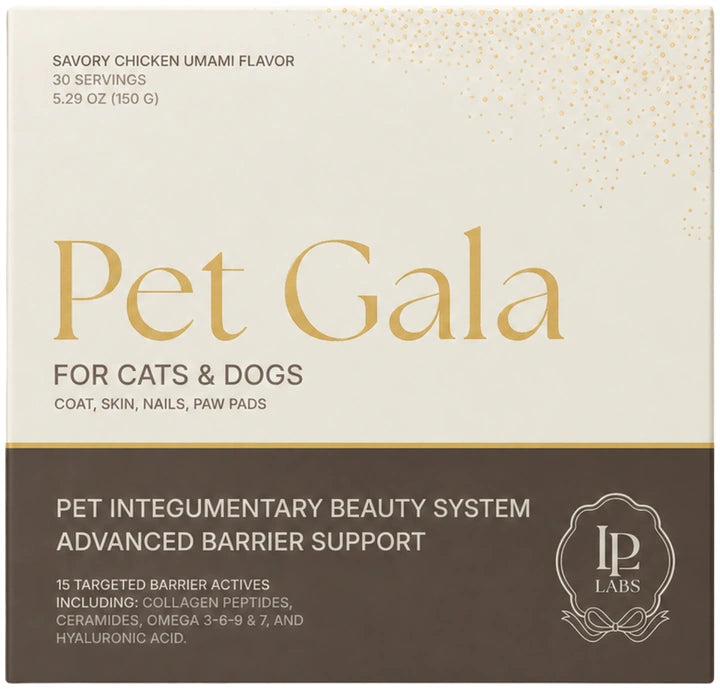
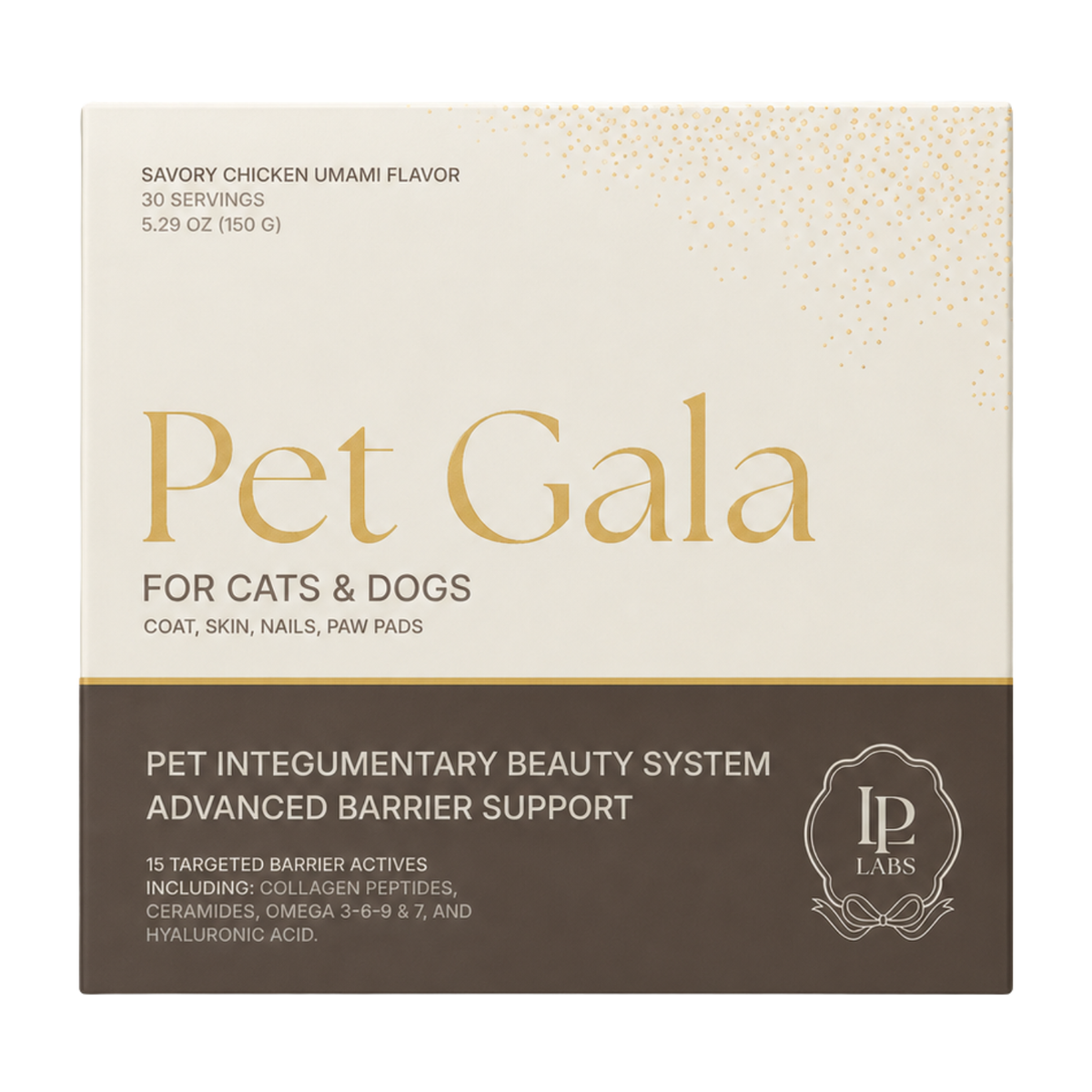
La Petite Labs sells powders, not soft chews, so we have an interest in this comparison, and our products are excluded from the census. Without a chew base to hold together, more of each serving can be formula: in a 2.5 g Hollywood Elixir® sachet, the 17 actives weigh about a quarter of the serving, and in Pet Gala™ more than half, against a median of 14% for soft chews that print both weights.
Our Palatants, Disclosed
A supplement only works if it’s eaten, so we still use a small flavor system: chicken flavor, chicken liver powder and yeast extract, with glycine and a cyclodextrin, five inactive ingredients in all, printed on every label. If your pet has a chicken or yeast sensitivity, the advice above applies to us too.
Read the Weight, Not the Shape
Gummies taught people that a supplement could feel like a treat. Soft chews taught dogs the same thing. The next step for both is a label that tells owners, plainly, how much of each serving is the supplement. Until then, the weight chart, the actives panel and the inactive list are the three places to look.
Compare the supplement inside, not the treat around it.
Educational content only. This material is not a substitute for veterinary advice. Always consult your veterinarian about your dog’s specific needs. These statements have not been evaluated by the Food and Drug Administration. Products mentioned are not intended to diagnose, treat, cure, or prevent any disease.
Glossary
Soft chew: A chewable, treat-like supplement held together by a base such as glycerin, starches and flavorings.
Active ingredient: An ingredient included for its intended nutritional role, as opposed to texture, taste or shelf life.
Inactive ingredient: An ingredient that forms the base, flavor or preservation system of a supplement.
Palatant: An ingredient added to make a supplement taste appealing to a pet.
Glycerin: A sweet-tasting liquid that keeps soft chews moist and pliable.
Related Reading
Common Canine Integumentary Issues
• Hot Spots on Dogs
• Dog Licking Paws
• Dog Itch Relief
• Dog Skin Allergies
• Dog Dandruff
Comfort & Recovery
• Skin & Coat Supplements for Dogs
• Coat Growth Supplement for Dogs
• Dog Nail Supplement
Ingredient-Level Articles
• Biotin for Dogs
• Silica for Dogs
• Hyaluronic Acid for Dogs
• Ceramides for Dogs
References
Numbered references identify the sources used for specific claims. Read the study design, species and evidence boundaries alongside each finding.
-
[1]
La Petite Labs Research. Pet Supplement Statistics (2026 edition). La Petite Labs · 2026Study design/context: Census of 2,865 supplements; 318 soft chews and 122 powders with inactive lists; 39 chews with both weightsSpecies/context: dog, catEvidence boundary: Public product information; not product safety or efficacy.
-
[2]
Nutraceuticals World. Nutrition Business Journal data on supplement delivery formats. Nutraceuticals World · 2026
-
[3]
ConsumerLab. Multivitamin and multimineral supplements review: gummies most likely to exceed label amounts. ConsumerLab · 2020
-
[4]
New Hope Network. Analyst’s take: gummies are the most popular supplement format. New Hope Network · 2025
FAQ
Discover LPL-01: How This Fits Into a Complete Canine Integumentary Support System
Skin, coat, and nails aren’t cosmetic features. They’re the visible surface of deeper biological systems—barrier function, hydration balance, structural protein turnover, and lipid integrity—working in concert.
When these systems fall out of sync, it shows: dull coat, shedding, dryness, brittleness, sensitivity.
This article explores one piece of that puzzle. If you want to understand how true coat quality and skin resilience are built—and what actually moves the needle—you need to zoom out.
Start with the underlying science:
- Canine Skin & Coat Framework →
A structured view of how skin, coat, and nail health are maintained across collagen synthesis, lipid balance, and barrier function. - Barrier Protection Coverage Modeling →
A systems-level map of which integumentary pathways are most vulnerable—and how layered nutritional inputs can support them. - 2026 Market Research: Best Dog Skin & Coat Supplements →
A category review of dog formulas for coat quality, skin barrier support, fatty acid balance, collagen support, shedding, and visible beauty. - LPL-01 Standard →
The formulation system that translates these models into real-world supplementation—covering multiple pathways in a coordinated way.
Keep exploring
What would you like to understand next?
Search practical guides about skin, coat, barrier health, ingredients, and daily care for dogs.
Essential Summary
How much of a soft chew is the supplement?
In soft chews that print both weights, the active ingredients make up a median of 14% of a roughly 3 g chew.
The median chew lists 13 inactive ingredients, including glycerin and taste ingredients; the median powder lists 2. Price per day is similar across formats.
Compare the amount of each active ingredient per day for your pet’s weight, and read the inactive list for food sensitivities.

Pet Gala™ Skin & Coat Supplement for Dogs
15 science-backed barrier actives in every sachet
Skin, coat, paw and nail support
60-day first-box guarantee
The scratching is completely gone, his coat looks healthy and shiny!
— Lena
He was struggling with itching, now he's glowing.
— Grace
Looking for skin and coat nutrition without the chew?
More formula in every serving.
Pet Gala brings marine collagen peptides, hydrolyzed whey, omega 3-6-9 and omega 7, hyaluronic acid, MSM, biotin and zinc into a food-mixed powder, with actives making up more than half of each 2.5 g sachet and every amount printed by weight band.
See how the formula fits together, then choose the serving for your dog.
Learn about how our DVMs think about the canine barrier
Dr. Sarah Calvin DVM

Pet Gala™ Skin & Coat Supplement for Dogs
15 science-backed barrier actives in every sachet
Skin, coat, paw and nail support
60-day first-box guarantee
Explore the visible signs of whole-body wellness
Related Reading
Soft chews are the pet aisle’s favorite format. In the median chew, 14% of the weight is active ingredient. What the rest is, and how formats compare on amount and price.


