Lifting Harnesses for Senior Dogs: Choose the Support

Fit the assistance to the movement, then fit the harness to both dog and handler.

By La Petite Labs Editorial 7 min read

As Seen On

Woman hugging a golden retriever while holding a Hollywood Elixir box
Hollywood Elixir® Senior Dog Supplement

17 science-backed actives

From$50/moSave up to 44%Shop Now
Contents

Choose a lifting harness for the part of your dog that needs support and the movement you need to help with. Assisting a rise, steadying a walk and lifting the entire dog are different tasks. Ask your veterinarian or rehabilitation team to identify the support and demonstrate the handling before choosing equipment.

A rear sling may be useful for one task while a connected front-and-rear system is needed for another. A handle on an ordinary walking harness does not, by itself, establish that the product is intended to suspend your dog’s weight.

Name the task and support location before selecting a model.

Check the dog’s fit and the handler’s reach together.

Follow each model’s full-lift, connection and wear restrictions.

Start with what the dog can still do

Describe the moment when help is needed: getting up from a bed, walking to the garden, crossing a threshold or entering the car. Record whether the difficulty appears at the front, rear or throughout the body without trying to diagnose it. AAHA includes fitted, padded harnesses among individualized senior-care adaptations and warns that pain-related changes may be mistaken for normal aging. 1

A useful demonstration shows how much assistance to provide, where pressure belongs and when to stop. Tell the professional about the actual route and who will help. A plan that requires two people is not workable for a household where only one person is present for most bathroom trips.

Rear sling or connected support system?

GingerLead illustrates the rear-sling format: a support pad beneath the body, adjustable straps above it and a lead that can connect to a collar or separate chest harness. Its instructions say to let a dog use remaining hind-leg movement rather than leaving the legs dangling. The amount of support should follow the dog’s veterinary instructions. 2

Help Em Up illustrates a connected front-and-rear lifting system. Its rear Hip Lift must connect to the front section to stay in position; the maker expressly says not to use the rear piece alone. 34 That difference matters when choosing between a wrap you position for a task and a fitted system with several body contact areas. Neither design is automatically right because the dog is large or old.

For the individual systems’ fit details, see the GingerLead review and Help Em Up harness review.

For a wheeled mobility aid, see dog wheelchairs for senior dogs and discuss the choice with your dog’s care team.

Overhead view of a black-and-white dog beside a food bowl and Hollywood Elixir box

Full lifting needs an explicit answer

GingerLead expressly prohibits lifting a dog entirely off the ground when its lead is attached to the dog’s collar. 2 Changing the attachment to a chest harness does not automatically answer every other full-lift question. Confirm the intended use of the exact sling and any connected equipment, then have the care team show an appropriate method for your dog.

Do not turn a short assistance demonstration into an improvised staircase carry. The dog’s movement, the handler’s balance, handrail access and the route all change on stairs. If you cannot control the intended task comfortably, resolve the route or assistance plan before use. A second handle cannot establish how much weight you can safely manage.

Woman smiling beside a golden retriever, a green food bowl and a Hollywood Elixir box

Fit includes anatomy, toileting and owner reach

Check the support pad and straps against the dog’s actual shape. A weight chart is a starting point; the chest and rear may not need the same size. Help Em Up offers mixed configurations for some body shapes and a U-Band rear option for certain male anatomy. Those choices should be matched to the maker’s fitting guidance, not selected by sex or weight alone. 4

GingerLead adjusts for dog and owner height and instructs users to keep its two support-strap sliders at matching positions. 2 During the demonstrated task, check that you can reach the handle without continually stooping or pulling the dog sideways. Also check clearance for urination and defecation, and ask how to avoid sensitive areas or any healing site. Do not add padding or change strap routing to compensate for an unresolved fit.

Support-and-handler planning sheet

Work through each row with your dog’s measurements and the exact equipment instructions.

Discuss or checkRecord for your dog
Assistance taskRise, supported walk, threshold or full transfer
Support locationRear, front or connected support as demonstrated
Exact configurationModel, size combination and permitted attachment points
Body clearancePad position, sensitive areas and toileting
Handler setupHandle reach, available helpers and actual route
Review planFit/skin checks, removal and signs that require reassessment

Original consultation sheet combining AAHA’s individualized adaptation guidance with model-specific GingerLead and Help Em Up restrictions.

Not a lifting technique, diagnostic tool or substitute for a demonstration with the dog and handler.

Make inspection and removal part of the routine

Help Em Up identifies friction areas between the legs and torso, under the belly and around the pelvis, and recommends taking the harness off at night. It permits machine washing and recommends air drying. 3 These are product-specific instructions; they are not a universal wear allowance for every sling or skin condition.

Recheck after a change in body shape, movement or required assistance. A harness that slips, rubs or obstructs toileting needs adjustment or a different plan before continuing. Keep the equipment’s care instructions with the handling plan so another caregiver can reproduce the same setup. Mobility support does not establish the cause of weakness or replace its assessment.

For the wider room-by-room plan, see home modifications for senior dogs. This guide resolves the equipment choice; the home plan puts it alongside the other changes your dog needs.

If you are noticing a change in body condition, muscle wasting in dogs addresses that separate clinical question.

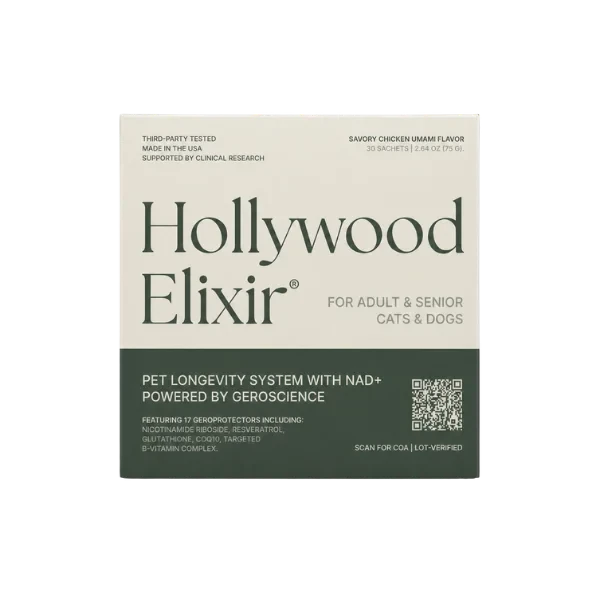
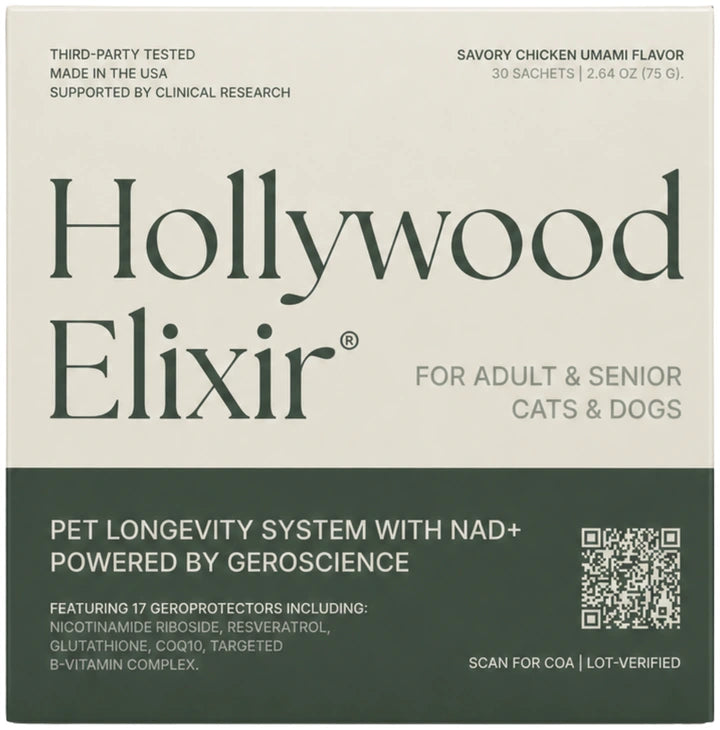
A repeatable care routine also helps when reviewing daily nutrition. Hollywood Elixir combines 17 disclosed actives, including NAD+ precursor support, CoQ10 and antioxidant nutrients, in one healthy-aging powder for adult dogs and cats. It mixes into the normal meal, with ingredient amounts and weight-based servings available to check against the rest of your dog’s routine. Explore the full formula and serving guide. 5

Woman sitting with a beagle in a kitchen while holding a Hollywood Elixir box

DVM Voice: Clinical Vignette of a Common Pattern in Senior Dog Aging

Case provided by JoAnna Pendergrass, DVM

Rex, a 7-year-old Labrador Retriever, was brought in after his owner noticed he was slower to rise, hesitant on stairs, and less able to play as before. Examination showed stiffness and reduced hip mobility; radiographs confirmed degenerative joint changes.

His care required weight management, veterinary-guided pain control, nutritional support, and rehabilitation — a comprehensive plan, but one started only after visible decline appeared.

Clinical takeaway: Rex’s case reflects the value of proactive aging support: maintaining lean body condition, monitoring mobility early, and supporting cellular resilience, antioxidant defense, and healthy inflammatory balance before decline becomes obvious.

Single-case vignette. Not generalizable. Veterinary oversight is essential for pain, stiffness, or suspected joint disease.

Explore Hollywood Elixir Research →

Educational content only. This material is not a substitute for veterinary advice. Always consult your veterinarian about your dog’s specific needs. These statements have not been evaluated by the Food and Drug Administration. Products mentioned are not intended to diagnose, treat, cure, or prevent any disease.

Glossary

rear sling: An under-belly support pad held by straps to assist the rear of the dog during the intended handling task.

front-and-rear system: A harness format with front and rear support sections. Help Em Up's rear section must remain connected to its front section.

U-Band: A Help Em Up rear Hip Lift option recommended by the maker for male dogs whose penis sits farther back between the hind legs.

Related Reading

References

Numbered references identify the sources used for specific claims. Read the study design, species and evidence boundaries alongside each finding.

  1. 2023 AAHA Senior Care Guidelines: Pain Management. American Animal Hospital Association · 2023Species/context: dog, catEvidence boundary: Consensus guidance supports assessment and individually appropriate adaptations; it is not a product trial.↩ 1 · ↩ 2
  2. GingerLead dog support harness instructions. GingerLead · Undated current pageSpecies/context: dogEvidence boundary: Manufacturer-reported design and instructions only; no independent performance measurement or clinical outcome established.↩ 1 · ↩ 2 · ↩ 3 · ↩ 4
  3. Help Em Up fitting instructions. Help Em Up · Undated current pageSpecies/context: dogEvidence boundary: Manufacturer-reported design and instructions only; no independent performance measurement or clinical outcome established.↩ 1 · ↩ 2 · ↩ 3 · ↩ 4
  4. Help Em Up current harness configuration. Help Em Up · Undated current pageSpecies/context: dogEvidence boundary: Manufacturer-reported design and instructions only; no independent performance measurement or clinical outcome established.↩ 1 · ↩ 2
  5. Hollywood Elixir: current product description and supplement facts. La Petite Labs · Undated current pageSpecies/context: dog, catEvidence boundary: Manufacturer formulation and intended support only; no equipment, disease, mobility or symptom outcome is asserted.↩

FAQ

Should I choose a rear sling or a full-body lifting harness?

Choose according to the support your dog needs for the specific task. A rear sling and connected front-and-rear system distribute assistance differently. Ask the care team to demonstrate the appropriate support, then check the exact product instructions and your ability to manage it. 1

Can I lift my dog with GingerLead attached to a collar?

GingerLead explicitly says never to lift the dog entirely off the ground when its lead is attached to a collar. Its instructions allow a separate chest-harness attachment, but that does not replace an individual handling demonstration or establish suitability for every full-lift task. 2

Can I use only the rear half of Help Em Up?

No. The maker says the rear Hip Lift needs its connection to the front section to stay in place. The front section can be used alone, but that permission does not extend to the rear. Follow the instructions for the exact configuration you have. 3

Can a lifting harness stay on overnight?

Do not assume so. Help Em Up recommends removal at night and checks at friction areas; other products have their own limits. Follow the exact manufacturer instructions and any individual skin or medical advice. Convenient access to handles should not replace rest from the equipment. 3

Is a lifting harness a car restraint?

Only if the exact model has separately established vehicle-restraint suitability and is installed accordingly. A lifting handle or strong webbing does not demonstrate crash performance. Resolve boarding assistance first, then select the travel restraint as its own decision.

Dalmatian looking toward a Hollywood Elixir box held in a person's hand

Discover LPL-01: How This Fits Into a Larger Canine Longevity System

Aging in dogs is not driven by a single pathway. It’s the result of interacting biological systems—energy metabolism, oxidative stress, immune signaling, and structural integrity—changing over time.

This article explores one piece of that puzzle. If you want to understand how these pieces connect—and what actually moves the needle—you need to zoom out.

Start with the underlying science:

Keep exploring

What would you like to understand next?

Search practical guides about healthy aging, cellular energy, ingredients, and daily support for dogs.