

Dog Wheelchairs for Senior Dogs: Fit Before Buying

A cart supports active movement; choosing one begins with an individual fitting plan.

By La Petite Labs Editorial 7 min read

As Seen On

Woman hugging a golden retriever while holding a Hollywood Elixir box
Hollywood Elixir® Senior Dog Supplement

17 science-backed actives

From$50/moSave up to 44%Shop Now
Contents

A dog wheelchair should be chosen for the support your dog needs and fitted with a veterinary rehabilitation professional. Rear, front and full-support carts do different jobs. A weight range identifies a possible frame size; it does not establish that a dog is a suitable candidate or that the assembled cart fits.

Unlike a stroller, a mobility cart supports the dog in a position for active movement. The buying decision therefore includes a clinical assessment, a product-specific measurement process and a plan for use, rest and adjustments.

Decide the required support configuration with the rehabilitation team.

Use the exact maker’s measurement posture and landmarks.

Arrange a fitting after the cart arrives, with a plan for supervised use and rest.

Choose the support before the frame

Manufacturers distinguish rear support, front support and four-wheel or quad support. Walkin’ Pets describes rear carts for the hind end, front carts for the front legs and quad carts supporting all four. 2 These are equipment categories, not a home test for deciding how much function your dog has.

The rehabilitation team needs to consider the whole dog and the intended activity. Tell them about pain, fatigue, the surface outside, steps at the exit and who will assist. Veterinary Specialty Center describes a process of preliminary measurements followed by a formal fitting when the cart arrives. 1 That second appointment matters: ordering the right size and setting the cart up correctly are separate jobs.

Adjustable and custom carts require different measurements

Walkin’ Wheels is an adjustable option whose sizing process uses weight, breed and rear-leg height. Its FAQ asks for that leg measurement with the dog lying on its side, the leg in a natural position with a slight bend, from the thigh/body crease to the toe pad. 2 Do not substitute standing back height or a measurement guessed from breed.

Eddie’s Wheels builds custom carts for body shape and support requirements, with some height and length adjustment. Its measurement guide instead requires supported, normal standing posture and straight-line measurements using a metal tape or yardstick. 34 The two methods are not contradictory instructions for the same product; they are different ordering systems. Use the guide attached to the cart being considered.

Overhead view of a black-and-white dog beside a food bowl and Hollywood Elixir box

Custom does not mean every dimension can be changed later

Eddie’s guide asks for measurements A–E for rear carts and A–J for front or quad carts. It specifically identifies C and E as welded frame and saddle dimensions that cannot be adjusted. 4 That makes accurate measurement and professional assistance particularly valuable; do not assume an adjustable height will compensate for the wrong width or saddle geometry.

For either system, arrange who will measure, who will review the order and who will do the first fitting. Ask how photographs or video should be supplied if remote support is needed. If you are considering a rental or second-hand cart, confirm that its model, size and adjustment range can meet the same individual plan rather than treating availability as proof of fit.

Wheelchair fitting handoff

Work through each row with your dog’s measurements and the exact equipment instructions.

DecisionBring or arrange
Support configurationClinical assessment and the activities the cart should enable
Exact sizing systemCurrent model chart and its measurement posture
Measurement reviewWho takes and checks the required landmarks
First fittingAppointment or agreed professional fitting service after delivery
Home routeDoor widths, turn space, surfaces and exit obstacles
Daily care planTransfers, supervision, rest, skin checks and follow-up contact

Original consultation checklist grounded in the veterinary service’s two-stage fitting process and the two manufacturers’ distinct measurement systems.

No diagnostic score, eligibility test, treatment promise or universal exercise schedule. Measurements must follow the exact current model guide.

Woman smiling beside a golden retriever, a green food bowl and a Hollywood Elixir box

The first fitting must include movement and the home route

Walkin’s FAQ uses the hip as a frame-position reference and describes a level alignment of the side bars. 2 These details help explain why a cart that merely clears the floor is not necessarily correctly fitted. Have the professional check the complete alignment and demonstrate any adjustments appropriate to your model.

Bring measurements of doorways and the route to the garden, including the room needed to turn. Ask how to get the dog into and out of the cart, how the support should contact the body, and which skin or movement changes should prompt a pause. Do not practise a difficult transfer alone simply because a demonstration video makes it look quick.

If a separate aid is needed for transfers, lifting harnesses for senior dogs explains the support configurations to discuss.

Agree on use and rest before the first outing

Walkin’ Pets advises supervision, a duration agreed with the veterinarian and removal from the cart for comfortable sleep. 2 There is no universal session length in this guide. The useful plan states what your dog should do, how to recognize fatigue or discomfort, when to remove the cart and whom to contact about a change.

A mobility cart is not a bed or passive transport compartment. If the outing calls for the dog to lie down and be carried along, a stroller or wagon addresses that separate need. Keep the cart’s maintenance, fitting follow-up and any prescribed activity in the same care plan so the equipment continues to match the dog as circumstances change.

For the wider room-by-room plan, see home modifications for senior dogs. This guide resolves the equipment choice; the home plan puts it alongside the other changes your dog needs.

For outings where the dog should ride and rest, dog strollers for senior dogs covers cabin and boarding choices.

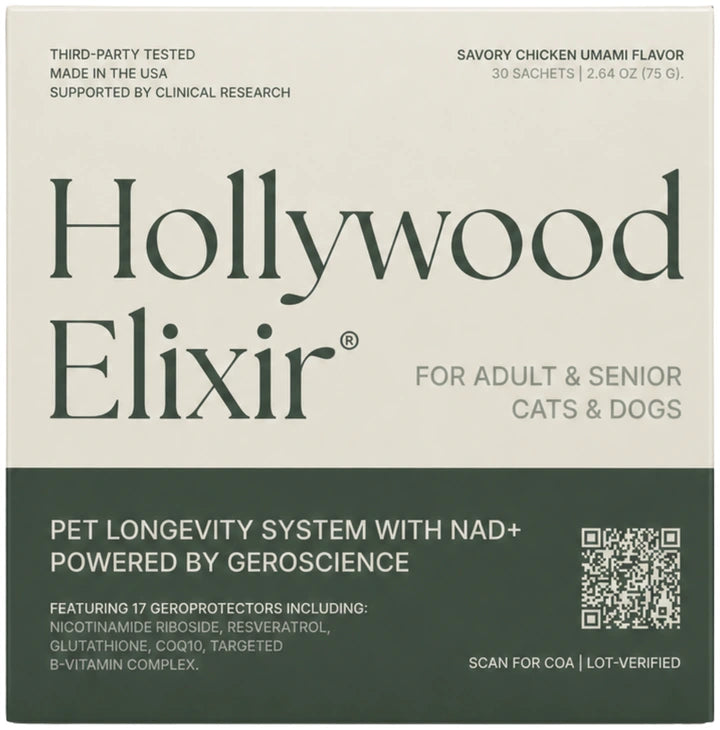
When reviewing the daily care plan, Hollywood Elixir offers a separate healthy-aging nutrition option for adult dogs and cats. Its 17-active powder combines NAD+ precursor support, CoQ10 and antioxidant nutrients with disclosed amounts, and mixes into the food already being served. That transparency gives you and the care team a clear formula to review alongside existing supplements. Explore the ingredients and serving guide. 5

Woman sitting with a beagle in a kitchen while holding a Hollywood Elixir box

DVM Voice: Clinical Vignette of a Common Pattern in Senior Dog Aging

Case provided by JoAnna Pendergrass, DVM

Rex, a 7-year-old Labrador Retriever, was brought in after his owner noticed he was slower to rise, hesitant on stairs, and less able to play as before. Examination showed stiffness and reduced hip mobility; radiographs confirmed degenerative joint changes.

His care required weight management, veterinary-guided pain control, nutritional support, and rehabilitation — a comprehensive plan, but one started only after visible decline appeared.

Clinical takeaway: Rex’s case reflects the value of proactive aging support: maintaining lean body condition, monitoring mobility early, and supporting cellular resilience, antioxidant defense, and healthy inflammatory balance before decline becomes obvious.

Single-case vignette. Not generalizable. Veterinary oversight is essential for pain, stiffness, or suspected joint disease.

Explore Hollywood Elixir Research →

Educational content only. This material is not a substitute for veterinary advice. Always consult your veterinarian about your dog’s specific needs. These statements have not been evaluated by the Food and Drug Administration. Products mentioned are not intended to diagnose, treat, cure, or prevent any disease.

Glossary

Quad support: A four-wheel cart configuration that supports all four legs, rather than only the front or hind end.

Rear-leg height: Walkin’ Wheels’ product-specific sizing measurement from the thigh/body crease to the toe pad, taken in its prescribed side-lying position.

Welded dimensions: Cart measurements fixed by the welded construction. Eddie’s identifies frame and saddle dimensions C and E as non-adjustable.

Related Reading

References

Numbered references identify the sources used for specific claims. Read the study design, species and evidence boundaries alongside each finding.

  1. Pet Mobility Carts. Veterinary Specialty Center · Undated current guidanceSpecies/context: dogEvidence boundary: Primary veterinary rehabilitation service describing its clinical fitting process; not a comparative device trial or a universal treatment outcome.↩ 1 · ↩ 2 · ↩ 3
  2. Frequently Asked Questions About Dog Wheelchairs. Walkin Pets · Undated current pageSpecies/context: dogEvidence boundary: Manufacturer sizing and use guidance only. Outcome, muscle recovery and condition-based eligibility claims are not adopted. Verify the exact model chart rather than the broad FAQ size list.↩ 1 · ↩ 2 · ↩ 3 · ↩ 4 · ↩ 5 · ↩ 6 · ↩ 7
  3. Eddie’s Wheels custom-cart designs. Eddie’s Wheels · Undated current pageSpecies/context: dogEvidence boundary: Manufacturer-reported design and instructions only; no independent performance measurement or clinical outcome established.↩
  4. A Visual Guide to Measuring Your Pet. Eddie’s Wheels · Undated current pageSpecies/context: dogEvidence boundary: Manufacturer-reported design and instructions only; no independent performance measurement or clinical outcome established.↩ 1 · ↩ 2 · ↩ 3 · ↩ 4
  5. Hollywood Elixir: current product description and supplement facts. La Petite Labs · Undated current pageSpecies/context: dog, catEvidence boundary: Manufacturer formulation and intended support only; no equipment, disease, mobility or symptom outcome is asserted.↩

FAQ

Can a dog that still walks use a wheelchair?

Possibly, but remaining walking ability alone does not decide suitability or the required support. Discuss the intended activity and the dog’s overall function with a rehabilitation professional. The cart needs an individual fitting and use plan, whether the dog has some limb movement or much greater support needs. 1

How do I measure a senior dog for a wheelchair?

Use the instructions for the exact cart. Walkin’ Wheels uses a side-lying rear-leg measurement; Eddie’s guide uses supported standing measurements and a different set of landmarks. Do not transfer numbers between the systems. Have the rehabilitation team help when positioning or accurate measurement is difficult. 24

Is a custom cart automatically a better fit?

Custom construction can address an individual body shape, but it still depends on accurate measurements and a fitting afterward. Some dimensions may be fixed: Eddie’s identifies C and E as welded dimensions that cannot be adjusted. Adjustable carts also need careful setup; neither label replaces fitting. 14

Can my dog lie down or sleep in a wheelchair?

Do not use the cart as a resting enclosure. Walkin’ Pets describes its wheelchairs as supporting an upright position and advises taking the dog out for comfortable sleep. Arrange an accessible resting place and a manageable transfer routine as part of the fitting plan. 2

How long should my dog use the cart?

Agree on this with the veterinarian or rehabilitation professional managing your dog. Walkin’ Pets notes that age, fitness and stamina affect duration and requires supervision. Ask for an individual progression and clear reasons to pause instead of adopting a universal number of minutes. 2

Dalmatian looking toward a Hollywood Elixir box held in a person's hand

Discover LPL-01: How This Fits Into a Larger Canine Longevity System

Aging in dogs is not driven by a single pathway. It’s the result of interacting biological systems—energy metabolism, oxidative stress, immune signaling, and structural integrity—changing over time.

This article explores one piece of that puzzle. If you want to understand how these pieces connect—and what actually moves the needle—you need to zoom out.

Start with the underlying science:

Keep exploring

What would you like to understand next?

Search practical guides about healthy aging, cellular energy, ingredients, and daily support for dogs.