Toys for Deaf Dogs: Visible Invitations and Rewarding Play

Choose food, texture and visible interaction, then make the start and end of the game easy for your dog to understand.

By La Petite Labs Editorial 5 min read

As Seen On

Woman hugging a golden retriever while holding a Hollywood Elixir box
Hollywood Elixir® Senior Dog Supplement

17 science-backed actives

From$50/moSave up to 44%Shop Now
Contents

Toys for deaf dogs do not need to be louder. Choose an activity your dog can see, smell or feel, and begin where they can see you invite them to play. A familiar toy may work well once the cue to start changes.

Start where the dog can see the invitation.

Pair a visual marker with a real reward. 2

Choose the toy by chewing and comfortable movement.

Make the invitation visible first

Begin where the dog can see you and offer the toy without startling them from behind. The sound of a squeaker or your voice may no longer announce the game. A familiar object can remain enjoyable once the invitation becomes clear.

Blue Cross recommends a visual reward marker, such as a thumbs-up, for a deaf or hard-of-hearing dog and pairing that marker with a reward. 2 Use one consistent sign that means something good follows. The sign communicates the successful moment; the food or toy is the reward.

Choose an activity with an accessible payoff

A food-filled rubber toy offers food and texture without needing sound. KONG Senior is the softer purple formula; KONG Extreme is intended for power chewers. 1 Hearing ability does not determine chewing strength, so choose the exact formula and size for the dog rather than the sensory label.

A lick mat offers a stationary food surface. LickiMat says its products are not chew toys and need supervision; remove the mat if a piece loosens or detaches. 4 If your dog enjoys searching instead, snuffle mats for senior dogs compares that activity’s food access and fabric care.

Overhead view of a black-and-white dog beside a food bowl and Hollywood Elixir box

Keep movement visible without encouraging light chasing

A short gentle roll of an appropriate familiar toy can invite visual following in a clear area. The dog does not need to chase far or turn quickly for the interaction to count as play. Choose the speed and distance around ordinary comfortable movement.

VCA advises avoiding flashlights and laser pointers as reward signals because they can create compulsive light-chasing behavior. 3 Use a visible hand marker and a real food or toy reward instead. A projected point of light is not equivalent to an object the dog can reach and finish interacting with.

Woman smiling beside a golden retriever, a green food bowl and a Hollywood Elixir box

Keep the cues consistent across caregivers

Agree on how the game starts, the reward marker and how it ends. Use the activity card to record the chosen toy and the dog’s response, so a new caregiver does not assume lack of response to sound means lack of interest.

The parent guide to mental stimulation for senior dogs owns the full activity schedule. If vision is also reduced, toys for blind dogs covers scent and cue persistence. Shorten or simplify the game when the dog loses interest, and assess a new change in appetite, movement or responsiveness with the veterinary team.

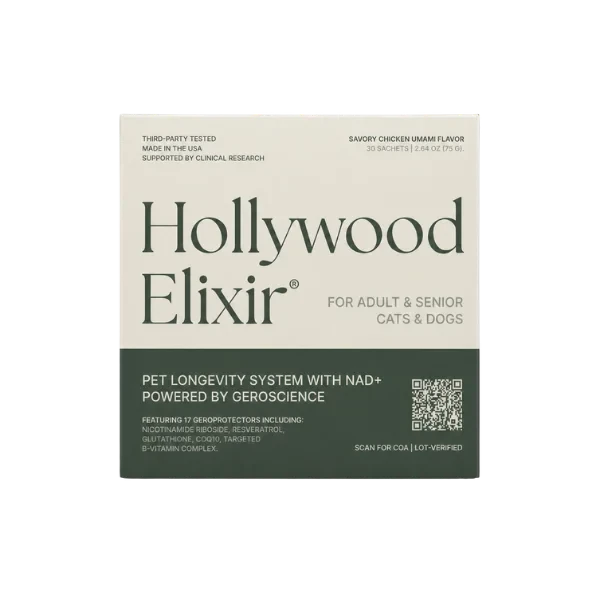
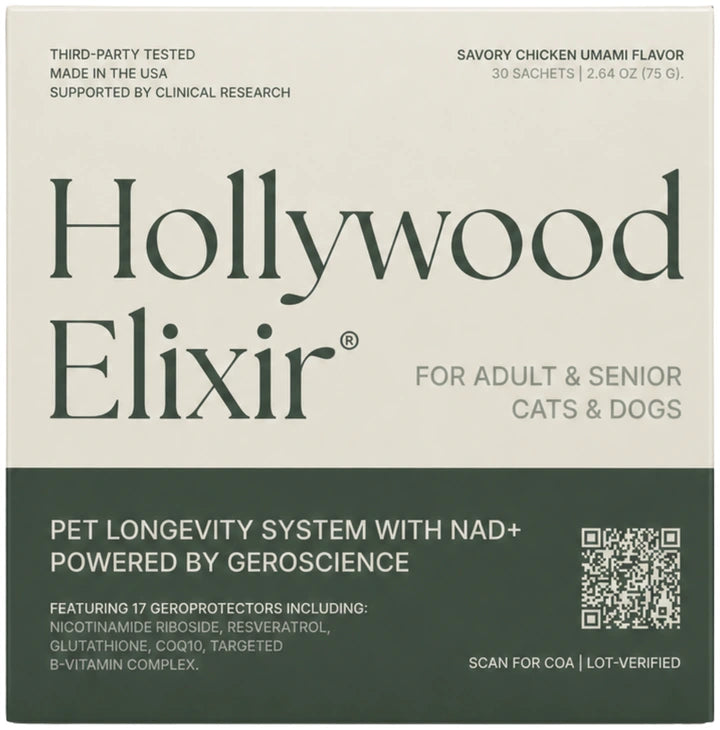
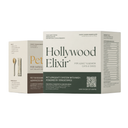
The familiar meal gives caregivers another clear shared routine. Hollywood Elixir combines nicotinamide riboside, CoQ10 and antioxidant ingredients for healthy-aging nutrition in a powder that mixes into usual food. Its seventeen disclosed actives make it possible to review one combined formula against the rest of the diet. Explore the full formula and serving guide. 5

A shared play-cue card

Use this table to record the factors that apply to your dog and the exact product you are considering.

Part of the gameChoose one clear approachCheck the response
InvitationApproach in view and present the familiar toyDog notices and chooses to engage
Reward markerConsistent visible sign followed by food or toy 2Dog understands that reward follows
ActivityAppropriate rubber toy, lick surface or easy searchReaches the payoff without frustration
FinishConsistent end gesture and put equipment awayNo unattended mat chewing or leftover food

Based on the cited manufacturer specifications and care instructions and professional veterinary guidance.

Published dimensions and instructions do not establish individual fit, comparative performance or a universal medical recommendation.

Woman sitting with a beagle in a kitchen while holding a Hollywood Elixir box

DVM Voice: Clinical Vignette of a Common Pattern in Senior Dog Aging

Case provided by JoAnna Pendergrass, DVM

Rex, a 7-year-old Labrador Retriever, was brought in after his owner noticed he was slower to rise, hesitant on stairs, and less able to play as before. Examination showed stiffness and reduced hip mobility; radiographs confirmed degenerative joint changes.

His care required weight management, veterinary-guided pain control, nutritional support, and rehabilitation — a comprehensive plan, but one started only after visible decline appeared.

Clinical takeaway: Rex’s case reflects the value of proactive aging support: maintaining lean body condition, monitoring mobility early, and supporting cellular resilience, antioxidant defense, and healthy inflammatory balance before decline becomes obvious.

Single-case vignette. Not generalizable. Veterinary oversight is essential for pain, stiffness, or suspected joint disease.

Explore Hollywood Elixir Research →

Educational content only. This material is not a substitute for veterinary advice. Always consult your veterinarian about your dog’s specific needs. These statements have not been evaluated by the Food and Drug Administration. Products mentioned are not intended to diagnose, treat, cure, or prevent any disease.

Glossary

Visual reward marker: A consistent visible sign, such as a thumbs-up, that tells the dog a reward is coming.

Power chewers: Dogs with a forceful chewing style, the group for which KONG describes its more durable Extreme rubber formula.

Lick mat: A surface that holds spreadable food for licking; the reviewed LickiMat is not intended as a chew toy.

Related Reading

References

Numbered references identify the sources used for specific claims. Read the study design, species and evidence boundaries alongside each finding.

  1. KONG rubber formulas and toy selection. KONG Company · Undated current manufacturer pageSpecies/context: dogEvidence boundary: Current first-party document evidence; specifications and care directions are distinct from clinical outcome evidence.↩
  2. Dog and puppy training: visual reward markers. Blue Cross · Current professional guidanceSpecies/context: dogEvidence boundary: Veterinary/professional guidance used only for the stated care boundary.↩ 1 · ↩ 2 · ↩ 3 · ↩ 4
  3. How to train dogs who are deaf or hard of hearing. VCA Animal Hospitals · Current professional guidanceSpecies/context: dogEvidence boundary: Veterinary/professional guidance used only for the stated care boundary.↩ 1 · ↩ 2
  4. LickiMat Tuff Buddy: supervision and care. LickiMat · Undated current manufacturer pageSpecies/context: dogEvidence boundary: Current first-party document evidence; specifications and care directions are distinct from clinical outcome evidence.↩
  5. Hollywood Elixir: formula and supplement facts. La Petite Labs · Undated current manufacturer pageSpecies/context: dog, catEvidence boundary: Current first-party document evidence; specifications and care directions are distinct from clinical outcome evidence.↩

FAQ

Does my deaf dog need special toys?

Not necessarily. A familiar toy may still provide texture, food or visible movement. Change the invitation and reward cue, then choose the toy’s size and construction around actual play and chewing behavior.

Can I use a laser pointer to play with a deaf dog?

VCA advises avoiding laser pointers and flashlights as training signals because they can create compulsive light chasing. Use a visible hand marker paired with a real reward instead. 3

How do I tell a deaf dog they did the right thing?

Blue Cross recommends a visual reward marker such as a thumbs-up. Pair it consistently with food or a toy so the sign predicts a reward. It replaces the audible marker, not the reward itself. 2

Dalmatian looking toward a Hollywood Elixir box held in a person's hand

Discover LPL-01: How This Fits Into a Larger Canine Longevity System

Aging in dogs is not driven by a single pathway. It’s the result of interacting biological systems—energy metabolism, oxidative stress, immune signaling, and structural integrity—changing over time.

This article explores one piece of that puzzle. If you want to understand how these pieces connect—and what actually moves the needle—you need to zoom out.

Start with the underlying science:

Keep exploring

What would you like to understand next?

Search practical guides about healthy aging, cellular energy, ingredients, and daily support for dogs.