Natural Dog Company Paw Soother Review: A Dry-Pad Routine

A close look at Paw Soother’s conditioning role, ingredient list and the application details that matter after you open the tin.

By La Petite Labs Editorial 7 min read

As Seen On

Woman cuddling a golden retriever and a collie beside a Pet Gala box and a food bowl
Pet Gala™ Skin & Coat Supplement for Dogs

15 science-backed barrier actives

From$43/moSave up to 46%Shop Now
Contents

Natural Dog Company Paw Soother is worth considering for routine conditioning of dry, intact paw pads if you can allow a quiet moment after application. The maker warns that paws become slick, and the formula includes cajeput essential oil. 1

This Natural Dog Company Paw Soother review examines the current manufacturer information, not a hands-on trial. It explains what you are buying, how to plan its use and which concerns call for a different next step.

Paw Soother is a reasonable conditioning option when its ingredients suit your dog and you can accommodate slick paws after application. It is not a wound-care decision. 1 4

The strongest reason to choose Paw Soother

Paw Soother’s clearest role is moisturizing the pads. If your dog’s paws feel rough but the skin is intact and your veterinarian has not identified a condition needing treatment, a conditioning topical is the purchase to investigate. The manufacturer’s formula combines oils, wax and butters, including coconut oil, candelilla wax, mango butter and cocoa butter. 1

Buy it for that specific task. If your main question is which product to apply before an outing, our dog paw balm comparison separates the conditioning and pre-walk options. You do not have to buy both types simply because they are sold as a pair.

Read the ingredient list before the marketing

The current list includes cajeput essential oil as well as botanical extracts. That makes Paw Soother a poor match for a shopping brief that specifically excludes essential oils. It does not tell us that every dog will react to it; it tells us what the shopper needs to check. 1

If your dog has a known ingredient restriction, compare the exact name with the label on the pack. “Natural” is not a substitute for that comparison. For an owner who simply dislikes scented grooming products, look at the scent description and formula together rather than interpreting a plant-based label as fragrance free.

Hand lifting a sachet from an open Pet Gala box beside a dog's long golden coat

Make room for the slick-paw stage

The manufacturer describes applying the product to the pads with two fingers or a low-absorbent cloth after removing visible dirt. It also says to let the area dry because paws will be slick. Choose a settled moment rather than applying just before your dog launches across a polished floor. 1

Lay out what you need before handling a paw. Work calmly, allow your dog to settle afterward and use the current pack directions for frequency.

If your dog resists because a paw appears painful, pause. Repeated licking or limping can have causes that a moisturizer will not identify. The guide to dog licking paws explains that broader question. 2 3

Woman leaning toward a golden retriever in a kitchen while holding a Pet Gala box

A useful check before and after purchase

Paw Soother is listed in 1 oz, 2 oz and 4 oz tins and a 2 oz stick. A tin suits an owner who prefers picking up product with fingers or a cloth; a stick gives a different way to hold the product at the paw. Choose for handling comfort rather than assuming one package works better. The manufacturer’s shared directions describe finger or cloth application. 1

For occasional use or a first purchase, the 1 oz tin is the smallest listed option. Compare the delivered unit price only after deciding on the format; a larger tin can be poor value if you do not enjoy using it. No fixed number of applications is established. 1

Once you introduce it, keep a short note of when you apply it and whether the routine is comfortable for your dog. A simple record is more informative than adding several new topicals at once. Do not turn a photograph of a smoother pad into proof that a wound or allergy has been treated.

Does Paw Soother fit your routine?

What you needWhat the source establishesBuying implication
Conditioning dry, intact padsThe maker positions Paw Soother as a moisturizer. 1A reasonable product to inspect for this job.
An essential-oil-free formulaCajeput essential oil appears in the ingredient list. 1Choose another formula if this is a firm requirement.
Immediate movement on smooth floorsThe directions warn of slick paws after application. 1Plan a quiet settling period.
Help with a painful or injured padInjury signs need assessment. 2 4Seek veterinary advice before adding a topical.

Compared the current manufacturer ingredient lists, product options and application directions accessed October 25, 2026.

Details apply to the named products and versions; follow the label supplied with the purchased pack.

When Paw Soother is the wrong next step

A torn, bleeding or painful pad needs assessment rather than a balm shopping experiment. Veterinary guidance identifies licking and limping as possible signs of pad injury, and recommends veterinary attention for wounds beyond a minor cut or graze. 2 4

The useful conclusion is narrow: Paw Soother is a conditioning option with disclosed ingredients and a real application tradeoff. It is not a diagnosis, an infection treatment or a reason to keep using a product when the paw looks worse.

Woman in a white coat sitting with a pug while holding a Pet Gala box

DVM Voice: Clinical Vignette of When Skin Changes Point Deeper Than the Surface

Case contributed by Sarah Calvin, DVM

Rosey, a 10-year-old Shih Tzu, was brought in after two weeks of paw redness and head shaking. Her owner had also noticed lower energy, thinning abdominal hair, and mild generalized itchiness over the previous few months.

Examination showed inflammation in the ears, skin folds, and paws. Testing confirmed mixed yeast and bacterial infections, while parasites and dermatophytosis were ruled out. Because Rosey’s skin changes appeared alongside reduced energy and coat thinning, her veterinarian performed a broader workup, which revealed hypothyroidism as a likely underlying contributor.

Her care required a staged approach: treating the infections, addressing the thyroid imbalance, and then restoring the skin barrier through diet, bathing support, paw care, and omega-3 supplementation.

Six months later, Rosey’s owner reported a thicker coat, fewer tangles, less breakage, no itch, and restored energy.

Editorial takeaway: Rosey’s case shows why skin and coat changes should not be treated as cosmetic alone. Healthy skin depends on immune balance, endocrine health, nutrition, barrier integrity, and daily support for resilient coat growth.

Single-case vignette. Not generalizable. Veterinary diagnosis and oversight are essential for itching, redness, ear irritation, hair thinning, recurrent infections, or suspected endocrine disease.

Explore Pet Gala Research →

Paw care also has a nutritional side

Conditioning the pads can sit alongside attention to the food bowl. A complete, balanced diet supplies the foundation for skin and hair; protein contributes to their development, while fatty acids and ceramides have roles in the skin barrier. 5 6 7

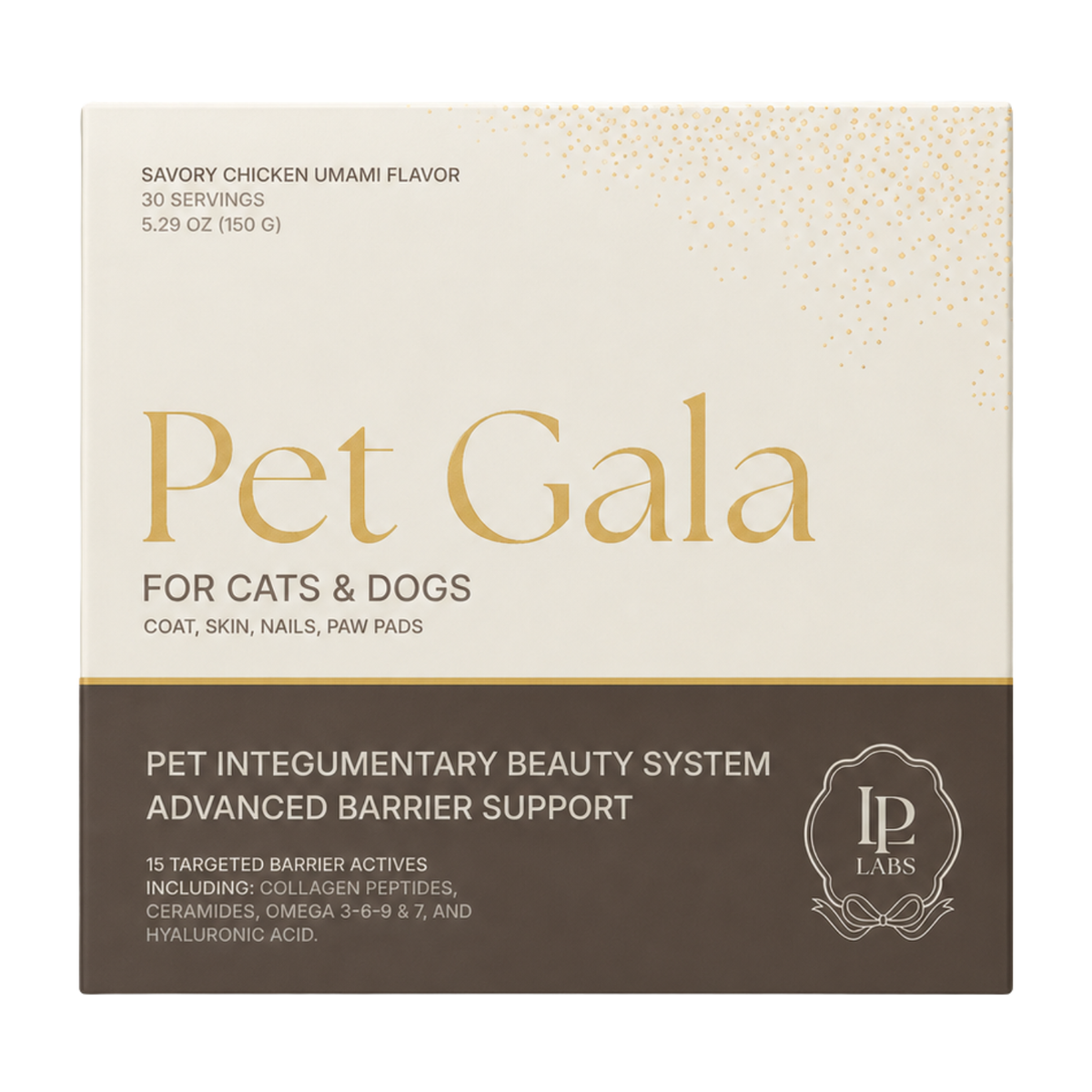
Pet Gala™ Barrier System puts that skin-and-coat nutritional focus into a food-mixed powder for adult and senior dogs and cats. The prepared formula combines collagen peptides, whey protein and beef gelatin with omega fatty acids and ceramides. Inspect the formula and serving options if a mealtime skin-and-coat supplement is the next choice you want to make; it is separate from applying balm to a pad. 8

Explore Pet Gala Barrier System to see the full formula and serving options for your dog’s skin-and-coat routine. 8

Educational content only. This material is not a substitute for veterinary advice. Always consult your veterinarian about your dog’s specific needs. These statements have not been evaluated by the Food and Drug Administration. Products mentioned are not intended to diagnose, treat, cure, or prevent any disease.

Glossary

Topical: A product applied to a body surface, such as the paw pads.

Conditioning: In this review, routine moisturizing care of intact paw pads.

Skin barrier: The skin’s outer protective structure, whose lipids include fatty acids and ceramides.

Related Reading

References

Numbered references identify the sources used for specific claims. Read the study design, species and evidence boundaries alongside each finding.

  1. Paw Soother. Natural Dog Company · unknownSpecies/context: dogEvidence boundary: Manufacturer information used for the moisturizing role, declared ingredients and slick-paw application caution.↩ 1 · ↩ 2 · ↩ 3 · ↩ 4 · ↩ 5 · ↩ 6 · ↩ 7 · ↩ 8 · ↩ 9 · ↩ 10 · ↩ 11 · ↩ 12 · ↩ 13 · ↩ 14 · ↩ 15 · ↩ 16 · ↩ 17 · ↩ 18
  2. First Aid for Torn or Injured Foot Pads in Dogs. VCA Animal Hospitals / LifeLearn · 2024-06-20Species/context: dogEvidence boundary: Veterinary guidance on recognizing and responding to injured paw pads.↩ 1 · ↩ 2 · ↩ 3 · ↩ 4
  3. Vet Q&A: Why is my dog biting/licking their paws? PDSA veterinary team · 2020-08-26Species/context: dogEvidence boundary: Veterinary guidance on repeated paw licking and the need to assess its cause.↩ 1 · ↩ 2
  4. Wounds and skin injuries. PDSA veterinary team · unknownSpecies/context: dog, catEvidence boundary: Veterinary guidance on wounds that need professional attention.↩ 1 · ↩ 2 · ↩ 3
  5. Nutrition and Your Dog’s Skin and Haircoat. VCA Animal Hospitals / LifeLearn · 2025-08-29Species/context: dogEvidence boundary: Veterinary guidance on complete, balanced food and the normal nutritional roles of protein and energy in skin and coat.↩ 1 · ↩ 2
  6. Essential Fatty Acids for Integumentary Disease in Animals. Merck Veterinary Manual · 2025-11Species/context: dog, catEvidence boundary: Veterinary reference used for the role of fatty acids in the skin’s outer barrier, not for a product treatment claim.↩
  7. Dietary constituents are able to play a beneficial role in canine epidermal barrier function. Watson et al., Experimental Dermatology / PubMed · 2006-01Species/context: dogEvidence boundary: Research abstract used for the composition of skin-barrier lipids. It is not evidence of Pet Gala’s effects.↩
  8. Pet Gala Barrier System: formula and directions. La Petite Labs · unknownSpecies/context: dog, catEvidence boundary: La Petite Labs product information used for declared ingredients, intended audience and directions; not a clinical outcome study.↩ 1 · ↩ 2 · ↩ 3

FAQ

How often should I apply Paw Soother?

Use the directions on your current pack and allow for the slick-paw stage each time. Do not borrow another balm’s schedule or assume that more frequent application is better. A painful or damaged pad needs assessment rather than a more intensive conditioning routine. 1 2

Can Paw Soother stop paw licking?

A moisturizing product does not establish why your dog is licking. Repeated licking or biting deserves veterinary advice because the possible causes differ. Do not choose Paw Soother on an assumption that dryness is the cause. 3

Is Paw Soother free from essential oils?

No. The current manufacturer list includes cajeput essential oil. If your dog has a specific ingredient restriction, check the full label before buying rather than relying on “natural” or “plant-based” language. 1

Should I apply it immediately before a walk?

Allow for the manufacturer’s slick-paw warning and drying instruction. Paw Soother’s role in this review is conditioning; a pre-walk wax has its own directions. Choose the routine for the product you actually bought. 1

Can I replace skin-and-coat nutrition with a balm?

A balm and dietary nutrition act in different places. A complete, balanced diet remains the foundation for skin and coat. Pet Gala is a food-mixed nutritional option, not a topical substitute and not a proven treatment for cracked pads. 5 8

Black-and-white dog between a bowl of food and a Pet Gala box held in a person's hands

Discover LPL-01: How This Fits Into a Complete Canine Integumentary Support System

Skin, coat, and nails aren’t cosmetic features. They’re the visible surface of deeper biological systems—barrier function, hydration balance, structural protein turnover, and lipid integrity—working in concert.

When these systems fall out of sync, it shows: dull coat, shedding, dryness, brittleness, sensitivity.

This article explores one piece of that puzzle. If you want to understand how true coat quality and skin resilience are built—and what actually moves the needle—you need to zoom out.

Start with the underlying science:

Keep exploring

What would you like to understand next?

Search practical guides about skin, coat, barrier health, ingredients, and daily care for dogs.