

Dog Ramps for Senior Dogs: Choose by Height and Space

Match the ramp to the destination, the space around it and the dog who will use it.

By La Petite Labs Editorial 8 min read

As Seen On

Woman hugging a golden retriever while holding a Hollywood Elixir box
Hollywood Elixir® Senior Dog Supplement

17 science-backed actives

From$50/moSave up to 44%Shop Now
Contents

Choose dog ramps for senior dogs by the access task first. A car ramp must travel and meet a vehicle landing; a bed ramp must fit a room; an outdoor ramp must suit its supports and exposure. Measure the rise, available ground space and usable walkway before comparing load limits.

AAHA includes appropriate ramps among possible home adaptations, but age alone does not tell you which setup a dog can use. 1 A useful selection begins with one destination and the approach to it, rather than a universal “best senior ramp.”

Measure rise, horizontal space and walkway width as separate quantities.

Allow for the approach, landing and turn as well as the ramp itself.

Check exact support and storage requirements before considering the load rating sufficient.

Choose the ramp family around its everyday job

A portable folding or telescoping ramp suits a task where the equipment must be carried and put away. PetStep’s Folding Pet Ramp is a concrete example: the maker lists a 70-inch length, 17-inch width and 18.5-pound empty weight. 2 Those numbers belong in a transport-and-storage decision as well as a dog-fit decision.

A furniture ramp can remain beside a bed and include its own base and landing. DoggoRamps’ Large Bed Ramp illustrates that design, with a listed 64 × 20-inch floor footprint and a separate 70 × 18-inch walkway. 3 For an outdoor staircase, first decide whether a portable supported bypass is realistic or a fixed route needs professional design. A portable product’s length is not a construction plan for an entire flight of stairs.

For vehicle loading, use the car ramp selection guide to resolve the doorway and supported landing.

The bed ramp layout guide focuses on furniture height and room clearance.

The outdoor stair-ramp guide works through the full rise, landing and installation questions.

Rise, ground run and ramp length are different measurements

Rise is the vertical height from the lower surface to the upper destination. Run is the horizontal ground distance occupied by an inclined segment. Ramp length follows the slope. Product pages may also quote a total footprint that includes legs or a landing, so do not assume a single advertised “length” describes all three.

For a deliberately hypothetical straight incline rising 12 inches, a 36-inch horizontal run gives about 37.9 inches of sloping length. Extending the run to 60 inches gives about 61.2 inches of sloping length and a shallower incline. The tradeoff is 24 inches more ground space. These calculations describe geometry only; neither arrangement is a recommended slope for a particular dog.

Keep additional approach and landing space outside that calculation. A ramp that fits wall-to-wall may leave nowhere to line up at the bottom or step off at the top. The shortest object that reaches the height is not necessarily a usable route.

Overhead view of a black-and-white dog beside a food bowl and Hollywood Elixir box

Check usable width and the transfer at the top

Overall width can include rails and frame. Ask for the usable walking width when the listing does not distinguish it. DoggoRamps explicitly separates a 20-inch-wide base from an 18-inch-wide walkway on its Large Bed Ramp. 3 That is why comparing catalogue widths without their definitions can mislead.

Look at the movement after the incline too. The dog may need to turn onto a mattress, pass through a car door or cross a threshold. Record the available landing and any gap or soft edge. A generous walkway does not solve a cramped turn immediately beyond it.

Woman smiling beside a golden retriever, a green food bowl and a Hollywood Elixir box

Support comes before the load label

Load capacity describes a manufacturer’s stated limit under its intended setup. It does not tell you that the top is properly supported, the base cannot slide or the doorway is wide enough. Use the exact model’s support instructions and do not invent a percentage safety margin or test a pet ramp by standing on it.

For example, PetSafe’s Happy Ride Telescoping Ramp instructions require all four rubber feet to rest on stable surfaces and explicitly exclude human use. 4 PetStep likewise identifies its product for animal use. 2 Those instructions are model-specific: read the directions for the ramp you are actually considering, including any required attachment or compatible accessory.

Include the owner’s handling and care

For a car ramp, check whether you can lift the empty ramp, unfold it with the dog safely away and store it without blocking the restraint setup. For a bed ramp, consider the space it occupies when left out. A product that folds is not necessarily light or convenient to move daily: DoggoRamps lists the Large Bed Ramp at 45 pounds. 3

For an outdoor or portable ramp, read the permitted cleaning method and inspect the contact surfaces after use. PetStep permits soap-and-water cleaning. 2 A clean surface still needs the correct support arrangement. Do not treat a weather-resistant description as evidence that the dog can use it in every wet, muddy or icy condition.

Woman sitting with a beagle in a kitchen while holding a Hollywood Elixir box

DVM Voice: Clinical Vignette of a Common Pattern in Senior Dog Aging

Case provided by JoAnna Pendergrass, DVM

Rex, a 7-year-old Labrador Retriever, was brought in after his owner noticed he was slower to rise, hesitant on stairs, and less able to play as before. Examination showed stiffness and reduced hip mobility; radiographs confirmed degenerative joint changes.

His care required weight management, veterinary-guided pain control, nutritional support, and rehabilitation — a comprehensive plan, but one started only after visible decline appeared.

Clinical takeaway: Rex’s case reflects the value of proactive aging support: maintaining lean body condition, monitoring mobility early, and supporting cellular resilience, antioxidant defense, and healthy inflammatory balance before decline becomes obvious.

Single-case vignette. Not generalizable. Veterinary oversight is essential for pain, stiffness, or suspected joint disease.

Explore Hollywood Elixir Research →

Turn the measurements into one purchase decision

Complete the worksheet for one destination. Reject any option whose required footprint, walking width or support cannot be matched to the site. Then check the intended load limit and the handling routine. This order prevents a high capacity number from overshadowing a basic fit problem.

Once the ramp is appropriate, introduce it without pressure. For its Happy Ride Telescoping Ramp, PetSafe begins with flat crossings and rewards, then adds height as the pet becomes comfortable; it says never to force or pull the pet up. 4 Use this progression only within your exact model’s permitted setup. If a previously manageable task has become difficult, have the change assessed. The home modifications for senior dogs guide connects ramp access with the other daily routes that may need attention.

The ramp training guide gives the complete voluntary introduction sequence once the equipment fits the task.

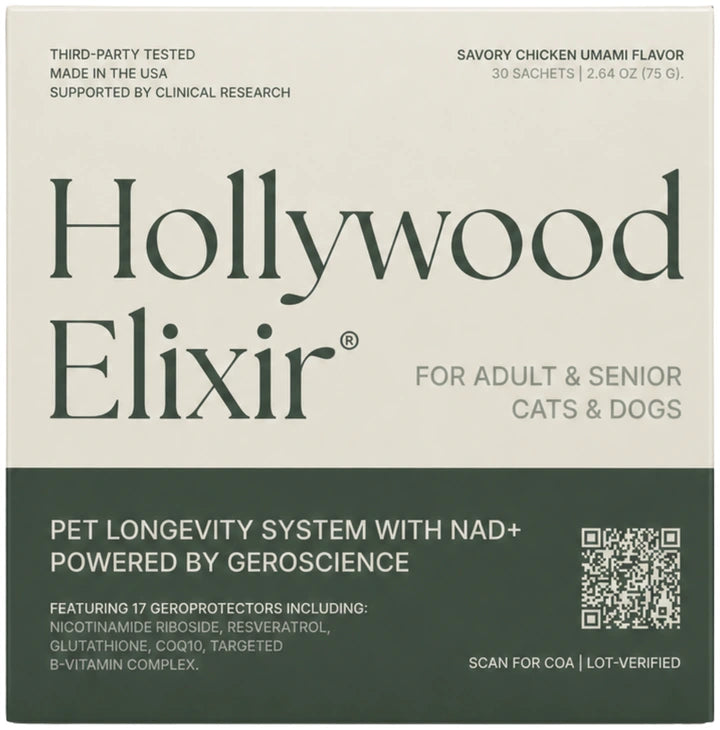
With the access route planned, the nutrition part of senior care can be a separate, simple routine. Hollywood Elixir brings NAD+ precursors, CoQ10 and antioxidant nutrients together in a 17-active healthy-aging formula for the usual meal. Its full formula and serving information let you review the combined addition alongside your dog’s food and existing supplements. 5

Ramp-family measurement sheet

Record the destination, supports and full route before shortlisting a ramp.

RecordWhy it mattersExample of the distinction
Destination and vertical riseIdentifies the height the dog must reachMeasure to the actual mattress, landing or vehicle surface
Available horizontal spaceSets the possible footprint before approach/landing12 in rise over 36 in run differs from 12 in over 60 in run
Walking width versus overall widthFrame and rails can occupy part of the totalDoggoRamps lists 20 in base width and 18 in walkway 3
Top and bottom supportReaching the height is not the same as supported placementUse the exact model’s support or attachment instructions
Approach and departureAllows lining up, stepping off and any required turnAdd these spaces beyond the inclined segment
Empty weight and storageThe owner must manage the equipment as wellPetStep lists 18.5 lb; DoggoRamps Large Bed Ramp lists 45 lb 2 3

Editorial selection worksheet. The illustrative lengths use the right-triangle relation length = square root of rise squared plus run squared: 12/36 gives 37.95 inches, and 12/60 gives 61.19 inches. Rounded values describe geometry, not medical suitability.

No ramp was physically tested. Manufacturer dimensions and load labels do not establish a safe slope or suitable route for an individual dog.

Educational content only. This material is not a substitute for veterinary advice. Always consult your veterinarian about your dog’s specific needs. These statements have not been evaluated by the Food and Drug Administration. Products mentioned are not intended to diagnose, treat, cure, or prevent any disease.

Glossary

Floor footprint: The length and width of the ramp's supporting base on the floor. It differs from the length measured along the sloping walkway.

Walkway: The surface available for the dog to walk on, which can be narrower than the complete base or frame.

Landing: The platform at the top where the dog finishes the incline and steps onto the destination.

Related Reading

References

Numbered references identify the sources used for specific claims. Read the study design, species and evidence boundaries alongside each finding.

  1. 2023 AAHA Senior Care Guidelines: Pain Management. American Animal Hospital Association · 2023Species/context: dog, catEvidence boundary: Consensus guidance supports assessment and individually appropriate adaptations; it is not a product trial.↩ 1 · ↩ 2 · ↩ 3
  2. PetStep Folding Pet Ramp, SKU 222. PetStep · Undated current pageSpecies/context: dogEvidence boundary: Manufacturer-reported design and instructions only; no independent performance measurement or clinical outcome established.↩ 1 · ↩ 2 · ↩ 3 · ↩ 4 · ↩ 5
  3. Large Bed Ramp for Dogs. DoggoRamps · Undated current pageSpecies/context: dogEvidence boundary: Manufacturer-reported design and instructions only; no independent performance measurement or clinical outcome established.↩ 1 · ↩ 2 · ↩ 3 · ↩ 4 · ↩ 5
  4. How to acclimate and train a pet to the Happy Ride Telescoping Ramp. PetSafe · Undated current pageSpecies/context: dogEvidence boundary: Manufacturer-reported design and instructions only; no independent performance measurement or clinical outcome established.↩ 1 · ↩ 2 · ↩ 3 · ↩ 4
  5. Hollywood Elixir: current product description and supplement facts. La Petite Labs · Undated current pageSpecies/context: dog, catEvidence boundary: Manufacturer formulation and intended support only; no equipment, disease, mobility or symptom outcome is asserted.↩

FAQ

What ramp angle is best for a senior dog?

There is no single angle established here as suitable for every senior dog. The same rise becomes less steep when more horizontal distance is available, but the resulting setup still needs appropriate width, supports, approach and landing. Discuss the task with your veterinary team if pain or movement difficulty is involved. 1

How long does a dog ramp need to be?

Begin with the vertical rise and the ground space you can actually use. A longer inclined segment can make the same rise shallower, but you also need room to approach and leave it. Check whether the manufacturer’s “length” describes the walkway, folded object or complete floor footprint; those are different measurements.

Is a ramp suitable if its weight limit exceeds my dog’s weight?

That is one necessary check, not a complete fit decision. The ramp still needs a supported top and base, adequate walking width and space for the dog to enter and leave. Follow its intended setup and restrictions. Do not test a pet-only ramp by walking on it yourself. 2 4

Can one ramp serve the car and the bed?

Possibly, if the exact model permits both uses and fits both destinations. Check each height, landing, support and available space separately. A portable ramp that meets a rear cargo opening may be awkward to leave beside a bed, while a self-supporting furniture ramp may be too heavy or bulky for routine vehicle use.

What if my dog will not use the ramp?

Check that the surface and supports are suitable, then return to an easier, permitted stage of introduction. PetSafe advises a lower surface if needed and says never to force or pull the dog. Refusal does not tell you whether the issue is unfamiliarity, the setup or a physical problem; seek help if difficulty persists or movement has changed. 4 1

Dalmatian looking toward a Hollywood Elixir box held in a person's hand

Discover LPL-01: How This Fits Into a Larger Canine Longevity System

Aging in dogs is not driven by a single pathway. It’s the result of interacting biological systems—energy metabolism, oxidative stress, immune signaling, and structural integrity—changing over time.

This article explores one piece of that puzzle. If you want to understand how these pieces connect—and what actually moves the needle—you need to zoom out.

Start with the underlying science:

Keep exploring

What would you like to understand next?

Search practical guides about healthy aging, cellular energy, ingredients, and daily support for dogs.