


5 Coat Warning Signs of Illness in Dogs & Cats
Read full insightCat Hair Loss Treatment and Home Remedies
Why cats lose fur, what different treatments do, and how to make home care count.
By La Petite Labs Editorial 16 min read

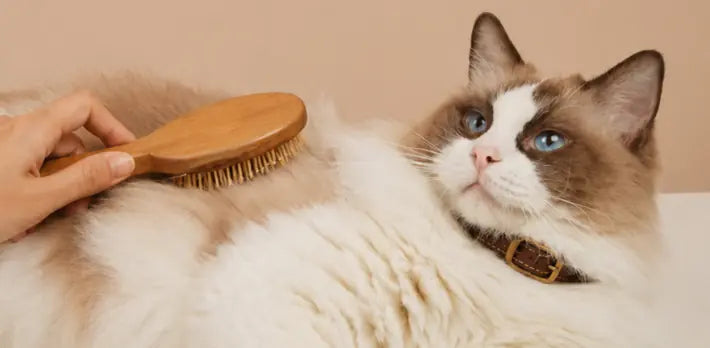
No scratching does not mean no itch

A few flea bites can cause a great deal of trouble

Flea control involves the household, not just the patch

Ringworm is a fungus, and it does not always make rings

A food trial is more specific than changing food

A negative allergy test does not close the case

Stress can contribute, but it deserves a careful diagnosis

DVM Voice: Clinical Vignette of When Skin Changes Point Deeper Than the Surface
Case provided by Sarah Calvin, DVM
Maverick, a 4-year-old Siamese cat, was brought in for hair loss across his lower abdomen and red, flaky skin lesions that had progressed over the previous month. His owners were unsure whether he was itchy or overgrooming.
Examination showed broken hairs, abdominal alopecia, and lesions consistent with bacterial skin infection. Further testing ruled out fleas, FeLV/FIV, and common fungal causes. Because his grooming pattern suggested deeper discomfort, his veterinarian continued the workup.
Radiographs and urinalysis revealed bladder stones, crystalluria, and blood in the urine. Maverick’s overgrooming was linked to urinary pain — a case where skin changes were secondary to an internal problem.
His care required a staged plan: stabilizing the skin infection, surgically removing the bladder stones, managing pain, transitioning to a therapeutic diet, and supporting skin-barrier recovery with appropriate nutrition and fish oil.
Hair regrowth began by 8 weeks. By 6 months, his coat had fully recovered, with no recurrence after the urinary issue was resolved.
Clinical takeaway: Maverick’s case shows why feline coat loss and overgrooming deserve careful veterinary investigation. Skin and coat health can reflect pain, stress, nutrition, infection, barrier weakness, or internal disease — not just surface-level grooming behavior.
Single-case vignette. Not generalizable. Veterinary diagnosis and oversight are essential for overgrooming, hair loss, skin lesions, urinary signs, pain, or suspected infection.

Keep grooming comfortable while the skin is sore

Make food, rest and retreat easy to reach

Why an itch medicine can help before the cause is settled

Comfort can improve before the coat fills in

When several treatments have helped only a little
References
Numbered references identify the sources used for specific claims. Read the study design, species and evidence boundaries alongside each finding.
-
Karen A. Moriello. Hair Loss (Alopecia) in Cats. Species/context: catEvidence boundary: Explains the main causes and clinical investigation of feline hair loss. The pattern of missing hair alone does not establish a diagnosis.↩ 1 · ↩ 2 · ↩ 3
-
Stephen E. Waisglass, Gary M. Landsberg, Julie A. Yager and Jan A. Hall. Underlying medical conditions in cats with presumptive psychogenic alopecia. Species/context: catEvidence boundary: Examined 21 referred cats initially suspected of behavioral hair loss. Medical itch was common in this selected group; the findings do not estimate its prevalence in all cats with alopecia.↩
-
Cornell Feline Health Center. Flea Allergy. Species/context: catEvidence boundary: Explains flea-saliva allergy in cats and why a small number of bites can cause marked itch. Failure to find a flea does not reliably exclude flea allergy.↩ 1 · ↩ 2
-
UK Veterinary Medicines Directorate. Permethrin: don’t put your cat at risk. Species/context: catEvidence boundary: Warns that dog-only permethrin spot-ons can poison cats through direct application or contact with a treated dog. The warning concerns product selection and exposure, rather than an owner-calculated safe dose.↩
-
Sandra R. Merchant. Ringworm (Dermatophytosis) in Cats. Species/context: cats, dogs and human exposure contextEvidence boundary: Explains feline ringworm, its variable appearance and its potential to spread to other animals and people. Diagnosis requires more than the shape of a patch or a Wood’s lamp result.↩
-
Domenico Santoro, Cherie M. Pucheu-Haston, Christine Prost, Ralf S. Mueller and Hilary Jackson. Clinical signs and diagnosis of feline atopic syndrome: detailed guidelines for a correct diagnosis. Species/context: catEvidence boundary: Provides clinical guidance for diagnosing feline atopic syndrome after investigating other causes. Allergen tests help select allergens for immunotherapy; they do not establish the diagnosis by themselves.↩ 1 · ↩ 2 · ↩ 3
-
Cornell Feline Health Center. Food Allergies. Species/context: catEvidence boundary: Explains food-allergy investigation using a selected diet followed by a food challenge. Other foods, treats and supplements can affect the interpretation of the trial.↩ 1 · ↩ 2
-
Cornell Feline Health Center. Cats that Lick Too Much. Species/context: catEvidence boundary: Explains how itch, pain and behavioral factors can contribute to excessive grooming. The location of licking is useful history, but is not a diagnosis.↩
-
Sarah L. H. Ellis et al. AAFP and ISFM Feline Environmental Needs Guidelines. Species/context: catEvidence boundary: Provides guidance on feline environmental needs, including safe retreats and access to resources. It is not a clinical trial of treatment for hair loss.↩
-
Kathy C. Tater, Sharon Gwaltney-Brant and Tina Wismer. Topical Minoxidil Exposures and Toxicoses in Dogs and Cats: 211 Cases (2001–2019). Species/context: dogs and catsEvidence boundary: Reviews reported minoxidil poisonings in dogs and cats, including accidental feline exposures. These cases establish a serious hazard but do not measure its frequency in the general pet population.↩
-
Cornell Feline Health Center. Feeding Your Cat. Species/context: catEvidence boundary: Explains complete diets, life stages and nutrient balance for cats. It provides a feeding foundation rather than evidence for a particular coat supplement.↩
-
Wouter H. Hendriks, Michael F. Tarttelin and Paul J. Moughan. Seasonal Hair Growth in the Adult Domestic Cat (Felis catus). Species/context: catEvidence boundary: Measured seasonal changes in hair mass in 39 outdoor shorthaired cats. Hair mass is different from hair length, so these results cannot predict when an individual clipped coat will look restored.↩
-
Malcolm Weir, Ryan Llera, Tammy Hunter and Cheryl Yuill. Coat and Skin Appearance in the Healthy Cat. Species/context: catEvidence boundary: Explains routine grooming, coat care and changes that can accompany illness or reduced mobility. It does not establish that brushing accelerates follicle growth.↩
-
Cherie Pucheu-Haston. A Clinical Approach to Alopecia in Cats. Species/context: catEvidence boundary: Explains the clinical investigation of feline hair loss, including the distinction between hair that falls out and hair removed by grooming. Coat appearance alone cannot establish the cause.↩ 1 · ↩ 2

Discover LPL-01: How This Fits Into a Complete Feline Integumentary Support System
Skin, coat, and nails in cats are not surface traits. They reflect deeper biological systems—barrier integrity, hydration dynamics, lipid balance, and structural protein turnover—working in coordination.
When these systems drift, the signs are subtle but telling: reduced coat softness, increased shedding, dryness, brittle claws, changes in grooming behavior.
This article explores one piece of that system. If you want to understand how true coat quality and skin resilience are built in cats—and what actually drives visible improvement—you need to zoom out.
Start with the underlying science:
- Feline Skin & Coat Framework →
A structured view of how skin, coat, and claw health are maintained across collagen synthesis, lipid nourishment, and barrier function. - Barrier Protection Coverage Modeling →
A systems-level map of which integumentary pathways are most vulnerable—and how layered nutritional inputs can support them. - 2026 Market Research: Best Cat Skin & Coat Supplements →
A feline-focused review of skin and coat formulas shaped by grooming behavior, barrier resilience, coat softness, ingredient quality, and daily usability. - LPL-01 Standard →
The formulation system that translates these models into real-world supplementation—covering multiple pathways in a coordinated way.
Keep exploring
What would you like to understand next?
Search practical guides about skin, coat, barrier health, ingredients, and daily care for cats.


