ToeGrips vs PawFriction vs Dog Socks: How to Choose

Nail grips, pad coatings and socks place traction material in different locations—and ask different things of the owner.

By La Petite Labs Editorial 8 min read

As Seen On

Woman hugging a golden retriever while holding a Hollywood Elixir box
Hollywood Elixir® Senior Dog Supplement

17 science-backed actives

From$50/moSave up to 44%Shop Now
Contents

ToeGrips, PawFriction and dog socks add contact material in different places: around the nails, on the paw pads or around the paw. That changes fitting, daily checks and upkeep. The studies reviewed here do not establish one universal winner for senior dogs at home. 4 5

Choose the approach you can correctly apply and maintain, with your veterinary team’s input when pain, weakness or altered foot placement is involved. The useful comparison is the complete routine, not the number of grip claims on the package.

ToeGrips requires nail sizing and correct positioning; PawFriction requires pad preparation and coating.

Socks require paw fit, retention and washing, with checks that the grip stays aligned.

The two ToeGrips studies answer limited gait and postoperative questions, not which of the three products is best.

Start with where the added material meets the floor

ToeGrips are rubber cylinders fitted to the weight-bearing nails. 4 They leave the paw pads uncovered. PawFriction instead uses adhesive and granules on the pad areas that contact the ground. 2 Socks surround the paw and put their own grip material against the surface; Indoor Walkee Paws, for example, uses silicone dots on cotton socks. 3

Contact location explains the different fitting jobs. A nail grip can be the wrong size or position even when the paw itself looks uncovered and comfortable. A pad coating depends on appropriate preparation and application. A sock can move around the paw. None of those interfaces should be judged only by how grippy the material feels in your hand.

Compare the handling needed before the first use

ToeGrips’ instructions measure nail circumference around the midshaft, repeating the check on weight-bearing nails of a front and rear paw. The maker says to use the range of results rather than their average, because a dog may need two sizes. 1 This suits an owner who can manage nail handling or arrange appropriate help.

PawFriction’s directions require dry pads before adhesive and granules are applied. Its maker provides both standing and lying-down methods and acknowledges that another person may be needed. 2 Consider whether your dog can comfortably tolerate that preparation; a pad product is not automatically the easiest choice for a dog who resists paw handling.

Socks involve fitting the paw and retention system. Individual socks and connected leggings have different dressing routines: the latter adds an over-back connector, as Indoor Walkee Paws illustrates. 3 If your priority is a removable item, that may be useful, but removal does not eliminate the fitting work.

If socks are the practical choice, the anti-slip dog socks guide compares paw shapes, separate socks and connected leggings in more detail.

Overhead view of a black-and-white dog beside a food bowl and Hollywood Elixir box

Think through the upkeep, not just the first application

With nail grips, use the manufacturer’s positioning, monitoring and removal instructions. 1 Do not leave a loose or misplaced grip unexamined because it was fitted successfully on the first day. If you cannot tell whether the contact point is correct, ask for help before continuing.

PawFriction is a coating to renew as it wears. The maker estimates around seven days per application, depending on the dog’s size and activity. 2 Treat that as a manufacturer estimate, not a guaranteed replacement schedule or a measured result in your home. Socks instead add laundering and drying; Walkee Paws specifies a gentle wash and hang drying. 3 Your workable choice is the routine you can repeat correctly.

Contact and maintenance comparison

ApproachContact pointOwner’s recurring workEvidence boundary
ToeGripsWeight-bearing nails 4Measure, position and monitor; follow removal instructions 1Normal-dog gait and early TPLO studies do not establish a universal senior-home benefit 4 5
PawFrictionPad contact areas 2Prepare dry pads, apply adhesive/granules and renew as neededSeven-day duration is a maker estimate, not a household guarantee 2
Dog socks; Walkee Paws exampleGrip material around the paw 3Fit and check retention; wash and dry the selected designConstruction details are not comparative efficacy measurements
Secured floor coveringThe indoor route 6Keep the material stable, flat and cleanEnvironmental option; does not identify the cause of difficulty

Editorial comparison of the actual contact interfaces and manufacturer instructions, with research populations and limits stated separately. No products were physically tested.

The comparison is not a clinical prescription or a performance ranking. The reviewed studies do not supply a three-way efficacy comparison in senior dogs at home.

Woman smiling beside a golden retriever, a green food bowl and a Hollywood Elixir box

What the ToeGrips research does—and does not—show

A 2017 study examined gait before and after ToeGrips application in 15 normal dogs. It found small changes in gait measures that the authors judged unlikely to be clinically significant in normal dogs, and it did not measure friction. 4 That helps describe the tested gait response; it does not establish a reduction in household slipping among senior dogs.

A 2022 randomized study analyzed 30 dogs during the first two weeks after tibial plateau leveling osteotomy, a knee procedure: 13 wore nail grips and 17 wore sham devices. It found no significant group difference in measured lameness, pressure index or owner-reported tasks. 5 That is a meaningful limitation on a postoperative benefit claim. It is not proof that no individual dog in another setting could benefit.

The paper’s adverse-event section also describes one nail-grip dog with reduced wrist extension while standing, which resolved after the grips were removed. This single observation does not establish a general harm rate, but it reinforces the need to stop and seek advice if a device changes how the dog places or holds a foot. 5

Neither study compared ToeGrips against PawFriction and socks in senior dogs at home. A fair choice therefore combines the limited evidence with the actual application, tolerance and maintenance requirements, without turning the product descriptions into an efficacy ranking.

Keep paw wax and floor coverings in their proper roles

Paw wax is not an interchangeable fourth version of these three designs. A product intended to protect pads from outdoor conditions has not thereby demonstrated better dry-floor traction. The studies discussed above did not test wax, so they cannot support a wax recommendation or a claim that it performs better or worse than these options.

A secured floor covering changes the environment instead of what the dog wears. AAHA includes suitable rugs or mats as well as fitted footwear among home adaptations. 6 If one indoor route is the main difficulty, covering that route may reduce daily paw handling. Persistent difficulty still deserves assessment rather than an endless sequence of new products.

Use the mats and runners guide to choose a suitable material and attachment when covering the route is preferable.

Woman sitting with a beagle in a kitchen while holding a Hollywood Elixir box

DVM Voice: Clinical Vignette of a Common Pattern in Senior Dog Aging

Case provided by JoAnna Pendergrass, DVM

Rex, a 7-year-old Labrador Retriever, was brought in after his owner noticed he was slower to rise, hesitant on stairs, and less able to play as before. Examination showed stiffness and reduced hip mobility; radiographs confirmed degenerative joint changes.

His care required weight management, veterinary-guided pain control, nutritional support, and rehabilitation — a comprehensive plan, but one started only after visible decline appeared.

Clinical takeaway: Rex’s case reflects the value of proactive aging support: maintaining lean body condition, monitoring mobility early, and supporting cellular resilience, antioxidant defense, and healthy inflammatory balance before decline becomes obvious.

Single-case vignette. Not generalizable. Veterinary oversight is essential for pain, stiffness, or suspected joint disease.

Explore Hollywood Elixir Research →

Make the choice around one sustainable routine

Use the comparison sheet to identify the work you can manage: nail measuring and monitoring, pad preparation and reapplication, or sock fitting and cleaning. Then confirm the exact product’s instructions and watch whether the dog can use it comfortably during ordinary movement. Do not deliberately recreate a fall to test it.

If no wearable or coating is practical, revisit the route itself. The home modifications for senior dogs guide covers environmental changes across the house. The aim here is a feasible contact-and-maintenance choice, with an honest understanding of what the available evidence can support.

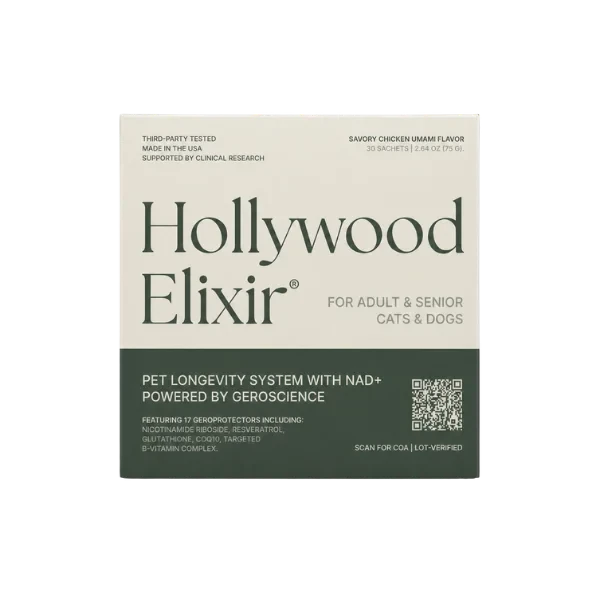
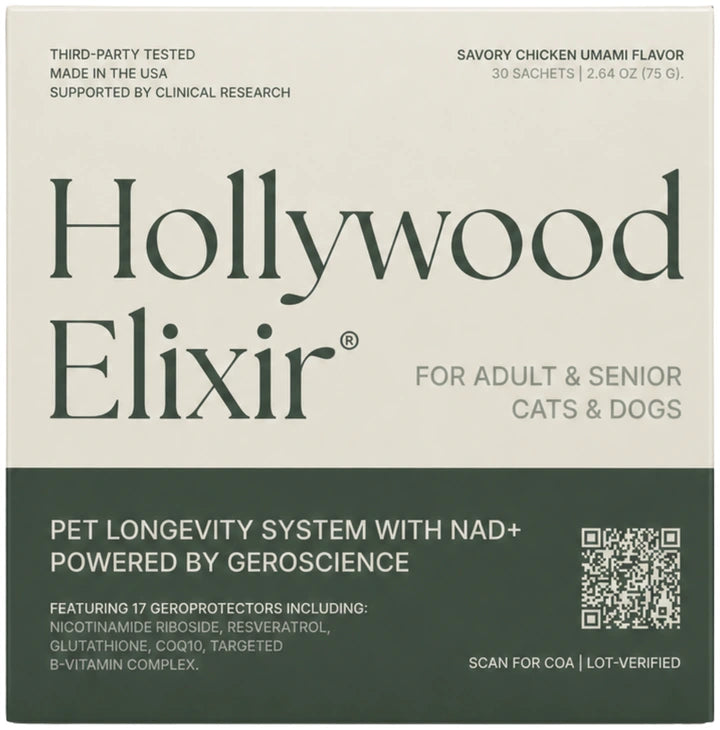
Traction addresses the contact between the dog and the floor. For the separate nutrition side of healthy aging, Hollywood Elixir combines 17 disclosed actives, including NAD+ precursors, CoQ10 and antioxidant nutrients. Its whole-formula approach makes these one mealtime addition; the formula and serving guide show what you would add alongside existing care. 7

Educational content only. This material is not a substitute for veterinary advice. Always consult your veterinarian about your dog’s specific needs. These statements have not been evaluated by the Food and Drug Administration. Products mentioned are not intended to diagnose, treat, cure, or prevent any disease.

Glossary

nail grips: Small rubber cylinders worn around weight-bearing toenails, rather than over the paw pads.

pad coating: Traction material applied directly to the pad areas that contact the ground; PawFriction uses adhesive and granules.

connected leggings: Socks joined by an over-the-back connector, adding a retention system beyond the fit of each individual sock.

Related Reading

References

Numbered references identify the sources used for specific claims. Read the study design, species and evidence boundaries alongside each finding.

  1. ToeGrips sizing and application instructions. Dr. Buzby’s ToeGrips · Undated current pageSpecies/context: dogEvidence boundary: Manufacturer-reported design and instructions only; no independent performance measurement or clinical outcome established.↩ 1 · ↩ 2 · ↩ 3 · ↩ 4
  2. PawFriction application directions. PawFriction EU · Undated current pageSpecies/context: dogEvidence boundary: Manufacturer-reported design and instructions only; no independent performance measurement or clinical outcome established.↩ 1 · ↩ 2 · ↩ 3 · ↩ 4 · ↩ 5 · ↩ 6 · ↩ 7 · ↩ 8
  3. Indoor Walkee Paws grippy sock leggings. Walkee Paws · Undated current pageSpecies/context: dogEvidence boundary: Manufacturer-reported design and instructions only; no independent performance measurement or clinical outcome established.↩ 1 · ↩ 2 · ↩ 3 · ↩ 4 · ↩ 5 · ↩ 6
  4. Dr. Buzby’s ToeGrips Application Results in Minimal Changes in Kinetic Gait Parameters in Normal Dogs. Frontiers in Veterinary Science · 2017Species/context: dogEvidence boundary: Before/after gait study in fifteen normal dogs; no comparative traction trial, friction measurement or senior-home efficacy result.↩ 1 · ↩ 2 · ↩ 3 · ↩ 4 · ↩ 5 · ↩ 6 · ↩ 7 · ↩ 8 · ↩ 9
  5. Effect of Nail Grips on Weight Bearing and Limb Function in 30 Dogs 2 Weeks Post Tibial Plateau Leveling Osteotomy. Animals · 2022Species/context: dogEvidence boundary: Small randomized sham-controlled trial during early TPLO recovery; not a three-way comparison and not evidence of universal benefit or universal ineffectiveness in senior dogs.↩ 1 · ↩ 2 · ↩ 3 · ↩ 4 · ↩ 5 · ↩ 6 · ↩ 7
  6. 2023 AAHA Senior Care Guidelines: Pain Management. American Animal Hospital Association · 2023Species/context: dog, catEvidence boundary: Consensus guidance supports assessment and individually appropriate adaptations; it is not a product trial.↩ 1 · ↩ 2
  7. Hollywood Elixir: current product description and supplement facts. La Petite Labs · Undated current pageSpecies/context: dog, catEvidence boundary: Manufacturer formulation and intended support only; no equipment, disease, mobility or symptom outcome is asserted.↩

FAQ

Is ToeGrips, PawFriction or a sock best for senior dogs?

No head-to-head result in the studies reviewed here establishes a universal winner. The options use different contact points and require different handling. Compare nail sizing, pad preparation or sock retention with what your dog tolerates and what you can maintain. Have new movement difficulty assessed rather than treating the choice as a diagnosis. 1 2 3 4 5

Which option leaves the paw pads uncovered?

ToeGrips fits around the weight-bearing toenails and leaves the pads uncovered. PawFriction coats pad contact areas, while socks surround the paw. That construction difference does not establish which product will work best for a particular dog; correct fitting and the reason for the difficulty still matter. 2 3 4

Does PawFriction last exactly seven days?

No. Its maker estimates seven days on average and explicitly ties that estimate to size and activity. Inspect and maintain the product according to its directions rather than treating a calendar date as proof the coating is still correctly applied or useful. The estimate is manufacturer-reported, not a result from our testing. 2

Do the ToeGrips studies show that nail grips do not work?

They support narrower conclusions. The 2017 normal-dog gait study did not measure friction. The 2022 early postoperative trial found no significant difference from sham devices on its measured outcomes. Neither study answers every senior-dog situation or compares all three approaches, so neither a universal success claim nor a universal failure claim follows. 4 5

Should I combine nail grips, pad coating and socks?

Do not assume stacking traction products improves the result. A sock changes which material contacts the floor and can complicate checking anything beneath it. Ask your veterinary or rehabilitation team and the manufacturers about the exact combination; the studies discussed here do not establish a benefit from layering these approaches. 4 5

Dalmatian looking toward a Hollywood Elixir box held in a person's hand

Discover LPL-01: How This Fits Into a Larger Canine Longevity System

Aging in dogs is not driven by a single pathway. It’s the result of interacting biological systems—energy metabolism, oxidative stress, immune signaling, and structural integrity—changing over time.

This article explores one piece of that puzzle. If you want to understand how these pieces connect—and what actually moves the needle—you need to zoom out.

Start with the underlying science:

Keep exploring

What would you like to understand next?

Search practical guides about healthy aging, cellular energy, ingredients, and daily support for dogs.