Non-Slip Stair Treads for Dogs: Fit and Attachment

A tread covering needs to fit the step and stay put. Start with those two checks.

By La Petite Labs Editorial 7 min read

As Seen On

Woman hugging a golden retriever while holding a Hollywood Elixir box
Hollywood Elixir® Senior Dog Supplement

17 science-backed actives

From$50/moSave up to 44%Shop Now
Contents

Non-slip stair treads for dogs need to fit the step and remain fixed through climbing and descending. Measure the flat tread, front edge and landing before buying. A covering changes the surface; it does not establish that the staircase is suitable for your dog.

If stair use remains appropriate, the main product choice is between a covering fixed to the stair and a removable piece whose backing must stay in place. Puppy Treads and WaterHog Dog Bones treads illustrate that difference; neither is a universal no-slip guarantee. 1 2

Measure usable flat depth and width, not just the overall staircase width.

Distinguish self-adhesive vinyl from a rubber-backed tread that can move.

Check flooring compatibility, edge placement and drying before allowing use.

First decide whether the stairs should remain in use

New difficulty on stairs deserves attention before another surface product. AAHA warns that changes attributed to aging can reflect pain and recommends individualized environmental adaptations. 3 Ask your veterinary team about the task if your dog is reluctant, unsteady or struggling; a product label cannot assess that.

If the current route is unsafe, prevent unsupervised access and use an appropriate alternative while you arrange help. Do not repeatedly ask the dog to demonstrate a difficult descent so you can compare treads. The selection below applies after the decision to continue using that staircase has been made.

Measure the usable surface, including the front edge

Write down the flat depth from the rear of each tread to the beginning of its front edge, and the width available for coverage. Note whether the front edge projects beyond the riser below it. A flat overlay and a product designed to wrap a rounded edge are different shapes; do not bend one around the other without the maker’s permission.

Check each step if the staircase varies. Also measure the upper and lower landing areas separately. A package of stair-sized pieces is not automatically enough material for the place where the dog approaches, turns or leaves the stairs. Keep the intended coverage continuous without overhanging edges or loose overlaps.

Overhead view of a black-and-white dog beside a food bowl and Hollywood Elixir box

Compare adhesive vinyl with removable textile

Handi Products Puppy Treads are self-adhering soft vinyl sheets, listed at 6 × 24 inches and trimmable to fit. The manufacturer identifies indoor applications including wood, laminate and tile, and says not to apply them over grout. 1 Consider this type when a compatible adhesive installation fits both the stair surface and your plan for removal.

WaterHog Dog Bones treads have a textile surface and smooth rubber backing. They are listed at approximately 8.5 × 30 inches and 0.25 inch thick, for indoor or outdoor use. The important qualification is on the same page: some shifting over time is expected. 2 Consider them only if you can establish a stable, compatible setup; rubber backing should not be mistaken for a fixed bond.

Woman smiling beside a golden retriever, a green food bowl and a Hollywood Elixir box

Check compatibility and removal before installation

A tread’s permitted surface list is a starting point. Your floor finish may have more specific restrictions, especially for adhesive or rubber contact. WaterHog tells owners of vinyl floors to consult their flooring care guide and heed any instruction to avoid rubber. 2 Confirm both sides of the pairing before installation.

For adhesive treads, obtain the exact preparation and removal instructions. HandiRamp describes warming Puppy Treads to loosen their adhesive, but that is not proof that every finish will tolerate the process. 1 If you cannot reconcile the tread and flooring instructions, ask the makers or choose a different covering. Do not improvise stronger adhesive to solve an unexplained lifting edge.

Cleaning is also a chance to inspect the attachment

Choose a care method you can complete without leaving dampness under the covering. WaterHog instructs owners to hose the treads, air-dry them and place them only when both tread and floor are dry; harsh cleaners and bleach are excluded. 2 “Removable” does not mean this model is machine-washable.

HandiRamp describes Puppy Treads as mop-friendly. 1 After cleaning, inspect the edges and attachment with the dog away from the stairs. Remove trapped debris or moisture according to the product instructions. If a covering shifts, curls or lifts, resolve that before use rather than expecting the dog to step around the defect.

Woman sitting with a beagle in a kitchen while holding a Hollywood Elixir box

DVM Voice: Clinical Vignette of a Common Pattern in Senior Dog Aging

Case provided by JoAnna Pendergrass, DVM

Rex, a 7-year-old Labrador Retriever, was brought in after his owner noticed he was slower to rise, hesitant on stairs, and less able to play as before. Examination showed stiffness and reduced hip mobility; radiographs confirmed degenerative joint changes.

His care required weight management, veterinary-guided pain control, nutritional support, and rehabilitation — a comprehensive plan, but one started only after visible decline appeared.

Clinical takeaway: Rex’s case reflects the value of proactive aging support: maintaining lean body condition, monitoring mobility early, and supporting cellular resilience, antioxidant defense, and healthy inflammatory balance before decline becomes obvious.

Single-case vignette. Not generalizable. Veterinary oversight is essential for pain, stiffness, or suspected joint disease.

Explore Hollywood Elixir Research →

Complete the staircase sheet before buying a full set

Use the sheet below to match the exact product dimensions to your staircase and floor. Count the steps, but do not stop there: establish how the covering attaches, whether its edge fits the tread shape, how it will be cleaned and where any removable pieces will dry.

Once installed, observe ordinary use only when the route is appropriate and the dog is willing. A surface change that leaves the climb difficult has not resolved the access problem. The wider home modifications for senior dogs guide covers the alternatives, including rerouting daily essentials, rather than treating every staircase as a surface-shopping problem.

If the difficult steps are outside, the dog ramps for outdoor stairs guide explains what the total rise, landing and available space mean for a possible alternative.

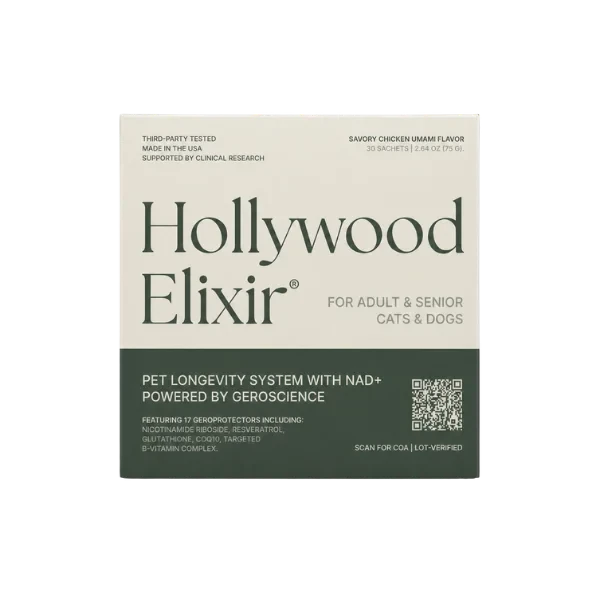
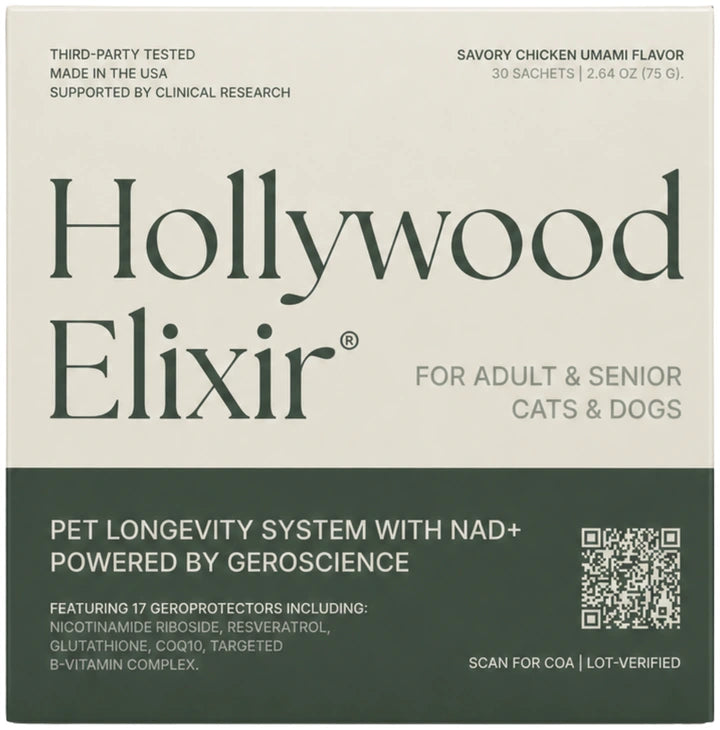
After the access decision, consider healthy-aging nutrition as its own part of care. Hollywood Elixir’s 17-active formula combines NAD+ precursors, CoQ10 and antioxidant nutrients in one daily addition. The appeal is a complete, disclosed combination that is easy to review alongside the rest of your dog’s diet. Its ingredient amounts and serving guide show exactly what you would be adding. 4

Stair-tread measurement and attachment sheet

CheckPuppy TreadsWaterHog Dog Bones
Listed footprint6 × 24 in; trimmable 1Approximately 8.5 × 30 in; listed sizes may vary 2
ConstructionSoft self-adhesive vinyl 1Textile top, smooth rubber backing; 0.25 in overall height 2
Intended settingIndoor; maker says avoid grout 1Indoor or outdoor 2
Attachment decisionConfirm adhesive and removal compatibilityDo not assume fixed placement; maker acknowledges shifting
Stair measurements to recordFlat depth, width, edge shape, step count and landingsThe same measurements; also allow for dimensional variation
After cleaningInspect bond and edges before reuseDry the tread and floor fully, then recheck placement 2

Editorial fit-and-attachment comparison drawn from current first-party specifications. Measurements are manufacturer-reported; the products were not physically tested.

The sheet does not establish staircase suitability, comparative traction or a damage-free installation. Exact product and flooring instructions control.

Educational content only. This material is not a substitute for veterinary advice. Always consult your veterinarian about your dog’s specific needs. These statements have not been evaluated by the Food and Drug Administration. Products mentioned are not intended to diagnose, treat, cure, or prevent any disease.

Glossary

Self-adhesive: Supplied with a sticky backing that attaches the covering to the stair after its protective layer is peeled away.

Rubber backing: The rubber underside of a tread covering. It is a contact surface, not automatically a fixed adhesive bond.

Dimensional variation: The allowed difference between a listed size and the actual piece; WaterHog lists a possible size variation of plus or minus 3%.

Related Reading

References

Numbered references identify the sources used for specific claims. Read the study design, species and evidence boundaries alongside each finding.

  1. Handi Products Puppy Treads. HandiRamp · Undated current pageSpecies/context: dogEvidence boundary: Manufacturer description establishes construction and instructions, not comparative performance or a clinical outcome.↩ 1 · ↩ 2 · ↩ 3 · ↩ 4 · ↩ 5 · ↩ 6 · ↩ 7 · ↩ 8 · ↩ 9 · ↩ 10
  2. WaterHog Dog Bones Stair Treads. WaterHog · Undated current pageSpecies/context: dogEvidence boundary: Manufacturer description establishes construction and instructions, not comparative performance or a clinical outcome.↩ 1 · ↩ 2 · ↩ 3 · ↩ 4 · ↩ 5 · ↩ 6 · ↩ 7 · ↩ 8 · ↩ 9 · ↩ 10 · ↩ 11 · ↩ 12
  3. 2023 AAHA Senior Care Guidelines: Pain Management. American Animal Hospital Association · 2023Species/context: dog, catEvidence boundary: Consensus guidance supports assessment and individually appropriate adaptations; it is not a product trial.↩ 1 · ↩ 2
  4. Hollywood Elixir: current product description and supplement facts. La Petite Labs · Undated current pageSpecies/context: dog, catEvidence boundary: Manufacturer formulation and intended support only; no equipment, disease, mobility or symptom outcome is asserted.↩

FAQ

Will rubber-backed stair treads stay in place without adhesive?

Do not assume so. WaterHog states that its rubber-backed Dog Bones treads can shift over time. Check the exact product’s installation instructions and the floor’s restrictions. If you cannot establish stable placement, that tread is not a workable choice for the staircase. Adding arbitrary adhesive is not a substitute for compatible instructions. 2

What size stair treads should I buy for my dog?

Measure the usable flat depth and coverage width on your stairs, including any differences between steps. Compare those measurements with the exact product, rather than choosing by dog weight. Puppy Treads are listed at 6 × 24 inches; WaterHog Dog Bones treads are approximately 8.5 × 30 inches. Neither size is a universal recommendation. 1 2

Can indoor stair treads be used outdoors?

Use a tread only in the environment the manufacturer specifies. Puppy Treads are described for indoor surfaces. WaterHog labels Dog Bones treads for indoor and outdoor use, but weather suitability does not establish secure placement on your particular stairs. Check attachment and drying requirements as well as the indoor/outdoor label. 1 2

Which stair tread is suitable for a rental home?

Start with the landlord’s permission and the exact flooring restrictions. A removable rubber-backed tread can still react with some floors or move in use. An adhesive tread’s removal instructions do not guarantee an undamaged finish. Choose only after the installation and removal requirements are compatible with that staircase. 1 2

Do stair treads make stairs safe for a dog with arthritis?

A tread changes the contact surface; it does not determine whether climbing or descending is appropriate for the individual dog. Have new difficulty assessed and discuss the route with your veterinary team. If the dog still struggles despite secure footing, changing access may be more useful than buying another tread. 3

Dalmatian looking toward a Hollywood Elixir box held in a person's hand

Discover LPL-01: How This Fits Into a Larger Canine Longevity System

Aging in dogs is not driven by a single pathway. It’s the result of interacting biological systems—energy metabolism, oxidative stress, immune signaling, and structural integrity—changing over time.

This article explores one piece of that puzzle. If you want to understand how these pieces connect—and what actually moves the needle—you need to zoom out.

Start with the underlying science:

Keep exploring

What would you like to understand next?

Search practical guides about healthy aging, cellular energy, ingredients, and daily support for dogs.