Dog Stroller vs Wagon: Which Fits Your Outing?

Choose the entry and handling features; the label alone cannot decide.

By La Petite Labs Editorial 7 min read

As Seen On

Woman hugging a golden retriever while holding a Hollywood Elixir box
Hollywood Elixir® Senior Dog Supplement

17 science-backed actives

From$50/moSave up to 44%Shop Now
Contents

Choose between a dog stroller and wagon by how the dog will board, how they will be contained and how you will move the equipment along your usual route. A stroller can have walk-through doors; a wagon can have a fully enclosed cabin and push handle. The names overlap, so compare the actual design.

Both provide passive transport for a dog who rides inside. Neither is the same as a wheelchair that supports active movement, and neither label establishes an exercise plan or vehicle crash protection.

Start with boarding: lift-in, step-in or an assisted ramp.

Match closed resting space and containment to the dog.

Compare route width, turns, visibility and the empty lift before shopping by category.

The first split is how your dog gets inside

A top opening gives access for placing the dog into a cabin. Low doors or a ramp create another route, but still require a suitable threshold, approach and handling plan. If lifting is the main difficulty, rule out designs that depend on an unmanageable lift before comparing wheel sizes or storage pockets.

The named examples show why labels are unreliable. Ibiyaya’s Grand Cruiser stroller has a fully opening canopy. Pet Gear’s Excursion stroller has front and rear entry so a dog can exit without turning inside. WonderFold’s Max stroller wagon has ramp entries, yet its manual specifically requires assisted boarding. 123 A wagon is not automatically lift-free, and a stroller is not automatically top-loading.

Closed space and containment matter more than an open photograph

Compare the floor and headroom in the actual riding configuration. An open canopy, lowered wall or extended deck can make a product look much roomier than the space available once secured. REDCAMP’s shared wagon page, for example, distinguishes its standard rear deck from an extended length. 4 Clarify what is permitted during movement before counting that extension as resting space.

An enclosed design still needs the maker’s closure and restraint procedure. Max requires its included fitted Pet Harness Latch and the brake during loading and unloading. 3 An open design requires an equally clear containment plan; calm behaviour on a sofa does not establish that a dog will remain in an open cart around traffic, other dogs or sudden noises.

Overhead view of a black-and-white dog beside a food bowl and Hollywood Elixir box

Pushing and pulling create different handling jobs

With a push handle, the cabin is ahead of you. With a pull handle, the wagon follows behind, so decide how you will maintain observation and control. Some products combine features, but use only the handle configurations and accessories the maker permits.

Check overall width, turning room and stops with the complete frame in mind. A large resting floor can be valuable for the dog but awkward in a narrow lift or shop entrance. Wheel size and an all-terrain label do not establish tested performance on your particular surface. Max’s manual, for example, prohibits running, jogging and skating despite its outdoor-transport purpose. 3

Choose features before the category

Work through each row with your dog’s measurements and the exact equipment instructions.

Your limiting taskFeature to investigateStill verify
Dog cannot manage a lift into a cabinLow doors or manufacturer-approved assisted rampThreshold, support and boarding instructions
Dog needs room to stretchUsable floor in the secured riding configurationClosure, headroom and weight limit
Narrow doors or crowded routeOverall width and workable handling positionTurns, stopping space and visibility
Owner must load equipment into a carManageable empty weight and folded dimensionsWhether wheels or accessories must be removed
Dog needs clear containmentAppropriate enclosure plus specified fitted restraintSupervision and exact closure instructions

Original format-selection matrix using documented features from named models and explicitly hypothetical route scenarios.

No universal category winner and no physical terrain, comfort or durability testing. Full model specifications belong in the linked selectors.

Woman smiling beside a golden retriever, a green food bowl and a Hollywood Elixir box

Two hypothetical outings lead to different shortlists

Imagine an apartment outing that begins with a narrow lift, a tight lobby turn and crowded pavements. The first screening questions are overall width, turning space, the owner’s view of the dog and whether the frame can be parked without blocking access. A compact stroller or a suitably compact hybrid might fit; the name “wagon” is not the exclusion criterion.

Now imagine a wide, level park path reached directly from home, with a large dog who needs space to stretch and an assisted entry. A roomy enclosed wagon or low-entry stroller could be worth investigating. But if the same outing starts with lifting the empty equipment into a high car boot, the frame’s weight and folded configuration may change the choice. These are planning examples, not tested outcomes or model endorsements.

Take a feature brief to the model comparison

Write a short requirement list: the boarding method you can manage, minimum usable resting space, the narrowest door, permitted containment and the empty equipment you can lift. Add how it will be cleaned and stored. This gives you a better shortlist than choosing “stroller” or “wagon” first and trying to make the dog fit afterward.

Choose an enclosed low-entry design when it solves the actual boarding and containment problem within the available route. Choose a smaller design when it still fits the dog and is substantially more manageable. If neither works, a different outing or supported carrier may be more practical. Keep any walking portion aligned with the dog’s care plan; transport convenience does not determine how much activity they should do.

For the wider room-by-room plan, see home modifications for senior dogs. This guide resolves the equipment choice; the home plan puts it alongside the other changes your dog needs.

Take those measurements to dog strollers for senior dogs for cabin and entry options, or dog wagons for senior dogs for enclosed hybrids and deck-versus-floor checks.

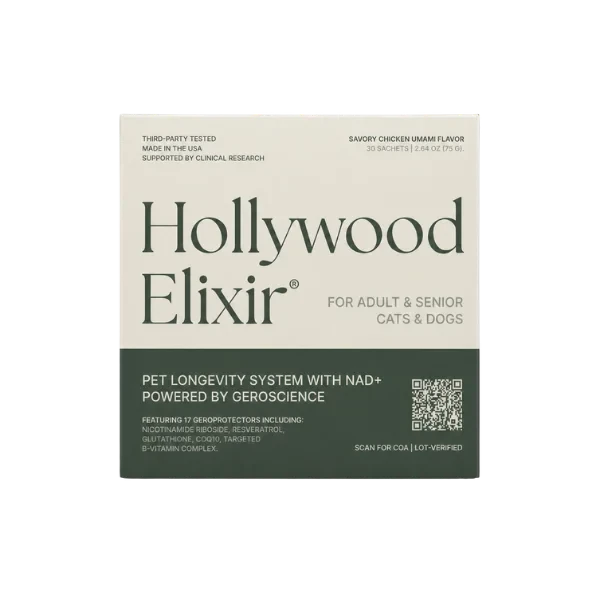
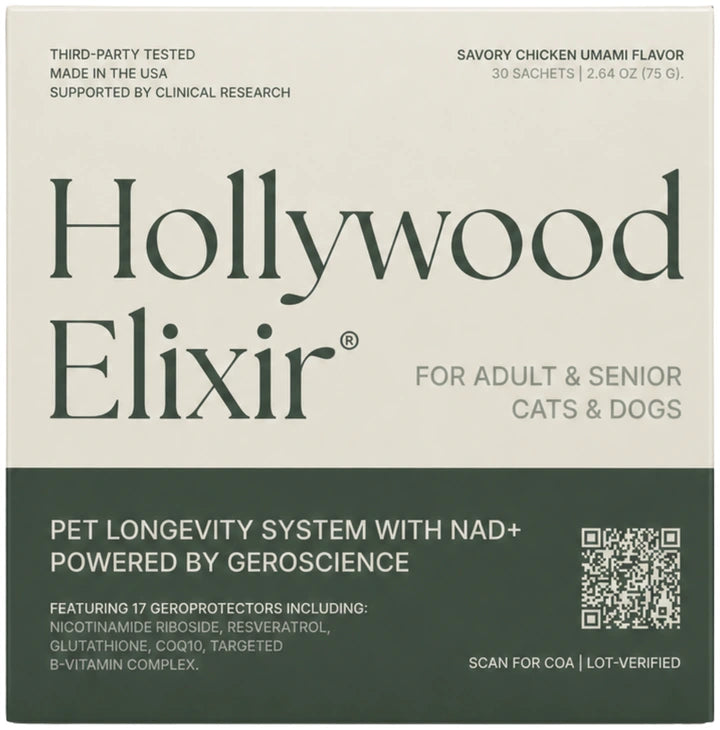
Once the outing format is chosen, the daily meal offers a separate opportunity to keep healthy-aging nutrition straightforward. Hollywood Elixir combines 17 disclosed actives—including NAD+ precursor support, CoQ10 and antioxidant nutrients—in one powder for adult dogs and cats. It mixes into the usual food, and the full amounts and serving guide let you review what the formula adds. Explore the formula and serving guide. 5

For the carrying option, compare carriers for senior dogs using the same entry, size and handling requirements.

Woman sitting with a beagle in a kitchen while holding a Hollywood Elixir box

DVM Voice: Clinical Vignette of a Common Pattern in Senior Dog Aging

Case provided by JoAnna Pendergrass, DVM

Rex, a 7-year-old Labrador Retriever, was brought in after his owner noticed he was slower to rise, hesitant on stairs, and less able to play as before. Examination showed stiffness and reduced hip mobility; radiographs confirmed degenerative joint changes.

His care required weight management, veterinary-guided pain control, nutritional support, and rehabilitation — a comprehensive plan, but one started only after visible decline appeared.

Clinical takeaway: Rex’s case reflects the value of proactive aging support: maintaining lean body condition, monitoring mobility early, and supporting cellular resilience, antioxidant defense, and healthy inflammatory balance before decline becomes obvious.

Single-case vignette. Not generalizable. Veterinary oversight is essential for pain, stiffness, or suspected joint disease.

Explore Hollywood Elixir Research →

Educational content only. This material is not a substitute for veterinary advice. Always consult your veterinarian about your dog’s specific needs. These statements have not been evaluated by the Food and Drug Administration. Products mentioned are not intended to diagnose, treat, cure, or prevent any disease.

Glossary

Through-entry: Front-and-back access that lets a dog enter through one door and leave through the other without turning inside.

Canopy: The upper cover over the riding space. An opening canopy provides top access, but its open position does not describe the secured riding space.

Folded dimensions: The measurements of the packed equipment used to judge storage fit, rather than the space available to the dog while riding.

Related Reading

References

Numbered references identify the sources used for specific claims. Read the study design, species and evidence boundaries alongside each finding.

  1. Grand Cruiser Large Dog Stroller FS2380-B. ibiyaya · Undated current pageSpecies/context: dogEvidence boundary: Only dimensions and physical design adopted. Unverified no-strain, clinical cushion, universal-terrain and safety claims are excluded; folded and cushion dimensions conflict and are not used.↩
  2. NO-Zip Excursion current product page. Pet Gear · Undated current pageSpecies/context: dogEvidence boundary: Manufacturer-reported design and instructions only; no independent performance measurement or clinical outcome established.↩ 1 · ↩ 2 · ↩ 3
  3. Max Large Pet Stroller Wagon linked current manual. WonderFold · Undated current pageSpecies/context: dogEvidence boundary: Text extracted from search text array in the exact manufacturer-linked current manual, with page markers. Current manual and PDP both say 180 lb; older higher limit is excluded. Overall dimensions are not interior floor dimensions.↩ 1 · ↩ 2 · ↩ 3 · ↩ 4 · ↩ 5 · ↩ 6
  4. Folding Dog Wagon variant listings. REDCAMP · Undated current pageSpecies/context: dogEvidence boundary: Shared variant page. Do not adopt unassigned weight/folded dimensions or assume brake, tether, extension riding permission or containment instructions. Not a cleared recommendation.↩
  5. Hollywood Elixir: current product description and supplement facts. La Petite Labs · Undated current pageSpecies/context: dog, catEvidence boundary: Manufacturer formulation and intended support only; no equipment, disease, mobility or symptom outcome is asserted.↩

FAQ

What is the difference between a dog stroller and wagon?

Typically the names suggest different cabin and handling styles, but hybrids overlap. Compare entry height, floor space, closures, restraint, push or pull operation and the overall frame. Those features tell you more about suitability than the label alone.

Is a wagon better for a large senior dog?

Only if it offers enough usable closed space and a boarding method the dog and handler can manage. Some strollers have low front and rear doors, while some wagons still need assistance at their ramps. A high load capacity alone does not establish resting room or manageable handling. 23

Which option avoids lifting my dog?

Investigate a permitted low-door or ramp-entry design, but check the exact instructions. Pet Gear describes through-entry for Excursion; WonderFold Max requires assisted boarding despite its ramps. The dog’s ability to cross the threshold and the support plan remain separate checks. 23

Are wagon wheels better for rough ground?

The category name does not prove that. Check the exact model’s allowed surfaces and activities, the route’s obstacles and the handling instructions. Do not infer comparative ride quality, stability or durability from wheel size without relevant evidence.

Can one product count as both a stroller and a wagon?

Yes. WonderFold markets Max as a large pet stroller wagon, with a push handle, enclosed pet space and ramp entries. Treat the overlap as a reason to shop by features. Its own boarding and restraint instructions still govern use. 3

Dalmatian looking toward a Hollywood Elixir box held in a person's hand

Discover LPL-01: How This Fits Into a Larger Canine Longevity System

Aging in dogs is not driven by a single pathway. It’s the result of interacting biological systems—energy metabolism, oxidative stress, immune signaling, and structural integrity—changing over time.

This article explores one piece of that puzzle. If you want to understand how these pieces connect—and what actually moves the needle—you need to zoom out.

Start with the underlying science:

Keep exploring

What would you like to understand next?

Search practical guides about healthy aging, cellular energy, ingredients, and daily support for dogs.