Allergy Chews for Cats

What actually supports itchy skin: chews vs a clean powder

By La Petite Labs Editorial 15 min read

Woman nuzzling an orange cat beside a fluffy gray-and-white cat, a Pet Gala box and a food bowl
Pet Gala™ Daily skin & coat system · adult & senior cats Starting at $56/month 

If you're shopping for allergy chews for cats, the honest first answer is that a chew isn't automatically the best tool for an itchy cat — a cleaner powder you mix into one consistent meal often makes it far easier to see what's actually changing. Chews are built for palatability, so they tend to carry flavor proteins, binders, and low-dose 'kitchen sink' blends right when your household needs clarity. Skin flares in cats rarely trace to one simple cause: the visible problem may be overgrooming, scabs, dandruff, or recurrent ear debris, but underneath is usually a mix of itch signaling, a disrupted skin barrier, and sometimes secondary infection — which is why relapses are common when the barrier stays fragile. This page has two practical goals: help you compare cat skin allergy chews vs powder without muddying your decision, and build an orderly, trackable routine that supports normal skin function while your veterinarian handles fleas, infection, and true allergy triggers.

  • Chews vs powder: chews aren't stronger; a powder mixed into one meal is cleaner and lets you change one variable at a time.
  • 'Allergy' is three problems: itch signaling, barrier breakdown, and sometimes infection — one product rarely solves all three.
  • Is bromelain safe for cats? It has anti-inflammatory activity but also reported GI upset, bleeding-risk, and drug-interaction concerns — clear it with your vet first [3].
  • Watch the binders: flavor systems, multiple starches, and guar-type gums add proteins that complicate a food-sensitivity trial.
  • Track measurables: licking minutes, new scabs, ear scratching, and stool changes beat vague 'seems better' impressions.
  • Bring a tight log to the vet and ask about fleas, infection, ear cytology, and a strict diet trial.

Why Treat-like Formats Can Mislead Allergy Decisions

Many owners assume allergy chews for cats are “stronger” because they look like a treat. The reality is that the chew format often forces compromises: tiny active doses, heat and moisture that can destabilize sensitive ingredients, and flavor systems that add extra proteins or gums that some cats react to. For itchy cats, the target is rarely a single trigger; it is the skin’s barrier, the immune signaling around that barrier, and the secondary infections that follow when scratching starts.

A cleaner routine begins by separating “delivery” from “support.” A cat allergy supplement powder can be mixed into a known, consistent food so the household can change one variable at a time. That makes response patterns easier to interpret: if the cat’s licking eases but ear debris persists, the next step is different than if the coat improves but the belly stays inflamed. This pacing creates leeway for better decisions instead of chasing the newest chew.

Woman smiling with a tabby cat on her shoulder while holding a Pet Gala box

Itch, Barrier, or Infection: What “Allergy” Often Means

“Allergy” is a shorthand that hides three different problems: itch signaling, barrier breakdown, and microbial overgrowth. Feline atopic skin syndrome can involve environmental sensitivity, but the visible crisis is often the barrier losing its orderly structure, letting irritants and microbes interact with immune cells more easily [6]. When that happens, a supplement can support normal skin function, yet it cannot replace diagnosis of fleas, food reactions, mites, or infection.

At home, the most useful shift is to stop labeling every flare as “the same allergy.” Note where the cat targets: chin acne-like bumps, belly overgrooming, paw chewing, or ear scratching. Also note timing: worse after litter changes, seasonal windows, or after a new treat. This context helps decide whether a clean allergy alternative cats approach (simpler ingredients, fewer extras) is worth trying before layering on more products.

Woman kissing a fluffy gray cat while holding an orange tabby and a Pet Gala box

Cat Allergy Chews vs. Powder: Which Gives You Cleaner Answers?

Chews are built for palatability, not clinical clarity — that's the heart of cat skin allergy chews vs powder. They often rely on animal digest, dairy notes, or multiple plant fibers to hold shape, and those extras can muddy the picture in a cat with food sensitivity. A powder can be simpler: fewer binders, fewer flavor layers, more room for ingredients dosed at meaningful amounts.

You can test this without drama. Standardize the base diet for two weeks and change only the delivery format. A chew becomes 'another treat' — extra calories, extra snack proteins — while a powder keeps the normal meal as the anchor and lets you hold litter, shampoo, and treat frequency steady. That stability is what makes the next vet conversation productive.

Woman petting a silver tabby on a kitchen counter beside an open Pet Gala box

The Antihistamine Myth and What It Misses in Cats

A common misconception is that “if it’s allergies, an antihistamine should fix it.” In cats, itch can be driven by multiple mediators, and antihistamines may be well tolerated yet not reliably effective for atopic dermatitis-related pruritus [4]. That does not mean nothing works; it means the plan should not depend on a single lever. Barrier support, parasite control, and infection checks often determine whether the skin becomes less turbulent.

Households often see partial changes: the cat sleeps better but still overgrooms the belly, or the ears stay waxy. Those mixed signals are valuable, not confusing, when tracked. A powder-based routine can be paired with consistent flea prevention and a simple grooming schedule so the owner can see what is truly shifting. When a chew is swapped in and out like a treat, the pattern can disappear under day-to-day variability.

Woman holding a fluffy white cat and a Pet Gala box

A Real-world Scenario That Shows Why Clean Inputs Matter

Illustrative scenario; not a patient record: A five-year-old indoor cat starts licking the belly until the hair thins, then develops small scabs along the neck. The owner tries allergy chews for cats for a month; the cat eats them happily, but the licking returns whenever the home switches to a new bag of treats. When the household moves to a cat allergy supplement powder mixed into a single, consistent wet food, the response becomes clearer: less licking within weeks, but persistent ear scratching that later proves to be yeast.

The point of the story is not that powder is “magic.” It is that cleaner inputs create clearer outputs. Once the belly improves, the household has leeway to address the remaining problem with the veterinarian instead of guessing. This is how a clean allergy alternative cats strategy supports decision-making: simplify, observe, then choose the next step based on what the cat’s skin is actually doing.

“Treat-like supplements can add variables when the goal is clarity.”

Owner Checklist: Signs That Point to the Next Step

Owner checklist (home observations that matter more than “itchy”): (1) symmetry—does grooming focus on belly/inner thighs or one spot only; (2) skin texture—greasy, flaky, or normal; (3) ear debris—dark wax, odor, or head shaking; (4) litter box clues—soft stool can travel with food sensitivity; (5) coat change—broken hairs from overgrooming versus true shedding. These details help separate barrier trouble from infection or parasites.

Write these observations down before changing products. If a chew is used, record the exact brand and flavor, because “chicken” can mean multiple protein sources and additives. If a powder is used, record the base food it is mixed into and whether the cat finishes the full portion. The goal is an orderly log that a veterinarian can interpret, not a rotating shelf of half-tried options.

Two long-haired cats looking toward a Pet Gala box held above a food bowl

What to Track Week over Week for Clearer Patterns

What to track week over week: (1) minutes per day spent licking or chewing; (2) number of new scabs felt during petting; (3) ear scratching episodes; (4) stool consistency and frequency; (5) coat shine versus dandruff; (6) sleep disruption from itching. These markers are more measurable than “seems better,” and they reveal response patterns that can guide whether the plan is working or simply shifting symptoms.

Tracking also prevents a common trap: changing three things at once. If the household switches litter, adds a new chew, and starts a medicated wipe in the same week, there is no way to know what created change. A cat allergy supplement powder is often easiest to keep constant because it can be measured and mixed into the same meal daily. That consistency creates cleaner comparisons over time.

Hand gently petting an orange-and-white cat beside a Pet Gala box and a food bowl

Hidden Proteins and Binders: the Chew Format Problem

Ingredient “extras” are where chews can quietly complicate allergy-prone cats. Flavorings, glycerin, multiple starches, and mixed proteins can all add variables, and some cats react to the chew itself rather than the intended actives. Powders can be formulated with fewer binders, which is why cat skin allergy chews vs powder is not just a preference debate—it is a control-of-variables debate. Cleaner formulas also make it easier to stop and restart without changing the entire diet.

In practice, “clean” should mean short ingredient lists and transparent labeling, not trendy botanicals. If a cat refuses a powder, it can be mixed into a small amount of a familiar topper and offered separately, so the main meal stays predictable. If a cat only accepts chews, treat them like a controlled trial: same time daily, no additional treats, and a written log of skin and ear changes.

Man sitting with two long-haired cats on a sofa beside a Pet Gala box and a food bowl

Fel D 1 Strategies Aren’t the Same as Skin Support

Some “allergy” products aim at the household’s human allergy burden rather than the cat’s skin. Diets containing egg-derived anti–Fel d 1 IgY have been shown to lower measurable Fel d 1 levels in cat saliva, a mechanism that may reduce allergen spread in the home [2]. That is a different goal than calming a cat’s inflamed skin. It can be useful, but it should not be confused with a direct plan for feline itching, ear disease, or overgrooming.

Owners can decide which problem they are solving by asking one question: is the priority the cat’s comfort, or the family’s symptoms around the cat? If the cat is chewing paws and developing scabs, the plan needs barrier support and medical evaluation. If the cat is comfortable but the household is sneezy, Fel d 1–focused strategies may fit. Mixing these goals is how expectations become mismatched.

Supplements Work Best as Maintenance, Not Rescue

Supplements can support normal skin function, but they are not a substitute for targeted veterinary therapies when disease is active. In cats with hypersensitivity dermatitis, dietary supplementation with ultramicronized palmitoylethanolamide has been studied for maintaining remission, highlighting that nutrition-based support can be part of a longer plan rather than a quick fix [5]. This is the right mental model for powders: daily support that contributes to barrier and comfort while the primary cause is addressed.

At home, this means setting the timeline correctly. Expecting a chew to “stop itching tonight” often leads to overuse, frequent brand switching, or stacking multiple products. A cleaner powder routine is easier to keep steady for several weeks, which is the time window where coat quality, dandruff, and grooming intensity can become more orderly. If the cat is worsening, that is a signal to escalate to the veterinarian rather than doubling down on supplements.

“Track licking, scabs, and ears—then adjust one thing at a time.”

Close-up of long white cat fur beside a veterinary vignette about visible skin and coat changes

DVM Voice: Clinical Vignette of When Skin Changes Point Deeper Than the Surface

Case provided by Sarah Calvin, DVM

Maverick, a 4-year-old Siamese cat, was brought in for hair loss across his lower abdomen and red, flaky skin lesions that had progressed over the previous month. His owners were unsure whether he was itchy or overgrooming.

Examination showed broken hairs, abdominal alopecia, and lesions consistent with bacterial skin infection. Further testing ruled out fleas, FeLV/FIV, and common fungal causes. Because his grooming pattern suggested deeper discomfort, his veterinarian continued the workup.

Radiographs and urinalysis revealed bladder stones, crystalluria, and blood in the urine. Maverick’s overgrooming was linked to urinary pain — a case where skin changes were secondary to an internal problem.

His care required a staged plan: stabilizing the skin infection, surgically removing the bladder stones, managing pain, transitioning to a therapeutic diet, and supporting skin-barrier recovery with appropriate nutrition and fish oil.

Hair regrowth began by 8 weeks. By 6 months, his coat had fully recovered, with no recurrence after the urinary issue was resolved.

Clinical takeaway: Maverick’s case shows why feline coat loss and overgrooming deserve careful veterinary investigation. Skin and coat health can reflect pain, stress, nutrition, infection, barrier weakness, or internal disease — not just surface-level grooming behavior.

Single-case vignette. Not generalizable. Veterinary diagnosis and oversight are essential for overgrooming, hair loss, skin lesions, urinary signs, pain, or suspected infection.

Explore Pet Gala Research →
Long-haired tabby being combed beside a Pet Gala box and a food bowl

What Not to Do During an Itchy-cat Flare

What not to do (common mistakes that prolong flares): (1) using multiple new treats while “testing” allergy chews for cats; (2) stopping flea control because the cat is indoors; (3) bathing too often with scented shampoos that strip oils; (4) ignoring ear debris until the cat is head-shy; (5) assuming hair loss is shedding rather than overgrooming. Each of these adds friction to the skin’s recuperation speed.

A cleaner plan is deliberately boring: one base diet, one supplement format, and one tracking sheet. If the household wants a clean allergy alternative cats approach, remove unnecessary variables first—especially flavored dental treats and table scraps. If the cat needs a reward, use a measured portion of the regular diet. This keeps the “trial” honest and prevents the supplement from being blamed for unrelated triggers.

Orange-and-white cat eating from a bowl beside a Pet Gala box

Vet Visit Prep That Speeds up the Right Diagnosis

Vet visit prep: bring a short timeline and specific questions. Useful items include photos of the worst days, a list of all chews/treats and flavors, and whether itching is seasonal or year-round. Ask: “Where do you think the itch is coming from—fleas, food, atopy, infection, or a mix?” “Do the ears need cytology today?” “Should a diet trial be strict, and for how long?” These questions help the veterinarian choose the next diagnostic step rather than guessing.

Also ask how to judge success. Many cats look better for a week after a steroid injection, then relapse because the barrier and triggers were never addressed. A powder-based support plan can be discussed as part of the long game: supporting normal skin and coat while the clinician manages parasites, infection, and inflammation. That shared plan reduces frustration and makes follow-ups more efficient.

Brown-and-white tabby licking its nose beside a Pet Gala box and a food bowl

Is Bromelain Safe for Cats?

Is bromelain safe for cats? Not automatically — treat it as a real intervention, not a gentle 'natural' add-on. Bromelain has reported anti-inflammatory and immunomodulatory activity, but it also carries reported gastrointestinal side effects, potential bleeding-risk considerations, and drug-interaction potential [3]. That doesn't forbid it; it means clearing it with your veterinarian first, especially for cats on other medications or facing a dental procedure.

This is another reason a powder can be the cleaner choice: it can skip the 'kitchen sink' blends that stack many botanicals at once. When a cat has skin disease, fewer ingredients means fewer things that could disrupt appetite or stool — so if soft stool appears, you still know whether the skin plan is helping or the gut is just irritated.

Diet Stability: the Quiet Foundation Behind Skin Change

Food can contribute to clinical management in feline atopic skin syndrome, but it works best as part of a structured plan rather than a rotating set of “allergy” products [6]. The skin barrier depends on adequate nutrients, consistent energy intake, and a stable gut environment that does not keep shifting. When chews are added freely, they can unintentionally become a daily mix of proteins and additives that undermines the very stability the skin needs.

A practical household approach is to treat the cat’s diet like a controlled environment. Keep the base food consistent, choose either chews or a cat allergy supplement powder (not both), and avoid “limited ingredient” claims that still include multiple animal sources. If the cat is on a veterinary diet trial, confirm whether any chew—no matter how “hypoallergenic”—breaks the rules. That clarity prevents accidental resets.

A Decision Framework for Chews, Powder, and Next Steps

The cleanest decision framework is to match the tool to the problem. If the cat’s main issue is barrier fragility—dandruff, brittle coat, recurrent scabs—daily nutritional support can be reasonable. If the main issue is sudden intense itch, ear pain, or oozing lesions, the priority is diagnosis and medical management, with supplements as background support. This prevents the common cycle where owners keep switching allergy chews for cats while an infection quietly persists.

Owners can also match the format to the cat’s behavior. Cats that graze may not finish a full meal, making powders harder unless offered in a small “dose meal.” Cats that inhale treats may do better with chews, but only if the chew’s ingredient list is short and the household can keep other treats out. The best plan is the one that can be followed consistently for weeks.

Long-haired tabby beside a Pet Gala box held by a person wearing blue scrubs and a stethoscope

Home Irritants That Keep Skin More Turbulent

A clean allergy alternative cats approach also includes the environment, because skin flares are often multi-factor. Dust, fragranced laundry products on bedding, and harsh cleaners can add irritation when the barrier is already compromised. None of these are “the cause” in every cat, but reducing irritant load can create leeway while the veterinarian addresses primary drivers. The goal is not perfection; it is fewer avoidable hits to already reactive skin.

Simple changes tend to be the most sustainable: unscented litter, rinsing detergent thoroughly, and wiping paws after balcony time if pollen is heavy. Pair these with a consistent supplement format so the household can see whether the cat’s grooming becomes less turbulent. When the home environment is chaotic and the supplement changes weekly, it is nearly impossible to know what is helping.

Couple cuddling a silver tabby cat

Human Cat Allergies vs. Cat Skin Disease: Don’t Mix Goals

When human family members are allergic, it helps to understand what is evidence-backed and what is wishful thinking. Cat allergen immunotherapy has been described as a potential option for cat-allergic patients when avoidance and medications are not enough, though evidence and practical considerations vary [1]. That is a human-directed medical pathway, separate from the cat’s skin plan. Confusing these two goals can lead to buying the wrong product for the wrong outcome.

In mixed-goal households, split the plan into two columns: “cat comfort” and “home allergen management.” The cat comfort column focuses on fleas, infection checks, diet stability, and barrier support. The home column focuses on cleaning routines, HEPA filtration, and possibly Fel d 1–targeted nutrition. Keeping these lanes separate reduces disappointment and helps each intervention be judged fairly.

A Simple Closing Checklist for More Orderly Skin Routines

A thoughtful plan for itchy cats is less about the 'best' chew and more about an orderly routine the skin can respond to. Clarify the problem (itch vs barrier vs infection), track measurable markers, and bring a tight log to your veterinarian when the pattern doesn't add up. Keep flea prevention consistent, remove extra treats for a defined window, and change one variable at a time.

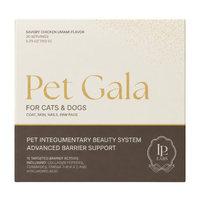
For the daily barrier-support piece, Pet Gala is the food-mixed powder that fits this lane: it discloses its amounts — ceramides at 8 mg, an omega 3-6-9 blend at 150 mg plus omega 7 at 50 mg, biotin at 50 mcg, and zinc at 1.5 mg per sachet — the lipids and keratin nutrients that support a comfortable skin barrier and easier grooming days. It supports normal skin function; it doesn't replace veterinary care for fleas, infection, or allergy. Explore Pet Gala →

“Barrier support is maintenance; diagnosis is what stops relapses.”

Educational content only. This material is not a substitute for veterinary advice. Always consult your veterinarian about your cat’s specific needs. These statements have not been evaluated by the Food and Drug Administration. Products mentioned are not intended to diagnose, treat, cure, or prevent any disease.

Glossary

  • Feline atopic skin syndrome (FASS) - A pattern of allergic skin disease in cats involving itch, inflammation, and barrier disruption.
  • Skin barrier - The outer layers of skin that limit water loss and block irritants and microbes.
  • Overgrooming - Excessive licking or chewing that causes broken hairs or bald patches.
  • Secondary infection - Bacterial or yeast overgrowth that develops after scratching or barrier breakdown.
  • Ear cytology - A microscope check of ear debris to look for yeast, bacteria, and inflammation.
  • Food trial - A veterinarian-guided period of feeding a strict diet to evaluate food-related skin or gastrointestinal signs.
  • Binders (in chews) - Ingredients like gums or starches that hold a chew together but add variables for sensitive cats.
  • Response patterns - Repeatable changes in signs (licking, scabs, ear scratching) that can be measured week over week.
  • Fel d 1 - A major cat allergen found largely in saliva and spread to fur during grooming.

Related Reading

References

Numbered references identify the sources used for specific claims. Read the study design, species and evidence boundaries alongside each finding.

  1. Dhami S, Agarwal A. Does evidence support the use of cat allergen immunotherapy? Current opinion in allergy and clinical immunology · 2018· DOI 10.1097/aci.0000000000000457Study design/context: not-stated-in-titleSpecies/context: catEvidence boundary: The species/context tag is inferred only from the source title; the actual study population and claim-level relevance still depend on the full methods and outcomes.
  2. Satyaraj E, Li Q, Sun P, et al. Anti-Fel d1 immunoglobulin Y antibody-containing egg ingredient lowers allergen levels in cat saliva. Journal of feline medicine and surgery · 2019· DOI 10.1177/1098612x19861218Study design/context: not-stated-in-titleSpecies/context: catEvidence boundary: The species/context tag is inferred only from the source title; the actual study population and claim-level relevance still depend on the full methods and outcomes.
  3. Chakraborty AJ, Mitra S, Tallei TE, et al. Bromelain a Potential Bioactive Compound: A Comprehensive Overview from a Pharmacological Perspective. Life (Basel, Switzerland) · 2021· DOI 10.3390/life11040317Study design/context: not-stated-in-titleSpecies/context: not-stated-in-titleEvidence boundary: The species or study context is not established by the title; consult the full source before applying it to an individual pet.↩ 1 · ↩ 2
  4. Wildermuth K, Zabel S, Rosychuk RA. The efficacy of cetirizine hydrochloride on the pruritus of cats with atopic dermatitis: a randomized, double-blind, placebo-controlled, crossover study. Veterinary dermatology · 2013· DOI 10.1111/vde.12067Study design/context: not-stated-in-titleSpecies/context: catEvidence boundary: The species/context tag is inferred only from the source title; the actual study population and claim-level relevance still depend on the full methods and outcomes.
  5. Noli C, Della Valle MF, Miolo A, et al. Effect of dietary supplementation with ultramicronized palmitoylethanolamide in maintaining remission in cats with nonflea hypersensitivity dermatitis: a double-blind, multicentre, randomized, placebo-controlled study. Veterinary dermatology · 2019· DOI 10.1111/vde.12764Study design/context: not-stated-in-titleSpecies/context: catEvidence boundary: The species/context tag is inferred only from the source title; the actual study population and claim-level relevance still depend on the full methods and outcomes.
  6. Watson A, Laxalde J, Brément T, et al. A Randomised-Controlled Study Demonstrates That Diet Can Contribute to the Clinical Management of Feline Atopic Skin Syndrome (FASS). Animals : an open access journal from MDPI · 2025· DOI 10.3390/ani15101429Study design/context: not-stated-in-titleSpecies/context: catEvidence boundary: The species/context tag is inferred only from the source title; the actual study population and claim-level relevance still depend on the full methods and outcomes.↩ 1 · ↩ 2

FAQ

What are allergy chews for cats meant to do?

Most allergy chews for cats are positioned as daily support for normal skin comfort, coat quality, or seasonal sensitivity. They typically combine fatty acids, vitamins, and sometimes botanicals in a treat-like format.

They are not a substitute for diagnosing fleas, mites, infection, or food reactions. The most useful way to think about them is as background support that is easiest to judge when the rest of the diet and treats are kept consistent.

Why do chews sometimes disappoint with itchy cats?

Chews can disappoint because the format often requires binders, flavorings, and extra proteins that add variables. In a sensitive cat, the chew itself may become part of the problem, especially if it functions like an additional daily treat.

They can also set unrealistic expectations: many skin issues involve barrier disruption plus secondary infection, which cannot be solved by a supplement alone. A cleaner plan focuses on stability, tracking, and veterinary evaluation when signs persist.

Is a cat allergy supplement powder a cleaner option?

Often, yes. A cat allergy supplement powder can be formulated with fewer binders and less flavor “machinery,” which helps owners control variables when troubleshooting skin and coat problems.

Powder also fits better into a measured routine: it can be mixed into a consistent meal and kept steady for several weeks. That makes response patterns easier to interpret than when a chew is offered intermittently like a snack.

Can antihistamines replace supplements for itchy cats?

Not reliably. In a controlled trial of cats with atopic dermatitis, cetirizine did not show significant antipruritic benefit compared with placebo, even though it was generally well tolerated(Wildermuth, 2013).

That does not mean antihistamines never have a role; it means the plan should not depend on them alone. Many cats need parasite control, infection checks, and barrier support, with medications chosen by a veterinarian based on the cat’s pattern.

Are “natural” enzymes like bromelain always safe for cats?

“Natural” does not automatically mean low-risk. Bromelain has reported gastrointestinal side effects and potential bleeding-risk considerations, and it may interact with some drugs in general pharmacology discussions(Chakraborty, 2021).

For cats, the safest approach is to review any multi-botanical chew with a veterinarian, especially if the cat is on other medications or has a procedure coming up. Cleaner formulas with fewer extras are often easier to manage.

Is it okay to combine chews and powder together?

Combining formats often makes troubleshooting harder because it adds more ingredients and more variability. If the goal is to learn what helps, it is usually better to choose one format and keep everything else steady.

If a veterinarian recommends multiple supports, introduce them one at a time with a tracking log. That pacing protects clarity and reduces the chance that a new chew’s flavor proteins will be mistaken for “allergies getting worse.”

When should an owner call the vet urgently?

Call promptly if there are open sores, swelling of the face, rapid worsening itch, lethargy, refusal to eat, or signs of significant ear pain (crying, head tilt, or sudden head-shyness). These can indicate infection, parasites, or other problems that need direct care.

Also call if a new supplement coincides with vomiting, diarrhea, or collapse. A supplement plan should support normal function; it should never be used to “wait out” severe symptoms.

Can diet changes help feline atopic skin syndrome?

Diet can contribute to clinical management for some cats with feline atopic skin syndrome, especially when it supports barrier function and reduces unnecessary variability(Watson, 2025). The key is structure: consistent feeding and a clear plan, not frequent switching.

If a strict diet trial is recommended, even “hypoallergenic” chews can break it. Ask the veterinarian what counts as a violation, and consider a powder mixed into the approved food only if it fits the trial rules.

Orange tabby cat stretching on a green rug in the feline integumentary-system framework section

Discover LPL-01: How This Fits Into a Complete Feline Integumentary Support System

Skin, coat, and nails in cats are not surface traits. They reflect deeper biological systems—barrier integrity, hydration dynamics, lipid balance, and structural protein turnover—working in coordination.

When these systems drift, the signs are subtle but telling: reduced coat softness, increased shedding, dryness, brittle claws, changes in grooming behavior.

This article explores one piece of that system. If you want to understand how true coat quality and skin resilience are built in cats—and what actually drives visible improvement—you need to zoom out.

Start with the underlying science:

Keep exploring

What would you like to understand next?

Search practical guides about skin, coat, barrier health, ingredients, and daily care for cats.