
RESEARCH CORNER
Dogs - Omega-3 Coat Trial

Combarros et al. 2020: Omega-3, EPA/DHA, and Coat Quality in Dogs

This is one of the cleaner dog coat-quality trials behind omega-3 marketing. It supports EPA/DHA as a real coat-health lane, but it also shows why dose, duration, and freshness matter more than vague "omega blend" copy.

Evidence grade
B
randomized placebo-controlled trial
Species
Dogs
poor-quality coats
Misuse risk
Medium
omega-label vagueness
Last reviewed
June 7, 2026
v 2026.3
Executive Summary
SHOPPER TRANSLATION - 60-SEC READ
  1. 1 This was a real coat-quality trial. It tested dogs with poor haircoat, not just fatty-acid theory.
  2. 2 The active dose was specific. The active capsules provided 110 mg EPA and 68 mg DHA daily.
  3. 3 Visible change took time. Clinical coat score improved from Day 60 and returned toward baseline after withdrawal.
  4. 4 Consistency matters. EPA/DHA rose in erythrocyte membranes by Day 30 and dropped after the routine stopped.
  5. 5 Use it as a label filter. "Contains omegas" is too weak; ask for EPA/DHA amounts, source, freshness controls, and realistic timing.

Quick answers

What did Combarros et al. 2020 test?

It tested daily n-3 oil capsules against placebo in dogs with poor haircoat for 90 days, with follow-up after withdrawal.

What did it find?

Clinical coat scores improved from Day 60, EPA/DHA incorporated into erythrocyte membranes earlier, and effects faded after stopping.

Does "omega blend" equal this evidence?

No. The study used defined EPA and DHA amounts; labels need per-serving EPA/DHA disclosure to be comparable.

How long should shoppers expect coat support to take?

The paper supports a weeks-to-months expectation, not overnight shine.

How does La Petite Labs use it?

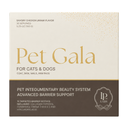
We use it as a strong omega lane inside Pet Gala, not as the whole skin-and-coat system.

A prospective, randomized, double blind, placebo-controlled evaluation of the effects of an n-3 essential fatty acids supplement (Agepi omega 3) on clinical signs, and fatty acid concentrations in the erythrocyte membrane, hair shafts and skin surface of dogs with poor quality coats

§I·Study at a Glance

Twenty-four dogs with poor haircoat received placebo or daily n-3 oil capsules for 90 days. Supplemented dogs showed improved clinical scores from Day 60, EPA/DHA incorporation from Day 30, increased total lipids on hair shafts, and loss of effect after withdrawal.

Authors
Combarros D, Castilla-Castano E, Lecru LA, Pressanti C, Amalric N, Cadiergues MC
Journal
Prostaglandins, Leukotrienes and Essential Fatty Acids
Year
2020
Cohort N
24 dogs with poor haircoat
Duration
90 days supplementation, followed through Day 180 after withdrawal
Intervention
Daily n-3 oil capsules providing 110 mg EPA and 68 mg DHA, compared with placebo
Primary endpoint
Clinical coat score, EPA/DHA in erythrocyte membrane, hair-shaft total lipids, skin-surface neutral lipids
Topic
Skin, Coat and Fatty Acids
Grade B· randomized placebo-controlled trialRelevance · HighMisuse risk · Medium
Plain-English Boundary

What a product is allowed to take from this paper.

This paper supports EPA/DHA as a real coat-quality lane. It does not support vague omega claims or whole-formula superiority by itself.

I · Supports

Strongest fair reading

  • Daily EPA/DHA supplementation can influence coat-quality markers in dogs with poor haircoat.
  • Tissue fatty-acid incorporation and visible coat change operate on different timelines.
  • Stopping supplementation can reverse gains, making routine consistency important.
  • Per-serving EPA and DHA disclosure is decision-useful for shoppers.
§II.A · cite as #boundary-supports
II · Suggests

Useful shopping implications

  • Ask labels for EPA and DHA milligrams, not only fish oil or omega blend.
  • Expect 8 to 12 weeks before judging visible coat outcomes.
  • Look for freshness, oxidation, and contaminant controls for marine oils.
  • Treat omega support as one lane within a broader skin-and-coat system.
§II.B · cite as #boundary-suggests
III · Does not prove

What it does not prove

  • It does not test cats.
  • It does not prove every omega source or blend is equivalent.
  • It does not prove disease treatment for dermatologic conditions.
  • It does not prove Pet Gala or any finished multi-ingredient formula reproduces the trial.
§II.C · cite as #boundary-does-not-prove
IV · Claims to avoid

Language to distrust

  • "Omega blend clinically proven" without EPA/DHA disclosure.
  • "Overnight coat transformation" based on a 90-day trial.
  • "Treats allergies or dermatitis" based on coat-quality data.
  • "Plant omega-3 equals EPA/DHA" especially for cats.
§II.D · cite as #boundary-avoid
§III · What Was Tested

What the trial actually tested

Combarros 2020 is useful because it tested real dogs with poor haircoat, not just fatty-acid theory.

Twenty-four dogs received placebo or n-3 oil capsules for 90 days. The active capsules supplied defined EPA and DHA amounts, and the researchers followed clinical signs and tissue fatty-acid changes through Day 180.

That design gives shoppers a rare practical lesson: coat changes take time, and the body only keeps the signal while the routine continues.

Figure 1
Defined EPA/DHA over a real coat timeline
The study followed dogs through supplementation and withdrawal.
Source: Combarros et al. 2020Figure is a La Petite Labs editorial visualization of the paper design; it is not a reproduction from the article.
§IV · What Was Found

What the paper found

The treated dogs improved clinically from Day 60, and fatty-acid incorporation appeared earlier.

EPA and DHA increased in erythrocyte membranes from Day 30, while total lipids on hair shafts increased progressively in supplemented dogs. After supplementation stopped, the clinical score returned toward baseline by Day 180.

That is exactly the kind of result a careful skin-and-coat brand should respect: useful, visible, and not magical.

Figure 2
Visible coat change took time
Simplified direction: tissue incorporation appeared before visible score improvement.
Source: Combarros et al. 2020Simplified editorial summary. Read the cited paper before using these data in formal claims.
Figure 3
What transfers to the product shelf
EPA/DHA disclosure is the buyer-relevant bridge.
Source: La Petite Labs interpretationThis is a claim-boundary aid, not veterinary advice and not a product efficacy claim.
§V · What It Does Not Prove

What no product should claim from this paper

The paper does not make every omega claim equal.

It used defined amounts of EPA and DHA. A product that only says fish oil, salmon oil, or omega blend cannot be compared to the trial without more detail.

The study also does not prove cat outcomes, dermatology treatment, or the effect of a multi-ingredient finished formula. It supports the omega lane; it does not replace the rest of the skin-and-coat evidence stack.

§VI · Why It Matters

Why the paper still deserves attention

It turns omega shopping from vibes into a label question.

Many skin-and-coat products use omega language because it feels familiar and safe. This paper makes the standard more concrete: dose, duration, endpoint, and consistency matter.

For pet parents, that reduces frustration. If a product does not disclose EPA/DHA, protect oil freshness, or set realistic timing, the product is asking for trust without giving enough evidence to inspect.

§VII · Shopping Translation

How this should change your shopping

Turn the study into label questions.

  • Does the product disclose EPA and DHA separately? Total oil weight is not enough.
  • Does it explain source and freshness? Marine oils need oxidation and contaminant controls.
  • Does the timeline sound realistic? The study points to weeks and months, not overnight shine.
  • Is omega the whole product or one lane? A full skin-and-coat system should also explain barrier lipids, hydration, collagen/structure, keratin/nails, and testing.
§VIII · Supplement Relevance

Where supplements can honestly fit

Omega support is a strong lane when it is disclosed.

Pet Gala uses omega 3-6-9, omega-7, ceramides, hyaluronic acid, collagen peptides, MSM, zinc, silica, and biotin in a broader skin/coat/nail architecture.

The omega evidence matters, but the commercial point is bigger: serious skin-and-coat products should show the whole architecture, not lean on a single shiny ingredient.

§IX · Commercial Translation

How brands turn the evidence into product claims

The dominant productization is omega-3 as an undifferentiated ingredient mention.

"Contains omega-3s" without dose disclosure covers everything from a credible per-serving dose to a flavor-level sprinkle. A second pattern is plant-source equivalence, especially problematic for cats. A third is premium oil language without freshness or contaminant documentation.

The better product page gives milligrams, source, quality controls, and timeline.

§X· Commercial honesty ·Claim Decoder

Marketing shortcuts, translated.

A quick read on the claims a pet parent is likely to see while shopping.

Common claim · overstated

"Contains omegas, so it matches the trial."

The trial used defined EPA and DHA amounts.

Better interpretation

Better: disclose EPA and DHA per serving.

Milligrams make comparison possible.

Common claim · overstated

"Shiny coat in days."

Clinical score improvement appeared from Day 60.

Better interpretation

Better: evaluate over 8 to 12 weeks.

That matches biology and the trial timeline.

Common claim · overstated

"Treats skin disease."

Poor coat quality is not the same as diagnosed dermatologic disease.

Better interpretation

Better: supports coat quality and skin-barrier-related nutrition.

Support language fits the endpoint.

§XI· Commercial honesty ·Marketing Translation

What this means on a supplement page.

Use this as a shopper decoder: the idea can be useful, but the claim still has to stay honest.

Concept Common claim Better interpretation Caution LPL system
EPA/DHA disclosure "Omega blend." Show EPA and DHA milligrams per serving. Total oil weight is not enough. Pet Gala
Timeline "Fast shine." Set a realistic 8- to 12-week evaluation window. Coat biology takes time. Skin and Coat Rubric
Full system "Omega does everything." Use omega as one lane beside barrier lipids, hydration, structure, and keratin support. Do not flatten the category. Pampered System
Freshness "Premium fish oil." Show oxidation and contaminant controls or COA access. Oil quality is part of efficacy trust. COA Lookup
§XII· Commercial honesty ·Buyer Checklist

Questions to ask before citing Combarros et al. 2020

Use these questions before accepting any study-backed product claim.

  1. Are EPA and DHA disclosed separately?
  2. Is the product making dog claims, cat claims, or both?
  3. Does it avoid dermatology treatment language?
  4. Is the timeline realistic?
  5. Does the product explain freshness and contaminant controls?
  6. Is omega treated as one lane or the whole formula?
§XIII·LPL Interpretation

La Petite Labs' interpretation

We read Combarros 2020 as a strong omega lane, not the whole beauty system.

Pet Gala uses omega 3-6-9, omega-7, ceramides, hyaluronic acid, collagen peptides, MSM, zinc, silica, and biotin in a broader skin/coat/nail architecture.

The omega evidence matters, but the commercial point is bigger: serious skin-and-coat products should show the whole architecture, not lean on a single shiny ingredient.

LPL-01 STANDARDRead the LPL-01 Standard
OMEGA SHOPPING LENS

Do not buy "omega" as a vibe.

Look for EPA/DHA disclosure, oil-quality controls, realistic timing, and a broader skin-and-coat architecture.

§XV·FAQ

Questions careful skin-and-coat shoppers ask

Short answers for the shopping questions this study usually creates.

What did Combarros et al. 2020 actually test?

It tested daily n-3 oil capsules against placebo in dogs with poor haircoat.

What EPA/DHA dose was used?

The active capsules provided 110 mg EPA and 68 mg DHA daily.

When did coat scores improve?

Clinical scores improved from Day 60 and returned toward baseline after supplementation stopped.

Is "omega blend" enough information?

No. Shoppers need EPA and DHA amounts to compare a product with the evidence.

Does this prove cat coat claims?

No. The study was in dogs; cat claims need careful species-specific explanation.

How does La Petite Labs use this paper?

We use it as an omega-lane reference inside Pet Gala, not as proof of the whole formula.

§XVI·Glossary

Plain-English terms

Useful definitions for reading the study without turning it into marketing haze.

EPA
Eicosapentaenoic acid, a long-chain omega-3 fatty acid from marine sources.
DHA
Docosahexaenoic acid, a long-chain omega-3 fatty acid important in animal nutrition.
Erythrocyte membrane
The red blood cell membrane; fatty-acid composition can reflect intake over time.
Hair-shaft lipids
Lipids associated with the hair shaft, relevant to coat quality measures.
Withdrawal phase
The period after supplementation stops, useful for seeing whether effects persist.
Oxidation
Degradation of oils that can affect quality and palatability; testing and packaging matter.
§XVII·References

Sources used for this translation

Primary paper first, followed by practical veterinary or nutrition references where relevant.

  1. A prospective, randomized, double blind, placebo-controlled evaluation of the effects of an n-3 essential fatty acids supplement on dogs with poor quality coats[link ↗]Combarros D et al.·Prostaglandins, Leukotrienes and Essential Fatty Acids·2020· Primary paper
  2. Nutritional management of canine skin and coat health[link ↗]Veterinary dermatology nutrition literature·Context·Context· Background
  3. LPL-01 Standard[link ↗]La Petite Labs Editorial·La Petite Labs·2026· Internal standard

Research Library is educational. It does not diagnose, treat, cure, or prevent disease, and it does not replace veterinary advice.