
Common claim · overstated
"Ceramides treat dog atopic dermatitis."
The paper measured skin lipids; it did not test treatment.
Better interpretation
Better: ceramide biology is relevant to skin barrier architecture.
That matches the study design.
This paper is a useful corrective to surface-level "shiny coat" marketing. It frames the skin barrier as lipid architecture - but it does not prove oral ceramides, cats, or any finished supplement formula.
It measured ceramide and cholesterol patterns in nonlesional skin from dogs with atopic dermatitis compared with matched healthy controls.
Ceramides 1 and 9 were significantly lower in the atopic-dog group, while cholesterol percentage and cholesterol-to-ceramide ratio were higher.
No. It was not an oral supplement trial and does not test treatment outcomes.
It shows that barrier-lipid architecture is real, so skin-and-coat claims should be more specific than shine language.
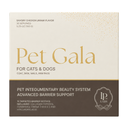
We use it as one barrier-biology rationale for Pet Gala, while avoiding dermatitis treatment claims.
The study found lower percentages of ceramides 1 and 9 in nonlesional skin from dogs with atopic dermatitis versus matched healthy controls, plus a higher cholesterol percentage and cholesterol-to-ceramide ratio in the atopic-dog group.
The paper supports barrier-lipid relevance. It does not support disease-treatment claims or finished-product efficacy claims.
Reiter 2009 looked at the outer skin barrier, not at a supplement bottle.
The researchers sampled the stratum corneum from nonlesional caudal-abdominal skin of dogs with atopic dermatitis and matched healthy controls. Ceramide subclasses and relative amounts were assessed blindly by thin-layer chromatography.
That design makes the paper valuable for barrier architecture. It asks whether the "mortar" between skin cells looks different in affected dogs, even away from obvious lesions.
The atopic-dog group had lower ceramide 1 and 9 percentages, with a higher cholesterol signal.
The paper reported significantly lower ceramides 1 and 9 in nonlesional skin from dogs with atopic dermatitis, plus a significantly higher cholesterol percentage and cholesterol-to-ceramide ratio.
The authors framed these findings as evidence that lower ceramides may be involved in impaired skin barrier function. That is a useful biological bridge, but still not a treatment claim.
The paper did not test an oral product.
It did not feed dogs ceramides, measure coat change after supplementation, or study cats. It also did not test a finished product like Pet Gala.
The correct commercial bridge is barrier-biology rationale. A product can be designed around skin barrier support, but it cannot claim to treat atopic dermatitis or reproduce this paper unless directly tested.
It makes skin-and-coat marketing less shallow.
Many products sell visible shine. This paper points to a deeper concept: the stratum corneum has lipid architecture, and altered lipid patterns can matter in dog skin.
For pet parents, that means a strong skin-and-coat formula should be able to explain structure, barrier lipids, hydration, fatty acids, keratin/nails, and veterinary boundaries without pretending to be a dermatology treatment.
A good skin-and-coat product should talk about barrier structure without pretending to be dermatology.
Barrier support is a legitimate design lane when the claim stays careful.
Pet Gala includes ceramides as one part of a broader integumentary system, alongside omega fatty acids, hyaluronic acid, collagen peptides, MSM, zinc, silica, biotin, and L-carnitine.
It does not claim to treat atopic dermatitis or reproduce this paper. The honest point is cleaner: barrier biology is real, so skin-and-coat formulas should show their architecture and their limits.
The common overreach is turning a case-control skin-lipid paper into an oral treatment claim.
Another pattern is cross-species transfer: canine atopic skin data becomes dog-and-cat beauty proof. A third is single-ingredient heroism, where "ceramides" become the whole story even though barrier support is a broader architecture.
A better page gives the paper credit, then uses it to teach buyers what barrier claims should and should not say.
A quick read on the claims a pet parent is likely to see while shopping.
"Ceramides treat dog atopic dermatitis."
The paper measured skin lipids; it did not test treatment.
Better: ceramide biology is relevant to skin barrier architecture.
That matches the study design.
"This proves our dog-and-cat coat supplement works."
No finished product or cat cohort was tested.
Better: the paper supports one rationale for barrier-lipid formulation.
Rationale is useful when clearly labeled.
"Barrier repair" as a guaranteed outcome.
Repair implies measured product effect that this paper does not show.
Better: supports normal skin barrier structure.
Support language avoids treatment overreach.
Use this as a shopper decoder: the idea can be useful, but the claim still has to stay honest.
| Concept | Common claim | Better interpretation | Caution | LPL system |
|---|---|---|---|---|
| Ceramides | "Repairs the skin barrier." | Supports barrier-lipid architecture when formulated and disclosed carefully. | No oral supplement outcome in this paper. | Pet Gala |
| Dermatitis | "Helps allergies and itch." | Keep diagnosed skin disease in veterinary-care territory. | Treatment claims are not supported. | LPL-01 |
| Skin system | "Shiny coat formula." | Explain lipids, hydration, collagen, keratin, omega support, and testing. | Cosmetic language can understate the biology. | Pampered System |
| Proof trail | "Vet-formulated barrier blend." | Show actives, doses, source, and COA/testing path. | Credentials are not a substitute for disclosure. | COA Lookup |
Use these questions before accepting any study-backed product claim.
We read Reiter 2009 as a reason to respect barrier-lipid architecture.
Pet Gala includes ceramides as one part of a broader integumentary system, alongside omega fatty acids, hyaluronic acid, collagen peptides, MSM, zinc, silica, biotin, and L-carnitine.
It does not claim to treat atopic dermatitis or reproduce this paper. The honest commercial point is cleaner: barrier biology is real, so skin-and-coat formulas should show their architecture and their limits.
A serious formula should show more than shine: lipids, hydration, structure, keratin support, dose disclosure, and claim boundaries.
Short answers for the shopping questions this study usually creates.
It measured ceramide and cholesterol patterns in skin samples from atopic dogs and matched healthy controls.
No. No oral product was fed or tested.
No. The study was in dogs only.
No. It supports barrier-biology rationale, not treatment claims.
Look for disclosed barrier, fatty-acid, hydration, collagen, and keratin-support lanes, plus testing and careful claims.
We use it as a barrier-lipid rationale for Pet Gala while avoiding dermatology treatment claims.
Useful definitions for reading the study without turning it into marketing haze.
Primary paper first, followed by practical veterinary or nutrition references where relevant.
Research Library is educational. It does not diagnose, treat, cure, or prevent disease, and it does not replace veterinary advice.

