
Common claim · overstated
"This proves HA makes coats shinier."
The paper did not measure coat outcomes.
Better interpretation
Better: oral HA has absorption and tissue-distribution plausibility.
That matches the evidence type.
Hyaluronic acid is easy to market as hydration magic. Balogh 2008 is useful because it asks a quieter question first: after oral dosing, can high-molecular-weight hyaluronan be detected beyond the gut? That supports plausibility - not a finished-product skin, coat, or joint outcome.
It tracked radiolabeled high-molecular-weight hyaluronan after oral administration in rats and dogs.
The paper reported evidence consistent with uptake and tissue affinity beyond simple gut passage.
No. It was not a skin, coat, joint, or finished-product outcome trial.
It makes oral HA more plausible, but it should not be used as a shortcut for visible benefits.
We use it as connective-tissue and hydration plausibility inside Pet Gala, with clear outcome boundaries.
Balogh et al. used radiolabeled high-molecular-weight hyaluronan to examine oral uptake and tissue distribution in rats and dogs. The paper supports biological plausibility for oral HA uptake and connective-tissue affinity, not a direct claim that a pet supplement improves skin, coat, or joint outcomes.
This paper supports oral HA plausibility. It does not support finished-product outcome claims by itself.
Balogh 2008 starts with a basic but important question: does oral high-molecular-weight hyaluronan go anywhere useful?
The researchers used radiolabeled high-molecular-weight hyaluronan and tracer comparisons after oral administration in Wistar rats and Beagle dogs. They examined excretion, tissue radioactivity, whole-body imaging, and autoradiography.
That is not the same as measuring a pet parent outcome. It is upstream evidence: absorption and tissue-distribution plausibility.
The paper reported signals consistent with uptake and tissue affinity.
In rats, most recovered radioactivity was excreted in feces, but tissue radioactivity patterns differed from tracer control. Whole-body scintigraphy and autoradiography showed nonalimentary radioactivity concentrated in connective-tissue-relevant areas such as joints, vertebrae, salivary glands, skin, bone, and joint tissues in reported observations.
The authors framed the work as evidence that orally administered high-molecular-weight HA can be taken up and distributed to connective tissues. That is meaningful plausibility. It is not an outcome claim.
Absorption is not the same as visible benefit.
The study does not show improved skin hydration, coat gloss, nail strength, joint comfort, or mobility. It also does not test a finished formula, a daily long-term routine, or cats.
For pet supplement pages, the cleanest use is narrow: oral HA is plausible as part of a connective-tissue or hydration-support architecture. The outcome language should stay modest unless the finished product has its own evidence.
It answers the first objection to oral HA claims.
If a brand uses HA in a pet formula, shoppers reasonably ask whether oral HA can be absorbed at all. This paper gives a stronger answer than hand-waving, because dogs are part of the model.
But it also teaches a discipline that many pages skip: biological plausibility is useful, not final. A serious formula has to connect absorption, dose, complementary ingredients, testing, and claim boundaries.
Read HA claims in two steps: can it plausibly be absorbed, and what outcome is being promised?
HA can be a sensible support lane when it is not oversold.
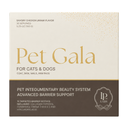
Pet Gala uses hyaluronic acid as part of a broader skin, coat, nail, and barrier-support system. The stronger claim is not "HA fixes hydration." It is that HA belongs inside a disclosed architecture for connective-tissue and surface-support pathways.
The usual overreach is turning "detected in tissues" into "visible benefits guaranteed."
Another pattern is using human beauty language on pet formulas without pet-specific outcome evidence. A third is hiding HA in a blend so buyers cannot see the dose.
The better page says: here is why HA is biologically plausible, here is how much is included, here is what the product claims, and here is what the study did not prove.
A quick read on the claims a pet parent is likely to see while shopping.
"This proves HA makes coats shinier."
The paper did not measure coat outcomes.
Better: oral HA has absorption and tissue-distribution plausibility.
That matches the evidence type.
"HA repairs joints."
The paper did not test clinical mobility or joint outcomes.
Better: HA may be part of connective-tissue support logic.
Support language is the fair bridge.
"Dog and cat HA proof."
Dogs were included, but cats were not.
Better: dog-including absorption evidence can inform formula thinking, with species limits labeled.
Species clarity prevents overreach.
Use this as a shopper decoder: the idea can be useful, but the claim still has to stay honest.
| Concept | Common claim | Better interpretation | Caution | LPL system |
|---|---|---|---|---|
| HA absorption | "Clinically proven hydration." | Say oral HA has uptake plausibility and disclose the amount. | No finished-product hydration outcome. | Pet Gala |
| Connective tissue | "Repairs joints and skin." | Frame as support for normal connective-tissue and hydration pathways. | Avoid treatment and repair language. | LPL-01 |
| Formula architecture | "HA does the work." | Use HA beside collagen, ceramides, omega support, and minerals. | One ingredient is not a system. | Pampered System |
| Proof trail | "Beauty science." | Show the study, dose, species limit, and product boundary. | Beauty language can overrun evidence. | Research Library |
Use these questions before accepting any study-backed product claim.
We read Balogh 2008 as a plausibility study, not an outcome shortcut.
Pet Gala uses hyaluronic acid inside a broader skin, coat, nail, and barrier-support architecture. The study helps explain why oral HA is not a random beauty ingredient, but it does not prove Pet Gala outcomes.
That distinction is exactly the Research Library job: make the biology useful without making the claim bigger than the evidence.
A strong page should disclose the HA amount, explain the formula architecture, and separate absorption evidence from visible outcomes.
Short answers for the shopping questions this study usually creates.
It tracked radiolabeled high-molecular-weight hyaluronan after oral administration in rats and dogs.
No. It measured uptake and tissue distribution, not visible or clinical outcomes.
Yes. Beagle dogs were included, which makes it more relevant than rodent-only HA citations.
No. Cats were not tested, so cat claims should be framed as formula rationale, not direct evidence.
Look for HA amount, form, broader formula architecture, quality documentation, and modest support claims.
We use it as HA plausibility inside Pet Gala, not as finished-product proof.
Useful definitions for reading the study without turning it into marketing haze.
Primary paper first, followed by practical veterinary or nutrition references where relevant.
Research Library is educational. It does not diagnose, treat, cure, or prevent disease, and it does not replace veterinary advice.

