Small Breed Dog lifespan and senior care
How Long Do Small Breed Dogs Live?
Small dogs often get a longer calendar; an explicit weight band and breed-specific risks turn that advantage into a useful senior plan.
- Typical lifespan
- 13–15 years (planning band)
- Senior age
- Usually around 10–12 years
- Start watching at
- Build baselines from 7–8 years
For this guide, small means an expected healthy adult weight under 11 kg (about 24 lb), including toy dogs. Published endpoints range roughly 13–16 years.
Quick Answers for Pet Parents
Direct answers to the questions people ask when they are trying to plan care.
What lifespan should I plan for in a small dog?
A 13-to-15-year household band is reasonable for dogs expected to remain under about 11 kg as adults, then breed, ancestry, health, and function should narrow it.
What counts as a small breed dog here?
The working cutoff is under 11 kg, or roughly 24 lb, at healthy adult condition. It deliberately includes toy dogs and states the boundary because research classifications are inconsistent.
Why do small dogs tend to outlive large dogs?
Large datasets repeatedly show an inverse size–longevity association within dogs, but they do not reduce the mechanism to weight alone. Genetics, growth, disease mix, and breed history also matter.
When should a small dog start senior-style monitoring?
Often around age 10 to 12 under the final-quarter framework, with mouth, movement, heart, or sensory baselines beginning several years earlier.
Which health checks matter most across small breeds?
Prioritize oral examination, body and muscle condition, gait and kneecaps, cough and cardiac findings, vision and hearing, household safety, and any breed-specific screening.
Does toy size guarantee exceptional longevity?
No. Toy size shifts the population odds but cannot cancel severe airway anatomy, inherited disease, accidents, dental burden, or an individual diagnosis.
Lifespan at a Glance
The short answer with the context a careful pet parent needs.
| Working definition | Expected healthy adult weight under 11 kg (about 24 lb); toy dogs are included, while published cutoffs vary. |
|---|---|
| Planning band | Use roughly 13 to 15 years until a breed estimate, ancestry, and the dog’s medical record make the calendar more specific. |
| Why studies differ | UK breed-assigned, US measured-weight, and clinical life-table studies report different endpoints rather than one combinable answer. |
| Senior timing | AAHA places the senior stage in the final quarter of expected life, which often means structured review around 10 to 12 for this cohort. |
| Earlier baseline | From 7 or 8, date changes in teeth, chewing, cough, gait, jumping, weight, muscle, vision, hearing, sleep, and thirst. |
| Cohort priorities | Long survival increases the years available for dental disease, valve changes, sensory loss, patellar trouble, and muscle decline to accumulate. |
| Size is not destiny | A flat-faced or long-backed small dog may depart sharply from the general small-size pattern; the relevant breed guide takes priority. |
Small dogs often get described as “young for their age.” That can be reassuring at 9 and misleading at 12. A compact dog may still bounce onto the sofa while periodontal disease, a heart murmur, a slipping kneecap, or loss of muscle has been developing quietly for years.
Here is the useful answer: large clinical datasets place small-dog population estimates from about 13 to 16 years, while 13 to 15 years is a sensible household planning band until breed and health history narrow it. That is not a biological guarantee for every dog below a certain weight. It is a planning interval assembled from studies that use different definitions, populations, and statistical endpoints.
For clarity, “small breed” here means a dog whose expected healthy adult weight is under 11 kg, or about 24 lb; toy dogs are included. The cutoff is practical rather than universal. One US life-table study separated toy dogs below 5.5 kg from small dogs at 5.5 to under 11 kg. The Dog Aging Project used under 10 kg as its smallest class. A large UK longevity study classified whole breeds by expert consensus instead of weighing each animal. Those are close enough to reveal a size pattern, but not interchangeable enough to support one magic number.
If You Only Have Five Minutes
Small size is associated with longer survival on average, but breed can move the estimate by years. In a 2024 UK analysis, small purebred dogs had median survival of 12.7 years; individual small breeds in the same dataset ranged from under 10 to more than 15 years. A US primary-care study reported a 16.2-year median survival for dogs in its measured small-weight class. A separate US life-table analysis estimated 13.53 years of life expectancy at birth for its small category and 13.36 for toy breeds.
The spread is the lesson. Use 13 to 15 years to organize a calendar, then replace the generic band with the relevant breed estimate, medical record, and current function. The dog lifespan by breed guide is the next stop when ancestry is known.
Start a mature-dog baseline around age 7 or 8 rather than waiting for a double-digit birthday. Put the mouth at the top of that record. Smaller dogs are disproportionately represented in periodontal-disease research, and an apparently normal appetite does not establish a pain-free mouth.
Watch the dog at floor level. A skipped rear step, pause before jumping, cough after excitement, slower recovery, or new preference for lower furniture can be an early functional signal. A light dog is easy to carry; being carryable does not make impaired movement harmless.
Treat collapse, hard breathing, pale or blue-gray gums, seizure, sudden paralysis, or severe trauma as urgent. Book an ordinary appointment for the quieter trends: worsening breath, chewing changes, a repeated hop, nighttime cough, weight drift, thirst change, or a gradual loss of muscle.
Why Small-Dog Lifespan Numbers Don't Agree
Three statistical ideas are often collapsed into the word “lifespan.” Life expectancy at birth estimates remaining years for a population at age zero. Median survival marks the age by which half a studied population has died. Mean age at death describes only animals known to have died and can be distorted by how they entered the dataset. A rounded consumer range is none of those; it is a planning translation.
The data source also changes the number. The 2024 Dogs Trust analysis combined records from 18 UK organizations and included living dogs in survival models. The 2023 Banfield analysis built life tables from millions of clinical records across the United States. The 2020 independent-practice study followed patients at three US clinics and produced notably higher survival estimates. Geography, referral and insurance patterns, breed popularity, care access, censoring, and the proportion of young animals all shape the result.
Size definitions add another layer. A 10.8 kg adult may be “small” in one paper and “medium” in another. Breed-assigned categories can misclassify an unusually light or heavy individual. Body weight is also not the whole dog: skull shape, ancestry, genetic diversity, sex, body condition, and disease history can pull in different directions.
The strongest conclusion is comparative, not prophetic. Across methods, smaller dogs generally outlive larger dogs. The exact birthday for one terrier, toy spaniel, dachshund, or companion mix still belongs to that dog's own biology. The dog lifespan methodology explains how to read a population estimate without turning it into a countdown.
The small-dog band, made explicit
| Planning layer | Working definition | What the published data say | How to use it |
|---|---|---|---|
| Toy | Expected adult weight below 5.5 kg (12 lb) | One US life-table study estimated 13.36 years at birth; breed estimates vary widely | Treat weight as a starting category, then check airway, heart, dental, neurologic, and breed-specific evidence |
| Small | Expected adult weight 5.5 to under 11 kg (12–24 lb) | The same study estimated 13.53 years at birth for this band | Begin mature-dog baselines before the dog looks old, especially for mouth and muscle |
| Small, measured in clinic | Adult measured weight in the study's lowest class | A three-clinic US cohort reported median survival of 16.2 years | Read as a result from that clinical population, not a universal ceiling |
| Small, breed-assigned | Breed placed in the study's small category | A large UK cohort reported median survival of 12.7 years | Use for the size signal; use the individual breed row for a known purebred |
This table deliberately keeps endpoints visible. “13.53-year life expectancy at birth” and “16.2-year median survival” cannot be averaged into a more accurate answer. They answer related but different questions.
What Shapes a Small Dog's Healthspan
Longer average survival changes the maintenance burden. A small dog can spend more years accumulating oral disease, valve changes, ocular disease, and gradual loss of strength. The Dog Aging Project found that smaller size was associated with higher reported lifetime prevalence in several categories, including cardiac, ocular, liver or pancreatic, and respiratory disease, even though larger dogs carried more of many other disease categories. “Lives longer” and “has fewer health problems” are not synonyms.
The mouth is a long-term organ
UK primary-care records show periodontal disease associated with smaller body size and older age. Crowding, proportionally large teeth, and less supporting bone can make a small mouth unforgiving. AAHA senior-care guidance notes that advanced periodontal bone loss in tiny and small dogs can become severe enough to contribute to pathological jaw fracture.
Look beyond bad breath. Red or bleeding gums, chewing on one side, dropping kibble, pawing at the face, resisting head handling, or suddenly preferring soft food can all justify an examination. An awake look is useful; diagnosis and treatment of disease below the gumline require veterinary dental assessment and, when indicated, intraoral imaging under anesthesia.
Heart and breathing changes need separation
Owner-reported disease histories in the Dog Aging Project rose more steeply with age for cardiac disease in smaller dogs. That is a category-level observation, not proof that every small dog will develop myxomatous mitral valve disease. Breed, murmur findings, and echocardiography matter.
A cough is similarly nonspecific. Airway collapse, heart disease, respiratory infection, and other conditions can sound similar at home. Record when it happens—sleep, excitement, pulling, eating, heat—and film an episode if it is safe. Faster or labored breathing at rest, fainting, weakness, or discolored gums moves the question out of routine observation.
Kneecaps, backs, and invisible compensation
Patellar luxation is strongly breed-associated, with several small breeds showing increased odds in a VetCompass study of more than 210,000 dogs. A brief rear-leg hop may be the only visible clue, and a dog may resume running immediately afterward. Recurrence, soreness, reduced jumping, or altered gait deserves a video and veterinary assessment.
Small does not automatically mean low orthopedic risk. Dachshund-shaped dogs bring a different spinal architecture; toy dogs can be injured by falls or rough handling; older dogs of any size can lose muscle and traction. The useful unit is function: rising, turning, toileting, stairs, jumping, and recovery the next morning.
Body condition without miniature thinking
A few hundred grams can be a meaningful percentage of a tiny dog's mass, yet a number on the scale cannot distinguish fat from muscle. Pair regular weight with body-condition and muscle-condition assessment. The dog body condition calculator can organize the conversation, while a veterinarian can account for frame, disease, and age-related muscle loss.
Weight control should never become indiscriminate restriction in an older dog. Unplanned weight loss, loss over the spine or thighs, reduced appetite, or difficulty chewing calls for investigation. The goal is an adequately nourished dog with visible shape and preserved muscle, not the lowest achievable number.
Eyes, hearing, and cognitive change
Because many small dogs reach advanced ages, families may face cataracts, retinal disease, hearing loss, and cognitive dysfunction. A dog who startles, sticks close to walls, misses a familiar step, wakes at night, or becomes distressed when separated may be adapting to sensory or cognitive change. These signs can overlap with pain and systemic illness, so “old age” is not a diagnosis.
What Aging Looks Like in a Small Dog
The calendar can understate change because familiar routines are easy to modify unconsciously. The family lifts the dog onto the sofa, carries it down stairs, softens the food, shortens the walk, and moves the water closer. Each accommodation may be kind. Together, they can hide a declining mouth, knee, spine, heart, vision, or confidence.
Once a month, observe one ordinary sequence without helping: rising from bed, crossing a smooth floor, turning, using a step, eating, drinking, settling to sleep, and recovering from a familiar walk. The goal is not to test endurance. It is to see what the dog now finds costly.
Useful changes to date include:
- a new chewing preference, odor, or face sensitivity;
- repeated hopping, trembling when lifted, or hesitation at an edge;
- cough timing, resting-breathing change, or slower recovery;
- weight gain accompanied by a disappearing waist;
- weight loss accompanied by reduced muscle or appetite;
- night waking, house-soiling, staring, startle, or social withdrawal;
- increasing dependence on being carried through normal parts of the home.
The senior dog signs guide covers system-wide changes that are not unique to body size. Use it alongside—not instead of—the relevant breed guide.
When to Call a Veterinarian
Go now for breathing distress, collapse, pale or blue-gray gums, seizure lasting several minutes or clustering, sudden inability to stand, major fall or crush injury, uncontrolled bleeding, a swollen painful abdomen, repeated unproductive retching, or rapid deterioration.
Arrange a prompt visit for a cough that recurs, a murmur paired with lower stamina, bad breath with chewing change, repeated patellar hopping, neck or back pain, new disorientation, altered thirst or urination, unexplained weight change, or any adaptation that is expanding week by week.
Bring a precise history: weight trend, exact food and treats, medication and supplement list, dental photographs, short gait or cough videos, resting-breathing observations, and the first date another household member noticed something. For comfort questions, complete the dog quality of life scale before the appointment rather than asking appetite to stand in for the whole dog.
How Small Dogs Compare With Similar Breeds
A size cohort is a map legend, not a destination. The long-lived Chihuahua needs particular attention to mouth, heart, airway, knees, and household falls. A Miniature Dachshund may share the small-weight band while carrying a very different spinal risk. A Cavalier King Charles Spaniel shifts the cardiac conversation earlier. A Pug demonstrates why flat-faced conformation can outweigh the usual small-size survival advantage.
That is why “small dogs live longer” is scientifically useful and clinically incomplete. Let size set the first calendar; let breed, shape, measured function, and diagnoses rewrite it.
Questions for Your Breeder, Rescue, or Veterinarian
For a breeder or rescue:
- What adult weight is realistic, and is that based on parents or only appearance now?
- What ages did close relatives reach, and what were the major causes of illness or death?
- What is known about dental disease, heart murmurs, patellar luxation, airway signs, eye disease, and spine problems in the family?
- Has the dog had a professional dental procedure, retained teeth, fractures, falls, or recurring lameness?
For your veterinarian:
- Which size and breed lifespan data best fit this dog?
- What body- and muscle-condition targets should we record separately?
- Does the mouth need dental imaging or treatment rather than observation?
- Does this cough sound more like airway, heart, lung, or something else?
- Should the repeated rear-leg hop or reluctance to jump change activity now?
- When should routine visits become more frequent for this individual's expected final quarter of life?
Sources
- McMillan KM, Bielby J, Williams CL, et al. Longevity of companion dog breeds: those at risk from early death. Scientific Reports. https://www.nature.com/articles/s41598-023-50458-w
- Montoya M, Morrison JA, Arrignon F, et al. Life expectancy tables for dogs and cats derived from clinical data. Frontiers in Veterinary Science. https://www.frontiersin.org/journals/veterinary-science/articles/10.3389/fvets.2023.1082102/full
- Urfer SR, Kaeberlein M, Promislow DEL, Creevy KE. Lifespan of companion dogs seen in three independent primary care veterinary clinics in the United States. Canine Medicine and Genetics. https://link.springer.com/article/10.1186/s40575-020-00086-8
- Nam J, Mersha TB, Hutton VE, et al. Dog size and patterns of disease history across the canine age spectrum: Results from the Dog Aging Project. PLOS ONE. https://pmc.ncbi.nlm.nih.gov/articles/PMC10793924/
- O'Neill DG, Mitchell CE, Humphrey J, Church DB, Brodbelt DC, Pegram C. Epidemiology of periodontal disease in dogs in the UK primary-care veterinary setting. Journal of Small Animal Practice. https://pmc.ncbi.nlm.nih.gov/articles/PMC9291557/
- O'Neill DG, Meeson RL, Sheridan A, Church DB, Brodbelt DC. The epidemiology of patellar luxation in dogs attending primary-care veterinary practices in England. Canine Genetics and Epidemiology. https://pubmed.ncbi.nlm.nih.gov/27280025/
- Creevy KE, Grady J, Little SE, et al. 2019 AAHA Canine Life Stage Guidelines: Canine Life Stage Definitions. https://www.aaha.org/resources/life-stage-canine-2019/canine-life-stage-definitions/
- American Animal Hospital Association. Dentistry: 2023 AAHA Senior Care Guidelines for Dogs and Cats. https://www.aaha.org/resources/2023-aaha-senior-care-guidelines-for-dogs-and-cats/dentistry/
Healthspan by Life Stage
Know what to track before senior age, not only after decline appears.
Define the adult band
Record parent size and longevity, retained teeth, bite, patellas, heart findings, airway or spine conformation, nutrition, handling, and injury hazards before small accommodations become invisible.
Keep a compact baseline
Maintain lean condition and useful muscle, establish tooth care the dog tolerates, film ordinary movement, and investigate cough, repeated hopping, pain, or exercise limitation instead of normalizing size stereotypes.
Start measuring quiet drift
Add dated weight, muscle, dental, gait, recovery, sleep, thirst, vision, hearing, and social notes while the dog still performs familiar routines easily.
Protect the long final quarter
Individualize exam frequency, oral treatment, cardiac assessment, pain care, diagnostics, calories, home access, sensory support, and medication review with the veterinary team.
Judge function without miniature bias
Ask whether the dog can breathe, eat comfortably, rise, cross the home, toilet, sleep, and seek valued contact without untreated pain or fear.
Breed Health Map
The main breed-specific topics that can shape lifespan, comfort, and quality of life.
The 13-to-16-year study spread
Small-dog figures span endpoints and populations: about 12.7 years in one UK median-survival cohort, 13.53 years in a US life table, and 16.2 years in a three-clinic US survival analysis.
A small mouth can carry advanced disease
Crowding and reduced supporting bone make bad breath, bleeding gums, dropped food, face sensitivity, and one-sided chewing worth early examination even when appetite remains strong.
Separate cough from familiarity
Record timing and triggers because valve disease, airway collapse, lung disease, infection, and other causes can overlap; distress, fainting, or discolored gums is urgent.
Light weight can conceal impaired movement
Repeated rear-leg hopping, back sensitivity, reluctance at furniture, or next-day soreness needs assessment; carrying the dog around a problem does not resolve it.
Small changes can be proportionally large
Pair a precise scale with rib feel, waist, and muscle condition. Investigate unplanned loss instead of treating every lower number as a success.
Long lives expose gradual adaptation
Night waking, startle, wall-following, missed edges, social dependence, or confusion may reflect vision, hearing, cognition, pain, or systemic disease.
Convenience should not hide decline
Steps, ramps, traction, low beds, and safe handling are useful only when the reason for needing them is also documented and discussed.

One serving a day, built for aging dogs
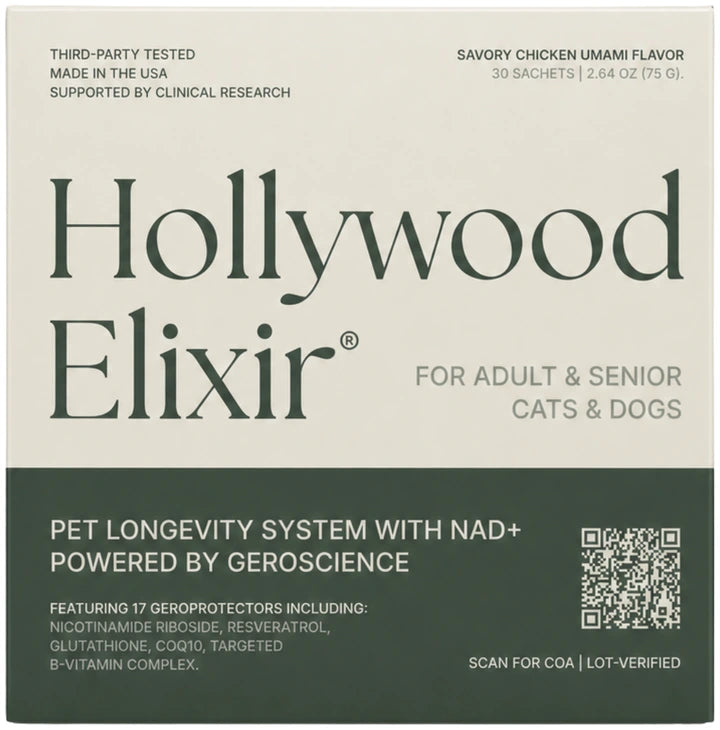
Hollywood Elixir is our daily supplement for adult and senior dogs, made to the LPL-01 standard with every active ingredient at a visible amount. It never replaces your veterinarian — it sits alongside the routine on this page.
Meet Hollywood ElixirWhen to Call the Vet
Split urgent signs from trends that deserve a scheduled veterinary conversation.
Go urgently
- Labored breathing, collapse, fainting-like weakness, pale or blue-gray gums, or inability to settle.
- Seizure lasting several minutes or clustering, sudden paralysis, severe spinal pain, or abrupt inability to stand.
- Major fall or crush injury, uncontrolled bleeding, suspected poisoning, swollen painful abdomen, or rapid deterioration.
Schedule promptly
- Worsening breath, bleeding gums, dropped food, one-sided chewing, or resistance to face handling.
- Recurring cough, lower stamina, faster resting breathing, new murmur information, or a delayed return to easy breathing.
- Repeated rear-leg hopping, trembling when lifted, toe dragging, furniture hesitation, or soreness after normal activity.
- Weight or muscle change, altered thirst or urination, night waking, disorientation, startle, or social withdrawal.
- An accommodation that is expanding each month, such as carrying the dog through more ordinary household movement.
The 90-Day Support Routine
Ninety days of small, repeatable habits make subtle changes visible — and give any new routine a fair test.
- Week one: confirm expected healthy adult weight and relevant breed or ancestry, then record weight, body condition, muscle, teeth, gait, cough, sleep, thirst, and ordinary recovery.
- Week one: film rising, turning, walking on a nonslip surface, using one familiar step, eating, and settling without deliberately provoking fatigue or pain.
- Weekly: look at the gumline, note cough triggers, feel ribs and major muscle groups, watch rear steps, and check whether household help is increasing.
- Monthly: repeat precise weight, mouth photographs, the same movement clip, recovery notes, thirst, sleep, vision or hearing behavior, and medication changes.
- Before appointments: bring food and treat amounts, supplements, videos, dental images, weight history, murmur or cough timing, and the date the pattern began.
- At day 90: ask which generic size assumptions should now be replaced by breed evidence, examination findings, diagnostics, and an individual senior schedule.
Tools for Tracking Comfort and Aging
Use these when a life-stage, body-condition, or quality-of-life question needs more structure.
Dog Quality of Life Scale
Score breathing, comfort, sleep, movement, appetite, and engagement together when one good signal hides another concern.
ToolDog Biological Age Calculator
Use calendar age as the beginning of a life-stage discussion, then let breed, size, and current function refine it.
ToolDog Body Condition Calculator
Put rib feel, waist, and muscle beside the scale so weight change is interpreted rather than merely counted.
Frequently Asked Questions
Short answers to the questions owners ask most.
What is the average lifespan of a small breed dog?
A practical planning answer is about 13 to 15 years for dogs expected to remain under 11 kg, although published small-dog estimates span roughly 13 to 16 years across different methods.
Is under 25 pounds considered a small dog?
It is a reasonable household approximation. This guide uses under 11 kg, about 24 lb, while acknowledging that veterinary studies and breed registries draw different boundaries.
Is a 10-year-old small dog already senior?
Ten can mark the beginning of the final-quarter senior window for some small dogs. A long-lived breed in excellent health may enter later, while chronic disease can make senior-style care useful earlier.
Can small dogs live beyond 15 years?
Yes, some do. An exceptional birthday is possible but should not replace attention to mouth comfort, heart and breathing signs, mobility, body composition, senses, and quality of life.
Why are published small-dog estimates so different?
Studies use different weight cutoffs, breed assignments, countries, clinical populations, and endpoints. Median survival and life expectancy at birth are related measures, not synonyms.
Are toy breeds included in this guide?
Yes. Dogs below 5.5 kg sit inside the broader under-11-kg working cohort, though toy-specific anatomy and breed evidence can change their care priorities.
Why are dental problems emphasized in small dogs?
Primary-care research links smaller size with periodontal disease, and small mouths can lose substantial supporting bone. Eating normally does not rule out oral pain.
Does a skipped back step always mean patellar luxation?
No. A repeated hop can fit patellar luxation, pain, or another orthopedic or neurologic issue. Film it safely and let a veterinarian examine the dog.
Should a small dog with a cough be checked?
A recurring cough deserves context because airway, cardiac, lung, and infectious causes can overlap. Breathing distress, fainting, or pale or blue-gray gums is urgent.
How often should an older small dog see the veterinarian?
Twice yearly is a common senior-care rhythm, but the right interval depends on the breed, oral disease, heart findings, pain, medications, diagnostics, and speed of change.
How can I tell fat loss from muscle loss?
Use weight, body-condition score, and muscle-condition assessment together. Loss over the spine or thighs can be clinically important even when the scale looks stable.
What should I record before a senior visit?
Bring a weight trend, exact diet and treats, dental photographs, cough and gait videos, medication and supplement list, resting-breathing observations, and a dated change timeline.
Do stairs and ramps mean my dog is declining?
Not necessarily. They can prevent falls and preserve independence, but a growing need for help should be recorded so pain, weakness, sensory change, or fear is not hidden.
Is Hollywood Elixir necessary for a small senior dog?
No supplement is necessary by default. Hollywood Elixir is La Petite Labs’ daily supplement for adult and senior dogs; it does not replace diagnosis, dental care, medication, or an individual nutrition plan.
A restrained note from La Petite Labs
Hollywood Elixir is La Petite Labs’ daily supplement for adult and senior dogs. It is not a treatment for any condition discussed here, and veterinary and nutrition decisions remain individual.