


Maine Coon lifespan and senior care
How Long Do Maine Coon Cats Live?
11–13+Years, typical
Most Maine Coons should be planned into the low teens, with early attention to heart screening, weight, jumping, grooming, and appetite.
- Start watching at
- From 7-8 years
- Senior age
- 10+ years
- Typical lifespan
- 11-13+ years
Current guidance and UK primary-care data point to low-teen planning, with HCM, body condition, mobility, dental comfort, and kidney signs shaping comfort.
Quick Answers for Pet Parents
Direct answers to the questions people ask when they are trying to plan care.
How long do Maine Coon cats live?
Many Maine Coon cats live into the low teens. A practical planning range is roughly 11 to 13+ years, with individual variation.
What is the average Maine Coon life expectancy?
There is no perfect single number. Current veterinary breed guidance often says around 13 years, while older UK primary-care mortality data reported 11.0 years median longevity in a small sample.
Do indoor Maine Coon cats live longer?
Indoor living can reduce trauma, infectious exposure, and roaming risk, but it does not remove inherited disease risk, HCM risk, dental disease, obesity, kidney disease, arthritis, or age-related decline.
When is a Maine Coon considered senior?
Cats older than 10 are senior under AAHA/AAFP guidance, but Maine Coon owners should begin baseline tracking around age 7.
What most affects Maine Coon healthspan?
Heart screening, body condition, mobility, dental care, appetite stability, grooming tolerance, hydration and litter patterns, and early vet conversations when breathing, weight, or movement changes.
Lifespan at a Glance
The short answer with the context a careful pet parent needs.
| Typical lifespan | Often low teens; around 13 years in current veterinary breed guidance. |
|---|---|
| Research signal to know | UK VetCompass mortality work reported Maine Coon median longevity of 11.0 years in a small sample; broader feline life-table work shows body weight, sex, neuter status, and breed status can affect lifespan patterns. |
| Senior age | 10+ years under AAHA/AAFP feline life-stage guidance. |
| Earlier watchpoint | 7 to 8 years, especially for weight, breathing, jumping, dental comfort, grooming, and appetite. |
| Breed-specific priority | Heart screening conversation because Maine Coons are associated with hypertrophic cardiomyopathy. |
| Most important at-home signals | Resting breathing, open-mouth breathing, sudden hind-limb weakness, jumping confidence, appetite, weight trend, mats, and litter-box posture. |

You can’t slow the clock. You can change what happens while it runs.
11-13+ years is the range. What fills those years — lean condition, easy movement, steady digestion, good sleep — is built one ordinary day at a time.
Start the daily system → Starting at $50/month
If your Maine Coon is filling the sofa like a small lion but now pauses before a jump, pants after play, lets mats form near the hips, drops food, or seems quieter around meals, the lifespan question is really a comfort question.
Here is the direct answer first: many Maine Coons live about 11 to 13+ years. Current veterinary breed guidance often frames the breed around the low teens; earlier UK primary-care mortality work reported 11.0 years in a small Maine Coon sample, and modern cat life-table research shows body weight, sex, neuter status, and breed status can shift estimates.
The number is the start, not the plan. A Maine Coon's size is the complication: a big, calm, heavily-coated cat can hide weight change under fur, hide sore hips under dignity, and hide a heart problem behind a nap. Families who do well with this breed learn to measure what the eye cannot see — breathing at rest, jump height, the coat behind the hips — and to treat "he's just mellow" as a claim worth checking.
If You Only Have Five Minutes
- Use the low teens as the planning center, not a prediction for one cat.
- Under AAHA/AAFP guidance, 10+ is senior, but Maine Coon owners should start structured tracking around 7 to 8.
- Ask about heart screening because Maine Coons are associated with hypertrophic cardiomyopathy.
- Do not let size hide body condition. Big is not the same as overconditioned.
- Track jumping, breathing at rest, grooming, mats, appetite, dental comfort, thirst, and litter changes.
- Open-mouth breathing, collapse, labored breathing, sudden hind-limb weakness, or repeated unproductive litter-box trips is urgent.
Choose the next step by the worry: the senior cat signs guide if you are deciding whether a change is aging or illness, and the cat quality of life scale if comfort is the real question underneath the search.
Why Lifespan Numbers for Maine Coons Don't Agree
Maine Coon estimates vary because some sources use broad breed profiles, some use deceased-cat records, and newer work uses life tables. A small breed sample can point lower than a polished owner range, while individual cats can still live much longer.
The most useful way to read the evidence is to separate population estimates from the cat in your home. Life expectancy is a population signal. Median longevity is a middle point among deaths. Healthspan is daily reality: breathing, jumping, grooming, appetite, litter habits, teeth, and social interest.
For a deeper explanation of why cat sources disagree, the cat lifespan methodology walks through the estimate types used across this library.
The honest reading: the low-teens framing and the 11.0-year median can both be true, because small breed samples wobble and individual cats vary widely. What the spread cannot do is excuse skipping the heart conversation — screening decisions should ride on this cat's exam, murmur status, and family history, not on whichever lifespan number felt most reassuring.
What Shapes a Maine Coon's Healthspan
Maine Coon healthspan is shaped by a few practical areas: heart conversations, body condition under the coat, movement in a large cat, dental comfort, kidney and urinary monitoring, grooming tolerance, and breathing changes.
Hypertrophic cardiomyopathy
HCM is the Maine Coon topic that needs the most care. Cornell describes HCM as thickening of the heart muscle that can reduce heart efficiency and contribute to heart failure or blood clots. UC Davis describes a Maine Coon A31P mutation in MYBPC3 associated with increased risk, while NC State emphasizes that mutation results are not lifetime guarantees.
Mobility, hips, and arthritis
A large cat who stops jumping may be painful, overweight, weak, nauseated, or cautious after a fall. Watch reduced jumping, stair avoidance, litter-box posture changes, hip sensitivity, slipping, or less play. Weight, nail length, ramps, lower perches, and pain assessment all matter.
Two breed-specific notes belong here. Maine Coons carry a recognized predisposition to hip dysplasia — unusual prominence for a cat breed — so a young Maine Coon who bunny-hops up stairs or sits oddly deserves an orthopedic look rather than an "it's just how he sits." And spinal muscular atrophy, a separate inherited condition with an available DNA test, is worth asking about when buying a kitten; affected cats develop weakness young, and responsible breeders test for it.
Body condition and weight trend
The 2024 UK cat life-table study found non-ideal body weight linked with decreased lifespan patterns. A Maine Coon coat can hide both weight gain and weight loss, so use your hands, a scale when possible, and your veterinarian’s body condition score.
Dental comfort
One-sided chewing, dropping food, pawing at the mouth, bad breath, face sensitivity, softer-food preference, or a cat who seems hungry but hesitant can signal mouth pain. Dental disease can change grooming, sleep, mood, and appetite long before it changes lifespan.
Kidney, urinary, and hydration signs
Maine Coons are not only a heart story. Senior cats need kidney and urinary monitoring. Increased thirst, larger urine clumps, appetite change, weight loss, nausea, poor coat, vomiting, or lethargy deserves attention; straining or little urine is urgent.
Coat, grooming, and mats
New mats can mean pain, weight change, fatigue, nausea, dental discomfort, or reduced flexibility. Where mats form matters: hips and back can point toward mobility, while chest and face issues may point toward dental, skin, or handling discomfort.
Breathing, heat, and stamina
A relaxed Maine Coon should not breathe with effort. Increased resting respiratory rate, open-mouth breathing, panting after mild activity, collapse, or sudden stamina loss needs veterinary care, especially with the breed’s heart context.
Making the plan real in a Maine Coon home
The one habit worth building before anything else: count breaths while your cat sleeps. Pick a quiet nap, count chest rises for thirty seconds, double it, and write it down. Most relaxed, sleeping cats sit comfortably under about thirty breaths a minute; a number that climbs across weeks is exactly the kind of early heart signal a Maine Coon's calm can otherwise bury. It costs nothing and takes less time than filling the food bowl.
Once a month, add hands and a landmark. Hands: through the coat along ribs, spine, and hips, because this much fur can hide a body-condition change in either direction. Landmark: pick one jump your cat makes daily — the windowsill, the bed — and notice whether it is still made in one motion or now needs a chair in between. Mats forming behind the hips go in the same note, since a big cat who stops grooming the hard-to-reach places is usually telling you about flexibility or pain, not laziness.
What Aging Looks Like in a Maine Coon
Maine Coon aging may look like lower jumps, more floor sleeping, mats near the hips, slower grooming, weight drift, appetite changes, larger urine clumps, bad breath, lower play stamina, breathing changes, or a cat who still wants closeness but chooses easier routes.
Use the baseline test:
- Is movement different from six months ago?
- Is appetite, weight, thirst, stool, urine, or litter-box behavior different?
- Is breathing, sleep, or recovery after normal activity different?
- Is dental comfort, grooming, skin, ears, eyes, or coat different?
- Are there new lumps, wounds, mats, odors, coughs, or pain signals?
- Is joy different: greeting, play, voice, social interest, or familiar routines?
Aging in a giant breed cat earns lower perches and longer naps. It does not earn effortful breathing, a heart never discussed, mats never investigated, or pain filed under personality.
When to Call a Veterinarian
The go-now list for this breed is short and absolute: open-mouth or labored breathing, sudden hind-limb weakness or dragging (a possible clot, and an emergency), collapse, repeated unproductive litter-box trips or straining without urine, or fast decline. Everything slower — climbing resting breath counts, a lost jump, new mats, weight drift under the coat, thirst or litter changes, worsening breath — gets booked this week, with your notes.
Arrive with the numbers rather than adjectives: the resting-breath log, the weight trend if you have a scale, the date the windowsill jump changed, photos of mat locations, and diet detail. For a breed with a screening conversation attached, also bring family history if you have it, and ask plainly whether this cat's exam warrants an echocardiogram now or a recheck interval.
When the underlying question is comfort rather than diagnosis, the cat quality of life scale turns "he seems okay, mostly" into something you and your veterinarian can actually compare month to month.
How Maine Coons Compare With Similar Breeds
Maine Coons and Ragdolls share large-body and HCM conversations, but Ragdolls bring a calmer temperament that can hide pain differently. Persians bring coat and kidney care with a face-shape overlay. Sphynx cats share heart-monitoring questions with a very different skin and temperature profile.
The wider set of patterns lives in the cat lifespan by breed hub; the cat lifespan methodology explains why the underlying numbers differ study to study.
Questions for Your Breeder, Rescue, or Veterinarian
For a breeder or rescue:
- What HCM history and heart-screening records exist in the line?
- Were MYBPC3, spinal muscular atrophy, PKD, hip, and dental concerns discussed?
- What lifespan, sudden death, kidney, mobility, and grooming patterns are known in relatives?
For your veterinarian:
- Should this Maine Coon have an echocardiogram or other heart monitoring?
- What body condition target fits this frame and coat?
- Are dental checks, bloodwork, blood pressure, urinalysis, or pain assessment due?
- Which breathing, jumping, grooming, appetite, or litter changes would make this urgent?
A Maine Coon adopted without papers starts with the exam instead of the pedigree: heart auscultation, body condition under all that coat, a dental look, and a resting-breath baseline you start counting that week.
Sources
- Teng KT, Brodbelt DC, Church DB, O'Neill DG, et al. Life tables of annual life expectancy and risk factors for mortality in cats in the UK. Journal of Feline Medicine and Surgery. 2024. https://journals.sagepub.com/doi/10.1177/1098612X241234556
- Royal Veterinary College VetCompass. New research from the RVC predicts the future life expectancy for companion cats. https://www.rvc.ac.uk/vetcompass/news/new-research-from-the-rvc-predicts-the-future-life-expectancy-for-companion-cats
- O'Neill DG, Church DB, McGreevy PD, Thomson PC, Brodbelt DC. Longevity and mortality of cats attending primary care veterinary practices in England. https://pmc.ncbi.nlm.nih.gov/articles/PMC10816413/
- AAHA/AAFP. 2021 Feline Life Stage Guidelines. https://catvets.com/resource/aaha-aafp-feline-life-stage-guidelines/
- UC Davis Veterinary Genetics Laboratory. Hypertrophic Cardiomyopathy in Maine Coons. https://vgl.ucdavis.edu/test/maine-coon-hcm
- NC State Veterinary Hospital. Maine Coon Cat Hypertrophic Cardiomyopathy. https://hospital.cvm.ncsu.edu/services/small-animals/genetics/maine-coon-cat-hypertrophic-cardiomyopathy-hcm/
- Cornell Feline Health Center. Hypertrophic Cardiomyopathy. https://www.vet.cornell.edu/departments-centers-and-institutes/cornell-feline-health-center/health-information/feline-health-topics/hypertrophic-cardiomyopathy
- Cornell Feline Health Center. The Special Needs of the Senior Cat. https://www.vet.cornell.edu/departments-centers-and-institutes/cornell-feline-health-center/health-information/feline-health-topics/special-needs-senior-cat
- PetMD. Maine Coon Cat Breed Health and Care. https://www.petmd.com/cat/breeds/maine-coon
Healthspan by Life Stage
Know what to track before senior age, not only after decline appears.
Build the baseline
Document breeder health records, growth, movement, breathing, appetite, early dental development, and normal play recovery.
Keep size from hiding risk
Protect lean body condition, dental care, enrichment, and heart-screening conversations while the cat still looks strong.
Start the dashboard
Track breathing, weight, jumping, grooming, appetite, litter habits, play stamina, and social behavior monthly.
Protect comfort
Use structured veterinary monitoring, easier home access, pain assessment, and quality-of-life tracking.
Track comfort honestly
Watch breathing, appetite, hydration, pain, mobility, grooming, litter-box dignity, interaction, and whether treatment is helping more than it burdens.
Breed Health Map
The main breed-specific topics that can shape lifespan, comfort, and quality of life.
Hypertrophic cardiomyopathy
Maine Coons are associated with HCM; DNA results are useful but do not replace veterinary screening.
Large-body wear
Reduced jumping, stair avoidance, litter-box posture changes, or hip sensitivity deserve attention, especially with extra weight.
Big should not mean overconditioned
A large Maine Coon still needs a lean waist, ribs that can be felt under the coat, and easy movement.
Chewing comfort
Dropping food, bad breath, one-sided chewing, or face sensitivity may point to dental pain.
Older-cat monitoring
Increased thirst, urine changes, weight loss, nausea, or litter-box pattern changes should trigger a veterinary conversation.
Coat and matting
New mats can signal pain, weight change, fatigue, nausea, or reduced flexibility.
Do not normalize panting
Open-mouth breathing, labored breathing, collapse, or sudden hind-limb weakness are urgent signs.
Comfort over calendar age
Use appetite, pain, mobility, grooming, social interest, litter-box dignity, and treatment burden to guide senior conversations.

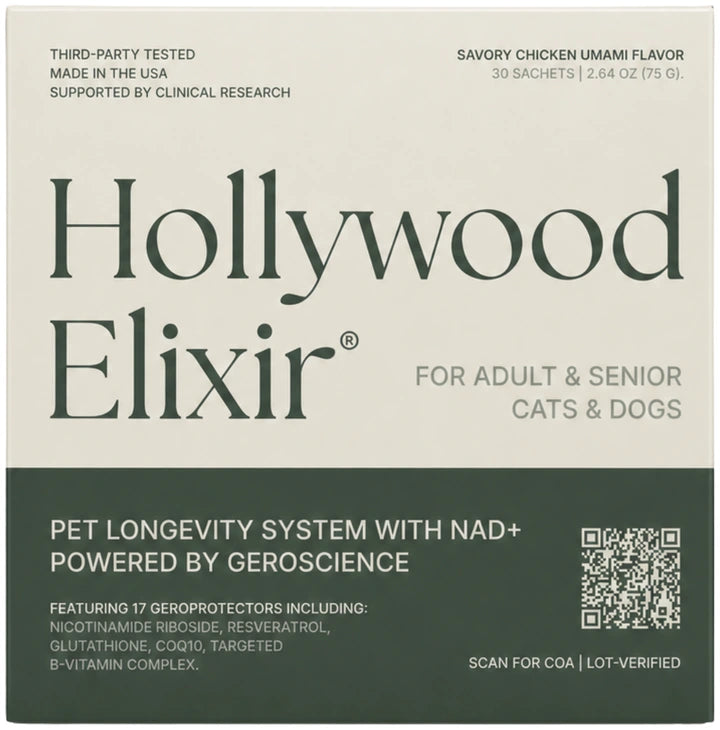
One serving a day, built for aging cats
Hollywood Elixir is our daily supplement for adult and senior cats, made to the LPL-01 standard with every active ingredient at a visible amount. It never replaces your veterinarian — it sits alongside the routine on this page.
Starting at $50/month · cancel anytime
Shop Hollywood ElixirWhen to Call the Vet
Split urgent signs from trends that deserve a scheduled veterinary conversation.
Go urgently
- Open-mouth breathing, labored breathing, blue-tinged gums, collapse, or extreme weakness.
- Sudden hind-limb weakness, dragging, severe pain, or cold rear paws.
- Not eating, repeated vomiting, severe lethargy, or hiding with obvious distress.
- Straining to urinate, repeated litter-box trips with little output, or crying in the litter box.
- Rapidly worsening breathing, stamina, pain, or neurologic signs.
Schedule promptly
- New reluctance to jump, stair avoidance, or choosing lower resting places.
- Weight loss, weight gain, appetite changes, or slower eating.
- New mats, brushing resistance, greasy coat, or reduced self-grooming.
- Bad breath, drooling, dropping food, pawing at the mouth, or one-sided chewing.
- Increased thirst, larger urine clumps, litter-box misses, or posture changes.
- Sleeping more deeply, withdrawing, reduced play stamina, or behavior that is clearly different from this cat's normal.
The 90-Day Support Routine
Ninety days of small, repeatable habits make subtle changes visible — and give any new routine a fair test.
- Week one: set a Maine Coon baseline for sleeping respiratory rate, weight, body condition, jumping routes, stair use, litter-box posture, coat condition, dental comfort, and appetite.
- Week one: decide where heart-screening records, breeder or rescue notes, genetic results, diet details, and prior veterinary findings will live before senior changes begin.
- Weekly: brush before mats tighten, feel through the coat for body condition, and treat new tangles, reduced jumping, or litter-box awkwardness as health information.
- Monthly: repeat the sleeping-breathing count and mobility check, then note hydration, appetite, grooming effort, dental breath, play, and social engagement.
- Day 90: bring the log to your veterinarian and reassess whether heart screening, dental work, weight targets, or home access need adjustment for this large cat.
Tools for Tracking Comfort and Aging
Use these when a life-stage, body-condition, or quality-of-life question needs more structure.
Cat Age Calculator
Translate age into feline life stage before subtle senior changes become obvious.
ToolCat Quality of Life Scale
Use when appetite, grooming, breathing, litter habits, mobility, or comfort are changing.
ToolCat Biological Age Calculator
Frame healthy-aging conversations with more structure.
Frequently Asked Questions
Short answers to the questions owners ask most.
What is a realistic life plan for Maine Coons?
Maine Coon lifespan and Maine Coon cat lifespan should be read as planning context, not a forecast. Use 11-13+ years as the practical range, then individualize with your veterinarian around body condition, breed risk, symptoms, and health history.
Can Maine Coons live longer than 11-13+ years?
Yes, some do. A range is not a ceiling. Genetics, accidents, early disease, body condition, dental care, pain control, veterinary access, and luck can move one cat above or below the common range.
When should Maine Coon senior care start?
Maine Coon senior care should start before crisis. Use 10+ years as the senior-planning marker and from 7-8 years for baseline tracking, earlier if symptoms or chronic disease are already present.
Which Maine Coon health issues matter most?
Maine Coon health problems and Maine Coon cat health problems that shape comfort include hypertrophic cardiomyopathy, mobility, hips, and arthritis, body condition and weight trend, dental comfort. The exact priority depends on your cat's exam findings, family history, and day-to-day changes.
Which aging signs should Maine Coon owners watch?
Maine Coon aging signs include changes in appetite, weight, movement, breathing, sleep, pain, grooming, bathroom habits, social interest, recovery after activity, and willingness to do familiar routines.
What changes are urgent for a Maine Coon?
Sudden breathing distress, collapse, blue or pale gums, severe pain, seizure, rapid decline, inability to rise, or major neurologic change should be treated as urgent. Breed-specific emergency signs are listed in the watch section.
What should I track each month?
Track weight, body condition, appetite, water intake, bathroom habits, movement, breathing, dental comfort, skin or coat, eyes or ears, sleep, mood, and one change from your cat's normal.
How often should an older Maine Coon see the veterinarian?
Many senior cats benefit from at least twice-yearly check-ins, but frequency should follow the cat's risk, medications, pain, dental needs, bloodwork, weight trend, and new signs.
How does body condition affect Maine Coon healthspan?
Healthy body condition gives more mobility, breathing, heat, anesthesia, and senior comfort margin. Ask your veterinarian for a body condition score rather than guessing from looks alone.
What should I ask a breeder or rescue?
Ask what is known about lifespan, early deaths, inherited disease, major surgeries, dental problems, mobility, breathing, skin, eyes, heart, kidney, and behavior. Unknown history is common and still workable.
How do I compare Maine Coons with similar breeds?
Compare the aging pattern, not the winner. Similar breeds may share one risk, but your cat's plan should come from this breed's watchpoints and your veterinarian's exam.
How do I judge quality of life in an older Maine Coon?
Look beyond appetite alone. Breathing, pain, sleep, mobility, hygiene, bathroom dignity, anxiety, social interest, and whether care is helping more than it burdens all belong in the answer.
Does genetic testing replace Maine Coon heart screening?
No. Genetic testing can be useful, but it does not replace veterinary screening decisions. Maine Coon health problems can also include hip dysplasia, dental disease, kidney or urinary signs, grooming difficulty, body-condition change, and breathing changes.
What makes Maine Coon lifespan uncertain?
Population data cannot see every line, home, accident, diagnosis, or care decision. That is why Maine Coon lifespan and Maine Coon cat lifespan belongs with ranges, baselines, and veterinary interpretation rather than exact promises.
A note from La Petite Labs
Hollywood Elixir is La Petite Labs' daily supplement for adult and senior cats. It is not a treatment for anything on this page, and it never replaces your veterinarian.

Why Pampered belongs in a Maine Coon 90-day plan
Pampered is La Petite Labs' complete daily system, with a recommended 90-day starting window. Use it alongside the page's setting a Maine Coon baseline for sleeping respiratory rate, weight, body condition, jumping routes, stair use, litter-box posture,; for Maine Coon, the daily record should keep circling back to heart, mobility, body condition, and dental before the fit check.
Explore the Pampered™ System →