


Persian lifespan and senior care
How Long Do Persian Cats Live?
10–13+Years, typical
Persian cats are often planned in the low teens, with comfort shaped by breathing, eyes, teeth, coat, nails, kidneys, and routine care.
- Start watching at
- From 7 years
- Senior age
- 10+ years
- Typical lifespan
- 10-13+ years
RVC Persian data reported average lifespan around 13.5 years, while owner guidance varies; comfort depends heavily on face, coat, dental, kidney, and body condition care.
Quick Answers for Pet Parents
Direct answers to the questions people ask when they are trying to plan care.
How long do Persian cats live?
Many Persian cats are described as living around 10 to 13 years in consumer veterinary breed profiles. RVC/VetCompass Persian data reported average lifespan around 13.5 years.
What is the average Persian life expectancy?
The strongest breed-specific signal in this sample is the RVC/VetCompass finding of about 13.5 years. Individual Persian life expectancy depends on genetics, face shape, breathing comfort, dental care, coat care, body condition, kidney health, lifestyle, and veterinary monitoring.
When is a Persian cat considered senior?
Cats older than 10 are senior under AAHA/AAFP guidance. Persian senior planning should begin earlier, around age 7, because breathing, eye, dental, coat, nail, appetite, and kidney changes can build quietly.
Are Persian cats prone to health problems?
Yes. RVC/VetCompass reporting found common Persian health problems including haircoat disorders, dental disease, overgrown nails, and eye discharge, and noted kidney disease as the most common grouped cause of death.
What most affects Persian healthspan?
Breathing comfort, eye comfort, dental comfort, coat and mat prevention, nail care, body condition, appetite, hydration, kidney monitoring, and early veterinary care when pain or litter-box changes appear.
Lifespan at a Glance
The short answer with the context a careful pet parent needs.
| Common consumer range | Often around 10 to 13 years in veterinary breed profiles. |
|---|---|
| Breed-specific veterinary signal | RVC/VetCompass reported Persian average lifespan around 13.5 years. |
| Senior age | 10+ years under AAHA/AAFP feline life-stage guidance. |
| Earlier watchpoint | 7 to 8 years for breathing, eyes, dental comfort, coat, nails, appetite, weight, thirst, and litter habits. |
| Breed-specific priority | Comfort monitoring because Persian face shape, coat, eyes, teeth, nails, and kidney risk can shape quality of life. |
| Most important at-home signals | Open-mouth breathing, noisy breathing, eye pain, changing discharge, bad breath, one-sided chewing, matting, overgrown nails, increased thirst, larger urine clumps, appetite decline, and weight loss. |

You can’t slow the clock. You can change what happens while it runs.
10-13+ years is the range. What fills those years — lean condition, easy movement, steady digestion, good sleep — is built one ordinary day at a time.
Start the daily system → Starting at $50/month
If your Persian is hiding face pain behind a sweet expression, breathing louder in warm rooms, getting mats around the hips, dropping food, squinting, or drinking more than before, the lifespan question has already become a daily-care question.
Here is the direct answer first: many Persian cats live about 10 to 13+ years. RVC/VetCompass Persian work reported average lifespan around 13.5 years and highlighted haircoat disorders, dental disease, overgrown nails, eye discharge, and kidney disease as major owner-relevant signals. Individual cats vary with face shape, kidney genetics, dental care, weight, grooming, and veterinary monitoring.
The number is the start, not the plan. The Persian's particular difficulty is that its face was bred to look serene, so pain has to be read from everything except the expression: the eye that waters, the food that gets dropped, the mats that appear where grooming stopped, the brush that suddenly is not welcome. Persian care is largely the art of taking "cosmetic" signs seriously.
If You Only Have Five Minutes
- Use the low teens as a practical planning range, with RVC Persian data around 13.5 years as one useful breed-specific signal.
- Start structured tracking around 7 years and treat 10+ as senior under AAHA/AAFP guidance.
- Open-mouth breathing, labored breathing, blue gums, collapse, heat distress, or severe eye pain is urgent.
- Do not treat watery eyes, mats, overgrown nails, bad breath, or face-cleaning resistance as merely cosmetic.
- Kidney disease and PKD matter in Persians; track thirst, litter clumps, appetite, nausea signs, and weight.
- A calm grooming routine is health care when it prevents mats and reveals pain early.
When a change is clearly about comfort rather than diagnosis, the cat quality of life scale gives it a score you can track; for everything in the "is this aging or illness?" category, start with the senior cat signs guide.
Why Lifespan Numbers for Persian Cats Don't Agree
Persian lifespan estimates vary because consumer breed profiles, primary-care research, and owner stories do not measure the same thing. Some sources round the breed into a broad 10 to 15 range, while the RVC Persian study offers a more specific primary-care picture.
RVC/VetCompass reporting is especially useful because it ties lifespan to disorders owners can actually watch: coat problems, dental disease, nails, eye discharge, and kidney disease as a grouped cause of death. That is why a Persian range should never be separated from comfort work.
For the estimate vocabulary behind these ranges, the cat lifespan methodology explains life expectancy, median longevity, and why ranges beat false precision.
The practical translation of the RVC list is unusual and useful: for this breed, the everyday grooming-table observations — coat, teeth, nails, eyes — are not adjacent to the lifespan question, they are the lifespan question. A Persian range without comfort work attached is just a number.
What Shapes a Persian's Healthspan
Persian healthspan is high-touch care: breathing comfort, eye comfort, dental comfort, coat and skin integrity, nail care, kidney monitoring, body condition, and a routine calm enough that changes stand out.
Brachycephalic breathing and heat
Persian face shape is not just appearance. PetMD describes brachycephalic airway syndrome as upper-airway issues that can limit exercise and heat tolerance. Open-mouth breathing is an emergency. More breathing noise, lower heat tolerance, or unusual sleep posture deserves attention.
Eyes and face comfort
RVC/VetCompass reporting listed eye discharge among common Persian disorders. Tear staining can look routine, but squinting, redness, cloudiness, rubbing, pawing, discharge change, or a cat who resists face cleaning may be showing pain.
Dental disease
RVC reported dental disease among common Persian disorders, and flat face shape can contribute to crowding. Dropping food, one-sided chewing, drooling, bad breath, soft-food preference, or face sensitivity deserves a dental conversation.
Coat, mats, and skin
Haircoat disorders were among common Persian findings. Mats can pull skin, hide irritation, and signal that grooming is harder because of pain, obesity, dental disease, nausea, reduced flexibility, or senior decline.
Overgrown nails and paw comfort
Overgrown nails were reported among common Persian disorders. Senior cats may scratch less or tolerate nail care poorly. Thick, curved, or embedded nails can become painful and change movement.
Kidney disease and PKD
RVC/VetCompass reported kidney disease as the most common grouped cause of death. Cornell describes PKD as fluid-filled kidney cysts that can eventually lead to kidney failure, and UC Davis describes PKD1 as heritable in Persians and Persian-derived cats.
Weight trend under the coat
A plush coat can hide weight gain, weight loss, and muscle loss. Extra weight can worsen breathing and grooming; weight loss can signal dental pain, kidney disease, nausea, thyroid disease, cancer, stress, or other illness.
Making the plan real in a Persian home
For this breed, the grooming session is the exam. A Persian needs regular brushing anyway, so use the time deliberately: note where mats are starting (hips and britches usually mean the cat has stopped reaching them), whether the comb is suddenly resented in one spot, how the face smells, whether the eyes are wetter, and whether the breath has turned. A cat who used to tolerate the routine and now resists is reporting something — location is the clue.
Keep a small daily rhythm for the face: wipe, look, done. What you are looking for is change — one eye wetter than the other, a squint, new staining, food dropped mid-bite. And once a week, glance at the litter box with kidney eyes: bigger clumps and a lighter cat is a pattern worth a phone call, not a note for next year's checkup.
Two Persian-specific home details earn their keep. Climate first: a flat face borrows against heat tolerance, so give this cat cool retreat options in summer and notice if the loud-breathing rooms are getting more numerous. Grooming logistics second: keep sessions short, frequent, and boringly predictable rather than long and occasional — a Persian who associates the comb with a calm five minutes will keep showing you its body; one who associates it with an hour of mat-pulling will start hiding, and a hiding Persian takes its health signals with it.
If skin, eyes, appetite, or digestion is already an open question, resist the urge to overhaul everything in one enthusiastic weekend. Change the food or the shampoo or the routine — one at a time, a couple of weeks apart, with notes — or the improvement you finally see will have no traceable cause.
What Aging Looks Like in a Persian
Persian aging may look like more sleep, less heat tolerance, louder breathing, more eye discharge, mats near the armpits or hips, slower grooming, nail overgrowth, bad breath, food dropping, thirst changes, bigger litter clumps, weight loss, or a cat who avoids face handling.
Use the baseline test:
- Is movement different from six months ago?
- Is appetite, weight, thirst, stool, urine, or litter-box behavior different?
- Is breathing, sleep, or recovery after normal activity different?
- Is dental comfort, grooming, skin, ears, eyes, or coat different?
- Are there new lumps, wounds, mats, odors, coughs, or pain signals?
- Is joy different: greeting, play, voice, social interest, or familiar routines?
An old Persian is entitled to more sleep and lower perches. It is not entitled to a permanently weeping eye, a mouth that hurts, a coat that has quietly become a mat suit, or breathing that gets loud in a warm room — those are treatable problems wearing an "old age" costume.
When to Call a Veterinarian
Go immediately for open-mouth or labored breathing, blue-tinged gums, heat distress, collapse, an eye that suddenly closes, changes color, or bulges (corneal emergencies move fast in this face), sudden hind-limb weakness, or straining without producing urine. The book-this-week list is the Persian's slow signals: eye discharge that changed character, resistance to grooming in a new spot, worsening breath, dropped food, bigger litter clumps with a slimmer body, or spreading mats.
Bring photographs — this is the breed where photos work best, because faces, eyes, and coats change too gradually for memory. A weekly face photo, mat-location notes, thirst impressions, and any PKD or family kidney history you have. If kidneys have never been discussed, ask directly what baseline bloodwork, urine testing, and blood pressure make sense at this cat's age.
For the comfort question underneath many senior Persian visits, complete the cat quality of life scale first, so the sweet expression does not answer for the cat.
How Persian Cats Compare With Similar Breeds
Persians differ from Maine Coons and Ragdolls because face shape, eyes, coat care, dental crowding, and kidney monitoring sit closer to the center of the plan. Compared with Sphynx cats, both breeds need high-touch routines, but for opposite skin and coat reasons.
The rest of the library lives in the cat lifespan by breed hub, with the estimate vocabulary explained in the cat lifespan methodology.
Questions for Your Breeder, Rescue, or Veterinarian
For a breeder or rescue:
- What PKD1 testing, kidney history, breathing, eye, dental, coat, and grooming records exist for the parents?
- Has either parent needed airway, eye, dental, or kidney treatment?
- How severe is the face shape, and what daily care does this line usually need?
For your veterinarian:
- Does this breathing pattern, eye discharge, or face comfort need workup?
- Should we run bloodwork, urinalysis, blood pressure, or kidney monitoring now?
- Does this mouth need a dental assessment?
- Is grooming resistance pain, skin irritation, dental pain, obesity, or anxiety?
A Persian rehomed without records needs three early answers more than a pedigree: what the kidneys look like on baseline testing, what the mouth looks like under anesthesia-grade examination when appropriate, and what this individual face means for breathing and eye care. Everything else can be learned on the grooming table.
Sources
- RVC VetCompass. Persian cats at high risk of health problems. https://www.rvc.ac.uk/vetcompass/news/persian-cats-at-high-risk-of-health-problems-study-shows
- O'Neill DG, Romans C, Brodbelt DC, Church DB, Černá P, Gunn-Moore DA. Persian cats under first opinion veterinary care in the UK: demography, mortality and disorders. Scientific Reports. https://doi.org/10.1038/s41598-019-49317-4
- RVC. Disorders of Persian cats. https://www.rvc.ac.uk/research/focus/brachycephaly/latest-research/projects/disorders-of-persian-cats
- PetMD. Persian Cat Breed Health and Care. https://www.petmd.com/cat/breeds/persian
- AAHA/AAFP. 2021 Feline Life Stage Guidelines. https://catvets.com/resource/aaha-aafp-feline-life-stage-guidelines/
- Cornell Feline Health Center. Polycystic Kidney Disease. https://www.vet.cornell.edu/departments-centers-and-institutes/cornell-feline-health-center/health-information/feline-health-topics/polycystic-kidney-disease
- UC Davis Veterinary Genetics Laboratory. Polycystic Kidney Disease (PKD1). https://vgl.ucdavis.edu/test/pkd1-cat
- Cornell Feline Health Center. The Special Needs of the Senior Cat. https://www.vet.cornell.edu/departments-centers-and-institutes/cornell-feline-health-center/health-information/feline-health-topics/special-needs-senior-cat
- PetMD. Complete Cat Health Guide for Every Life Stage. https://www.petmd.com/cat/general-health/complete-cat-health-guide-every-life-stage
Healthspan by Life Stage
Know what to track before senior age, not only after decline appears.
Build the baseline
Document parent health, PKD1 testing where relevant, breathing history, eye comfort, dental or jaw concerns, diet, coat routine, and normal handling tolerance.
Prevent comfort debt
Brush before mats form, keep face checks gentle, watch chewing, protect body condition, and avoid letting grooming or dental issues accumulate.
Start the Persian comfort dashboard
Track breathing, eyes, dental comfort, grooming tolerance, nail length, appetite, weight, thirst, urine clumps, movement, and social behavior.
Protect comfort
Use structured veterinary monitoring, dental assessment, kidney monitoring, eye and airway comfort checks, pain assessment, and easier grooming routines.
Track comfort honestly
Watch breathing, appetite, hydration, pain, coat condition, eye comfort, mouth pain, litter-box dignity, social interest, and treatment burden.
Breed Health Map
The main breed-specific topics that can shape lifespan, comfort, and quality of life.
Brachycephalic airway comfort
Open-mouth breathing is urgent; noisy breathing, heat intolerance, and reduced activity deserve veterinary attention.
Eye discharge and face comfort
Changing discharge, squinting, redness, pawing, cloudiness, swelling, or appetite change with eye signs should not be treated as cosmetic.
Chewing comfort
Bad breath, drooling, dropped food, one-sided chewing, face sensitivity, or soft-food preference can point to mouth pain.
Matting and skin comfort
New mats can signal pain, obesity, dental disease, skin irritation, nausea, reduced flexibility, or senior decline.
Paw comfort
Overgrown nails can become painful and may increase when senior cats scratch less or tolerate care poorly.
PKD and kidney monitoring
Increased thirst, larger urine clumps, appetite decline, vomiting, weight loss, and lethargy deserve a veterinary conversation.
Weight and appetite trend
Dense coats can hide weight change, muscle loss, and matting; track numbers when possible.
Comfort over appearance
Use breathing, eyes, mouth, coat, appetite, litter-box dignity, grooming tolerance, and treatment burden to guide senior conversations.

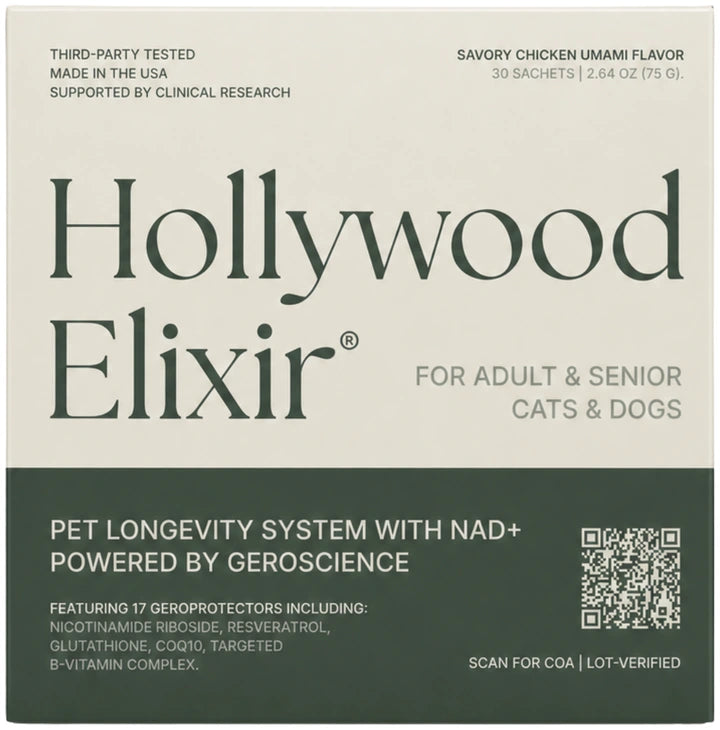
One serving a day, built for aging cats
Hollywood Elixir is our daily supplement for adult and senior cats, made to the LPL-01 standard with every active ingredient at a visible amount. It never replaces your veterinarian — it sits alongside the routine on this page.
Starting at $50/month · cancel anytime
Shop Hollywood ElixirWhen to Call the Vet
Split urgent signs from trends that deserve a scheduled veterinary conversation.
Go urgently
- Open-mouth breathing, labored breathing, blue-tinged gums, collapse, or extreme weakness.
- Heat distress or rapidly worsening breathing effort.
- Eye injury, severe squinting, sudden cloudiness, or obvious eye pain.
- Not eating with lethargy or distress, or repeated vomiting with weakness.
- Straining to urinate or repeated litter-box trips with little output.
- Severe pain, sudden inability to move normally, or a mat/skin wound that appears infected.
Schedule promptly
- Changing eye discharge, face rubbing, redness, or squinting.
- Noisy breathing that is new or worsening, or reduced heat tolerance.
- Bad breath, drooling, dropped food, slower eating, or soft-food preference.
- New mats, grooming resistance, or skin irritation.
- Overgrown nails or paw sensitivity.
- Increased thirst, larger urine clumps, appetite decline, nausea signs, vomiting, or weight loss.
- Hiding or behavior that is clearly different from this cat's normal.
The 90-Day Support Routine
Ninety days of small, repeatable habits make subtle changes visible — and give any new routine a fair test.
- Week one: document relaxed breathing, eye discharge, facial skin, coat tangles, brushing tolerance, chewing speed, food dropping, nail length, paw comfort, appetite, water intake, and litter clumps.
- Week one: choose a grooming rhythm that prevents mats around armpits, belly, hips, and behind the ears before coat changes become painful.
- Weekly: check eyes and face gently, brush through hidden friction points, watch chewing, and note whether breathing noise changes during sleep or rest.
- Monthly: compare weight, appetite, water intake, litter clumps, grooming tolerance, dental signs, nail length, mobility, and social behavior with the first notes.
- Day 90: review breathing, eye, dental, coat, kidney-pattern, and comfort changes with your veterinarian before small Persian problems become layered.
Tools for Tracking Comfort and Aging
Use these when a life-stage, body-condition, or quality-of-life question needs more structure.
Cat Age Calculator
Translate age into feline life stage before subtle senior changes become obvious.
ToolCat Quality of Life Scale
Use when appetite, grooming, breathing, litter habits, mobility, or comfort are changing.
ToolCat Biological Age Calculator
Frame healthy-aging conversations with more structure.
Frequently Asked Questions
Short answers to the questions owners ask most.
What is a realistic life plan for Persian Cats?
Persian lifespan and Persian cat lifespan should be read as planning context, not a forecast. Use 10-13+ years as the practical range, then individualize with your veterinarian around body condition, breed risk, symptoms, and health history.
Can Persian Cats live longer than 10-13+ years?
Yes, some do. A range is not a ceiling. Genetics, accidents, early disease, body condition, dental care, pain control, veterinary access, and luck can move one cat above or below the common range.
When should Persian senior care start?
Persian senior care should start before crisis. Use 10+ years as the senior-planning marker and from 7 years for baseline tracking, earlier if symptoms or chronic disease are already present.
Which Persian health issues matter most?
Persian health problems and Persian cat health problems that shape comfort include brachycephalic breathing and heat, eyes and face comfort, dental disease, coat, mats, and skin. The exact priority depends on your cat's exam findings, family history, and day-to-day changes.
Which aging signs should Persian owners watch?
Persian aging signs include changes in appetite, weight, movement, breathing, sleep, pain, grooming, bathroom habits, social interest, recovery after activity, and willingness to do familiar routines.
What changes are urgent for a Persian?
Sudden breathing distress, collapse, blue or pale gums, severe pain, seizure, rapid decline, inability to rise, or major neurologic change should be treated as urgent. Breed-specific emergency signs are listed in the watch section.
What should I track each month?
Track weight, body condition, appetite, water intake, bathroom habits, movement, breathing, dental comfort, skin or coat, eyes or ears, sleep, mood, and one change from your cat's normal.
How often should an older Persian see the veterinarian?
Many senior cats benefit from at least twice-yearly check-ins, but frequency should follow the cat's risk, medications, pain, dental needs, bloodwork, weight trend, and new signs.
How does body condition affect Persian healthspan?
Healthy body condition gives more mobility, breathing, heat, anesthesia, and senior comfort margin. Ask your veterinarian for a body condition score rather than guessing from looks alone.
What should I ask a breeder or rescue?
Ask what is known about lifespan, early deaths, inherited disease, major surgeries, dental problems, mobility, breathing, skin, eyes, heart, kidney, and behavior. Unknown history is common and still workable.
How do I compare Persian Cats with similar breeds?
Compare the aging pattern, not the winner. Similar breeds may share one risk, but your cat's plan should come from this breed's watchpoints and your veterinarian's exam.
How do I judge quality of life in an older Persian?
Look beyond appetite alone. Breathing, pain, sleep, mobility, hygiene, bathroom dignity, anxiety, social interest, and whether care is helping more than it burdens all belong in the answer.
Which tools are useful for Persian owners?
Use the cat age or biological-age tool for life-stage framing and the quality-of-life scale when comfort, treatment burden, appetite, or mobility is hard to judge.
What makes Persian lifespan uncertain?
Population data cannot see every line, home, accident, diagnosis, or care decision. That is why Persian lifespan and Persian cat lifespan belongs with ranges, baselines, and veterinary interpretation rather than exact promises.
A note from La Petite Labs
Hollywood Elixir is La Petite Labs' daily supplement for adult and senior cats. It is not a treatment for anything on this page, and it never replaces your veterinarian.

Why Pampered for a Persian household
Pampered is La Petite Labs' complete daily system, with a recommended 90-day starting window. Pampered can share the same 90-day track as this guide's document relaxed breathing, eye discharge, facial skin, coat tangles, brushing tolerance, chewing speed, food dropping, nail length, paw, with breathing, eyes, dental, and coat used as the Persian watch list.
Explore the Pampered™ System →