Golden Retriever lifespan and senior care
How Long Do Golden Retrievers Live?
10–12Years, typical
Most Goldens live 10 to 12 years. The useful plan is calm cancer awareness, lean weight, comfortable movement, and early vet conversations.
- Start watching at
- From 5-6 years
- Senior age
- Around 8-9 years
- Typical lifespan
- 10-12 years
A practical planning range, not a promise for one dog; cancer risk, body condition, mobility, skin, ears, dental care, and luck all matter.
Quick Answers for Pet Parents
Direct answers to the questions people ask when they are trying to plan care.
How long do Golden Retrievers live?
Golden Retrievers are commonly described as living about 10 to 12 years, with some individuals living into the early or mid-teens.
What is the average Golden Retriever life expectancy?
Many owner-facing sources use 10 to 12 years as the average Golden Retriever lifespan. Treat that as planning context, not a promise.
When is a Golden Retriever considered senior?
AAHA defines senior as the last 25% of estimated lifespan. For a Golden planning around 10 to 12 years, senior-style monitoring often begins around 8 to 9 years.
What health problems are Golden Retrievers prone to?
Common Golden Retriever healthspan topics include cancer risk, hip and elbow concerns, osteoarthritis, obesity, ear infections, skin allergies or hot spots, dental disease, cardiac screening concerns, eye screening concerns, and senior quality-of-life changes.
What most affects Golden Retriever healthspan?
Cancer awareness, early lump checks, lean body condition, regular veterinary exams, mobility protection, ear and skin comfort, dental care, appropriate exercise, appetite and weight tracking, enrichment, and quick action when a normally happy Golden changes behavior.
Lifespan at a Glance
The short answer with the context a careful pet parent needs.
| Typical lifespan framing | Often about 10 to 12 years, with some Golden Retrievers living longer and some shorter. |
|---|---|
| Senior planning | Around 8 to 9+ years for many Goldens, individualized by the veterinarian. |
| Earlier watchpoint | Start structured tracking around 5 to 6 years for lumps, stamina, skin, ears, weight, dental comfort, gait, appetite, and behavior. |
| Breed-specific priority | Do not let a happy personality hide pain, cancer signs, weight gain, ear pain, skin itch, reduced stamina, or mobility decline. |
| Cancer context | Morris Animal Foundation reports that 60% of Golden Retrievers are impacted by cancer and follows more than 3,000 Goldens through the Golden Retriever Lifetime Study. |
| Most important at-home signals | New lumps, changing lumps, collapse, pale gums, belly swelling, appetite change, weight change, limp, stiffness, ear odor, scratching, hot spots, thirst, breathing, sleep, and social interest. |

You can’t add sand to the glass. You can change what happens while it falls.
10-12 years is the range. What fills those years — lean condition, easy movement, steady digestion, good sleep — is built one ordinary day at a time.
Start the daily system → Starting at $63/month
If you are reading because your Golden is 7, 9, or 11, you may be watching a happy dog who still greets every person like good news but now rises more slowly, has a new lump, shakes an ear, scratches at a hot spot, or seems tired after ordinary play.
Here is the direct answer first: most Golden Retrievers live about 10 to 12 years. Owner-facing ranges commonly center there, while the strongest Golden-specific research is less about one exact age and more about the breed health map: cancer awareness, body condition, mobility, ears, skin, dental comfort, and quality of life.
The number is the start, not the plan. For a Golden, the lived years are mostly decided by what the family notices between annual visits: the lump found at eight weeks instead of eight months, the ear treated before it becomes a habit, the waist kept visible, the limp that gets a diagnosis instead of a rest day. Goldens deserve that attention without panic — breed risk is a reason to watch, not a verdict.
If You Only Have Five Minutes
- Use 10 to 12 years as the planning center, with some Goldens reaching the early or mid-teens and some leaving earlier because of cancer, serious illness, or accidents.
- Start a mature-adult dashboard around 5 to 6 years so lumps, stamina, gait, ears, skin, weight, and dental comfort have a baseline.
- Senior-style care often begins around 8 to 9 years, earlier if there are lumps, pain, obesity, chronic ear or skin disease, or appetite changes.
- Map lumps calmly. Photograph, measure, date, and ask your veterinarian which ones should be sampled.
- Do not write off limping, stiffness, ear odor, hot spots, or weight drift as personality. Goldens stay cheerful through discomfort.
- Collapse, pale gums, belly swelling, labored breathing, uncontrolled bleeding, seizure, sudden inability to rise, or rapid decline is urgent.
Not sure where to start? The senior dog signs guide sorts ordinary aging from warning signs, the dog quality of life scale turns comfort worries into something concrete, and the dog lifespan methodology explains why honest sources give you a range instead of a promise.
Why Lifespan Numbers for Golden Retrievers Don't Agree
Golden Retriever lifespan ranges disagree because sources blend owner guides, breed-club experience, age-at-death reports, and newer population studies. Life expectancy is a population estimate, median survival is a middle point in a dataset, and a family dog still has an individual history.
The 2024 Scientific Reports dog-longevity study is useful context because it shows breed, size, sex, and skull shape all influence survival patterns across a very large UK dataset. Goldens are large dogs, so they should not be compared casually with toy breeds when a family is planning senior timing.
Morris Animal Foundation adds the Golden-specific layer through the Golden Retriever Lifetime Study. That work has made cancer, hemangiosarcoma, lymphoma, mast cell tumors, osteosarcoma, environment, genetics, and routine monitoring central to serious Golden health conversations. The right owner response is not dread. It is earlier notes, calmer questions, and less guessing.
Treat the range as scheduling advice, not prophecy: it tells a Golden family to open the notebook around five, book the senior workup around eight, and refuse to let "he's just getting older" postpone a lump check.
What Shapes a Golden Retriever's Healthspan
Golden Retriever healthspan is shaped by the places owners can actually observe: lumps, movement, ears, skin, mouth comfort, weight, appetite, sleep, and recovery after fun.
Cancer, lumps, and the fear every Golden parent knows
Golden Retriever cancer risk needs calm language. Morris reports that 60% of Goldens are impacted by cancer, and the Golden Retriever Lifetime Study was built to understand major cancers and other diseases in the breed. A new lump is not automatically cancer, but guessing by sight is not care. Photograph lumps with a date, ask which should be sampled, and move faster for masses that grow, bleed, ulcerate, hurt, attach firmly, or arrive with weakness, appetite change, pale gums, cough, or weight loss.
Hemangiosarcoma and sudden change
Hemangiosarcoma is emotionally loaded because it can grow silently and appear as a sudden crisis. Collapse, profound weakness, pale gums, a distended abdomen, labored breathing, or rapid decline should not be watched at home. Those signs have several possible causes, and all of them deserve urgent veterinary help.
Mobility, hips, elbows, and arthritis
Goldens often keep trying because participation matters to them. Stiffness after rest, limping that comes and goes, slipping, reluctance with stairs or the car, shorter walks, or a dog who plays first and pays later may be showing pain. Body condition, nail length, traction, lower-impact exercise, and actual pain diagnosis all shape the senior chapter.
Weight, muscle, and recovery
A lean Golden usually has more joint, heat, anesthesia, and senior comfort margin than an overconditioned Golden. Ask for both a body condition score and a muscle condition score. Weight gain matters, but so does weight loss, especially if it arrives with appetite change, lumps, lower stamina, dental pain, or dullness.
Skin, hot spots, and coat comfort
A dense Golden coat can hide hot spots, parasites, wounds, skin masses, mats, and weight change. Recurrent licking, chewing, redness, moist painful patches, odor, hair loss, dandruff, or a sudden dislike of brushing should be treated as comfort information, not grooming drama.
Ears, water, and otitis externa
A VetCompass otitis study found Goldens had increased odds of otitis externa compared with crossbred dogs. Head shaking, odor, redness, discharge, pain, head tilt, imbalance, or recurring post-swim ear problems deserve a veterinary plan rather than endless cleaning.
Dental comfort and appetite
Goldens can keep eating when their mouths hurt. Bad breath, red gums, drooling, dropping food, chewing on one side, face rubbing, or reluctance with hard food may be the signs the food bowl hides. Mouth comfort affects sleep, mood, and senior quality of life.
Making the plan real in a Golden home
The Golden plan runs on hands. This is a coat that hides things, so the weekly minute that matters most is a slow pet with intent: fingertips through the coat over ribs, armpits, belly, and hips, feeling for new lumps and checking the waist while the dog assumes it is affection. Photograph anything you find next to a coin, with the date.
Keep a one-line log after the big outings — how fast the recovery, any limp the next morning, any head shake after the lake. Golden problems tend to announce themselves as patterns rather than events: the third ear flare of the summer, the stiffness that now follows every swim. A dated note turns "I think this keeps happening" into a timeline a veterinarian can actually use.
The rest of the senior playbook — traction, ramps, measured meals, baseline videos, one change at a time — is the same for every aging dog, and it lives in the senior dog signs guide. What is Golden-specific is the discipline of hands in the coat, eyes on the waist, and a lump map that never goes stale.
What Aging Looks Like in a Golden Retriever
Golden aging often looks like a little less spring in the rise, shorter play recovery, weight drift, muscle loss over the hips, new lumps, ear or skin flare-ups, worse breath, lower stamina, more sleep, coughing, thirst changes, or a dog who still wants to be included but chooses the easier route.
Use the baseline test:
- Is movement different from six months ago?
- Is appetite, weight, thirst, stool, urination, or house-training behavior different?
- Is breathing, sleep, or recovery after normal activity different?
- Is dental comfort, grooming, skin, ears, eyes, or coat different?
- Are there new lumps, wounds, mats, odors, coughs, or pain signals?
- Is joy different: greeting, play, voice, social interest, or familiar routines?
A Golden is allowed to slow down; it is not required to be uncomfortable. Longer sleep is aging. Pain nobody has assessed, ears nobody has treated, or a dog who cannot settle at night is a medical to-do list.
When to Call a Veterinarian
Two speeds. Go now for collapse, pale gums, a swelling belly, labored breathing, uncontrolled bleeding, seizure, sudden inability to rise, or fast decline — with hemangiosarcoma in the breed's history, "suddenly weak with white gums" is an emergency-room sentence, not a wait-and-see one. Book this week for the trends: a lump that changed, a limp that returns, ear odor, weight drift, new thirst, or a dulled dog.
Walk in with evidence: dated lump photos, a weight history, a phone video of the limp, food and medication lists, and one line on what changed when. For lumps specifically, ask the direct version of the question — "Which of these do we sample, and how do we track the rest?" It is the single highest-value sentence a Golden owner can bring to an exam room.
If the visit is really about comfort, complete the dog quality of life scale first, so the conversation starts from shared language instead of competing impressions.
How Golden Retrievers Compare With Similar Breeds
Compared with Labradors, Goldens usually bring cancer vigilance higher into the plan, while both retriever breeds need lean body condition, ears, skin, and mobility tracking. Compared with giant breeds, Goldens often get a longer senior chapter to protect. Compared with brachycephalic or spine-first breeds, the Golden plan is less about one defining emergency and more about noticing patterns early.
More breed patterns are in the dog lifespan by breed hub — read them for planning contrast, not competition.
Questions for Your Breeder, Rescue, or Veterinarian
For a breeder or rescue:
- What cancer history, early deaths, hemangiosarcoma, lymphoma, osteosarcoma, mast cell tumors, heart disease, severe allergies, ear disease, or orthopedic disease are known in the family?
- Were hip, elbow, eye, and cardiac clearances completed and publicly verifiable?
- What skin, ear, diet, body condition, and temperament patterns are common in this line?
For your veterinarian:
- Which lumps should be sampled, and how should we map the rest?
- What body condition and muscle condition should we target now?
- When should senior bloodwork, urine testing, dental assessment, and pain assessment begin?
- Which changes would make you want to see this Golden urgently rather than at the next routine visit?
A rescue Golden with no paperwork starts in the same place a well-documented one does: a baseline exam, a waist target, a lump map, and a notebook.
Sources
- McMillan KM, Bielby J, Williams CL, Upjohn MM, Casey RA, Christley RM. Longevity of companion dog breeds: those at risk from early death. Scientific Reports. https://www.nature.com/articles/s41598-023-50458-w
- Morris Animal Foundation. Golden Retriever Lifetime Study. https://www.morrisanimalfoundation.org/golden-retriever-lifetime-study
- Morris Animal Foundation. What the Golden Retriever Lifetime Study Tells Us About Dog Health. https://www.morrisanimalfoundation.org/article/golden-retriever-lifetime-study-2026-update
- Morris Animal Foundation. New Research Initiative to Address Hemangiosarcoma in Dogs. https://www.morrisanimalfoundation.org/article/new-research-initiative-address-leading-cause-canine-cancer-deaths
- York D, et al. A variant in the 5'UTR of ERBB4 is associated with lifespan in Golden Retrievers. GeroScience. https://link.springer.com/article/10.1007/s11357-023-00968-2
- UC Davis. Golden Retriever gene found associated with longevity. https://www.ucdavis.edu/health/news/can-golden-retrievers-live-longer
- AAHA. 2019 AAHA Canine Life Stage Guidelines. https://www.aaha.org/wp-content/uploads/globalassets/02-guidelines/canine-life-stage-2019/2019-aaha-canine-life-stage-guidelines-final.pdf
- Royal Veterinary College VetCompass. New evidence for health-related welfare prioritisation of canine disorders. https://www.rvc.ac.uk/vetcompass/news/new-evidence-for-health-related-welfare-prioritisation-of-canine-disorders
- O'Neill DG, Volk AV, Soares T, Church DB, Brodbelt DC, Pegram C. Frequency and predisposing factors for canine otitis externa in the UK. Companion Animal Health and Genetics. https://link.springer.com/article/10.1186/s40575-021-00106-1
- Golden Retriever Club of America. Health Screenings for the Parents of a Litter. https://grca.org/about-the-breed/health-research/health-screenings-for-the-parents-of-a-litter/
- Golden Retriever Club of America. Electronic Health Survey Results at 1 year: Health Table 1. https://grca.org/about-the-breed/health-research/electronic-health-survey-results-at-1-year/health-table-1/
Healthspan by Life Stage
Know what to track before senior age, not only after decline appears.
Build the baseline
Collect breeder or rescue records, parent health clearances, hip and elbow information, eye and cardiac screening information, cancer history if known, skin and ear history, diet history, vaccination records, and early orthopedic or digestive concerns.
Protect the athlete without overdoing it
Build lean muscle, watch recovery, prevent excess weight, monitor ears after swimming, and normalize handling for ears, skin, paws, teeth, body condition, nails, and lumps.
Start the Golden healthspan dashboard
Track body condition, new lumps, appetite, stamina, gait, ears, skin, dental comfort, thirst, urination, cough, breathing, mood, play interest, and sleep.
Individualize the plan
Discuss exam frequency, dental care, body condition, pain assessment, bloodwork, urine testing, lump mapping, skin and ear plans, mobility support, cancer screening conversations, and quality-of-life tools.
Track comfort honestly
Use appetite, hydration, breathing, pain, mobility, sleep, elimination, social interest, anxiety, and treatment burden to guide veterinary quality-of-life conversations.
Breed Health Map
The main breed-specific topics that can shape lifespan, comfort, and quality of life.
Lumps and sudden-change awareness
Map lumps early, test concerning masses, and treat collapse, pale gums, belly swelling, sudden weakness, labored breathing, or rapid decline as urgent.
Emergency-pattern awareness
This cancer can grow silently; collapse, weakness, pale gums, and distended abdomen deserve urgent veterinary care.
Hips, elbows, osteoarthritis, and pain
Watch limping, stiffness, bunny-hopping, stair hesitation, slipping, toe dragging, reduced play, or paying for activity later.
Weight and muscle
A lean Golden usually has more joint, heat, anesthesia, and senior comfort margin than an overconditioned Golden.
Hot spots, itch, and coat comfort
Dense coats can hide hot spots, masses, redness, parasites, mats, and weight changes.
Otitis externa and water-loving dogs
Head shaking, odor, redness, discharge, pain, head tilt, imbalance, or recurrent infections after swimming need a veterinary plan.
Eating comfort
Bad breath, red gums, drooling, dropping food, one-sided chewing, or soft-food preference can signal mouth pain.
Comfort over a single lifespan number
Track sleep, appetite, movement, pain, treatment burden, social interest, anxiety, and recovery.

One serving a day, built for aging dogs
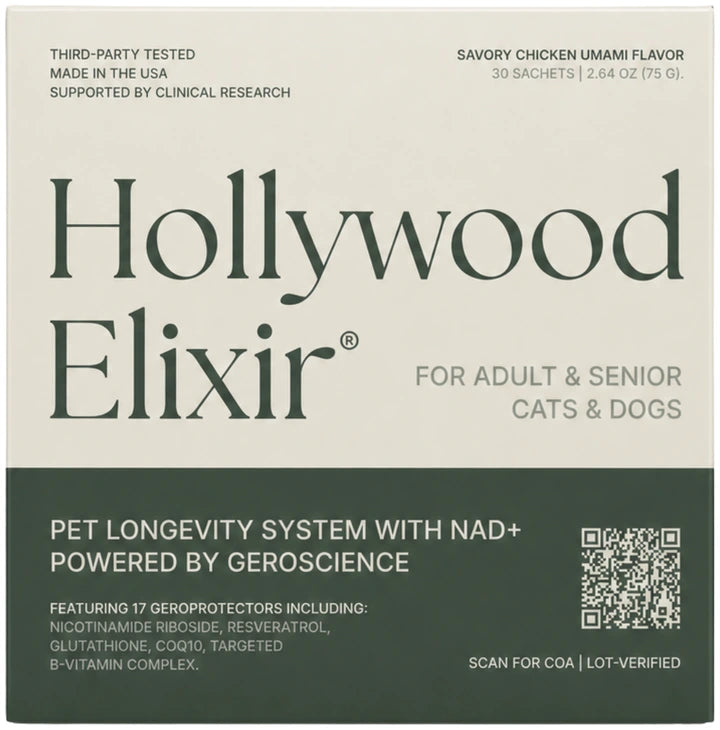
Hollywood Elixir is our daily supplement for adult and senior dogs, made to the LPL-01 standard with every active ingredient at a visible amount. It never replaces your veterinarian — it sits alongside the routine on this page.
Starting at $63/month · cancel anytime
Shop Hollywood ElixirWhen to Call the Vet
Split urgent signs from trends that deserve a scheduled veterinary conversation.
Go urgently
- Collapse, pale or white gums, sudden weakness, swollen abdomen, labored breathing, blue or gray gums, uncontrolled bleeding, seizure, severe pain, sudden inability to rise, sudden hind-limb weakness, heat distress, repeated vomiting with weakness, or rapid decline.
- A painful, rapidly enlarging, bleeding, ulcerated, or infected mass, especially with weakness, appetite change, weight loss, breathing change, pale gums, or collapse.
- Severe ear pain with head tilt, imbalance, neurologic signs, or obvious distress.
- Sudden major change from the dog's baseline.
Schedule promptly
- New lumps, changing lumps, unexplained weight loss, weight gain, appetite change, or muscle loss.
- Chronic itch, recurrent hot spots, ear odor, head shaking, redness, discharge, or pain.
- Lameness, stiffness, stair hesitation, dental odor, chewing changes, cough, reduced stamina, increased thirst, or urinary accidents.
- Sleep disruption, anxiety, hiding, dullness, reluctance to be brushed, reduced social interest, or any clear trend away from this Golden's normal.
- Slower recovery after walks, swimming, fetch, travel, heat, or excitement.
The 90-Day Support Routine
Ninety days of small, repeatable habits make subtle changes visible — and give any new routine a fair test.
- Week one: set a Golden Retriever baseline for weight, body condition, gum color, dental breath, ears, skin, coat, lumps, gait, stairs, appetite, thirst, stool, urine, stamina, sleep, anxiety, play, and social interest.
- Week one: start a dated lump map with photos or measurements, and gather diet details, supplements, medications, breeder or rescue records, and health clearances.
- Weekly: check ears after water, scan skin and hot spots, feel known lumps, watch rising and stairs, and note whether the dog is staying cheerful while sore.
- Monthly: repeat body condition, gait videos, lump photos, appetite, thirst, stool, recovery after activity, and sleep quality so small changes do not blur together.
- Day 90: review the map with your veterinarian and adjust lump sampling, ear care, weight targets, pain plans, dental timing, or exercise intensity.
Tools for Tracking Comfort and Aging
Use these when a life-stage, body-condition, or quality-of-life question needs more structure.
Dog Quality of Life Scale
A structured comfort check for appetite, mobility, breathing, pain, sleep, and joy.
ToolDog Biological Age Calculator
Place your dog in a life stage before you decide what senior care should mean.
ToolDog Body Condition Calculator
Turn weight worry into a body condition conversation with your veterinarian.
Frequently Asked Questions
Short answers to the questions owners ask most.
What is a realistic life plan for Golden Retrievers?
Golden Retriever lifespan should be read as planning context, not a forecast. Use 10-12 years as the practical range, then individualize with your veterinarian around body condition, breed risk, symptoms, and health history.
Can Golden Retrievers live longer than 10-12 years?
Yes, some do. A range is not a ceiling. Genetics, accidents, early disease, body condition, dental care, pain control, veterinary access, and luck can move one dog above or below the common range.
When should Golden Retriever senior care start?
Golden Retriever senior care should start before crisis. Use Around 8-9 years as the senior-planning marker and from 5-6 years for baseline tracking, earlier if symptoms or chronic disease are already present.
Which Golden Retriever health issues matter most?
Golden Retriever health problems that shape comfort include cancer, lumps, and the fear every golden parent knows, hemangiosarcoma and sudden change, mobility, hips, elbows, and arthritis, weight, muscle, and recovery. The exact priority depends on your dog's exam findings, family history, and day-to-day changes.
Which aging signs should Golden Retriever owners watch?
Golden Retriever aging signs include changes in appetite, weight, movement, breathing, sleep, pain, grooming, bathroom habits, social interest, recovery after activity, and willingness to do familiar routines.
What changes are urgent for a Golden Retriever?
Sudden breathing distress, collapse, blue or pale gums, severe pain, seizure, rapid decline, inability to rise, or major neurologic change should be treated as urgent. Breed-specific emergency signs are listed in the watch section.
What should I track each month?
Track weight, body condition, appetite, water intake, bathroom habits, movement, breathing, dental comfort, skin or coat, eyes or ears, sleep, mood, and one change from your dog's normal.
How often should an older Golden Retriever see the veterinarian?
Many senior dogs benefit from at least twice-yearly check-ins, but frequency should follow the dog's risk, medications, pain, dental needs, bloodwork, weight trend, and new signs.
How does body condition affect Golden Retriever healthspan?
Healthy body condition gives more mobility, breathing, heat, anesthesia, and senior comfort margin. Ask your veterinarian for a body condition score rather than guessing from looks alone.
What should I ask a breeder or rescue?
Ask what is known about lifespan, early deaths, inherited disease, major surgeries, dental problems, mobility, breathing, skin, eyes, heart, kidney, and behavior. Unknown history is common and still workable.
How do I compare Golden Retrievers with similar breeds?
Compare the aging pattern, not the winner. Similar breeds may share one risk, but your dog's plan should come from this breed's watchpoints and your veterinarian's exam.
How do I judge quality of life in an older Golden Retriever?
Look beyond appetite alone. Breathing, pain, sleep, mobility, hygiene, bathroom dignity, anxiety, social interest, and whether care is helping more than it burdens all belong in the answer.
Which tools are useful for Golden Retriever owners?
Use the dog age or biological-age tool for life-stage framing and the quality-of-life scale when comfort, treatment burden, appetite, or mobility is hard to judge.
What makes Golden Retriever lifespan uncertain?
Population data cannot see every line, home, accident, diagnosis, or care decision. That is why Golden Retriever lifespan belongs with ranges, baselines, and veterinary interpretation rather than exact promises.
A note from La Petite Labs
Hollywood Elixir is La Petite Labs' daily supplement for adult and senior dogs. It is not a treatment for anything on this page, and it never replaces your veterinarian.

Why Pampered matches Golden Retriever watchpoints
Pampered is La Petite Labs' complete daily system, with a recommended 90-day starting window. This page already asks for setting a Golden Retriever baseline for weight, body condition, gum color, dental breath, ears, skin, coat, lumps, gait, before repeating body condition, gait videos, lump photos, appetite, thirst, stool, recovery after activity, and sleep quality so small; Pampered gives that 90-day calendar a daily container while cancer, hemangiosarcoma, mobility, and body condition stay visible.
Explore the Pampered™ System →