Brachycephalic Dog lifespan and senior care
How Long Do Brachycephalic Dogs Live?
A short skull is a population signal, not an airway grade; lifespan planning must separate breed, size, BOAS function, body condition, and heat exposure.
- Typical lifespan
- About 10–12 years; breed-specific
- Senior age
- Often 7–9 years; breed-specific
- Start watching at
- Airway baseline by 1–2 years
UK and Swiss cohorts report different estimates, and size-by-shape groups vary. Use the breed estimate and the individual dog’s respiratory function before this pooled band.
Quick Answers for Pet Parents
Direct answers to the questions people ask when they are trying to plan care.
What population lifespan is reported for flat-faced dogs?
Across large studies, pooled brachycephalic groups sit roughly around 10 to 12 years, but this compresses wide breed, size, sex, geography, and method differences.
Is every brachycephalic dog affected by BOAS?
No. Skull shape increases concern, while functional BOAS requires assessment of the individual. Some dogs are clinically unaffected; others compensate at rest and struggle during sleep, eating, exercise, or heat.
Why can a small flat-faced dog lose the usual size advantage?
Size and skull shape interact with breed lineage, airway function, and other disorders. A reassuring small-weight category cannot cancel severe conformation or disease.
Which daily measures reveal respiratory reserve?
Track quiet breathing effort, sleep position and arousals, distance to the first voluntary stop, recovery time, warmth and humidity, gagging, regurgitation, and body composition.
Can weight management resolve BOAS?
No. Lean condition may remove avoidable load and is worth protecting, but stenotic nares, excessive soft tissue, and secondary airway changes need veterinary assessment.
When should airway screening begin?
Breathing and exercise baselines belong in young adulthood because clinically important BOAS can be present long before a dog reaches a conventional senior age.
When to Call the Vet
Split urgent signs from trends that deserve a scheduled veterinary conversation.
Go urgently
- Blue-gray gums or tongue, collapse, severe or rapidly increasing breathing effort, inability to settle, or loss of responsiveness.
- Suspected heat illness with confusion, marked weakness, vomiting or diarrhea, seizure, collapse, or a dangerously hot body.
- Sudden eye injury, repeated retching with a swollen abdomen, acute paralysis, or severe neck or back pain.
Schedule promptly
- Noisy breathing that is increasing, nostril narrowing, visible abdominal effort, or open-mouth breathing outside ordinary exertion.
- Longer recovery, refusal of a formerly easy route, disproportionate panting, or difficulty in mild warmth.
- Interrupted sleep, upright sleeping, choking sounds, morning fatigue, or repeated positional changes.
- Gagging, regurgitation, vomiting, food interruption, swallowing trouble, or recurrent airway-related distress around meals.
- Weight gain, muscle loss, skin-fold inflammation, squinting, corneal discomfort, gait change, or back sensitivity.
Lifespan at a Glance
The short answer with the context a careful pet parent needs.
| Cohort estimate | Large datasets place pooled brachycephalic groups around 10 to 12 years, with meaningful differences by breed and size. |
|---|---|
| Not one diagnosis | Brachycephaly describes shortened skull conformation; BOAS is a clinical syndrome assessed through history, examination, function, and sometimes further testing. |
| Size interaction | One large UK analysis reported sex-stratified medians of 11.8 and 11.9 years for small, 9.1 and 9.6 for medium, and 10.6 and 10.8 for large brachycephalic subgroups. |
| Functional baseline | Record breathing effort, sleep, exercise recovery, swallowing, regurgitation, heat response, body condition, and muscle before signs are treated as breed-normal. |
| Heat posture | There is no universal safe temperature; humidity, sun, excitement, age, fitness, body condition, medication, and airway grade alter the margin. |
| Modifiable load | Lean body condition can reduce avoidable respiratory workload, but weight change cannot repair airway anatomy or replace BOAS assessment. |
| Emergency threshold | Labored breathing, blue-gray mucosa, collapse, confusion, marked weakness, or suspected heat illness requires urgent veterinary care. |
A flat face is visible. The work of breathing often is not. Families may be told that snorting, sleeping upright, stopping on warm walks, or taking a long time to recover is simply how a Bulldog, French Bulldog, Pug, Pekingese, Boston Terrier, or Japanese Chin behaves. Some noise is common in these breeds; common does not mean harmless.
The cohort answer is necessarily qualified: large population studies place brachycephalic groups at roughly 10 to 12 years, but breed, body size, airway function, and study design shift the estimate substantially. A 2024 UK survival analysis reported 11.2 years for brachycephalic purebreds overall. Within that same work, the two sex-stratified medians were 11.8 and 11.9 years for small brachycephalic dogs, 9.1 and 9.6 for medium brachycephalic dogs, and 10.6 and 10.8 for large brachycephalic dogs. These paired values are male/female subgroup estimates, not uncertainty ranges. A Swiss mortality study reported a 9.8-year mean for its brachycephalic group.
Those figures describe populations, not an airway grade and not one dog's prognosis. “Brachycephalic” names a skull conformation; it does not tell you whether an individual has clinically important brachycephalic obstructive airway syndrome, or BOAS. Some short-faced dogs breathe functionally. Others compensate every hour of the day.
If You Only Have Five Minutes
Start with the breed-specific estimate, then add conformation and function. A Pug, French Bulldog, Boxer, Shih Tzu, Japanese Chin, and Dogue de Bordeaux should not share one lifespan prediction merely because all are described as short-faced.
Do not grade breathing by volume alone. Listen and look: nostril narrowing, abdominal effort, extended neck, open-mouth breathing outside ordinary heat or exertion, gagging, sleep interruption, blue-gray gums, collapse, and slow recovery all carry more information than the familiar snore.
BOAS is not an inevitable tax of companionship. It is a clinical syndrome that can be assessed. Published studies have used structured exercise tests, respiratory function testing, airway examination, and functional grading rather than relying on owner familiarity with the breed.
Heat planning begins before summer. Brachycephalic skull shape was associated with higher odds of heat-related illness in UK primary-care records and with higher odds of a fatal outcome among dogs that developed it. Humidity, excitement, poor fitness, higher body condition, age, and the individual airway all change the margin of safety.
Keep the dog lean without sacrificing muscle. Obesity does not create the shortened skull, but studies in commonly affected breeds have linked higher body condition with clinically important BOAS or poorer respiratory measurements. Weight management cannot replace airway assessment or alter anatomy.
Seek urgent care for labored breathing, blue-gray or very pale gums, collapse, confusion, marked weakness, repeated vomiting with heat exposure, a body that feels dangerously hot, or inability to settle.
Why Brachycephalic Lifespan Numbers Don't Agree
The first problem is definition. There is no single universally applied craniofacial cutoff that places every dog neatly into brachycephalic, mesocephalic, or dolichocephalic groups. Some datasets assign a cephalic category to the breed. A clinician evaluating one dog cares about the actual nostrils, muzzle, neck, respiratory effort, sleep, exercise response, and internal airway.
The second problem is mixture. Brachycephalic breeds span small companion dogs, medium bull breeds, and larger mastiff-type dogs. Body size has its own association with longevity. When skull category and size interact, a pooled mean can obscure rather than explain. In the large Dogs Trust dataset, the medium brachycephalic subgroup had a lower median survival than both the small and large brachycephalic subgroups. That does not make medium size causal; it reflects the breeds, ancestries, and records inside each cell.
The third problem is endpoint. The UK analysis estimated median survival using both living and deceased records from multiple organizations. The Swiss study examined registered deaths and reported average age at death. Neither study recorded BOAS grade for every dog, and neither proves that airway obstruction caused every early death in the brachycephalic group.
Breed popularity can further bias a dataset toward young animals, which may lower apparent survival when a breed has expanded rapidly. Insurance exclusions, referral behavior, euthanasia decisions, breeding trends, and geography also affect who appears in the records. The dog lifespan methodology gives these differences the space they deserve.
What each variable can—and cannot—tell you
| Variable | Signal in the literature | What it does not establish | Practical use |
|---|---|---|---|
| Skull-shape category | Brachycephalic cohorts show shorter survival than mesocephalic cohorts in large UK and Swiss datasets | That every short-faced dog has BOAS, or that skull category alone caused death | Treat conformation as a reason to assess function, not a diagnosis |
| Size × skull shape | UK medians differed markedly among small, medium, and large brachycephalic groups | A universal size correction for an individual breed | Use the breed row before the pooled brachycephalic number |
| Breed | Bulldog and French Bulldog survival estimates were lower than several other small companion breeds in the UK analysis | That all dogs within a breed share anatomy, care, or outcome | Ask for breed-specific screening and family history |
| BOAS status | Functional testing identifies affected and unaffected dogs within brachycephalic breeds | That quiet breathing at rest rules out exercise limitation | Discuss a structured respiratory assessment when signs or conformation warrant it |
| Body condition | Higher body condition and obesity have been associated with BOAS severity or impaired respiratory variables in several studies | That weight loss repairs stenotic nares or an elongated soft palate | Preserve lean condition as one modifiable load on a fixed anatomy |
| Heat exposure | Brachycephalic dogs have higher heat-illness risk; skull shape was linked with fatality among affected cases | A safe universal temperature, because humidity, exertion, age, acclimation, and airway differ | Build conservative, dog-specific stop rules and an emergency route |
| Study endpoint | Median survival, mean age at death, BOAS grade, and quality-of-life surveys answer different questions | A single combined “true lifespan” number | Keep the endpoint attached to every statistic |
The table is not a scorecard. It prevents one impressive number from swallowing the causal uncertainty around it.
What Shapes a Brachycephalic Dog's Healthspan
Airway anatomy and functional BOAS
BOAS can involve narrowed nostrils, excessive or displaced soft tissue, and secondary airway changes created by chronic negative pressure. Visible muzzle length alone does not reveal all internal lesions. Studies of Pugs, French Bulldogs, and Bulldogs have found substantial proportions with clinically important functional grades, including dogs recruited outside referral settings.
Ask what the dog can do without respiratory compromise. Can it walk at an ordinary pace, recover promptly, sleep without repeated arousal, eat without gagging, and regulate temperature? A structured veterinary assessment may include history, examination of the nares and airway, an exercise test, and further diagnostics. Surgery is a clinical decision based on anatomy and severity; it is neither a cosmetic procedure nor something an internet checklist can prescribe.
Heat, exertion, and recovery debt
Panting moves air to dissipate heat. A restricted upper airway makes that task harder precisely when the dog needs more airflow. In UK records, brachycephalic dogs were at increased risk of heat-related illness. Among dogs with heat illness, brachycephalic skull shape carried about three times the odds of a fatal outcome compared with mesocephalic shape after adjustment in one VetCompass analysis.
Do not turn 19°C, 24°C, or any other threshold into a universal rule. One referral questionnaire found owners reporting worse signs above 19°C, but those were dogs severe enough to be presented for surgery and the result was owner-reported. Shade, humidity, sun, surface temperature, excitement, fitness, medications, age, and airway grade alter risk. The correct threshold is the point before this dog begins to struggle.
Sleep is part of respiratory health
Snoring is often treated as comic branding. Studies using owner reports, video, and accelerometry have found more disturbed sleep in brachycephalic dogs and associations between poorer breathing scores and disrupted rest. Sleeping with the chin elevated, changing position repeatedly, waking abruptly, or choosing to sleep sitting may be compensation.
Film a representative sleep period when the dog is stable, not only the loudest minute. The pattern helps a veterinarian separate ordinary variation from sustained obstruction and gives a baseline for change after weight management or an airway intervention.
Body condition and neck load
In a non-referral study spanning multiple brachycephalic breeds, shorter craniofacial ratios and thicker neck girths were associated with BOAS risk; higher body condition also independently predicted increased risk. Work in Pugs, French Bulldogs, and Bulldogs likewise found obesity associated with clinically important BOAS grades.
This relationship can run both ways: restricted exercise can encourage weight gain, and additional tissue or workload may worsen breathing. The answer is not aggressive calorie restriction. Record both body condition and muscle condition, choose activity the airway can tolerate, and address pain or heat limits that make movement difficult. The dog body condition calculator can make the visual trend easier to discuss.
Gastrointestinal, dental, skin, eye, and spinal burden
Airway disease is central, not solitary. Brachycephalic dogs may show reflux, regurgitation, retching, or difficulty swallowing alongside respiratory signs. Facial folds can trap moisture. Prominent eyes may be more exposed to injury or ulceration. Crowded teeth and malocclusion complicate oral care. Some breeds also carry important spinal, cardiac, orthopedic, or dermatologic predispositions unrelated to skull length.
That is why a conformation synthesis must hand off to the breed guide. The French Bulldog lifespan guide weighs spine and skin alongside BOAS; the Pug lifespan guide has its own ocular and neurologic context; the English Bulldog lifespan guide reflects a different body and risk mix.
Breeding choices and the next generation
Functional parents matter. Ask for results from a recognized respiratory-function grading scheme where available, not only a statement that a dog “breathes fine.” Request health records relevant to the breed and ask whether close relatives required airway surgery, had heat collapse, slept poorly, or died young. A pedigree certificate cannot substitute for phenotype.
What Aging Looks Like in a Brachycephalic Dog
Age can shrink respiratory reserve. A walk that was manageable at 4 may expose limitation at 8 after weight gain, reduced fitness, arthritis, cardiac change, laryngeal change, or progression of secondary airway lesions. The mistake is to call every new pause “senior slowing” without asking what system forced it.
Track a repeatable, low-risk routine:
- breathing sound and abdominal effort during quiet rest;
- sleeping position, awakenings, and morning energy;
- distance and weather at the first voluntary stop;
- minutes required to return to easy breathing;
- gagging, regurgitation, swallowing difficulty, or meal interruption;
- body condition, neck girth trend, and muscle over the spine and thighs;
- eye comfort, facial folds, mouth odor, gait, and back sensitivity.
Never provoke symptoms to collect data. A short clip of ordinary movement or sleep is more useful than an improvised stress test. Universal age-related changes are covered in the senior dog signs guide; respiratory change in a flat-faced dog deserves its own threshold.
When to Call a Veterinarian
Breathing distress is an emergency. Go immediately for blue-gray gums or tongue, collapse, severe or rapidly increasing respiratory effort, inability to settle, confusion, marked weakness, repeated vomiting or diarrhea during heat exposure, seizure, or suspected heat-related illness. For suspected heat illness, start cooling at once while arranging transport: saturate the coat and skin with any safe water cooler than the dog and add airflow, avoiding the head and neck when pouring water over an unwilling or obtunded dog. Do not delay travel to chase a home temperature.
Book an assessment for noisy breathing that is increasing, prolonged recovery, sleep disruption, gagging or regurgitation, reduced exercise tolerance, intolerance of mild warmth, recurrent skin-fold trouble, eye pain, or weight gain that is becoming hard to reverse. Ask directly whether BOAS functional grading or referral is appropriate.
Bring ordinary-life evidence: videos at rest and asleep, a walk-and-weather log, recovery times, body-weight trend, meal symptoms, medication list, and any previous anesthesia or airway notes. Complete the dog quality of life scale when sleep, play, breathing, and recovery are all changing; those domains should be judged together.
How Brachycephalic Dogs Compare With Similar Breeds
The central contrast is not flat-faced versus “normal.” It is pooled conformation data versus a real animal. A Boston Terrier and a large mastiff-type dog occupy different size cells. A Pug without clinically important BOAS and a Pug with grade III obstruction share a breed name while living different respiratory lives. A long-muzzled dog can still develop heart, lung, heat, or laryngeal disease.
Use the dog lifespan by breed hub to restore specificity after reading the cohort signal. Use the dog biological age calculator only as a conversation aid; it cannot calculate airway reserve.
Questions for Your Breeder, Rescue, or Veterinarian
For a breeder or rescue:
- Has this dog or either parent completed a recognized respiratory-function assessment?
- Do close relatives exercise and sleep quietly, and how quickly do they recover in mild weather?
- Which relatives required airway surgery, emergency cooling, eye treatment, or spinal care?
- What were the ages and recorded causes of death in the nearest generations?
- Can I see the relevant heart, eye, orthopedic, spine, and genetic results for this breed?
For your veterinarian:
- Is the current breathing functional, or are we seeing clinically important BOAS?
- Which signs suggest upper-airway obstruction versus heart, lung, pain, or deconditioning?
- Does body condition add avoidable load, and how do we reduce it without losing muscle?
- What heat and exercise stop rules fit this dog rather than the breed stereotype?
- Would respiratory grading, advanced imaging, endoscopy, or surgical consultation change management?
- Which sleep, recovery, or meal signs should move the next appointment forward?
Sources
- McMillan KM, Bielby J, Williams CL, et al. Longevity of companion dog breeds: those at risk from early death. Scientific Reports. https://www.nature.com/articles/s41598-023-50458-w
- Reich L, Hartnack S, Fitzi-Rathgen J, Reichler IM. Life expectancy of mesocephalic, dolichocephalic and brachycephalic dog breeds in Switzerland. Schweizer Archiv für Tierheilkunde. https://pubmed.ncbi.nlm.nih.gov/37021744/
- Packer RMA, Hendricks A, Tivers MS, Burn CC. Impact of facial conformation on canine health: brachycephalic obstructive airway syndrome. PLOS ONE. https://pmc.ncbi.nlm.nih.gov/articles/PMC4624979/
- Liu NC, Sargan DR, Adams VJ, Ladlow JF. Whole-body barometric plethysmography characterizes upper airway obstruction in three brachycephalic breeds of dogs. Journal of Veterinary Internal Medicine. https://pmc.ncbi.nlm.nih.gov/articles/PMC4913582/
- Packer RMA, O'Neill DG, Fletcher F, Farnworth MJ. Great expectations, inconvenient truths, and the paradoxes of the dog-owner relationship for owners of brachycephalic dogs. PLOS ONE. https://pmc.ncbi.nlm.nih.gov/articles/PMC6641206/
- Hall EJ, Carter AJ, O'Neill DG. Incidence and risk factors for heat-related illness in UK dogs under primary veterinary care in 2016. Scientific Reports. https://pmc.ncbi.nlm.nih.gov/articles/PMC7303136/
- Hall EJ, Carter AJ, Bradbury J, Barfield D, O'Neill DG. Risk factors for severe and fatal heat-related illness in UK dogs. Veterinary Sciences. https://pmc.ncbi.nlm.nih.gov/articles/PMC9144152/
- Roedler FS, Pohl S, Oechtering GU. How does severe brachycephaly affect dogs' lives? Results of a structured preoperative owner questionnaire. The Veterinary Journal. https://pubmed.ncbi.nlm.nih.gov/24176279/
- Tomlinson F, Liu N-C, Sargan DR, Ladlow JF. A cross-sectional study into the prevalence and conformational risk factors of BOAS across fourteen brachycephalic dog breeds. PLOS ONE. https://pmc.ncbi.nlm.nih.gov/articles/PMC12915975/
- Barker DA, Tovey E, Jeffery A, Blackwell E, Tivers MS. Owner reported breathing scores, accelerometry and sleep disturbances in brachycephalic and control dogs: a pilot study. Veterinary Record. https://pubmed.ncbi.nlm.nih.gov/34403514/
- Niinikoski I, Himanen S-L, Tenhunen M, Lilja-Maula L, Rajamäki MM. Evaluation of risk factors for sleep-disordered breathing in dogs. Journal of Veterinary Internal Medicine. https://pmc.ncbi.nlm.nih.gov/articles/PMC10937515/
- Bradbury J, Hall E, O'Neill D. Recognising, clinically grading and managing heat-related illness (heatstroke) in dogs. In Practice. https://doi.org/10.1002/inpr.70070
Healthspan by Life Stage
Know what to track before senior age, not only after decline appears.
Choose function over facial fashion
Collect parent respiratory grades where available, observe nostrils, sleep, feeding, play recovery, and heat response, and obtain every heart, eye, spine, joint, or genetic screen relevant to the breed.
Establish an airway grade
Discuss structured respiratory assessment when conformation or signs warrant it; record exercise tolerance, recovery, sleep, gastrointestinal signs, body condition, and any anesthesia history.
Protect shrinking reserve
Reassess weight and muscle, heat stop rules, sleep, skin folds, eyes, teeth, back, joints, heart, and whether former activity now produces disproportionate respiratory effort.
Separate aging from obstruction
Review new slowing for airway, cardiac, pulmonary, pain, neurologic, and deconditioning causes rather than assigning every pause to the calendar.
Center breathable comfort
Judge whether the dog can rest, sleep, eat, move, regulate temperature, and engage without sustained distress; build transport and emergency decisions before a crisis.
Breed Health Map
The main breed-specific topics that can shape lifespan, comfort, and quality of life.
Shape, size, and breed pull apart
Pooled brachycephalic survival sits below mesocephalic estimates in major datasets, but subgroup medians show why one cohort number cannot replace a breed-specific estimate.
Functional obstruction is the decisive clinical question
Noise alone is an incomplete screen. Nostril stenosis, effort, exercise response, sleep, swallowing, and internal lesions require an individual veterinary assessment.
Panting demand meets restricted airflow
Brachycephalic dogs are over-represented in heat-illness research, and skull shape was associated with higher odds of fatality among affected cases in one UK study.
Nighttime compensation can be welfare loss
Repeated arousal, elevated head position, choking sounds, restless repositioning, and daytime fatigue can carry information even when owners recognize the snore as familiar.
Extra load can amplify fixed anatomy
Higher body condition and neck measures have been associated with BOAS in common flat-faced breeds; preserve muscle while reducing excess fat with veterinary guidance.
The airway is central but not solitary
Regurgitation, dental crowding, exposed eyes, skin folds, spine disease, cardiac findings, and orthopedic pain differ by breed and can alter exercise or senior care.
Respiratory phenotype belongs in selection
Recognized function grading, family airway history, and breed-relevant health testing carry more welfare information than pedigree status or a claim that noisy breathing is normal.

One serving a day, built for aging dogs
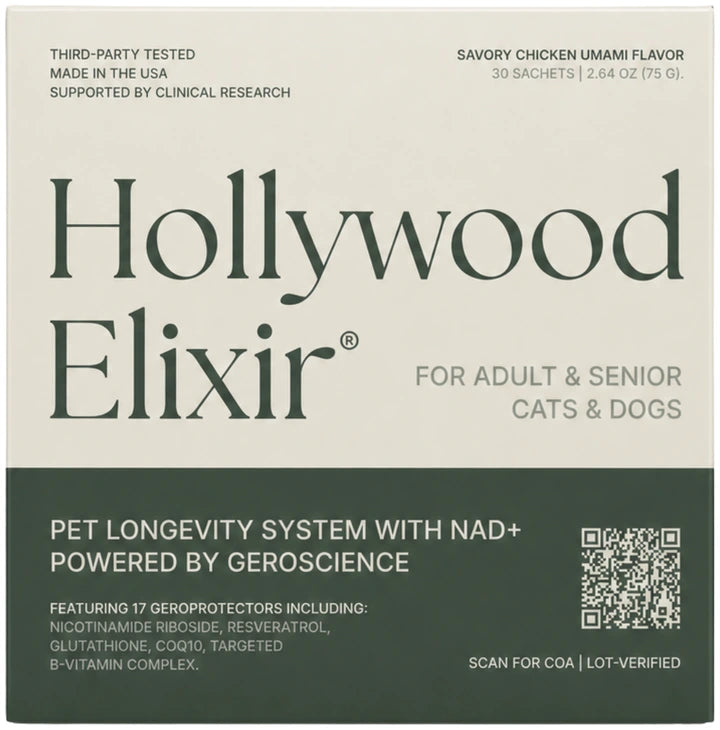
Hollywood Elixir is our daily supplement for adult and senior dogs, made to the LPL-01 standard with every active ingredient at a visible amount. It never replaces your veterinarian — it sits alongside the routine on this page.
Meet Hollywood ElixirThe 90-Day Support Routine
Ninety days of small, repeatable habits make subtle changes visible — and give any new routine a fair test.
- Week one: film relaxed breathing and a representative sleep period, then record nostril appearance, effort, recovery, meal signs, weight, body condition, muscle, and current weather limits.
- Week one: identify the nearest emergency hospital, a climate-controlled transport route, cooling supplies, and the signs that every caregiver will treat as urgent.
- Weekly: note warmth and humidity, the first voluntary stop on a familiar route, time to easy breathing, sleep disruption, regurgitation, and skin or eye comfort.
- Monthly: repeat weight, body and muscle condition, the same low-risk movement clip, sleeping position, resting effort, and any new gastrointestinal or airway event.
- Before anesthesia or travel: provide prior airway notes, heat history, BOAS grade if known, medications, vomiting or reflux history, and recovery concerns to the veterinary team.
- At day 90: decide whether signs justify functional grading, referral, diagnostics, surgical discussion, weight-plan revision, pain care, or stricter heat and exercise boundaries.
Tools for Tracking Comfort and Aging
Use these when a life-stage, body-condition, or quality-of-life question needs more structure.
Dog Quality of Life Scale
Use when breathing, sleep, heat tolerance, movement, and enjoyment are changing together.
ToolDog Biological Age Calculator
Use calendar age as the beginning of a life-stage discussion, then let breed, size, and current function refine it.
ToolDog Body Condition Calculator
Put rib feel, waist, and muscle beside the scale so weight change is interpreted rather than merely counted.
Frequently Asked Questions
Short answers to the questions owners ask most.
What is the average lifespan of a brachycephalic dog?
A pooled planning answer is roughly 10 to 12 years, but large studies show important differences by breed and body size. Use the individual breed estimate before the cohort average.
What does brachycephalic mean?
It describes a shortened skull and muzzle conformation. The label identifies a risk context; it does not by itself diagnose clinically important airway obstruction.
What is BOAS?
Brachycephalic obstructive airway syndrome is a conformation-related respiratory disorder involving upper-airway restriction and secondary changes. Severity must be assessed in the individual dog.
Is snoring normal in a flat-faced dog?
Snoring is common but can accompany sleep-disordered breathing. Repeated arousal, choking sounds, upright sleep, effort, or daytime fatigue deserves veterinary discussion.
Can a brachycephalic dog have BOAS without loud breathing at rest?
Yes. Some dogs compensate when quiet and show limitation during exercise, heat, sleep, excitement, or eating. A structured functional assessment is more informative than one resting minute.
Why do medium brachycephalic dogs look worse in one longevity dataset?
That subgroup contained particular breeds and lineages, and the analysis was observational. The result shows an interaction worth attention, not proof that medium size itself caused earlier death.
Does losing weight cure BOAS?
No. Lean condition may reduce avoidable respiratory load, but it cannot lengthen the skull or correct obstructive tissue. Veterinary assessment remains necessary.
What temperature is too hot for a flat-faced dog?
There is no universal cutoff. Humidity, sun, exertion, excitement, fitness, age, body condition, medication, and airway severity all change risk, so conservative individual stop rules are safer.
Which heat signs are an emergency?
Collapse, confusion, marked weakness, severe breathing effort, seizure, repeated vomiting or diarrhea, blue-gray mucosa, or inability to settle requires urgent veterinary care.
Should every brachycephalic dog have airway surgery?
No. Surgery is considered from clinical signs, functional grade, anatomy, progression, and veterinary assessment. It is not prescribed by breed name alone.
What should I film for the veterinarian?
Capture relaxed breathing, a representative sleep period, and ordinary low-risk movement with recovery. Do not deliberately exercise or heat the dog to provoke signs.
Can regurgitation be connected with BOAS?
Upper-airway disease and gastrointestinal signs can occur together in brachycephalic dogs. Gagging, regurgitation, vomiting, swallowing difficulty, and meal interruption belong in the history.
How should a breeder demonstrate respiratory health?
Ask for recognized respiratory-function grading where available, quiet sleep and exercise history, airway procedures in relatives, longevity records, and every other breed-relevant health result.
Can Hollywood Elixir improve a brachycephalic airway?
No. Hollywood Elixir is La Petite Labs’ daily supplement for adult and senior dogs; it cannot change airway anatomy, treat BOAS, replace cooling, or substitute for veterinary care.
A restrained note from La Petite Labs
Hollywood Elixir is La Petite Labs’ daily supplement for adult and senior dogs. It does not change airway anatomy or replace BOAS assessment, heat precautions, surgery, medication, or emergency care.