Disclosure: La Petite Labs sells Pampered, a daily wellness system that may be relevant to some VitaDog shoppers. It is not a duplicate of VitaDog's powder-plus-oil Daily All-In-One Kit.
VitaDog Pros and Cons
VitaDog is worth considering if you want joint-blend ingredients, digestive fiber, probiotics, vitamins and oils in one daily kit. The powder-and-oil format can make sense when you already add toppers to meals. Its clearest advantages are a broad formula, published amounts for many ingredients and two public Eurofins microbiology reports. Its main compromises are the measuring involved, several grouped ingredient amounts, and a research story that concerns ingredients rather than a trial of the complete kit. 1 2 4 5 9
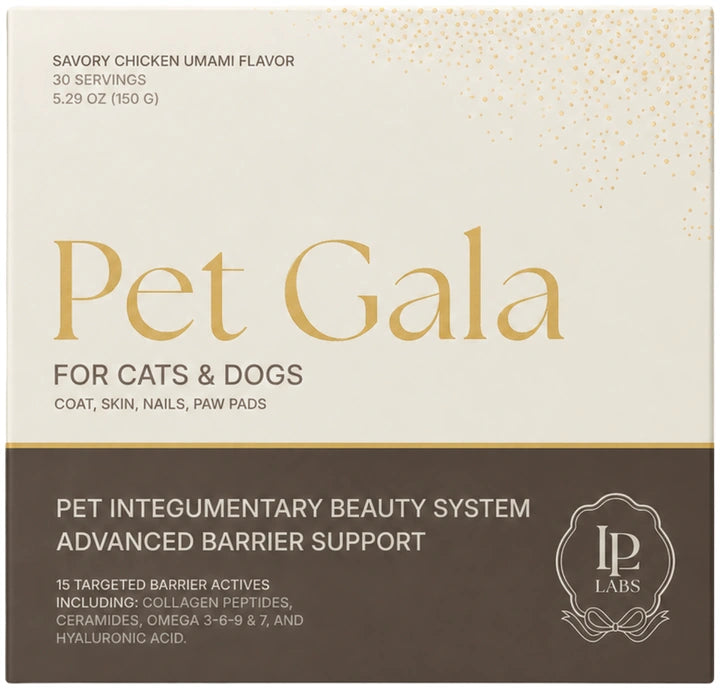
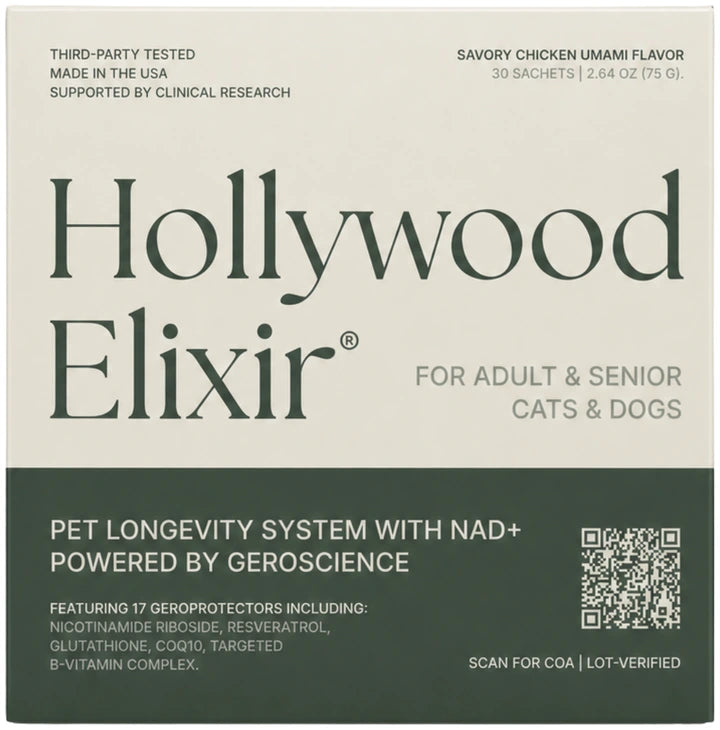
The choice becomes more useful when you decide what you want the addition to your dog’s food to do. The Pampered System pairs Hollywood Elixir’s nutrition for cellular energy and healthy aging with Pet Gala’s skin-and-coat nutrition. It brings two prepared formulas to the bowl: one built around NAD+ precursor nutrition, cofactors and antioxidant ingredients; the other around skin proteins, lipids and moisture-related ingredients. Each formula comes prepared to add to daily meals. 20 22 23
This review covers the US VitaDog powder-and-oil kit, including its peanut-butter powder label. Beef-flavor powder is also sold, but its ingredient details should be checked separately. The latest offer heading is Daily Longevity & Vitality Powder; the Daily All-In-One name still appears on the package and lab reports. 1 2 4 11
What comes in the kit and goes into the bowl
The checked kit contains a 600 g powder bag, 30 mL oil bottle, shaker and scoop. The package directs you to combine water, powder and oil, shake, and give it during or after a meal. It also says to consume the mixture immediately. This is a measured two-component routine. 1 2
The bag’s daily directions are one 10 g scoop plus 0.5 mL oil for dogs up to 20 lb; two scoops plus 1 mL for 21–75 lb; and three scoops plus 1.5 mL above 75 lb. The corresponding water amounts are 40, 80 and 120 mL. The website uses slightly different water measures and labels its smallest selector “under 20 lb.” If your dog sits at the boundary, confirm the directions for the package you receive. 2 1
A meal topper can be easier than hiding several pills, but food acceptance still matters. The examined powder includes peanut flour and whey protein concentrate; its glucosamine comes from shellfish. These belong in the decision for a dog with dietary restrictions. The package is for dogs and says safe use in pregnant or breeding dogs has not been established. 2
The kit price is not the same monthly cost for every dog
The October 3 price snapshot was $86 one-time or $69 with autoship for the kit. At the package portions, both the powder and oil last 60, 30 or 20 days. Here is the equivalent cost over 30 days, before tax and shipping. 1 2
| Package weight band | Powder + oil per day | Kit lasts | One-time price, per 30 days | Autoship, per 30 days |
|---|---|---|---|---|
| Up to 20 lb | 10 g + 0.5 mL | 60 days | $43 | $34.50 |
| 21–75 lb | 20 g + 1 mL | 30 days | $86 | $69 |
| Over 75 lb | 30 g + 1.5 mL | 20 days | $129 | $103.50 |
The 30-day figures are arithmetic, not separate monthly charges for every size. Check the selected delivery interval before subscribing. A retailer’s powder-only price is also a different offer: Chewy listed the powder, oil and shaker separately, so a $63 powder bag should not be compared with the $86 complete kit as though the contents were identical. 11
The complete powder panel and separate oil blend
VitaDog combines a glucosamine/MSM blend, inulin and pumpkin, a probiotic blend, vitamins, minerals and plant ingredients. The oil adds fish, flaxseed, evening primrose and coconut-derived MCT oils. That breadth is part of the kit’s appeal; it also makes the complete label more useful than a single “40+ actives” headline. 1 2
These are the powder’s declared amounts per 10 g scoop, as shown on the official package image. A two- or three-scoop daily portion multiplies these amounts accordingly. 2
| Powder ingredient | Amount per scoop |
|---|---|
| Joint blend: glucosamine HCl (shellfish) + MSM | 600 mg |
| Inulin | 100 mg |
| Pumpkin | 100 mg |
| Sodium hexametaphosphate | 75 mg |
| Astragalus root | 50 mg |
| Quercetin dihydrate | 50 mg |
| Liquorice root | 50 mg |
| Rosemary extract | 30 mg |
| Turmeric | 25 mg |
| Ascorbic acid (vitamin C) | 25 mg |
| Calcium (calcium propionate) | 10 mg |
| Niacinamide | 6.5 mg |
| Magnesium (magnesium citrate) | 5 mg |
| Black pepper extract | 5 mg |
| B-vitamin blend¹ | 2.34 mg |
| Manganese (as manganese proteinate) | 0.2 mg |
| Zinc (as zinc proteinate) | 0.1 mg |
| Copper (as copper bisglycinate chelate) | 0.1 mg |
| Biotin | 0.01 mg |
| Vitamin A | 750 IU |
| Vitamin D3 | 60 IU |
| Vitamin E | 5 IU |
| Probiotic blend | 1 billion CFU |
¹The B blend lists thiamine HCl, pyridoxine HCl, pantothenic acid, riboflavin, methylcobalamin and folic acid. The probiotic list names Bacillus subtilis, Bifidobacterium bifidum, Enterococcus faecium, Lactobacillus acidophilus, L. brevis, L. delbrueckii, L. fermentum and L. plantarum. These are species names; the panel does not provide strain identifiers. 2
The inactive powder ingredients are natural peanut-butter flavor, oat flour, peanut flour, whey protein concentrate and xanthan gum. The oil’s declared blend is 459.54 mg per 0.5 mL, with mixed tocopherols listed separately as an inactive ingredient. That total is the combined oil weight. 2 1
Four blend numbers that need careful reading
Several VitaDog totals are useful without revealing every component:
- 600 mg is the joint blend, shared by glucosamine HCl and MSM. It is not 600 mg of glucosamine plus an additional 600 mg of MSM.
- 2.34 mg is the B-vitamin blend, rather than a separately stated dose for each of its six vitamins.
- One billion CFU is the probiotic total per scoop. The eight species do not each receive that count, and a species name does not identify a studied strain.
- 459.54 mg is the oil blend per 0.5 mL. It does not establish the amounts of EPA, DHA, ALA or GLA. 2 1
This matters most if you are replacing something specific, such as a prescribed fatty-acid amount or a probiotic with evidence for a particular use. Match that requirement to the actual formulation before making the swap. The same rule applies to alternatives: Pet Gala declares an omega 3-6-9 blend, so its total should not be presented as a fully specified EPA/DHA dose either. 22
What the canine research supports
VitaDog publishes a sources library and ingredient explanations. That is useful starting material. The next question is whether the dogs, intervention and measured outcome in a paper match the purchase claim. The primary studies below illustrate why those details matter. We did not identify a published randomized trial of the complete VitaDog powder-and-oil kit in the official and research sources checked. 9 6
Glucosamine research used a different combination. McCarthy and colleagues’ 2007 trial included 35 dogs with hip or elbow osteoarthritis. A glucosamine HCl/chondroitin combination improved veterinarians’ subjective pain, weight-bearing and condition scores by day 70; the response was slower than with carprofen. VitaDog combines glucosamine with MSM and does not list chondroitin in that blend. The trial therefore cannot establish its effect or a day-70 expectation. 15 2
The fish-oil study tested a complete food. Roush and colleagues randomized 127 dogs with osteoarthritis to foods for six months. The test food had 31 times the control food’s total omega-3 content and a much lower omega-6:omega-3 ratio. Owners reported better rising and play at six weeks, and better walking at 12 and 24 weeks. Those results support that dietary intervention; an oil-blend weight without its fatty-acid profile cannot reproduce the comparison. 16
Probiotic findings depend on the strain and population. In Kelley and colleagues’ study, 31 dogs with acute diarrhea received placebo or B. animalis AHC7 at 20 billion CFU a day. Mean resolution time was 3.9 versus 6.6 days. That named organism, amount and clinical situation differ from VitaDog’s blend. In a separate 2025 study, 12 healthy beagles received a specified B. subtilis strain at one or five billion CFU a day; fecal characteristics did not improve, although some bacterial abundances changed. A general probiotic label cannot carry every probiotic study’s result. 17 18
There is a reasonable nutritional basis for many of these ingredients. There is also a clear difference between that basis and knowing what the complete kit will do for your dog. Treat the brand’s response timelines as marketing expectations, not a clinical forecast. A complete and balanced main food remains the starting point; AAHA recommends considering additions within the dog’s overall feeding plan. 19
The named veterinarian’s role is article review
VitaDog does name a veterinarian: Samantha Zebley, DVM, whose practice is limited to dermatology. Her independent AnimERge profile records her veterinary qualification and training. VitaDog’s September 21, 2026 profile describes her as an outside reviewer of articles within her expertise. 7 8
The brand also states that she is not its employee, has not evaluated its products and does not endorse them. Her profile explicitly distinguishes her dermatology training from board certification. That is useful, specific accountability for named articles. It should not be turned into a claim that she formulated or clinically validated the supplement. 7
VitaDog’s separate Vet Science page describes a veterinary advisory board, but it does not identify its members in the material reviewed. That leaves two separate questions: who reviewed a named article, and who took responsibility for the formulation. 6
What the two Eurofins reports actually cover
The public reports provide concrete results for two powder lots. They have different panels. 4 5
| Report | Sample and date | Results shown |
|---|---|---|
| AR-25-QK-040764-01 | Powder lot 528702F; October 27, 2025 | Yeast, mold and E. coli each below 10 CFU/g; Salmonella not detected in 25 g |
| AR-26-QK-005022-01 | Powder lot 534901F; February 7, 2026 | E. coli below 10 CFU/g; Salmonella not detected in 25 g |
The February report does not contain yeast or mold results. Neither PDF is a heavy-metal, pesticide, active-potency, ingredient-identity or oil-profile report. Their results concern the samples submitted. These are worthwhile microbiology disclosures, with a defined scope. 4 5
VitaDog describes additional controls: raw-ingredient identity checks, stability and shelf-life testing, batch traceability and a US cGMP-compliant facility. It says supplier COAs are available to veterinary professionals and bulk buyers on request. The factory name and address are deliberately redacted from the public PDFs; the brand offers unredacted copies under NDA to institutional buyers. Those statements explain what is private, while remaining distinct from a public test report. 3
La Petite Labs’ current product materials state US manufacture in a cGMP-compliant, NASC Preferred Supplier facility, third-party heavy-metal and microbial checks, and a public COA lookup. This review does not treat that facility statement as a finished-product certification or claim that every active has a publicly verified potency assay. 21
The 66/100 VitaDog score retained in the Brand Transparency Report is the disclosure assessment dated July 3, 2026. It is a historical report result, not a new score from this review or a measurement of effectiveness or safety. The rubric explains that assessment. 14
Taste, mixing and the opened-bag question
A Reddit owner’s question captures the attraction well: could one kit replace the work of hiding several supplements for two adult Alsatians? The visible replies included a positive health anecdote and skepticism about the company. Neither verifies a clinical effect or a company-wide conclusion. The useful question is whether this format makes feeding easier in your household. 10
The accessible Chewy reviews included owners reporting enthusiastic acceptance and easy mixing. Trustpilot showed a different side: one owner said the dog would not touch the product and raised an opened-bag refund problem; another reported good acceptance and service. VitaDog replied to the complaint with an offer to replace the flavor. This small, self-selected set helps identify buying questions, not the chance that your dog will respond. 11 12
Before relying on a trial purchase, clarify the terms. The offer page advertises a 30-day satisfaction guarantee, while the refund policy dated August 10, 2025 says returns must be unopened and in their original packaging within 30 days. Get a clear answer about an opened bag your dog refuses before committing to repeat delivery. That is more useful than assuming the guarantee means an automatic refund. 1 13
Hollywood Elixir: nutrition for the work cells do as dogs age
Cells keep turning food into usable energy and maintaining their antioxidant defenses throughout a dog’s life. Hollywood Elixir brings ingredients for those connected jobs into one prepared formula: an NAD+ precursor, mitochondrial cofactors, glutathione and other antioxidant ingredients, with vitamins, plant ingredients and protein completing the combination. 20
NAD participates in energy reactions, and NR is one route cells can use to make NAD. CoQ carries electrons within mitochondria. Riboflavin supplies cofactors used in energy metabolism and glutathione recycling; that recycling also uses NADPH. These are related but distinct jobs, which explains why HE combines several types of ingredients. The underlying biology does not establish a measured increase in a dog’s energy, NAD level or lifespan from the finished formula. 24 25 27 26
Here is the full 17-active declaration per 2.5 g sachet. Preparation names matter: the B12 and astaxanthin rows describe diluted preparations, not the same weight of pure active. 20
| Hollywood Elixir ingredient | Declared amount |
|---|---|
| Nicotinamide riboside tartrate | 60 mg |
| Coenzyme Q10 98% (ubidecarenone) | 40 mg |
| Vitamin B3 as niacin | 2 mg |
| Vitamin B2 as riboflavin USP | 0.5 mg |
| Vitamin B6 as pyridoxal 5-phosphate | 1 mg |
| Vitamin B12 as methylcobalamin trituration 1% on DCP | 0.25 mg |
| Reduced L-glutathione | 50 mg |
| Vitamin C as ascorbic acid | 10 mg |
| Vitamin E as D-alpha tocopheryl acid succinate 1210 | 15 IU |
| Natural astaxanthin 2% preparation | 2 mg |
| Resveratrol extract, standardized to 98%, from Polygonum cuspidatum | 15 mg |
| Quercetin dihydrate 95% | 25 mg |
| Blueberry fruit powder | 50 mg |
| Beta-1,3/1,6-D-glucan powder from Saccharomyces cerevisiae | 50 mg |
| Reishi mushroom extract powder, standardized to 35% polysaccharides | 25 mg |
| Organic spirulina powder | 50 mg |
| Whey protein isolate 90% | 250 mg |
Additional ingredients are chicken flavor, chicken liver powder, yeast extract, glycine and hydroxypropyl beta-cyclodextrin. VitaDog already supplies B vitamins, quercetin, vitamin C, vitamin E and other plant ingredients. HE’s reason to choose is its complete combination around NAD+ precursor nutrition, cellular metabolism and antioxidant defense, not a claim that VitaDog lacks those entire nutrient categories. 20 2
Choose Hollywood Elixir when you want to add this full cellular-nutrition formula to daily meals as your dog grows older. It puts the precursor, cofactors and antioxidant ingredients together, rather than leaving you to assemble that particular combination from separate products.
Pet Gala: protein, lipids and moisture-related nutrition for skin and coat
Skin protects the body and limits water loss; hair is built largely from protein. The body needs amino-acid building blocks for keratin, collagen and elastin. Ceramides are part of the outer skin’s lipid barrier, while hyaluronan helps form water-rich material around cells. Those roles explain the different parts of Pet Gala’s formula. 28 29 30
Pet Gala combines several protein sources with fatty acids, ceramides, HA and supporting nutrients. It adds skin-and-coat nutrition to meals through a prepared powder. This nutritional purpose should not be confused with treating an allergy or a demonstrated repair of a damaged skin barrier. 22
The complete declaration is per full 2.5 g sachet. 22
| Pet Gala ingredient | Declared amount |
|---|---|
| Marine collagen peptides | 500 mg |
| Hydrolyzed whey protein | 250 mg |
| Beef gelatin | 200 mg |
| Bone broth | 100 mg |
| Omega 3-6-9 | 150 mg |
| Omega 7 | 50 mg |
| Ceramides | 8 mg |
| Hyaluronic acid | 50 mg |
| Biotin | 50 mcg |
| Zinc | 1.5 mg |
| Silica | 10 mg |
| MSM | 100 mg |
| L-carnitine | 20 mg |
The formula also includes chicken flavor, chicken liver powder, yeast extract, glycine and hydroxypropyl beta-cyclodextrin. Its milk, fish, beef and chicken sources matter for dietary restrictions. Neither this formula nor VitaDog’s peanut-butter powder is a universal choice for food-sensitive dogs. 22 2
VitaDog also includes oils, biotin, zinc and whey among its ingredients. Pet Gala’s appeal is its particular combination of structural protein sources, fatty acids, ceramides, HA and supporting nutrients in one food-mixed formula. Choose Pet Gala when skin and coat nutrition is the addition you want to make to your dog’s usual meals.
When Pampered is worth choosing
Choose VitaDog when its glucosamine/MSM blend, prebiotic ingredients, probiotics and separate oils match what you want to add, and you are happy measuring the powder-and-oil kit. Choose Pampered when you want Hollywood Elixir’s cellular nutrition and Pet Gala’s skin-and-coat nutrition together. Both systems have two components; Pampered supplies two prepared powder formulas in sachets. 2 23
The higher price should be clear. These examples use the October 3 monthly-plan and one-time prices, before tax and shipping. They compare the feeding expense for the same dog weights, not equivalent clinical doses. 1 23
| Dog and daily routine | 30-day contents | Recurring plan | One-time |
|---|---|---|---|
| 25 lb: VitaDog, 20 g powder + 1 mL oil | One 600 g + 30 mL kit | $69 | $86 |
| 25 lb: Pampered, 1 sachet of each formula | 30 HE + 30 PG sachets | $128 | $168 |
| 75 lb: VitaDog, 20 g powder + 1 mL oil | One 600 g + 30 mL kit | $69 | $86 |
| 75 lb: Pampered, 2 sachets of each formula | 60 HE + 60 PG sachets | $238 | $298 |
VitaDog costs less in both examples. Pampered earns consideration through what its two formulas bring together: ingredients for cellular energy and antioxidant defense alongside protein, lipid and moisture-related nutrition for skin and coat. That is the reason to pay for the pairing. A narrower goal may suit HE alone or PG alone. 20 22 23
Current LPL adult/senior guidance is half a sachet daily below 7 lb, one at 7–30 lb and two above 30 lb, of each selected formula. Mix into food and serve promptly. Keep the complete and balanced diet as the foundation, and account for existing supplements or prescribed diets before adding more. A healthy dog doing well on its food does not automatically need a broad daily supplement. 23 19
For the full pairing, choose Pampered: two prepared formulas that bring daily cellular nutrition and skin-and-coat nutrition into the meals you already serve.
Frequently asked questions
Is VitaDog a legitimate brand?
VitaDog has identifiable products, ingredient disclosures, retailer listings and two public Eurofins powder reports. Those are concrete reasons to assess it seriously. Decide from the kit’s actual composition, feeding routine, cost and evidence, rather than treating a trust badge as the whole answer. 1 4 5
Can I calculate VitaDog’s cost per day?
At the checked $69 autoship kit price, the package portions give 60, 30 or 20 days of supply: $1.15, $2.30 or $3.45 per day. That is $34.50, $69 or $103.50 per 30 days, before tax and shipping. The $86 one-time kit produces different costs; the table above shows both. 1 2
Do VitaDog owner reviews prove that the supplement works?
No. The accessible reviews help with practical questions such as taste, mixing, service and returns. They are small, self-selected accounts and do not establish that VitaDog caused a health change or predict your dog’s response. 10 11 12
What do VitaDog’s public Eurofins COAs show?
The October 2025 report for lot 528702F shows yeast, mold and E. coli below 10 CFU/g and Salmonella not detected in 25 g. The February 2026 report for lot 534901F shows E. coli and Salmonella results only. Both concern powder samples; neither contains a heavy-metal, potency, ingredient-identity or oil-profile panel. 4 5
Is VitaDog vet reviewed?
VitaDog names Samantha Zebley, DVM as an outside article reviewer. Its profile expressly says she has not evaluated the products and does not endorse them. Her role supports the named articles within her expertise; it does not establish that she formulated or tested the kit. 7 8
Where is VitaDog made?
Its US materials state US manufacture in a cGMP-compliant facility. VitaDog says the contract manufacturer’s name and address are redacted from the public COAs, with unredacted copies available under NDA to institutional buyers. The distributor address on the package is not the factory location. 3 2
Can I get VitaDog test documentation beyond the microbiology COAs?
The brand says supplier COAs are available to veterinary professionals and bulk buyers on request, and describes identity, stability and traceability controls beyond the public reports. Ask which documents are available for the relevant product and lot; a stated control is different from having its report in hand. 3
What ingredient sensitivities should I check before buying VitaDog?
The examined peanut-butter powder contains peanut flour, whey protein concentrate and shellfish-derived glucosamine. The oil includes fish, flaxseed, evening primrose and coconut-derived MCT oils. Read the specific flavor’s label and account for prescribed diets or known ingredient restrictions before adding it. 1 2
How does VitaDog compare with Pampered?
VitaDog pairs a broad powder with oils, including a glucosamine/MSM blend and probiotics. Pampered pairs HE’s ingredients for cellular metabolism and antioxidant defense with PG’s protein, lipid and moisture-related skin-and-coat nutrition. Pampered costs more in the matched examples and offers prepared sachets of two different formulas. Choose for the nutritional combination you want to add to meals. 2 20 22 23
Does every dog need a daily all-in-one supplement?
No. AAHA advises assessing the overall feeding plan; healthy dogs maintaining an appropriate weight may not need major dietary changes unless a nutritional risk factor is identified. A complete and balanced main food remains the foundation. Add a supplement for a specific nutritional purpose rather than assuming the existing food is deficient. 19
Sources
- VitaDog Nutrition. Daily Longevity & Vitality Powder: Daily All-In-One Supplement. n.d.. Current US kit contents, oil composition, offer and purchase conditions. ↩ ↩ ↩ ↩ ↩ ↩ ↩ ↩ ↩ ↩ ↩ ↩ ↩
- VitaDog Nutrition. VitaDog Daily All-In-One: official package product facts. n.d.. Official peanut-butter powder package: all active rows, ingredients and feeding directions. ↩ ↩ ↩ ↩ ↩ ↩ ↩ ↩ ↩ ↩ ↩ ↩ ↩ ↩ ↩ ↩ ↩ ↩ ↩
- VitaDog Nutrition. Lab Results: Eurofins COA & Quality. n.d.. Published quality-control statements and access to factory and supplier records. ↩ ↩ ↩
- Eurofins Microbiology Laboratories — Atlanta. Analytical Report AR-25-QK-040764-01: VitaDog lot 528702F. 2025. Microbiology results for powder lot 528702F, reported October 27, 2025. ↩ ↩ ↩ ↩ ↩ ↩
- Eurofins Microbiology Laboratories — Atlanta. Analytical Report AR-26-QK-005022-01: VitaDog lot 534901F. 2026. Microbiology results for powder lot 534901F, reported February 7, 2026. ↩ ↩ ↩ ↩ ↩
- VitaDog Nutrition. Vet Science. n.d.. The brand’s formulation approach, advisory-board description and research claims. ↩ ↩
- VitaDog Nutrition. Samantha Zebley, DVM: Dermatology Reviewer. 2026. The named veterinarian’s article-review role and its explicit limits. ↩ ↩ ↩
- AnimERge. Meet Dr. Samantha Zebley. n.d.. Independent practice profile documenting Samantha Zebley’s veterinary qualification and training. ↩ ↩
- VitaDog Nutrition. Sources. n.d.. VitaDog’s ingredient-reference library. ↩ ↩
- Reddit contributors. Has anyone heard of VitaDog Nutrition?. 2026. Individual owner question and visible replies about the daily kit. ↩ ↩
- Chewy customers. VitaDog Daily All-in-One Powder: customer reviews. 2026. Retailer offer and individual owner accounts of feeding the powder. ↩ ↩ ↩ ↩
- Trustpilot contributors and VitaDog replies. VitaDog Nutrition customer reviews. 2026. Two visible customer accounts and the brand’s replies concerning acceptance and service. ↩ ↩
- VitaDog Nutrition. Refund policy. 2025. Published return conditions, including opened supplements. ↩
- La Petite Labs. Pet Supplement Brand Transparency Report: VitaDog historical entry. 2026. July 3, 2026 historical disclosure assessment retained in this review. ↩
- Grainne McCarthy, James O’Donovan, Boyd Jones, Hester McAllister, Michael Seed, Carmel Mooney. Randomised double-blind, positive-controlled trial to assess the efficacy of glucosamine/chondroitin sulfate for the treatment of dogs with osteoarthritis. 2007. DOI: 10.1016/j.tvjl.2006.02.015. Positive-controlled trial of glucosamine/chondroitin in dogs with osteoarthritis. ↩
- James K Roush, Chadwick E Dodd, Dale A Fritsch, Timothy A Allen, Dennis E Jewell, William D Schoenherr, Daniel C Richardson, Phillip S Leventhal, Kevin A Hahn. Multicenter veterinary practice assessment of the effects of omega-3 fatty acids on osteoarthritis in dogs. 2010. DOI: 10.2460/javma.236.1.59. Six-month complete-food trial in dogs with osteoarthritis. ↩
- R L Kelley, Debbie Minikhiem, Barry Kiely, Liam O’Mahony, David O’Sullivan, Tom Boileau, Jean Soon Park. Clinical benefits of probiotic canine-derived Bifidobacterium animalis strain AHC7 in dogs with acute idiopathic diarrhea. 2009. Strain-specific probiotic trial in dogs with acute diarrhea. ↩
- Patrícia M Oba, Olivia R Swanson, Yifei Kang, Julio C Mioto, John F Menton, Elena Vinay, Mathieu Millette, Melissa R Kelly, Kelly S Swanson. Effects of Bacillus subtilis ATCC PTA-122264 on apparent total tract macronutrient digestibility and fecal characteristics, metabolites, and microbiota of healthy adult dogs. 2025. DOI: 10.1093/jas/skaf038. Defined Bacillus strain and doses in healthy adult beagles. ↩
- American Animal Hospital Association. Feeding Plans for Healthy, Appropriate Weight Cats and Dogs. 2021. Individual feeding plans, nutritional adequacy and supplement adjustments. ↩ ↩ ↩
- La Petite Labs. Hollywood Elixir®: current ingredient declaration. n.d.. Complete Hollywood Elixir declaration and preparation amounts. ↩ ↩ ↩ ↩ ↩ ↩
- La Petite Labs. Publicly verified lab results and COA Lookup. n.d.. La Petite Labs’ stated manufacturing and testing scope and public COA route. ↩
- La Petite Labs. Pet Gala ingredient guide and declared supplement facts. 2026. Complete Pet Gala declaration and ingredient amounts. ↩ ↩ ↩ ↩ ↩ ↩ ↩
- La Petite Labs. The Pampered System™: formulas, serving and purchase options. 2026. Pampered’s paired formulas, adult/senior portions and current purchase options. ↩ ↩ ↩ ↩ ↩ ↩
- Rachel S Fletcher, Joanna Ratajczak, Craig L Doig, Lucy A Oakey, Rebecca Callingham, Gabriella Da Silva Xavier, Antje Garten, Yasir S Elhassan, Philip Redpath, Marie E Migaud, Andrew Philp, Charles Brenner, Carles Canto, Gareth G Lavery. Nicotinamide riboside kinases display redundancy in mediating nicotinamide mononucleotide and nicotinamide riboside metabolism in skeletal muscle cells. 2017. DOI: 10.1016/j.molmet.2017.05.011. Mouse muscle and cell experiments concerning NR metabolism and NAD biosynthesis. ↩
- Reactome. Complex I oxidises NADH to NAD+, reduces CoQ to CoQH2. n.d.. Curated molecular account of electron transfer from NADH to CoQ. ↩
- Reactome. glutathione (oxidized) + NADPH + H+ => 2 glutathione (reduced) + NADP+. n.d.. Curated molecular account of glutathione recycling using NADPH. ↩
- NIH Office of Dietary Supplements. Riboflavin: Fact Sheet for Health Professionals. n.d.. Riboflavin’s roles as a source of FMN and FAD cofactors. ↩
- Connolly ED, Wu G. Functions and Metabolism of Amino Acids in the Hair and Skin of Dogs and Cats. 2024. DOI: 10.1007/978-3-031-54192-6_6. Amino-acid functions in the normal hair and skin of dogs and cats. ↩
- Hamilton A. VCA Animal Hospitals. Ceramides. 2024. Normal skin-ceramide biology and veterinary topical-product context. ↩
- Simpson M, Schaefer L, Hascall V, Esko JD. Hyaluronan. 2022. DOI: 10.1101/glycobiology.4e.16. Hyaluronan structure and its roles in water-rich tissue matrices. ↩